Article Contents:
- MDF as a Material for Slat Panels: Why Density Decides Everything
- Density: The Only Characteristic You Can't Ignore
- Structure of MDF Slat Panel
- Module Format
- MDF Slat Profiles: Three Geometries, Three Characters
- Rectangular Profile: Precision and Architectural Rigor
- Semicircular Profile: Softness and Organicity Even in MDF
- Trapezoidal profile: volume and decorative richness
- Color of MDF Panels: From System to Choice
- Monochromatic system: the power of a single tone
- Tonal accent: safe expressiveness
- Saturated accent: transforming space through color
- Two-color system: third dimension through color
- Slat spacing: rhythm that sets the scale
- Practical table
- MDF slat panel on wall in different rooms
- Living room: accent wall with character
- Bedroom: MDF headboard wall
- Hallway: meeting with space
- Kitchen: zoning and accent
- Office and meeting room: architecture of reputation
- Coordinated finishing system with MDF slat panels
- Moldings and Cornices
- Baseboards
- Decorative appliqués
- Elements for Stairs
- Installation of MDF slat panel on wall: two methods and their requirements
- Adhesive installation: for even walls
- Frame installation: for uneven walls and laying utilities
- Acclimatization: mandatory stage
- MDF vs solid oak: when to choose what
- Lighting MDF slat panels: light as the key to the result
- Ten questions for the manufacturer before buying MDF panels
- About the Company STAVROS
- FAQ: MDF slat panel on wall — answers to popular questions

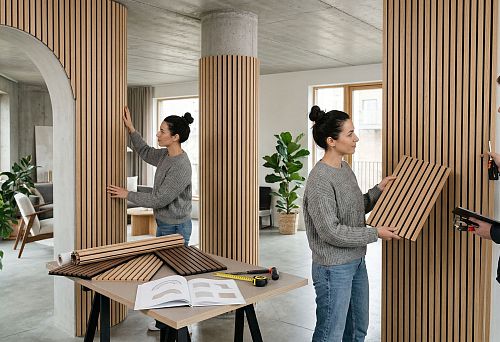
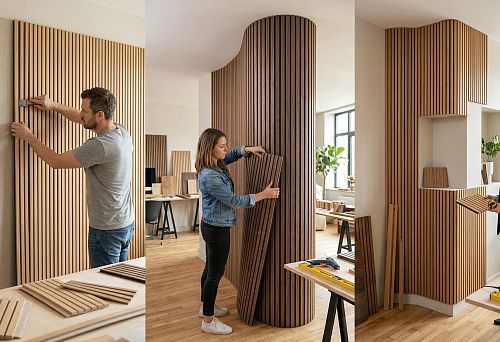
There are materials that transform a wall. They don't just decorate—they genuinely change it: turning a flat surface into an architectural statement, adding character to a space, and making the eye linger. An MDF slatted wall panel is one such material. Precise, controllable, versatile in color and profile, reliable when chosen correctly.
Why MDF specifically? Because this material provides what solid wood, plastic, or plaster cannot: perfect slat geometry combined with unlimited color freedom. Any RAL, any NCS, monochrome or two-tone system, pristine white minimalism or deep anthracite—all of this is achievable with MDF without compromise.
But this material has one crucial nuance: the quality of MDF panels varies dramatically. A density of 750 kg/m³ or 630 kg/m³ isn't just numbers in the specs; it's the difference between a wall that will last twenty years and a problem in six months. This—MDF density—is where the conversation about making the right choice begins.
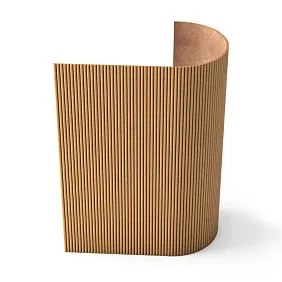
MDF as a material for slatted panels: why density decides everything
MDF (medium-density fiberboard) is a pressed wood fiberboard made from fine wood fibers under high pressure with a binder added. The structure is homogeneous, free from natural defects, knots, and variations. This is precisely what makes MDF the ideal base for slatted panels, where geometric precision is a manufacturing priority.




Density: the only characteristic you cannot ignore
750–850 kg/m³ is the working range for slatted wall panels. At this density, MDF:
-
maintains slat geometry at humidity fluctuations of 40–70% without deformation;
-
holds fasteners (finish nails, screws) without fiber breakdown;
-
sealed ends do not swell when primed;
-
The paint coating adheres evenly, without "bubbles" or peeling.
650–700 kg/m³ — loose material. 20–30% cheaper. After 6–12 months: ends swelled from moisture, fasteners loosened, battens developed micro-bends. On a wall under directional lighting, this is immediately visible.
Below 600 kg/m³ — material unsuitable for wall batten systems. This density is used in packaging structures, not architectural ones.
How to check before purchase: request a technical data sheet for the MDF from the manufacturer indicating the batch density. A conscientious manufacturer will provide it without questions. An evasive answer "high-quality MDF" is not an answer.
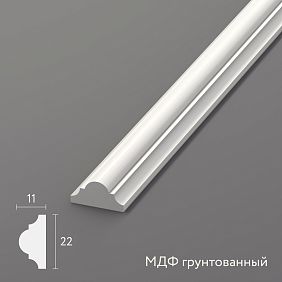
Our factory also produces:


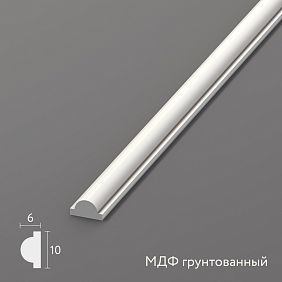
Structure of an MDF batten panel
StandardMDF batten panel on the wallconsists of three elements:
Backing (MDF 12–16 mm) — the load-bearing board attached to the wall or frame. 12 mm thickness is standard for wall systems. 16 mm — enhanced rigidity for large formats and ceiling mounting.
Battens (moldings) — vertical or horizontal strips made of MDF of the same or higher density. Height above backing: 15–35 mm depending on profile. Width: 12–50 mm.
Coating — factory primer, finish paint, or decorative film. On the backing ends — primed or covered with edge banding film.
Get Consultation
Module format
Standard: 0.6 × 2.4 m = 1.44 sq.m. Most production programs are designed for this format. For non-standard room heights (ceiling 3.0 m, 3.6 m) — request a non-standard format from the manufacturer.
MDF slat profiles: three geometries, three characters
Profile — the cross-section of the slat — controls light and shadow and defines the character of the surface. Choosing the right profile is choosing the atmosphere you create.
Rectangular profile: precision and architectural rigor
Slat with straight vertical edges. Sharp edges create contrasting shadow with a clear boundary under directional light. The surface reads as structural, disciplined, precise.
Application: office spaces, meeting rooms, reception areas, minimalist residential interiors, kitchen fronts with linear design. Rectangular MDF profile for painting is absolute geometric purity that works as an architectural thesis.
Semi-circular profile: softness and organicity even in MDF
Rounded edges. Shadow is smooth, without sharp boundaries. Surface is soft, natural — despite the material being synthetic. It's the semi-circular profile that makes MDF 'warm'.
Application: living room, bedroom, children's room, hallway — spaces where humanity is needed, not architectural rigor. In white RAL 9010 with warm light 2700 K — semi-circular MDF profile creates an interior you want to touch.
Trapezoidal profile: volume and decorative richness
Extension of slats to the substrate. Multi-level shadow — the side edge and bottom platform create different shadow zones. The most decoratively rich profile.
Application: restaurant, lobby, commercial spaces with high decorative requirements. In dark anthracite RAL — a monumental, weighty surface.
Color of MDF panels: from system to selection
The ability to specify an exact color from the RAL or NCS catalog is the main advantage of MDF over solid wood. It is a designer's tool that allows implementing any color concept with an accuracy of several delta-E units.
Monochrome system: the power of a single tone
MDF slatted panelis painted the same color as adjacent walls. Molding, baseboard — the same RAL. Relief exists only through shadow. This is the highest form of architectural restraint: the surface exists, but it doesn't 'shout'. With proper side lighting — a delicate, meditative rhythm of parallel shadows on a monolithic surface.
For minimalist interiors — this is the only correct solution.
Tonal accent: safe expressiveness
Walls — light neutral tone (RAL 9001, 9002, 9010). Slatted panel — the same tone, but 2–3 shades deeper. Relief is perceived through both color contrast and shadow simultaneously. A safe, universal, professionally flawless strategy — works in 90% of residential projects.
Bold Accent: Transforming Space Through Color
One slatted wall in a deep, rich RAL color against neutral other surfaces. The wall becomes an architectural focal point.
Working Accent RAL Colors:
-
RAL 7016 Anthracite — severity, modernity
-
RAL 6005 Moss Green — nature, organic
-
RAL 5011 Steel Blue — style, depth
-
RAL 3005 Wine Red — warmth, character
-
RAL 8025 Pale Brown — earth, coziness
-
RAL 4009 Pastel Violet — tenderness, sophistication
Two-color system: third dimension through color
Reiki and substrate — in different RAL colors. The substrate is visible in the gaps, creating 'depth' behind the slats:
-
white slats + black substrate = maximum graphic contrast;
-
cream slats + dark green substrate = natural luxury;
-
gray slats + pastel blue substrate = delicate spatial complexity.
Slat spacing: the rhythm that sets the scale
Spacing — the distance between the centers of adjacent slats — controls the visual density of the surface and its perception in a specific space.
Practical table
| Step | Rhythm | Visual effect | Recommended spaces |
|---|---|---|---|
| 15–20 mm | Very dense | Active, rich surface | Large spaces from 30 sq.m |
| 25–30 mm | Dense | Pronounced rhythm, substantial surface | Living rooms, hallways, offices |
| 35–40 mm | Balanced | Versatile, elegant rhythm | Any spaces |
| 45–55 mm | Airy | Lightness, visually expands | Small rooms, Japandi |
| 60 mm and more | Monumental | Each slat is an architectural accent | Niches, accent fragments |
Rule for MDF: when working with a monochrome system, choose a wider spacing. With narrow spacing in monochrome, the surface loses readability of the relief.
MDF slatted panel on the wall in different rooms
Living room: accent wall with character
Accent wall behind the sofa — a space of 10–16 sq.m that defines the character of the entire living room. For residential interiors leaning towards minimalism and monochrome,MDF slatted panels on the wallin a neutral or accent RAL — this is a solution without alternative.
Scheme: 8–12 modules 0.6 × 2.4 m.wooden moldingalong the upper edge — in the same RAL or oak for a natural accent.MDF Skirting Boardat the bottom in the same RAL. Directional spotlights at a 35–40° angle.
For a two-color system — LED strip on a substrate in the gaps. With warm light at 2700 K and white slats on a black substrate — the effect of a 'glowing grid,' one of the most cinematic techniques for living rooms.
Bedroom: headboard wall in MDF
Headboard area — 3–4 modules, delicate rhythm with a 35–40 mm step, semi-circular profile. White or soft cream RAL — a clean, calm surface. Or a rich accent — deep blue, bottle green, dark beige — for a bold design solution.
LED strip along the lower perimeter of the panel — upward light along the slatted surface. In warm 2700 K — intimate, natural light, ideal for the sleeping area.
In the bedroom, one detail is important: molding along the upper edge of the panel +Wooden baseboardor MDF at the bottom. Without these elements, the wall behind the headboard looks unfinished.
Hallway: meeting with space
The hallway is an intimate, functional space with high traffic. MDF here wins over oak in practicality: moisture-resistant coating, cleans with wiping, does not require periodic oil renewal.
For narrow corridors — horizontal slats, medium spacing 30–35 mm. Visually 'expand' the space. RAL neutral warm (9001, 7044, 7032) — creates a feeling of a bright, welcoming space.
Additional slatMDF for corner transitions in the same RAL. Molding along the top edge. A monolithic system, completed down to the last horizontal line.
Kitchen: zoning and accent
MDF slatted panel in the dining table or kitchen island area — an accent that zones the space without partitions. Moisture-resistant coating is mandatory for any kitchen application. Rectangular profile — clear, concise.
In kitchens with furniture in an exact RAL — panel in the same RAL. Kitchen fronts + wall slatted panel in a unified color = monolithic color concept.
Furniture Handlesin a coordinated material — the finishing touch to the system.
Office and meeting room: architecture of reputation
MDF in corporate RAL. Rectangular profile. Reception area — one accent slatted wall, forming the first impression of the company. Meeting room — slatted panels around the perimeter + acoustic filling in the frame.
Color accuracy to RAL is a key parameter for corporate facilities. MDF provides it. When ordering a large batch — request control color samples before shipment.
Coordinated finishing system with MDF slatted panels
MDF slatted wall panel is the foundation of an architectural system, not a standalone element. Maximum result is achieved only with coordinated linear footage from the same production program.
Moldings and cornices
wooden moldingor an MDF molding for painting along the upper boundary of the panel field — a horizontal architectural line that 'closes' the system. Molding in the same RAL — a monolithic surface. Oak molding with MDF panels — a natural accent at the boundary.
For classic interiors —Wooden cornicewith a profiled surface. The architectural 'roof' of the slatted field with a historical character.
Technical technique: molding with a 20–30 mm gap from the ceiling — space for an LED strip with downward light onto the slatted surface.
Baseboards
— is a horizontal element that frames the room at the bottom of the walls where the wall meets the floor. Skirting boards perform several functions: they hide the technological gap between the wall and floor covering (necessary for thermal expansion), protect the lower part of the wall from mechanical damage, create visual completion, and may conceal wiring.in the same RAL — the lower boundary of the MDF system. Seamless color monolithic quality from floor to ceiling. Orsolid wood baseboardfor the natural 'grounding' of the MDF system.
Decorative appliqués
Decorative Insertsframing the slatted field creates an architectural 'frame' — vertical and horizontal posts that turn a beautiful wall into a panel system with architectural weight. In modern classic style, this is a mandatory element: slatted field + frame = classic boiserie.
Elements for stairs
In a house with slatted MDF wallsbalusters for staircasesmade of solid oak create a natural 'warm' contrast to the precise geometry of MDF. Wood and MDF in one space — it's a dialogue between natural variability and production precision that enriches the interior.
Installation of MDF slatted panel on the wall: two methods and their requirements
Adhesive installation: for even walls
Substrate requirements: deviation no more than 5 mm on a two-meter straightedge. Surface clean, dry, without flaking coating. For deviation of 2–5 mm — local adhesive beacons.
Adhesive: neutral mounting adhesive (type MS-polymer or acrylic-polyurethane), without solvents. Solvents destroy the MDF surface from within. Application: zigzag along the perimeter of the substrate + dots in the center.
Fixation: finishing nails Ø1.2–1.4 × 30 mm along the perimeter until the adhesive fully cures (24–48 hours). Without nails — risk of panel displacement from accidental contact.
First panel: set strictly according to laser level. A 1 mm error on the first module = visible displacement after 5–6 modules.
Frame installation: for uneven walls and routing utilities
Frame: metal profile CD 60×27 mm, load-bearing horizontal profiles. Vertical UD guides around the perimeter. Load-bearing profile spacing: 400–600 mm. Each 600 mm wide module — on at least two load-bearing profiles (at the edges).
Horizontal alignment: laser level mandatory. The frame compensates for any wall irregularities.
Utilities in the frame: LED strip, cables to outlets, junction boxes — all laid before installing the first panel.
Panel fixation: mounting adhesive on the substrate + finishing nails into the profile through the substrate. Double fixation — reliability for heavy MDF (16 mm substrate weighs ~11–12 kg/module).
Acclimatization: a mandatory step
48 hours horizontally in the installation room at operating temperature and humidity. MDF expands and contracts with humidity changes. After acclimatization, the geometry is stabilized. Without acclimatization during installation, there is a risk of slat deformation after installation.
MDF vs. solid oak: when to choose what
| Parameter | MDF for painting | Solid oak |
|---|---|---|
| Color freedom | Any RAL/NCS | Toning while preserving texture |
| Natural texture | No | Yes, unique |
| Repainting | Yes, without dismantling | No |
| Module weight | Lighter | Heavier |
| For corporate | Ideally | Less common |
| For Scandinavian style | Possible | Organically |
| Maintenance | Does not require | Oil update every 3–5 years |
Conclusion: MDF is the choice for precise color, architectural geometry, easy updating, and corporate projects. Oak is the choice for natural character, tactility, and organic expressiveness. This is not better/worse — these are different tools for different tasks.
Lighting MDF slatted panels: light as the key to the result
A monochrome white MDF panel without lighting is an invisible surface. The same panel with proper lighting is an architectural work. This is not an exaggeration.
Directional spotlights at a 30–45° angle to the surface. Shadow in the gaps creates depth. The sharper the angle, the more contrast the shadow, the more pronounced the relief. 2700 K for living spaces, 3000–3500 K for offices.
LED strip behind the molding. Gap behindwooden molding20–30 mm + strip with downward light. The entire slatted plane is softly illuminated from top to bottom.
LED in the gaps. The strip is mounted on the substrate before attaching to the wall. With warm light + white slats — the effect of 'warm glow' from inside the surface.
Dimmer. For living spaces — essential. A slatted surface with dimmable light is a surface with mood: bright and architecturally crisp for daytime scenarios, warm and soft for evening.
Ten questions to ask the manufacturer before buying MDF panels
-
Density of MDF substrate and slats in kg/m³?
-
Accuracy of slat spacing: guaranteed deviation?
-
Are the MDF ends sealed at the factory (primer or edge banding)?
-
What coating is applied to the slats: primer, paint, varnish?
-
Is precise RAL color painting possible at the factory?
-
Is there coordinated trim: moldings, baseboards, slats?
-
Is RAL color match guaranteed for reorders after 3–6 months?
-
Are physical samples provided before ordering?
-
Minimum shipment volume: Is piece-by-piece shipment possible?
-
What are the production and delivery times?
About the company STAVROS
Behind every successful MDF slatted wall is a manufacturer who controls material density, step accuracy, and color consistency from batch to batch. These are not declarations—these are specific production processes that either exist or they don't.
STAVROS is a Russian manufacturer of MDF and solid wood products for interior finishing and furniture production. MDF wall slatted panels with a density of 750–850 kg/m³ — with step accuracy control ≤ 0.5 mm in each production batch. All profiles: rectangular, semicircular, trapezoidal. Painting in any RAL or NCS at the factory. Two-tier quality control system (Standard and Prestige). Manual processing of decorative elements.
Fully coordinated system:Moldings and cornices, MDF skirting boardsandBaseboards made of solid oak, additional slats, Decorative Inserts, balusters for staircases, Furniture Handles.
Over 4000 models. 20,000 modifications. 39 product groups. Shipment from one piece. Delivery across all of Russia. Professional consultation: quantity calculation, system selection, lighting and installation recommendations — before placing an order.
FAQ: MDF wall slatted panel — answers to popular questions
Why do MDF slatted panels from different manufacturers vary so much in price?
The main reason is MDF density. At a density of 750–850 kg/m³ — stable geometry, reliable fastening, long service life. At 630–680 kg/m³ — 25–30% cheaper, deformation after 6–12 months. Plus step accuracy, edge processing, coating quality — all this costs money and is reflected in the price.
Can MDF slatted panels be repainted after installation?
Yes — this is one of the key advantages of MDF. Light sanding of the slat surface + primer + new RAL. Slats are not removed. Refreshing takes 1–2 days for one wall.
Are molding and baseboard needed when installing MDF slatted panels?
Technically no. Architecturally — yes. Without molding, the top edge of the panel looks like an unfinished line. Without a baseboard, the bottom edge is an untreated cut. A system with trim from the same production program — the difference between 'done' and 'designed'.
How to calculate the number of MDF slatted panels for a wall?
Surface area (minus openings) ÷ 1.44 sq.m (area of a standard module) = number of modules. Round up. Add 15% reserve for trimming. Do not calculate 'tightly': reordering from another batch is a risk of RAL mismatch.
MDF slatted panels in the bathroom — is it possible?
Yes, provided there is a moisture-resistant two-component lacquer coating (2K lacquer). An exposed MDF surface without moisture-resistant coating in the bathroom is unacceptable. Installation — only framed on galvanized profile. A closed panel type (without gaps or with a narrow gap) is preferable for high humidity areas.
Which MDF slat profile is better for minimalism?
Rectangular is the only correct choice for strict minimalism. Sharp, clear edges, contrasting shadow. In a monochrome system — maximum architectural precision.
Is acclimatization needed for MDF panels before installation?
Yes: 48 hours in a horizontal position at the room's operating temperature and humidity. MDF reacts to changes in humidity. Acclimatization stabilizes the geometry before installation — prevents slat deformation after installation.