Article Contents:
- Philosophy of plank wall paneling: why it works
- Wood species for decorative planks: characteristics and aesthetics
- Sizes and profiles of decorative planks
- Plank finishing methods: creating visual character
- Color solutions: from natural tones to bold accents
- Plank installation schemes: geometry and visual effects
- Plank installation: technologies and mounting methods
- Functional advantages of plank wall paneling
- Applications of plank wall paneling in various rooms
- Combining plank wall paneling with other materials
- Interior styles and plank wall paneling
- Practical tips for selecting and purchasing planks
- Care for plank wall paneling

Modern interiors strive for a balance between the technological nature of space and the natural authenticity of materials, between minimalist geometry and the tactile warmth of wood, between open layouts and a sense of structure and protection. Plank wall paneling embodies this balance perfectly — the clear graphic of parallel lines creates visual order, while natural wood brings in natural energy, color, texture, and the ability of the material to live and change over time. Decorative wooden plank is not simply a plank of a given cross-section; it is a building module from which a three-dimensional wall texture, an architectural composition, plays with light and shadow, creating rhythm and scale.
Made from solid wood, they are available in a wide variety of species, sizes, profiles, and finishing methods — from budget pine planks in natural color to exclusive oak or walnut planks with brushing and staining, from thin laths 20 millimeters wide to massive planks 120 millimeters wide, from smooth sanded surfaces to textured surfaces with emphasized wood grain patterns. The choice of material, size, color, and mounting method determines the final visual effect — from delicate background texturing to dominant architectural accents, from warm, natural Scandinavian coziness to strict geometric modernity.
rafter walls for wallsCombined adhesive + screw mounting — planks are glued to the wall or frame and additionally secured with screws for reliability until the adhesive dries. After the adhesive dries, screws can be removed (if screwed into the plank from the front side, leaving holes that are spackled and painted) or left in place for additional strength.


Philosophy of plank wall paneling: why it works
The popularity of plank wall paneling in modern interiors is explained by several factors operating on psychological, visual, and functional levels.
The naturalness of the material responds to the deep human need for contact with natural textures, especially heightened in urban environments. Wood is a living material carrying information about the tree’s growth, its age, growing conditions, encoded in the texture of annual rings, color, density. Touching wood is tactilely pleasant — it is warm, unlike cold plastic or metal, has a soft roughness that connects with nature. The scent of natural wood, especially coniferous species, creates an atmosphere of freshness, associated with forests, nature, rest.
The geometric rhythm of the plank structure satisfies the need for visual order and spatial organization. The human brain seeks patterns, structures, repeating elements — this reduces cognitive load, creates a sense of predictability, safety, control. Parallel planks with regular spacing create a simple, clear pattern, easily readable and calming. At the same time, the rhythm is not monotonous due to natural variations in wood texture — each plank is unique in its pattern, adding interest without disrupting the overall order.
The play of light and shadow on the textured plank surface creates a dynamic visual environment, changing depending on the time of day, position of the sun, artificial lighting. Morning side light creates long shadows in the gaps between planks, emphasizing depth and relief. Daylight diffused light softens shadows, making the surface calmer. Evening directional lighting from lamps creates dramatic shadows, enhancing graphic quality. The wall stops being a static background and becomes a living surface reacting to light.
Acoustic comfort — the textured surface of planks with gaps between them disperses sound waves, reducing reverberation and echo, making the acoustic environment of the room more comfortable. This is especially valuable in rooms with many hard reflective surfaces — glass, tiles, concrete, where sound reflects, creating a dullness. Plank wall paneling on one or several walls improves acoustics without the need for special acoustic panels.
Spatial zoning without physical barriers — a plank wall or plank partition (planks not reaching the ceiling, installed freely) visually divides space into zones while maintaining visual connection, light, and air. This is important for open floor plans where kitchen, dining, and living areas are combined — the plank element marks zone boundaries without creating a sense of enclosure or claustrophobia.
Visual correction of room proportions — vertical planks visually increase height, which is valuable in rooms with ceilings 2.5–2.7 meters, where one desires a sense of greater space. Horizontal planks visually widen narrow rooms — corridors, elongated rooms. Diagonal planks create an illusion of greater volume and dynamism.
Hiding wall defects — plank paneling is mounted on a frame, creating a new surface over the existing wall. This allows not to level the wall to perfection — minor irregularities will be hidden behind planks. Behind planks, one can hide utilities — wiring, low-voltage cables, pipes of small diameter.
Ecological safety — solid wood without synthetic coatings (or with water-based coatings) is ecologically clean, does not emit harmful substances, capable of regulating air humidity, absorbing excess moisture and releasing it during dryness. This creates a healthier microclimate, especially valuable in bedrooms and children’s rooms.




Wood species for decorative planks: characteristics and aesthetics
The choice of wood species determines the color, texture, strength, durability, and cost of the planks.
Spruce is the most accessible and widely used species for productiondecorative planksColor ranges from light yellow to pinkish with characteristic dark knots. The texture is expressive, with clearly visible growth rings creating a natural pattern. Spruce is soft, easy to work with, sands well, and accepts oils and varnishes. The resinous nature of spruce provides natural protection against rot and insects, along with a distinctive pine aroma. Spruce planks are the optimal choice for most residential interiors where a balance of quality and affordability is important. The price of spruce planks is 2-4 times lower than oak, yet delivers a respectable visual result, especially after staining or painting.
Drawbacks of spruce: its softness makes it vulnerable to mechanical damage, scratches, and dents. In areas of intensive contact (hallways, children’s rooms), spruce loses its original appearance more quickly. Resin may appear as raised resin spots, especially in hot rooms or under direct sunlight. Knots may fall out over time, particularly during drying. Solution — choose high-quality spruce of class A or Extra with minimal knots, and treat with oils or varnishes that isolate the resin.
Fir resembles spruce but is lighter in color, with a more uniform tone without a pinkish hue, less resinous, and has smaller, rarer knots. Fir planks are suitable for Scandinavian interiors, where light, natural-colored wood is prized. Fir is softer than spruce and less resistant to moisture, requiring mandatory protection with oils or varnishes. Price is comparable to spruce.
Larch is a coniferous species with unique characteristics, combining the accessibility of conifers with the strength of hardwoods. Larch density is 1.5 times higher than spruce, providing high strength, durability, and longevity. Color ranges from yellow-gold to reddish-brown with an expressive contrasting texture. Larch contains tannin — a natural resin with antiseptic properties, making the wood practically rot-resistant even without treatment. This makes larch planks the optimal choice for humid areas (bathrooms, saunas, pools), kitchens, terraces, and balconies.
Over time, larch darkens, acquiring a noble gray-brown hue and a patina of age. This is a natural process that adds character. If maintaining a light color is desired — UV-protective oils are necessary. Larch planks are 2-3 times more expensive than spruce, but their durability, strength, and moisture resistance justify the difference. This is an investment for decades.
The drawback of larch is its high density, which makes it more difficult to process, requiring more powerful tools and sharp saws. Larch is prone to cracking during rapid drying, so proper kiln drying is essential. Resin may appear as spots if stored improperly.
Oak is the benchmark for strength, durability, and status in the world of wood. Oak planks are chosen for prestigious interiors where quality is valued for centuries. Oak density of 650-750 kg/m³ ensures exceptional hardness, wear resistance, and dimensional stability. Color ranges from light yellow (young oak) through honey-brown and dark brown to nearly black (water-aged oak, soaked for decades). Texture is expressive, with large pores and distinctive heartwood rays, creating a unique pattern, especially on radial cuts.
Oak planks have visual weight, nobility, and respectability. They set the tone of an interior — classic, English, office, or castle-style. Oak tones beautifully, accepting shades from bleached white to deep black, while preserving visible texture. Sanded oak creates an exceptional relief effect — soft fibers are removed, hard pores remain, and the texture becomes tactilely perceptible.
Oak planks are expensive — 4-7 times more expensive than spruce, but this is a generational investment. Oak lasts for centuries, retaining quality, gaining patina, and noble color. Drawbacks — high cost, significant weight (requires secure mounting), difficulty in processing (requires professional tools). Oak sawdust contains tannins and may cause respiratory irritation — protective gear is necessary.
Ash is an alternative to oak, comparable in strength but lighter in color and with less contrasting texture. Density 650-700 kg/m³, color from light gray to yellowish-white with a beautiful soft wood grain pattern. Ash is more elastic than oak, better withstands impact loads, and does not splinter. Texture is more refined than oak, pattern is more delicate, making ash suitable for modern, Scandinavian, minimalist interiors where strength is needed without the visual heaviness of oak.
Ash stains and tones beautifully, accepting any shade. Bleached ash is a popular solution for Scandinavian interiors, while dark-toned ash suits modern minimalist spaces. Sanded ash creates an expressive relief due to the contrast between hard and soft fibers. Price of ash planks is comparable to oak or slightly lower. Drawback — ash is less moisture-resistant than oak, requiring quality protection in humid areas.
Beech is a hard species with density 650-680 kg/m³, color ranging from pinkish to reddish-brown, uniform texture without pronounced grain. Beech planks provide a clean color tone, delicate texture, and stain well. Beech is used less frequently than oak or ash due to its hygroscopic nature — it actively absorbs moisture and may deform with humidity fluctuations. Suitable for dry living spaces with stable climate. Price is comparable to ash.
Walnut is a premium species with luxurious dark brown color featuring chocolate-like, almost black veins and rich texture. Walnut planks are chosen for exclusive interiors, offices, libraries, and bedrooms in classic style. Medium density 600-650 kg/m³, good workability. Walnut color is self-sufficient and does not require toning. Cost is high, comparable to oak or higher depending on origin (American walnut is more expensive than European walnut).
Exotic species — teak, merbau, iroko, wenge — are used for exclusive projects. They possess unique colors (from golden-brown teak to nearly black wenge), high density, oiliness, and natural moisture resistance. Price is very high, 10-20 times higher than spruce. Application is limited to prestigious objects where budget is not restricted.
Thermowood is wood processed at high temperature (160-240°C) in an oxygen-free environment. The process alters the wood’s structure at the molecular level, reducing hygroscopicity, increasing biostability, and dimensional stability. Thermowood color is dark — from dark brown to nearly black depending on the degree of thermal treatment. Thermospruce and thermowood ash are popular materials for planks in interiors where natural dark wood is needed without staining. Thermowood does not rot, does not decay from fungi, and does not change dimensions with humidity fluctuations — ideal for bathrooms, saunas, and humid areas. Price is 50-80% higher than regular wood of the same species.
Our factory also produces:

Dimensions and profiles of decorative planks
The visual effect of plank cladding is largely determined by the dimensions and profile of the planks.
Narrow planks — width 20-40 mm — create a delicate, refined texture, numerous fine lines, lightness, and airiness. Suitable for small rooms where wide planks would appear bulky. When installed with a 20-30 mm gap, they create a dense, graphic structure. Narrow planks visually appear lighter, creating a sense of elegance and modernity.
Medium-width planks — 40-70 mm — are universal and the most popular size. Balance between visibility of individual planks and overall surface. Planks are readable as individual elements but do not dominate excessively. With a 30-50 mm gap, they create a balanced rhythm of lines and gaps. Medium-width planks suit most interiors and rooms of various sizes.
Wide planks — 70-120 mm — create a large-scale, powerful, expressive cladding. Each plank is a significant element, visible from afar. Wide planks emphasize wood texture — on surfaces 100-120 mm, growth rings, knots, and natural color variations are clearly visible. Suitable for spacious rooms with high ceilings where monumentality is needed. When installed with a 50-100 mm gap, they create a rhythm of large verticals or horizontals, visually powerful and architectural.
Combining planks of different widths creates a more complex, dynamic rhythm. Alternating narrow and wide planks (40 mm — 80 mm — 40 mm — 80 mm) creates a visual melody, richness, and individuality. Grouping planks — several narrow planks close together, then a wide gap, then another group — forms vertical or horizontal stripes, graphically zoning walls.
Plank thickness affects visual volume, shadows, and strength. Thin planks — 10-15 mm — create a flat, graphic cladding with minimal shadows. Suitable for minimalist interiors where lightness and absence of excessive volume are important. Medium-thickness planks — 15-25 mm — are standard size, creating noticeable relief, play of light and shadow under side lighting. Thick planks — 25-40 mm — create pronounced volumetric relief, deep shadows, sculptural surfaces. Suitable for industrial and loft interiors where materiality and mass are valued.
Planks with rectangular profile and sharp edges — the simplest, most rigid option. Cross-section is rectangular or square, edges at 90-degree angles. Create a clear, graphic texture, contrasting shadows, modern minimalist character. Suitable for lofts, minimalism, industrial styles.
Planks with beveled edges — edges cut at 45-degree angle for 2-5 mm. Create a soft transition between plank face and edge, delicate shadows, visually make planks thinner and more elegant. Suitable for classic, neoclassical, Scandinavian interiors.
Planks with rounded edges — edges rounded with radius 3-8 mm. Create the softest, most comfortable visual effect, almost without sharp shadows. Sense of smoothness, coziness, tactile pleasantness (rounded edges are more pleasant to touch accidentally). Suitable for living interiors, children’s rooms, bedrooms, Scandinavian style.
Complex profiles — planks with asymmetric cross-section, where one edge is rounded and the other cut, or with longitudinal grooves and relief on the face. Create individual, authorial character, visual complexity. Used for exclusive projects, accent walls.
Plank length is determined by room height and transportation convenience. Standard lengths — 2000, 2400, 2700, 3000 mm. For rooms with ceilings 2.5-2.7 meters, planks 2700-3000 mm are optimal, installed from floor to ceiling without joints. For higher rooms, planks are joined end-to-end or custom lengths are ordered (more expensive, more complex transportation).
Get Consultation
Ways to process planks: creating visual character
Final processing of planks significantly affects the visual result.
Sanding — basic processing where planks pass through a jointer or planer, achieving a smooth, even surface with clearly visible wood grain. Sanded planks have a clean, neat surface, with wood grain visible in all details — growth rings, knots (if any), natural color variations. Suitable for modern, Scandinavian, minimalist interiors where material purity and natural texture without additional effects are valued.
Sanding — additional processing after planing using abrasive materials of varying grit (from coarse 80-120 to fine 180-240). Creates an ideally smooth, silky surface, pleasant to the touch. Sanded planks have no even minor roughness, scratches, or fuzz. After sanding, oils and varnishes lay down evenly, without spots. Sanding is mandatory before painting or applying transparent finishes for an ideal result.
Brushing — a process of removing soft wood fibers using metal brushes (bristles), resulting in a textured, tactile, three-dimensional surface. The soft spring layers of growth rings are removed, while the hard summer layers remain, creating a relief of 0.5–2 millimeters. Brushed surfaces are tactile when touched and visually expressive under any lighting, especially under side lighting that creates shadows on the relief.
Brushing highlights the nature of wood, its living structure. Brushedplanks made of woodeffectively from species with contrasting grain — oak, ash, larch. Pine is less effective for brushing due to its softer, less contrasting grain. After brushing, planks are often stained with oils that accentuate the relief — dark stains settle in pores, while raised areas remain lighter, enhancing contrast.
Aging — a complex set of techniques creating the effect of wood that has lived for decades. Includes brushing, patination (application of dark stain or paint followed by partial removal to leave dark pigment in cracks and pores), creation of artificial cracks, wear marks, tool marks (axe, adze), wormholes. Aged planks create an atmosphere of history, time, authenticity. Suitable for Provence, country, rustic, loft, vintage interiors.
Charring (yakisugi, shou-sugi-ban) — traditional Japanese technique of surface charring wood with open flame followed by brushing to remove loose charcoal. Result — deep black or dark brown color, emphasized relief texture, natural protection against rot, insects, UV radiation (charred layer — natural antiseptic and UV filter). Charred planks have a dramatic, modern, industrial character. Suitable for lofts, minimalism, Japanese interiors. Combination of black charred planks and white walls creates maximum graphic contrast.
Staining with oils and stains changes the color of wood while preserving grain visibility. Oils based on natural plant components (linseed, tung) with colored pigments penetrate into wood pores, coloring it from within. The texture remains visible, often even accentuated, as different wood areas absorb oil differently. Stains (spirit, water, oil-based) work similarly but are more liquid and penetrate deeper.
Light stains (white oil, light gray) create the effect of bleached Scandinavian wood, lighten the natural color, make the texture more delicate. Medium stains (honey, walnut, amber) emphasize the warmth of wood, enhance the natural color. Dark stains (dark brown, wenge, black) create a dramatic effect, accentuate texture contrast, especially effective on brushed planks.
Painting with covering paints hides the wood texture, providing a uniform color tone. White planks — classic for Scandinavian, Provence, neoclassical interiors. White color makes planks visually lighter, creates cleanliness, freshness, spaciousness. Dark painted planks (gray, black, dark blue, dark green) create contrasting graphic finishes, emphasize geometry. Colored painted planks (pastel or saturated) turn the plank wall into a color accent in the interior.
Modern water-based paints for wood are eco-friendly, odorless, dry quickly, provide durable coverage. Can be matte (for modern minimalist interiors), satin (light silk finish), glossy (for glamorous, classic interiors).
Varnishing creates a protective transparent layer, highlights wood texture, provides gloss or maintains matte finish. Matte varnishes preserve the natural look of wood, make the surface velvety, protect against moisture and dirt. Satin (satin) varnishes provide a light silk finish, highlight wood color and texture. Glossy varnishes create a bright sheen, visually deepen color, make texture more contrasting.
Water-based varnishes are eco-friendly, odorless, dry quickly (2–4 hours between coats), but less durable. Alkyd and polyurethane varnishes are more durable, wear-resistant, moisture-resistant, but have odor during application and take longer to dry (8–12 hours). For residential interiors, water-based varnishes are preferred; for commercial spaces or humid areas — polyurethane.
Waxing — application of natural beeswax or carnauba wax, which penetrates into wood pores, creating a water-repellent layer, highlighting texture, providing a soft matte sheen and tactile silkiness. Waxed wood is pleasant to the touch, has a characteristic natural wax scent, looks natural and noble. Wax requires periodic renewal (every 1–2 years), but the process is simple — applying wax with a soft cloth and polishing. Suitable for interiors where naturalness and traditional processing are valued.
Oils without pigments — transparent protective compositions that penetrate into wood, protecting it from moisture, dirt, mechanical impacts, while preserving natural color and texture. Oils highlight the beauty of wood, slightly intensify color, make texture clearer. Oiled wood looks alive, natural, warm. Oils are easy to renew — simply apply a new layer to a cleaned surface, without sanding. Suitable for residential interiors where eco-friendliness, naturalness, and simple maintenance are valued.
Color solutions: from natural tones to bold accents
The color of planks determines the mood, character, visual weight of the finish.
Natural light tones — pine, spruce, light ash without staining or with light oil. Color ranges from light yellow to light gray, texture visible delicately. Create freshness, cleanliness, Scandinavian lightness, visually expand space, increase room brightness. Suitable for small rooms, spaces with insufficient natural light, Scandinavian, minimalist, eco-interiors. Combine with white or light gray walls for monochromatic tonal composition or with contrasting dark furniture or floor elements.
Natural medium tones — larch, oak, ash with light honey or walnut staining. Color ranges from golden-brown to warm brown, texture expressive. Create warmth, coziness, natural harmony, connection with natural materials. Universal, suitable for most styles — from classic to country, from Scandinavian to eco. Combine with beige, warm gray, white walls, medium-toned wooden floors, natural textiles.
Natural dark tones — walnut, dark oak, dark stained ash or larch. Color ranges from dark brown to chocolate, texture deep, contrasting. Create monumentality, respectability, protection, intimacy of space. Visually reduce room size, make it more intimate, cozy. Suitable for spacious rooms with good natural and artificial lighting, classic, English, office, library interiors. Combine with light walls for contrast or with dark for monochromatic depth.
Whitewashed wood — natural wood treated with white oil or paint with partial preservation of texture visibility. Color ranges from light gray to almost white, texture visible through the white layer. Creates Scandinavian freshness, lightness, airiness while preserving natural wood texture. Suitable for Scandinavian, Provence, beach, cottage interiors. Combines with white walls for monochromatic purity or with pastel tones for a soft color palette.
Black and graphite planks — wood painted black or charred. Color ranges from dark gray (graphite) to deep black. Texture either hidden (paint) or emphasized (charred). Create dramatic, modern, graphic effect, maximum contrast against light backgrounds. Suitable for lofts, minimalism, industrial, modern interiors. Black planks on white walls — classic of modern design, clean graphics, visual clarity.
Gray planks — wood stained or painted in various shades of gray, from light gray to dark gray. Gray — a universal neutral color, suitable for modern, minimalist, industrial, Scandinavian interiors. Light gray planks are delicate, create a calm background. Dark gray planks are expressive, create contrast, modern character. Combine with white or gray walls for monochromatic palette or with colorful furniture or textiles accents.
Colored planks — painted in saturated or pastel colors. Blue, green, terracotta, mustard, powder planks turn the wall into a color accent in the interior. Pastel tones (mint, powder pink, peach, lavender) create softness, gentleness, suitable for bedrooms, children's rooms, Provence. Saturated colors (emerald, sapphire, terracotta, mustard) create energy, dynamism, individuality, suitable for living rooms, kitchens, modern eclectic interiors.
Two-tone solutions — alternating planks of two colors. Black and white planks alternately — contrasting zebra, graphic, dynamic. Gray and beige — soft alternation, tonal play. Dark blue and light blue — gradient effect, depth. Two-tone planks create a more complex visual structure, richness, individuality.
Gradient coloring — planks painted in gradually changing shades of one color. From dark blue at the bottom through medium blue to light blue and white at the top — mimicking sky, vertical gradient. From dark wood through medium tones to light — natural transition. Technically more complex — each plank is painted in its own shade individually. Result — dynamic, unique wall.
Combination of painted and natural planks — part of planks in natural wood color, part painted (white, black, colored). Creates a balance between naturalness and graphics, warmth and clarity. For example, every third plank is white, the rest are natural wood — rhythm, dynamics, individuality.
Plank installation schemes: geometry and visual effects
The direction and method of installing boards significantly affect the perception of space.
Vertical installation — boards run vertically from floor to ceiling. The most common option, creating a visual effect of increased room height. Vertical lines draw the eye upward, creating a sense of lightness, airiness, and spaciousness. Suitable for rooms with low ceilings (2.5–2.7 meters), where you want to visually increase height. Vertical boards create rhythm, graphic patterns, and structure the wall. The gap between boards (spacing) determines density and character — frequent boards with narrow gaps create a dense, graphic texture, while sparse boards with wide gaps create airiness and individual vertical accents.
Horizontal installation — boards run horizontally along the wall. Creates a visual effect of space expansion, emphasizing the wall’s length. Horizontal lines ground the space, creating stability and calm. Suitable for narrow, elongated rooms (hallways, narrow rooms), where you need to visually expand the space. Horizontal boards create a sense of layering, horizontal bands, and architectural division of the wall. Suitable for nautical, beach styles (association with ship or beach house cladding), and American siding.
Diagonal installation — boards installed at a 30–60 degree angle to the horizontal. Creates dynamism, movement, uniqueness, breaking out of the conventional vertical-horizontal geometry. Diagonal boards visually expand space, create an illusion of greater volume, and add energy. Suitable for modern, avant-garde, eclectic interiors, accent walls. Technically more complex than vertical or horizontal installation — requires precise marking of angles, cutting boards at angles at ends.
“Fishtail” — boards installed at a 45-degree angle, changing direction from the central axis, creating a classic parquet pattern. Two boards meet at a right angle, forming a V-shaped element, repeated vertically or horizontally. Creates visual complexity, richness, and tradition (association with parquet). Suitable for classic and neoclassical interiors, accent walls. Requires precise angle fitting and high installer skill.
“Chevron” — similar to fishtail, but boards meet at their peaks, forming a continuous zigzag line. Creates a more modern, graphic effect than fishtail. Suitable for modern, eclectic interiors.
Frames and panels — boards form rectangular or square frames on the wall, within which contrasting finishes (different wall color, wallpaper, decorative plaster, fabric) can be applied. Creates an effect of classic wall panels and architectural wall division. Suitable for classic, neoclassical, English, and French interiors. Boards are installed vertically and horizontally, forming panel framing. Internal fill contrasts or harmonizes with the boards.
Combined installation — boards installed in different directions on one wall, creating a geometric pattern. Part of the wall with vertical boards, part with horizontal, part with diagonal — a complex, authorial composition. Requires designer vision to appear intentional, not chaotic.
Accent stripe — boards not covering the entire wall, but in the form of a vertical or horizontal stripe. A vertical stripe 80–120 cm wide from floor to ceiling in the center of the wall or to the side creates a vertical accent, zoning the wall. A horizontal stripe 80–120 cm high at eye level creates a horizontal band, rhythm.
Partial cladding — boards installed on part of the wall height. Lower half of the wall (up to 100–120 cm) — creates an effect similar to classic wall panels, protection against damage in contact zones. Upper half — creates visual lightness. Central stripe — at eye level, forms an accent band.
Board installation: technologies and mounting methods
Quality installation ensures longevity, smoothness, and aesthetics.
Wall preparation begins with assessing flatness. Boarding on a frame conceals unevenness up to 10–20 mm, but significant discrepancies (over 30 mm) are better leveled. Clean the wall of old wallpaper, peeling paint, and dust. Prime with antiseptic primer to protect against mold, especially if there will be a gap behind the boards with air circulation.
Frame — a system of wooden or metal profiles to which boards are attached. If boards are vertical — frame is horizontal (boards run horizontally with 40–60 cm spacing). If boards are horizontal — frame is vertical. Wooden beams 40x20 or 50x25 mm (depending on board thickness and desired gap between boards and wall) are attached to the wall with screws and self-tapping screws at 50–70 cm spacing.
It is important to install the frame in one plane, using a level and, if necessary, shims (wooden wedges, fiberboard strips) under beams in wall recesses. This ensures a smooth board surface. Frame can be installed only in mounting zones — if boards are installed with gaps (material savings), or continuous (if boards are mounted frequently).
Alternative to wooden frame — metal profile for drywall (CD-profile 60x27 mm), more stable to humidity, does not deform, but less convenient for attaching boards with self-tapping screws (requires drilling or use of special metal screws).
Marking board positions — critical stage. Mark the position of the first board on the frame or wall (usually from the corner with 5–10 mm offset from the corner or flush). From the first board, measure board width plus gap width — this is the position of the second board. Continue marking along the entire wall length. Use a laser level or long bubble level to check verticality (if boards are vertical) or horizontality (if horizontal). Deviation from vertical/horizontal will be noticeable and ruin the result.
Board mounting methods vary in complexity, visual result, and reliability.
Hidden mounting with screws from the back — screws are screwed into the back (invisible) side of the board into the frame at an angle (angled drive). Screw heads remain on the back side, and mounting hardware is not visible from the front. Result — clean surface without visible fasteners, professional look. Requires care to avoid piercing the front side of the board. Use screws no longer than board thickness plus half the frame beam thickness.
Hidden mounting with dowels (wooden pins) — holes are drilled on the back side of the board, into which dowels (wooden cylindrical pins 8–10 mm diameter, protruding 15–20 mm) are inserted. Corresponding holes are drilled in the wall or frame. The board with inserted dowels is placed over the wall holes, and dowels enter the holes, securing the board. Additional glue can be applied. Method is labor-intensive, requires precise marking, but provides a completely clean front surface and allows for board removal without damage.
Combined mounting with glue + screws — boards are glued to the wall or frame and additionally secured with screws for reliability until the glue dries. After the glue dries, screws can be removed (if screwed into the board from the front, leaving holes that are spackled and painted) or left for additional strength.
Combined adhesive + screw mounting — planks are glued to the wall or frame and additionally secured with screws for reliability until the adhesive dries. After the adhesive dries, screws can be removed (if screwed into the plank from the front side, leaving holes that are spackled and painted) or left in place for additional strength.
Open mounting with screws from the front — screws are screwed into the front side of the board into the frame, screw heads remain visible. Faster and simpler than hidden mounting. Screw heads can be left visible (if using decorative screws in bronze, black metal, matching the style) or spackled with acrylic wood putty, sanded, and painted to match board color (heads are recessed, holes filled, becoming invisible).
Mounting with clips or mounting strips — special metal or plastic clips are attached to the frame, and boards snap into the clips. System allows for quick installation and removal of boards without damage. Used in ready-made board systems (panels).
Corner and opening treatment — complex areas. In internal corners, vertical boards from two walls meet at a 90-degree angle. You can leave a 5–10 mm gap (visually separates walls, simplifies installation) or cut the last boards at 45 degrees and fit tightly (requires precision, provides seamless junction). In external corners, similarly — 45-degree fitting for tight junction or installing a decorative corner element (wooden corner trim, metal angle).
Around door and window openings, boards are cut to size, ends can be left open (if end is neatly finished and painted) or covered with trim, framing the opening.
For outlets and switches — holes are cut in boards for outlets. The cut location is marked, cut with an electric jigsaw or router. Board is installed so that the hole aligns with the outlet. Outlet frame will cover the cut irregularities.
Final finishing after installation includes filling visible screw holes (if open mounting was used) with acrylic sealant or wood putty in board color, sanding, and repainting. Checking all joints — if gaps appear, fill with sealant. Final dust cleaning.
Functional advantages of board cladding
Besides aesthetics, boards solve practical problems.
Acoustic comfort — a textured surface of slats with gaps between them disperses sound waves, reducing reverberation (echo), making the acoustic environment more comfortable. Especially valuable in rooms with hard reflective surfaces — glass, tiles, concrete walls, where sound reflects, creating a noisy atmosphere. If sound-absorbing material (acoustic wool, mineral wool) is installed behind the slats, the effect is enhanced — resulting in an acoustic wall panel, significantly improving the acoustics of a home theater, music room, or open-plan living room.
Concealing utilities — behind the slats, between them and the wall, a space (when mounted on a frame) can be created where electrical wiring for outlets, switches, and lighting; low-voltage cables for internet, TV, and security systems; thin pipes (e.g., for humidification or vertical greenery irrigation) can be installed. Utilities are hidden from view, keeping the interior clean and neat.
Integration of lighting — LED strips can be installed between the slats or in the gaps, creating a glowing effect through the gaps. Light penetrating between the slats creates a dramatic visual effect, emphasizing texture and adding depth. This can be decorative lighting (soft warm light for evening, RGB strip with adjustable color for mood setting) or functional lighting (bright LED strip as primary lighting for hallways or closets).
Zoning of space — a slatted partition (slats mounted on a frame, not touching the wall, freestanding or suspended from the ceiling) divides an open space into zones while preserving visual continuity, light, and air. Between the living room and dining room, between the bedroom and workspace, between the hallway and living room — a slatted partition marks the boundary without creating a sense of enclosure or claustrophobia, unlike a solid wall.
Vertical greening — behind slats with gaps from the wall, a vertical greening system can be created — hydroponic planters or soil-filled containers into which climbing or hanging plants are planted. Plants wrap around the slats, fill the gaps, creating a living green wall. Slats serve as support for the plants, concealing the irrigation system. Result — a biophilic interior combining natural wood and living plants, creating a healthy microclimate, improving air quality, and reducing stress.
Protection of walls from damage — in hallways, corridors, and children’s rooms, slats protect walls from mechanical impacts — furniture bumps, scratches, dirt. Wood is stronger than wallpaper or paint, and local damage to one slat is easily fixed by replacing that slat without redoing the entire wall.
Humidity regulation — solid wood is hygroscopic, capable of absorbing excess moisture from the air during high humidity and releasing it during dryness. This creates a more stable and comfortable microclimate, especially valuable in bedrooms and children’s rooms, where air quality is critical for health. Wooden slatted cladding works as a natural humidity regulator.
Thermal comfort — wood has low thermal conductivity and feels warm to the touch, unlike cold concrete, tile, or metal. Touching a wooden wall is tactilely pleasant, creating a sense of coziness and warmth. In rooms where slatted cladding covers a significant area, subjective temperature perception is 1–2 degrees higher at the same objective air temperature.
Application of slatted cladding in various rooms
Different rooms require different approaches to slatted cladding.
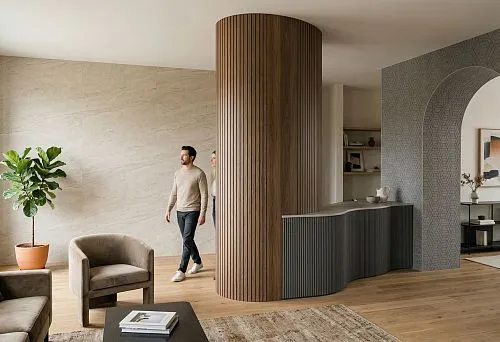
Living room — the main space in the house, where slatted cladding often becomes a central architectural element. Accent wall behind the sofa or TV zone — classic application. Vertical slats of medium-toned oak or ash create a warm natural texture, making furniture appear more expressive. Built-in lighting between slats adds evening coziness. Ceiling height of 2.7–3 meters allows using medium or wide slats 60–80 mm wide with 40–60 mm gaps for balanced rhythm.
Slatted wall can include functional elements — TV niche, shelves, built-in fireplace. Slats frame these elements, creating a unified composition. If the living room is combined with the kitchen or dining area, a slatted wall or partial slatted partition zones the space, marking the living room zone.
Color solution for the living room depends on the style. Scandinavian living room — light slats of pine or bleached ash, natural color or white oil. Modern living room — gray or black slats, graphic contrast. Classic living room — medium or dark oak slats, nobility of natural wood. Eco-living room — natural-colored larch, emphasized texture, combined with live plants.
Bedroom — space for rest, where tranquility, coziness, and natural materials are important. Slatted cladding behind the headboard — popular solution, creating a visual focus and soft natural background. Vertical slats visually increase height, horizontal slats create intimacy and protection. Preferred colors are warm, calming — light and medium wood tones, bleached shades, soft grays. Avoid dark, heavy tones that may feel oppressive in small bedrooms.
Built-in soft lighting between slats creates comfortable evening lighting for reading in bed. Behind the slats, soft headboard with upholstery can be integrated — slats on the sides, soft upholstered panel in the center. Ecology is important in the bedroom — use solid wood slats without synthetic coatings or water-based oils and varnishes.
Children’s room — space where slatted cladding solves functional and aesthetic tasks. Slats protect walls from damage by active children. Hooks for clothes, shelves for toys, chalkboard or magnetic drawing board can be integrated between the slats. Colors can be playful — pastel (mint, powder pink, peach) or saturated natural (terracotta, mustard, sky blue). Avoid aggressive bright acidic colors.
Ecology is critical in children’s rooms — only solid wood without toxic coatings, water-based paints and oils with safety certifications. Rounded slat edges are safer than sharp ones — a child won’t get hurt from accidental bumps. Slats must be securely fastened to withstand load if a child tries to hang from them.
Kitchen and dining room — spaces where slatted cladding creates coziness, zoning, and accents. Slatted wall in the dining area highlights it, creating a backdrop for the dining table. Slats can be made of moisture-resistant species (larch, thermowood) or treated with moisture-resistant oils and varnishes. Avoid installing slats in the backsplash zone (directly above the stove and sink), where high humidity, grease, and water splashes occur — use tiles, glass, or metal there. Slats are suitable for accent walls opposite the kitchen, bar area, or dining section.
Colors for the kitchen — light and medium tones that expand space and create freshness. Dark slats in a small kitchen will make it feel cramped. Horizontal slats visually expand a narrow kitchen. Built-in lighting between slats provides additional lighting for the dining area.
Hallway and corridor — spaces where slatted cladding solves functional tasks. Slats protect walls from damage by furniture, bags, and mechanical impacts. Vertical slats visually increase the height of often low hallways. Hooks for clothes, shoe shelves, mirrors can be mounted between or on the slats. Dark or medium-toned slats are more practical than light ones — dirt is less visible.
Narrow corridor visually expands with horizontal slats on long walls or vertical slats on end walls, drawing the eye inward. Light slats make a dark corridor brighter. Built-in lighting between slats creates soft navigational lighting.
Bathroom — a humid space requiring moisture-resistant materials.Slats of larch, thermowood, or treated with moisture-resistant oils and varnishes withstand bathroom humidity. Slats are not recommended in areas directly exposed to water (shower zone) — use tiles there. On walls away from direct water contact, slats create a spa atmosphere, natural coziness, complementing stone or concrete.
Sauna and bath — spaces where wood is traditionally and functionally used. Slats of lime (does not heat up, pleasant to touch, does not emit resin), alder, or abash (exotic species for saunas) create a classic atmosphere. Vertical or horizontal slats on walls and ceiling, plank flooring — traditional cladding. No synthetic coatings — only natural wood, permissible treatment with special sauna oils.
Office and library — spaces where slatted cladding creates solidity, respectability, and intimacy. Dark oak or walnut slats, brushed with rich texture, create an English office atmosphere. Slats can be combined with bookshelves — slats as background, shelves against them. Horizontal slats create classic office paneling. Built-in lighting creates soft working lighting.
Balcony and loggia — spaces at the boundary of interior and exterior, where slatted cladding creates coziness, sun protection, and zoning. Slats of larch or thermowood withstand temperature fluctuations and humidity of open and semi-open spaces. Vertical slats on the parapet create partial privacy, scatter direct sunlight, and maintain ventilation. Slats on loggia walls create an extension of the interior, a cozy space for relaxation.
Combination of slatted cladding with other materials
Harmonious combination of materials creates visual richness and balance of textures.
Wood and concrete — combination of natural and industrial, warm and cold. Wooden slats against a concrete wall or partially covering concrete create a contrast of textures — rough concrete texture and warm wood texture. Suitable for lofts, industrial, and modern interiors. Concrete can be natural gray or painted, wooden slats natural tones or dark.
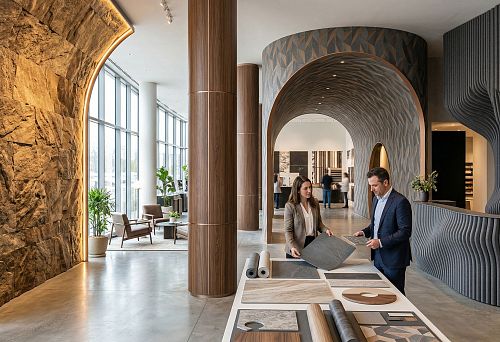
Wood and stone — a combination of two natural materials, creating solidity and a connection to nature. Stone walls (natural stone, decorative stone, brick) and wooden planks — for chalets, rustic, country, eco styles. Stone is usually used on accent areas (fireplace, part of the wall), planks on the rest — a balance of stone's massiveness and wood's lightness.
Wood and white walls — a classic universal combination. White painted or plastered walls — neutral background, wooden planks — accent, texture, warmth. Suitable for most styles — from Scandinavian to classic. Light planks on white create a tonal soft composition. Dark planks on white — graphic contrast.
Wood and wallpaper — a combination for creating classic panel compositions. Lower part of the wall (up to 100-120 cm) — wooden planks or solid wood cladding, upper part — patterned wallpaper (stripes, damask, floral for classic; geometric, solid textured for modern). Wooden molding at the junction separates zones. Classic solution for hallways, offices, bedrooms in traditional styles.
Wood and textile — a combination for creating coziness, softness, tactile comfort. Wooden planks and upholstered panels in the center (headboard, sofa area) — a balance of wood's hardness and fabric's softness. Textile can be natural (linen, cotton, wool) for eco styles or velvet, velour for glamorous interiors. Fabric color harmonizes or contrasts with wood.
Wood and metal — a combination for industrial, loft, modern interiors. Wooden planks and metal elements (black steel frames, bronze accents, copper pipes, aluminum profiles) create a contrast between warm natural and cold industrial. Metal as frame, fasteners, decorative inserts between planks, lighting fixtures.
Wood and glass — a combination for modern, light, bright interiors. Wooden planks and glass panels (matte, transparent, tinted glass) create a balance of naturalness and modernity, privacy and openness. Glass can be in partitions between planks, in doors against plank walls, in furniture.
Wood and greenery — a biophilic combination, creating a natural environment in the interior. Wooden planks and live plants in planters on walls, shelves between planks, climbing plants winding around planks — the most natural, healthy, living environment. Suitable for eco styles, Scandinavian, modern interiors with an emphasis on eco-friendliness.
Interior styles and plank cladding
Each style requires its own approach to planks.
Scandinavian style — light planks of pine, spruce, bleached beech, natural color or white oil. Vertical installation, medium plank width 40-60 mm, gap 30-50 mm. Minimal processing — sanded surface, colorless or slightly white-pigmented oil. Combination with white walls, light wooden floor, natural textiles. Emphasis on purity, light, naturalness, functionality.
Minimalism — planks of any color (often gray, black, white), but strict geometry. Vertical or horizontal installation with regular spacing. Rectangular profile with sharp edges, clear graphics. No decorative elements — planks as pure form, geometry, rhythm. Combination with monochrome palette, minimal furniture, open space.
Loft and industrial style — planks in dark tones (dark wood, charred, black) or natural color with rough finish. Wide planks 70-120 mm, massive, creating visual weight. Brushing, aging, rough texture. Combination with concrete, brick, metal, exposed utilities. Emphasis on materiality, texture, industrial character.
Modern style (contemporary) — planks of any color depending on the concept, but with emphasis on current trends and freshness. Combination of vertical and horizontal, asymmetrical compositions, integration of lighting, bold color solutions. Combination with various materials, experimentation, individuality.
Eco style — planks of natural wood in natural tones without synthetic coatings. Visible texture, knots, natural color variations are welcome. Colorless oils, wax — natural protection. Combination with live plants, natural fabrics, stone. Emphasis on eco-friendliness, naturalness, health.
Japanese style — planks of light wood (pine, cedar, bamboo) or dark (charred wood). Strict geometry, regular rhythm, minimalism of details. Planks as elements of traditional Japanese shoji screens, fusuma sliding panels. Vertical or horizontal, thin or medium width. Combination with rice paper, tatami, low furniture. Emphasis on Zen, calmness, harmony.
Country and rustic — planks of natural wood in medium and dark tones with pronounced texture, knots. Horizontal installation is common (association with barn or farmhouse cladding). Wide planks, aged, brushed. Combination with wooden beams on ceiling, stone, checkered and striped textiles. Emphasis on rustic coziness, tradition, naturalness.
Classic and neoclassical style — planks used to create wall panels, frames. Oak or walnut planks in medium and dark tones, possibly with carving, patina. Planks form frames, with contrasting finishes inside. Combination with moldings, cornices, classic furniture. Emphasis on symmetry, proportions, nobility of materials.
Practical tips for choosing and purchasing planks
Correct selection ensures quality and longevity.
Determine budget in advance — plank prices vary from 300 rubles per linear meter for pine to 3000 rubles per meter for oak or exotic wood. Add cost of fasteners, frame, coatings, installation (if hiring professionals). For a 20 sq. m room with one wall clad in planks, budget options require 30-50 thousand rubles for materials and labor, 80-150 thousand for mid-range, 200-400 thousand for premium.
Choose wood species based on usage conditions — any species suits dry living spaces. For humid areas (bathrooms, saunas) — larch, thermowood. For high loads (hallways, commercial) — hardwoods (oak, beech). For budget projects — pine. For premium — oak, walnut.
Check wood quality when purchasing — planks must be dry (moisture 8-12%, checked with moisture meter), without large through knots (may fall out), without cracks (especially end-grain, which will grow), without blue stain or mold (sign of improper storage), straight and flat without warping or twisting (place plank against flat surface, check for gaps).
Buy with 10-15% extra — for trimming, defects, installation errors. It’s better to have a few extra planks than to buy more later and face color or texture differences between batches.
Store planks properly until installation — in a dry room, horizontally on stands with ventilation, avoiding direct sunlight and moisture contact. Planks must acclimate in the room where they will be installed, minimum 3-7 days to equalize moisture.
Order finishing from the manufacturer if possible — many manufacturers offer services like brushing, staining, painting planks. Factory finishing is often better quality than DIY, saves time, but costs more.
Buy from reliable suppliers with quality guarantees, return options for defective planks, delivery. Check reviews, request samples before large orders.
Care for plank cladding
Proper care extends service life and preserves appearance.
Regular dry cleaning — dust accumulates on planks and in gaps between them. Wipe with a dry soft cloth, use a vacuum cleaner with a soft brush attachment to remove dust from gaps every 1-2 weeks. This prevents dirt buildup.
Wet cleaning as needed — for visible dirt, wipe with slightly damp (not wet) cloth and mild cleaning agent (wood or neutral soap solution). Avoid excess water — wipe with damp cloth, then immediately dry with a dry cloth. Do not use abrasive cleaners, stiff brushes, solvents.
Coverage renewal — oils and waxes require periodic renewal. For oiled boards, renew every 1-2 years — clean the surface, apply a new layer of oil with a soft cloth, wipe off excess, and polish. For waxed boards, renew with wax every 1-2 years similarly. Lacquered boards last 5-10 years without renewal if properly maintained.
Protection from direct sunlight — UV radiation causes darkening or fading of wood. Use curtains or blinds to protect louvered walls from direct sun. Alternatively, cover the boards with oils containing UV filters.
Humidity control — maintain air humidity at 40-60% to prevent wood from drying out or swelling. Use humidifiers in winter during heating, and dehumidifiers in summer during high humidity.
Repairing damage — minor scratches on oiled boards are repaired by locally applying oil. Deep scratches and dents are sanded with fine sandpaper and covered with oil or lacquer. A damaged board can be replaced — unscrew the fasteners, remove the board, and install a new one.
Louvered wall claddingsolid wood decorative lathsLouvered wall cladding — this is an investment in quality of life, creating a space that is visually beautiful, tactilely pleasant, functionally thought out, and ecologically healthy. Natural wood brings warmth, texture, and a connection to nature into an urban environment. The geometry of laths creates visual order, rhythm, and structure. The play of light and shadow on the textured surface makes the wall alive, changing, and interesting. The variety of species, sizes, finishes, and installation methods allows for any design concept — from budget Scandinavian freshness to exclusive classic luxury. Properly selected, correctly installed, and well-treated laths serve for decades, aging gracefully, acquiring the patina of time, becoming part of the home and family’s history.