


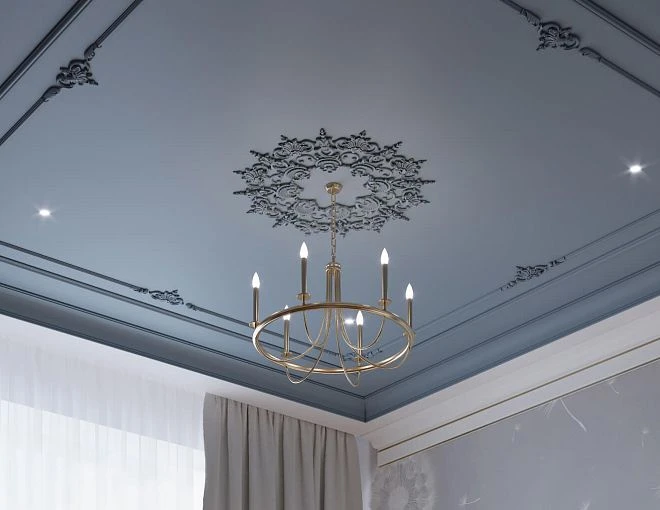
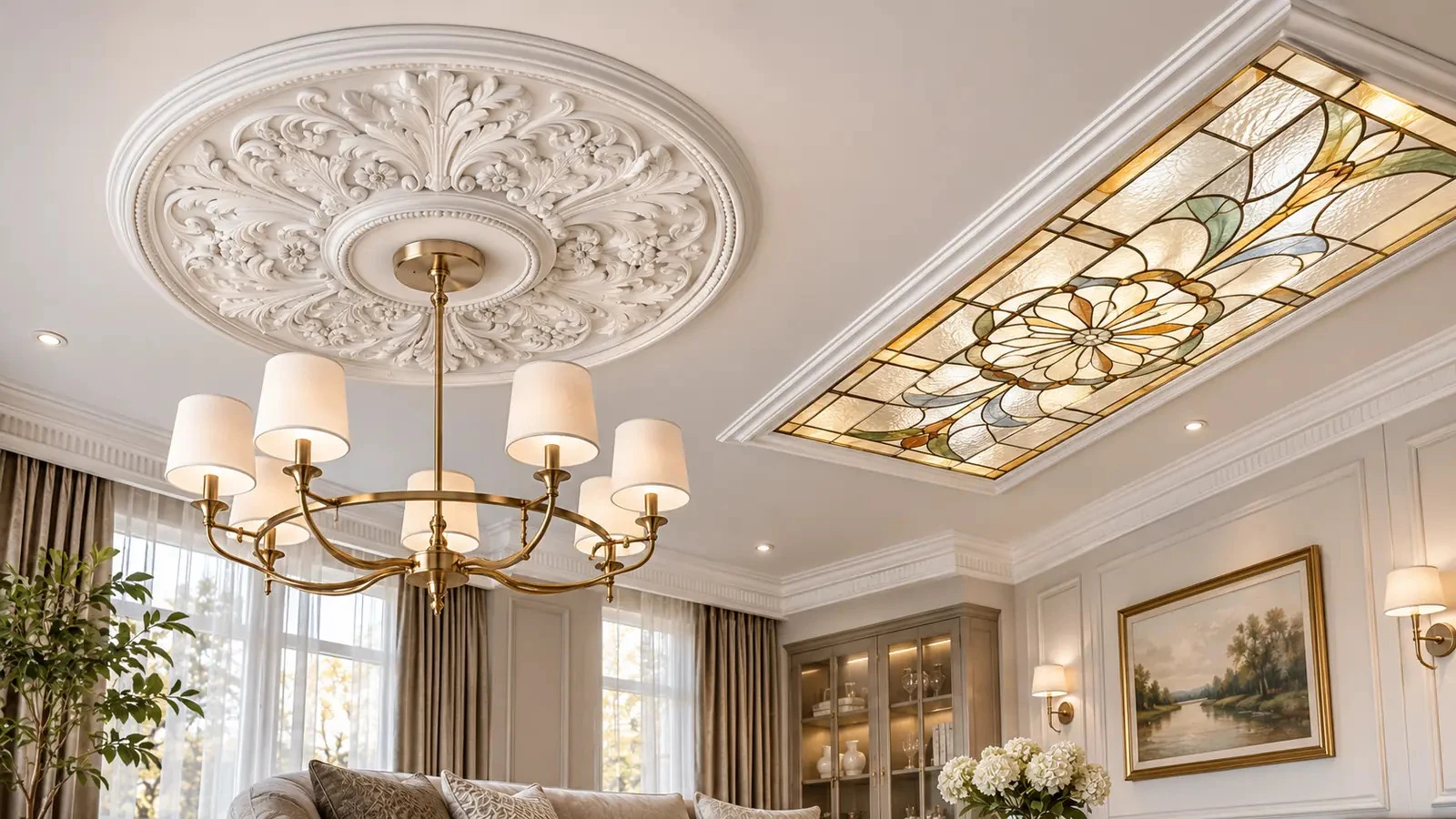
In a living room with a ceiling stained-glass panel, the chandelier's mounting point is often already fixed: the fixture sits above the table or seating area, while the glass insert lights the adjacent part of the room. Adding moulded ornament to these two elements creates a challenge that doesn't arise with a plain, single-colour ceiling. You need to choose not just an attractive medallion, but a composition that fits the available space, doesn't overlap the stained-glass frame, and leaves room to service both structures. Here the product's size matters as much as the pattern and the price.
Let's look at the choice of four STAVROS ceiling medallions for a hypothetical living room of 29.76 m². There is 650 mm between the chandelier axis and the nearest edge of the stained-glass frame. That is enough for the preliminary placement of three of the models under consideration; the fourth requires a revised design or a check of the actual outline. At the same time, the most compact composition costs the least, while two medallions of similar dimensions differ substantially in the character of their ornament. This example helps move from an attractive picture to a well-founded purchase.
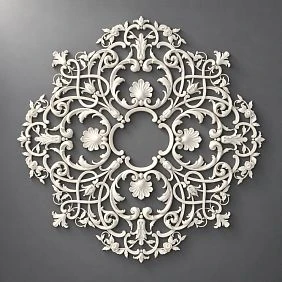
Where to buy a ceiling medallion in Nizhnevartovsk
To buy a ceiling medallion in Nizhnevartovsk, you can go directly to the STAVROS catalogue. It lists polyurethane products with their item codes, outer dimensions, thickness and price. For a buyer from the Khanty-Mansi Autonomous Okrug, this is an opportunity to agree on a specific item in advance with the designer, electrician and moulding specialist, and then arrange delivery. There's no need to choose a vague medallion from a photo and only find out after delivery whether it fits in terms of size.
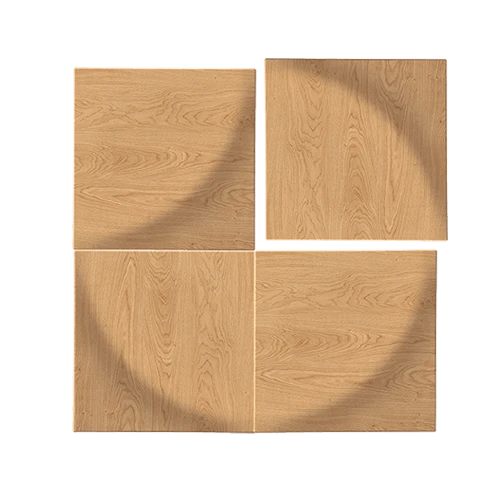
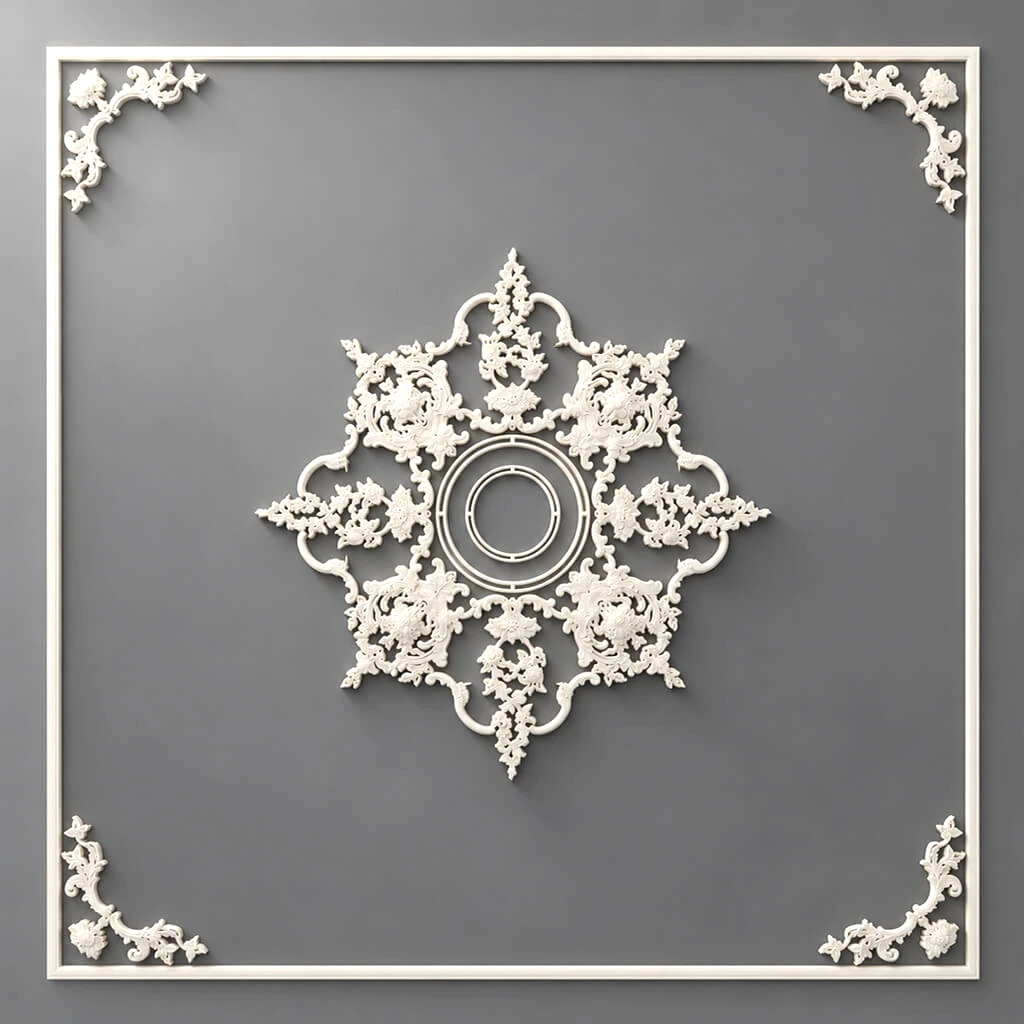
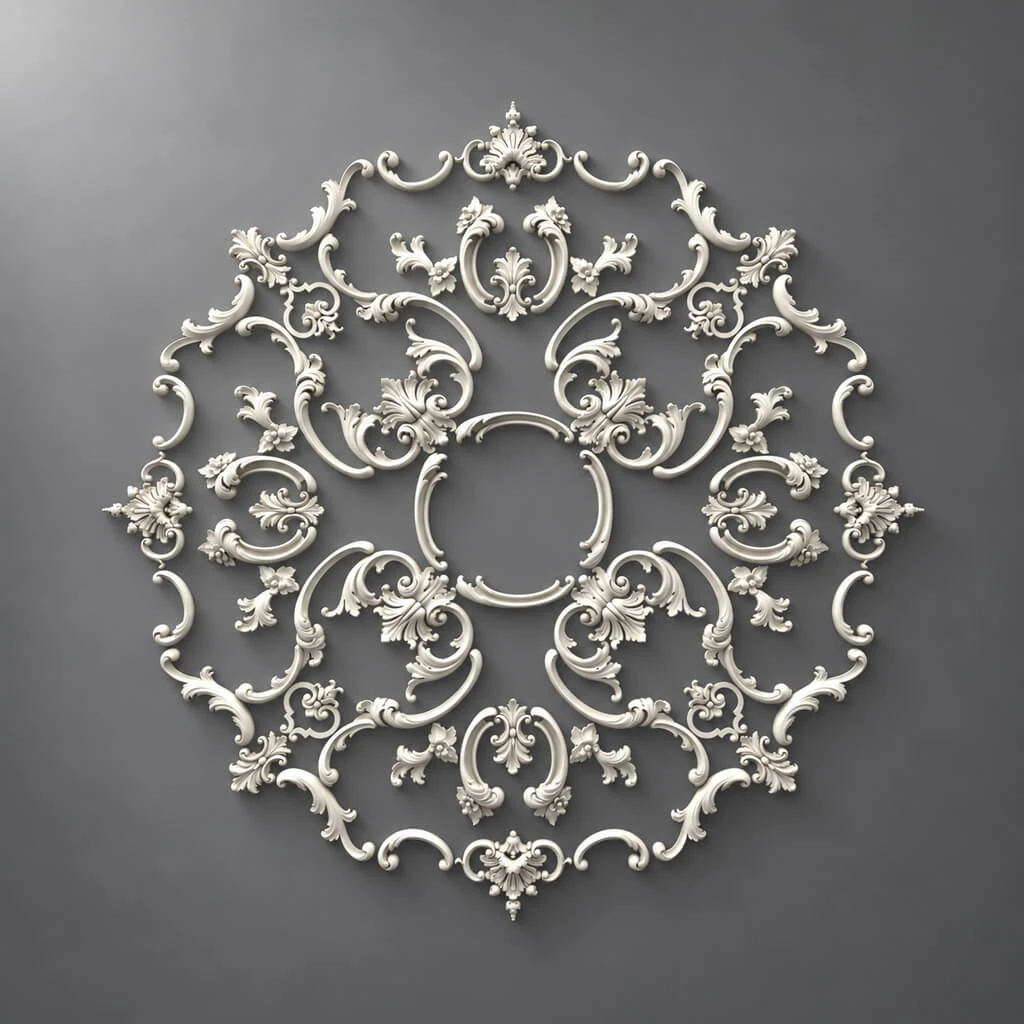
Ceiling compositions in this family are not necessarily a solid round plate. Among them are modular products in which the pattern is formed by separate pieces, and the open ceiling plane remains part of the composition. That's why it's important to look not only at the size but also at the layout drawing. If the chandelier has a large decorative cup, it may cover the inner part of the ornament. With a small mounting base, on the other hand, you may need to carefully finish the transition to the open centre, avoiding accidental gaps between the cup and the pieces.
When ordering for a ceiling with a stained-glass panel, it's useful to give the STAVROS specialist three parameters right away: the outer size of the glass insert's frame, the distance from its edge to the chandelier axis, and the dimensions of the ceiling cup. If you have an electrical or ceiling plan ready, attach it to your request. This information lets you discuss the actual placement of the chosen item code rather than an abstract style. For modular systems, you should also ask for details of the kit contents and the installation template.
Don't rely on a photo of the living room alone. In a wide-angle shot, two objects sometimes appear much farther apart than they are on the plan. This is especially noticeable when shooting from a corner of the room: perspective foreshortening changes the apparent gaps. It's wiser to buy mouldings based on dimensions and a verified layout, and to use interior images to assess the overall character of the design.
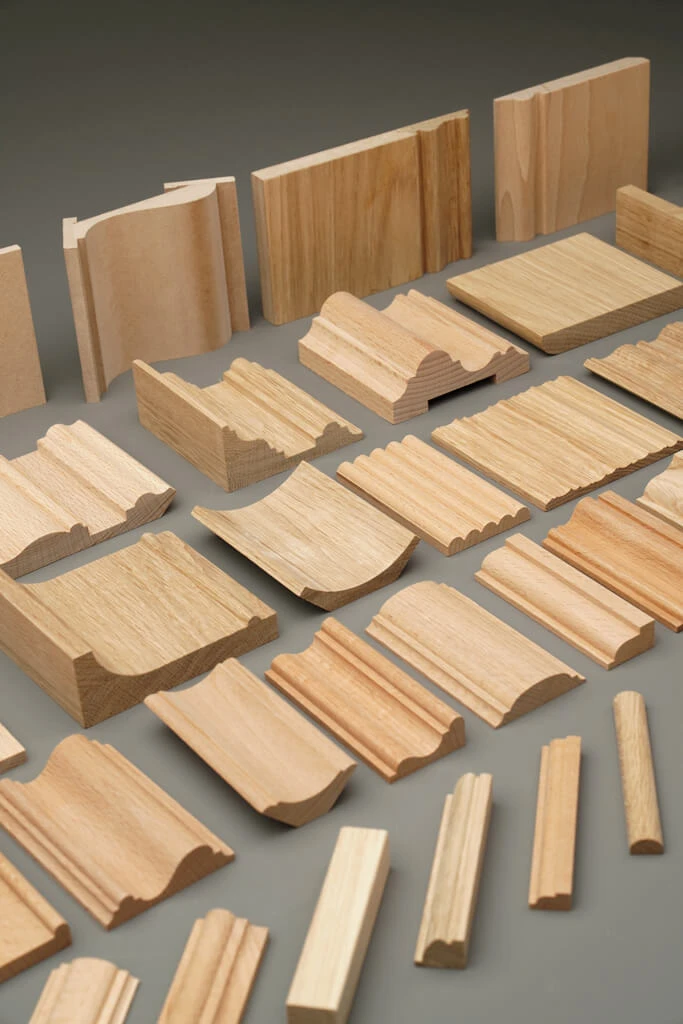


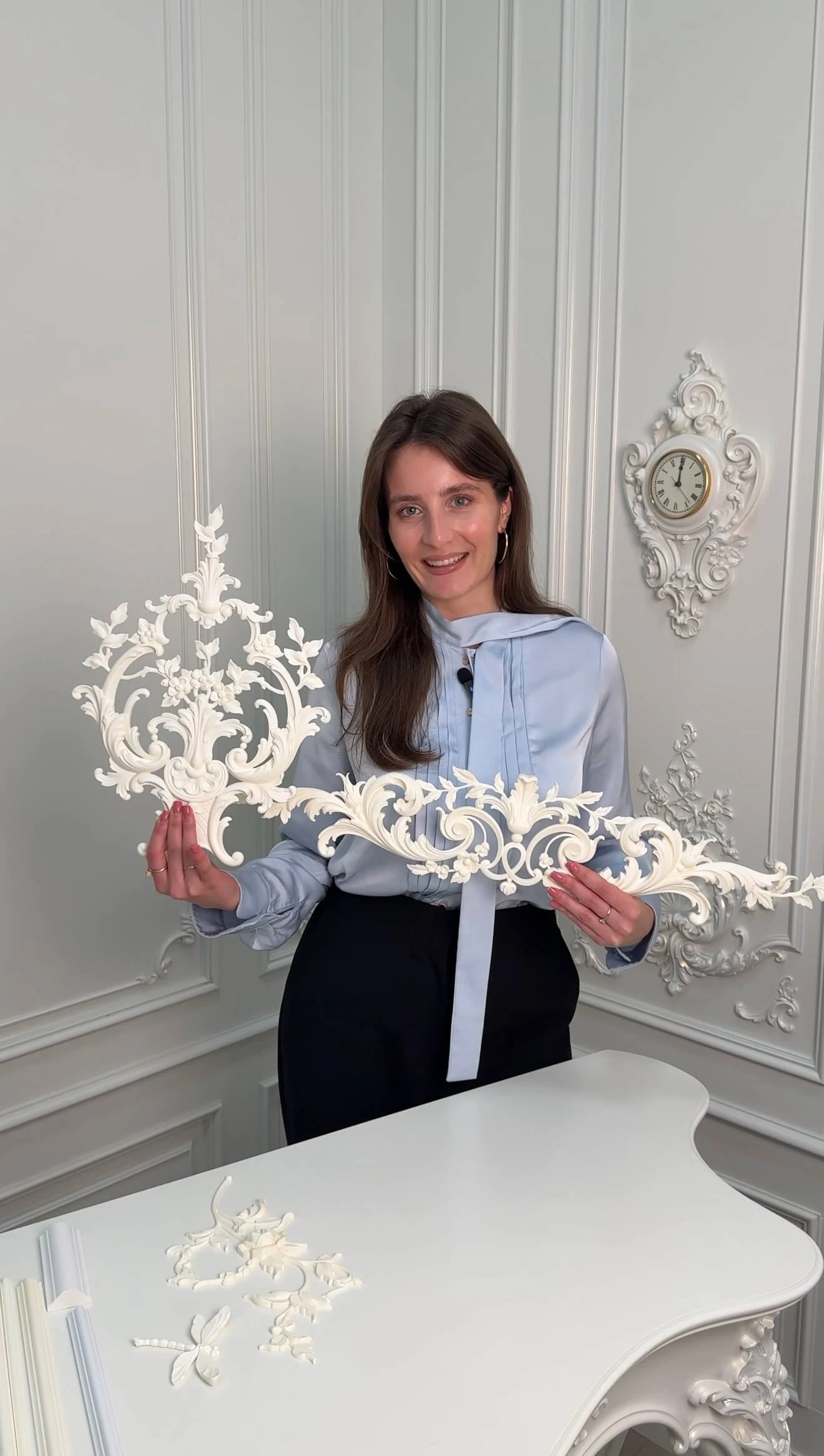
Medallion and stained glass: two independent accents on the ceiling
Colored glass and white molded relief act differently. A stained-glass window draws attention to the light, the combination of shades, and the graphic pattern of the muntins. A ceiling medallion concentrates attention around the axis of the chandelier and emphasizes the fixture's construction. Together they can make the ceiling expressive, but each element must retain its own space. If the ornament comes too close to the frame, the two compositions will be perceived as randomly colliding parts of the finish.
Choosing Polyurethane ceiling rosettes, compare them with the actual geometry of the stained glass. For a rectangular glass field, a radial or soft oval composition can be considered: different silhouettes help avoid the impression that the entire design consists of identical frames. But the contrast of form must be intentional. If the ceiling already has a complex grid of rectangular coffers, additional molding should not cross their lines or mask the joints provided for by the design.
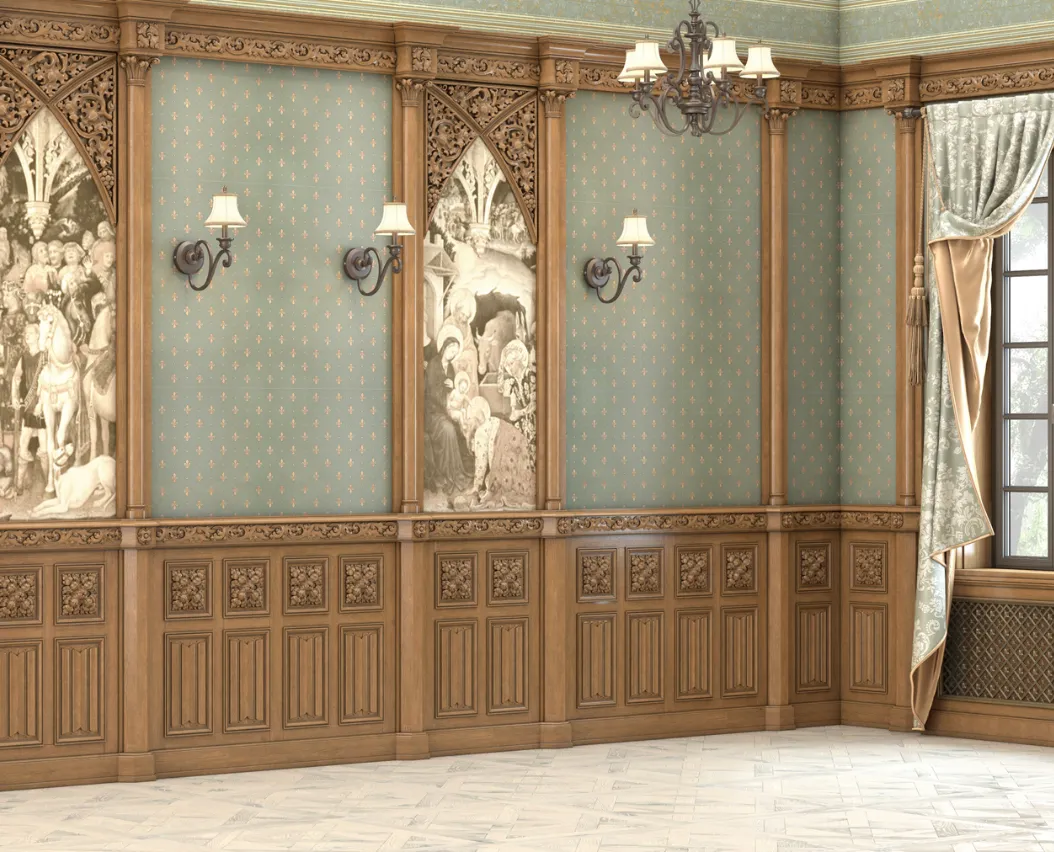
In an interior with classic wall panels and a brass chandelier, a white botanical pattern can tie together the metal, furniture, and architectural trim. If, however, the stained glass is made with large geometric sections of blue, green, and amber glass, it is worth checking a lighter composition with clearly distinguishable gaps. It competes less with the glass pattern. This approach does not require repeating every motif of the stained glass in the molding. A general sense of proportion and a careful rhythm are enough.
The view of the ceiling from different parts of the living room also matters. A person sitting on the sofa sees the ornament at an oblique angle, whereas someone standing under the fixture notices mainly its inner part. Make two sketches or perspective views: from the entrance and from the main seating area. If two separate decorative centers are visually legible from both points, the concept works. If they merge, it is sometimes better to reduce the medallion than to change the already installed glass structure.
Why the stained-glass pattern influences the choice of ornament
A ceiling stained-glass panel can be almost colorless, with a few tinted inserts, or have a rich multicolored pattern. In the first case, you can afford a denser botanical relief around the chandelier. In the second, it is better to check whether the ornament becomes too active a neighbor to the glass panel. Perception is determined not only by the area of the decor: many small leaves and scrolls create a different visual weight than a few large details with the same outer dimensions.
If the stained-glass muntins are dark, they form a clearly visible grid even when the backlight is off. A medallion painted in the ceiling color looks softer and helps balance such a pattern. On a light base, the relief manifests itself mainly through shadows, so its prominence changes throughout the day. There is no need to automatically cover the ornament with gold paint just because the fixture has brass hardware. Metallic decor should first be evaluated on a sample together with the glass and ceiling paint.
When the fixture and the stained glass define different functional zones, their patterns do not have to match. For example, a rectangular insert may be located above a passage, while the medallion is above the dining table. In this case, the molded pattern emphasizes the center of the dining group, and the stained glass helps indicate the direction of movement. Such zoning is especially convenient in an elongated living room, where a single central decorative element does not explain the entire architecture of the room.
The height and character of the furniture should also be taken into account. A tall cabinet with glass doors, carved fronts, and massive cornices already create many details in the upper part of the room. A small medallion with an open center may be preferable in such surroundings to a large solid pattern. In a calm modern interior with minimalist furniture, more expressive molding, on the contrary, can become the only classic accent. The decision is made in the context of the entire room, not based on a single fragment of the ceiling.
What dimensions to measure before purchase
Begin measuring from the ceiling plan. Record the finished dimensions of the room, the position of the wall cornices, the stained-glass frame, and the axis of the chandelier mounting. For the glass insert, it is important to indicate the outer contour of the frame together with the decorative surround, if it projects onto the adjacent plane. The size of the transparent field itself does not show the entire occupied area. If the frame has several steps, the most protruding boundary should be marked on the plan.
Measure the distance from the fixture axis to the nearest edge of this boundary. In the project under consideration, it is 650 mm. For ease of comparison, let us take the rectangular footprint of each socket, divide the dimension in the direction of the stained-glass panel in half, and subtract it from the distance to the frame. This calculation assumes a central position of the composition, symmetry about the axis, and parallel placement of the nominal footprint relative to the frame edge. In case of rotation or asymmetry, a separate check along the contour is required.
Next, clarify the dimensions of the chandelier itself: the outer diameter or width of the canopy, the cable exit point, the configuration of the mounting bracket, and the need for access to the connections. The diameter of the entire fixture does not replace the size of its ceiling base. On a chandelier with wide arms, the canopy may be quite compact, while on a flat model the body near the ceiling sometimes occupies most of the intended free center.
Record two more parameters: the thickness of the finished ceiling finish and the height of the protruding parts of the stained-glass frame. If there are steps, niches, light profiles, or suspended panels, the working plane for the socket may differ from the plane of the glass field. It is also important to know the location of access hatches, fastening elements, and the areas that will be needed when removing the frame. A gap that looks convenient on paper will not necessarily be sufficient for the craftsman to work.
Ceiling socket CRPU-070: a compact composition
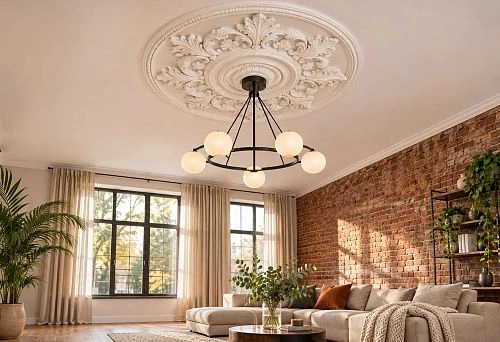
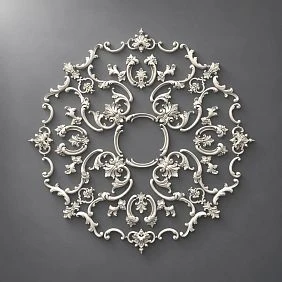
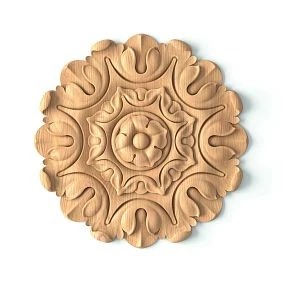
Model CRPU-070 has an outer dimension of 765 × 765 mm and a thickness of 18 mm. The price in the STAVROS catalog as of November 24, 2026 is 35,680 rubles. Of the four products under consideration, this is the most compact and affordable option. The radial floral pattern is well worth considering for a living room where the glass panel occupies a significant part of the ceiling and you want to keep a noticeable strip of free finish around the chandelier.
If you plan to buy ceiling socket CRPU-070, start by reviewing the factory drawing and the position of the central elements. With symmetrical placement in our example, half of the outer dimension is 382.5 mm, and the calculated distance from its edge to the frame is 267.5 mm. This is the most spacious placement in the group under consideration. It leaves more room for refining the finishing boundaries than the options measuring around 910 mm.
A small footprint does not make the socket inconspicuous. With a room height of 3100 mm, the scale of the molding will depend on the size of the fixture, the contrast of the paintwork, the area of the stained glass, and the overall viewing distance. Before purchasing, you can mark the contour on the ceiling with painter's tape that is safe for the specific finish, or show it on a full-size paper sketch. At this stage, assess whether the chandelier canopy covers a significant part of the pattern. The size of the central free space cannot be obtained by subtracting an arbitrary width of the ornament from the outer dimension: it is determined by the actual layout.
CRPU-070 is especially useful when the buyer has already approved the position of the glass insert and cannot move it for the sake of new molding. Instead of an expensive ceiling rework, you can first check the compact item. The cost of the product is lower than that of the other three positions, and the preserved free zone between the accents can become an important part of the composition.
Ceiling socket CRPU-069: a richer floral pattern
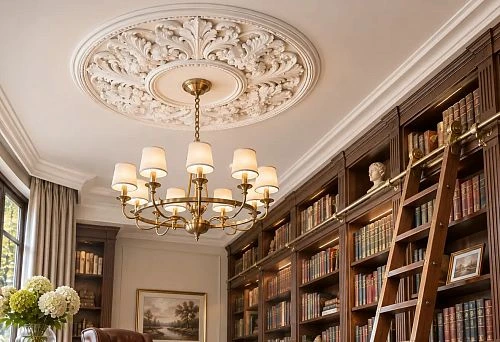
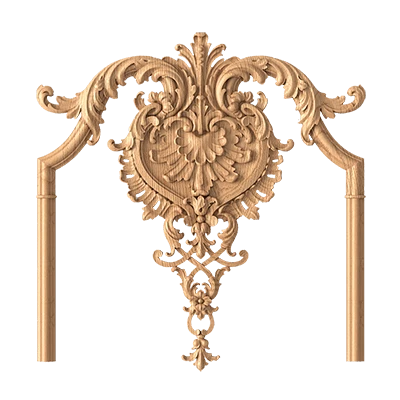
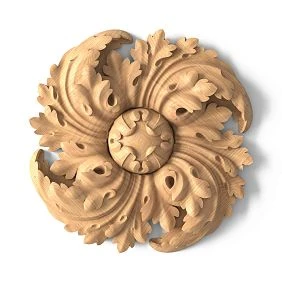
CRPU-069 is a modular composition measuring 910 × 910 × 15 mm. Its price is 62,560 rubles. When comparing it with CRPU-070, you should take into account not only the 145 mm increase in the outer dimension, but also the different character of the relief. The composition includes many individual plant details that are assembled into a circular frame with an open center. This is a solution for a room where a more pronounced classical accent is needed around the chandelier.
In the living room under consideration, half of the overall dimension of CRPU-069 is 455 mm. With a distance of 650 mm to the edge of the stained-glass frame, 195 mm remains along the calculated rectangular contour. Such placement looks promising if the project does not provide for profiles protruding into this area or a trajectory for removing the glass panel. But the figure of 195 mm is not in itself an established installation tolerance. It must be compared with the requirements of the installers of the two types of finishing.
If it is decided order the CRPU-069 ceiling medallion, and at the same time clarify the method for marking out the composition. The product page lists a separately purchased paper installation template. It helps to position the modular elements in the intended sequence. For a ceiling next to a stained-glass window, the template is also useful because the outer accents can be assessed before the parts are glued on. Check the dimensions of the printout or factory template and do not use a reduced on-screen image as working markup.
Compared with the compact model, this option costs 26,880 rubles more. The purchase is justified when the character of the ornament is genuinely needed for the interior: for example, when the living room already has plant motifs on furniture, doors and the metal fittings of the chandelier. If the main accent should remain on a rich stained-glass window, it makes sense to compare a more compact medallion or a composition that is close in outer size but less fragmented.
RPU.VRS-001: an open symmetrical composition
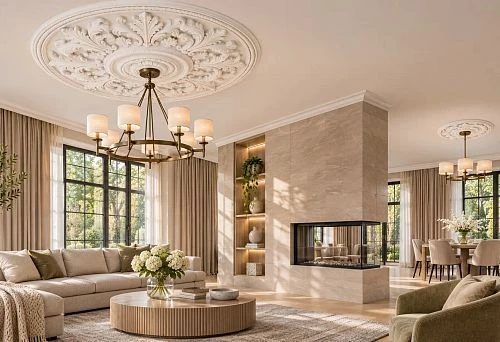
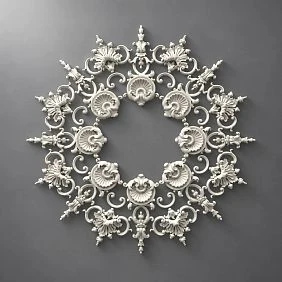
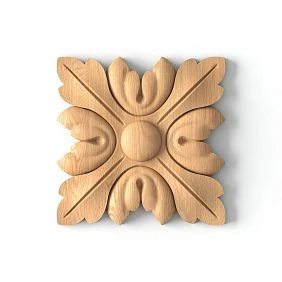
Polyurethane rosette RPU.VRS-001 has an overall dimension of 911 × 911 × 18 mm and costs 67,360 rubles. The official product page states that it is assembled from eight elements: four pieces each of NPU-507 and NPU-508. Unlike CRPU-069, it uses significantly fewer individual parts. This allows the ornament to be perceived as large repeating accents around a free center.
In our calculation, from half of the overall dimension, 455.5 mm, to the edge of the stained-glass frame, 194.5 mm remains. The difference from CRPU-069 is only 0.5 mm. In this case, buying one of the models simply because its size is a millimeter smaller is not advisable: the real accuracy of measurement, the position of the frame and the finishing tolerances matter more than this difference. What should be compared is the pattern, thickness, composition of elements, position of the free center and cost.
RPU.VRS-001 makes sense to consider in a room with a stained-glass window built on large areas of color. Repeating stucco elements can support the scale of the glass graphics without copying it literally. If the glass field contains many small fragments, a calm composition made up of a small number of large stucco details can sometimes distribute the visual load better. Check this effect on a ceiling sketch with the actual stained-glass pattern, not on a plain rectangle.
The price difference between RPU.VRS-001 and CRPU-069 is 4,800 rubles. It does not allow one to automatically judge the complexity of installation or the quality of the products: the structure of the kits differs, and the labor intensity of marking out, fitting and painting is assessed by the installer. If the RPU.VRS-001 composition is chosen, request a layout diagram of all eight elements and clarify what is included in the kit. You should not add extra overlays to the set on your own just to fill the free area near the chandelier: this may disrupt the intended symmetry.
CRPU-068: a large ceiling rose for a different placement
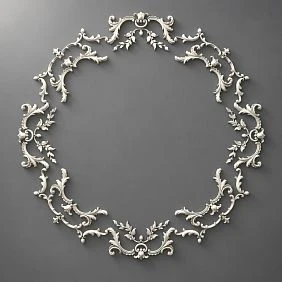
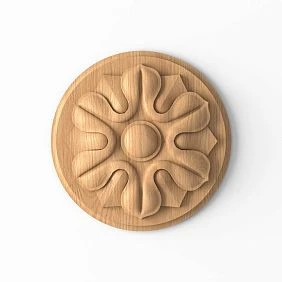
Large ceiling rose CRPU-068 measures 1325 × 1325 × 18 mm. The price is 50,480 rubles. This modular composition forms a soft oval silhouette within a square outer dimension. Despite the significant increase in size, the product is cheaper than two models with an outer dimension of around 910 mm. Consequently, the relationship between price and outer dimensions is not direct: the cost depends on the specific product and its composition.
If the socket is installed at the center of the chandelier at a distance of 650 mm from the frame, half of its dimension will be 662.5 mm. The calculation yields a negative value: minus 12.5 mm. This means that the conditional outer areas may overlap. With such initial geometry, CRPU-068 cannot be confidently recommended for ordering without additional verification. A negative value does not prove that a specific protruding ornament detail will necessarily hit the glass: the actual silhouette does not fill the entire square. It shows that the simple conservative method no longer confirms free placement.
The problem should not be solved by arbitrarily trimming stucco details, shifting individual modules, or rotating the composition without verification. The product has an intended pattern that must be preserved. If the large variant is fundamentally important for the design, first obtain the drawing and compare it with the actual contour of the stained-glass frame. If it is possible to relocate the chandelier or revise the ceiling insert, involve the relevant specialists: the changes may affect the mounting, wiring, panel layout, and lighting.
For a new living room where the position of the glass field has not yet been approved, CRPU-068 can become the basis for a beautiful ceiling composition. But in our example, it is more rational to consider it as an alternative in case the project is revised. Its lower price compared to CRPU-069 does not compensate for the risk of incompatibility with an already installed stained-glass window. It is important to buy a suitable product, not the largest one available for the amount.
Comparison of sizes and prices of four STAVROS rosettes
All four items belong to polyurethane ceiling decor. The table shows the outer dimensions and catalog prices for one product as of November 24, 2026. For modular decor, the price refers to the catalog item, not to an arbitrarily selected number of individual parts. When placing an order, it is necessary to confirm the current price, the contents of the set, and additional accessories.
| Article | Size A × B × C, mm | Price per item, ₽ | Preliminary assessment |
|---|---|---|---|
| CRPU-070 | 765 × 765 × 18 | 35 680 | The most spacious option |
| CRPU-069 | 910 × 910 × 15 | 62 560 | Check the contour and clearance |
| RPU.VRS-001 | 911 × 911 × 18 | 67 360 | Check the contour and clearance |
| CRPU-068 | 1325 × 1325 × 18 | 50 480 | Fails simplified validation |
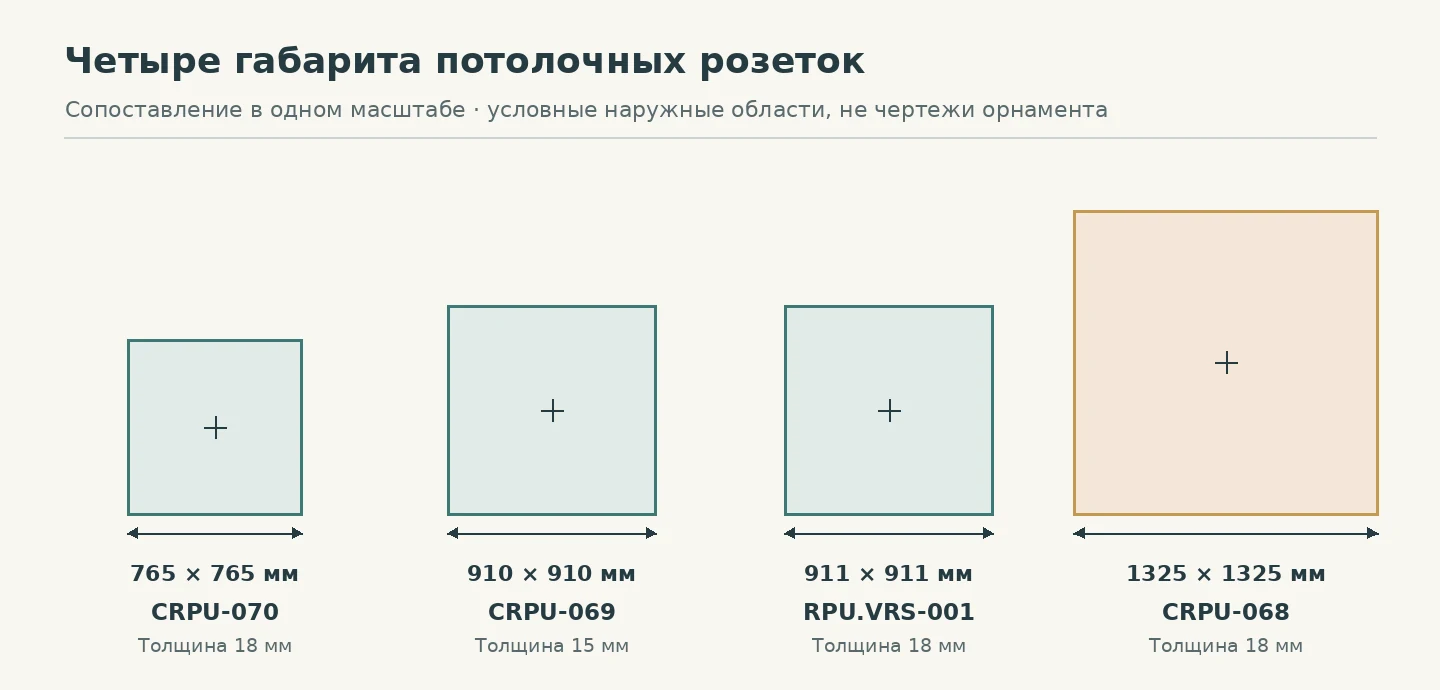
Comparing Decorative ceiling rosettes, you can see that the two middle models form practically one size group. CRPU-070 stands out for its smaller scale, while CRPU-068 stands out for a substantial increase in the outer field. For a preliminary assessment of the composition, it is more useful to first choose one of the three size groups and then consider the pattern features within the appropriate range. This way the buyer rules out obviously inconvenient options before even discussing the finish.
The thickness of the rosette does not determine the entire height of the structure next to the glass. If the stained-glass panel is recessed into a niche or separated by a protruding frame, the two surfaces are at different levels. On the plan below, their outlines may be adjacent, while in section they may have a complex junction. Therefore, the vertical dimensions of the product should also be included in the project, especially when the chandelier is close to the edge of the ceiling niche.
Practical calculation for a living room 6.2 × 4.8 m
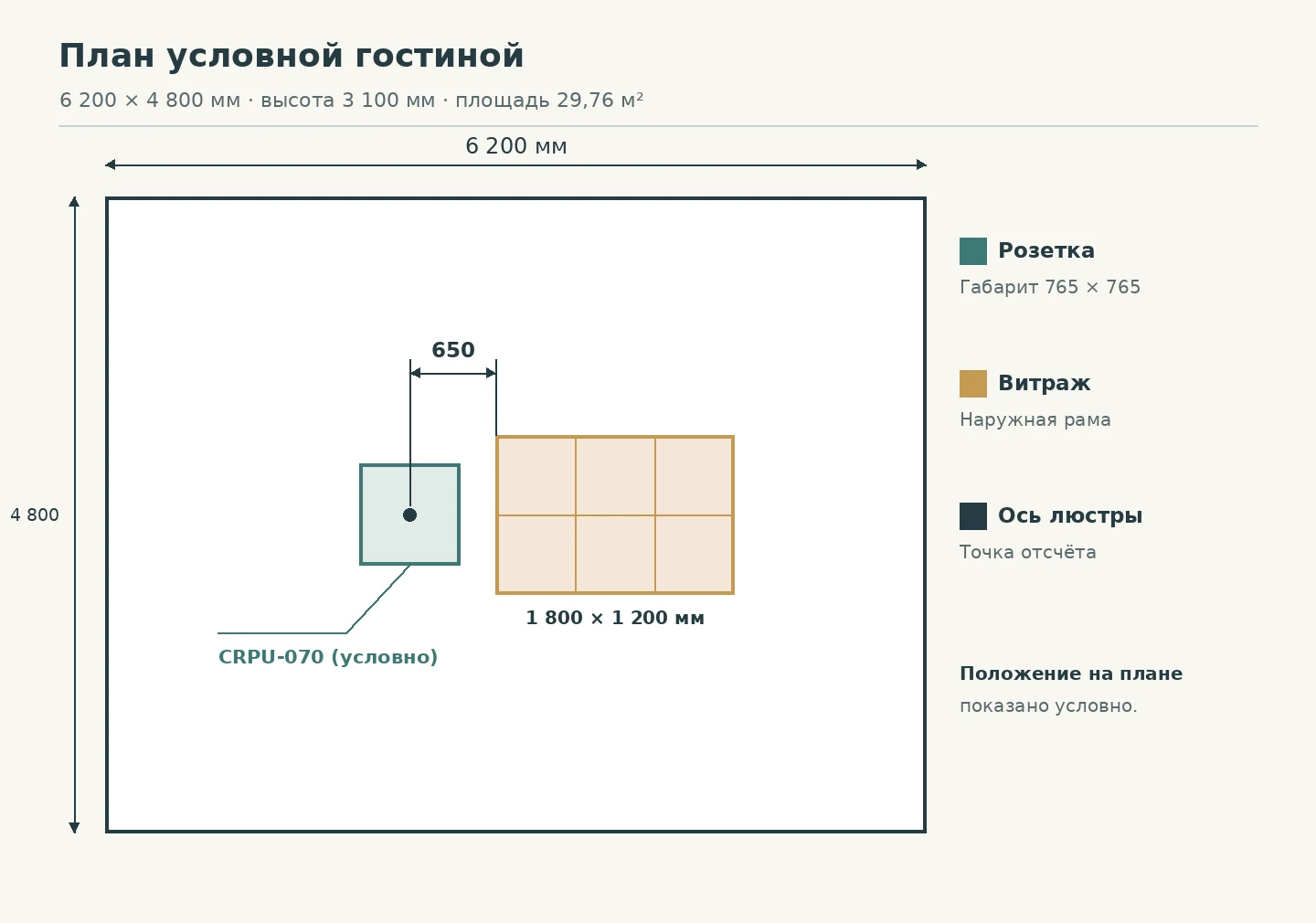
Let us imagine a living room in Nizhnevartovsk with finished dimensions of 6200 × 4800 mm. The ceiling height is 3100 mm. A rectangular stained-glass insert with external dimensions of 1800 × 1200 mm is provided, and a chandelier is placed on the adjacent flat part of the ceiling. The distance between its axis and the nearest outer edge of the frame is 650 mm. It is required to order one ceiling rosette without changing the approved position of the light fixture and the glass panel.
The room area is 6.2 × 4.8 = 29.76 m². The area of the conventional outer rectangle of the stained-glass panel is 1.8 × 1.2 = 2.16 m². This is about 7.3% of the total ceiling area. However, these figures alone do not allow determining the size of the rosette. Even with a relatively small share of the stained-glass panel, the obstacle may be located close to the chandelier. Therefore, the key number in the calculation remains the distance of 650 mm, while the room area helps estimate the overall visual scale.
Determining the free ceiling field
To verify, let's draw a plan at a uniform scale. On it, we'll mark the luminaire axis and the line of the nearest edge of the stained-glass frame. In the direction perpendicular to this line, we'll lay off 650 mm. Around the axis, we'll construct a schematic square based on the rosette's outer dimensions. Such a square is a simplified bounding area, not a depiction of a specific ornament. In the absence of other obstacles, it allows an initial comparison of models.
If the ceiling has perimeter moldings, light channels, or seams of suspended finishes, they should be shown on the same plan. In our training example, only the adjacency of the stained-glass window and the rosette is checked, while the remaining areas are considered clear for a preliminary assessment. On a real site, one cannot limit oneself to one side: a compact composition may fit on the stained-glass side but conflict with the cornice on the opposite side.
Calculating the distance from the rosette to the stained-glass frame
For a symmetrically positioned square bounding box whose sides are parallel to the nearest frame boundary, we use the expression: remaining free field = 650 mm − half the outer dimension. For example, for CRPU-070 the result is 650 − 765/2 = 267.5 mm. For CRPU-069 — 650 − 910/2 = 195 mm. The other options are calculated by analogy.
| Model | Half of the overall dimension, mm | Remaining distance to frame, mm |
|---|---|---|
| CRPU-070 | 382,5 | 267,5 |
| CRPU-069 | 455 | 195 |
| RPU.VRS-001 | 455,5 | 194,5 |
| CRPU-068 | 662,5 | −12,5 |
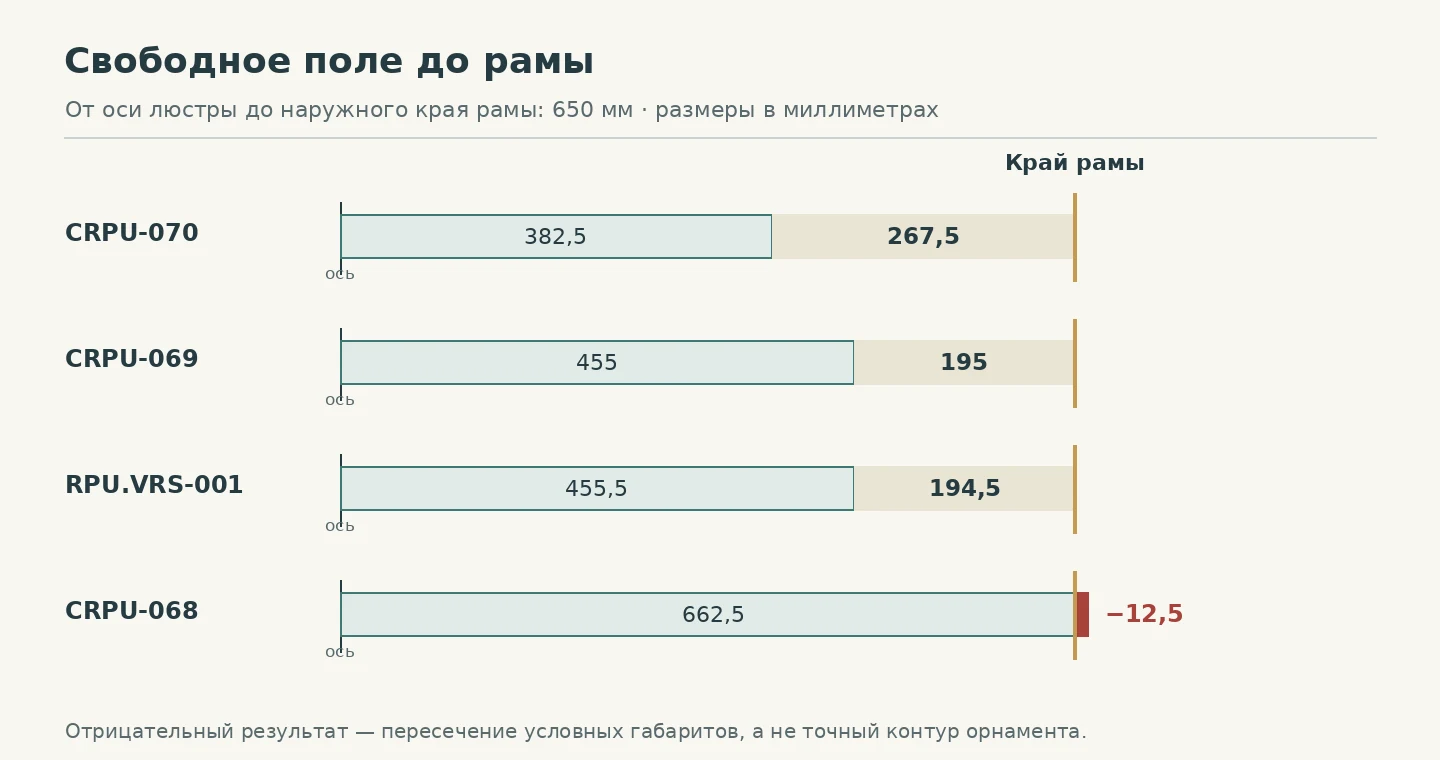
A positive result means there is a free strip between the calculated boundaries. A negative result signals a possible overlap of dimensions. If, during the frame survey, it turns out that the decorative edging protrudes 40 mm toward the chandelier relative to the assumed line, the distance should be reduced to 610 mm. For CRPU-070, 227.5 mm will remain; for CRPU-069 — 155 mm; for RPU.VRS-001 — 154.5 mm; and for CRPU-068 the result becomes −52.5 mm. This is an additional conditional scenario demonstrating the importance of an accurate reference point.
Choosing a scale and checking the factory drawing
For the final decision, transfer the actual outer contour of the selected model onto the plan. For modular rosettes, the free areas inside and outside the ornament may differ from the schematic square. When the composition is rotated relative to the frame, the bounding projection also changes. Therefore, one should not apply half the 910 mm dimension as a fixed radius for all possible orientations of CRPU-069. The drawing or scale layout must correspond to the selected position of the product.
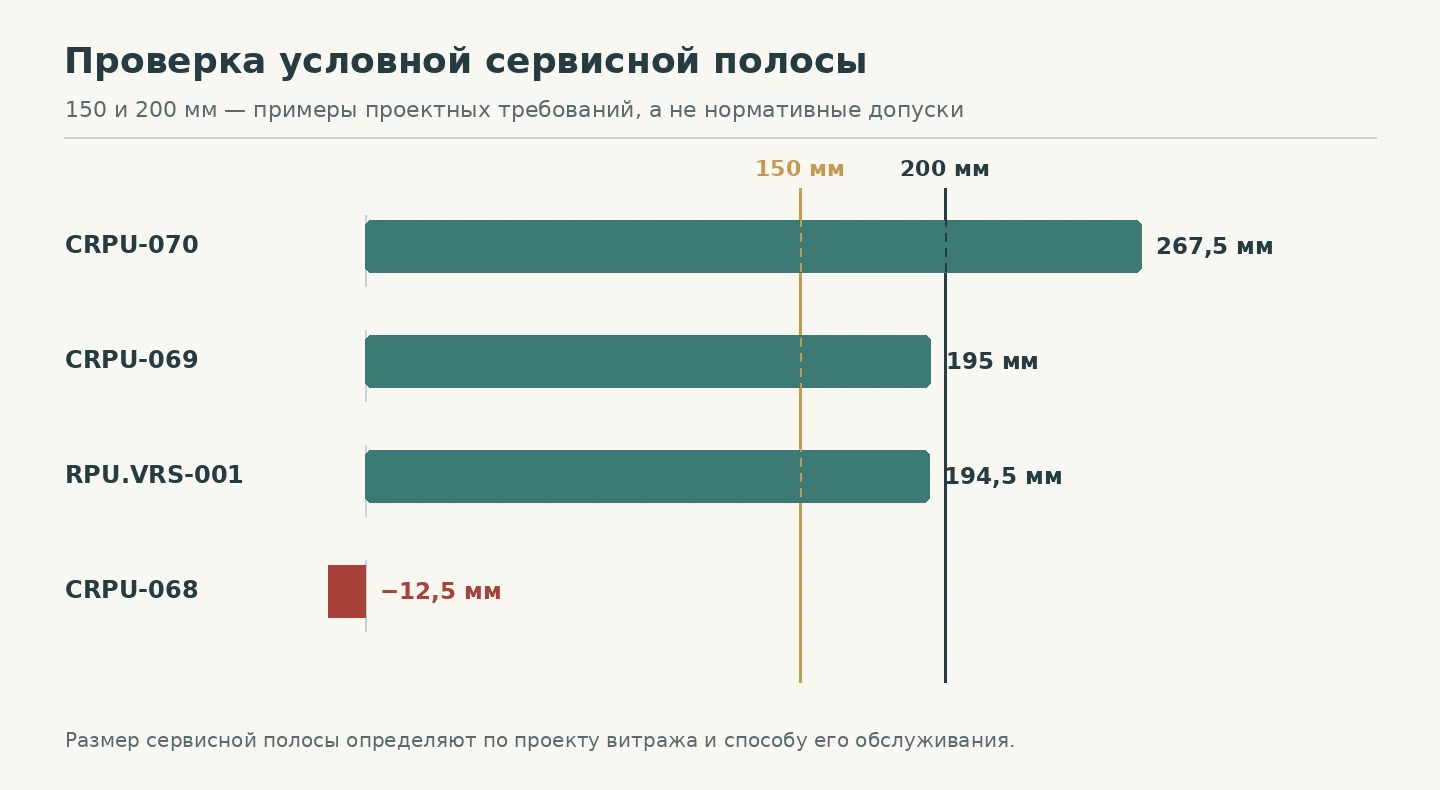
The geometric clearance must be compared with the stained-glass maintenance requirement. Suppose, as a purely design assumption, the installers ask to preserve a 200 mm strip. Then CRPU-070 leaves 67.5 mm beyond this conditional requirement. CRPU-069 falls short by 5 mm, and RPU.VRS-001 by 5.5 mm. With a 150 mm requirement, all three smaller models preliminarily qualify. These examples are not standards or universal recommendations: the actual value is determined by the frame design, the mounting type, and the maintenance method.
Molded ornament under daylight and artificial lighting
Stained glass changes the color of the ceiling not only through its own pattern. If internal backlighting is provided, part of the light may reflect off neighboring surfaces. Such reflections are especially visible on white molding. Under daylight from windows, the relief reads differently than in the evening with the chandelier on. Before approving a shade, it is useful to look at a material sample or a test paint application in the room under both lighting conditions.
There is an important distinction between the lighting of the glass insert and the lighting of the ornament. Stained glass may have its own uniform backlighting, while the molded relief receives light from the chandelier and windows. If the shades direct light mainly downward, the ceiling medallion will not always be brightly lit. With a fixture that has open top light sources, the scrolls cast more pronounced shadows. This affects visual richness but does not change the geometric requirements for installation.
Do not install the medallion in areas where the fixture manufacturer requires free space or ventilation. Polyurethane elements are not designed to bear the thermal and mechanical loads of the fixture. The permissible conditions for using a specific decor and lighting equipment must be checked against their documentation. Even if a small gap between the molding and the glass looks beautiful in the visualization, it must remain safe and suitable for operation.
White or tinted medallion: how to tie it to colored glass
White molding on a white ceiling emphasizes the pattern without additional color contrast. This option is especially convenient when the stained glass has several rich shades. The ornament retains its expressiveness thanks to natural shadows. If the ceiling paint has a warm tint, match the medallion color to it: a cool bright-white relief next to a cream base may look like a separate object rather than part of the architectural finish.
A tinted composition is appropriate if you need to support a specific shade of the glass or the chandelier finish. But it is not necessary to transfer the brightest color of the stained glass to the entire relief. Sometimes it is enough to slightly change the tone of the base or choose a delicate highlighting of individual protrusions. When using decorative coatings with a metallic effect, it is important to consider light reflection: a small sample and a large radial composition are perceived differently.
First, perform a test on a suitable sample using materials compatible with polyurethane. Compare it with the stained glass frame, ceiling paint, and fixture finish. The coating should be selected according to the manufacturer's and craftsman's recommendations, especially if the project includes primer, multiple coats of paint, or special effects. Do not start by applying the composition to the entire set: shade or compatibility errors are easier to correct on a small part.
Installation next to a stained glass structure
A chandelier, a glass panel and stucco decor are different structures. The load-bearing part of the light fixture must be fixed to the base provided for it, independently of the ceiling rose. The stained glass and its frame also require their own separate fastening system. Decorative polyurethane elements are not used as a support for the light fixture or the glass, do not replace embedded anchors, and must not block access to important connections.
Before starting work, the sequence of actions must be agreed with the electrician, the stained-glass specialist and the finishing craftsman. At the marking stage, the contours, the position of the chandelier, access to the fastening areas and the possibility of removing the frame for maintenance are clarified. If wiring work is required for installation, it is carried out by a qualified specialist with the power switched off and the necessary safety measures observed. The stucco composition is installed only on a suitable prepared base in accordance with the recommendations of the product and installation material manufacturers.
It is useful to lay out the modular parts in advance on a clean surface or on an installation template. This allows you to check the quantity and arrangement of the elements, as well as to understand which side of the ornament faces the stained glass. You should not change the direction of individual scrolls in order to free up a few millimetres: a change that is imperceptible on the drawing may disrupt the symmetry of the entire composition. If the drawing shows a conflict, the choice of article number or the agreed ceiling plan is adjusted.
Before final fixing, the craftsman must confirm that the finishing can be carried out in the gap between the stained glass and the stucco. Even if the actual contours do not intersect, space will be needed for careful painting, joint treatment and future maintenance. At the completion of work, the cleanliness of the stained-glass pane, the absence of contamination on the frame and free access to the service elements provided for by the project are checked.
Polyurethane decor package contents
Purchasing a modular ceiling rose begins with checking the exact article number and composition. The catalogue may list various ceiling compositions, individual overlays and similarly shaped elements side by side. The same material does not mean the products are interchangeable. For CRPU-069 and CRPU-068 it is especially important to obtain the assembly diagram, and for RPU.VRS-001 — to confirm that all eight parts of the two types are present. When ordering a single item, you need to understand exactly what will be supplied in the set.
Please clarify whether the installation template is included in the order or must be purchased separately. For certain models, the website provides for the additional purchase of a paper template. It is not a load-bearing part and does not replace the installation documentation. Its purpose is to help transfer the pattern onto the working surface at the required scale. If an electronic drawing is used, the print scale and the position of the centre lines must be checked.
Upon receiving the product, verify the marking and quantity of parts against the delivery documents, and inspect the decorative surfaces and packaging. Before installation work begins, any issues regarding completeness or damage should be resolved. This is especially important when delivering to another region: the absence of a small recurring part can halt the assembly of the entire composition, even if the remaining elements have already been received. Keep the documents and photos of the packaging in case you need to contact the seller.
How much does a ceiling medallion cost in Nizhnevartovsk
The product price is only one part of the estimate. In our case, the CRPU-070 medallion costs 35,680 rubles, CRPU-068 — 50,480 rubles, CRPU-069 — 62,560 rubles, RPU.VRS-001 — 67,360 rubles. Prices are based on the catalog as of November 24, 2026, and may change. Since a single composition is required, we compare four alternative orders rather than adding all items into one total purchase.
| Model | Price per item, ₽ | Difference from CRPU-070, ₽ |
|---|---|---|
| CRPU-070 | 35 680 | 0 |
| CRPU-068 | 50 480 | 14 800 |
| CRPU-069 | 62 560 | 26 880 |
| RPU.VRS-001 | 67 360 | 31 680 |
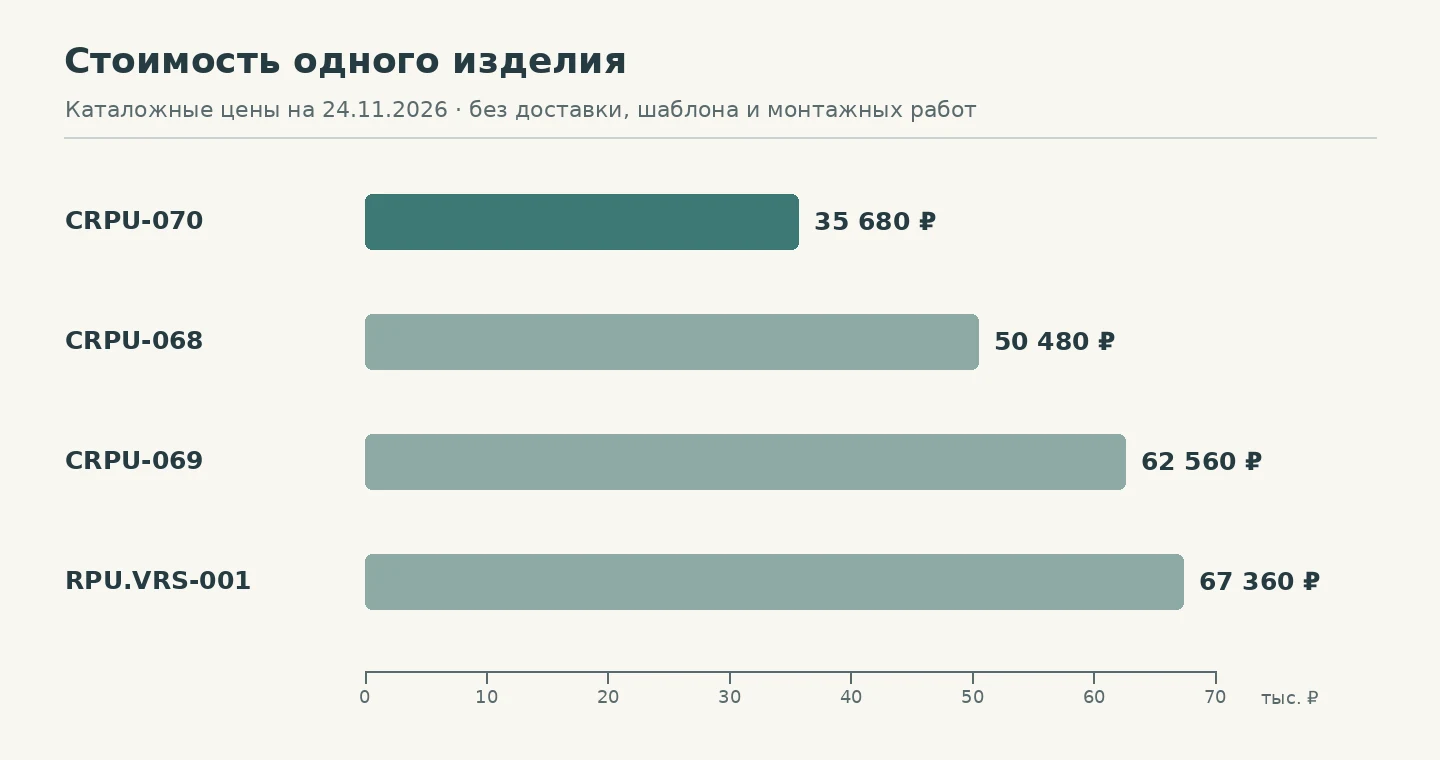
With the chandelier in the same position, CRPU-070 is the most economical preliminarily suitable option. CRPU-069 or RPU.VRS-001 may be favored by a larger composition and a different pattern, if they match the project and the necessary space around the frame remains. Purchasing CRPU-068 would cost less than the two middle models; however, with the adopted geometry, a more detailed check will be required, and in the event of an actual conflict, a project change.
If you need Buy a ceiling rosette for a chandelier within a certain budget, include in the estimate separately the cost of decor, a template if necessary, packaging and transportation, priming and finishing materials, as well as specialist work. Do not set a universal installation cost as a percentage of the item price: the number of elements, ceiling height, condition of the base and complexity of access to the area have an independent impact on labor intensity. The stained glass and the light fixture are not evaluated in our comparison table.
How to place an order with delivery to KhMAO
STAVROS offers Contact us to confirm shipping to your destination. For a buyer from Nizhnevartovsk, it is recommended to start the order by selecting the exact item code, then clarify product availability or the possibility of made-to-order production, packaging, the carrier, and the final delivery cost to the desired location. The receipt time should not be determined solely by the average production time: it may be extended by assembly, preparation for shipment, transportation, and other conditions stipulated by the order.
Before payment, provide the seller with a list of the agreed items. For our example, this is one polyurethane ceiling socket of the selected model, as well as an installation template if it is required and purchased separately. If, at the same time, you are selecting stucco molding in Nizhnevartovsk, it makes sense to coordinate the remaining decorative elements with the overall ceiling plan so that there are no intersections between the cornices, the stained glass frame and the rosette.
When choosing a delivery method, consider the nature of the modular product. The packaging may contain several decorative elements, so the dimensions of the finished composition do not always match the size of the shipped package. Clarify the actual packaging parameters and acceptance conditions. If the installer begins finishing immediately after receiving the goods, first make sure that all parts are complete and match the order, and then set the final work date. This makes it easier to avoid downtime if questions arise regarding the delivery.
Mistakes when choosing a ceiling medallion next to a stained-glass window
- Measuring the distance to the edge of the colored glass instead of the outer contour of the frame. With a protruding surround, the free field will be smaller than planned.
- Using only the living room area to determine the size of the stucco decor. The actual position of the stained-glass window and other elements matters more than the room's average proportion.
- Taking the size of the chandelier body as the size of the ceiling cup. These values can differ greatly, so the suitability of the free center is checked separately.
- Assuming the square dimensions are the exact silhouette of the ornament. For modular compositions, the actual contours are established from the factory drawing.
- Not checking the position of the pattern when rotating it. Even a slight change in orientation can affect the projection of the outer parts toward the frame.
- Trying to hide the overlap by trimming part of the relief. This approach can disrupt the intended design and also complicate further finishing.
- Buying a large item only because of a favorable price. The cost of modifying the ceiling structure may be incomparable to the price difference between the two medallions.
- Assuming a positive geometric clearance guarantees glass maintenance. The required service zone is determined by the actual construction of the stained-glass window.
- Not confirming the completeness of the set and the availability of a mounting template. Without proper marking, it is difficult to assemble a complex pattern in the specified position.
- Use a decorative ceiling medallion as the fixture mount. The chandelier and the stained-glass panel must have their own independent load-bearing mounts provided for them.
Frequently asked questions
Which ceiling medallion should I choose when the distance from the chandelier to the stained-glass panel is 650 mm?
As a first option, consider CRPU-070, measuring 765 × 765 mm. In the adopted symmetrical layout, its outer dimension leaves 267.5 mm to the frame. CRPU-069 and RPU.VRS-001 can also be provisionally placed, but they leave less clearance. All three models require verification of the actual contour and service zone.
Why can't CRPU-068 be ordered right away?
With half the outer dimension at 662.5 mm and a distance of 650 mm, the calculated area extends 12.5 mm beyond the adopted frame line. This is not a final conclusion that every part will collide, but it is sufficient reason to postpone the purchase until the drawing and the position of the composition are verified.
Is CRPU-069 suitable for a room of about 30 m²?
The model measures 910 × 910 mm and can be considered for such a living room. However, the area alone does not determine the suitability of the product. It is necessary to assess the position of the fixture, the stained-glass frame, curtain rods and other obstacles, as well as the pattern and scale of the interior.
How does RPU.VRS-001 differ from CRPU-069?
The outer dimensions are almost identical: 911 and 910 mm respectively. RPU.VRS-001 is made up of eight parts of two types, while CRPU-069 is a more finely divided modular floral composition. In this example, the difference in free field is only half a millimetre, so the character of the ornament and the completeness of the set matter more.
Do I need to order a mounting template?
For some modular sockets, the product pages offer a paper mounting template that must be purchased separately. Please check availability and price for your specific item code. A working diagram helps you align the elements before fixing them in place, which is especially useful near a stained-glass window.
Can a socket be installed flush against a stained-glass window?
There is no universal acceptable gap. You should check the stained-glass structure, protruding profiles, access to fasteners, and the possibility of further finishing. The project must leave space agreed with the specialists who install and maintain the glass insert.
Which stucco color goes best with a stained-glass window?
With bright multicolored glass, a white composition painted to match the ceiling often works well. If the interior requires tinting, first evaluate a sample under daylight and artificial lighting. Use only compatible finishing materials.
Can a chandelier be mounted directly on the socket?
No. The socket is a decorative element and does not replace a load-bearing backing or the fixture's mounting bracket. The electrical installation and mechanical fixing of the chandelier must be carried out by specialists, taking into account the substrate, the weight of the fixture, and the manufacturer's requirements.
Why does a large model cost less than some smaller items?
The price depends not only on the external size but also on the design and composition of the specific item. In the comparison given, CRPU-068 costs 50,480 rubles, CRPU-069 costs 62,560 rubles, and RPU.VRS-001 costs 67,360 rubles. You should choose based on compatibility with the project, and then on budget.
How to order decor with delivery to Nizhnevartovsk?
Open the product page for the selected item, and confirm the current price, package contents, availability or production possibility, packaging, and shipping terms. If necessary, provide the consultant with a ceiling drawing. The final costs and timelines are confirmed when placing the order.


Which STAVROS socket should I buy for a ceiling with a stained-glass insert?
For the living room considered, with a distance of 650 mm from the chandelier axis to the nearest edge of the stained-glass frame, it is reasonable to start with CRPU-070. It has the most compact outer dimensions and the lowest cost among the four options. If a larger floral relief is needed, consider CRPU-069. If you prefer an ornament with fewer large modules, compare it with RPU.VRS-001. Both medium-sized models should be checked against the actual service area of the frame. Leave CRPU-068 for a project where the absence of a conflict with the stained-glass insert has been confirmed.
To make a purchase, prepare a ceiling plan and specify the size of the chandelier cup and the outer boundaries of the frame. Choose a product from the STAVROS ceiling medallion catalog, request a drawing, and agree on the order contents. Once the dimensions are confirmed, you can check the current price and arrange delivery to Nizhnevartovsk. This procedure allows you to achieve an expressive stucco composition without disrupting the carefully considered combination of the light fixture, colored glass, and architectural trim.