Article Contents:
- A rosette is not a trifle
- What is a polyurethane ceiling rosette: material and properties
- Key properties of polyurethane for ceiling rosettes
- When a ceiling rosette is necessary
- How to choose the size of a ceiling rosette: principles and proportions
- Chandelier diameter and rosette diameter
- Room area and rosette diameter
- Ceiling height and visual scale
- Ceiling rosette shape: round, square, oval
- Round rosette — a universal choice
- Square rosette — for strict interiors
- Oval rosette — for elongated spaces
- Rosette relief: from smooth to baroque
- Smooth rosette
- Rosette with moderate relief
- Relief classic rosette
- How to choose a rosette to match the chandelier style: detailed breakdown
- Classic chandelier with crystal or candles
- Modern designer chandelier
- Chandelier in art deco or empire style
- Simple ceiling light or spotlights
- Several chandeliers in a row
- Table: chandelier — socket
- Ceiling socket and ceiling decor system
- Socket + cornice or ceiling molding
- Socket + ceiling stucco
- Socket without perimeter decor
- Dimensions in detail: diameter, relief height, opening
- Diameter
- Relief height
- Central Hole
- Product weight
- How to properly install a ceiling socket: key points
- Preparing the ceiling
- Center Marking
- Adhesive
- Fixation
- Joint sealing
- Sockets and painting: how to do it right
- Medallion matching the ceiling color
- White socket on a colored ceiling
- Gold or gilded socket
- Beige or cream socket
- Socket catalog: what to look for when choosing
- Socket selection checklist
- Socket for each room: specific recommendations
- Living Room
- Bedroom
- Dining Room
- Hallway and corridor
- Hall and grand entrance
- Children's room
- What to buy with a ceiling rosette: complete set
- Five mistakes when choosing a ceiling socket
- Frequently Asked Questions
- About the Company STAVROS
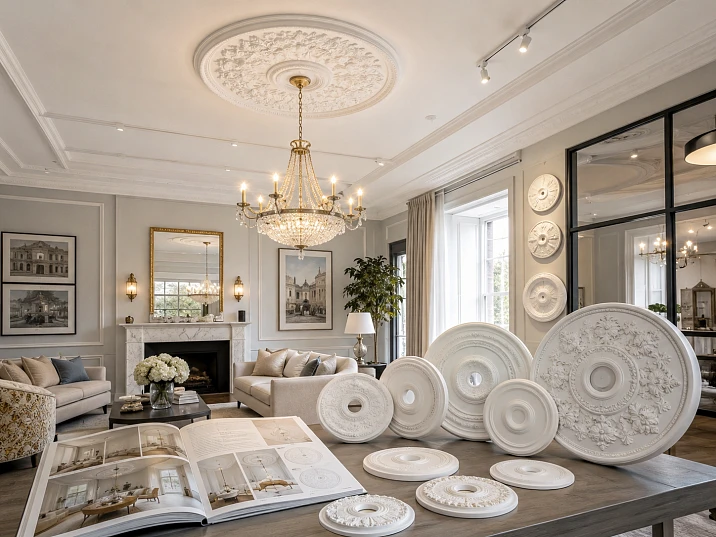
A polyurethane ceiling socket makes the chandelier part of the ceiling architecture: the right diameter, shape, relief, and painting help connect the light fixture to moldings, cornices, and overall stucco, rather than leaving it as a lonely spot on a white ceiling. It's a small element — but it determines whether the ceiling looks finished or unfinished.
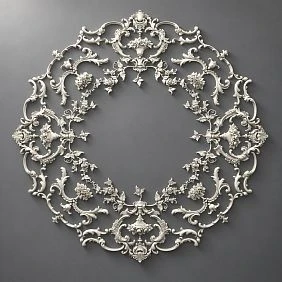
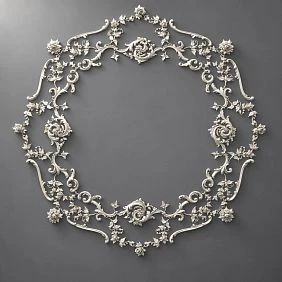
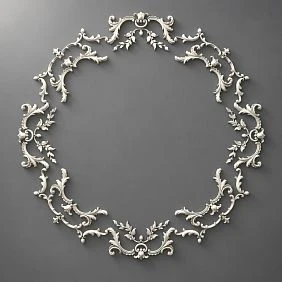
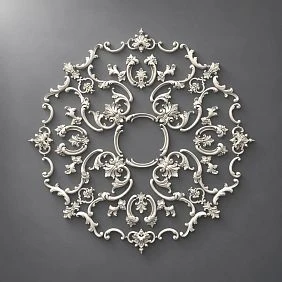
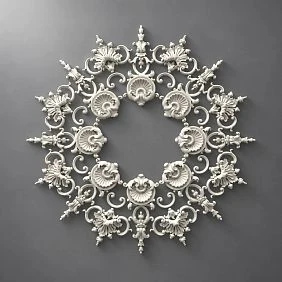
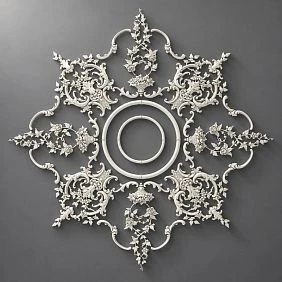
A rosette is not a trifle
Look at the ceiling without a rosette. A chandelier hangs. The cord goes up. The mounting plate or cup disappears into the white space. And that's it. The ceiling is empty. The chandelier is on its own.
Now imagine the same chandelier, but around the mount there is a neat decorative circle with an ornament. The relief echoes the theme of the cornice. The diameter is proportionate to the chandelier. The paint matches the ceiling color or is slightly more contrasting.
This is a different interior. The ceiling has become architectural. The chandelier is an element of the system, not a suspended fixture.
This is exactly how a polyurethane ceiling rosette works. And that is why its selection requires no less attention than the selection of the chandelier itself.




What is a polyurethane ceiling rosette: material and properties
Polyurethane ceiling rosettes are made from rigid polyurethane — a lightweight, durable synthetic material that accurately reproduces complex ornaments and reliefs. This is not the plaster of Soviet times, not the foam that crumbles at a touch. It is a modern material with precise casting and a durable structure.
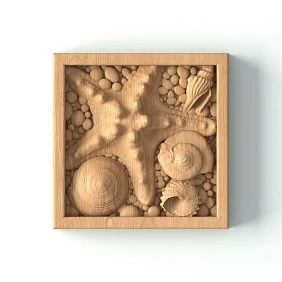
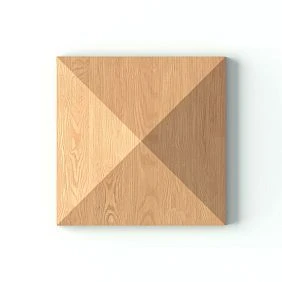
Our factory also produces:
Key properties of polyurethane for ceiling rosettes
Lightness. A polyurethane rosette weighs several times less than a plaster one of the same diameter. This is critical for the ceiling: a heavy element requires additional mechanical fastening, a light one holds securely on mounting adhesive.
Precision of relief. Polyurethane is cast in molds with high detail. Thin leaves, ornaments, beads — everything is reproduced clearly, without loss of detail.
Moisture resistance. Unlike plaster, polyurethane does not deteriorate from humidity fluctuations. This makes it suitable not only for living rooms and bedrooms, but also for hallways, corridors, and dining rooms.
Paintability. Polyurethane polyurethane rosettes can be painted with any water-based paint after installation. You can match it with the ceiling, with moldings, create contrast — any solution is available.
Ease of installation. Installation with mounting adhesive — no ceiling drilling, no complex preparation. The rosette is glued, fixed until dry, then painted.
Get Consultation
When a ceiling rosette is necessary
There are situations where a ceiling rosette is not a whim, but a logical architectural solution.
Classic, neoclassical, art deco interior. In these styles, a ceiling without a rosette under the chandelier looks unfinished. The rosette is an organic part of the classic decor system.
Ceiling with moldings or cornice. If there is Ceiling molding or cornice around the perimeter of the ceiling, the rosette in the center completes the system. The perimeter is decorated, the center is decorated, the ceiling becomes unified.
Large chandelier on a white ceiling. A large multi-tiered chandelier without a rosette looks "suspended." A rosette of the correct diameter "receives" the chandelier and connects it to the ceiling.
The ceiling seems too simple. One decorative element in the center — a rosette — can radically change the perception of the ceiling without renovation.
You need to hide the mounting area. If the chandelier mounting spot is unsightly for some reason — a putty mark, a stain — the rosette covers it.
How to choose the size of a ceiling rosette: principles and proportions
The size question is the most frequently asked. And the most frequently violated when choosing. People pick a rosette "bigger" or "by eye" — and end up with either an overloaded ceiling or a lost small circle under a huge chandelier.
Chandelier diameter and rosette diameter
Basic rule: the diameter of the rosette is from 1 to 1.5 times the diameter of the chandelier (more precisely, its upper mounting part or canopy).
If the chandelier canopy is 15 centimeters, the rosette is from 25 to 45 centimeters. The rosette "frames" the canopy, neither blending with it nor getting lost.
If the chandelier is large — the mounting part diameter is 25–30 centimeters — the rosette can be 40–60 centimeters.
Room area and rosette diameter
| Room area | Recommended rosette diameter |
|---|---|
| Up to 12 m² | 25–35 cm |
| 12–20 m² | 35–50 cm |
| 20–30 m² | 45–65 cm |
| 30–50 m² | 55–80 cm |
| More than 50 m² | from 70 cm and more |
Ceiling height and visual scale
With a low ceiling (up to 2.5 meters), the rosette should be small — not only in diameter but also in relief height. A high relief on a low ceiling visually lowers it. Choose rosettes with a low, delicate ornament.
With a ceiling of 3 meters or higher — you can afford a large rosette with an expressive ornament. It does not overwhelm but decorates.
Ceiling rosette shape: round, square, oval
Round rosette — a universal choice
Round polyurethane rosette — the most common option. It suits most chandeliers and any room geometry. The circle is a neutral shape: it does not conflict with a rectangular room or a chandelier of any shape.
In a classic interior — a relief round rosette with an ornament of acanthus, leaves, curls. In a modern one — smooth or with minimal relief. In a Scandinavian one — a simple, almost flat round shape.
Square rosette — for strict interiors
A square ceiling rosette is a rarer and more "characterful" option. It is organic in strict classic interiors with clear geometry, in Empire or Art Deco style. The square shape requires symmetry: if the ceiling is regular and the chandelier is centered, a square rosette looks architecturally precise.
A square rosette works poorly if the chandelier is offset from the center or the room is of an irregular shape.
Oval socket — for elongated spaces
The oval shape is rare, but striking above a long dining table, in a gallery hallway, or in an elongated living room with multiple light points. The oval follows the shape of the space — a visually intelligent solution.
Socket relief: from smooth to baroque
Relief is the character of the socket. It determines how actively the socket 'speaks' in the interior.
Smooth rosette
Almost flat profile, minimal relief — a circle with a chamfer or simple band. For modern interiors, minimalism, Scandinavian style. Such a socket adds structure without adding a 'historical' note.
Socket with moderate relief
Even ornament — petals, simple leaves, geometric elements. For neoclassicism, modern classic. This is the 'golden mean': you can see there is decor, but it does not dominate.
Relief classic socket
Acanthus, grape leaves, scrolls, rocailles — for a full classical or baroque interior. Such a socket only works in pair with a matching chandelier and matching stucco around the ceiling perimeter.
Mistake: placing a relief baroque socket in a room with modern furniture and a simple chandelier. The style conflict will be obvious.
How to choose a ceiling medallion to match your chandelier style: a detailed breakdown
A chandelier and a ceiling medallion are a pair. They must speak the same language.
Classic chandelier with crystal or candles
For this chandelier — a relief medallion with ornament. Crystal 'demands' richness of relief around it. Diameter — significant, ornament — classic. A medallion with acanthus leaves, scrolls, or floral motifs.
Modern designer chandelier
For a minimalist light fixture — a smooth or low-relief medallion. Otherwise, the decorative medallion will 'overshadow' the chandelier's design. Simple circle, minimal profile, monochrome.
Chandelier in Art Deco or Empire style
A medallion with geometric ornament — rays, concentric circles, symmetrical geometric pattern. A square shape is also possible.
Simple ceiling light or spotlights
For a simple light fixture, a medallion is not needed at all, or the most minimalist one is needed — as a light framing of the mounting area.
Several chandeliers in a row
If there are several chandeliers in a room — several small identical rosettes. They form a rhythmic sequence on the ceiling. The size of each is proportionate to the individual light fixture, not the entire group.
Table: chandelier — rosette
| Chandelier type | Recommended rosette |
|---|---|
| Classic crystal | Relief, large, with ornament |
| Modern minimalist | Smooth or with minimal relief |
| Art Deco, Empire | Geometric pattern, possibly square |
| Provencal, wrought iron | Moderate classic ornament |
| Scandinavian, minimalist | Smooth round |
| Multiple spots | Small identical rosettes for each |
| Large chain chandelier | Large relief, diameter from 50 cm |
Ceiling rosette and ceiling decor system
The rosette is not a standalone element. It is part of the ceiling decor system. The better it fits into this system, the more professional the result looks.
Socket + cornice or ceiling molding
Cornice around the ceiling perimeter + socket in the center = classic scheme. The perimeter and center are decorated. The ceiling is complete.
For the system to work, the ornament of the socket and cornice must be consistent in style. Not necessarily identical motifs — but one stylistic 'language': both classic, both modern, both in the same degree of relief.
Moldings made of polyurethane for the ceiling perimeter + socket from the same collection — a ready-made system.
Socket + ceiling stucco
If there are Ceiling molding — decorative elements, medallions, corner overlays — the socket is the central element of this system. It should be the most noticeable, the most expressive point on the ceiling.
Socket without perimeter decor
If there is no cornice, no moldings — the socket works as a single accent. In this case, it should be expressive enough to carry the entire decorative load of the ceiling center.
Dimensions in detail: diameter, relief height, opening
Before ordering, you need to check several technical parameters.
Diameter
Main parameter. Measured in centimeters along the outer edge. Standard range in the catalog buy polyurethane rosettes — from 15–20 cm (small) to 80–100 cm (large exhibition ones).
Relief height
Distance from the plane adjacent to the ceiling to the highest point of the relief. For low ceilings — no more than 25–30 mm. For high ceilings — up to 60–80 mm.
Central hole
Most rosettes have a central hole for a hook or chandelier tube. Standard diameter — 25–35 mm. Check that it matches the diameter of your chandelier's mounting element.
If the rosette has no hole, it needs to be drilled before installation.
Product weight
A polyurethane rosette with a diameter of 50 centimeters typically weighs 200–400 grams. This is significantly less than a plaster counterpart. It holds securely with standard glue. If the weight exceeds 600–700 grams, additional mechanical fastening (a dowel in the central hole) is recommended.
How to properly install a ceiling rosette: key points
Installing a ceiling rosette is a simple task. But there are nuances that determine the quality of the result.
Ceiling preparation
The surface must be clean, dry, and dust-free. If the ceiling is freshly painted, allow the paint to dry completely (at least 24 hours).
Center marking
Find the geometric center of the ceiling or the center of the light fixture location. Mark it with a pencil. The rosette should be centered relative to the light fixture, not the ceiling — if the light fixture is offset from the geometric center.
Adhesive
For installing polyurethane rosettes — use a special mounting adhesive for polyurethane (e.g., "Liquid Nails" or specialized polyurethane glue). Apply it along the perimeter of the back side of the rosette — not in a continuous layer, but in a "zigzag" or dots.
Fixation
After applying the adhesive, press the rosette against the ceiling, hold for 1–2 minutes, then additionally secure with painter's tape for 30–60 minutes until initial bonding.
Joint sealing
Fill the gap between the edge of the rosette and the ceiling with white acrylic sealant, smooth it with your finger, and let it dry. After sanding — paint.
Detailed installation technique — in the article about installation of polyurethane molding.
Rosettes and painting: how to do it right
Polyurethane rosettes are sold in a white "primed" finish — ready for painting.
Rosette in the color of the ceiling
The most common option. The rosette is painted with the same paint as the ceiling. It reads in the relief, creates a shadow under side lighting, but does not create a color contrast. Delicate and professional.
White rosette on a colored ceiling
If the ceiling is colored (dark blue, green, anthracite — popular solutions in modern interiors) — a white rosette becomes an accent. It stands out, attracts attention, and "activates" the chandelier in the decorative system.
Gold or gilded rosette
For a classic or baroque interior — the rosette can be coated with gold paint or wax. This creates a rich, saturated accent. Important: such a solution requires a matching chandelier and cornice in the same color scheme.
Beige or cream rosette
For interiors in warm tones — a rosette in ivory, beige, or cream. It is slightly "warmer" than a white ceiling but does not create a harsh contrast.
Catalog of rosettes: what to pay attention to when choosing
When you open the catalog of polyurethane ceiling rosettes, there are dozens of items before your eyes. How not to get lost?
Socket selection checklist
-
Determine the diameter using the formula (see the section on sizes);
-
Choose the shape — round, square, oval;
-
Determine the degree of relief by the interior style;
-
Check the relief height — is it proportionate to the ceiling?
-
Ensure the pattern matches the style of the chandelier;
-
Check the central hole — does it fit the chandelier's mounting?
-
Clarify the weight — will additional mechanical fastening be required?
-
Check the style compatibility with the cornice or moldings, if present.
Socket for each room: specific recommendations
Living Room
The living room is the main room. A large, expressive rosette with rich ornamentation is acceptable here. Diameter — 50–70 centimeters for an area of 20–30 m². Relief — moderate or active. Ornament — classic or geometric.
Bedroom
The bedroom requires delicacy. The rosette here is calm, not large. The ornament is soft, without heavy baroque forms. Diameter — 30–45 centimeters. Painting — in the color of the ceiling or slightly warmer.
Dining Room
In the dining room, the chandelier above the table is the central element. The rosette is proportionate and well-readable. If the interior is in Provencal or Italian style — a rosette with leaves, grapevines. If Art Deco — a geometric ornament.
Hallway and corridor
The hallway is the first space that greets you. Here, a small elegant rosette under a compact light fixture adds a touch of classic style. Diameter — 25–35 centimeters.
Hall and grand foyer
The hall is a place for expressive solutions. A large rosette, rich relief, possibly gilding. Diameter — 60–100 centimeters. Ornament — as expressive as possible.
Children's room
In the children's room — a simple smooth rosette or one with a soft floral ornament. Not large, delicate. Possibly coated with paint "in color" — for example, soft pink or blue.
What to buy together with the ceiling rosette: complete set
| Position | Purpose |
|---|---|
| ceiling rose made of polyurethane | main decorative element |
| Mounting adhesive for polyurethane | ceiling mounting |
| Painter's tape | fixation while drying |
| White acrylic sealant | sealing joints |
| Fine sandpaper 220 | sanding joints |
| Acrylic paint | painting in the color of the ceiling |
| Ceiling molding | ceiling decor |
| Moldings made of polyurethane | cornice around the ceiling perimeter |
| Decorative stucco | corner covers, medallions |
Five mistakes when choosing a ceiling rosette
Mistake 1: Too small rosette under a large chandelier. The rosette gets lost, the chandelier "hovers" over emptiness. The proportion is broken.
Mistake 2: Too large rosette on a low ceiling. The rosette "presses down", the ceiling visually lowers.
Mistake 3: Baroque ornament in a modern interior. The stylistic conflict is glaring and looks unprofessional.
Mistake 4: The rosette ornament does not match the style of the cornice. The perimeter in one style, the center in another — the ceiling turns into a "mishmash".
Mistake 5: Rosette without checking the central hole. The purchased rosette does not fit the chandelier mount — the hole is too small or too large. It should have been checked in advance.
Frequently asked questions
How to choose the size of a ceiling rosette?
Focus on the chandelier canopy diameter (rosette 1.5–2 times larger), room area, and ceiling height. For a room of 15–20 m² — rosette 35–50 cm. For a room of 25–30 m² — 50–65 cm.
What types of polyurethane rosettes are there?
Round, square, oval. By relief: smooth, with moderate ornament, classic embossed. By diameter: from 15 to 100 centimeters and more.
Can a polyurethane ceiling rosette be painted?
Yes, definitely. Rosettes are sold in a white primed finish. After installation, they are painted with any water-based paint — to match the ceiling color, in a contrasting color, or in gold.
How is a ceiling rosette attached?
With mounting adhesive for polyurethane. Until it dries — additional fixation with painter's tape. If the weight exceeds 600–700 g, mechanical fastening through the central hole is recommended.
Is a cornice or molding needed together with the rosette?
Not necessarily, but it is advisable. A rosette in the center and a cornice around the perimeter is a classic scheme for a finished ceiling. If there is no cornice, the rosette works as a standalone decorative accent.
Are polyurethane rosettes suitable for the kitchen or bathroom?
For the kitchen — yes, provided there is good ventilation. For the bathroom — not recommended: constant high humidity can damage the adhesive bond.
Where to buy polyurethane ceiling rosettes?
The STAVROS catalog features a full range ceiling fixtures made of polyurethane of different diameters, shapes, and ornaments.
About the company STAVROS
The ceiling is the fifth wall in the room. And it deserves the same attention as the other four. A ceiling rosette is a small but essential element that connects the chandelier to the ceiling architecture and makes the interior complete.
STAVROS is a Russian manufacturer and supplier of decorative polyurethane products. The company's catalog includes: polyurethane rosettes all formats — from compact and delicate to large and expressive, Ceiling molding, Polyurethane moldings and cornices, Decorative stucco for walls and ceilings, as well as the entire range polyurethane products for professional and home decor.
STAVROS means precision casting, reliable material, a wide range, and expertise in decorative finishing. Each rosette in the catalog is a ready-made architectural solution that just needs to be correctly chosen and carefully installed.