Article Contents:
- Lightness: revolution in installation and expanded possibilities
- Geometric stability: unchanging shape over time
- Moisture resistance: freedom of application in any room
- Use in kitchen: grease, steam, odors
- Use in bathroom: humidity, condensation, direct contact with water
- Temperature fluctuations: stability under extreme conditions
- Comparison with gypsum: objective assessment
- Practical recommendations for selection and use
- Conclusion
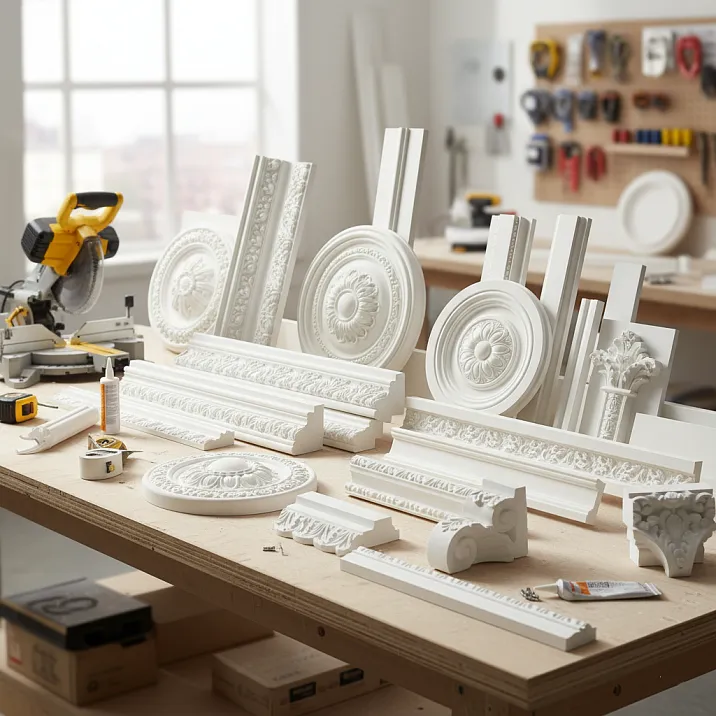
The choice of material for moldings determines not only the aesthetics of the interior, but also the practicality of use for decades ahead. Gypsum moldings — classic, surrounded by an aura of aristocracy, but demanding conditions. It fears moisture, is heavy, brittle, fussy during installation. Wooden moldings are noble, but expensive, prone to deformation, require constant care. Polystyrene is cheap, but looks cheap, lacks strength, quickly loses its appearance.
Polyurethane revolutionized the world of moldings, combining the best qualities of traditional materials and eliminating their shortcomings. It is as light as polystyrene, but as strong as gypsum. It is moisture-resistant like plastic, but visually indistinguishable from stone. Geometrically stable like metal, but as easy to process as wood. This is not a compromise between conflicting requirements, but a synthesis of advantages, creating a material close to ideal for interior decoration.
Three key properties makepolyurethane moldinga universal solution for any room: lightness, geometric stability, moisture resistance. Each of these properties is critical for specific tasks, but their combination opens possibilities unattainable by other materials. Lightness simplifies installation, reduces load on load-bearing structures, allows decorating gypsum board partitions and stretch ceilings. Geometric stability guarantees that elements retain their size and shape regardless of climatic conditions during operation. Moisture resistance expands the application scope to kitchens, bathrooms, swimming pools — spaces where traditional gypsum moldings are doomed to rapid deterioration.
Polyurethane is a synthetic polymer obtained by the reaction of polyols with isocyanates. The production technology allows controlling the material's density from 150 to 420 kg/m³, creating products ranging from lightweight decorative to high-strength structural. For moldings, the optimal density is 180-250 kg/m³ — a balance between strength, weight, and cost-effectiveness.
In this article, we will thoroughly examine three key advantages of polyurethane moldings. You will learn exact weight figures compared to gypsum, understand the mechanisms of geometric stability under temperature fluctuations, and receive practical recommendations for use in kitchens and bathrooms. The information is based on material technical specifications, long-term application experience, and real-world experience under various climatic conditions.


Lightness: revolution in installation and expanded possibilities
The weight of a decorative element determines the complexity of installation, requirements for the load-bearing capacity of the base, and safety during operation. Gypsum moldings are heavy — a linear meter of a 150 mm wide cornice weighs 3-5 kilograms. A similar polyurethane cornice weighs 300-500 grams, 10 times lighter.
Mathematics is impressive. For a room with a 20-meter perimeter, 20 meters of cornice are required. A gypsum version weighs 60-100 kg in total. A polyurethane version weighs 6-10 kg. The 90 kg difference is a load borne by the walls. For load-bearing walls, this is insignificant, but for gypsum board partitions, it is critical. Gypsum board withstands a load of up to 15 kg per linear meter without reinforcing the frame. Gypsum moldings require embedded elements, profile reinforcement, and additional mounting points. Polyurethane can be glued with ordinary glue without reinforcement — its weight is within the load-bearing capacity of standard construction.
Retrofitting demonstrates the difference even more vividly. A gypsum rosette with a diameter of 800 mm weighs 8-12 kg. Installing such a weight on a ceiling creates a critical load — the adhesive must hold the mass acting vertically downward. Additional mechanical fastening with screws or anchors is required, complicating installation and leaving visible mounting points requiring concealment. A polyurethane rosette of the same diameter weighs 800-1200 grams, 10 times lighter. Specialized polyurethane adhesive holds such a weight without additional fasteners — adhesive adhesion of 1.5-2 MPa is sufficient with a significant safety margin.
Transportation and storage are simplified proportionally to the reduction in weight. A box with 10 polyurethane cornice strips (20 linear meters) weighs 5-7 kg — one person can carry it without effort. The same quantity of gypsum cornices weighs 60-80 kg, requiring two laborers, and the risk of damage during loading/unloading is significantly higher. Delivery cost depends on weight — lightweight polyurethane is cheaper in logistics.
Installation by one person is a reality for polyurethane moldings. Installing a 2-meter-long cornice on a ceiling alone is possible due to its low weight — the element can be held with one hand while the other adjusts its position and presses it against the surface. A gypsum cornice of the same length requires a partner — one holds it while the other adjusts and secures it. For a homeowner performing repairs alone, this is a critical advantage.
Safety during operation increases with reduced weight. In case of detachment (due to improper installation technique or deformation of the base), the fall of a lightweight polyurethane cornice does not create a hazardous situation. The fall of a heavy gypsum element may cause serious injuries, especially if someone is underneath. This is particularly relevant for children's rooms, where safety is paramount.
Stretch ceilings become suitable for molding decoration due to the low weight of polyurethane. Stretch fabric lacks a rigid base and cannot withstand loads. Physically, gypsum moldings on stretch ceilings are impossible. Polyurethane cornices and rosettes are mounted on special embedded elements installed before the fabric is stretched, or on the wall with visual alignment to the ceiling. The weight of the elements is so low that it does not create tension in the fabric.
The density of polyurethane varies depending on the manufacturer and the intended use of the product. Budget series have a density of 150-180 kg/m³ — maximum lightness with sufficient strength for most applications. Premium series — 220-250 kg/m³ — increased strength while maintaining lightness relative to gypsum. Facade products — 250-350 kg/m³ — maximum strength for outdoor applications.
Comparison with other materials highlights the advantage. Polystyrene is lighter than polyurethane (density 25-35 kg/m³), but its strength is insufficient — elements easily break, deform, and cannot maintain clear geometry. Wood is heavier (density 400-800 kg/m³), comparable to gypsum in weight. Polyurethane — optimal balance of lightness and strength.




Geometric stability: unchanging shape over time
Geometric stability — the ability of a material to maintain its dimensions and shape under changes in temperature, humidity, and mechanical loads. Unstable materials expand when heated, contract when cooled, swell when moistened, and shrink when drying. This creates stresses in the structure, leading to cracks, delamination, and deformation.
Gypsum is hygroscopic — it absorbs moisture from the air. When humidity increases, gypsum moldings absorb water, increasing in volume by 0.1-0.3%. When drying, they return to their original dimensions, but with microcracks from internal stresses. Cycles of moistening and drying gradually destroy the material. In rooms with unstable humidity (kitchens, bathrooms, unheated cottages), gypsum moldings last 5-10 years until critical damage occurs.
Wood reacts even more strongly to humidity — dimensional changes reach 3-8% when air humidity fluctuates from 40% to 80%. Wooden moldings in a heated home shrink in winter and swell in summer. This creates gaps at joints in winter and bulges in summer. Wood stabilization (drying, impregnation) reduces fluctuations to 1-2%, but does not eliminate them completely.
Polyurethane is hydrophobic — does not absorb water. Water absorption coefficient is less than 1% by mass after 24 hours of immersion. Under real operating conditions, polyurethane moldings do not change dimensions when humidity fluctuates from 20% to 90%. This is critical for bathrooms, where humidity fluctuates from 40% (after airing) to 90% (during shower).
Polyurethane has minimal thermal expansion — linear expansion coefficient 0.00015–0.0002 per 1°C. For an element 2 meters long, with a temperature change of 20°C (from +10°C in winter to +30°C in summer), expansion will be 0.6–0.8 mm. This is compensated by the elasticity of the adhesive joint and is visually imperceptible.
Operating temperature range of polyurethane moldings — from -60°C to +100°C without loss of properties. This covers any conditions in residential and public spaces. Moldings on an unheated country house will withstand frost down to -40°C. Moldings on a kitchen near a stove will withstand localized heating up to +60–80°C without deformation.
Manufacturers indicate an upper temperature limit of +100–120°C for interior items, +300°C for special heat-resistant compositions (used near fireplaces and stoves). The lower limit of -60°C guarantees applicability in the most severe climatic zones.
Shape stability under mechanical loads is ensured by the polymer structure. Polyurethane combines hardness (does not deform under pressure) and elasticity (restores shape after localized impact). Gypsum is hard but brittle — impact creates chips and cracks. Polystyrene foam is soft — it retains dents from accidental contact. Polyurethane absorbs impact, distributes stress, and returns to its original shape.
Preservation of ornament geometry is critical for aesthetics. Fine relief details — leaves, scrolls, beads — must remain sharp for decades. Gypsum gradually flakes and loses detail. Polystyrene foam compresses, smoothing the relief. Polyurethane maintains sharp edges and consistent relief depth throughout its service life.
Stability testing includes heating-cooling, wet-drying, and mechanical impact cycles. High-quality polyurethane moldings withstand 100 temperature cycles from -20°C to +60°C without cracks or deformation. 50 wet-drying cycles up to 95% humidity and down to 30% without dimensional changes. 20 impacts with 5 J energy without visible damage.
Company STAVROS suppliespolyurethane moldingDensity of 180–220 kg/m³, providing optimal balance of lightness, strength, and stability. Items undergo quality control ensuring dimensional accuracy ±1 mm per 2 meters length.
Our factory also produces:


Moisture resistance: freedom of application in any room
Moisture resistance — the ability of a material to retain its properties upon contact with water and water vapor. Hygroscopic materials (gypsum, wood) absorb moisture, swell, lose strength, and become a medium for mold and fungi. Hydrophobic materials (polyurethane, plastics) do not absorb moisture, retain shape and strength.
The moisture resistance mechanism of polyurethane — a closed molecular polymer structure. Polyurethane molecules form a dense network with no pores accessible for water penetration. Water beads and rolls off the surface without absorption. Even with prolonged contact (immersion in water for 24 hours), water absorption does not exceed 1% by mass, and this moisture concentrates in a surface layer 0.1–0.2 mm thick.
Comparison with gypsum shows a fundamental difference. Gypsum absorbs 5–15% water by mass within 24 hours of immersion. During this time, strength drops by 30–50%, and dimensions increase by 0.2–0.5%. After drying, gypsum does not fully return to its original state — microcracks remain, reducing strength. Several wet-dry cycles destroy gypsum moldings.
Wood absorbs 10–30% water depending on species. Swelling reaches 5–10% across fibers. Wooden moldings in humid rooms deform, warp, and crack. Protective coatings (varnish, paint) slow the process but do not stop it — moisture penetrates through coating microcracks and end surfaces.
Biological resistance of polyurethane — a result of its moisture resistance. Mold, fungi, and bacteria require moisture to develop. Polyurethane does not absorb moisture, does not create a nutrient medium for microorganisms. Gypsum in humid environments becomes covered with mold within months. Wood is attacked by fungi, mold, and rot. Polyurethane remains biologically inert for decades even at 90–95% humidity.
Cleaning polyurethane moldings is simplified due to moisture resistance. The surface can be washed with water and cleaning agents without risk of damage. Gypsum moldings cannot be washed — water is absorbed, leaves stains, and destroys the material. Only dry cleaning with a soft brush or vacuum cleaner is permitted. Polyurethane withstands wet cleaning with any frequency.
Condensation — enemy of gypsum moldings. In rooms with temperature fluctuations (cold exterior walls in winter), condensation forms on surfaces. Gypsum molding on a cold wall absorbs condensation, swells, and flakes off. Polyurethane molding on the same wall remains dry — condensation runs off without absorption.
Polyurethane's vapor permeability is low — vapor permeability coefficient 0.05–0.08 mg/(m·h·Pa). This means polyurethane molding does not allow water vapor to pass through. For walls, vapor permeability is important to allow moisture release from the structure. But molding is a surface decorative element not involved in wall moisture exchange. Low vapor permeability does not create problems.
Service life of polyurethane molding in humid rooms — 25–30 years without loss of properties. Gypsum — 5–10 years with regular ventilation, 2–3 years under constant high humidity. The economics are clear — polyurethane lasts 3–5 times longer, requiring no replacement, restoration, or special maintenance.
Get Consultation
Operation in the kitchen: grease, steam, odors
Kitchen — a room with extreme conditions for decorative materials. High humidity during cooking (up to 80–90% near the stove), temperature fluctuations (from +15°C near windows in winter to +35–40°C near the stove), grease vapors settling on all surfaces, and odors penetrating porous materials.
Gypsum molding in the kitchen is doomed. Humidity causes swelling-shrinking cycles, creating microcracks. Grease settles in gypsum pores, penetrates, and cannot be removed. Within one to two years, gypsum molding on the kitchen turns yellow from grease, darkens, and develops stains. Wet cleaning is impossible — water destroys gypsum. Dry cleaning is ineffective — grease cannot be removed with a brush.
Polyurethane molding in the kitchen lasts for decades. The smooth, non-porous surface does not absorb grease — it settles as a thin film, easily removed during wet cleaning. Cleaning agents (soap solution, dishwashing detergent) completely remove grease, restoring the molding’s original whiteness.
Temperature stability is critical near the stove, wherePolyurethane cornicessurfaces can heat up to +50–60°C during intensive cooking. Polyurethane retains shape and strength at these temperatures. Deformation begins at +100–120°C, which is unreachable under normal kitchen operating conditions.
Odors are not absorbed by polyurethane due to its closed structure. Kitchen odors (fried food, spices, fish) remain in the air, dissipate with ventilation, and do not linger in the molding. Gypsum and wood are porous, absorb odors, which then release over months, creating an unpleasant background.
Cleaning frequency for polyurethane molding in the kitchen — every 1–3 months depending on cooking intensity. Cornices and moldings are wiped with a damp cloth and cleaning agent, rinsed with clean water, and dried. The procedure takes 15–20 minutes and requires no special skills.
Painting polyurethane molding in the kitchen is recommended with washable paints — latex or acrylic with enhanced abrasion resistance. These paints form a dense, smooth film, further simplifying cleaning. Matte paints absorb grease more than glossy ones, but look more elegant. Semi-gloss (satin) — a compromise between aesthetics and practicality.
Placement of molding in the kitchen considers functional zones. Molding is not placed directly above the stove — temperatures are too high and grease concentration is too great. Cornices along the ceiling perimeter, moldings on walls outside the working zone, and door frame trim — standard solutions. In the dining zone, more elaborate compositions are possible — panels on walls, a ceiling rose above the table.
Color solution for the kitchen is practical in light tones. White or light beige molding hides grease residues better than dark tones. Dark contrasting molding is striking but requires more frequent cleaning — even minor dirt is visible.
Kitchen ventilation is critical for longevity of any materials. The range hood above the stove removes humid air with grease vapors, reducing pollutant concentration. With good ventilation, even gypsum molding lasts longer. But polyurethane remains stable even with poor ventilation — moisture and grease do not absorb, and are easily removed.
Service lifepolyurethane moldingService life of molding in the kitchen — 20–30 years with regular cleaning. Gypsum — 3–7 years with gradual degradation. Replacing gypsum molding every 5 years costs more than installing polyurethane molding once for 25 years.
Bathroom use: humidity, condensation, direct contact with water
The bathroom is the most humid room in the apartment. During a shower, humidity reaches up to 95%, temperature +30-35°C. Condensation settles on all cold surfaces — walls, ceiling, plaster. Direct water splashes hit the walls and ceiling near the shower enclosure and bathtub.
Gypsum plaster in the bathroom is a technical error. Moisture is absorbed within hours, gypsum swells, loses strength, and peels off the base. Mold appears within 2-3 months of use — black or green spots in corners, at joints, in recesses of the ornament. Mold spores are hazardous to health, especially for allergy sufferers and asthmatics. Removing mold from gypsum is impossible — it penetrates deep into the material, and antiseptic treatment only provides temporary effect.
Polyurethane plaster in the bathroom lasts for decades without problems. Moisture is not absorbed, condensation drips off and dries within an hour after water procedures. Mold does not form — there is no nutrient medium. The surface remains white, clean, without stains or deposits.
Direct contact with water does not damage polyurethane. Splashes from the shower hitting theCeiling corniceor wall molding, drip off without leaving traces. You can wash the plaster with a stream of water from the showerhead — this is an effective way to clean off soap scum and lime deposits.
Ventilation in the bathroom is critical for humidity control. An exhaust fan, which turns on simultaneously with the light or runs continuously on low power, removes humid air, reducing humidity to 50-60% within 30-60 minutes after a shower. With good ventilation, even wooden furniture in the bathroom lasts for years. Polyurethane plaster remains stable even without ventilation, but drying the room reduces overall humidity, making it more comfortable for residents.
Temperature fluctuations in the bathroom are significant — from +15-18°C (cold wall in winter before heating) to +35-40°C (hot humid air during a shower). Difference of 20-25°C. Polyurethane expands by 0.3-0.5 mm per 2-meter element — insignificantly, compensated by the elasticity of the adhesive joint.
Chemical resistance of polyurethane is important in the bathroom, where cleaning agents are used. Chlorine-containing cleaners, acidic cleaners, alkaline compositions do not damage polyurethane during brief contact. Plaster withstands cleaning with any household products, except abrasive powders (scratch the surface) and solvents (acetone, white spirit may soften the polymer with prolonged contact).
Plaster in the bathroom is painted with moisture-resistant paints — latex for humid areas, acrylic with antibacterial additives. These paints form a moisture-impermeable film that prevents microbial growth. Repainting frequency — 5-7 years, when the paint loses its initial gloss.
Placement of plaster in the bathroom is not limited. Cornice along the ceiling perimeter,Baseboardsalong the floor perimeter (if the floor is not flooded with water), moldings on walls, mirror frame — any compositions are possible. In areas of direct water impact (shower enclosure wall), plaster is mounted above the showerhead level or protected by a glass partition.
Swimming pools, saunas, hammams — spaces with extreme humidity 80-100% constantly. Polyurethane plaster is applicable here too. In swimming pools, decorative zones are used for relaxation, walls above the waterline. In saunas — relaxation rooms, verandas (in the steam room, temperature +80-100°C, polyurethane softens, special heat-resistant plaster or wood is used). In hammams at +40-50°C and 100% humidity, polyurethane plaster is used without restrictions.
Service life in the bathroom — 25-30 years with regular cleaning every 1-2 months. Gypsum plaster in the bathroom — 1-3 years until critical mold damage and peeling. Polyurethane proves its economic efficiency here too.
Temperature fluctuations: stability under extreme conditions
Temperature fluctuations — reality of operation in different climatic zones and types of rooms. Heated apartment in winter — +20-25°C. Unheated dacha in winter — down to -20-30°C. Summer heat on the attic — up to +50-60°C. Temperature difference between winter and summer reaches 80-90°C.
Materials react to temperature by changing dimensions (thermal expansion) and properties (softening when heated, brittleness when cooled). Coefficient of linear thermal expansion (CLTE) shows the change in length per 1 meter for a 1°C temperature change.
CLTE of polyurethane — 0.00015-0.0002 1/°C. For a 2-meter element with a 50°C temperature change (from -10°C in winter to +40°C in summer), expansion will be: 2000 mm × 0.00015 × 50 = 1.5 mm. This is the minimum value, visually insignificant, easily compensated by the elasticity of the adhesive joint.
CLTE of gypsum — 0.000018 1/°C, 8-10 times less than polyurethane. Apparently, gypsum’s advantage. But gypsum is brittle — when the base (concrete, wood) expands, gypsum plaster does not deform along with the base, but cracks at rigidly fixed points. CLTE of wood — 0.00003-0.00008 1/°C across fibers, several times higher along fibers. Wood deforms unevenly and warps under temperature fluctuations.
Polyurethane combines moderate expansion with elasticity — the material deforms along with the base, without creating internal stresses. When cooled, polyurethane contracts synchronously with concrete or wooden base. When heated, it expands proportionally. This prevents peeling and cracking.
Low-temperature brittleness — a problem for some polymers. Below -20-30°C, plastics become brittle and break under impact. High-quality polyurethane for plaster retains elasticity down to -60°C. This guarantees applicability in northern regions, where unheated rooms freeze to -30-40°C in winter.
High-temperature stability of polyurethane — up to +100-120°C for standard compositions. Above this temperature, the polymer softens and loses shape. But in interiors, temperatures above +50°C are rare — only directly near radiators, fireplaces, stoves. For these zones, heat-resistant polyurethane plaster with upper limit +200-300°C or alternative materials (stone, metal) is used.
Solar radiation creates localized heating of surfaces on southern windows. Plaster on the southern window sill may heat up to +60-70°C in summer under direct sunlight. Polyurethane retains its shape at these temperatures. But UV radiation gradually degrades the polymer — after 5-10 years of direct exposure, the surface yellows and becomes brittle. Solution — painting with UV-filter paints or choosing facade plaster containing UV stabilizers.
Seasonal heating-cooling cycles occur without consequences for polyurethane plaster. An unheated dacha freezes to outdoor temperature in winter. In spring, it warms to +20-25°C. In autumn, it cools again. Polyurethane withstands 20-30 such cycles over years without cracks or peeling. Gypsum begins cracking after 3-5 cycles. Wood warps and dries out.
Heating appliances create localized temperature zones. The cornice above the radiator heats to +40-50°C in winter when heating is at full power. In summer, room temperature is +20-25°C. Temperature difference of 20-30°C. Polyurethane cornice expands by 0.6-0.9 mm over 2 meters — imperceptibly. Gypsum may peel off the wall due to material expansion differences.
Thermally insulated rooms (insulated attics, balconies) have smaller temperature fluctuations — even in winter, temperature does not drop below +15-18°C. Here, any materials are stable. But uninsulated rooms (cold verandas, unheated warehouses) require frost-resistant materials. Polyurethane is optimal.
Comparison with gypsum: objective assessment
Gypsum — traditional plaster material, used for millennia in architecture. Polyurethane — modern alternative, appearing in the 1980s. Direct comparison by key parameters shows advantages and limitations of both materials.
Weight: gypsum 1200-1500 kg/m³, polyurethane 180-250 kg/m³. Polyurethane is 5-7 times lighter. Per meter of cornice 150 mm: gypsum 3-5 kg, polyurethane 0.3-0.5 kg, 10 times lighter. Rosette 800 mm diameter: gypsum 8-12 kg, polyurethane 0.8-1.2 kg, 10 times lighter.
Moisture resistance: gypsum absorbs 5-15% water, polyurethane less than 1%. Gypsum swells, loses strength, and becomes covered with mold in humid areas. Polyurethane does not absorb moisture, does not deform, and does not create a mold environment.
Strength: Gypsum is brittle, breaks under impact, crumbles. Polyurethane is elastic, absorbs impact, returns to original shape. Gypsum molding is easily damaged during installation or use. Polyurethane is difficult to break.
Durability: Gypsum lasts 50-100 years in dry rooms, 5-10 years in humid ones. Polyurethane lasts 30-40 years regardless of humidity. In dry rooms, gypsum is more durable, but in humid rooms, polyurethane is many times superior.
Cost: Gypsum is 30-50% more expensive for comparable ornament complexity. Handmade gypsum molding is 3-5 times more expensive than polyurethane. Cast gypsum is comparable in price to polyurethane, but more expensive when considering installation.
Installation: Gypsum requires professional installation, two to three people, mechanical fastening (screws, anchors). Polyurethane is installed by one person using adhesive without mechanical fastening. Installation cost for gypsum is 100-200% of material cost. Polyurethane can be installed independently for free.
Aesthetics: Gypsum has a deeper, more volumetric relief, matte noble surface. Polyurethane visually resembles gypsum, but a specialist will notice — slightly shallower relief, slightly smoother surface. For most interiors, the difference is insignificant.
Repairability: Damaged gypsum is restored with gypsum paste, sanded, and touched up. Damaged polyurethane is easier to replace with a new element — disassembly is simple, a new element is installed within an hour.
Ecology: Gypsum is a natural mineral, absolutely eco-friendly. Polyurethane is a synthetic polymer; modern compositions are safe, certified, and do not emit harmful substances. Both materials are suitable for residential spaces.
Conclusion: Polyurethane surpasses gypsum in lightness (10 times lighter), water resistance (does not absorb water), ease of installation (self-installation with adhesive), impact resistance (does not break). Gypsum surpasses polyurethane in durability in dry rooms (50-100 years vs. 30-40), depth of relief, traditional aesthetics. For humid rooms (kitchens, bathrooms), polyurethane is the only sensible solution. For dry rooms, the choice depends on budget, installation requirements, and aesthetic preferences.
Practical recommendations for selection and operation
Choosing polyurethane molding begins with assessing usage conditions. For dry rooms with normal humidity (living rooms, bedrooms, offices), any density from 150-250 kg/m³ is suitable. For humid rooms (kitchens, bathrooms), a density of 180-250 kg/m³ is recommended — increased strength and density reduce water absorption to a minimum.
Manufacturer matters. European brands (Orac Decor, NMC, Perfect) guarantee top quality — density 215-350 kg/m³, clear relief, precise geometry. Price is 50-100% higher. Russian brands (Evroplast, Decomaster) offer excellent price/quality ratio, density 180-250 kg/m³, quality proven over decades. Chinese unnamed manufacturers are 30-50% cheaper, but quality is unstable; each element requires careful inspection.
Inspection before purchase is mandatory. Check geometry — element must not be warped or twisted. Place on a flat surface — gaps no more than 1-2 mm. Inspect relief — details sharp, no blurring or pitting. Check cut — uniform, no voids or inclusions. White or beige cut — quality polyurethane. Grey with inclusions — possibly recycled material.
Acclimatization before installation is mandatory. Elements brought from cold storage must rest in the installation room for 24-48 hours. During this time, polyurethane will reach room temperature, and dimensions will stabilize. Installing cold elements in a warm room will cause expansion after installation, possible delamination.
Use specialized polyurethane adhesive — polyurethane adhesives (Orac Decofix, Decomaster), thick acrylic compositions for molding. Universal construction adhesives are less suitable — slower setting, weaker hold. Liquid nails are acceptable for light elements, insufficient for heavy cornices.
Polyurethane molding is painted with water-emulsion paints — acrylic or latex. Do not use solvent-based paints (alkyd, nitro enamel) — they may dissolve or deform polyurethane. Primer before painting is recommended — equalizes absorption, paint lays evenly.
Maintenance is minimal. Dry cleaning with soft brush or vacuum cleaner once every 1-2 months for residential spaces. Wet cleaning with cloth and detergent once every 3-6 months for kitchens and bathrooms. Do not use abrasives (scratch), solvents (damage polymer), stiff brushes (leave marks).
Repairing damage — small chips are filled with acrylic putty, sanded, and touched up. Large damage — replace element. Disassembly — cut adhesive seam with knife, carefully remove element. Installation of new — by standard technology.
Service life under proper use — 30-40 years without loss of properties. Signs of replacement needed — yellowing (UV exposure), brittleness of surface (polymer aging), delamination (adhesive bond failure). But under normal conditions, these signs do not appear for decades.
The company STAVROS offerspolyurethane moldingQuality-checked from reliable manufacturers. Professional consultants will help select elements for specific usage conditions, calculate quantity, recommend optimal adhesive and paint. Quality guarantee, delivery, full technical support.
Conclusion
Polyurethane molding is a technologically advanced material combining the best qualities of traditional materials and surpassing them in key performance characteristics. Three fundamental properties — lightness, geometric stability, water resistance — make polyurethane a universal solution for any space.
Lightness 10 times less than gypsum simplifies installation to a level accessible to a home handyman. One person installs a 2-meter cornice without helpers. Transportation does not require laborers. Load on structural elements is minimal — gypsum board partitions withstand weight without reinforcement. Tensioned ceilings can be decorated without restrictions.
Geometric stability guarantees that elements retain size and shape during temperature fluctuations from -60°C to +100°C, humidity variations from 20% to 90%, and mechanical impacts. Polyurethane does not swell, shrink, warp, or crack. Heating-cooling cycles, humidification-drying cycles occur without consequences. Ornament retains relief clarity for decades.
Water resistance expands application to spaces where gypsum molding is doomed to rapid destruction. Kitchens with high humidity and grease vapors. Bathrooms with condensation and direct water contact. Pools, saunas with extreme humidity. Polyurethane does not absorb moisture, does not create mold environment, easily cleaned with wet wiping.
Use in kitchen and bathroom — practical test of polyurethane advantages. Material withstands grease, odors, temperature fluctuations, direct water contact, detergents without degradation. Cleaning is simple, maintenance frequency is low, service life 25-30 years. Gypsum under the same conditions lasts 3-7 years with constant problems.
Comparison with gypsum shows that polyurethane surpasses traditional material on most practical parameters with comparable aesthetics. Choosing polyurethane is justified for 80-90% of applications. Gypsum remains a choice for perfectionists in dry rooms, where traditional aesthetics are valued and a premium is paid for it.
Company STAVROS — reliable supplierquality polyurethane moldingfor implementing any projects. Wide assortmentcrown moldings, molding, baseboards, rosettesin various styles from classic to modern. Material density 180-220 kg/m³ ensures optimal balance of lightness and strength.
STAVROS professional consultants will help select elements for specific usage conditions of a particular room. For humid rooms, they will recommend dense water-resistant compositions. For dry rooms — optimal price/quality ratio. They will calculate material quantities, advise on installation technology, and recommend proven adhesives and paints.
Create an interior that will delight for decades without special care, repairs, or replacements. An interior where classic molding aesthetics combine with the practicality of modern materials.polyurethane moldingsfrom STAVROS — a sensible choice for sensible people who value beauty and practicality equally.
Lightness, stability, moisture resistance — three pillars upon which the durability and versatility of polyurethane molding rests. Choose the material of the future, proven by time. Begin transforming your home today.