








































Article Contents:
- How a large table differs from a regular one
- A long tabletop creates a larger span
- The weight of the tabletop increases the load
- A large table is often used more actively
- Too narrow underframe
- Small support area
- Too much overhang of the tabletop at the edges
- Weak attachment to the countertop
- Light base with a heavy countertop
- Uneven floor
- Large span between supports
- Insufficient countertop thickness
- Heavy material
- Lack of central support
- Individual legs instead of a solid underframe
- Measure the length and width of the tabletop
- Determine the material and weight
- Choose the shape of the underframe
- Check the width of the base
- Assess the overhang of the tabletop
- Consider the height of the finished table
- Two massive supports
- Four separate legs
- One-piece frame
- Additional center support
- For Kitchen
- For the dining room
- For Country Houses
- For Modern Interiors
- Need a large family table for the dining room
- Need a long table for a kitchen-living room
- Need a table for a heavy tabletop
- Need a large table for a country house
- Need a table for a conference room or commercial space
- Choosing a table base only by photo
- Not considering the length of the tabletop
- Making too large an overhang on the edges
- Placing a heavy tabletop on a light base
- Not checking lateral stability
- Forgetting about central support
- Using individual legs where a frame is needed
- Do not take into account the thickness of the tabletop when calculating the height
- Which underframe to choose for a large table?
- Why does a large table wobble?
- How to choose an underframe for a long tabletop?
- How many supports are needed for a large table?
- How to avoid tabletop sagging?
- What is better: separate legs or a solid underframe?
- How to choose the dimensions of the underframe relative to the tabletop?
- Will a wooden underframe be suitable for a heavy tabletop?
- Can a small underframe be used under a large table?
- Why is the overhang of the tabletop important?
- How to know if central support is needed?
- Where to buy a stable underframe for a large table?
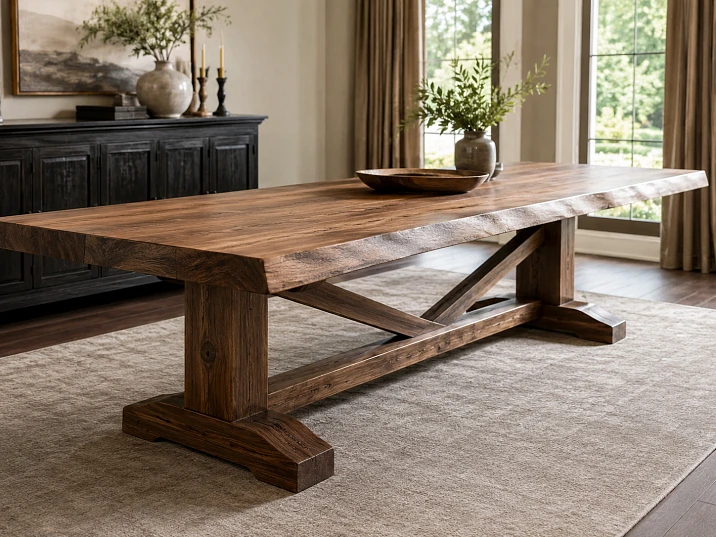
An underframe for a large table is not chosen based on a single beautiful photo. The longer and heavier the tabletop, the more requirements for the base: base width, number of supports, structural rigidity, attachment area, edge overhang, and lateral stability. If you make a mistake with the underframe, a large table may wobble, the tabletop may start to sag, and using the furniture will become uncomfortable even with an expensive top material.
A large dining table, a table for the kitchen, a spacious dining room, living room, or meeting area must stand confidently. Several people sit at it, and dishes, decor, dishes, laptops, books, and sometimes heavy wooden or stone tabletops are placed on it. Therefore, the base should not just 'stand under the table' but properly distribute the load along the entire length.
In the STAVROS catalog you can buy a stable underframe for a large table and choose a wooden base to match the size, shape, and style of the tabletop. But before purchasing, it is important to understand why a large table wobbles at all, why a long tabletop sags, how many supports are needed, and what dimensions of the underframe relative to the tabletop to check before ordering.
This article will help you choose a base for a large dining table, a long wooden tabletop, a kitchen table, or a table for a spacious dining room. This is not about a small decorative table, but about furniture where a design flaw is immediately noticeable in daily use.


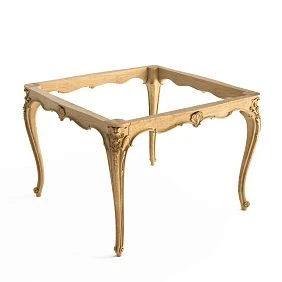
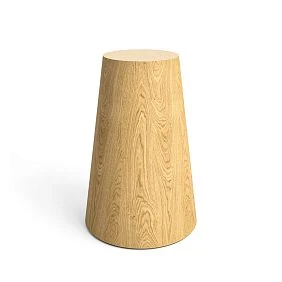
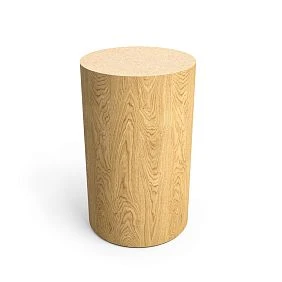
How a large table differs from a regular one
A regular table often forgives small errors in the base. If the tabletop is short, light, and has a small overhang beyond the edges of the supports, the load is distributed relatively calmly. A large table has different physics. The longer the surface, the larger the span between support points. The heavier the material, the stronger the pressure on the base. The more people sit at the table, the higher the dynamic load.
A large table can be a dining table, family table, kitchen table, conference table, decorative table, or work table. But in all cases, the base must match the length and weight of the tabletop. If the base is too narrow, the table will be unstable. If the supports are too far from the edges or, conversely, do not support the middle, sagging is possible. If the fastening is weak, even a massive base will not save the structure.
Therefore, a base for a large dining table is chosen differently than a base for a small coffee or side table. Here, not only decorativeness is important, but also geometry. The width of the base affects lateral stability. The length of the base affects the risk of sagging. The number of support points helps distribute the weight. The fastening area determines how securely the tabletop is connected to the base.
If the buyer has already chosen a long tabletop, it is useful to separately study the material about Countertop substructure. But for a large table, you need to go further: consider not just the fact of support, but the entire load scenario.

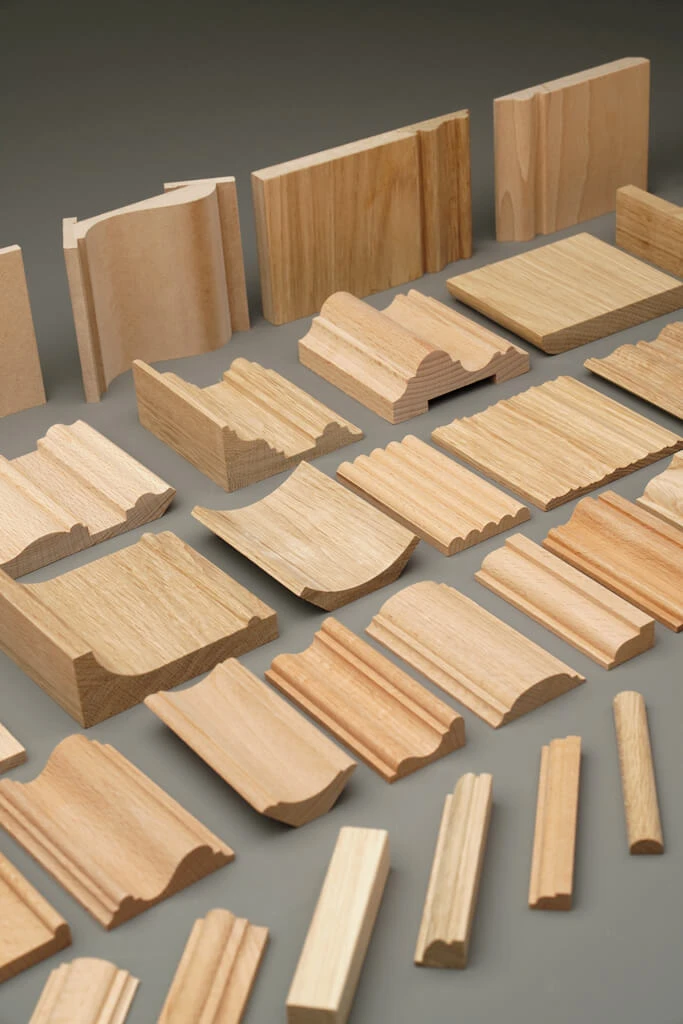


A long tabletop creates a larger span
The span is the distance between the points where the tabletop actually rests on the base. The larger it is, the higher the risk that the middle will start to sag. This is especially noticeable on long wooden tabletops, wide dining tables, and structures where supports are only at the edges.
If the tabletop is about two meters long or more, a compact base under the center may look beautiful, but it does not always solve the problem. The tabletop gets a large overhang on the sides, and the edges begin to act as levers. Therefore, a base for a tabletop of 2 meters or more must be chosen with special attention to the length of the base and support of the middle.
Our factory also produces:

The weight of the tabletop increases the load
A large tabletop is almost always heavier than a small one. If it is solid wood, a thick slab, a composite material, or a tabletop with decorative treatment, the load on the underframe increases. A lightweight base may visually not match the top and structurally fail to provide the necessary rigidity.
When it comes to heavy material, it is worth reading the material about Underframe for a heavy tabletop. The same logic applies there: the base must match not only the style but also the weight.
Get Consultation
A large table is often used more actively
A large table rarely stands just for decoration. People eat at it, work, gather guests, hold meetings, lay out dishes, place heavy meals, and use the surface from different sides. Load appears not only from above but also from the side: someone leans on the edge, someone moves a chair, someone accidentally bumps the table with their hip or hand.
Therefore, the underframe support must hold not only vertical weight but also lateral impacts. If the base is narrow, tall, and light, the table may wobble even with a normal tabletop.
Why a large table wobbles
A large table wobbles not due to a single reason. Usually, the problem arises from several factors: a narrow base, weak fastening, excessive tabletop overhang, a light base, an incorrect number of supports, an uneven floor, or an unsuitable underframe shape. Sometimes the table seems stable in an empty room but starts wobbling during actual use.
If the table is already in place and wobbles, you need to check not only the legs. It is important to understand where the movement occurs: in the floor, in the supports, in the connection of the underframe to the tabletop, in the frame itself, or in the tabletop. For a new table, it is better not to let it get to this point and immediately choose a base with a stability margin.
Too narrow underframe
Base width affects lateral stability. If the underframe is significantly narrower than the tabletop, the table has a large overhang on the sides. Under lateral load, such a table is easier to wobble. This is especially noticeable on long rectangular tables where people sit on both sides and constantly create uneven pressure.
A too narrow base may be chosen for visual lightness, but for a large table this is a risk. The base should be wide enough so that the table does not appear to be placed on a small central point. In a residential interior, it is important to maintain balance: the underframe should not interfere with legs, but it should not be too small relative to the tabletop.
Small support area
Support area is not just the number of legs. It is important how widely they are spaced, how they are connected, whether there is a frame, aprons, crossbars, central support. Individual legs can stand at corners, but with weak connections between them, the table will still wobble.
For a large table, it is better to consider not random supports, but a solid or reinforced structure. In the STAVROS section you can see furniture frames, to understand how different base options work with large furniture.
Too large tabletop overhang on edges
Overhang is the part of the tabletop that extends beyond the underframe. A small overhang is needed for seating comfort and beautiful proportions. But if it is too large, the edge of the tabletop starts to act as a lever. A person leans on the edge, and the table receives a force that can wobble the entire structure.
For a large table, the overhang needs to be calculated especially carefully. A beautiful long edge without support may look impressive, but in use, wobbling and risk of sagging will appear.
Weak attachment to the tabletop
Even a good base won't help if the tabletop is poorly secured. The attachment must transfer the load evenly to the base. If the attachment points are few, weak, or poorly positioned, the table may wobble at the joint rather than at the supports.
Before ordering, you need to check how the tabletop will be attached to the base, whether the contact area is sufficient, and whether additional elements will be required. This is especially important for heavy and long tabletops.
Light base with a heavy tabletop
When a heavy top sits on a light base, the table looks unbalanced. Even if the base can handle the vertical load, it may not provide a sense of stability. This is especially noticeable in large dining tables where the tabletop visually dominates the base.
In such a situation, it's better to consider wooden table base a more substantial geometry. Wood visually and structurally pairs better with a large tabletop than a random light base.
Uneven floor
Sometimes the cause of wobbling is not the base but the floor. If the base stands on an uneven surface, one of the support points may not have firm contact. The table starts to rock, even though the structure itself may be fine.
Before making a final assessment of the base, you need to check the floor, the position of the supports, and the possibility of adjustment. But you cannot rely solely on adjustment. If the base is too narrow or weak, a level floor won't fully solve the problem.
Why a long tabletop bends
Tabletop bending is a separate issue. The table may not wobble, but the middle will gradually start to sag. This is especially problematic for long wooden tabletops, massive dining tables, large kitchen tables, and tables where the base does not support the central part.
Bending occurs due to a large span between support points, insufficient tabletop thickness, heavy material, lack of central support, a weak frame, or incorrect underframe dimensions. The longer the table, the more important it is to consider support in advance.
Large span between supports
If the supports are only at the edges, the middle of a long tabletop may remain unsupported. This is not always noticeable at first. But over time, under its own weight and daily load, the tabletop may begin to sag. The longer and thinner the material, the higher the risk.
For a large table, it is better to reduce the span: use a longer underframe, a reinforced frame, two massive supports, or additional central support. The specific solution depends on the material and size of the tabletop.
Insufficient tabletop thickness
A thin tabletop looks lighter but resists bending worse. If it is long and the underframe is short or lacks central support, the load is distributed poorly. The top thickness must match the length, material, and base.
You cannot choose the underframe separately from the tabletop. The dimensions of the underframe relative to the tabletop are checked together: length, width, height, overhang, thickness, and weight work as a single system.
Heavy material
An array of wood, a thick slab, and composite materials can create a serious load. If the base is light, short, or weak, deflection and wobbling become more likely. Therefore, the table base for a wooden tabletop should be chosen considering weight, not just appearance.
Lack of central support
For a long tabletop, the central area often needs support. This could be a reinforced frame, an additional support, a crossbar, or a table base structure that distributes the load along the length. If the middle is completely free, especially with a large length, the risk of deflection is higher.
Individual legs instead of a solid table base
Individual legs are not always suitable. For small and medium tables, they can be convenient. But for a large table, separate supports without a rigid connection may not provide the necessary stability. The tabletop is held at the corners, while the middle remains a weak area.
If the goal is to avoid deflection, it is better to look towards a solid frame, a reinforced wooden base, or a table base with well-thought-out support.
How to choose a table base for a long tabletop
Choosing a table base for a long tabletop starts with measurements. You need to know the length, width, thickness, material, and approximate weight of the top. Then, evaluate the installation location: kitchen, dining room, living room, conference room, country house, commercial area. After that, choose the shape and dimensions of the base.
Measure the length and width of the tabletop
The length determines the span, and the width affects lateral stability and fit. The larger the tabletop, the more carefully you need to select the base. A small table base under a large top looks visually weak and may operate unstably.
If the tabletop is long, you shouldn't focus only on the center. You need to understand where people will sit, what overhang is needed at the edges, how far apart the supports will be, and whether it will be convenient to place chairs.
Determine the material and weight
Tabletops of the same size can vary greatly in weight. Lightweight material and solid wood require different bases. A wooden underframe for a tabletop looks good with a wooden top, but the shape and rigidity must still match the load.
If the weight is unknown, it's worth checking with the tabletop manufacturer or the craftsman. Selecting an underframe "by eye" for a large table is risky.
Choose the shape of the underframe
The shape depends on the type of table. For a large rectangular table, two massive supports, a long frame, or a reinforced base are often suitable. For a round table, a central base may be appropriate, but for a long rectangular tabletop, a single central base is usually insufficient.
If the table is a dining table, seating must be considered. The supports should not interfere with legs, chairs, or people's movement. If the table is a conference table, stability along the entire length is important. If the table is in a living room or dining room, decorativeness also matters.
Check the width of the base
The width of the base should keep the table from swaying sideways. A too-narrow underframe may look elegant, but with a large tabletop, it will feel unstable. A too-wide one may interfere with seating. You need to find a balance between comfort and stability.
Evaluate the tabletop overhang
The overhang should be convenient but not excessive. If the edge extends too far beyond the base, the table gains extra leverage. This is especially dangerous with a large length. It's better to draw a diagram in advance or measure distances to understand where the supports will be relative to the edges.
Consider the height of the finished table
The height of the underframe together with the thickness of the tabletop determines the final table height. If the tabletop is thick, the base may need to be lower. If thin, the standard underframe height can provide a comfortable seating. For an accurate choice, you can use the material about underframe height for a table.
What underframe dimensions to consider
The dimensions of the underframe for a dining table cannot be reduced only to height. A large table requires checking the base length, base width, tabletop overhang, number of support points, and attachment area. All these parameters work together.
| Parameter | Why it's important | What to check before ordering |
|---|---|---|
| Underframe length | The longer the support area, the lower the risk of tabletop sagging. | Ratio of base length to total tabletop length. |
| Base width | Affects the lateral stability of a large table. | Will the base be too narrow relative to the top. |
| Undercarriage height | Determines seating comfort together with the tabletop thickness. | The final height of the finished table. |
| Tabletop overhang | Too large an overhang increases the risk of wobbling and sagging. | Distance from the edge of the tabletop to the nearest support. |
| Number of support points | Affects load distribution along the length. | Whether central support or a reinforced frame is needed. |
| Mounting area | The larger and more reliable the contact, the more stable the connection. | How will the tabletop be fixed to the base. |
This table helps to quickly understand why the dimensions of the underframe relative to the tabletop are more important than they seem. A large tabletop should not just rest on a beautiful base. It must be properly supported.
How many supports are needed for a large table
The number of supports depends on the length, weight, and shape of the tabletop. For a small table, a compact base or four separate legs may suffice. For a large rectangular table, two massive supports, a reinforced frame, or additional central support are often needed. For a heavy tabletop, it is important that the underframe distributes the load rather than just holding the corners.
Table supports and underframe must work as a system. If each leg stands on its own with no rigid connection between them, the table may be less stable. If the underframe is solid, the load is distributed better. Therefore, for a large table, a well-thought-out base is often chosen over separate decorative legs.
Two massive supports
For a large rectangular table, two massive supports can be a good solution. They provide support along the length, leave room for legs, and visually match a large tabletop. However, it is important to correctly calculate the overhang at the edges. If the supports are placed too close to the center, the edges will be overloaded.
Four separate legs
Four legs are familiar, but not always sufficient for a large table. If the tabletop is long, the middle may lack support. Additionally, separate legs must be connected by a rigid structure or properly secured, otherwise the table may wobble.
Solid frame
A solid frame works well with a long and heavy tabletop. It helps distribute the load around the perimeter, reduce the risk of sagging, and make the table more stable. There is only one downside: such a base needs to be carefully matched in style so it doesn't look too technical.
Additional central support
If the tabletop is very long or the material is prone to sagging, central support may be needed. This is especially important for dining and conference tables where a large surface is actively used.
Wooden underframe for a large table: when it is a good choice
A wooden underframe is well suited for a large table when a warm, solid, and interior-friendly base is needed. In a kitchen, dining room, living room, or country house, wood looks softer and more natural than a cold technical structure. It pairs well with a wooden tabletop, classic furniture, panels, baseboards, doors, and other interior elements.
It is important to remember: the material does not replace structural calculation. Even a beautiful wooden underframe must have the correct shape, sufficient width, rigidity, and fastening. A large table requires not just solid wood, but stable geometry.
If you need a solid wooden base, you can buying a wooden table underframe in the STAVROS section, after first checking the dimensions of your tabletop and the future height of the finished table.
For the kitchen
A kitchen table is used daily. People eat, cook, place dishes on it, and sometimes use it as an additional work surface. Therefore, the underframe should be not only beautiful but also practical. It is important that the supports do not interfere with chairs and that the base is stable on the actual floor.
If the question is "which table base to choose for a kitchen table", you need to start with the dimensions of the room and the tabletop. For a small kitchen, one logic works; for a large kitchen-dining room, another.
For the dining room
In the dining room, a large table often becomes the main piece. It should look solid, withstand loads, and not wobble when several people sit down. A wooden table base is especially appropriate here because it supports the feeling of a family, warm, and durable interior.
For the dining area, you can also check out the material about Base for Dining Tables, if you need to compare kitchen and dining room scenarios.
For a country house
In a country house, a large table is often made of solid wood or imitation solid wood. It can stand in a spacious kitchen, dining room, living room, on a closed terrace, or in a common family area. Here, a wooden base looks especially organic, but the table base must match the weight and length of the tabletop.
For modern interior
A wooden table base doesn't necessarily have to look only classic. In a modern interior, it can be laconic, massive, geometric, or calm in shape. The main thing is not to overload the space and to choose a base that matches the proportions of the tabletop.
What is better for a large table: legs, supports, or a solid table base
For a large table, you cannot automatically choose the simplest option. Separate legs, two massive supports, a central table base, a solid frame, and a reinforced wooden base solve different problems. The difference is especially noticeable on a long tabletop.
| Option | When it fits | Risk |
|---|---|---|
| Separate legs | Small or medium table. | There may not be enough rigidity for a long length. |
| Two massive supports | Large rectangular table. | You need to correctly calculate the tabletop overhang. |
| Central underframe | Round or compact table. | There may be little support for a long tabletop. |
| Solid frame | Long and heavy tabletop. | It is important to choose a style and not weigh down the interior. |
| Reinforced wooden table base | Large dining table. | Requires precise size matching for the tabletop. |
If you are unsure where the legs end and a full base begins, it is helpful to read the material table frame or underframe. For a large table, this is not a terminological question but a practical one: stability depends on the design.
What to buy for a large table
Buying a table base for a large table should start from the task. One buyer is assembling a family dining table. Another — a long countertop for a dining room. A third — a large kitchen table. A fourth — a wooden tabletop for a country house. Each scenario requires its own balance between size, stability, and appearance.
| Buyer's task | What to choose | Why this is important |
|---|---|---|
| Large dining table | buy a stable underframe for a large table | The base must support the length and weight of the tabletop. |
| Long countertop | Underframe with a wide base or multiple supports | This reduces the risk of sagging and wobbling. |
| Heavy wooden tabletop | furniture frames or a solid wood underframe | The structure must match the weight and style of the wood. |
| Table for kitchen or dining room | wooden table base | Wood fits better into a residential interior. |
| Table in classic or modern style | STAVROS underframes | You can choose a base to match the collection, finish, and interior. |
What to buy together with the underframe for a large table
The underframe is only part of the future table. To make the furniture stable, comfortable, and beautiful, you need to plan the tabletop, fastening, finishing, surface protection, and alignment with the overall style in advance. A large table is especially sensitive to mismatches: if the top is too heavy and the base is too light, the furniture will look and function poorly.
| What to add to the purchase | Why this is needed | What to pay attention to |
|---|---|---|
| Tabletop of suitable length and thickness | Form the work surface of a large table. | Weight, thickness, edge overhang, and tendency to sag. |
| Fasteners and mounting solutions | Securely connect the tabletop to the base. | Mounting area and compatibility with the top material. |
| furniture frames | Compare adjacent solutions and select a base for the task. | Size, shape, purpose, and structural rigidity. |
| Protective wood finish | Preserve appearance and simplify maintenance. | Wood type, kitchen or dining room conditions. |
| Chairs with proper seating | Check seating comfort at the finished table. | Table height, leg placement, legroom. |
How not to confuse a large table base with similar solutions
A buyer may search for a large table base but see legs, supports, frames, table bases for tabletops, dining table bases, and furniture bases in the catalog. These items are similar in meaning but not always suitable for the same task.
Individual legs may be good for a small table, but for a long tabletop they may lack rigidity. A central base is suitable for a round or compact table, but may not always support a long rectangular top. A furniture frame can be useful for complex structures, but must be selected according to purpose.
| What the buyer chooses | What not to confuse it with | Why this is important |
|---|---|---|
| Large table base | Small underframe for a decorative table | A large table requires greater rigidity and base width. |
| Table supports | Random individual legs | A long tabletop needs a connected structure. |
| Wooden base | Light decorative base | The material must match the correct geometry. |
| Underframe for a dining table | Base for a coffee or side table | Height, load, and usage scenario differ. |
| Frame for tabletop | Decorative support only | The frame must support the weight and distribute the load. |
Practical selection for different situations
Need a large family table for the dining room
For a family table, stability, seating comfort, and appearance are important. Several people sit at such a table, so the supports should not interfere with legs, and the base must withstand the load along its entire length. It is better to choose a stable wooden underframe with sufficient width and rigidity.
Before purchasing, you need to measure the tabletop, determine the number of seats, and check the overhang on the edges. If the table will be the main item in the room, decorativeness is also important, but it should not outweigh the structure.
Need a long table for the kitchen-living room
In a kitchen-living room, the table is often used daily. It can be a dining, work, and decorative table simultaneously. The base must withstand the load, not interfere with chairs, and match the kitchen furniture.
If the tabletop is wooden, it makes sense to look at a wooden underframe. If the top is heavy, you need to check the central support and rigidity. For the kitchen, it is especially important that the table does not wobble during daily use.
Need a table for a heavy tabletop
A heavy tabletop requires a reinforced base. In this case, you cannot choose the underframe solely by style. You need to check the weight, length, thickness, and attachment area. If the base is light, the table will look unstable and may actually wobble.
Here it is worth additionally studying the material about Underframe for a heavy tabletop, and then select the base in the catalog taking into account the specific size.
Need a large table for a country house
In a country house, the table is often made large, wooden, and expressive. It can stand in the dining room, kitchen, living room, or common family area. In such an interior, a wooden underframe looks natural but must be sufficiently sturdy.
If the tabletop is made of solid wood, the base must match it visually and structurally. A too-light base will look alien, and a too-narrow one will create a risk of wobbling.
Need a table for a meeting room or commercial space
In a meeting room, the table is used actively and must look confident. People sit on different sides, placing laptops, documents, and equipment. The base must be stable and not interfere with seating.
For commercial spaces, it is especially important not to skimp on the structure. If a large table wobbles during meetings with clients or partners, it immediately spoils the impression of the room.
Mistakes when choosing an underframe for a large table
Choosing a table base only by photo
A photo shows style but not load capacity. In the image, the base may look beautiful, but in real size it may turn out to be too narrow, light, or short for the chosen tabletop. Before purchasing, you need to check dimensions, shape, and purpose.
Not considering the length of the tabletop
A long tabletop requires support along its length. If you choose a base designed for a smaller table, the edges may have too much overhang, and the middle may lack sufficient support. This leads to wobbling and sagging.
Making too large an overhang on the edges
Overhang is needed for convenience, but within reasonable limits. If the edge extends too far beyond the base, the table is easier to rock. This is especially noticeable when a person leans on the edge or places a heavy object closer to the corner.
Putting a heavy tabletop on a light base
Such a table may look impressive in a picture, but in real life it often feels unstable. A heavy top requires a corresponding base. A wooden base must be not only beautiful but also sufficiently rigid.
Not checking lateral stability
A large table may hold weight from above but wobble from the side. Lateral stability is especially important for long tables that are actively used by several people. The width of the base and the connection between supports are critical here.
Forgetting about central support
If the tabletop is long, the middle may need support. Without it, there is a risk of sagging. This is not always noticeable immediately, but over time the problem can worsen.
Using separate legs where a frame is needed
Separate legs do not always provide the necessary rigidity. For a large table, a solid or reinforced structure is often better. The legs should not work on their own, but as part of a system.
Not considering the thickness of the tabletop when calculating height
The final table height consists of the underframe height and the tabletop thickness. If the top is thick, the table may become too high. If this is not checked in advance, the seating will be uncomfortable.
Who is a stable underframe for a large table suitable for
This solution is suitable for those who are assembling a large dining table, a long countertop, a table for a kitchen-living room, dining room, country house, or spacious living room. It is needed by buyers who want not temporary furniture, but a stable item for daily use.
A stable underframe is especially important for families who often gather at the table, for owners of country houses, interior designers, furniture workshops, and those who are selecting a base for a massive wooden tabletop.
This option is not suitable for those who are looking for a lightweight decorative base for a small table, do not know the dimensions of the tabletop, are not ready to check the weight and overhang, or want to use random legs without structural calculation. For a large table, this approach is too risky.
Where to buy a stable table base for a large table
It's better to start your purchase not with color and shape, but with the dimensions of the tabletop. First, determine the length, width, thickness, material, and weight. Then, understand where the table will be placed: kitchen, dining room, living room, conference room, country house. After that, you can choose the table base based on shape, base width, number of supports, and style.
In STAVROS, you can go to the section and buy a stable underframe for a large table, comparing options for wooden, dining, or long tabletops. If the task is broader and you need to look at different bases, it's worth opening furniture frames and choosing a solution for a specific project.
Before ordering, you need to check the dimensions, material, construction, height, fastening, compatibility with the tabletop, and operating conditions. If the tabletop is heavy, long, or non-standard, it's better to check compatibility with a STAVROS manager in advance.
FAQ
Which table base to choose for a large table?
For a large table, you need to choose a table base with sufficient base width, rigid construction, reliable fastening, and the right number of support points. The longer and heavier the tabletop, the stronger the base should be.
Why does a large table wobble?
Most often, a table wobbles due to a narrow base, weak fastening, too light a table base, large tabletop overhang, uneven floor, or insufficient number of supports.
How to choose a table base for a long tabletop?
You need to consider the length of the tabletop, its weight, thickness, material, overhang on the edges, distance between supports, base width, and the attachment area to the table base.
How many supports are needed for a large table?
It depends on the length and weight of the tabletop. For a long rectangular table, two massive supports, a reinforced frame, or additional central support are often needed.
How to avoid tabletop sagging?
You need to reduce the span between supports, correctly choose the dimensions of the table base, reinforce the central part, and avoid too large an overhang of the tabletop on the edges.
What is better: individual legs or a solid table base?
For a large table, a solid or reinforced table base is often more reliable because it distributes the load better and reduces the risk of wobbling. Individual legs are not suitable for all long tabletops.
How to choose the dimensions of the table base relative to the tabletop?
You need to compare the length and width of the base with the length and width of the tabletop, calculate the overhang on the edges, check the height of the finished table, and assess whether central support is needed.
Will a wooden table base be suitable for a heavy tabletop?
Yes, if the structure is sufficiently rigid, wide, and properly sized. It's important to consider not only the material but also the shape, fastening, and number of support points.
Can a small table base be used under a large table?
This is usually risky. A small base may not provide the necessary stability, especially if the tabletop is long and heavy. For a large table, the base should match the size of the top.
Why is the overhang of the tabletop important?
Too much overhang creates leverage. If someone leans on the edge, the table is easier to rock, and the tabletop is more heavily stressed. The overhang should be comfortable but not excessive.
How do I know if central support is needed?
Central support is needed if the tabletop is long, heavy, thin, or has a large span between supports. The decision depends on the material and size of the tabletop.
Where can I buy a stable table base for a large table?
A stable table base can be selected in the STAVROS table bases section. Before purchasing, you need to check the dimensions of the tabletop, weight, shape, height, overhang, and fastening.
Bottom line: a large table starts with the right base
The underframe for a large table should not just be beautiful, but stable, rigid, and correctly matched to the tabletop. The longer and heavier the top, the more important the base width, number of supports, attachment area, central support, and proper edge overhang.
If you choose a base that is too light or narrow, a large table may wobble. If you don't account for the span between supports, the tabletop may sag. If you don't check the height, the seating will be uncomfortable. Therefore, it's better to choose the underframe after precise measurements, not based on first impressions alone.
At STAVROS you can buy a stable underframe for a large table, choose a wooden base for a dining, kitchen, or long tabletop and check in advance how well the structure handles the actual load. This approach helps assemble a table that doesn't sag, doesn't wobble, and looks confident in the interior.