Article Contents:
- When MDF skirting board wood effect is the right choice
- MDF skirting board oak: the main and most versatile shade
- Why oak is almost a universal choice
- MDF skirting board light oak
- MDF skirting board oak 80 mm: when height matters
- MDF skirting board ash: when oak is too warm
- Where MDF skirting board ash works
- MDF skirting board wenge: dark contrast as a design statement
- When wenge works flawlessly
- When you need to be careful with wenge
- Gray MDF baseboard and gray oak: the best choice for a modern interior
- Gray MDF baseboard: when neutrality is strength
- Gray oak MDF baseboard: texture and modernity at the same time
- What to match the color of MDF baseboard to: floor, doors, or walls
- How not to make a mistake with the wood shade on MDF baseboard
- Compare in reality, not on screen
- Check under different lighting
- Don't mix too many wood tones
- Consider the undertone, not just the "temperature"
- Don't forget about wooden architraves
- MDF skirting board height for wood: how to choose the right format
- 60–70 mm: delicate lower contour
- 80 mm: universal height
- 100 mm: expensive visual effect
- 120 mm and above: for high rooms
- Where to use MDF skirting board for wood: scenarios by room
- Living room with oak laminate
- Bedroom with wooden furniture
- Hallway with doors in oak or ash
- Open-plan kitchen-living room
- Study with dark furniture
- Corridor: gray oak as a unifying element
- Country house: natural oak or ash
- MDF skirting board in wood look or solid wood: the difference you need to understand
- MDF skirting board in wood look
- Solid wood skirting board
- MDF skirting board in wood look paired with other finishing elements
- Architraves and door trims
- Wooden moldings on walls
- Wooden cornice at the ceiling
- Wooden corners
- Decorative slats on walls
- Furniture handles and legs
- Mistakes when buying MDF skirting board in wood look
- What to buy together with MDF skirting board in wood look
- About the company
- FAQ: answers to questions before purchase
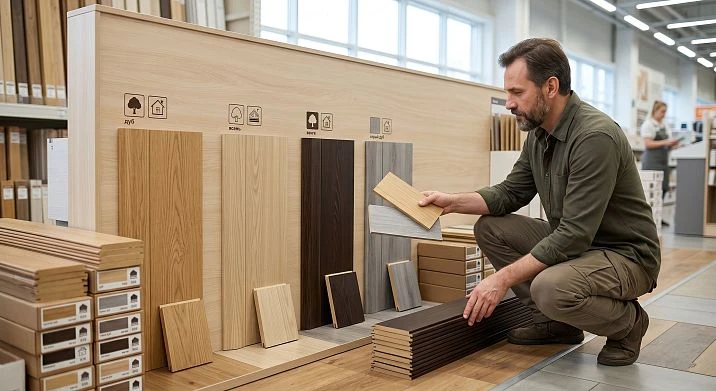
The same skirting board can make an interior complete — or ruin it. Everything comes down to color. That's why someone who has already decided on the material and profile height stops before the next question: oak or ash? Gray or natural? To match the floor or the doors? This is not a trivial choice — it's the final step before purchase, and this is where mistakes are made most often.
an MDF skirting board with a wood finish is — is not a compromise or a budget replacement for natural wood. It's a well-thought-out solution for a modern interior, where an MDF skirting board with the texture of oak, ash, wenge, or gray oak organically integrates into the unified material system of the space. Let's examine each scenario in detail — so you come to the catalog with a clear understanding of exactly what you need.
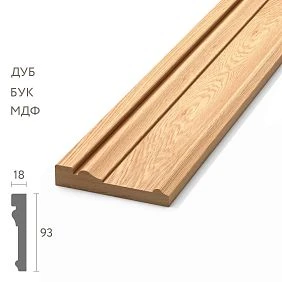
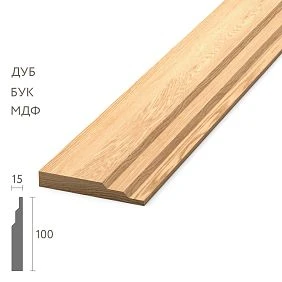
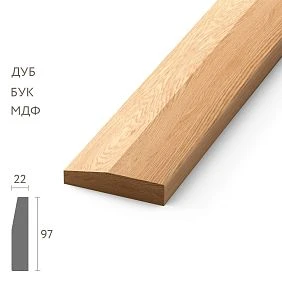
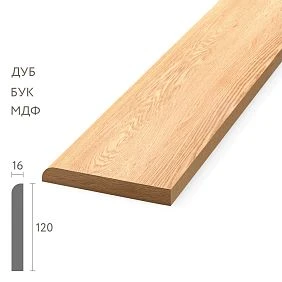
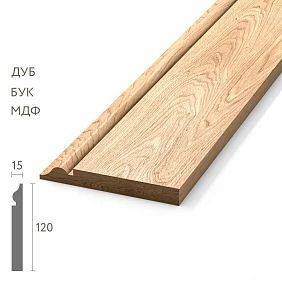
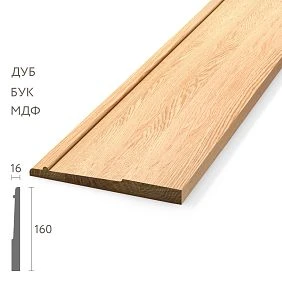
When MDF skirting board in wood look is the right choice
Before choosing a shade, it's worth figuring out: do you even need a wood-look skirting board, or would a white or paintable option work better in your situation?
The answer is simple. Buy MDF skirting board in wood look is worth it in the following cases.
Floor in a wood tone. Laminate, parquet board, engineered wood, wood-look tiles, cork flooring — all of these require either a matching or deliberately contrasting skirting board. A white skirting board on a warm oak floor is a break in the material language of the space. It's possible as a deliberate design technique but requires confidence.
Doors and architraves in a wood shade. Doors in colors like "oak", "ash", "wenge", "walnut" set the color tone for the entire room perimeter. A skirting board that picks up this tone — even if not exactly matching, but staying within the same family of shades — creates visual coherence.
Wooden slats and panels. If the wall is finished wooden planks or slatted panels made of solid wood, a baseboard matching the slats creates a continuous finishing system. The wall, floor, and the transition between them are finished with a single material solution — this is a sign of a well-thought-out renovation.
Wooden furniture as a dominant element. A kitchen set with oak fronts, a wardrobe in walnut, a wooden bed and nightstands — furniture can set the wood tone just as well as the floor.
A white baseboard looks alien. Sometimes that's enough. If you look at a newly installed white baseboard and feel it doesn't fit — trust that feeling. Most likely, a wood tone is needed.
The interior needs to be visually 'warmed up'. Gray floor, gray walls, white doors — cold minimalism. Adding a baseboard in a light oak or ash tone adds natural warmth to the space without disrupting the overall restraint.




MDF baseboard oak: the main and most versatile shade
If designers were to name one baseboard color that works in most cases — it would be oak. Not white. Not dark wenge. Specifically oak: warm, organic, not neutral to the point of colorlessness, but not aggressively bright either.
Our factory also produces:


Why oak is an almost universal choice
The oak shade is a medium tone, a warm beige-brown with a golden undertone. It pairs with:
-
white and light gray walls
-
laminate in tones of "Sonoma oak", "bleached oak", "natural oak"
-
MDF doors with oak texture
-
light and natural wooden furniture
-
interiors in Scandinavian, Japandi, modern classic, loft styles with warm accents
MDF skirting board oak should be chosen when the interior has at least one large wooden element — floor, doors, or furniture — and the baseboard should not contrast but support the overall tone.
Get Consultation
MDF baseboard light oak
Light oak is a cooler shade, closer to linen or gray-beige. It works great where you need not to "warm up" the space but to preserve its lightness and airiness. Bleached oak, Scandinavian oak, bleached oak — different commercial names for the same principle: oak without yellowness.
What is MDF baseboard light oak suitable for:
-
light laminate in the bedroom or children's room
-
hallway with soft neutral shades
-
scandi interior with natural textiles and unfinished wood
-
small spaces where visual lightness is important
MDF skirting board oak 80 mm: when height matters
Height 80 mm is one of the most popular formats. It is enough to create a noticeable horizontal line at the floor, and at the same time does not overload the space in standard rooms with ceilings of 2.7–3 m.
for MDF skirting boards oak 80 mm matters: the wider the profile, the more noticeable the texture — and the more important its quality. Make sure the oak texture print on MDF looks realistic, without a 'pixelated' or uniform effect.
MDF skirting board ash: when oak is too warm
Ash and oak are the two closest wood shades in the interior palette. But the difference between them is noticeable. Oak is warmer, with a pronounced yellow or golden undertone. Ash is cooler, more gray-beige, almost lilac-gray in some shades.
Where MDF ash skirting board works
This is a solution for interiors where a wood tone is needed, but without 'rustic' warmth. Ash is ideal for:
-
Bedrooms in a neutral palette. Gray walls, white textiles, light wooden decor — ash fits without excessive warmth.
-
Children's rooms. Light, soft, natural shade without sharp contrasts.
-
Modern hallways. If the doors in the hallway are finished in ash, a baseboard in the same shade creates clear, professional consistency.
-
Kitchen-living room. When the furniture set is finished in ash and the floor is neutral gray, the MDF ash baseboard connects two different tones into one calm system.
MDF ash baseboard is a choice for those who want a natural wood tone but don't want the "yellowness" of oak. If an oak baseboard seems too warm to you — look at ash.
MDF wenge baseboard: dark contrast as a design statement
Wenge is one of the most definitive design choices. It is not neutral, not compromising. Dark brown, almost black with a chocolate undertone — it's a statement, not a background.
When wenge works flawlessly
MDF wenge floor baseboard appropriate in interiors where:
Dark doors. Wenge door + wenge baseboard = a clear, expressive perimeter that organizes the space. If the doors are dark and the baseboard is light, a visual break occurs.
Dark furniture. An office with a dark desk and shelves, a living room with a dark brown or graphite-colored sofa — wenge sets the tone for the entire lower horizontal line.
Light walls and dark floor. The contrast of 'dark floor — light walls' is one of the classic techniques in modern interiors. In this case, the wenge baseboard continues the dark horizontal line of the floor, creating a clear dividing line.
Laconic minimalist interior. Where every detail 'reads,' the wenge baseboard adds graphic clarity to the room's geometry.
When to be careful with wenge
A dark baseboard emphasizes the lower contour of the room and visually lowers the ceiling. In a small room with low ceilings, it can create a feeling of pressure. If the area is up to 12 sq.m and ceilings are below 2.7 m, think carefully before choosing wenge.
Also, wenge does not 'forgive' installation inaccuracies: on a dark baseboard, whitish traces of glue, scratches, and uneven joints are more visible than on light shades. Installation requires precision.
MDF baseboard in gray and gray oak: the best choice for a modern interior
This is one of the most interesting and underestimated segments. A gray baseboard is not white and not woody, but a special solution for those who build an interior on modern neutral shades.
Gray MDF skirting board: when neutrality is strength
Gray MDF floor skirting board — it's not "neither here nor there." It's a precise fit for an interior built on a gray palette: gray walls, gray porcelain stoneware, graphite doors, concrete textures.
Gray skirting board works as an "invisible" in the right sense — it doesn't compete with other interior elements but supports the overall chromatic scheme. White would be too bright in such a scheme, wood too warm. Gray is just right.
It works especially well MDF skirting board gray in combination with:
-
light gray or beige-gray porcelain stoneware
-
gray or anthracite laminate
-
walls in colors "light concrete," "basalt," "silver-gray"
-
doors in graphite, anthracite, dark gray
Gray oak MDF skirting board: texture and modernity at the same time
Gray oak is a synthesis of two trends: the natural texture of wood and the modern gray tone. The surface of the skirting board reveals the structure of oak fiber, but in a gray-ash palette, not in a warm golden one. This is one of the most relevant options in modern design.
Gray oak MDF skirting board is a solution for those who want:
-
a living wood texture, not a uniform gray color
-
a modern cool tone, not a warm traditional woodiness
-
a combination with gray coatings, which now dominate floor collections
Gray oak works perfectly with laminate "gray oak", "smoky oak", "Scandinavian oak", with tiles imitating gray wood, with doors in gray or walnut-gray tones. If you have such flooring or such doors, gray oak in the skirting board will be a precise match.
What to match the color of MDF skirting board to: floor, doors, or walls
This is one of the most common questions — and one of the few with no single correct answer. But there is logic that works.
| Guide for selection | When this is the main argument |
|---|---|
| To match the floor covering | The floor is bright, expressive, with a strong texture |
| To match the doors | Doors are a visual dominant, an opening element of the perimeter |
| To match the walls | A modern 'architectural' effect without accents is needed |
| To match the furniture | There are many wooden facades, slats, or panels in the room |
| Contrast to everything | Intentional design emphasis on the lower contour |
Practical rule: if a room has two dominant wooden elements — the floor and doors — it's better to focus on the one that is more noticeable upon entry. In most rooms, that's the doors. We look down at the floor, but doors are right in front of us.
Important nuance: the baseboard doesn't have to exactly match the floor or doors. It should be in the same color family, but a difference of 1–2 tones is acceptable. Exact matching can sometimes look unnatural — like a suit and tie that are identical.
How to avoid mistakes with the wood shade of an MDF baseboard
A mistake in color choice is not a tragedy, but it leads to extra costs and a ruined mood. Here are a few specific rules to help you choose correctly.
Compare in reality, not on screen
Monitors, tablets, and phones all reproduce color differently. Even a calibrated screen won't accurately show the exact shade that will appear in your specific room under your lighting. If possible, look at samples in person.
Check under different lighting conditions
The same oak baseboard can look completely different in daylight from a window versus under warm LED lamps in the evening. In warm light, the yellow undertone of oak will intensify. In cool light, it will shift to a gray-beige. Check the shade in both lighting modes.
Don't mix too many wood tones
Oak, ash, and gray oak in one space are already three different 'woodinesses.' If you add wenge or walnut, the space will lose its integrity. Rule: no more than two wood shades in one room. A third is only allowed if they all belong to the same family and are separated by zones.
Consider the undertone, not just the 'temperature'
Oak can have a yellow, pinkish, gray, or greenish undertone. Ash can have a purple or gray-blue undertone. Wenge can have a red or cool brown undertone. If you choose a baseboard without considering the undertone, it may match the floor 'in general' but create color tension.
Don't forget about Wooden casings
Architraves are vertical elements of the same color system as the baseboard. If the architraves are oak and the baseboard is wenge, the boundary between them in the corner of the room will look sloppy. Choose baseboards and architraves as a pair.
MDF baseboard height for wood: how to choose the right format
Color is decided — now height. This is a separate issue, but we'll briefly outline the guidelines.
60–70 mm: delicate lower contour
For small rooms, children's rooms, and bedrooms where a strong horizontal line near the floor is not needed. The baseboard is present, performs its function, but does not draw attention to itself.
80 mm: universal height
MDF baseboard oak 80 mm is the most popular format. Suitable for standard living spaces with ceilings of 2.5–3 m. It is noticeable enough to be a decorative element, yet does not dominate.
100 mm: expensive visual effect
A 100 mm high baseboard is already an architectural element. It adds a sense of solidity and a "luxurious" interior. For apartments with high ceilings and spacious living rooms, it is a justified choice.
120 mm and above: for tall rooms
In homes with ceilings of 3.2 m and higher, an 80 mm baseboard looks too modest — it gets lost on the vertical wall. A tall baseboard restores proper proportions. Under wood — oak or wenge — a wide baseboard looks particularly substantial.
Where to use MDF baseboard under wood: scenarios by room
Color and height are chosen. Now — the context: where exactly which shade works best.
Living room with oak laminate
The most common scenario. Laminate "oak" + doors "oak" — MDF baseboard oak creates a unified system. If the laminate is light — light oak baseboard. If the floor is more saturated, warm — natural oak or slightly darker.
Add Wooden planks on the accent wall behind the sofa in the same shade — and the living room acquires a professional designer look.
Bedroom with wooden furniture
An oak bed, bedside tables, a cabinet with wooden fronts — an MDF skirting board in oak or ash ties the furniture and floor into a single tone. Lighter and softer shades are appropriate in the bedroom: light oak, ash, bleached oak.
Hallway with doors in oak or ash
The hallway is the first thing a guest sees. Here, every element is on display. Skirting boards, architraves, doors must work as a system. If the doors are in an "ash" shade, an MDF ash skirting board with the same wooden casings creates a flawless perimeter.
Open-plan kitchen-living room
A conflict often arises here: in the kitchen area, there are tiles or porcelain stoneware, in the living room — laminate. If the tiles are gray and the laminate is oak-look, a gray oak skirting board can act as a connecting link, working with both coverings simultaneously.
Or the "zoning with skirting board" solution: gray in the kitchen area, oak in the living room area. This is appropriate if there is a visual boundary between the zones — for example, a different floor covering or a change in floor level.
Study with dark furniture
A dark desk, dark shelving, a leather chair — MDF wenge floor baseboard here it provides an organic lower boundary. It doesn't try to be "invisible" — it's part of the dark, restrained interior.
Corridor: gray oak as a unifying element
In a long corridor with several doors featuring different hardware and several floor coverings, the gray oak MDF baseboard acts as a "reconciling" element: it does not compete with any of the adjacent shades.
Country house: natural oak or ash
In a country house, where there are already many natural materials — wood, stone, natural textiles — an MDF skirting board with a wood finish is it fits organically into the aesthetic. Here, natural oak or Skirting made of solid wood — real wood with a living texture, which will only enhance the natural character of the space.
MDF baseboard with wood finish or solid wood: the difference you need to understand
This question arises naturally: if you need a "wood-like" look, maybe buy a real wooden baseboard?
Both options have a right to exist — and each has its own logic.
MDF baseboard with wood finish
-
Stable geometry: does not deform with humidity changes
-
Perfectly smooth surface for painting or with applied texture
-
Wide selection of color shades: oak, gray oak, ash, wenge, walnut — in one line
-
Good price with high visual appeal
MDF baseboard with wood finish is a baseboard with a decorative coating or film that imitates wood texture. The quality of this imitation is a key parameter when choosing.
Solid wood baseboard
-
Lively, unique texture of natural wood
-
Can be sanded and repainted when updating the interior
-
Durability with proper coating
-
Higher price, but also higher 'natural' value
Wooden baseboard — is living wood. Each plank is unique in its fiber pattern. This is something no film can reproduce.
Conclusion: if your budget allows and durability with upgradeability is important, choose solid wood. If you need even geometry, a wide selection of specific wood-like shades, and predictable stability, choose MDF.
MDF skirting board with wood finish paired with other trim elements
A skirting board never lives alone in an interior. It is part of a system. Here is how this system is built when choosing a wood-like shade.
Architraves and door trim
Wooden casings must be coordinated with the skirting board in color. Oak architrave + oak skirting board — a single color horizontal line along the doorway and around the room. This is a basic principle, and any violation is immediately noticeable.
All Pogonazh iz massiva — skirting boards, architraves, cornices, moldings — in a single catalog: you can select all elements from one line.
Wooden wall moldings
Wooden moldings — horizontal or vertical — create decorative panels on walls. If the moldings are painted in the same shade as the skirting board or made from the same wood species, the wall and floor form an architecturally cohesive system.
Wooden cornice at the ceiling
wooden cornice completes the vertical system of "skirting board — wall — cornice." When the skirting board at the bottom and the cornice at the top are in similar shades, the space gets a complete trim frame. In interiors with natural wood, this creates a sense of wholeness and lived-in comfort.
Wooden corner pieces
Where the skirting board meets an external corner — Wooden angle in the same shade covers the joint. Without a corner — the ends of the baseboard at the corner look sloppy and are open to damage. With a corner — a professional finish.
Decorative slats on walls
Decorative wooden lamination on the accent wall in the same shade as the baseboard — this is a unified material language from floor to baseboard, from baseboard to the slatted wall. For interiors with oak or gray oak — one of the most organic solutions.
Furniture handles and legs
wooden furniture handles и wooden supports and legs for furniture in the same wood shade as the baseboard — this is the final touch that turns a renovation into a design project.
Mistakes when buying MDF baseboard for wood
Here are eight real mistakes — not theoretical ones.
1. They match the baseboard only to the floor, forgetting about the doors. The floor and doors are the two main wooden elements of the interior. If the baseboard matches the floor but conflicts with the doors — a visual gap occurs exactly where the doors meet the floor, that is, in the most noticeable place.
2. They mix several wood shades without logic. Oak on the floor, ash on the architraves, wenge on the baseboard, gray oak on the slats — this is not a "richness of textures," it's chaos. Two shades in the system — maximum.
3. They choose a dark baseboard for a small room. Wenge in a 9 sq.m room with a low ceiling — this is visually cramped space. The dark lower contour presses down. In small rooms — a light or neutral shade.
4. They don't check the baseboard against the architraves. Architraves may be bought separately, from a different catalog, in a "similar" shade. At the junction — the difference is always noticeable.
5. They don't calculate the perimeter allowance. At least 10–15% above the estimated footage. Corners, trimming, defects during installation — all of this requires a reserve.
6. They take the baseboard without considering the ceiling height. High ceilings + a 60 mm baseboard — it will simply be "lost." Low ceilings + a 120 mm baseboard — it will "eat up" the vertical space.
7. They don't check compatibility with slatted panels made of solid wood. If the interior has or plans to have slatted panels on the walls — the baseboard must be coordinated with them in tone and wood species.
8. They buy the baseboard without considering wooden slats and panels. Slats on the wall may appear later. If you choose the baseboard now without a plan for the slats — later you'll either have to change the baseboard or put up with the mismatch.
What to buy together with the MDF wood-look baseboard
A complete list of elements for a systematic finish — so you don't have to go back for each item separately.
-
MDF Skirting Board — the profile itself in the desired shade and height
-
Wooden casings — in a coordinated color
-
Pogonazh iz massiva — the entire perimeter set from one source
-
wooden cornice — the top finish of the system
-
Wooden moldings — for panel walls and decorative frames
-
Wooden angle — for external corners
-
Wooden planks — for accent walls
-
solid wood slat panels — for quick slatted finishing
-
wooden furniture handles — final wooden accent
-
wooden supports and legs for furniture — for furniture in a unified style
About the Company
STAVROS is a Russian manufacturer of decorative finishing products made from solid wood and MDF. Skirting boards, cornices, moldings, architraves, slats, slatted panels, and furniture fittings — everything is produced in-house with quality control at every stage.
STAVROS offers MDF skirting boards in current wood shades: oak, light oak, gray oak, ash, wenge, and others. Precision of geometry, surface quality, and consistency of shades across the entire range are what distinguish a professional manufacturer from a reseller of imported material.
Custom profiles and shade selection for specific projects are possible. The entire range wood trim — in a single catalog. Delivery across all of Russia.
FAQ: answers to questions before purchase
Which MDF wood-effect skirting board is best to buy for laminate flooring?
Match it to the laminate shade: light laminate — light oak or ash, gray laminate — gray oak, dark — wenge or dark walnut. If the laminate is in the "natural oak" tone, an MDF oak skirting board will be a perfect match.
Does an MDF oak skirting board suit white doors?
Yes, if the interior has flooring or furniture in a wood tone. An oak skirting board against white doors creates a light, natural accent at the bottom. If everything is white and neutral, it's better to consider a white or paintable skirting board.
What to choose: gray MDF skirting board or gray oak?
Gray is for neutral modern schemes where wood texture isn't needed. Gray oak is when a lively texture in a cool tone matters, especially under gray laminate or wood-effect tiles.
Is a wenge MDF skirting board suitable for a small room?
It can be used, but with caution. A dark skirting board emphasizes the lower contour and can create pressure in a small space. In small rooms, a light or neutral shade is preferable.
What should an MDF skirting board be matched to first — the floor or the doors?
There is no universal answer, but a practical rule: if the doors are clearly visible at the entrance, match them. If the floor is expressive and clearly dominant, match the floor. Ideally, the skirting board should be in the same color family as both elements.
Is it possible to combine MDF skirting board with wood effect and solid wood skirting board in one apartment?
Technically — yes, if the shades are close. But for a uniform result, it is better to stick to one solution within the same floor or zone. Mixing MDF and solid wood in one room requires precise color coordination.
What margin in length should be taken when buying MDF skirting board?
At least 10–15% above the calculated perimeter. For rooms with niches, built-in wardrobes, columns, and non-standard corners — 15–20%. It is better to have a few extra planks than to go for one in the middle of installation.