Article Contents:
- Why MDF skirting boards are chosen for modern interiors
- Which height to choose: 60, 70, 80, 100 or 120 mm
- White, gray, wood-look or paintable: what to choose
- White MDF baseboard
- Paint-Ready MDF Skirting Board
- MDF skirting board wood-look and oak
- Gray MDF skirting board
- Straight or shaped profile: which skirting board looks more expensive
- Straight MDF baseboard
- Shaped Profile
- Wide MDF skirting board
- Price of MDF skirting board: what determines the cost
- How to calculate the amount of skirting board before purchasing
- Mistakes when buying MDF baseboard
- What to pair MDF skirting board with in the interior
- MDF skirting board for different rooms: what to consider
- Kitchen-living room
- Bedroom
- Living Room
- Hallway and entrance hall
- Where to buy MDF skirting board in Moscow and with Contact us to confirm shipping to your destination.
- About the company
- FAQ: Answers to Popular Questions
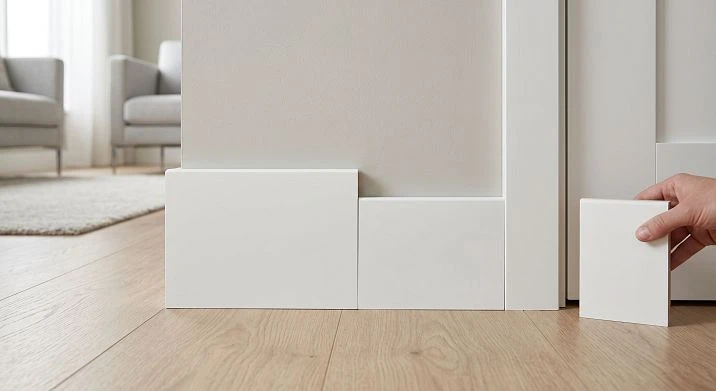
If you are currently choosing MDF Skirting Board for an apartment or house — the short answer is: for most standard rooms with ceilings of 2.5–3.0 m, an 80 mm skirting board will work. If the interior is spacious, doors are high, furniture is large, or ceilings are above 2.7 m — look at MDF skirting board 100 mm and higher. For minimalism and modern classic, choose a straight profile; for neoclassical and classic, choose a shaped or pronounced relief profile. You can view the current catalog and select the desired size here: buy MDF skirting board.
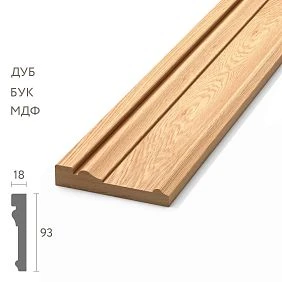
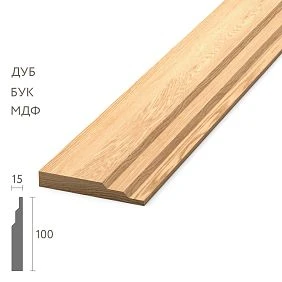
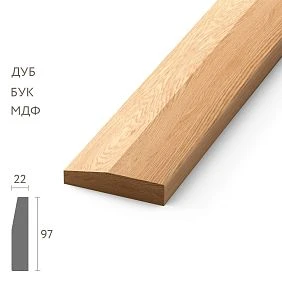
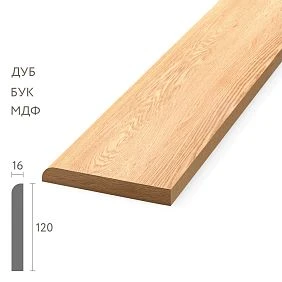
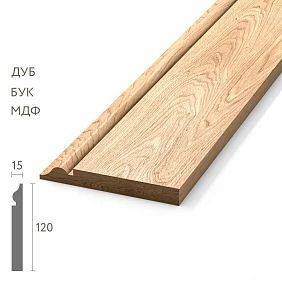
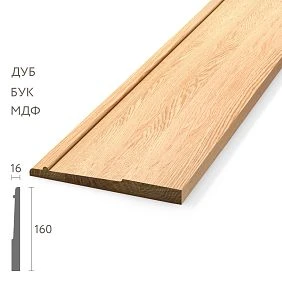
Why MDF skirting board is chosen for modern interiors
The question of choosing finishing materials is always more acute than it seems at first glance. It would seem that the skirting board is a secondary detail. But it is what forms the lower visual contour of the room, sets proportions, completes the finish, and ties together the floor, walls, doors, and furniture. That is why Baseboard MDF has become one of the most sought-after elements in modern residential and commercial interiors.
The main advantage of MDF as a material is its perfect geometry. Unlike solid wood, which even with good drying can slightly warp or crack, MDF maintains its shape stably. The surface is smooth, without live knots or streaks, which makes MDF skirting board for the floor ideal for painting: the paint lays evenly, without preparatory sanding in several passes.
Another important point is compatibility. MDF Skirting Board It fits organically into a unified finishing system: it visually rhymes with door trims, wall panels, decorative slats, and moldings. When all elements are executed in the same technique, it's not just beautiful—it's professional. This is exactly the approach designers use today when working on residential projects of any level: from a modest studio apartment to a spacious country residence.
It is also important that the MDF baseboard covers the technological gap between the wall and the flooring—whether it's laminate, parquet board, engineered wood, quartz vinyl tile, or porcelain stoneware. This gap is necessary to compensate for thermal expansion of the floor, and without a baseboard it would look untidy. A properly selected MDF baseboard for floor hides it completely, creating a feeling of a finished, cohesive space.




Which height to choose: 60, 70, 80, 100, or 120 mm
This is the most common question when choosing. And it is truly fundamental: a baseboard that is too small in a tall room looks random and disproportionate, while one that is too large in a compact room appears bulky and oppressive. The right height is a balance of proportions.
| Baseboard Height | For which interior |
|---|---|
| 60–70 mm | Small rooms, low ceilings up to 2.5 m, calm finishes, minimalism |
| 80 мм | Universal option for an apartment, kitchen-living room, bedroom, ceilings 2.5–3.0 m |
| 100 мм | Spacious rooms, ceilings from 2.8 m, tall doors, more expensive visual effect |
| 120 мм | Classic, neoclassical, high ceilings from 3.0 m, large doorways, status interior |
MDF skirting board 80 mm is the gold standard for most Russian apartments. It is noticeable enough to define the lower contour of the room, but not so large as to visually lower the ceiling. If you are not sure what to choose — MDF skirting board 80 will be the right choice in 80% of cases.
MDF skirting board 100 mm is already a deliberate design accent. It is chosen when you want to add volume to the interior, when doors are higher than the standard 2.0–2.1 m, when there is large furniture with massive legs or bodies, when the overall finish aims for solidity. MDF Skirting Board 100 works well in living rooms, studies, halls — where it is important to make an impression.
An important nuance: the height of the skirting board should correlate not only with the ceiling height, but also with the height of door casings and the width of window slopes. When MDF skirting board 80 mm combined with casings of the same width, it looks systematic and professional. If you want to explore options from natural wood in similar proportions, check out Skirting made of solid wood — it has its own aesthetics, its own advantages, and it works great in pair with MDF elements.
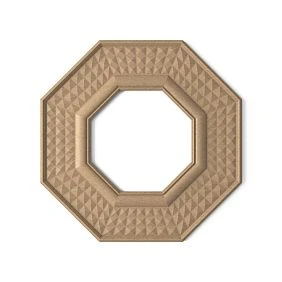
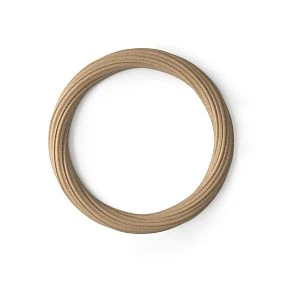
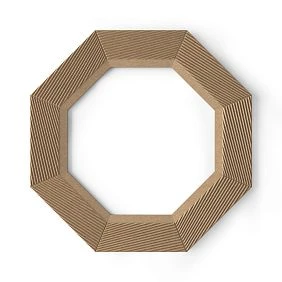
Our factory also produces:
White, gray, wood-look or paintable: what to choose
The color of the skirting board is not just about aesthetics. It is a decision about whether the skirting board will be a noticeable accent or a neutral finish. Let's break down the main options.
Get Consultation
White MDF skirting board
White MDF baseboard is the most popular option on the Russian market. It works with almost any wall: beige, gray, light green, pastel, white. A white baseboard visually "lightens" the lower part of the room, creating a feeling of cleanliness and neatness.
It looks especially advantageous MDF floor skirting board, white It looks great in combination with white door trims and white slopes — when all the "framing" of the room is done in a single color scheme, it creates a feeling of professional, finished finishing. If your doors are white or light gray, a white baseboard is almost an obvious choice.
Buy a white MDF baseboard for the floor can be purchased both in a ready-painted version and in a version for painting — more on this below.
MDF skirting board for painting
This is an option for those who want to achieve a perfect color match. Designers are increasingly working with baseboards for painting when the walls are painted in a rich color — the color of the baseboard repeats the color of the wall, and the border between them almost disappears. This creates an effect of depth and professional color work.
— is a horizontal element that frames the room at the bottom of the walls where the wall meets the floor. Skirting boards perform several functions: they hide the technological gap between the wall and floor covering (necessary for thermal expansion), protect the lower part of the wall from mechanical damage, create visual completion, and may conceal wiring. It is also chosen when you need to exactly match the shade of doors, furniture, or decorative elements. MDF for painting accepts any acrylic or alkyd paint, the surface is smooth and matte or glossy — depending on the chosen finish.
MDF baseboard in wood and oak style
When the interior features wooden doors, parquet, veneer or solid wood furniture, natural slats — a wood-style baseboard becomes a logical continuation of this theme. an MDF skirting board with a wood finish is It is made with a decorative film imitating wood texture: natural oak, bleached oak, walnut, wenge.
MDF skirting board oak — one of the most sought-after options in this category. It is especially popular in combination with laminate imitating oak or engineered oak flooring: the skirting board and floor work as a single system, creating a sense of naturalness and warmth.
If you are attracted to a real wood texture, pay attention to with a classic profile creates a sense of solidity, reliability. made of solid wood — it features a lively texture and the possibility of multiple restorations.
Gray MDF skirting board
MDF skirting board gray fits perfectly into modern interiors with a neutral or cool palette. It is relevant when there is gray porcelain stoneware on the floor, concrete walls, graphite doors, or high-tech furniture. The gray skirting board does not stand out from the context but organically completes the space.
Straight or shaped profile: which skirting board looks more expensive
This is a matter of style. And it directly affects the perception of the entire interior.
Straight MDF skirting board
Straight MDF skirting board — this is a laconic rectangular strip without relief on the front side. It has become a symbol of modern aesthetics: minimalism, Scandinavian style, modern classic, contemporary. The straight profile does not distract attention, does not compete with other interior details — it simply completes the space with a clean horizontal line.
It is important to understand: 'straight' does not mean 'cheap'. A high-quality straight skirting board in the right scale — for example, 80 or 100 mm high, with perfectly straight edges and impeccable coating — looks very expensive. This is exactly what designers choose when working with minimalist and modern projects.
Shaped profile
A shaped skirting board has relief on the front surface: a wave, a step, a heel, an S-shaped curve. This profile is characteristic of classic, neoclassical, French style, baroque. It adds detail, creates a play of light and shadow, and is perceived as a more traditional, 'interior' element.
A shaped profile works well in combination with wooden moldings on the walls, with MDF crown molding under the ceiling and with trims of a similar relief. When all elements repeat one profile, it looks like a cohesive architectural system.
Wide MDF skirting board
Wide MDF skirting board — from 100 mm and above — this is no longer just a finishing touch, but a design element. It visually "pulls together" the interior, making it complete and rich. A wide baseboard is especially relevant in living rooms with high ceilings, in hallways, studies — where scale and visual weight matter.
Interestingly, Wide Wooden Skirting Board made of solid wood in similar sizes makes an even stronger impression due to the living texture of the wood — this is an option for projects with an emphasis on naturalness and durability.
MDF baseboard price: what determines the cost
When a person searches for MDF baseboard price, they most often see a range from a few hundred rubles to several thousand per piece. Why such a range? Let's break it down honestly.
Height is the first and main factor. A 60 mm baseboard and a 120 mm baseboard with the same profile and coating will cost differently because the second requires more material.
Profile — a straight profile is simpler and cheaper to produce. A shaped one, especially with multiple radii, requires more complex milling and, accordingly, costs more.
Coating — — is a horizontal element that frames the room at the bottom of the walls where the wall meets the floor. Skirting boards perform several functions: they hide the technological gap between the wall and floor covering (necessary for thermal expansion), protect the lower part of the wall from mechanical damage, create visual completion, and may conceal wiring. In raw form, it is cheaper than painted. The finished factory coating — white, colored, wood-like — increases the price, but does not require additional costs for materials and time during installation.
The standard plank length is 2.2 m and 2.4 m. Longer planks (2.7–3.0 m) cost more, but result in fewer joints during installation, which is important for long walls.
The complexity of installation affects the final cost of work: non-standard corners, many doorways, radius walls — all this increases the number of cuts and the installer's time.
MDF skirting board price per linear meter is the correct metric for comparison. Not the price per plank, but the price per linear meter. This is how the actual cost of finishing is calculated. The final amount is determined as: price per meter × linear meters + labor + accessories (end caps, connectors, corner pieces).
If you want to select accompanying Pogonazh iz massiva — cornices, architraves, slats — this will allow you to form a unified finishing system with different materials, but in a single style.
How to calculate the amount of skirting board before purchasing
This is a practical point that many miss — and then go to the store to buy more. The formula is simple:
Room perimeter − width of doorways + 5–10% reserve
Example: room 18 m², rectangular, 4.5 × 4.0 m. Perimeter = (4.5 + 4.0) × 2 = 17 m. Doorway — 0.8 m. Total: 17 − 0.8 = 16.2 m. With a 10% reserve — about 18 linear meters.
A few nuances to consider:
-
Internal corners — usually the most numerous, each requiring two 45° cuts. A small piece goes to waste.
-
External corners — corners of protruding columns, niches, pilasters — also require cutting and can add 5–7% to consumption.
-
Long walls — if the wall is longer than a standard plank (2.2–2.4 m), a joint is needed. Plan joints in advance so they don't fall in the most visible spots.
-
Curved walls — if the room has a bay window or a rounded corner, material consumption increases sharply.
Proper calculation allows you to save on excess purchases and avoid the unpleasant situation of running out of material at the most critical moment.
Mistakes when buying MDF baseboards
Over years of practice in interior design, a consistent set of mistakes made when buying baseboards has emerged. Let's list them honestly and without unnecessary diplomacy.
Buying a baseboard that is too low for high ceilings. A 60 mm baseboard in a room with a 3.2 m ceiling looks like a thin, almost invisible strip — it doesn't anchor the space or set the scale. Ceilings above 2.8 m require a baseboard no lower than 80–100 mm.
Choosing a white baseboard without considering the door color. White baseboard + oak-colored doors is a conflict that immediately catches the eye. Before choosing the baseboard color, look at the doors, trims, and slopes. Everything should work as a system.
Not accounting for waste on corners and cutting. Buying exactly the perimeter length — and then falling short by 2–3 meters. Always add a minimum of 10% extra.
The profile is selected separately from the platbands, cornices, and moldings. A baseboard with a figured profile + straight platbands = visual disconnect. The elements must be consistent in style. If you have already chosen Wooden cornice for the ceiling, choose a baseboard in the same aesthetic.
They buy by the piece price but don't calculate the total cost for the room. A baseboard costing 400 rubles per piece sounds inexpensive. But if each piece is 2.2 m and you need 40 linear meters — that's 18–19 pieces, almost 7500 rubles just for the material without labor. Always calculate based on the price per linear meter.
They buy a baseboard without checking the availability of accessories. Connectors, end caps, internal and external corner pieces — all of these must be in stock and match the color.
What to pair MDF baseboard with in the interior
Here it's important to think systematically. The baseboard is not a separate detail but an element of a unified horizontal-vertical finishing system. What does it look like ideally?
The lower contour is the baseboard. It covers the joint between the floor and the wall, sets the scale, and fixes the lower boundary of the space.
The vertical is the door platbands. They frame the openings and visually stretch the wall upward. When — is a horizontal element that frames the room at the bottom of the walls where the wall meets the floor. Skirting boards perform several functions: they hide the technological gap between the wall and floor covering (necessary for thermal expansion), protect the lower part of the wall from mechanical damage, create visual completion, and may conceal wiring. it is done in the same color as the platbands, it works as a unified framing system.
The horizontal on the wall — Wooden planks or Wooden moldingsseparating the wall into zones. A slatted panel from the floor to a height of 90–120 cm, finished with a horizontal molding, is a classic technique that instantly elevates the level of finishing.
The upper contour — MDF Crown or Wooden cornice under the ceiling. It mirrors the baseboard: the lower contour and the upper contour, set in the same style, create the architectural integrity of the room.
Wall decor — Decorative wooden slat in a vertical rhythm creates depth and texture. Slats work beautifully in combination with polyurethane moldings and cornices — this allows for a rich decorative layer on a moderate budget.
Such a system allows you to create an interior that is perceived as professionally designed: it has rhythm, scale, material logic, and visual completeness. And it all starts with a properly selected baseboard.
MDF Baseboard for Different Rooms: What to Consider
Kitchen-living room
An open kitchen-living room space requires a unified approach to the baseboard along the entire perimeter — without breaks in the zones. An 80 mm MDF baseboard in white or a neutral color ensures visual continuity. The issue of moisture resistance is important: in the kitchen, the baseboard must have a high-quality coating that does not absorb water during cleaning.
Bedroom
In the bedroom, an MDF baseboard for the bedroom is primarily about calmness and proportion. Here you can afford white, a neutral tone matching the walls, or a wood option if there are wooden elements in the interior. 80 mm is the optimal height.
Living Room
In the living room, MDF skirting board for the living room works in tandem with the rest of the decorative system: slats, moldings, cornices. Here you can safely choose 100 mm and above — especially if the ceilings allow.
Corridor and hallway
High-traffic areas require special attention to the quality of the coating. The skirting board in the hallway suffers the most from impacts, scratches, and the mop during cleaning. Choose a skirting board with a durable coating or one for painting with wear-resistant enamel.
Where to buy MDF skirting board in Moscow and with Contact us to confirm shipping to your destination.
The commercial question — where to buy MDF skirting board in Moscow — has a simple answer: in the STAVROS catalog. Here are profiles of different heights, different colors and coatings, with the possibility of selecting related elements.
buy MDF skirting board you can online with Contact us to confirm shipping to your destination. — it's convenient and allows you to compare all options in a calm environment, without rushing. If you are also considering a natural wood option — take a look Wooden ceiling skirting board и Wide Wooden Skirting Board — this is a different price and aesthetic story, but in a number of interiors it gives the best result.
For a complete selection of the finishing system — skirting board, moldings, cornices, slats, architraves — use the section Pogonazh iz massiva: there the entire line of linear products is collected, from which a unified finish is formed.
About the Company
STAVROS is a Russian manufacturer of linear products and decorative elements from MDF and natural solid wood: oak, beech, ash. The company specializes in the production of skirting boards, cornices, moldings, architraves, decorative slats and related linear products for residential and commercial interiors.
STAVROS production is focused on European quality standards: high-density MDF of emission class E1, selected natural raw materials, modern milling and finishing equipment are used. Each batch undergoes geometry and coating quality control.
STAVROS offers both standard profiles from the catalog and custom molding production based on individual sketches and sizes. Delivery is available throughout Russia. The online store and technical consultations are available online — the company's specialists will help you select baseboards and related elements for your specific project.
FAQ: Answers to popular questions
Which MDF baseboard is better to buy — 80 or 100 mm?
80 mm is a universal option for most apartments with ceilings of 2.5–3.0 m. 100 mm looks better in spacious rooms with high doors, large furniture, and more expensive finishes. If in doubt, choose 80 mm: it fits in 80% of cases.
Should I buy a white MDF baseboard ready-made or for painting?
If you need a standard white color, a ready-made factory coating is easier to install and requires no additional costs. If it's important to match the exact color of walls, doors, or furniture, consider — is a horizontal element that frames the room at the bottom of the walls where the wall meets the floor. Skirting boards perform several functions: they hide the technological gap between the wall and floor covering (necessary for thermal expansion), protect the lower part of the wall from mechanical damage, create visual completion, and may conceal wiring.: it gives freedom of color choice.
Is MDF baseboard suitable for the kitchen?
Yes, provided the coating is of high quality. Choose a baseboard with a moisture-resistant or polymer coating, avoid unprotected raw MDF in areas where water may splash.
How to calculate the price of MDF baseboard per meter?
Look at the price per linear meter, not per piece. Multiply by the required number of meters (perimeter minus openings + 10% reserve) — and you'll get the actual cost of the material. Don't forget to add the cost of accessories and installation.
Can MDF baseboards be combined with wooden slats and moldings?
Yes, and this is one of the best techniques in modern interior design. Wooden planks they work on the wall, Wooden moldings create decorative geometry, and Baseboard MDF completes the lower contour. Together they form a cohesive architectural system.
Is MDF baseboard with a wood finish plastic or wood?
It is MDF — medium-density fiberboard — with a decorative coating that imitates wood texture. Do not confuse it with plastic: MDF is significantly denser, heavier, and easier to work with. In feel and appearance, it is close to painted wood.
How to combine MDF baseboards with oak doors?
Either choose MDF skirting board oak the same shade as the doors, or go with a white baseboard and white trim — this is a classic contrasting combination that always looks polished. Mixing a white baseboard with wood-colored trim is not recommended, as it creates a sense of incompleteness.
Can MDF baseboard be painted yourself?
Yes. — is a horizontal element that frames the room at the bottom of the walls where the wall meets the floor. Skirting boards perform several functions: they hide the technological gap between the wall and floor covering (necessary for thermal expansion), protect the lower part of the wall from mechanical damage, create visual completion, and may conceal wiring. It is designed for this. You need to prime the surface, apply 2-3 coats of acrylic or alkyd paint with intermediate drying. The quality will depend on proper preparation and tools.