










































































Article Contents:
- Why wood: arguments beyond aesthetics
- Wood species for slat wall panels: each with its own voice
- Oak
- Ash
- Walnut
- Spruce
- Thermowood
- Design options for wooden wall slat panels
- Solid wood slat
- MDF veneered
- Modular slat wall panel
- Soft wooden slat panels
- Wooden wall slat panel parameters: technical solutions with visual consequences
- Slat Width
- Gap between slats
- Installation direction
- Wood slat finishing
- Wooden wall slat panels in interior design: spaces and scenarios
- Living room: architectural statement
- Bedroom: wooden wall at the headboard
- Office: concentration and status
- Hallway: first and last impression
- Children's room: nature from birth
- Wall finishing with wooden slat panels: style codes
- Scandinavian minimalism
- Japanese wabi-sabi
- Modern classicism
- Industrial Style
- Eco-style and organic interior
- Wooden slat panel on the ceiling: the fifth dimension of interior
- Installation of wooden wall slat panels: professional approach
- Material acclimatization
- Preparation of the lathing
- Hidden fastening
- Compensatory gaps
- Final finishing
- Wooden wall slat panel care: what's needed and what's excessive
- Comparison: solid wood, veneer, and MDF wooden wall slat panels
- Wooden slat panels in interior design: adjacent elements
- FAQ: answers to key questions about wooden wall slat panels
- About the Company STAVROS

There is a difference between a wall and a surface. A wall is a load-bearing or enclosing building structure. A surface is what you see every day, what shapes the feeling of home, what speaks to you without words. A wooden wall slat panel is precisely a surface in the highest sense: living, textured, unique, capable of transforming any room from a geometric box into a space with character and soul.
This is not an exaggeration. Wood is the only finishing material that carries a biological history within it: annual rings, grain patterns, traces of seasonal changes, the uniqueness of each slat. Two adjacent pieces from the same trunk do not repeat each other. A machine will never create what nature has created over decades of growth. And when this story becomes an architectural surface—it works for the space in a way that no synthetic material does.
This article is a deep, honest, and professional guide to wooden wall slat panels: species, constructions, parameters, visual strategies, installation, care, and selection principles. For those who want a result for twenty years—not for two seasons.


Why wood: arguments beyond aesthetics
The conversation about wooden slat panels often begins with visual images—and rightly so. But let's start differently: with the physiology and psychology of perception.
Long-term research in neuroaesthetics—the science studying the brain's response to visual and tactile stimuli—shows a consistent result: the presence of natural materials in living spaces reduces cortisol levels, decreases heart rate, and improves concentration indicators. Wood works especially effectively in this context: its warm tones (beige, brown, golden) are in a range that our brain genetically associates with safety and coziness.
Tactile dimension: wooden surfaces feel warm to the touch—their thermal conductivity is lower than that of stone, metal, or plastic. When touching an oak or ash slat, the hand doesn't feel cold. This is physiologically pleasant and creates a sense of a lived-in, inhabited space.
Acoustics: solid wood absorbs and disperses sound, preventing surfaces from resonating. A room with wooden panels feels quieter and acoustically softer than a similar one with bare concrete or drywall walls.
Durability: with proper operating conditions and adequate care, woodenWooden wall slat paneloak lasts 30–50 years or more. The surface doesn't lose its properties and can be renewed by sanding and repainting without dismantling. Natural wood is the only finishing material that improves with age: patina, signs of use, darkening of the grain—all of this adds character rather than detracting from it.




Wood species for slatted wall panels: each with its own voice
Choosing the species is the first and most important decision when designing a wooden slatted wall. Different species aren't just different shades. They differ in hardness, grain pattern, reaction to finishes, and long-term behavior.
Our factory also produces:



Oak
The king of finishing wood. Brinell hardness—3.7–4.0 kN/mm². Resistant to mechanical damage, scratches, dents. Grain pattern—expressive, with characteristic medullary rays that create a large shimmering pattern on tangential cuts. On radial cuts—a calmer, parallel grain rhythm.
Oak Slat Panelunder clear oil—a honey-bronze tone with a lively grain sheen. Under white tinting—Scandinavian purity with a discernible structure. Under dark stain—noble brutality. Oak responds to any finish predictably and richly.
Get Consultation
Ash
Ash is close to oak in hardness (3.5–3.8 kN/mm²), but the pattern is different—more pronounced, graphic annual ring lines, less shimmer, more austerity. Ash's light beige base tone holds both light and dark finishes excellently. Ash is the choice for those who want wood expressiveness with a more restrained, almost graphic surface character.
Walnut
Walnut—a rare finishing material with a unique tone: chocolate-brown with a purple undertone, warm and rich. Hardness—3.0–3.5 kN/mm². Grain pattern—complex, with frequent transitions and swirls. Under clear oil, walnut looks like a luxury jewelry material. Used in premium projects: studies, meeting rooms, representative spaces.
Spruce
Softwood species (0.9–1.2 kN/mm²). Used in more budget-friendly and environmentally oriented projects: rustic style, Scandinavian minimalism, rustic. Under clear varnish — an amber-yellow tone with pronounced resinous veins. Scratches easily — not recommended for hallways and corridors with heavy traffic.
Thermowood
Wood that has undergone high-temperature treatment in an oxygen-free environment (190–230°C). As a result: a dark, rich tone (from caramel to almost black), increased biostability, reduced water absorption, stabilized geometry. Thermowood does not require protective coatings for exterior use. For interior slatted panels — a unique option with a dark tone without stain.
Structural options for wooden wall slatted panels
Wooden slat panels— is not a monolith. It is a structure where the load-bearing base and decorative slats are joined. The choice of structure determines the installation technology, cost, visual result, and long-term behavior.
Solid slat from solid wood
A slat is a cross-section sawn from a solid wooden block. Width 20–120 mm; thickness 14–25 mm; length 2000–3000 mm. Mounted on a load-bearing wall via battens or on an MDF/plywood base.
Main advantage: each slat is absolutely unique. The grain pattern — is unrepeatable. The ends — with a live wood cut, visible from the side. If the surface is damaged — sanding restores the original appearance.
Main limitation: solid wood reacts to changes in humidity. At humidity below 40% — it dries out, gaps between slats increase. At humidity above 65% — it swells. In rooms with unstable humidity, material acclimatization is required (minimum 7–14 days in the room before installation) and expansion gaps.
Veneered MDF
Slat from an MDF base with glued natural wood veneer 0.6–1.5 mm thick. Basic advantages: stability of MDF under humidity changes, precise geometry, authentic natural wood surface. The veneer reproduces all characteristics of solid wood: unique pattern, tactile warmth, reaction to coating.
MDF Slatted Wall Panel— with oak veneer — is the optimal combination for most residential interiors: natural surface with the stability of an industrial base.
Modular batten wall panel
slatted modular wall panel— is a ready-made construction: slats made of solid wood or veneered MDF are already fixed to a load-bearing base of MDF or plywood under factory conditions. The module measuring 600×2400 or 1200×2400 mm arrives on-site ready for installation. Installation speed is 2–3 times higher than with piece-by-piece slat installation. The accuracy of slat spacing and uniformity of gaps are factory-grade. This is a solution for commercial projects with tight deadlines and requirements for result uniformity.
Soft wooden slatted panels
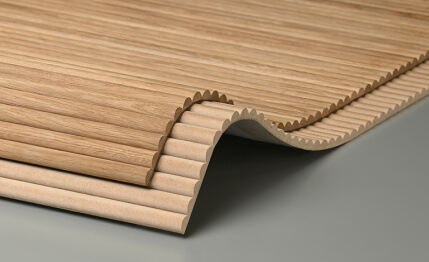
soft slat panels with wooden slats on a flexible base — a relatively new product for curved surfaces: arches, columns, rounded niches. Wooden slats on an elastic load-bearing substrate bend along a radius without destruction — something impossible with a rigid construction.
Parameters of wooden wall slatted panels: technical solutions with visual consequences
Each parameter of a wooden slatted panel is simultaneously a technical solution and a visual statement. Let's consider the key ones.
Slat width
This is the first and most visually significant parameter. Three main categories:
Narrow slat (20–40 mm): frequent rhythm, complex, ornamental surface. Creates a sense of richness and detail. In large spaces — an active, dynamic character. In small ones — risks creating overload.
Medium slat (40–80 mm): universal range. Large enough for the wood grain pattern to be clearly visible; frequent enough for the rhythm to be expressive. Suitable for most rooms and styles.
Wide slat (80–150 mm): monumental, calm rhythm. The wood grain pattern of each slat is visible in all its beauty — a wide slat allows you to appreciate the wood texture as a separate object. For living rooms with high ceilings — maximum architectural expressiveness.
Gap between slats
This is the second key parameter, which together with the slat width determines the character of the surface.
Narrow gap (5–10 mm): surface is dense, almost monolithic. Individual slats are perceived as a single mass with thin dividing lines.
Medium gap (10–20 mm): balance between the slat and the space between it. Each slat reads independently.
Wide gap (20–40 mm): structure is airy, "transparent." The supporting base or space behind the slats is visible between them — this technique is used with a dark supporting base and light slats to create maximum visual depth.
Installation direction
Vertical: classic. Slats emphasize the height of the room, guide the eye upward, create a sense of vertical spaciousness. Ideal for rooms with low ceilings — they visually "grow." In hallways and corridors, vertical slats create a sense of movement into the depth of the space.
Horizontal: slats accentuate the horizontal, visually expanding the space. In bedrooms and living rooms with normal ceiling heights — they create stability and "groundedness."
Diagonal: custom designer solution. Dynamic, unconventional character. More complex to install — more material waste when trimming around the perimeter.
Wooden slat finish
The choice of finish determines the long-term behavior of the wooden surface no less than the choice of wood species.
Clear oil (hard wax oil): penetrates the fiber structure, does not create a film on the surface. Wood "breathes," retains natural texture and tactility. If damaged — local restoration without dismantling: sand the damaged area, apply oil. Regular renewal every 3–5 years — standard maintenance.
Toning + oil: oil with pigment. Changes the tone of the wood while maintaining transparency — the grain pattern remains visible through the tint. White tint on oak — Scandinavian style; gray — industrial; cognac — classic.
Matte enamel (opaque): covers the wood grain pattern, turning the wooden slat into a colored volume. Used in projects where color, not texture, is important. Slats for painting are a classic example.
Varnish: creates a protective film on the surface. More resistant to mechanical impact than oil. Semi-matte varnish is a compromise between protection and preserving the natural look. Glossy varnish on wooden slats is a specific solution for spaces with a high risk of soiling.
Wooden wall slat panels in interior design: spaces and scenarios
Living room: an architectural statement
The living room is the central space of the home. It is here that the woodenSlatted wall panelunfolds to its full potential. An accent wall behind the sofa is a classic solution: oak slats 50–80 mm wide, 14–20 mm gap, transparent oil, dark backing. With side evening lighting, the slats cast soft shadows — the surface acquires a sculptural character.
Advanced technique: integrating LED strip into the gap space, at the level of the backing. Warm light 2700 K illuminates the slat ends from bottom to top — and in the evening, the wall becomes an independent source of architectural light. This effect cannot be achieved with any other material with the same intensity.
Bedroom: a wooden wall at the headboard
A headboard made of wooden slats is a solution that combines the function of an architectural detail and tactile comfort. Oak slats 30–50 mm, delicate gap 8–12 mm, tinted in a soft warm tone. LED strip behind the slats — a source of diffused evening lighting for reading.
In the bedroom, the woodenSlatted wall panelIt works on the psychological sensation of seclusion and coziness. The tree at the headboard is a biophilic design technique, based on the innate human inclination towards natural materials in a rest space.
Office: Concentration and Status
A study requires an atmosphere where thinking comes easily and speaking persuasively. The dark tones of the wooden slats—anthracite stain on ash, thermowood, fumed oak—create a psychological backdrop for concentration. The slats are wide (80–120 mm), with a calm and confident rhythm. Behind the desk—such a wall speaks of its owner's character and taste without a single word.
An important bonus: wooden slats disperse sound, reducing reverberation in the study. Negotiations in a room with wooden walls—an acoustic comfort that is felt but rarely consciously acknowledged.
Hallway: The First and Last Impression
The hallway is an interior handshake. The first three seconds in an apartment form an impression that lasts the entire visit. Vertical wooden slats on a long corridor wall—an architectural rhythm that guides the gaze inward and immediately imparts three qualities to the space: warmth, depth, and respect for the guest.
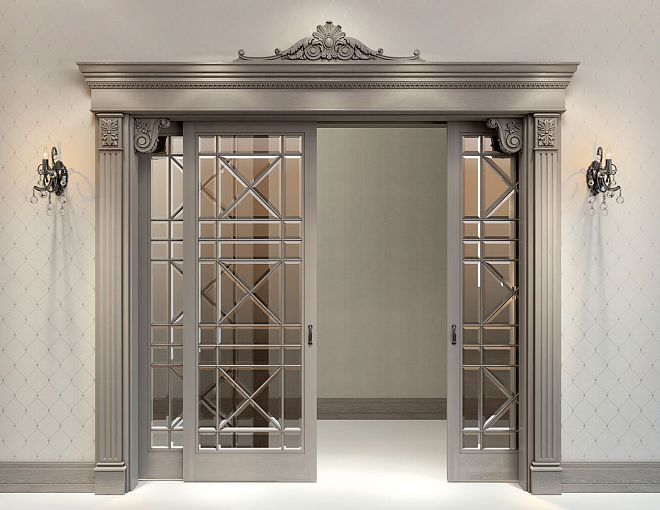
In combination withwooden floor baseboardmade from the same solid wood,wooden casingson the doors—a wooden hallway becomes a unified architectural space, not a collection of disparate details.
Children's Room: Nature Nearby from Birth
Wooden wall slat panels in a child's room are not just aesthetics. It's a biophilic principle: the presence of natural materials in a child's environment fosters a deeper connection with nature and ensures better neurocognitive indicators. The most crucial condition: only environmentally friendly coatings—solvent-free water-based oils, certified for children's rooms.
Light tones (white stain on oak, Scandinavian pastel gray), slats narrow and frequent—a lively, cheerful rhythm. The lower tier of slats can be done in a contrasting tone—creating a visual division of the wall, which simultaneously functions as a protective strip in the active play zone.
Wall Finishing with Wooden Slat Panels: Style Codes
Wall finishing with slatted panelsWood works across a wide stylistic range — and this is one reason for the product's enduring popularity.
Scandinavian minimalism
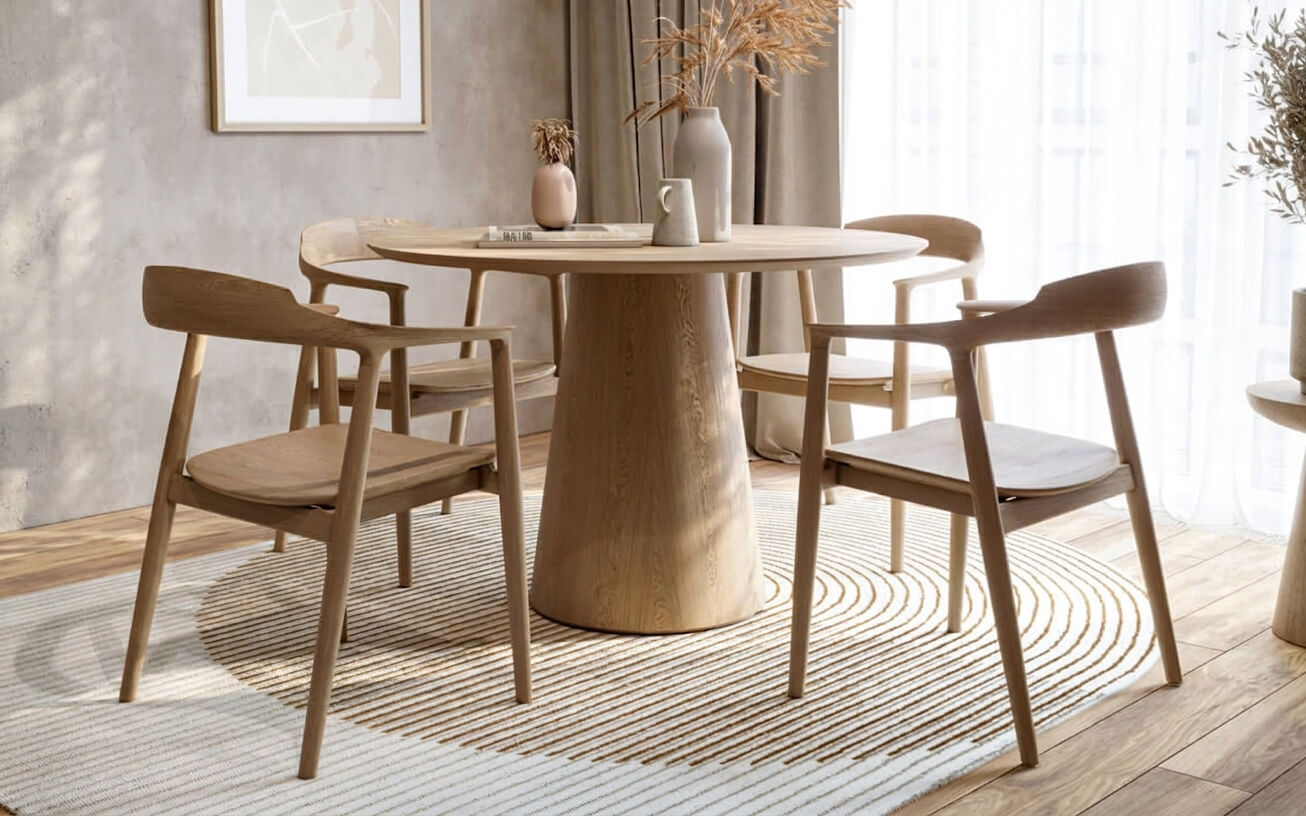
Oak or ash with white or light gray tint. Medium slats (40–60 mm), moderate gap (10–16 mm). The load-bearing base is white MDF. Furniture made of light wood, linen textiles, a monochrome color scheme. Here, the wooden slats are not an accent, but the very fabric of the interior.
Japanese wabi-sabi
Thermowood or oak with a dark tint in the spirit of shou-sugi-ban (charred wood). Wide slats (80–120 mm), irregular rhythm (intentionally variable spacing), maximally transparent coating that allows you to see natural cracks and irregularities. Imperfection is elevated to a principle — and becomes the main value of the surface.
Modern classic
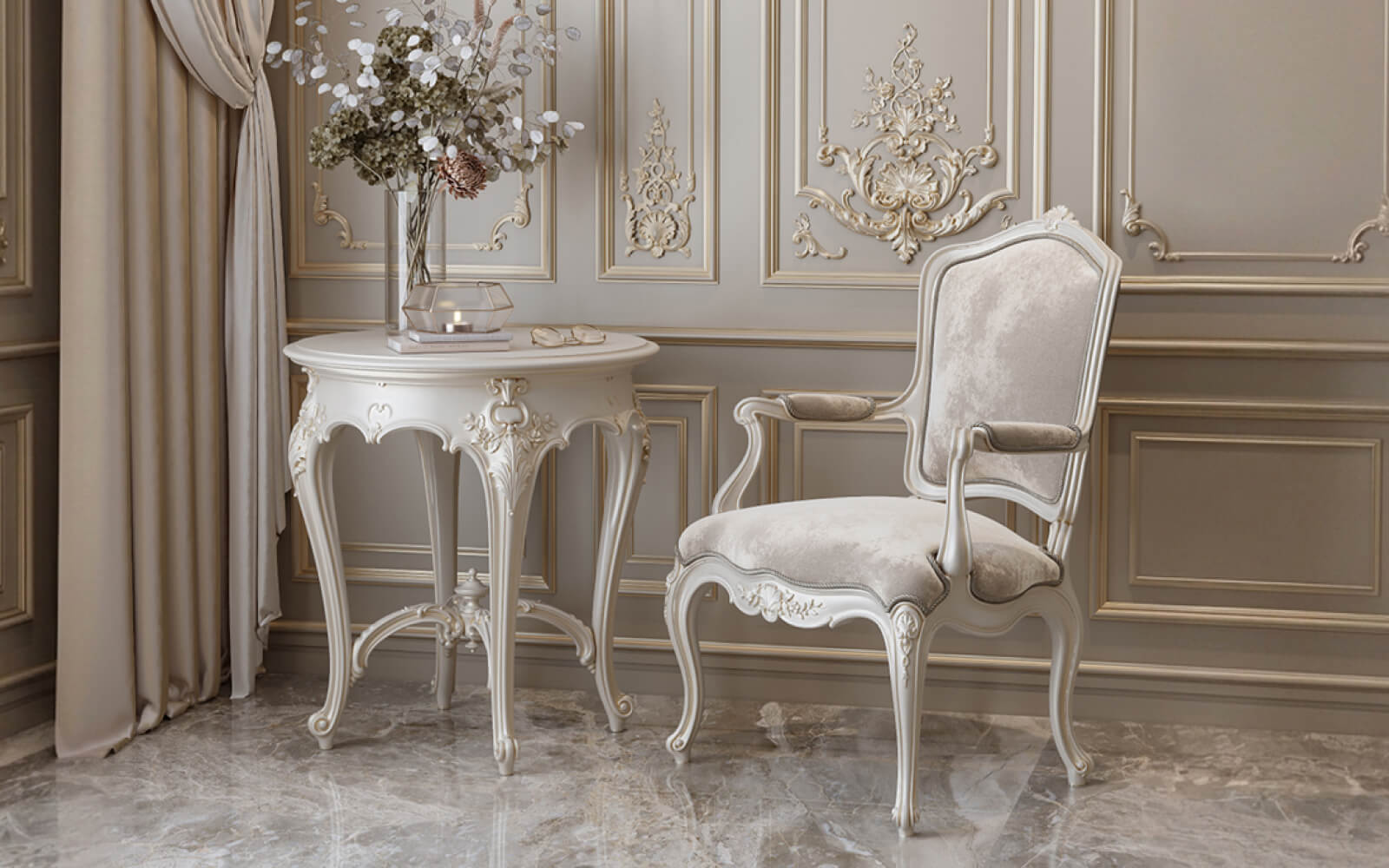
Oak with transparent oil or a warm honey tint. Medium and wide slats with a chamfer — the beveled edge creates an additional shadow pattern at the joint. An ornamental frame composition on the wall — slats frame rectangular or arched fields. In combination withclassic furnitureand quality textiles — a space of academic warmth and dignity.
Industrial style
Thermowood or oak with a charcoal tint. Slats of varying widths in a variable rhythm. Exposed metal fasteners — a decorative element, not hidden construction. In combination with a concrete floor, metal lighting, and a textured ceiling — a brutal power, where wood works as a warm counterbalance to cold materials.
Eco-style and organic interior
Maximally natural wood with minimal processing: oil without dyes, live edges of the slats, bark on individual elements. Mixing species — ash and oak in the same rhythm. This style requires professional confidence in the designer's hand: the 'randomness' must be intentional and thoughtful.
Wooden slatted panel for the ceiling: the fifth dimension of the interior
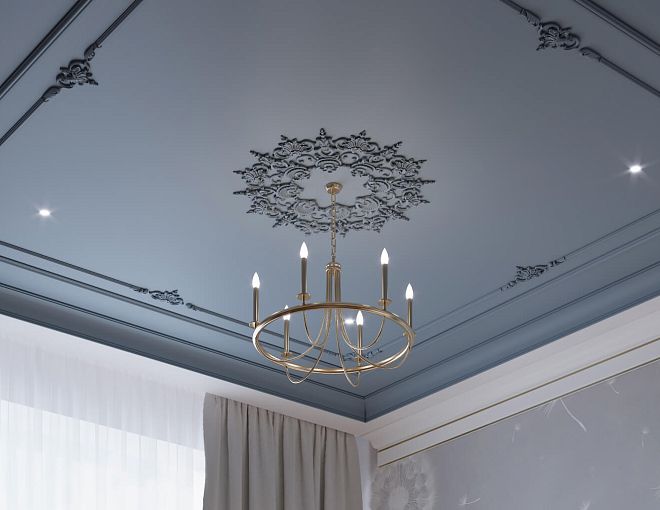
Batten panels for ceilingsWooden slat ceilings are a solution that radically changes the perception of height and volume in a room. A wooden slat ceiling creates a feeling of cozy, 'wrapped' space—the opposite of the cold white panels of a standard suspended ceiling.
In a living room with a wooden slat ceiling above the sofa area, it serves as an architectural canopy, psychologically highlighting the relaxation zone. In a restaurant, it's an atmospheric element that guests remember on an emotional level, not through rational description.
Technically: installing wooden slats on a ceiling is a more demanding task than wall installation. The supporting structure must bear the weight of the wood: an oak slat measuring 60×20 mm and 2700 mm long weighs about 1.5–1.8 kg. For 1 m² of ceiling with a 15 mm gap and a slat width of 60 mm, the weight is about 10–12 kg. This is a standard load for a metal suspended frame.
Installation of wooden wall slat panels: a professional approach
installation of slatted panelsInstallation of solid wood and veneered MDF slats is a responsible process where each stage affects the final result.
Material acclimatization
Solid wood must be acclimatized in the room before installation—at least 7–14 days at normal humidity (40–65%) and temperature (18–22°C). The slats are unpacked and laid horizontally, with spacers in between for free air circulation. Neglecting acclimatization is a direct path to deformation and gap misalignment after installation.
Preparing the battening
Battening made of 40×50 mm timber or metal profile. It is set strictly in plane—using a laser level. The spacing of battening elements perpendicular to the direction of the slats is 400–500 mm. Wooden battening is treated with an antiseptic—this is not optional, it's standard.
For wooden slat panels, wooden battening is preferable to metal profiles: the same material means the same reaction to changes in humidity and temperature. Metal battening expands and contracts differently than wooden slats under significant temperature fluctuations—this can create creaks and stress in the structure.
Hidden fasteners
Wooden slats are attached to the battening using a hidden method—through special clips or through the side edge of the slat at an angle (the 'nailing' method). Open fastening through the face of the slat is only for budget and utility projects where aesthetics are secondary.
How to install slatted panelswith maximum aesthetics — this is a separate professional issue, covered in detail in a specialized guide. The key rule: fasteners should not be visible from the front side under any lighting angle.
Expansion gaps
At end walls, floor, and ceiling — an 8–12 mm gap. Solid wood reacts to seasonal changes in humidity and temperature: in summer at 60–70% humidity, the slats swell slightly; in winter in a heated room at 30–40% humidity — they dry out. The expansion gap is the space for this movement. Without it — deformation, buckling, and structural failure.
Finish
If slats are installed without a final coating (e.g., for on-site painting), after installation, light sanding along the grain with 180–220 grit is performed. This removes installation marks and raised fibers. After sanding — apply oil, stain, or enamel as per the project.
DIY Batten Panelsare quite feasible with basic construction skills and the right tools. The main requirement for DIY installation is a laser level, precise battening, and patience when installing the first slat.
Care for wooden wall slat paneling: what's needed and what's unnecessary
Wood doesn't require complex care — it requires proper care. The difference is fundamental.
Oil finish: an annual or biennial renewal procedure. Applying a thin layer of hard wax oil with a soft cloth and polishing. This is 30–40 minutes of work for a 10 m² wall — and the surface looks like on the day of installation for another twenty years.
Varnish finish: more resistant to mechanical impact, but if deeply damaged, requires local sanding and application of a new coat. Complete revarnishing — every 8–12 years with intensive use.
Daily care: dry or slightly damp soft cloth along the grain. No abrasive agents. No aggressive cleaning compounds.
Stains: immediate removal — wood absorbs liquids through unsealed pores. Use a dry absorbent cloth, then a mild neutral cleaner.
Humidity control: the main contribution to the longevity of a wooden surface. An air humidifier in heated rooms in winter is not a whim but real protection for wooden finishes from cracks and deformation.
Comparison: solid wood, veneer, and MDF wall paneling
| Parameter | Solid wood | Veneered MDF | MDF for painting |
|---|---|---|---|
| Surface texture | Unique, natural | Unique, natural | No (solid color) |
| Stability under humidity changes | Medium | High | High |
| Repaintability | Yes (sanding + new coating) | Limited | Yes, without dismantling |
| Service life | 30–50+ years | 20–30 years | 15–25 years |
| Tactile quality | Maximum | High | Average |
| Acoustics | Absorption and dissipation | Absorption | Absorption |
| Ecological | Maximum | High (E0) | High (E0) |
| Price | High | Medium–high | Medium |
Wooden slat panels in interior design: adjacent elements
A wooden slat wall works most expressively when surrounded by related materials. The logic of a unified wood theme throughout the space is not necessarily literal, but fundamental.
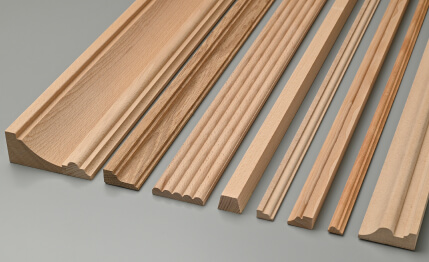
Pogonazh iz massiva— baseboards, cornices, moldings — in the same tone as the slats completes the structure and creates a sense of architectural integrity.Wooden baseboard— made of solid oak at the base of the slat wall — is a detailed transition from floor to wall that a professional designer never ignores.
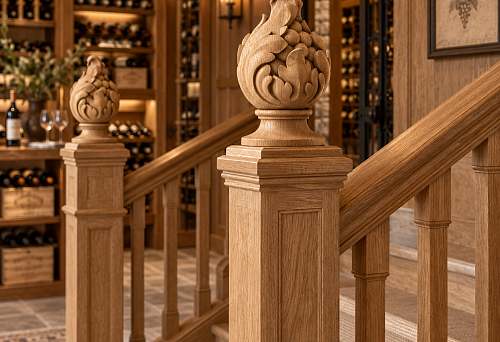
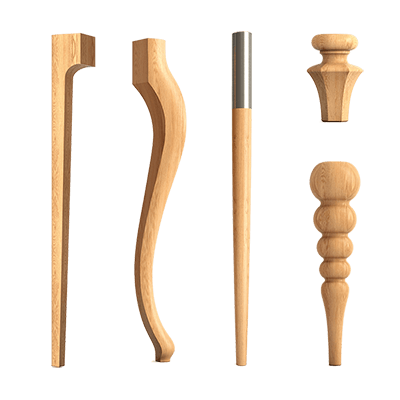
Furniture HandlesNatural wood on built-in cabinets is a tactile detail that connects the furniture with the wall covering.balusters for staircases— made of the same oak on the staircase next to the wooden slat wall — is a unified material world that connects the space vertically. If the style suggestsWooden planks— in decorative frames or moldings —wooden skirting board purchase— made of solid oak in the same profile as the moldings — is an architectural gesture that anyone who understands details will notice.
FAQ: answers to main questions about wooden wall slat panels
What is a wooden wall slat panel?
This is a construction of longitudinal wooden slats (battens) fixed to a load-bearing base or lathing with uniform gaps. The slats are made from solid wood, veneered MDF, or composite materials. The construction creates a textured architectural surface with a pronounced rhythm and the texture of natural wood.
What type of wood should I choose for a slatted wall?
Oak is the most versatile choice: high hardness, expressive grain, wide range of finishes. Ash has a more strict, graphic character. Walnut is a premium, chocolate tone for studies and representative spaces. Pine is for rustic and eco-styles with moderate requirements for mechanical strength.
What gap should I leave between the slats?
It depends on the task. 5–10 mm — a dense surface with light articulation. 10–20 mm — a balance of slat and space, a universal option. 20–40 mm — an airy, deep construction with contrast between the tones of the slat and the base. Acoustic constructions require a gap of at least 30% of the pitch.
Is acclimatization needed before installation?
For solid wood — mandatory, 7–14 days in the room. For veneered MDF — 48–72 hours is recommended. Without acclimatization — risk of deformation, cracks, and gap divergence after installation.
How to care for wooden slat panels?
A dry or slightly damp soft cloth along the grain. For oil finish — renewal every 1–2 years. Control room humidity: 40–65%. Immediate removal of stains. No abrasives or aggressive chemicals.
Can wooden slatted panels be installed independently?
Yes, with basic construction skills and a laser level. The most crucial step is precise lathing and proper material acclimatization. Installing the first slat requires maximum care — the entire row follows from it.
Can I repaint a wooden slatted wall?
Yes. With an oil finish — sanding the existing finish and applying a new tone. This is the main long-term advantage of solid wood over synthetic materials. Complete color change: sanding, priming, finishing coat — without dismantling.
Are wooden slat panels suitable for wet areas?
Not recommended for bathrooms with constant steam and splashes. For kitchen areas away from the sink — with high-quality oil or varnish coating. If you want natural wood in the bathroom — solid thermowood with oil impregnation, provided there is good ventilation and quick drying of the room after use.
How much does a wooden slat wall cost?
Price depends on wood species, construction, and coating. Reference: veneered MDF in the mid-range segment — 4000–8000 rub./m² with installation. Solid oak with high-quality coating — 8000–20000 rub./m² depending on project complexity.
Why are wooden slat panels better than wallpaper?
Relief, texture, tactility, durability (20–50 years vs. 5–10), eco-friendliness of natural material, uniqueness of each slat, and the ability to update without complete dismantling. Wallpaper is a two-dimensional imitation; wooden slats are three-dimensional architectural reality.
About the company STAVROS
If you are looking for a wooden wall slat panel backed by precise production, honest materials, and accountability for results — STAVROS is exactly that partner.
STAVROS is a Russian manufacturer of architectural wooden elements for interiors. Full production cycle: own equipment, strict quality control, wide range of coatings and wood species. In the catalog:Wooden slat panelsfrom oak, ash, and thermowood;Slatted wall panelsin a wide range of parameters;slatted modular wall panelfor commercial projects;soft slat panelsfor curved surfaces;Slatted Façade Panelsslatted panels for exterior applications;Pogonazh iz massivafor final tying of structures;Wooden baseboardfrom solid wood and MDF;Furniture Handlesmade from natural wood;balusters for staircaseshandcrafted;Classic Furniturefor demanding projects.
STAVROS works with private clients, designers, and architects. Samples, consultation, delivery, and support — from the first question to the final result. The space where wood lives is a space where you want to live. Choose STAVROS.