Article Contents:
- Why an open shelf against a slatted wall looks unfinished
- Where exactly the boundary should be visible
- Why a regular end edge doesn't always work
- How to understand that the problem is specifically the unfinished edge
- The smooth part of the wall should remain a full-fledged zone
- What the four dimensions mean
- A calm profile shape instead of fine ornament
- "Standard" and "Prestige" are not two different forms
- Under the enamel does not mean already painted
- What the card does not confirm
- Three levels of transition
- Where the visible profile is located relative to the end
- How the profile guides the eye from horizontal to vertical
- Why the bracket should not be placed on the front surface of the slats without checking the base
- Negative space between the bracket and the slats
- Do not cover the profile with the contents of the shelf
- Why a complex baguette nearby is usually unnecessary
- How to check the edge in three everyday angles
- How to separate real incompleteness from unfamiliar emptiness
- What should remain visually dominant
- Paint in the color of the shelf
- Tie in with painted panels
- Contrasting beech bracket
- The degree of gloss changes the relief
- When to paint: before or after installation
- "Under enamel" does not cancel the test coat
- Connection through the wood species, difference through form
- Three scenarios for oak tone
- Why the screen is not suitable for selecting oak
- The wood grain should not compete with the slats
- Oak is not mandatory just because the panels look wooden
- In the narrow field between the shelf and the panels
- At the active end of the shelf itself
- With a fine contrasting wall pattern
- When there are many small items on the shelf
- If the profile is barely visible
- In an interior where any decorative support is unnecessary
- When a more restrained bracket is needed
- 1. Exact article number and size
- 2. Drawing A × B × C × D
- 3. Actual location on a smooth wall
- 4. Difference between the smooth wall and the slats
- 5. Base and independent load-bearing system
- 0. Color and degree of gloss
- 11. Compatibility with lighting
- 12. Shelf contents
- 13. Completeness and fasteners
- 14. Current cost and timeframe
- 15. Packaging and acceptance
- 16. Final layout
- Assembly sheet: one sheet instead of verbal agreements
- Acceptance sample before finishing the entire batch
- Short order checklist
- Consider KR-039 a guaranteed load-bearing support
- Choose an option based on the initial price on the card
- Take 'under enamel' as a ready white color
- Mount only to decorative slats
- Place the profile flush against the first slat without a mockup
- Cover KR-039 with objects
- Add a baguette, overlays, and complex edging at the same time
- Selecting oak by photo
- Not distinguishing between "Standard" and "Prestige"
- Not opening the drawing
- Counting production time as the time of the finished assembly
- Buying a profile that is not visible
- Is KR‑039 suitable only for classic interiors?
- Can KR‑039 be placed directly on a slat panel?
- Do I need to cover the end of the panel itself with the bracket?
- Is the "enamel" version already painted?
- How is "Standard" different from "Prestige"?
- What material is best next to painted slats?
- Can oak be left without coating?
- How can I check KR-039 before purchasing if there is no sample?
- Can the bracket be turned the other way?
- What should I do if the bracket almost touches the first slat?
- Will KR-039 work for a shelf with lighting?
- Is the mounting hardware included in the product listing?
- What load can KR-039 support?
- Can KR-039 be used only as a decorative end cap?
- Will the same color look identical on the shelf and the bracket?
- Can I order KR-039 in a different size?
- How long does manufacturing take?
- What to do if the KR‑039 looks too active after the mockup?
- Is additional carved decor needed next to the shelf?
- How should I phrase the order to the manager?
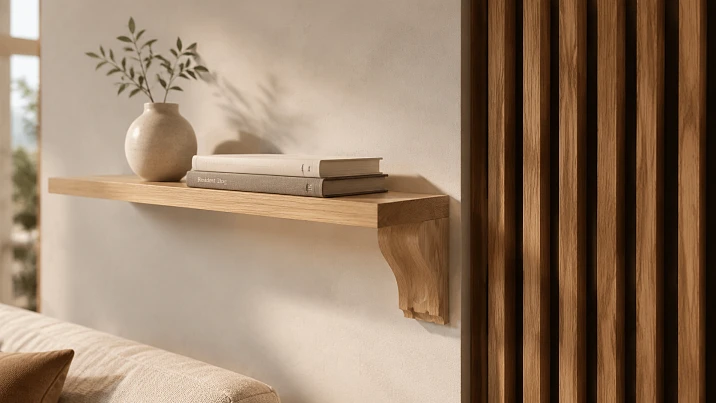
An open shelf that ends right before the slat panels often looks as if it was accidentally cut off. The horizontal plane reaches the strong vertical pattern of the wall and breaks off without a detail that would explain the transition. It is not necessary to redo the entire finish or extend the shelf onto the slat section. The visible wooden bracket KR‑039 can be used as a finishing sign: its profiled shape gathers the edge of the shelf, creates a clear vertical support under the horizontal line, and separates the furniture composition from the rhythm of the slats.
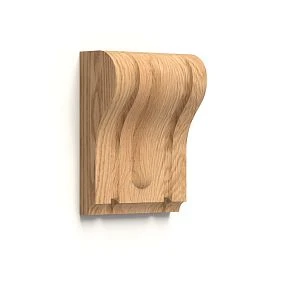
For this scenario, a specific version of 108 × 80 × 43 × 20 mm is considered, not the bracket category in general. KR‑039 has no fine floral ornament that would conflict with the frequent pattern of the panels. Its silhouette features a smooth curve, sequential steps, and a profiled lower edge. This geometry is noticeable enough to mark the end of the shelf, but with thoughtful finishing it does not have to become the main decorative object of the room.
The purchase is justified under three conditions. The bracket is actually visible from the main viewing points. Its shape is not obscured by items on the shelf and does not collide with the baseboard, switch, door trim, or protruding slats. The installer confirmed a reliable independent base and the shelf mounting system: the KR‑039 card does not specify the allowable load, so the decorative element cannot automatically be considered the only load-bearing part.
If these conditions are met, KR‑039 helps complete the open edge without overload. If the bracket hides in the shadow, ends up behind a vase, or is installed only on the front surface of decorative slats without a verified base, the beautiful profile will not solve either the compositional or the technical problem.
Why an open shelf near a slat wall looks unfinished
A smooth wall and slat cladding have different visual logic. A smooth surface is perceived as a calm field on which a horizontal shelf reads as an independent object. Slat panels are built on the repetition of verticals, shadow gaps, and protrusions. When the shelf ends at the point where these two systems meet, the eye looks for a detail that will explain the boundary.
Without such a finish, several effects arise at once:
-
the end of the shelf looks technical, even though the entire structure is in plain view;
-
the horizontal line seems interrupted by the panels, rather than deliberately completed before them;
-
the edge of the shelf and the first slat compete for the role of the boundary;
-
the shadow under the shelf breaks off without a vertical continuation;
-
even expensive materials can be perceived as the result of an unfinished junction.
The problem is especially noticeable if the shelf is light and the gaps between slats are dark. The contrasting vertical literally "cuts off" the horizontal plane. With similar shades, the reason is different: the shelf, bracket, and panels merge into a common wooden patch, and the endpoint is lost.




Where exactly the boundary should be read
The composition has three possible ending lines. The first is the end of the shelf itself. The second is the outer contour of the visible bracket. The third is the edge of the slat cladding or the first full slat. If all three are in random places, the viewer sees a set of mismatched ledges. If their mutual position is set in advance, the transition looks designed.
This does not mean that the edges must coincide to the millimeter. Sometimes the bracket recedes slightly from the end and creates a visible overhang; sometimes its outer contour becomes the main vertical, and the shelf protrudes forward. What matters is different: the offset should be the result of a drawing, not a leftover space after panel installation.
Before ordering, photograph the node frontally and at an angle. In the photo, draw three lines: the end of the shelf, the intended edge of KR-039, and the start of the slats. If a clear stepped composition forms between them, the profile will be able to complete the horizontal. If the lines overlap each other and turn into a tight bundle, first clarify the layout.
Our factory also produces:
Why a regular end is not always sufficient
A neatly finished shelf end can be sufficient on a smooth wall. Next to the slats, it remains a small flat edge against a strong textured background. The eye jumps from the horizontal straight to the verticals, barely pausing at the edge.
KR-039 adds an intermediate scale. The shelf remains the largest horizontal plane, the slats form a repeating background, and the bracket creates a local transition point. Its task is not to mask the end, but to give the termination architectural logic: above is the horizontal, below it appears a assembled profile volume, and then the vertical rhythm of the wall begins.
Get Consultation
How to understand that the problem is specifically an unfinished edge
Not every unsuccessful shelf needs a decorative bracket. Conduct a simple test:
-
remove all decor from the shelf;
-
align the frame so that the shelf and the boundary of the panels are visible;
-
temporarily cover the technical end with plain paper matching the shelf color;
-
add a cardboard silhouette of KR-039 in scale under the edge;
-
compare two photos from the same point.
If with the silhouette the edge becomes clearer and the shelf no longer looks cut off, the scenario is chosen correctly. If the composition barely changes, the reason may be something else: incorrect length of the shelf itself, random position relative to the panels, excessive number of items, poor lighting, or a color conflict.
The bracket should not be used as a universal "patch." It is valuable when it truly explains the transition from horizontal to verticals.
The smooth part of the wall should remain a full-fledged zone
Since the shelf is located on a smooth section, it is logical to perceive the bracket as part of this furniture composition. It is not a profile for closing the end of a slatted panel and should not replace a special solution for the edge of the cladding. If the panels have an unfinished end, first design the panel joint itself, and then place the shelf and KR‑039 next to an already clear boundary.
Such separation prevents a common mistake: trying to use one product to simultaneously hold the shelf, cover a construction joint, hide the panel end, and create decor. The more unrelated functions are assigned to a small part, the higher the risk that none will be solved cleanly.
Wooden bracket KR‑039 108 × 80 × 43 × 20 mm: what the card confirms
On the STAVROS website, KR‑039 is designated as a wooden bracket. The card contains several sizes, but this article only uses the selected version A × B × C × D = 108 × 80 × 43 × 20 mm. Comparing it with other dimensions and selecting a size range is not required: the task is to understand how a specific profile works at the visible edge of the shelf.
| Parameter | Confirmed data | Practical meaning before ordering |
|---|---|---|
| Name | Wooden bracket KR‑039 | The application must include the article number to avoid confusing the profile with similar models. |
| Selected size | 108 × 80 × 43 × 20 mm | Values A, B, C, and D are checked against the drawing, not deciphered by guesswork. |
| Material | Beech or oak | The wood species is chosen together with the future finish of the shelf and wall. |
| Sanding quality | "Standard" or "Prestige" | These are surface preparation options, not color names. |
| Preparation of the selected configuration | For enamel | The blank is intended for opaque finishing and is not a finished painted product. |
| Availability | Custom Order | Before payment, you need to confirm the selected wood species and sanding quality. |
| Average production time | 5–10 days | Approval, finishing, and delivery are added to the production time. |
| Delivery | CDEK within Russia | Shipping cost and schedule are confirmed upon ordering. |
Prices in the text are not fixed: they change, and the product card simultaneously shows different materials and finishing options. Before ordering, you need to open the selected combination and check the current price.
What the four dimensions mean
The line 108 × 80 × 43 × 20 mm by itself does not show which parameter refers to height, projection, thickness, or a separate ledge. The card labels them with letters A, B, C, and D, so the product drawing becomes the working document. Download it and pass it to the designer or installer.
You cannot build a mounting assembly based on the assumption that the first number is always the height, the second is the depth, and the last two are the thicknesses of specific sections. Even if such an interpretation seems obvious from the photo, a graphic reference is needed for marking.
The drawing is required not to choose a different size, but to verify the already selected KR‑039 in a specific location. It helps to see:
-
how the profile is positioned relative to the bottom surface of the shelf;
-
where its most protruding section runs;
-
what contour will be next to the first rail;
-
whether the bottom edge conflicts with a switch, outlet, or baseboard;
-
what surface will the installer get for coordinating the mounting.
A calm profiled shape instead of a fine ornament
Based on the image of product KR‑039, it reads as a profiled wooden element with a smooth line and a stepped lower finish. This is fundamental for a wall with slats. A frequent floral ornament would add many new lines next to an already active vertical pattern. KR‑039 has large contour changes, so it is perceived from a distance and does not require examining small details.
The term "carved bracket" in commercial wording should not create an expectation of openwork floral carving. In this model, the decorativeness is based on the silhouette and profiling. That is why it can be introduced between a calm shelf and modern panels without an obligatory stylistic conflict.
"Standard" and "Prestige" are not two different shapes
In the product card, the same geometry is available with different sanding quality. On the STAVROS information page, "Standard" is described as machine sanding, and "Prestige" as detailed hand sanding. These designations cannot be turned into names of wood grade or finished coating.
The choice depends on the finisher's requirements and the visibility of the part. KR‑039 is located at the edge of the shelf, so side transitions and the profile may catch sliding light. Such light reveals risks, local unevenness, and preparation quality more strongly than frontal uniform lighting. Before ordering, it is useful to discuss with the painting workshop which option it accepts for work and which preparatory operations are included in its cost.
A detailed explanation is provided on the page sanding quality of wooden decor. You need to check specifically the selected item in the commercial offer: the presence of the words "beech" and "for enamel" does not yet indicate whether "Standard" or "Prestige" was ordered.
Under enamel does not mean already painted
The card confirms preparation for enamel. This means orientation towards opaque finishing, not the presence of white or another ready color. The budget separately accounts for primer, finish system, labor, test coating, and possible interlayer preparation.
If the project involves visible wood texture, it cannot be automatically assumed that any KR-039 option in oak is supplied with the appropriate preparation for transparent coating. It is necessary to select a specific option in the card and confirm it with the manager. The characteristic of one selected execution does not transfer to all combinations of material and finish.
What the card does not confirm
The page does not contain the permissible load specifically for KR-039 of the selected size, nor a ready technical scheme for attaching this shelf to a specific wall. Therefore, from the name "bracket" it cannot be concluded that one element will independently hold the shelf with any contents.
In the project, two issues should be separated:
-
how the shelf is securely fixed to the base;
-
what decorative role the visible KR-039 plays.
Sometimes these functions can be combined in one unit, sometimes a hidden load-bearing system is necessary, and the wooden profile remains a visible finishing touch. The decision is made by the furniture designer or installer after checking the wall, shelf, and intended use. The article does not assign fasteners or calculate load.
Once the material and location are confirmed, you can buy wooden bracket KR-039 in the product card. Before payment, select the size 108 × 80 × 43 × 20 mm again: the page contains other options as well.
How a carved shelf bracket completes the horizontal line before vertical slats
KR-039 works not as a separate wall overlay, but as part of the shelf silhouette. The upper horizontal line receives a vertically oriented profile beneath it, so its ending no longer looks random. The visual logic resembles punctuation: the shelf ends not with emptiness, but with a clear sign before the beginning of another system — the slat wall.
Three levels of transition
In a successful joint, three scales are read simultaneously:
-
Large: the overall horizontal of the shelf and the vertical field of panels.
-
Medium: the silhouette of KR-039 under the visible edge.
-
Fine: profile ledges, shadows, and the quality of wood finishing.
If you remove the medium level, the shelf collides with the panels too abruptly. If you overload the fine level with molding, overlays, fluting, and carving, the bracket ceases to be a transition and turns into a decorative ensemble that competes with the slats.
KR-039 is appropriate because it provides a medium scale with a large contour. It does not need to be accompanied by additional ornamentation just for a "rich" look.
Where is the visible profile located relative to the end face
The position cannot be assigned as a universal rule, but three compositional schemes can be compared.
| Diagram | What it looks like | When possible | What to check |
| The bracket visually aligns with the edge line | A clear vertical finish is achieved | When the drawing and construction allow a clean alignment | Does a conflict arise with the first rail and the shelf end |
| The shelf has a controlled overhang | The horizontal line slightly extends beyond the profile | When a lighter furniture silhouette is needed | The overhang should look intentional from all angles |
| The bracket recedes inward | The end remains a separate visible face | When the shelf edge is well finished and a shadow gap is needed | Does the profile not look accidentally shifted |
The table describes visual options, not installation standards. The actual position is determined by the construction. The main goal is to choose one logic and show it on the elevation before manufacturing the shelf.
How the profile transitions the eye from horizontal to vertical
The shelf sets a direct left-to-right movement. At its end, the eye meets the smooth curve of KR-039, then the stepped lower edge. The perception speed decreases: instead of an abrupt cutoff, a short sequence of transitions appears. After it, the vertical slats are perceived as the next independent fragment of the wall.
This effect is especially noticeable with side lighting. The shadow under the shelf continues on the profile and gradually changes depth. However, overly harsh lighting can create several sharp shadow bands near the slats. Therefore, lighting is checked on a mockup, not assuming that any profile will automatically become expressive.
Why the bracket should not be installed on the front surface of the slats without checking the base
Slats and slat panels are decorative finishes. Their front plane does not confirm the presence of a load-bearing base at the required point. If you install a shelf or visible bracket only based on the relief, without knowing the wall construction, the fastening may end up in a void, soft backing, or an element not intended for such work.
Before ordering, the installer must determine:
-
where the slat cladding ends;
-
what the smooth part of the wall is made of;
-
whether there is an embedded element or other suitable base behind the finish;
-
what system actually holds the shelf;
-
whether KR‑039 can be placed on a smooth surface without cutting the slats;
-
whether the thickness difference between the smooth area and the panels interferes.
KR‑039 in the scenario under consideration refers to a shelf on the smooth part of the wall. It is not automatically intended for installation over protruding slats and does not cover their end. If the designer wants to extend the profile onto the cladding, that is a different assembly that requires a separate drawing.
Negative space between the bracket and the slats
Sometimes the best transition is created not by a tight fit, but by a small calm section of smooth wall. Such a gap separates the KR-039 profile from the frequent verticals and allows its contour to be seen. If you place the bracket flush against the first slat, the smooth curve may intersect with the straight line and get lost.
The size of the gap is not set by the article: it depends on the drawing, lighting, and wall scale. You can check it with a paper template. Cut out the front contour of KR-039 at a 1:1 scale, secure it with masking tape under the edge of the shelf, and sequentially shift it relative to the panels. Take photos from the main viewing point. On the screen, it is easier to notice where a clear boundary appears and where details blend together.
Do not cover the profile with shelf contents
A tall vase, a hanging plant, a stack of books at the very edge, or a lamp cable can visually cross the bracket. Items do not need to be removed completely, but their position must be included in the layout. An open shelf rarely remains empty, so evaluating the bare product without future contents gives too optimistic a result.
It is better to leave a calm group near the visible edge: one object, a few books with a flat spine, or an empty field. Then KR-039 will mark the ending, and the decor will not turn the node into a set of small contours.
Why a complex molding nearby is usually unnecessary
At the edge, the shelf, KR-039, and the slats already meet. If you run an active molding along the end, add a carved overlay to the wall, and place a profiled cornice above the panels, the eye will receive several competing endings. It becomes impossible to tell which detail is the main one.
Hierarchy works better: a simple shelf, one expressive visible bracket, a calm panel boundary. Additional decor is acceptable if it solves an independent node away from the edge, but it should not repeat the function of KR-039.
How to check the edge in three everyday angles
Frontal unfolding is necessary, but it shows only one layer of the composition. In a real room, the visible edge changes with movement. From one point, KR-039 overlaps a smooth wall, from another — the first slat, from a third — the dark gap between slats. The same color and contour are perceived differently.
For verification, three photographs with a fixed full-size template are needed:
-
main distant view — entrance to the room or passage, from where the shelf is seen in its entirety;
-
working view — position of a person who uses the shelf and notices the end edge up close;
-
oblique view along the wall — position where the difference between the smooth plane and slatted panels becomes noticeable.
In the first photo, the hierarchy is assessed: whether the bracket has become the main object. In the second — the quality of future finishing, distances to adjacent parts, and visibility of technical joints. In the third — the depth of the relief, the side edge of KR-039, and shadows.
The check is carried out with future lighting and approximate shelf contents. If the room is still under construction, a temporary light source can be placed at the intended point. Otherwise, a decision made under bright working light may unexpectedly change after installing a directional wall lamp or hidden backlighting.
How to distinguish real incompleteness from unfamiliar emptiness
After installing slatted panels, the eye adapts to the new rhythm for some time. An empty shelf edge may seem unfinished simply because there is no lamp, book, or other intended item nearby yet. Do not rush to fill every pause with decor.
Create two temporary compositions. In the first, place only items that will actually be stored on the shelf. In the second, add the KR-039 template, keeping the same contents. Compare not the close-up, but the entire wall. If the profile makes the boundary clearer and does not require another explanatory element, it performs an independent function. If the difference is noticeable only upon close inspection of the end edge, the purchase may not provide significant value.
It is useful to leave the mockup for two to three days. A quick reaction is often associated with the novelty of the form. With everyday viewing, it becomes clearer whether the bracket is perceived as a natural part of the shelf or constantly attracts unnecessary attention.
What should remain visually dominant
In the scene under consideration, three main objects are possible: the shelf itself with its contents, the slat wall, or the KR-039. The bracket works better in a subordinate role. It should be noticeable enough to complete the edge, but not so much that the viewer first sees a small profile, then looks for the shelf to which it belongs.
The check is simple: show the overall shot to a person who was not involved in the project for a few seconds. Ask what they noticed first and where, in their opinion, the shelf ends. If the answer is "the carved detail," and the contents and the wall disappear, you should reduce the color contrast or choose a calmer form. If the boundary looks clear, but the bracket is remembered as part of the shelf, the hierarchy is built correctly.
Beech bracket under enamel next to painted slat panels
The beech version under enamel is suitable for a project where the connection between the shelf, bracket, and panels is built through color, not through a visible wood grain pattern. The opaque finish gathers the profile into a solid volume: chiaroscuro shows the curves, but the lamellas and natural tonal differences do not become a separate ornament.
Paint to match the shelf color
The calmest scheme is the same or similar finish for the shelf and the KR-039. The bracket is perceived as a continuation of the furniture. Its silhouette is noticeable but does not look like a decorative object attached later. This solution is especially useful when the slat panels are already active in color or relief.
The match is checked on physical samples. The horizontal surface of the shelf catches light differently than the vertical and curved surface of the bracket. Even one enamel can look lighter on top, darker on the side edge, and have a bright highlight on the profile. A small fan deck with a color code is not enough.
Connect with painted panels
If the slats are coated with enamel, KR-039 can be made related in color, but not necessarily absolutely identical. A close shade preserves the overall palette, while the shape separates the shelf. Complete matching sometimes leads to merging: the profile is lost against the background of the first slat. A slight difference in lightness or degree of gloss can reveal the contour without sharp contrast.
You need to check the combination of four surfaces:
-
the front part of the slats;
-
the dark or light background between them;
-
shelf;
-
Bracket.
If you consider only the front color of the panels, the inter-slat background can unexpectedly become the main contrast next to the profile.
Contrasting beech bracket
Contrast is appropriate when the visible edge should become an accent. For example, a dark KR-039 under a light shelf forms a clear graphic finish before the light slats. But contrast increases the visual weight of the detail. The profile 108 × 80 × 43 × 20 mm begins to read earlier than the contents of the shelf.
Before choosing a bright or very dark enamel, look at the room as a whole. If it already has contrasting sockets, handles, frames, and lamps, another black or colored element can fragment the space. It is better to link KR-039 to one existing large object rather than repeat every small accent.
The degree of gloss changes the relief
Matte enamel softens the steps and makes the silhouette calm. Satin surface reveals a smooth curve with a light transition. High gloss enhances every edge and reflects the verticals of the slats, so the profile may look more complex than on the sample.
In a narrow corridor or niche, a glossy element sometimes catches bright point highlights and becomes too noticeable. In a spacious room with diffused light, the same effect is weaker. The degree of gloss is approved together with the color and lighting.
When to paint: before or after installation
The technological sequence is determined by the finisher and the installer. When painting before installation, it is easier to uniformly treat curves and lower ledges. After installation, the shelf and profile can be combined with one final coat, but access to internal areas is more difficult, and the junction with the wall requires protection.
Mounting surfaces are agreed upon separately. You cannot automatically cover every area equally if the chosen adhesive or fastener imposes requirements on the substrate. The card does not contain a universal installation scheme for KR-039, so the technology is assigned by the contractor.
"Under enamel" does not cancel a test coat
The wood blank, primer, and finish form a system. Changing the primer or layer thickness affects the profile's appearance, especially in recesses. The test sample should show not only the color but also whether edges are preserved and transitions are not filled with excessive material.
For a visible edge, the quality of the finish is checked under raking light. Place the sample in the same position the bracket will occupy, rather than examining it horizontally on a table. This makes highlights, scratches, and shadows that will be present after installation noticeable.
Oak decorative bracket next to wood-look panels
The oak version of KR-039 is suitable when the shelf should support the wall's wood theme. However, the phrase "oak to oak" is not a ready specification. Panels can be made of solid wood, veneer, coated MDF, or another material; the shade depends on the treatment, and the direction of the grain and light change perception.
Connection through species, difference through form
Narrow slats show the wood in elongated vertical stripes. The bracket demonstrates it on a curved profile and steps. Even with a close tone, the texture is perceived differently. This is useful: the material unites the shelf with the wall, while the KR‑039 contour preserves the boundary.
If you try to literally repeat the slat in the shape of the support, the edge will again dissolve into the vertical rhythm. The profile curve creates the necessary distinction without changing the material.
Three oak tone scenarios
| Scenario | Visual result | When to check especially carefully |
| Close tone to the panels | Calm transition, the form is read through the relief | In low light and with tight adjacency to the first slat |
| Lighter or darker than the wall | The shelf edge becomes more noticeable | When there are already several wood shades nearby |
| In tone with the shelf, different from the panels | The shelf and bracket form a single item | When you need to separate furniture from wall finishing |
No scenario is chosen based on the name of the tint. "Natural oak," "light oak," and "tobacco oak" from different manufacturers are not a unified color standard. A sample of the specific finish is needed.
Why the screen is not suitable for selecting oak
The photo on the card conveys the shape of the product but does not guarantee the shade of the delivered part. The camera, white balance, monitor, and natural variability of wood change the color. The result depends even more on the future finish.
Work sequence:
-
obtain a sample of the slat panel or leftover material from the site;
-
determine whether the shelf should blend with the wall or stand out;
-
approve the preparation of the specific oak KR‑039;
-
make a finish test on a comparable blank;
-
place the sample vertically at the edge of the shelf;
-
check daylight and evening light;
-
approve the sample before finishing the entire product.
The wood grain should not compete with the slats
A slat wall already breaks up the wood texture into many vertical fragments. If the oak shelf has an active pattern and KR-039 is covered with contrasting tint, the assembly may become too busy. Then it is better to reduce the contrast of the finish or make the shelf calmer.
Perfect texture matching between the panel and the bracket cannot be promised. These are different parts, orientations, and material batches. The goal is a harmonious combination, not imitation of a single board.
Oak is not mandatory just because the panels look wooden
If the panels have a decorative wood-look finish, a real oak part may differ in pattern more than painted beech. In some interiors this is a rich combination, in others it is a random mix. First compare samples, then choose the wood species.
A beech bracket under enamel can more precisely unify with a painted shelf and leave the wall as a separate wooden background. The material is chosen based on composition and finish, not on the principle of mandatory repetition.
When the profile shape of KR-039 becomes too noticeable
KR-039 should complete the shelf, not draw attention away from it and the slat wall. The profile becomes excessive when several active factors overlap: contrasting color, strong side light, tight adjacency to the slats, a complex shelf end, and a large number of items.
In the narrow field between the shelf and the panels
If only a tight strip of smooth wall remains for the bracket, the contour can visually cut into the first slat. In such a place, even a calm profile looks more complex. A full-size template will show the problem better than a small visualization.
Do not trim the decorative profile on site just to fit it into the remaining gap without consulting the manufacturer. Changing the contour will disrupt the proportions and may affect the mounting part. If there is no space, a different composition is needed, not a random adaptation of KR‑039.
At the active end of the shelf itself
A bevel, baguette, carved edge, contrasting edge, and multi-layer end already create a finish to the horizontal. KR‑039 will add a second full accent beneath it. Sometimes the combination is appropriate in a rich classic interior, but next to modern slats it often creates competition.
Run a test: in the collage, sequentially disable the end profile and the bracket. If each element individually solves the same task, keep one. Two equal details do not make the edge twice as finished.
With a fine contrasting wall pattern
Narrow slats, dark gaps, and directional lighting create a frequent rhythm. If KR‑039 is painted in a sharply contrasting color, its stepped lower edge will add another pattern. The profile can be calmed with the shelf color or a small offset from the panels.
When there are many small objects on the shelf
A collection of figurines, multicolored book spines, hanging plants, and exposed wiring form a complex upper level. The visible bracket adds complexity from below. As a result, the edge looks not finished, but overloaded.
KR-039 works better next to edited content. This is not a requirement to leave the shelf empty, but a need to form a hierarchy: one main object, a calm group, or a free field at the edge.
If the profile is barely visible
The opposite situation also makes the purchase irrational. The bracket may be too high, in deep shadow, behind furniture, or against a wall that is only seen from the side. Then its complex profile does not participate in the main shot.
Check not only the beautiful frontal angle specially chosen for visualization, but also the entrance to the room, the position of a seated person, and the everyday route. If KR-039 is only visible during cleaning, a less expressive solution may be more reasonable.
In an interior where any decorative support is superfluous
Some minimalist compositions are built on the feeling of a floating shelf and the absence of visible supporting details. KR-039 will change the character: the shelf will become more architectural and object-like. This is not a flaw of the model, but a mismatch with the task.
Do not buy the profile just because the edge seems empty in a large photo. Look at the entire wall. Perhaps the pause between the smooth plane and the slats is already a deliberate element, and the incompleteness is caused by the temporary absence of objects or unfinished lighting.
When a more restrained bracket is needed
If the paper template of KR-039 dominates, compare not prices, but the silhouettes of other products. In the category, you can buy a shelf bracket with a simpler or different profile shape. The alternative must solve the same edge-finishing task without turning into random additional decor.
What to check before ordering a wooden bracket
A proper order starts not with the "Buy" button, but with a short specification. It combines the product card, shelf drawing, wall layout, and finishing solution. None of these documents replaces the others.
1. Exact article number and size
Specify KR‑039, 108 × 80 × 43 × 20 mm. The card shows other sizes, so the phrase "bracket KR‑039" alone is not enough. The commercial offer must show all four numbers and the selected material-finish combination.
2. Drawing A × B × C × D
Download the drawing and mark the product's orientation on it. Check which contour will be visible from the front, where the ledges are, and which part fits the shelf and wall. Do not rotate the profile arbitrarily based on a photo: the orientation must be confirmed by the project.
3. Actual location on a smooth wall
Measure not the entire free area, but the actual field between the shelf end, panel boundaries, and neighboring objects. Account for switches, outlets, trim, baseboards, lighting, and door swing. Make separate front elevation and side section views.
4. Difference between the smooth wall and the slats
The slat protrudes relative to the base. This difference affects shadows and the visibility of the bracket's side face. KR‑039 must not accidentally hit the protruding slat or go beyond its front plane without a design solution.
5. The base and independent support system
The installer must check the wall material and the method of holding the shelf. The face slat is not proof of a solid base. If embedded parts, hidden rods, metal elements, or another assembly are needed, they are designed separately.
The card does not provide the allowable load for KR‑039, so the order cannot state that it is guaranteed to hold a shelf with books, dishes, or equipment. The shelf contents and safety requirements are transferred
0. Color and gloss level
Approve a physical color sample next to the shelf and panel. On the back of the sample, write the coating system, date, and code to avoid mixing up versions. Examine it vertically in daylight and evening light.
11. Compatibility with lighting
Check whether the LED line passes directly above the profile and whether the spot light creates too sharp shadows. If the backlight is already installed, a temporary mockup will show the real light pattern.
12. Shelf contents
On the elevation, show at least large items and hanging elements. They must not completely cover KR‑039. Consider not a staged shot, but normal use.
13. Completeness and fasteners
Ask the manager what is included in the item and what is purchased separately. Adhesive, mechanical fasteners, and a hidden support system should not be assumed from the photo. The final specification is approved by the installer.
14. Current price and timeline
The price depends on the material and the quality of sanding. Check it before payment in the selected configuration. The card indicates production to order in an average of 5–10 days, but the overall schedule also includes approval, finishing, delivery, acceptance, and installation.
15. Packaging and acceptance
Clarify the delivery method and the responsible person at the site. Upon receipt, verify the article number, size, material, sanding quality, and quantity per order, and inspect the profile and packaging. Only after incoming inspection is the product handed over for finishing.
16. Final mock-up
Before payment, secure a full-scale paper or foam board silhouette. Evaluate it from the entrance, from the sofa, or from the workstation, with the main lighting on. If the profile truly completes the shelf and does not conflict with the slats, the hypothesis is confirmed.
Node specification: one sheet instead of verbal agreements
Even a small decorative detail passes through several participants: the client, the designer, the manager, the finisher, and the installer. Each may have their own understanding of the words "at the very edge," "oak," "under enamel," or "as in the picture." A short specification eliminates ambiguity.
On one sheet, place:
-
a photo of the wall with the marked shelf;
-
a fragment of drawing KR‑039;
-
article number and dimensions 108 × 80 × 43 × 20 mm;
-
selected material and sanding quality;
-
finishing scheme or code of the approved sample;
-
dimension from the shelf end to the visible bracket line;
-
distance to the start of the slat cladding;
-
explanation of which structure holds the shelf;
-
mark indicating the completeness of the fasteners;
-
responsible for finishing and installation.
This is not a complex working project or a load calculation. The sheet records agreed decisions and shows which technical issues have already been passed to the specialist. If any line remains empty, it is better not to rush the order: it is precisely the empty spaces that most often turn into "on-site" decisions.
Approval sample before finishing the entire batch
If the project uses several identical elements or KR‑039 must exactly match the furniture finish, it is reasonable to first approve one sample. On it, they check how the enamel or tinting lays on the profile, whether the steps remain readable, whether there is too much gloss, and whether the result matches the shelf.
The approval sample is photographed under real light and signed. Verbal approval of "approximately this color" is not enough. In the future, the finisher relies on the physical reference, not on an image in correspondence. The possibility of manufacturing and the procedure for approving such a sample are clarified before payment, since the product card does not automatically promise this service.
Brief order checklist
-
The article number KR‑039 is specified.
-
The size 108 × 80 × 43 × 20 mm is selected.
-
The drawing A × B × C × D has been passed to the installer.
-
Beech or oak confirmed.
-
Confirmed "Standard" or "Prestige".
-
It is clear that "under enamel" is not a finished coating.
-
The shelf end, KR-039, and the first batten are marked on the development.
-
The thickness variation of the slat cladding has been checked.
-
The actual wall base has been determined.
-
The shelf support system is coordinated regardless of the decorative promise.
-
The bracket position has been verified with a full-size template.
-
Color and gloss have been approved with a physical paint sample.
-
The delivery contents and fasteners have been clarified.
-
The current price and delivery time have been confirmed before payment.
-
Delivery and finishing are included in the overall schedule.
Since the selected product is made to order, after agreeing on the specification, you can order a carved bracket KR‑039. In the request, it is better to attach a fragment of the layout so that the manager and the executor can see which option and finish are required.
Where to buy a bracket for a shelf and slatted panels
It is more convenient to build a commercial selection by levels. The KR‑039 card is needed for the exact article number, size version, material, and quality of sanding. The bracket category helps to find another silhouette if the full-size mockup turned out to be too active. The panel catalog is used to agree on the background when the slatted finish has not yet been chosen.
If the project has several shelves or other interior zones, you can first open the section buy wooden brackets and compile a single table of article numbers. This does not mean that KR‑039 should be used everywhere: repeating one profile is justified only when there is a common compositional task.
Additional details for furniture and walls are presented in the category to buy carved wooden decorSelect them to the visible edge should be restrained. If KR-039 is already completing the horizontal, the adjacent overlay or baguette should serve a different function, not duplicate it.
When the wall finish is still being designed, the background can be compared in the section buy slat panels for walls for interior finishing. For the node, not only color and material matter, but also rhythm, relief depth, background between slats, and the place where the cladding ends.
Purchase sequence:
-
confirm that the incompleteness is caused precisely by the empty visible edge;
-
check the full-size silhouette of KR-039 in the interior;
-
fix its position relative to the shelf and panels;
-
coordinate the base and support system with the installer;
-
choose beech or oak, "Standard" or "Prestige";
-
approve the finish according to the sample;
-
verify current price, lead time, and completeness;
-
place an order for the selected version and include it in the finishing schedule.
This way, the purchase remains commercially specific but does not turn into an impulsive order of a decorative item without a project.
Errors when specifying the visible edge of an open shelf
Treat KR-039 as a guaranteed load-bearing support
The error arises from the name "bracket." The consequence is that the shelf is designed without an independent check of the base and load. Prevention: hand over the wall, shelf, and intended contents to the designer; treat KR-039 as a confirmed product with a decorative role until a specialist approves otherwise.
Choose the option based on the initial price on the card
The page contains several sizes, materials, and levels of sanding. The initial price may not refer to the 108 × 80 × 43 × 20 mm version. Prevention: open the relevant line and check the commercial offer before payment.
Take "for enamel" as a ready white color
The buyer expects a finished part but receives a blank. The budget lacks finishing and the timeline of the painting workshop. Prevention: specify the finish system and the contractor as separate lines.
Attach only to decorative battens
Face finish does not confirm the load-bearing capacity of the substrate. Consequence — unreliable joint or damaged panels. Prevention: inspect the wall and place fasteners where the installer has confirmed a suitable substrate.
Place the profile flush against the first batten without a mockup
Smooth contour and vertical merge, forming a random shadow. Prevention: check the gap with a full-size template and a development.
Cover KR‑039 with objects
On an empty visualization the bracket is visible, after use it is covered by books or a plant. Prevention: include real content in the mockup and leave a calm margin at the edge.
Simultaneously add a molding, overlays, and a complex edge
All details try to complete the same horizontal line. Consequence — visual overload. Prevention: define the main element and remove duplicate decor.
Match oak from a photograph
The screen does not convey the exact tone and finish. Consequence — the bracket accidentally mismatches the panels and shelf. Prevention: approve a physical sample of the finish under the object's lighting.
Not distinguishing between "Standard" and "Prestige"
Only the word "beech" remains in the order, while the sanding quality is assumed. Consequence — varying amounts of preparation and an unexpected finishing budget. Prevention: specify the sanding level in the bill of quantities and agree on it with the painter.
Not opening the drawing
The four numbers are interpreted arbitrarily, and the profile is placed based on a photo. Consequence — conflict with the shelf, battens, or adjacent elements. Prevention: use the drawing A × B × C × D as a mandatory attachment.
Treating the production time as the time for the finished unit
Five to ten days refer to average custom production but do not automatically include finishing, delivery, and installation. Prevention: create a schedule of individual stages and allow time for sample approval.
Buying a profile that is not visible
In a real perspective, KR‑039 is hidden by shadow or furniture, but the decision was made based on a large catalog photo. Consequence — the decorative value is not realized. Prevention: check visibility from everyday viewpoints.
FAQ about the wooden bracket KR‑039
Is KR‑039 only suitable for classic interiors?
No. The selected profile has no rich fine plant carving; its expressiveness is based on a smooth silhouette and stepped finish. Next to modern slats, it can work as a transition if the color and surroundings remain restrained. In strict minimalism, the visible profile may still be superfluous, so a mockup is needed.
Can KR-039 be installed directly on a slat panel?
There is no universal solution. The slat panel is a finish, and the actual base and fastening must be checked by an installer. The scenario in question assumes a shelf and profile on the smooth part of the wall before the slats begin. Transferring to the panel requires a separate assembly.
Do I need to cover the end of the panel itself with a bracket?
No. KR-039 is a wooden shelf bracket, not a special end profile for slat cladding. First, design the panel finish, then place the shelf and decorative support nearby.
Is the "enamel" version already painted?
No. This is preparation of the blank for an opaque coating. The color, primer, finish, and finisher's work are agreed upon separately.
How does 'Standard' differ from 'Prestige'?
STAVROS attributes these names to the quality of sanding: "Standard" is machine sanding, "Prestige" is detailed hand sanding. For a specific order, clarify the option in the commercial offer and discuss the required preparation with the finisher.
Which material is better next to painted slats?
Beech under enamel is convenient when the bracket needs to be combined with the shelf or wall in an opaque color. Oak makes sense if its texture participates in the composition. The final decision is made based on samples, not just the name of the wood species.
Can the oak be left uncoated?
The article does not recommend operating an unprotected part. The specific finishing system and preparation of the selected oak version must be coordinated with the manufacturer and finisher. "Oak" in the product card is not a ready finish.
How to check KR‑039 before purchase if there is no sample?
Make a full-size paper or foam board template based on the drawing and photo. It is suitable for evaluating the silhouette, offset, and visibility, but not for marking the mounting. Color is checked with a separate physical sample.
Can the bracket be turned the other way?
The orientation must be checked against the drawing and project. Arbitrary rotation may change the joint, silhouette, and mounting surface. The product photo does not replace the technical diagram.
What to do if the bracket almost touches the first rail?
Check the joint at 1:1 scale. Sometimes a small section of smooth wall makes the contour clearer. If there is not enough space, do not trim the profile without approval; it is better to change the shelf position or choose a different silhouette.
Will KR‑039 work for a shelf with lighting?
Visually, it is possible, but light can both reveal the profile and create complex shadows near the rails. Do a test with real temperature and light direction. The electrical and mounting parts are designed by specialists separately.
Is the mounting hardware included in the product item?
Completeness must be confirmed with the manager before payment. The product card does not provide a universal mounting scheme for a specific shelf. Even if accompanying adhesive or fasteners are offered, their suitability is determined by the installer.
What load does KR‑039 support?
The product card does not have a confirmed allowable load specifically for the selected KR‑039 108 × 80 × 43 × 20 mm. Making up a value is not allowed. The load-bearing system is calculated based on the wall base, shelf material, fasteners, and actual contents.
Can KR‑039 be used only as a decorative finish?
Yes, this role matches the article's scenario if the shelf has a separately confirmed load-bearing system. The method of connecting the decorative element to the structure is still coordinated by the installer.
Will the same color look identical on the shelf and the bracket?
Not necessarily. The horizontal plane, vertical edge, and curved profile reflect light differently. Therefore, the same enamel code is checked on samples in the actual position and under room lighting.
Can KR‑039 be ordered in a different size?
The article only covers the catalog version 108 × 80 × 43 × 20 mm. The possibility of changing geometry, minimum batch, and conditions for custom production must be requested separately; a non-standard size cannot be considered a regular option.
How long does manufacturing take?
The card indicates an average production time for custom orders of 5–10 days. Before payment, confirm the timeline for the selected wood species and sanding finish. Add finishing, delivery, incoming inspection, and installation to the overall schedule.
What to do if KR‑039 looks too busy after the mockup?
First, try a calmer color and increase the visual gap to the slats. If the profile still dominates, choose a bracket with a simpler silhouette. There's no need to keep KR‑039 just for the article number: the piece should complete the edge, not overload it.
Is additional carved decor needed next to the shelf?
Usually no. KR‑039 already creates a noticeable finish. An additional overlay, molding, or rosette at the same edge can duplicate the function and conflict with the slat wall. Add other decor only for a standalone element and after the overall layout.
How to phrase the order to the manager?
Specify: wooden bracket KR‑039, size 108 × 80 × 43 × 20 mm, selected wood species, "Standard" or "Prestige", required preparation, quantity per project, and delivery address. Attach a drawing or layout fragment, request the current price, timeline, and completeness.