Article Contents:
- Two flowers of almost the same depth, but completely different in scale
- The overall area shows the scale even more clearly
- Large wardrobe door
- Central door of a sideboard or display cabinet
- One accent on a dresser
- Four identical doors
- Six identical boxes
- One large door and four small flowers
- How the impression differs
- Why this matters on furniture
- Don't measure the distance only from the center of the handle
- The template should show not only the flower but also the free field
- One large flower highlights the main module
- A small flower unites equal modules
- Ten fronts are no longer ten separate solutions
- Before ordering, look at the furniture in the morning and in the evening
- On the NPU-496 series, the error multiplies
- NPU-491 is easier to mark up, but a large error is more noticeable
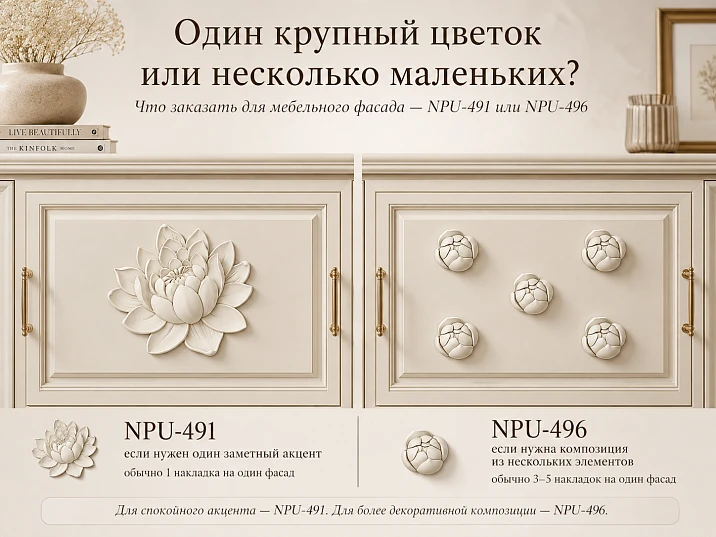
On a furniture facade, you can create two completely different things, even if you use the same material and a similar floral motif. The first way is to place one prominent flower NPU-491 measuring 105 × 94 × 17 mm and make it the center of a door, drawer, or panel. The second is to take a compact NPU-496 measuring 46 × 46 × 18 mm and repeat it several times: one per facade, in pairs, in fours, or in a rhythm across the entire piece of furniture.
Therefore, the question "NPU-491 or NPU-496?" cannot be reduced to a comparison of "bigger or smaller." In terms of relief depth, the items are almost identical: 17 and 18 mm. This means both elements can produce pronounced light and shadow. However, the area they occupy on the facade and the way the eye reads the composition differ greatly. NPU-491 works as an independent central accent. NPU-496 is more suitable where a repeating module is needed, and one small detail should tie several doors, drawers, or facades into a single pattern.
If a cabinet has four identical doors, the buyer indeed faces a basket question: place four large NPU-491 — one on each door — or take four, eight, or another number of NPU-496 and build a more frequent pattern? If a dresser has six drawers, a large lotus may be too active on each of them, while a small flower can provide an even rhythm. If there is only one facade, the situation changes: several small NPU-496 may look cohesive, but one NPU-491 more quickly forms a clear center.
Before purchasing, it is more useful not to ask "which article is prettier," but to decide which design principle the furniture needs. After that, you can buy molded decor NPU-491 for one pronounced accent or buy molded decor NPU-496 as a small repeating element.
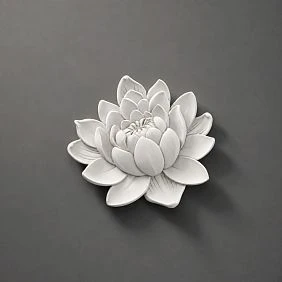
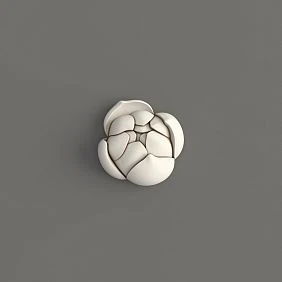
Two flowers of almost the same depth, but completely different in scale
In the product photo, both elements may seem similar in character: floral shape, relief, polyurethane. On a real facade, the difference becomes obvious.
| Characteristic | NPU-491 | NPU-496 | What changes for the buyer |
|---|---|---|---|
| Size | 105 × 94 × 17 mm | 46 × 46 × 18 mm | NPU-491 takes up noticeably more front area |
| Material | Polyurethane | Polyurethane | The material is not a reason for choosing between SKUs |
| Price at the time of writing the article | 1 370 ₽ | 560 ₽ | The total cost of the composition is calculated by the number of elements |
| Relief depth | 17 мм | 18 мм | Both elements provide pronounced volume |
| Ornament | Lotus flower | Stylized flower | The character of the pattern differs |
| Composition type | Central accent | Repeatable module | Different quantity in the order |
| Application on furniture | Possible | Directly oriented toward furniture facades | NPU-496 is especially convenient for facade series |
| Main question | “Where to place one center?” | “How many repeats are needed?” | Different design logic |
The price in the product card may change, so it needs to be rechecked before payment. For choosing between NPU-491 and NPU-496, what matters more is not the cost of one piece, but the cost of the entire approved composition.
An important observation emerges here. NPU-496 is more than twice as narrow as NPU-491, but even slightly larger in depth. Therefore, the small flower cannot be considered a "flat, almost invisible version." Its relief remains deep. The difference is not whether it is noticeable at all, but how much surface it occupies and how often it repeats.




The overall area shows the scale even more clearly
For a simple preliminary assessment, you can compare not the real complex flower shape, but the bounding rectangle.
NPU-491: 105 × 94 = 9870 mm².
NPU-496: 46 × 46 = 2116 mm².
The overall area of NPU-491 is approximately 4.66 times larger than the overall area of one NPU-496.
This figure does not mean that one NPU-491 is always visually equal to 4.66 small ones. The ornament does not completely fill the rectangle, the shape of the petals differs, and the distances between elements change perception. But the arithmetic clearly shows why one large and several small ones are indeed two different design principles.
Our factory also produces:
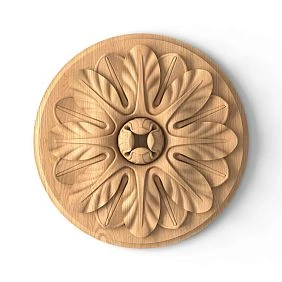
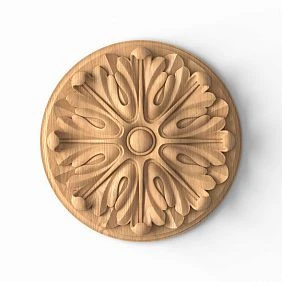
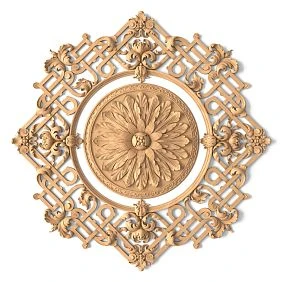
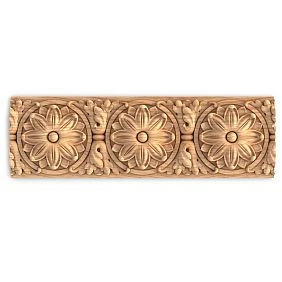
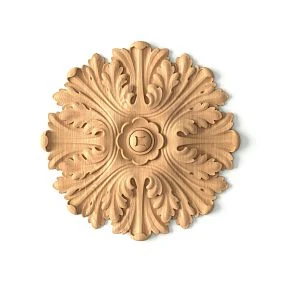
NPU-491: when the facade needs one center, not a decorative grid
NPU-491 is well perceived as a standalone object. The size of 105 × 94 mm is sufficient for the detail not to get lost on a medium or large cabinet door. The depth of 17 mm provides tangible light and shadow. The lotus flower has its own pattern, so it does not necessarily need to be supported by several similar elements nearby.
On a large facade, this is often a strong point: one focal point instead of many repetitions.
Get Consultation
Large cabinet door
Imagine a smooth door panel 500–600 mm wide and 1800–2200 mm high. A small NPU-496 alone may look like a dot. This creates a desire to add a second, third, fourth one.
NPU-491 occupies more space at once and is capable of working on its own.
It doesn't have to be placed in the geometric center of the entire door. If the facade has a molding frame, the decorative zone becomes the inner field of the frame. If the handle is positioned high or low, the position of the lotus can be adjusted relative to the functional part of the furniture. But the principle remains: one facade — one large motif.
Central door of a sideboard or display cabinet
In furniture with several facades of different sizes, NPU-491 is convenient to use not on each one, but only on the main one.
For example, the central tall door gets NPU-491, the side ones remain calmer, and the lower drawers are supported by moldings or handles. This way, the large flower becomes a sign of hierarchy, and the furniture does not turn into a repetition of the same motif on every surface.
One accent on the dresser
If the dresser has a wide solid door or a large central panel, one NPU-491 might be sufficient. But on six small identical drawers, the same approach would require six large pieces and create a dense rhythm.
Therefore, the product itself is not 'for a cabinet' or 'for a dresser'. It suits a specific facade area and the role of that facade in the furniture.
NPU-496: a small module that becomes strong through repetition
NPU-496 — 46 × 46 × 18 mm. It is more compact in frontal size, but the relief remains deep. This offers an interesting opportunity: one element looks neat, while several create a pattern without needing to buy a large central overlay.
If furniture has many identical facades, the small module is especially convenient.
Four identical doors
The simplest option: 4 facades × 1 NPU-496 = 4 pcs.
Each door gets the same point.
If you want to make two flowers per facade: 4 × 2 = 8 pcs.
But eight elements are not the 'correct' quantity. This is just a scheme that needs to be first checked with paper templates.
Six identical boxes
One flower per each: 6 × 1 = 6 NPU-496.
Two per each: 6 × 2 = 12 NPU-496.
For a narrow box, the first option is simpler in composition. The second requires sufficient width, otherwise two voluminous flowers of 46 mm each will be too close to each other and to the handle.
One large door and four small flowers
NPU-496 can be used not only one per facade. On one large surface, four elements can form a square, a diamond, or another symmetrical scheme.
Then the buyer compares not one large flower versus one small one, but one NPU-491 versus four NPU-496.
One NPU-491 versus four NPU-496 on one facade
Let's say there is a facade of 600 × 800 mm.
Option A: 1 × NPU-491.
We get one lotus 105 × 94 mm, which immediately sets the center.
Option B: 4 × NPU-496.
Four flowers 46 × 46 mm can be spread across the corners of the inner decorative field or gathered closer to the center.
In terms of total number of objects, option B is more active. But in terms of the area of a single object, each flower is much smaller.
How the impression differs
NPU-491 is read first as a shape, then as part of the facade.
Four NPU-496 are read first as rhythm and symmetry.
In the first case, attention is concentrated. In the second, it is distributed. This is exactly what needs to be chosen before ordering.
Almost identical depth — an unexpected fact of comparison.
The buyer may automatically assume: NPU-496 is almost half the size, so its relief is much thinner.
This is not the case.
NPU-491 — 17 mm.
NPU-496 — 18 mm.
The small flower is actually 1 mm deeper.
Why this matters on furniture
On a furniture front, a person constantly interacts with the surface: opens a door, grabs a handle, walks past, pulls out a drawer, wipes the front.
Therefore, a compact face area does not mean minimal volume.
NPU-496 should be perceived as a small but quite relief decorative object. If it stands next to a handle, a paper square of 46 × 46 mm will show only part of the picture — the actual 18 mm protrusion also needs to be considered.
Handle and flower: functional zone first
A furniture handle often occupies the central zone of the facade. If NPU-491 also needs to be placed in the center, two objects start competing for the same spot.
You can raise the lotus higher, lower it, place it in a separate molding frame, or choose small NPU-496 and distribute them around the hardware.
NPU-496 gives more freedom to go around the handle because each element is smaller in width. But the 18 mm depth means the working area for the hand still needs to be checked.
Don't measure the distance only from the center of the handle
Mark the full dimensions of the handle, rosette, or bar. Then grab it the way you do every day. Fingers and the hand take up more space than the metal or wooden part itself.
If the relief falls into this zone, the composition needs to be separated.
Paper templates: two sizes worth cutting out before ordering
For NPU-491 — 105 × 94 mm.
For NPU-496 — 46 × 46 mm.
You can cut out one large template and 8–12 small ones. Then you won't have to mentally multiply one piece of paper.
On a cabinet with four doors, lay out four NPU-496s at once. On a large facade, try one NPU-491, then four NPU-496s. Take photos from the same point.
After this, the question of what to order becomes much simpler.
The template should show not only the flower but also the free field
On the front, the overall dimension itself is not important. What matters are the distances to the edge, molding, handle, neighboring flower, panel, and decorative routing.
If four NPU-496 units physically fit, but there is too little air between them, the layout looks overcrowded.
If one NPU-491 occupies the center but there is too much empty area around it, the front may need a frame or a different scale of decor.
Smooth and paneled facades require different checks
On a smooth surface, there is no ready-made frame to explain the placement of decor. If NPU-491 is shifted without reason, the eye notices. If a row of NPU-496 is unevenly placed, it is even more noticeable.
A paneled door itself defines the inner field. You need to calculate based on that, not the entire width of the facade. An NPU-491 may fit freely on a 500 mm door, but turn out to be too large for a small upper panel. An NPU-496 offers more freedom, but the distance to the panel profile still needs to be meaningful.
Comparison of quantity: one large accent and a modular layout.
| Furniture situation | NPU-491 | NPU-496 | What to check |
| 1 central door | 1 pc. | 1–4 pcs. per layout | Scale and handle position |
| 2 symmetrical doors | 2 pcs. for the 'one by one' scheme | same number for each | Symmetry of both doors |
| 4 identical fronts | 4 pcs. when repeating a large motif | 4 / 8 / other number by module | Doesn't the rhythm become too frequent |
| 6 identical drawers | 6 pcs. only after the template | 6 pcs. with the 'one by one' scheme | Box height and fittings |
| 1 large front | 1 pc. | 4 pcs. can form a square composition | Free field |
| Central front + side ones | 1 pc. only on the central one | small ones can be repeated on the side ones | Hierarchy of furniture |
The table does not set the quantity norm. It shows the difference between the "single object" system and the "repeatable module" system.
Four facades: three different orders and three different cabinets
Let's imagine a cabinet with four identical doors.
The first option is four NPU-491, one large flower on each door. The composition will be pronounced, with a large repeat.
The second is four NPU-496, one small flower each. The rhythm will become calmer, and more free space will remain.
The third is eight NPU-496, two elements per facade. It's no longer a dot, but a paired pattern.
Three orders arrange the same furniture completely differently.
Six drawers: why NPU-496 is convenient as a module
A drawer is usually lower than the door. The height of NPU-491 is 94 mm. If the facade height is small, the lotus can take up a significant part of the field.
NPU-496 is 46 mm. Even with a depth of 18 mm, the front area is compact, so it's easier to fit between the top and bottom edges of the drawer.
But "simpler" does not mean "always better." On a wide, tall cabinet, one NPU-491 can look stronger and calmer than two small ones.
Large chest of drawers: one center requires fewer coordinates
One NPU-491 — one choice of position.
Six NPU-496 are six coordinates that must be coordinated.
The more elements, the more visible the errors: one is higher, another is lower, the distance differs, the handle shifts the pattern, the row "floats."
Therefore, a modular scheme requires a good template.
The rhythm of NPU-496 is built by the same rule
If small flowers repeat on several facades, they must have a unified logic: always centered, always at the same height from the top edge, always a pair with the same distance, or always one in each corner of the inner frame.
You cannot place one flower on the first door, two on the second, three on the third just because they all fit. If the asymmetry is not deliberately intended, such a pattern will look random.
Formula for the quantity of a repeating scheme
If each facade has the same number of elements:
Q = F × N,
where Q is the total quantity; F is the number of facades being decorated; N is the number of elements on one facade.
Examples:
4 facades × 1 = 4 pcs.
4 × 2 = 8 pcs.
6 × 1 = 6 pcs.
6 × 2 = 12 pcs.
The formula is simple, but it should only be applied after approving one control facade.
For NPU-491 the formula is the same, but the design question is different.
If each facade gets one lotus, the quantity equals the number of decorated facades. Four — four. Six — six.
But a large motif more often provokes another question: is it even necessary to repeat it on every facade?
Sometimes two central doors are enough. Then out of four facades, only two are decorated.
One large flower can mark the "main" facade, while NPU-496 is more often used for uniform repetition.
The molding frame enhances the difference between NPU-491 and NPU-496.
Inside a rectangular frame, one NPU-491 works as a central floral accent.
NPU-496 can be used one in the center, four in the corners, two vertically, or several as a repeat. But the more elements, the more important it is not to overload the field.
If the inner field of the frame is approximately 400 × 600 mm, NPU-491 takes up a noticeable but not dominant place, and four NPU-496 can form a calm geometric system.
If the field is 180 × 250 mm, NPU-491 already takes up a significant part, and one NPU-496 leaves more breathing room.
Therefore, molding is not just an addition to the decor. It sets the actual area within which you need to choose the scale.
Stucco for furniture changes not only the facade, but also the hierarchy of the entire piece of furniture.
The same cabinet with different decor is perceived differently.
NPU-491 creates large vertical or central accents. NPU-496 forms a more frequent rhythm. The body itself, color, handles, and furniture dimensions can remain the same, but the character of the facades will change.
That is why molding for furniture is not just surface decoration. It is a way to distribute attention. If you need a wider selection of overlays of a different size, Moldings for Furniture is presented in the category where you can compare other ornaments and dimensions.
One large flower highlights the main module.
If the central section of the cabinet is wider, NPU-491 can be placed only there. Leave the side facades calmer.
Thus, the quantity is reduced not for economy, but for compositional logic.
A small flower unites equal modules
If all doors are the same, NPU-496 is convenient to repeat with the same rule.
It does not declare one section as the main one, but connects a series of facades.
NPU-491 and NPU-496 on the same piece of furniture: possible, but hierarchy is needed
You can place NPU-491 on the central door, and repeat NPU-496 on the side ones. This creates a system where a large motif sets the center, and a small one supports the theme.
But such a combination should not be assembled directly in the cart.
First, you need to see the entire cabinet in a mockup. The two SKUs are not the same pattern in different sizes. NPU-491 is a lotus. NPU-496 is a different stylized flower.
They are united by their botanical nature, material, and relief, but this does not guarantee automatic stylistic compatibility in any layout.
NPU-496 cannot be considered a reduced copy of NPU-491
This is a fundamental point for the order.
Both SKUs start with NPU-49.
Both have a floral pattern.
Both are made of polyurethane.
But they are not the same model in two sizes.
In the specification, it is better to write in full:
NPU-491 — 105 × 94 × 17 mm — polyurethane.
NPU-496 — 46 × 46 × 18 mm — polyurethane.
The size and full article number help avoid errors, especially if both elements are involved in the project.
The difference in the pattern becomes more noticeable in a series.
One small NPU-496 can be perceived simply as a flower.
Ten identical NPU-496s on facades already create a repetition of a specific pattern.
The same with NPU-491: four large lotuses form a much more distinct thematic line than one.
The greater the quantity, the more important it is to evaluate not only the size, but also the ornament itself.
Kitchen facades: a small module quickly turns into a large system
A kitchen can have 10, 20, or more doors.
If you install NPU-496 on each one, a small element turns into a powerful system of repeats. Therefore, the quantity cannot be determined based on a single door.
You need to look at the entire row.
On a kitchen, it is more logical to use NPU-491 selectively: for example, on tall columns, central facades, or large decorative panels, if the design supports it.
Ten facades are no longer ten separate solutions
If each has one NPU-496, the eye sees not ten flowers, but a continuous rhythm.
If each has two, that's twenty relief points.
What looks calm on one facade can become too saturated across the entire kitchen.
Built-in wardrobe spanning the entire wall
The larger the furniture area, the more careful you need to be with the amount of identical decor.
One NPU-491 on the central section can organize the entire wall.
Multiple NPU-496 units can connect a large number of facades.
The choice depends on whether a hierarchy or a uniform rhythm is needed.
Cabinet: a small piece does not like random overload
On a compact cabinet, NPU-491 can immediately become the main motif. This may be exactly what is needed if the handle, legs, and moldings are calm enough.
NPU-496 allows for a more delicate accent.
But you should not automatically choose the small item just because the furniture itself is small. Sometimes one large flower creates a cleaner composition than four small ones.
Chest of drawers with three wide drawers
For NPU-491, the base layout is 3 pieces with one per drawer.
For NPU-496 — 3 pcs. with one, 6 pcs. with a pair, and 12 pcs. with four on each.
On wide drawers, four small flowers can work in the corners of the inner frame.
But if the drawers have large handles, the paired or corner scheme should already be built around the hardware.
Chest of drawers with six narrow drawers
Here NPU-496 gets an obvious advantage in frontal scale.
Six small flowers give a simple repeat.
NPU-491 requires particularly careful checking of the height and width of each facade. Its size of 105 × 94 mm can take up a significant part of a narrow drawer.
This is not a prohibition, but a signal: the large lotus must be checked with a template.
Two symmetrical doors: the same number does not yet guarantee symmetry
You can buy two NPU-491 and place one on each door leaf.
You can take four NPU-496 and install two on each.
But after the purchase, the question of coordinates remains.
If one door is hung slightly differently, handles are not strictly mirrored, or panels differ, mechanically transferring the size from the edge can create visual asymmetry.
It is better to first see both doors closed and build a common axis.
Four facades around the central section
Sometimes a wardrobe has a central open module and two doors on each side.
NPU-496 can be repeated on all four.
NPU-491 can only be placed on the two inner doors to gather the center.
This is a good example where the quantity is determined not by the number of doors, but by the furniture architecture.
Mirror frame and furniture nearby
NPU-496 in the card is designed not only for furniture facades: it can also be used on frames. If a small flower is repeated on the facades and the mirror frame, a connecting theme emerges.
NPU-491 can also work as a separate large centerpiece on furniture or a wall composition.
But combining two levels of decor should be done through the layout of the entire space, not through automatic repetition of the article number.
The color of the facade can change the answer to the question "large or small".
On a light facade in tone, NPU-491 will be read primarily through the wide shadow from the relief.
NPU-496 will create small deep dots.
If the elements are made contrasting, the situation changes.
A small NPU-496 in a contrasting color becomes significantly more active. Eight dark flowers on light furniture can attract more attention than one large NPU-491 painted in the color of the facade.
Therefore, scale is not just about millimeters.
Monochrome painting does not make the relief flat
NPU-491 has a depth of 17 mm.
NPU-496 — 18 mm.
Even after painting in the color of the facade, the chiaroscuro remains.
This is especially noticeable with side light from a window or a wall lamp.
Before ordering, look at the furniture in the morning and evening
If the cabinet stands next to a window, the direction of light changes throughout the day.
A relief that looks calm in frontal light can become much more active in the evening.
For NPU-496 this is important in a series: several identical shadows create an additional rhythm.
Contrast enhances the geometry of the small module.
The black NPU-496 on a white facade is no longer a small "dot," but a clear graphic sign.
Four such elements form a grid.
Eight form an ornamental row.
If you want a calm result, the number of contrasting elements needs to be checked especially carefully.
Facade size: do not compare decor only with the overall door width
The facade can have:
-
panel;
-
frame;
-
milling;
-
handle;
-
lock plate;
-
decorative insert.
The actual field for the flower is smaller than the total area.
For NPU-491, this limitation is more noticeable due to 105 × 94 mm.
For NPU-496 it is smaller, but still exists.
A large facade does not mean that a large decor is needed
A wide door of 700–800 mm can accommodate NPU-491.
But if it already has a complex frame and a large handle, small NPU-496 may be more appropriate.
Conversely, a smooth door of the same size may look empty with a single NPU-496.
Context matters more than a single size.
A small facade does not mean that large decor is forbidden
Sometimes one large flower almost fills the inner panel and creates a deliberately rich look.
This is an acceptable technique.
The main question: does the filling look intentional, or does it feel like the detail barely fits.
A paper template responds faster than any theory.
Minimum margins cannot be assigned with a single number for all facades
This article will not have a rule like "leave 30 mm" or "minimum 50 mm."
The reason is simple: different handles, frames, panels, and door sizes create different conditions.
You need to evaluate not an abstract margin, but a specific free field.
NPU-491 next to the molding
A single large flower inside the frame is especially sensitive to the distance to the profile.
Too tight — it looks cramped.
Too far — it loses connection with the frame.
Therefore, first the molding field is built, then 105 × 94 mm is tried inside it.
NPU-496 near the molding
Small elements can be distributed across corners or centers of sides.
But if each one is too close to the profile, the composition becomes fragmented.
The number of small flowers should account for the width of the molding itself and the internal air.
If a different scale is needed, the category of overlays matters more than the compromise.
Sometimes NPU-491 is too large, and NPU-496 is too small.
There is no need to choose the "lesser evil."
In the section where Relief Decoration, you can compare other dimensions and shapes.
This is more honest than stretching one of the two products for a task it is not suited for.
Decorative polyurethane elements: when one floral overlay is not enough
If the facade is built as a complex frame composition, the flower may be only one of the components.
In the category decorative polyurethane elements you can view additional shapes.
But they should only be added after the layout.
Empty space inside the frame is not a mistake that must necessarily be filled with more decor.
Polyurethane molding: the material is the same, the selection criterion is different
Both compared products are made of polyurethane.
Therefore, choosing NPU-491 versus NPU-496 based on the principle of "which material is better" is pointless.
The decision is determined by scale, quantity, pattern, free field, handle, and rhythm of the furniture.
If a frame is required for the composition, you can Buy polyurethane molding in the molding section, but after the frame appears, the free field under NPU needs to be recalculated.
What to buy together with NPU-491 or NPU-496
The commercial set depends on the layout, not on the desire to put more items in the cart.
| What to add | Why | When really needed | What to check |
| NPU-491 | One large floral accent | Large or main facade | Field 105 × 94 mm and handle location |
| NPU-496 | Small repeatable module | Series of doors and drawers | Quantity and identical coordinates |
| Other overlays | Compare scale | If both article numbers do not fit | Dimensions and pattern |
| Decor for moldings | Expand composition | If the facade has a frame system | Do not overload the field |
| Polyurethane moldings | Build a frame | If it is present on the sketch | Internal field after installation |
| Mounting compound | Secure the decor | After scheme approval | Compatibility with polyurethane and coating |
The table does not mean that you need to buy everything listed for one flower.
A simple smooth facade can only be achieved with NPU and a suitable mounting compound.
Adhesive is chosen after the facade, not before it
NPU are made of polyurethane.
But the facade can be:
-
painted MDF;
-
wooden;
-
veneered;
-
film-coated;
-
lacquered;
-
have a different finish coating.
The mounting system must account for both surfaces.
Therefore, the material molded decoration adhesive is useful to study after the facade has been chosen and its finish is understood.
Furniture is already painted: fitting is more important than haste
When the facade is still in production, an error can be corrected before the finish.
On finished furniture, one wants to avoid marks and rework.
The rational sequence is simple: paper templates, painter's tape, a photo, checking the handle, then choosing the quantity.
This is especially important for NPU-496: due to its small size, it's easy to think "a few will definitely fit," only to later find the pattern is too frequent.
Test door before the series
If there are 20 facades, first finish one.
On it, the quantity, distances, color, handle, relief, and position are checked.
After that, a template for the series is created.
On the NPU-496 series, the error multiplies
A slight offset on one door may be barely noticeable.
On ten identical fronts, the difference turns into a "floating" line.
Modular decor requires discipline.
NPU-491 is easier to mark, but a large error is more noticeable
One coordinate on each facade is simpler.
But the large flower is immediately noticeable.
If the installation height differs on adjacent doors, this is also perceived.
Rigid template-conductor for NPU-496
For the series, you can make a cardboard template the size of the facade or its corner.
The following are marked on it:
-
edge of the door;
-
axis;
-
installation points;
-
distance to the handle.
One template is transferred to all identical facades.
This is much more reliable than measuring with a tape measure from different edges each time.
For NPU-491, two control coordinates are sufficient.
If the facades are identical, the vertical and horizontal alignment of the center is fixed.
But if the handles are installed with deviations, each door still needs to be quickly checked visually.
The price of one element is not equal to the price of the composition
A buyer can see that one NPU-496 costs less than one NPU-491 and decide that the small circuit is automatically more profitable.
But if 4, 8, or 12 NPU-496 units are required, the entire composition must be calculated.
One NPU-491 versus four NPU-496 is a comparison of one and four product units.
It is more reasonable to check the current price directly in the product cards before ordering. The article should determine the quantity, not fix the cost, which changes over time.
Piece decor does not require a percentage allowance according to the molding rule
If the project requires 6 NPU-496, this does not automatically mean 7.
If 4 NPU-491, it does not mean 5.
The reserve is determined by the risk of damage, batch size, project requirements, and the possibility of purchasing additional items.
The allowance for linear products cannot be transferred to piece flowers.
When it makes sense to order one item for a trial fitting
For a complex project, this is a useful approach if the ordering conditions of a specific product card allow purchasing a single piece.
A real element provides understanding:
-
the actual contour;
-
of the volume;
-
shadows;
-
quality of handle interface;
-
appearance after painting.
The paper shows only a rectangle.
The real product should be applied before installing the entire batch.
If the cabinet consists of ten facades, you should not immediately glue all ten or twenty elements.
First, one test piece.
Look at it from a distance.
Open the door.
Check the light.
Only after that, transfer the layout further.
Ordering NPU-491 is worth it when you need exactly one large center
If the project has a large central door, a wide panel, or one main front, order NPU-491 made of polyurethane logical after fitting the template 105 × 94 mm.
A large lotus reduces the need for many small dots and helps quickly organize the composition.
Ordering NPU-496 is worth it when quantity is part of the idea
For a series of doors, drawers, or frame fields, you can order NPU-496 for furniture facades according to the number of approved decorative dots.
The phrase "several small" should turn into a specific number before placing the order.
Another direct product check for NPU-496
Before finalizing the cart, it is useful to open the product page again and buy molded decor NPU-496 after the specification already states: 46 × 46 × 18 mm, the required quantity, the selected facade, and the layout scheme.
Thus, repeated product verification works not as an advertising click, but as protection against quantity errors.
If neither option fits, don't force the facade to comply with two SKUs
NPU-491 may be too large.
NPU-496 may be too small or too frequent.
In this case, it is more reasonable Buy Molded Decoration of a different scale in the category than assembling a compromise pattern.
"Buy polyurethane decor" — first the scheme, then the catalog
If first buy polyurethane decor with a "spare" set, there is a high risk of getting extra elements.
First, the composition is selected.
Then the quantity.
Then the basket.
A large lotus and a small flower in the bedroom
On the bedroom wardrobe, decor is usually visible from several meters away.
NPU-491 is more quickly perceived as a standalone form.
NPU-496 alone can be almost unnoticeable from a distance, but repetition on several doors creates a good rhythm.
If the cabinet is opposite the bed, it is useful to evaluate the layout from that point, rather than standing 30 cm from the facade.
In the hallway, the distance is shorter — the small relief becomes more noticeable.
In a narrow corridor, a person passes close to the furniture.
NPU-496 is perceived more strongly because the distance to the facade is small.
A large NPU-491 can look especially voluminous.
Therefore, the same composition in the bedroom and hallway reads differently.
In the living room, a large facade can support a single NPU-491 without additional colors.
If the furniture is wide and in a large room, a single large flower can provide exactly as much decor as needed.
Many NPU-496 units should only be added if the repetition supports the overall architecture of the furniture.
In the children's room, it's especially important to carefully check the protruding relief.
A depth of 17–18 mm means that the elements protrude above the facade.
Mistakes that force reconsidering the choice of NPU-491 or NPU-496
Mistake 1. Comparing only the price of a single piece.
NPU-491 and NPU-496 have different prices per unit, but compositions require different quantities. One large flower cannot be compared by cost to one small one if the real alternative is four, eight, or twelve NPU-496 units.
First, the scheme is approved. Then, the set is calculated.
Mistake 2. Considering NPU-496 almost flat due to its small size
Its depth is 18 mm. This is even 1 mm more than the depth of NPU-491.
A small frontal size does not mean a weak relief.
Error 3. Placing NPU-491 on every facade without an overall layout
One lotus can look calm. Four or six large lotuses turn into a strong repeating ornament.
The entire cabinet needs to be evaluated.
Error 4. Order eight NPU-496 without laying them out at the same time
A pair on one facade looks normal, but four pairs on adjacent doors can create too frequent a pattern.
Lay out all templates at once.
Error 5. Forgetting the handle
The relief should not fall into the natural grip zone. This applies to both articles.
Error 6. Considering the door edge as the boundary of the decorative field
If there is a panel or molding frame, the actual field is smaller.
Error 7. Choosing NPU-496 only because the facade is small
Sometimes one large flower organizes a small field better than several small ones.
A fitting is needed.
Error 8. Choosing NPU-491 because it seems "richer"
A larger size does not equal a better composition. On a series of facades, it may become too active.
Error 9. Mixing both articles without hierarchy
If large and small flowers are used together, it should be clear which one is the main one.
Mistake 10. Not making paper templates
The screen does not convey the real scale. For this pair, the template is especially useful because the sizes differ sharply, and the depth is almost the same.
Mistake 11. Placing NPU-496 without a conductor template
On a series of facades, a difference of a few millimeters turns into a noticeably uneven row.
Mistake 12. Adding a percentage margin as for linear materials
Piece decor is calculated according to approved positions, and the reserve is set separately based on actual risk.
Mistake 13. Gluing before checking the color
After installation, changing the layout is significantly more difficult.
Mistake 14. Not considering side light
A depth of 17–18 mm creates a shadow. A row of small elements may look more active than expected.
Mistake 15. Treating NPU-496 as a reduced copy of NPU-491
These are different floral shapes.
Mistake 16. Looking at only one door
The furniture composition is read as a whole.
Mistake 17. Not writing down the size next to the article number
When ordering, it is better to record not only the code, but also 105 × 94 × 17 mm or 46 × 46 × 18 mm.
Mistake 18. Buying quantities before the final layout
The cart should be the result of the project, not a way to invent it.
For whom NPU-491 would be a more natural choice
NPU-491 should be tried first if the furniture has one large front, a central door, a wide panel, or a composition that requires a single floral center.
It is especially appropriate when:
-
you need to highlight one section;
-
you want to avoid frequent repetition;
-
the front is large enough;
-
the handle does not occupy the same place;
-
the lotus flower matches the style;
-
The relief should be readable from a distance.
In this case, one large element simplifies the composition: fewer marking points, fewer repetitions, a clearer center.
Who NPU-496 is more convenient for
NPU-496 is stronger in modular tasks.
It is suitable for a series of identical facades, several drawers, small doors, and schemes where decor should be distributed across the surface.
It should be considered first when:
-
there are many facades;
-
they are the same;
-
a repeat is needed;
-
a large flower takes up too much space;
-
the handle limits the central zone;
-
it is necessary to control the density by quantity.
Compactness helps to vary the scheme: one, two, or four elements per facade.
Who should not choose any article just because the theme is already liked
Both flowers may not be suitable if the furniture style does not imply a floral motif, the facade is very small, the field is excessively large, or there is already complex carving and active hardware nearby.
In that case, the correct next step is to look at other overlays, not to force NPU-491 or NPU-496 to solve someone else's task.
Control specification for one large facade
Option with one center:
NPU-491 — 105 × 94 × 17 mm — polyurethane — 1 pc.
Option with four small ones:
NPU-496 — 46 × 46 × 18 mm — polyurethane — 4 pcs.
It is advisable to add a coordinate diagram and attachment to the handle to the specification.
Control specification for four doors
With a large motif:
NPU-491 — 4 pcs., if one per door is approved.
With a small one:
NPU-496 — 4 pcs. with one per front.
Or:
NPU-496 — 8 pcs. with two per facade.
If the large flower is placed only on the two central doors, the quantity of NPU-491 is 2 pcs., even if there are four doors.
Control specification for six boxes
For NPU-496:
6 pcs. at one per box.
For the paired scheme:
12 pcs.
For NPU-491:
6 pcs. only after the template shows that 105 × 94 mm fit the height of each box and do not overload the entire dresser.
"A few small ones" needs to be turned into a number before the basket
The phrase "I'll take a few NPU-496" is useless for ordering.
It should turn into a specific scheme:
-
one on the front;
-
two on the facade;
-
four on one large door;
-
only on side sections;
-
only on the top drawers.
After that, the quantity is calculated with a simple formula.
How to buy on STAVROS without random selection
The commercial route for this topic is short and clear.
First, determine whether you need a center or a rhythm.
Then measure the actual decorative field.
After that, make template NPU-491 and several NPU-496 templates.
Only then open the product cards and record the quantity.
For a large center, you can buy the decorative lotus NPU-491 after checking the dimensions 105 × 94 × 17 mm.
If a repeating module is needed, NPU-496 is calculated by the number of points on the approved layout.
If both options turn out to be unsuccessful, the catalog of overlays allows switching to a different scale without trying to fit the facade to a preferred article.
Why the broad query "buy stucco molding" here should end with a precise specification
A person may start with a general search and want to buy molding for furniture.
But the actual purchase looks much more precise:
article number;
size;
quantity;
facade;
coordinates;
installation;
finish.
It is this specificity that turns interest in decorative molding into a correct order.
Full control before payment
Before placing an order, it is useful to answer the following questions:
-
one center or repeat is selected;
-
the free field is measured;
-
the handle is checked;
-
template made;
-
the quantity per one facade is determined;
-
total quantity calculated;
-
color scenario checked;
-
installation method understood;
-
article number recorded along with size;
-
All furniture is priced as a whole, not per single door.
If at least one item is not covered, it is better to finish the layout before purchasing.
FAQ: NPU-491 or NPU-496 for furniture facade
What is the exact size of NPU-491?
NPU-491 has dimensions of 105 × 94 × 17 mm.
What is the size of NPU-496?
NPU-496 has dimensions of 46 × 46 × 18 mm.
What material are both items made of?
Both items are made of polyurethane.
Which one is deeper?
NPU-496: 18 mm versus 17 mm for NPU-491.
Why does NPU-496 then look significantly smaller?
Because its frontal dimension of 46 × 46 mm is much smaller than the 105 × 94 mm of NPU-491. The difference is primarily in area, not depth.
Is NPU-491 really made in the shape of a lotus?
Yes. In the product card, it is described as a decorative overlay in the shape of a lotus flower.
What is NPU-496?
It is a compact stylized flower made of polyurethane that can be used as an overlay decoration on furniture facades and other interior surfaces.
Which option should be tried first on one large door?
First, it is reasonable to test NPU-491 as a single central accent, then compare it with a group of NPU-496.
Which option is more convenient for six identical drawers?
NPU-496 is more convenient to consider as a repeatable module because its front size is smaller. But the final choice depends on the size of the cabinets.
How many NPU-496 are needed for four facades?
With the "one per facade" scheme — 4 pcs. With the "two per facade" scheme — 8 pcs. These are examples, not a universal norm.
How many NPU-491 are needed for four doors?
If one on each — 4 pcs. But you can use a large motif only on two central facades or on one main section.
Can four NPU-496 be placed on one door?
Yes, such a composition can be designed if the free field allows placing four elements symmetrically and without conflict with the handle.
Can two NPU-491 be placed on one large facade?
You can consider this option, but two large elements significantly increase the decorative density. Without a full-size trial, it's not worth buying a pair.
Can NPU-491 and NPU-496 be combined?
Yes, if the elements have a clear hierarchy: for example, one large center and a small repeat on the side facades.
Are NPU-491 and NPU-496 the same pattern in two sizes?
No. These are two different SKUs and two different floral shapes.
Will NPU-496 fit next to a furniture handle?
It depends on the handle position. Despite the 46 × 46 mm size, the depth of the NPU-496 is 18 mm, so you need to check the actual hand grip area.
Can NPU-491 be installed on a small drawer?
Only after a trial fit. The 105 × 94 mm dimension can take up a significant part of a small front.
What is the fastest way to compare two SKUs?
Cut out one 105 × 94 mm template and several 46 × 46 mm templates, place them on the furniture, and photograph the options from one point.
Do I need to account for the relief depth during a paper try-on?
Yes. Paper shows the area but not the volume. For a final check, especially near a handle, you need to remember the 17–18 mm protrusion.
How do I calculate the quantity of NPU-496 for identical facades?
Multiply the number of fronts to be decorated by the number of elements in one approved layout.
Is a reserve of NPU-496 needed?
There is no universal percentage. The reserve for piece items is determined by the requirements of the specific project.
Is a reserve of NPU-491 needed?
Also not automatically. The quantity is calculated based on actual decorative positions, and a reserve is added only for a specific reason.
Can both elements be painted in the furniture color?
Such a scheme can be designed. The specific preparation and painting system must be compatible with polyurethane and the facade coating.
Can the flowers be made contrasting?
Yes, but contrast sharply increases visual activity, especially if NPU-496 is used repeatedly.
What is better for a smooth facade?
Both options can work. NPU-491 gives one large center, NPU-496 gives a rhythm of several points.
What is better for a paneled facade?
First, the inner field of the panel is measured. Then the dimensions of 105 × 94 and 46 × 46 mm are compared.
Are these overlays suitable for a cabinet?
Furniture scenarios are acceptable for both. NPU-496 is directly oriented in the card towards facades, cabinets, and dressers.
Can NPU-496 be used on a mirror frame?
Yes, such use is provided for in the product description.
Do I need to buy molding together with the flower?
No. The molding is only needed when it is present in the mockup. The overlay can be used as a standalone element.
What should I use to attach NPU to a finished facade?
The mounting compound is selected considering polyurethane and the specific facade coating. Without knowing the base, prescribing a universal adhesive is incorrect.
Can decor be installed on an already painted facade?
The possibility depends on the strength of the coating and the compatibility of the mounting compound. The substrate needs to be checked before gluing.
What to do if both SKUs seem unsuitable?
Go to the category of overlays and choose a different size or pattern, rather than trying to change the proportions of the selected items.
Can I first order one item as a test?
If the current card conditions allow piecemeal ordering, a trial purchase is useful for a complex series of facades.
What should I check upon receiving NPU?
SKU, size, quantity, appearance, and compliance with the working specification.
Can the distances between NPU-496 be changed on different facades?
Technically possible, but for identical facades, different spacing usually disrupts the rhythm. If asymmetry is not intended, use a uniform template.
What is more important when choosing — size or pattern?
Both parameters. Size determines the scale, pattern determines the character of the furniture. You cannot choose based on only one of them.
How to understand that NPU-491 is too large?
The template takes up almost the entire inner field, comes too close to the frame or handle, and no free space remains around it.
How to understand that NPU-496 is too small?
On a large facade, a single template gets lost, and to achieve a noticeable effect, you have to add so many repeats that the pattern becomes too frequent.
Can I make one NPU-491 on the central door and NPU-496 on the rest?
Yes, this is one of the logical hierarchy scenarios, but first you need to evaluate both ornaments together on a common layout.
Before the cart: a decision in three questions
First question: does the facade need one main center?
If yes — NPU-491 gets an advantage.
Second: is it necessary to repeat the motif on many identical surfaces?
If yes — NPU-496 becomes more flexible.
Third: how much weight can the entire piece of furniture actually withstand, not just one door?
It is the third question that protects against most mistakes.
One large lotus or a rhythm of small flowers: what to order in the end
NPU-491 and NPU-496 cannot be placed on a "better — worse" scale.
They solve different compositional tasks.
NPU-491 105 × 94 × 17 mm is a large lotus flower. It is needed where the facade requires one pronounced center. A single element can mark the main door, gather a wide decorative field, or become the only plant motif on calm furniture.
NPU-496 46 × 46 × 18 mm is a compact stylized flower. Its strength emerges through repetition. One element can be placed on each drawer, two on each door, four inside a large frame. Quantity becomes part of the design.
At the same time, the small NPU-496 is not a flat and barely noticeable version. In depth, it is even 1 mm larger than NPU-491. Therefore, when placed next to a handle, with contrasting coloring and side lighting, it remains a pronounced three-dimensional element.
Before ordering, do not just ask "which flower is prettier." Answer three practical questions: is one center or repetition needed; how many facades are involved; what free field is available on each.
After that, do a paper mock-up, determine the quantity, and only then move on to the product cards.
If a large center is chosen — NPU-491 is ordered by the number of main decorative positions.
If a modular pattern is needed — NPU-496 is calculated by the number of points on one facade, multiplied by the number of identical facades.
STAVROS company allows you not to limit yourself to two articles: in the catalog you can compare other overlays and select decorative molding for the specific scale of the furniture. But NPU-491 and NPU-496 especially well demonstrate the main selection principle: the size of one detail is important, but even more important is the way this detail is repeated on the facade.
One large flower concentrates attention.
Several small ones distribute it.
And it is this choice that must be made before the quantity turns into an order line.