Article Contents:
- Classification of Decorative Trim by Purpose
- Wall Mouldings
- Ceiling Cornices
- Baseboards
- Frame Moulding
- Door and Window Skirting
- Planks and Strips
- Classification by Wood Species
- Spruce
- Oak
- Ash
- Oak
- Exotic species
- Surface Treatment and Finishing Options
- Unfinished Sanded Wood
- Stained with Stains
- Lacquered
- Oil-Wax
- Painted with Enamels
- Patina and Artificial Aging
- Quality Assessment Criteria for Trim Samples
- Wood Quality
- Profile Accuracy
- Surface treatment quality
- Plank Geometry
- Collection Formation of Samples for Showroom
- Assortment Matrix Principle
- Physical Samples
- Catalog with Photos and Descriptions
- Interactive Tools
- Wholesale Supply Organization
- Minimum Order and Packaging
- Warehouse logistics
- Delivery
- Target Segments of Wholesale Buyers
- Construction and Repair Companies
- Design Studios and Architectural Offices
- Moulding Workshops
- Online stores
- Sample marketing and promotion
- Exhibition participation
- Showroom and demonstration area
- Online presence
- Working with designers
- Conclusion

Wall decorative finishing — the final stage of interior creation, defining its character, style, and visual perception of space. Properly selected decorative elements transform an ordinary room into a work of art, add architectural depth, create accents, highlight status. The modern market offers a wide variety of materials for decorative finishing — from classicpicture frame moldingto carved wooden molding, from minimalist moldings to luxurious stucco. Understanding the assortment, application specifics, and technical characteristics of various samples allows professionals to create flawless projects, and wholesale buyers to form optimal warehouse stock to meet diverse customer demands.
In this article, there is a comprehensive review of wall decorative finishing samples with emphasis onWholesale wooden trim— moldings, cornices, baseboards, picture frame molding. We will examine the classification of products by shape, size, wood species, surface treatment methods, and application areas. We will study quality assessment criteria for samples, ways to present the assortment in showrooms and catalogs, and strategies for forming optimal collections for wholesale trade. Get practical guidance on working with decorative molding samples for successful business development in the architectural decor field.


Classification of decorative molding by purpose
Decorative molding — a collective term for wooden or wood-based products with constant cross-section, sold by the linear meter. Profiled strips of various shapes are used for framing, dividing, and decorating wall, ceiling, and furniture surfaces, as well as creating architectural compositions.




Wall Moldings
Moldings — narrow decorative strips with convex profile used to create frames, panels, and borders on walls. Width from 20 to 120 mm, thickness 8–25 mm, standard length 2400 mm. Molding profile varies from simple semi-circular to complex multi-step relief with grooves, beads, and plant ornaments.
Molding samplesdemonstrate a variety of shapes: classic symmetrical profiles for traditional interiors, flat minimalist ones for modern styles, asymmetrical ones with accent relief on one side, carved ones with ornamentation for luxurious historical styles. Moldings are mounted horizontally at a height of 90–180 cm from the floor, forming rectangular or square frames, within which the wall is painted in contrasting colors, covered with patterned wallpaper, or finished with decorative plaster.
Purpose of moldings: visual division of walls into zones, creation of classical panels in neoclassical or art deco styles, framing areas with special finishes, masking joints between different materials, decorating smooth painted walls to add volume and architectural expressiveness.
Our factory also produces:


Ceiling cornices
Ceiling cornices (gables) — profiled strips for finishing the junction between wall and ceiling. Projection width on the wall 40–200 mm, on the ceiling 30–150 mm. Triangular cross-section profile with decorative front face — from simple concave for minimalist interiors to multi-profile with protrusions, recesses, and ornaments for classical styles.
Wooden cornices emphasize room height, visually lift the ceiling (especially if cornice and ceiling are painted in the same light color), hide irregularities at the wall-ceiling junction, and create a smooth transition between vertical and horizontal planes. In historical interiors, cornices were richly adorned with carving — meanders, acanthus leaves, egg-shaped ornaments, teeth, beads.
Wide cornice with 15–20 cm projection is used in rooms 3 meters high — creates monumentality, emphasizes the scale of space. Narrow cornice 4–6 cm is used in standard apartments with 2.5–2.7 m ceilings — delicately finishes the junction, does not visually overload.
Get Consultation
Baseboards
Baseboards cover the junction between wall and floor, protect the lower part of the wall from damage during cleaning, hide the technological gap between floor covering and wall (necessary to compensate for thermal expansion of parquet or laminate). Baseboard height 40–250 mm, thickness 15–25 mm.
Classic European baseboard 10–15 cm high with profiled top creates solidity and monumentality in interiors, visually balances high ceilings. Such baseboards are characteristic of palace interiors, English classicism, American traditional style. Modern minimalist baseboard 5–7 cm high with rectangular cross-section or minimal profiling suits minimalist interiors.
Baseboards are made from solid oak, ash, walnut, stained to match floor color or contrasting against walls. White painted baseboards are universal — match any wall and floor color, visually lighten the space, create a clear graphic line around the room perimeter.
Picture frame molding
Picture frame molding— profiled strips for making picture, photo, mirror, embroidery frames. Molding width 20–150 mm, slot depth (fold) for inserting image 8–20 mm. Molding profile determines the style of artwork presentation — from narrow minimalist strip for modern graphics to wide multi-step molding with gold for classical painting.
Classic molding has a sloped front surface (bevel from outer to inner edge at 15–30° angle), often decorated with carved ornament — plant scrolls, geometric borders, stucco imitation. Reverse molding with rise from outer to inner edge creates depth effect, separates image from wall. Flat molding without bevel — minimalist, suitable for modern art, photography.
Molding is sold in strips 2.4–3 m long, cut at 45° angle on a miter or crosscut saw, joined at frame corners. Internal frame dimensions match image size, external dimensions depend on molding width. Wholesale buyers of molding — molding workshops, art galleries, photo studios, interior stores.
Door and window casings
Casing profiles frame door and window openings, conceal the installation joint between the frame and wall, and create a decorative transition from the opening to the wall surface. Casing width is 60–120 mm, thickness 12–20 mm. Profile ranges from simple rounded to complex multi-step with protrusions and recesses.
Classic casings have symmetrical profiles, installed vertically on the sides of the opening and horizontally at the top, joined at 45° angles at the upper corners. Telescopic casings with G-shaped profiles fit into the groove of the door frame and are adjustable in depth — convenient for non-standard wall thickness.
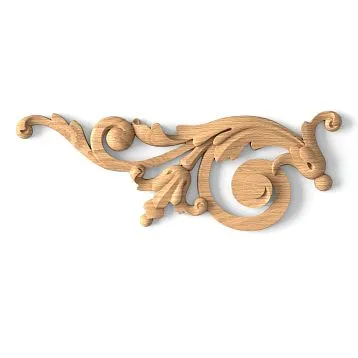
Carved casings with floral or geometric ornamentation are used in interiors of classical, baroque, and Russian styles. Minimalist, Scandinavian, and contemporary styles suit simple rectangular casings.
Molding and strips
Molding — thin strips with cross-sections of 10×10 mm to 25×15 mm for decorative division of flat surfaces, creating panels on doors, wall panels, and furniture facades. Strips — narrow strips for fixing glass in window frames, cabinet glass doors, and stained glass.
Decorative molding is glued onto smooth surfaces of doors or wall panels, forming rectangular or square sections — imitating paneling. They create a classic look for smooth modern doors and add architectural depth to flat walls.
Classification by wood species
Wood species determines color, texture, hardness, dimensional stability, durability of the product, and its price category.
Spruce
Spruce — the most affordable wood species, soft coniferous wood of light yellow color with distinct annual ring texture and resin pockets. Density 500 kg/m³, Brinell hardness 2.5. Easy to process, holds screws and nails well, but prone to dents from impacts.
Spruce molding — optimal choice for budget projects, country houses, or rooms in country or Scandinavian style. Spruce moldings, baseboards, and casings are painted with covering paints (white, gray) or stained with stains to imitate premium species.— optimal choice for budget projects, country-style or Scandinavian homes. Pine moldings, baseboards, and window casings can be painted with covering paints (white, gray) or stained with stains to imitate premium wood species.
The drawback of spruce is blue stain (gray-blue mold spots), resin exudation in resin pockets upon heating. Quality spruce molding is made from selected wood without blue stain, knots, resin pockets, and pre-treated with antiseptics.
Oak
Oak — premium hardwood, the standard of strength and durability. Density 700 kg/m³, Brinell hardness 3.7. Color ranges from light brown to dark brown with distinct coarse texture and characteristic rays on radial cuts. Resistant to moisture, temperature fluctuations, mechanical damage, and does not deform over time.
Oak molding — choice for premium classic interiors, historical styles, and formal spaces. Oak’s natural noble color is enhanced by transparent oils or varnishes, and staining intensifies texture contrast. Oak baseboards, cornices, and moldings last decades without losing appearance and withstand intensive use.
Oak’s high price is offset by its durability and prestige. Bulk purchases of oak molding are targeted at clients with high renovation budgets and designers of luxury interiors.
Ash
Ash — hard, elastic wood of light gray-brown color with contrasting, expressive texture. Density 680 kg/m³, hardness 4.0 — slightly exceeds oak. Strong, stable, resistant to splitting, easily bends when wet (used for bent elements).
Ash is lighter than oak, has a more modern appearance, suitable for light interiors in Scandinavian, minimalist, and eco styles. Ash molding is often coated with white or gray oil, highlighting the texture but lightening the overall tone.
Ash price is comparable to oak, sometimes slightly lower. Popularity is growing due to trends toward light interiors and natural materials.
Beech
Beech — hard, uniform-density wood of rose-brown color with fine, uniform texture and characteristic dark streaks on radial cuts. Density 650 kg/m³, hardness 3.8. Easy to process, can be sanded to perfect smoothness, easily painted and stained.
Beech molding — mid-price category between spruce and oak. Beech is unstable with humidity changes (swells when wet, dries in dry air), so beech products require stable indoor microclimate (humidity 40–60%). When conditions are met, beech is durable, aesthetic, and strong.
Beech is often stained to resemble walnut, redwood, or wenge for imitating exotic species under budget constraints. Beech’s natural rose color is distinctive and suitable for warm, cozy interiors.
Exotic species
Exotic tropical species — meranti, sapelli, iroko, teak, merbau — high-density (700–900 kg/m³), hard, moisture-resistant woods with unique colors ranging from golden-brown to dark chocolate with reddish tones. Used for luxury interiors, yachts, bathrooms (teak is naturally water-resistant due to high oil content).
Exotic species molding — narrow segment for VIP projects and exclusive orders. High price is due to rarity, logistics from tropical countries, and unique properties. Catalog samples of exotic molding demonstrate capabilities for premium clients.
Surface treatment and finishing options
Final surface treatment of molding determines appearance, protective properties, tactile feel, and product longevity.
Unfinished sanded wood
The trim is supplied sanded (grit P150-P220) but without a final finish — natural wood color and texture, ready for staining or painting as chosen by the buyer. Advantage — flexibility in selecting the final finish to match a specific project (any paint color, any stain tone, any type of varnish or oil).
Disadvantage — unfinished wood absorbs contaminants, is sensitive to moisture, requires mandatory final finishing after installation. Wholesale buyers of unfinished trim — carpentry workshops, construction companies performing final finishing on-site.
Stained with stains
Staining with stains (water-based, spirit-based, oil-based) changes the wood's color while preserving the visibility of the texture. Light woods (pine, beech) are stained to darker tones (walnut, wenge), emphasizing texture contrast and hiding natural defects (light pine blue). The stain does not form a surface film; it penetrates into the wood.
After staining, it is mandatory to apply varnish or oil for protection — the stain itself does not protect wood from moisture and abrasion. Stained trim is popular with clients who wish to achieve the color of premium woods using affordable wood.
Varnished
Varnish (polyurethane, acrylic, nitrocellulose) creates a hard, transparent film on the wood surface, protecting against moisture, dirt, and scratches. Glossy varnish provides a shiny surface, highlighting the texture and creating a luxurious feel (classic interiors). Matte or semi-gloss varnish — a modern choice, non-shiny surface, natural, tactilely pleasant.
Varnished trim is ready for installation immediately after purchase and does not require additional processing. Disadvantage of varnish — if the film is damaged (scratch, chip), local restoration is difficult, requiring full resanding and re-varnishing.
Oil-wax
Oil-wax finishes (hard oils, oil with wax) penetrate into the wood, filling pores, creating a silk-matte surface that highlights the texture. Protects against moisture and dirt while preserving the wood's 'breathable' properties and natural tactile feel. Local damage is easily restorable — the damaged area is sanded and re-coated with oil.
Suitable for eco-friendly interiors, Scandinavian style, natural materials. Surface requires periodic renewal (application of new oil layer every 2-3 years), but the technology is accessible for DIY.
Painted with enamels
Opaque painting with acrylic or alkyd enamels completely hides the wood texture, creating an even color. White is the most popular color for painted trim (versatility, visual space expansion, compatibility with any interiors). Colored enamels (grays, beige, black, pastels) are available to order for design projects.
Painted trim hides wood defects (knots, spots, color unevenness), allowing the use of inexpensive woods (pine) with a premium appearance. Matte enamel creates an elegant velvet surface, glossy enamel — a classic shiny finish.
Patina and artificial aging
Patina — application of contrasting pigment (usually gold, silver, bronze, dark brown) into recesses of the relief, followed by wiping off from raised parts. Creates an effect of noble aging, emphasizes relief, adds depth and volume. Characteristic of Baroque, Classicism, Art Deco styles.
Brushing — removal of soft spring wood fibers with a metal brush, emphasizing the relief of annual rings. Brushed trim acquires a pronounced texture, tactile appeal, vintage look. Used in loft, Provence, country, rustic styles.
Criteria for evaluating the quality of trim samples
When forming a collection of samples for client demonstration or wholesale purchases, objective quality assessment is critically important.
Wood quality
Absence of defects: premium-class samples do not contain knots, resin pockets, cracks, blue stains, rot, or insect damage. Small, healthy, light-colored knots up to 5 mm in diameter are allowed in quantities of no more than 1-2 per linear meter for the mid-price segment. The economy category allows knots up to 10 mm, dark knots, minor blue stains (for painting).
Color uniformity: boards from the same batch have the same shade, without abrupt color transitions. Important for items intended for transparent finishes — varnish, oil. For painted items, some color variation is acceptable.
Moisture content: trim must be dried to a moisture level of 8-12% (for use in heated rooms). Over-dried wood (less than 6%) is brittle and will swell when room humidity increases, potentially causing gaps at joints. Under-dried wood (more than 14%) will dry out and warp after installation, cracking. Moisture measurement is mandatory.
Profile accuracy
The trim profile must match the declared dimensions and shape along the entire length of the board. Tolerance ±0.5 mm for cross-section, ±1 mm for width. Inaccurate profile results in steps at joints, gaps, and inability to fit elements tightly.
Inspection: place the ends of two boards from the same batch on top of each other — profiles must match perfectly without gaps or protrusions. Profile-cutting knives on production wear out, requiring sharpening and replacement — trim produced with worn knives has blurred, inaccurate relief and dimensions.
Surface Processing Quality
Surface finish: surface is smooth, without scratches, dents, or fuzz. Final sanding grit P180-P220 ensures readiness for painting or varnishing without additional preparation. Insufficient sanding (coarse grit P80-P120) leaves visible imperfections after applying transparent finishes.
Coating uniformity: varnish, paint, oil are applied in an even layer without drips, runs, gaps, or uncoated areas. Varnish layer thickness 80-120 microns (2-3 coats), paint 100-150 microns. Inspection: examining under side lighting reveals coating unevenness.
Adhesion of coating: varnish or paint adheres firmly to wood, does not peel or flake. Check using the grid cut method (per GOST 31149): cut a 1x1 mm grid with a sharp knife, apply tape, and sharply pull — the coating should not peel off.
Board geometry
Straightness: the plank should not be bent or twisted. Allowable deflection is 2 mm per 2 meters of length. Bent planks cannot be installed evenly; they protrude from the wall and form waves. Check: place the plank on a flat surface and measure the gap between the plank and the surface in the middle.
End perpendicularity: plank ends must be cut strictly perpendicular to the longitudinal axis. A slanted end creates gaps at joints during installation. Check with a square.
Sample collection formation for showroom
Demonstration sample collection — key sales tool for wholesalers, designers, construction companies. A properly formed collection covers a variety of styles, price segments, and technical solutions.
Assortment matrix principle
The collection is built according to the matrix principle: rows — price segments (economy, medium, premium), columns — product categories (moldings, cornices, skirting boards, picture frames, door casings). Each cell in the matrix presents 3-5 samples of different profiles and wood species.
For example, economy segment moldings: pine 40x12 mm simple rounded profile, pine 60x18 mm two-step profile, pine 80x20 mm complex profile with grooves. Medium segment moldings: beech 50x15 mm classic, oak 70x20 mm carved ornament. Premium moldings: oak 90x25 mm multi-step relief, oak 110x30 mm with hand-carved details.
In total, 50-70 basic samples cover 90% of client needs. Additionally, 20-30 special samples (exotic species, exclusive profiles, non-standard sizes) for VIP projects.
Physical samples
Samples 30-50 cm long, processed with the same care as mass-produced items. Each sample is marked: article number, wood species, cross-section dimensions, finish type, price per linear meter (wholesale price for purchases above a certain volume).
Samples are mounted vertically or at a 30-45° angle on demonstration stands for optimal profile visibility. Lighting is directional, highlighting the relief (halogen spotlights). The ability to hold a sample, feel its texture, weight, and critically assess the finish is crucial — tactile contact influences purchase decisions more strongly than visual inspection.
Catalog with photos and descriptions
Printed or electronic catalog complements physical samples. For each article: close-up photo of the profile, photo in interior (application example), technical specifications (species, dimensions, weight, moisture content), style description and application areas, price.
High-quality sample photography: neutral gray background, side lighting emphasizing relief, color reproduction as close to reality as possible (monitor and print calibration). Interior photos demonstrate scale, combination with other finishing elements, and visual effect.
Catalog is structured by product categories, within categories — by price segments or wood species. Convenient navigation, article search, and filters by parameters (species, size, price) simplify selection.
Interactive tools
3D visualization allows the client to see how a specific molding profile will look on their wall, select color and scale. Decoration selection software loads the client’s room photo, overlays selected molding samples, and creates a photorealistic image of the future interior.
Quantity calculation calculator: client enters room dimensions (perimeter for cornices and skirting boards, frame sizes for moldings), program calculates required linear meters including cutting allowance, and outputs a cost estimate.
Augmented Reality (AR) via mobile app: client points smartphone camera at a wall, app overlays a virtual molding at real scale, allows moving, resizing, and changing color, instantly viewing results. Technology increases engagement and reduces uncertainty in selection.
Organization of wholesale deliveries
Efficient logistics and inventory management are critical for successful wholesale trade of molding.
Minimum order and packaging
Molding is packed in bundles of 10-20 planks (depending on cross-section), secured with stretch film. Standard plank length is 2.4 m (fits long-haul transport); non-standard lengths 1.8 m and 3.0 m are available upon request.
Minimum order for retail clients: 1 bundle (10-20 planks = 24-48 linear meters). For wholesale buyers (construction companies, chain stores): minimum 10 bundles (200-500 linear meters) or minimum order value of 50-100 thousand rubles. Progressive discount applies upon exceeding minimum: 5% for orders of 100 linear meters, up to 20% for orders of 1000 linear meters or more.
Warehouse Logistics
Molding is stored in a dry, ventilated warehouse at +10...+25°C temperature and 40-60% humidity. Planks are laid horizontally on racks; vertical storage is prohibited (deformation under self-weight), and storage on concrete floor without underlays (absorbs moisture from below).
Sorting by article, clear cell labeling, real-time inventory tracking system eliminates errors during order fulfillment. Average time to fulfill a typical order (5-10 articles, total 50-100 linear meters) — 30-60 minutes.
Delivery
Transportation of long goods requires specialized transport: box trucks with extended cargo length (up to 6 m), "Gazelles" with extended base, long-haul trucks for interregional deliveries. Bundled packages are placed on underlays and secured with straps to prevent shifting during transport.
City delivery cost: 1500-3000 rubles per trip (depends on distance and volume); regional delivery is calculated individually. Delivery is free for orders above a certain amount (e.g., 100 thousand rubles), encouraging higher average order value.
Delivery times: 1-2 working days within the city, 5-14 days across Russia (via PЭK, Delovye Liniy, KIT). Molding is not a perishable good, so economical, non-urgent delivery options are available.
Target wholesale buyer segments
Understanding the needs of different customer categories allows for targeted offers.
Construction and renovation companies
Perform comprehensive repairs of apartments, houses, commercial spaces. Purchase a wide range of mid-priced trim (oak, beech, stained pine) for standard projects. Volumes are medium (50-200 sq.m per project), frequency is high (several projects per month).
Supplier selection criteria: quality stability (to avoid installation issues), availability of warehouse stock (delivery within 1-2 days), flexibility in order formation (ability to purchase 2-3 additional boards if insufficient), competitive pricing.
Offer: fixed discount of 10-15% for regular orders, personal account manager, priority fulfillment of urgent orders, payment deferral of 14-30 days for loyal clients with a positive history.
Design studios and architectural offices
Develop individual interior projects for private clients. Require non-standard profiles, exclusive species (exotic), ability to manufacture carved trim according to sketches. Volumes are small (10-50 sq.m per project), but margin is high (premium segment).
Criteria: unique assortment, highest quality, customization capability, willingness to work with samples and sketches, consultative support.
Offer: premium collection catalog featuring exotic species and exclusive profiles, custom trim manufacturing service according to drawings (minimum order 50 sq.m of one profile), sample delivery to meet with designer and client, 3D visualization of selected elements in the project.
Frame workshops
Specialize in framing pictures, photographs, mirrors. Purchase exclusivelytrim for frames wholesale— wide range of profiles from narrow minimalist to wide carved, variety of species and finishes (natural wood, stained, patinated, with patina).
Volumes are stable, dependent on seasonality (peak before holidays — February 23, March 8, New Year). Require perfect quality (trim visible, defects not allowed), precise dimensions (for corner alignment in frames), variety of assortment (clients choose from dozens of options).
Offer: collection of 100+ frame profiles in stock, discount system based on monthly purchase volume (from 5% at 500 sq.m to 25% at 5000 sq.m), loyalty program with accumulated bonuses, samples of all profiles for demonstration in the client’s workshop.
Network construction hypermarkets
Sell trim to retail customers. Require mass positions in mid and economy segments (white stained pine, oak, beech), standard profiles, large volumes (hundreds of linear meters per item), stable deliveries for replenishing stock.
Criteria: low price (competitive battle between networks), stable deliveries (delivery delays lead to fines), logistics (delivery to network distribution center or directly to stores), labeling and packaging according to network standards (barcodes, price tags).
Offer: maximum volume discounts (up to 30% for networks), long-term annual contracts with fixed prices, logistical support, participation in network promotions (provision of advertising materials, POS materials for sales points).
Marketing and promotion of samples
Attracting wholesale buyers requires comprehensive marketing.
Participation in trade shows
Specialized construction and interior trade shows (MosBuild, Batimat Russia, Wood Processing) — platform to demonstrate samples to thousands of professionals in a few days. Booth with full sample collection, consultants, catalog distribution, collection of potential client contacts.
Effectiveness: 50-100 contacts per show, of which 10-20% convert to real orders within 3-6 months. Participation cost 200-500 thousand rubles (booth rental, stand construction, sample logistics), ROI when attracting 5-10 loyal wholesale clients.
Showroom and demonstration hall
Own space for client reception with full sample display, interior examples showcasing trim applications in various styles, consultation workstations. Located in a business district with convenient transportation access and parking.
Work format: by prior appointment (personal consultation 60-90 minutes) or free visits during business hours. Services: sample selection for client projects, quantity and cost calculation, order processing, installation consultations.
Online presence
Website with full electronic sample catalog: photos, descriptions, prices, ability to add to cart and place orders online. Optimized for search queries: "trim for frames wholesale", "buy wooden trim", "oak molding".
Contextual advertising in Yandex.Direct and Google Ads targeting keywords (shows for professionals searching for suppliers). Email newsletter for the client base: new product arrivals, seasonal promotions, case studies of implemented projects using molding.
Social media (Instagram, Pinterest, Houzz): posting interior photos featuring molding samples, decoration ideas, installation tips. Targeted advertising for interior designers, architects, and owners of renovation companies.
Working with designers
Architects and interior designers influence the client's material selection. Providing free molding samples (10-15 popular items) to design studios to build a material library. When a designer develops a project, they use familiar materials from the library — recommending a specific supplier to the client.
Affiliate program: designers receive 5-10% commission on orders from clients they refer. Motivates active recommendation of a specific supplier.
Conclusion
Wall decorative finish samples — the foundation of successful wholesale tradewooden moldingA well-structured collection demonstrates variety in profiles, wood species, finishes, and price segments, covering the needs of various client categories from budget to premium. High-quality physical samples, supported by professional catalogs and interactive visualization tools, create a compelling presentation of material capabilities, simplify selection, and accelerate purchase decisions.
Understanding quality criteria, characteristics of different wood species, and surface finishing methods allows forming an assortment that meets professional expectations. Effective showroom organization, participation in trade shows, and development of online promotion channels ensure a steady flow of wholesale clients. Flexible discount system, logistics support, and personalized service strengthen long-term partnerships.
Investments in creating a representative collection of samples pay off through increased sales, expanded client base, and strengthened reputation as a reliable supplier of high-quality decorative interior finishing materials.