Article Contents:
- The kitchen is not a living room. But stucco molding works here too
- Can you use stucco molding in the kitchen
- Where stucco molding looks best in the kitchen
- Moldings in the kitchen: when it's a good option
- Ceiling stucco molding in the kitchen
- Decorative stucco molding for the dining area
- What to buy for different tasks: practical table
- How to choose moldings for the kitchen: size, profile, style
- How to avoid mistakes when installing yourself
- Small kitchen and stucco: how not to overload
- Kitchen-living room and kitchen-dining room: how stucco helps with zoning
- Stucco near the window in the kitchen: wall section, niche, slopes
- How to combine stucco with a kitchen set
- What practice says
- Frequently Asked Questions
- About the Company STAVROS
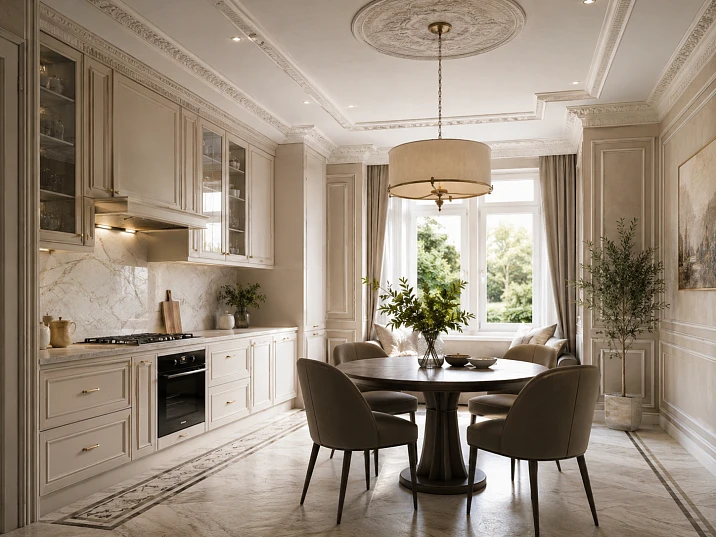


The kitchen is not a living room. But stucco works here too
Many people ask themselves this question: the kitchen is a special space. Steam, smells, moisture from the sink, grease from the stove, constant cleaning, kitchen backsplash, wall cabinets up to the ceiling. All this creates the feeling that stucco is inappropriate here. That it is the prerogative of living rooms, bedrooms, dining rooms. That any decor in the kitchen is doomed: it will turn yellow, peel off, become covered with grease, and in a year become a headache.
This is a common misconception that prevents people from making their kitchen truly beautiful. Because stucco in the kitchen It works. You just need to understand exactly where it works and where it's better not to install it.
The key word here is zoning. In the kitchen, there is a work area: stove, sink, backsplash, hood. And there is everything else: dining table, free walls, ceiling, wall section by the window, buffet area. It is this 'everything else' that is the territory for stucco.
One simple principle that changes everything: stucco in the kitchen is not placed where the stove burns and water flows. It is placed where a person sits, talks, dines, looks out the window — where the interior should please the eye, not resist grease and steam.




Can stucco be used in the kitchen
The direct answer: yes, it can. Moreover — it should be, if you want the kitchen to look more expensive, cohesive, and expressive than just a set of furniture and appliances. But it is important to choose the right zones and the right material.
The main condition is that stucco should be located where there is no direct contact with water, steam, grease, and constant mechanical cleaning. This automatically excludes the backsplash area, the wall above the stove, and surfaces right next to the sink. Everything beyond that is open for decoration.
Now about the material. Buy molding Today it can be made from different compositions: plaster, wood, polyurethane, polystyrene. For the kitchen, the undisputed favorite is polyurethane. Why? Because it is moisture-resistant. Not 'tolerates minor humidity', but truly moisture-resistant in the full sense: it does not swell, does not delaminate, does not lose its geometry with humidity fluctuations, which are normal in a kitchen. The polyurethane surface is non-porous, paint lays evenly and lasts long, and cleaning it from an accidental splash or film is a matter of a minute and a damp cloth.
Plaster stucco in the kitchen is a risk. Plaster is hygroscopic: with constant presence of steam, it begins to absorb moisture, which ultimately leads to loss of adhesive bond strength and, in the worst case, to delamination. Wooden stucco in the kitchen is an even more controversial solution for the same reason. Polyurethane lacks both of these drawbacks, which is why it has become the de facto standard for kitchen decor.
In summary: stucco in the kitchen — yes. Polyurethane — definitely. Correct zones — the key condition.
Our factory also produces:
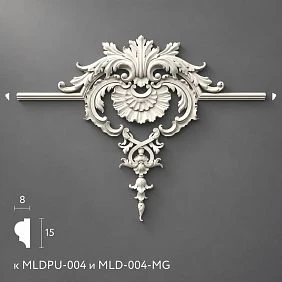
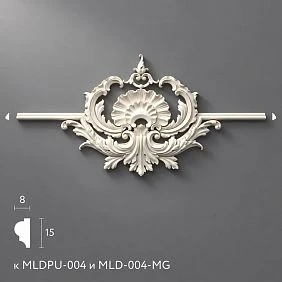
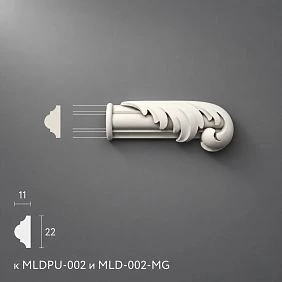

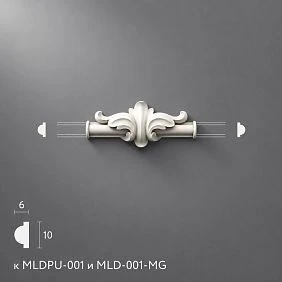


Where does stucco look best in the kitchen?
Before heading to the store and browsing the catalog, it's worth walking through your own kitchen and honestly answering one question: which surfaces here are free from functional load? That's where stucco lives.
The dining wall. The most obvious and most advantageous position. The wall by the dining table is the wall that is looked at during every meal. There is no backsplash, no splashes, no steam from the stove. Here is the face of the kitchen. Moldings with frame panels, decorative stucco, accent overlays — all of this works here to its full potential and creates the feeling that the kitchen is designed, not just furnished.
The area by the table. If the dining group is by a window or in a separate partition, this is an area with maximum decorative potential. Moldings around the perimeter of the wall, a decorative frame behind the chair back, stucco decor near the sconce — any of these techniques works as a finishing touch that turns a corner with furniture into a well-thought-out dining area.
A free wall without a backsplash. If there is a wall in the kitchen that is not occupied by cabinetry, does not serve as a backdrop for the stove, and is not splashed with water — this is an ideal place for moldings or decorative overlays. Here you can afford frame panels, an accent stucco element, and even a small decorative panel.
Ceiling and the junction of the wall with the ceiling. The ceiling in the kitchen is a separate story, which we will dedicate a whole section to below. Let's say right away: a ceiling cornice or molding around the perimeter of the kitchen is a solution that works in any kitchen, regardless of its size and style.
The buffet or display cabinet area. If the kitchen has a freestanding buffet, display cabinet, or tall shelving — the wall behind and around it perfectly accepts stucco decor. The stucco here frames the furniture, integrates it into the space, and creates a sense of built-in, even if the buffet stands separately.
The wall with a sconce. A wall light above the dining table or near the tea area looks completely different if there is a decorative overlay or molding frame around it. The sconce ceases to be just a "light fixture screwed to the wall" and becomes part of a decorative composition.
A niche or partition by the window. Window slopes, side walls of a niche, the partition between the window and the cabinetry wall — all these are small but expressive surfaces. A light molding around the perimeter of the niche or a decorative overlay on the partition gives a disproportionate effect: a small detail, a big visual change.
Get Consultation
Moldings in the kitchen: when it's a good option
Molding is the most versatile, most practical, and most affordable tool for decorative plasterwork in the kitchen. It is not a heavy bas-relief with angels and acanthus leaves. It is a profile, a strip, a line. Sometimes modest and almost invisible — matching the wall color. Sometimes expressive — with a classic cross-section, contrasting color, or gold accent. But always an element that brings the wall together, gives it structure, and makes the kitchen visually more expensive.
Moldings made of polyurethane in the kitchen — it is primarily frame panels. The technology is simple: moldings are cut to size, glued to the wall, creating rectangular or square "frames," and painted in the wall color or a contrasting shade. The result is a wall divided into panels. This is a technique that has long been used in classic interiors and is actively penetrating modern kitchens because it works in any style: from Provence to neoclassicism, from high-tech to loft with wooden details.
What to buy for molding decoration of the kitchen?
-
Moldings made of polyurethane — the main material, cut at a 45° angle at the corner points of the frame
-
Mounting adhesive — a special compound for polyurethane products, ensures reliable adhesion without anchors and a drill
-
Paint — water-based or acrylic enamel, used to paint both the wall and the moldings in a single color or in different tones
-
10–15% extra — for trimming, joints, and accidental defects during initial installation
An important nuance for the kitchen: it is better to paint the moldings the same color as the wall or the color of the kitchen set. This creates a calm, monolithic surface where the frames are read through relief and shadow, not through color. The kitchen is not "overloaded" with decor but gains that very depth that a simply painted wall lacks.
Another option is molding as a dividing line. A horizontal molding at a height of 90–100 cm from the floor, where the lower cabinet zone ends, is a simple technique that splits the wall into two fields and gives the kitchen character. The upper field can be painted a different color, wallpapered, or left neutral.
buy polyurethane moldings you can use both calm, narrow profiles (from 10 mm wide — for minimalist kitchens) and classic, voluminous ones (from 30–50 mm — for kitchens in Provence, neoclassical, classic styles). The choice of profile depends on the ceiling height and kitchen scale: the smaller the room, the thinner and more modest the molding should be.
Ceiling stucco molding in the kitchen
The ceiling is the only surface in the kitchen that is almost never touched by hands, splashed with water, or smeared with grease. Even if you cook every day, the ceiling above the dining area remains relatively clean. This means it offers maximum freedom for decor.
Ceiling molding in the kitchen solves several tasks at once. The first is visual: it closes the top of the room, linking the kitchen set, walls, curtains, and light into a single composition. Without a ceiling cornice, even a very beautiful kitchen looks "unfinished at the top" — the set simply sticks out against the wall, and an awkward gap gapes between the upper cabinets and the ceiling. A cornice or molding at the junction of the wall and ceiling removes this gap and gives the kitchen completeness.
The second task is zoning. In a kitchen-living room or kitchen-dining room, ceiling decor helps separate the dining area from the work area. A cornice around the perimeter of the dining area, a ceiling rosette above the table for a chandelier, a molding contour above the sofa area — these elements work as architectural markers, dividing the space without walls or partitions.
What is suitable for the kitchen ceiling?
-
Ceiling cornice — a profile around the perimeter that covers the junction of the wall and ceiling. In the kitchen, it is better to choose small and medium profiles: 40–70 mm, without excessive ornamentation. A laconic profile in the color of the ceiling gives a calm, noble finish.
-
Molding at the junction — a thinner version of the cornice. A narrow profile of 10–20 mm can work as a delicate line between the wall and ceiling, especially in modern kitchens where a heavy cornice would be inappropriate.
-
Neat profile around the perimeter — if the kitchen is small, instead of a classic cornice, you can use a thin polyurethane ceiling plinth. It performs the same function of closing the joint but does not "overhang" the space.
-
Ceiling rosette — if a chandelier hangs above the dining table, a ceiling rosette turns the attachment point into an architectural element. The chandelier ceases to be "just screwed to the ceiling" and becomes the center of the decorative composition.
Buy ceiling molding for the kitchen should be calculated based on the perimeter of the room plus 10–15% margin for cutting at corners. Corners are the most labor-intensive part of installation: they are cut at 45° and joined, so a margin is mandatory. During installation, it is important to work from corner to corner, fixing each element with mounting adhesive.
A separate technique for kitchens with high ceilings is ceiling stucco molding above the dining table in the form of a decorative zone: a cornice along the perimeter of a square above the table, molding contours inside, a rosette in the center for the chandelier. This turns the dining area into a true architectural scene. For small kitchens — only a cornice along the entire perimeter and a rosette above the table. Nothing extra, but the effect is a complete sense of completeness.
Ceiling Molding Purchase on the STAVROS website, it is available as ready-made sets for ceiling decor, which already include coordinated cornices, moldings, and central elements. This is convenient: you don't need to select compatible profiles yourself — everything has already been tested and balanced in scale.
Decorative stucco molding for the dining area
This is the heart of the theme. The dining area is the most advantageous place in the entire kitchen for stucco decor. It is here that there is no steam, no grease, and no constant cleaning. It is here that it will be visible every day. And it is here that its presence is felt immediately — turning a simple wall by the table into a thoughtfully designed decorative scene.
The wall by the dining table is, as a rule, the most "empty" wall in the kitchen. There are no cabinets, no backsplash, no appliances. There is only a surface that needs to be filled with something. And it is here that people most often hang one large painting, which hangs exactly in the center and creates a feeling of confusion. Stucco molding offers a different answer: it does not fill the wall with a single object, it creates a structure on it.
Frame moldings. The most common and most affordable technique is frames made of moldings on the wall by the table. One large frame spanning the entire width of the wall, three vertical frames side by side, two horizontal rows — there are many schemes, but the result is one: the wall gains depth and rhythm. Inside the frames, you can leave the same paint as on the wall, paint it in a different tone, or cover it with striped wallpaper — molding frames provide a container that accepts any decorative solution.
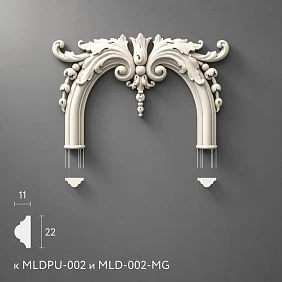
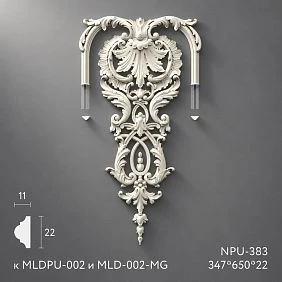
Decorative overlays. Decorative stucco — overlay elements: corner decors for molding frames, ornamental inserts, plant motifs, geometric accents. They are placed in the corners of the frames, in the center of the horizontal sides, above sconces or mirrors. This is the very "jewelry" work with the surface that distinguishes a professionally designed interior from one "made according to instructions."
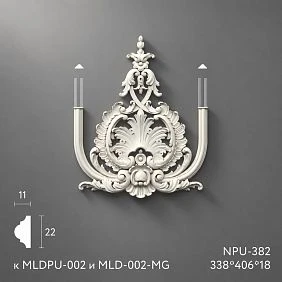
Decor near sconces. If wall lights — sconces — are installed above or near the dining table, a small decorative overlay or frame made of moldings can be placed around each of them. This creates the feeling that the light fixture is "inscribed" into the wall, is a part of it, and not just screwed onto it.
Decor near a mirror. A mirror in the dining area is a technique that visually expands the space and adds light. A molding frame around the mirror or Relief Decoration along its perimeter turns an ordinary mirror into an interior item with character.
Decor for a sideboard. If there is a sideboard, display cabinet, or credenza in the dining area, the wall behind it and the side walls around it accept moldings and overlays especially organically. Here, stucco works as an "embedding" of furniture into the wall architecture: the sideboard ceases to be just a placed cabinet and becomes part of a unified decorative system.
What to buy for the dining area?
-
decorative molding — corner and overlay elements for accents on the wall, near a sconce, near a mirror
-
Relief Decoration — ornamental inserts for molding frames and independent decorative dominants
-
moldings for frames — the basis of the entire system, cut to size and glued to the wall
-
Decor for moldings — corner and intermediate elements that saturate frames with details and transform them from a "set of strips" into a full-fledged decorative system
-
Glue — special mounting adhesive for polyurethane products
-
Paint — in the color of the wall or in the accent color
-
Reserve 10–15% — mandatory
buy decorative moldings can be purchased either as individual elements or as a set — this simplifies selection and guarantees stylistic unity of all details. If you see overlays from one collection in the catalog, take from it: the scale of the ornament and the character of the relief will be coordinated.
What to buy for different tasks: a practical table
Below are specific solutions for different kitchen tasks. No theory, just practice.
| Task | What to buy |
|---|---|
| Decorate the wall near the table | Polyurethane moldings, glue, paint, spare |
| Make the dining area more beautiful | Moldings + decorative stucco + molding decor |
| Decorate the top of the kitchen | Ceiling stucco or cornice around the perimeter |
| There is a chandelier above the table | Ceiling rosette for the mounting point |
| Need one accent | Stucco decor or decorative overlay |
| Small kitchen | Subtle moldings in wall color, narrow cornice |
| There is a sconce on the wall | Decorative overlay or molding frame around the sconce |
| There is a sideboard or display cabinet | Moldings on the wall behind furniture, stucco decor near the sideboard |
| LED lighting is planned | Cornice with a groove for LED strip along the ceiling perimeter |
How to choose the right moldings for the kitchen: size, profile, style
The question of choosing a molding for the kitchen is a question of proportions. A profile that is too heavy in a small room overloads the space. One that is too thin gets lost on the wall and is not readable. How to find the balance?
The first guideline is ceiling height. With ceilings of 2.5 m, the optimal width of the molding for frame panels is 10–20 mm. With ceilings of 2.7–2.9 m — 20–40 mm. With ceilings from 3 m — you can safely use profiles of 40–70 mm.
The second guideline is the kitchen style. A kitchen in Provence or classic style — a molding with an ornamental profile, S-shaped cross-section, smooth curves. A kitchen in neoclassical style — a molding with a stricter, geometric profile, without excessive decor. A kitchen in minimalist or Scandinavian style — a thin, flat molding that is read solely through relief and shadow.
The third guideline is color. A molding in the color of the wall — delicate, almost invisible, working through light and shadow. A molding in a contrasting color — an expressive accent that itself is a decorative element. A molding in the color of the kitchen set — a technique that connects the furniture and walls into a single system.
Buy polyurethane moldings On the STAVROS website, there is a wide range of profiles and sizes — from 10 mm to several centimeters, with different cross-section characters. Before ordering, it is worth looking at real projects using the selected molding: photos of finished interiors show the scale more accurately than any numbers in the product card.
How to avoid mistakes during DIY installation
Installing polyurethane stucco in the kitchen is a task accessible without professional skills. But several mistakes occur so often that it is worth warning about them in advance.
Mistake one: installation on an unprepared surface. The wall must be clean, level, free of oil stains and grease marks. In the kitchen, it is especially important to degrease the surface before installation: even an invisible grease film sharply reduces the adhesion of the glue. Degreaser is a mandatory first step.
Mistake two: wrong glue. For polyurethane products, a special mounting glue is needed. "Liquid nails" — acceptable, but only those compositions that are compatible with polyurethane. Regular PVA or construction glue for gypsum — are not suitable.
Mistake three: no markings. Molding for frames is glued strictly according to markings. Without a laser level or at least a long bubble level, horizontal lines "float" — and a frame that seemed level during installation ends up with a noticeable tilt after drying.
Mistake four: joints without trimming. Corner joints of molding are cut at 45°. A straight joint in a corner is a direct path to a noticeable gap that will ruin the entire result. A miter box or miter saw is an essential tool for even corner joints.
Mistake five: painting without primer. Polyurethane is a non-porous material; paint adheres well to it, but the first layer without primer may give uneven results. One coat of universal water-based primer — and the painting will go perfectly.
Small kitchen and molding: how not to overload
A small kitchen is not a contraindication for molding. It's just a different scale of solutions. The task is not to avoid decor, but to choose it in the right amount.
The main rule for a small kitchen: molding in the color of the wall, narrow profile, minimal ornamentation. Frames made of thin molding 10–15 mm, painted to match the wall — this adds structure and depth without eating up visual space. A wall with such frames looks significantly more expensive and thoughtful than just a painted one, but does not "overwhelm" a small room.
On the ceiling of a small kitchen — a thin cornice 40–50 mm around the perimeter. No more. It covers the joint, gives the kitchen a finished look from above — and that's where you should stop.
In the dining area of a small kitchen — one molding frame on the wall near the table, plus, if there is a sconce, a small decorative overlay nearby. This is enough for the kitchen to gain character without turning into an overloaded "decorative warehouse."
Molding for the kitchen in a small space — it's primarily about precision of choice, not volume. One well-chosen molding works better than five poorly selected ones.
Kitchen-living room and kitchen-dining room: how stucco helps with zoning
Open plan — a kitchen combined with a living room or dining room — is a special case. Here, stucco serves the function of architectural zoning without walls or partitions.
The principle is simple: a ceiling cornice or molding contour above the dining area visually 'marks' its boundaries. A ceiling rosette above the dining table under the chandelier anchors the center of this zone. Molding frames on the wall near the dining group form the background wall of the zone. As a result, the dining area reads as an independent architectural space — even in an open plan, without physical dividers.
On the living room or hall side — its own ceiling system, its own wall moldings. A unified ornamental language of both zones connects them into a single interior, while each zone retains its own character.
Buy molding for such a solution, it is worth using from one line — so that the scale of profiles and the character of ornaments match across the entire open space. Different collections of moldings in adjacent zones are a sure path to stylistic chaos.
Stucco at the kitchen window: pier, niche, slopes
The kitchen window is often an underestimated place for stucco decor. But in vain: the pier between the window and the side wall of the cabinet, the slopes of the window opening, the window sill niche — these are small but expressive surfaces.
A molding around the perimeter of the window opening is a window frame that makes it an element 'built into' the wall, rather than just a 'hole in the wall'. A thin profile of 15–20 mm around the opening gives the desired effect without overloading.
On the pier near the window — a small molding frame or a single decorative overlay. This looks especially expressive if there are flowers or planters on the windowsill: the stucco on the wall nearby turns this corner into a full-fledged decorative zone.
How to combine stucco with a kitchen cabinet set
A question that concerns many: how does stucco relate to the kitchen set? Won't it "compete" with cabinet facades?
The answer depends on where the decor is placed. Stucco on free walls, in the dining area, and on the ceiling does not intersect with the kitchen set at all. It works on other surfaces and in a different space.
If you want to stylistically connect the stucco with the kitchen set, there are several techniques. First — a unified color: moldings and cornices in the color of the facades create the feeling that the entire interior was designed as a single project. Second — a unified style: classic moldings with classic facades featuring milled inserts, minimalist moldings with flat matte facades. Third — stucco as an extension of facade decor: if the cabinets have a milled profile around the door perimeter, a molding on the wall nearby with the same cross-sectional profile "echoes" the furniture.
What practice says
Practice shows: kitchens where even minimal stucco was added — a cornice around the ceiling perimeter and a few molding frames on the dining wall — are perceived fundamentally differently than kitchens identical in layout and set but without decor. This is not a matter of luxury. It is a matter of completeness. Stucco gives the kitchen what architects call "closed geometry": every surface has a frame, every joint has a profile, every corner has a logical conclusion.
The cost of a basic kitchen set — a few molding frames on the dining wall, a cornice around the ceiling perimeter, a ceiling rosette above the table — is not comparable to the effect they produce. And that is why this investment is typically one of the best within a kitchen renovation.
Frequently asked questions
Can stucco be glued in the kitchen?
Yes. The main thing is to choose the right zones. Stucco works well in the dining area, on a free wall, on the ceiling, and near the window. It should not be placed close to the stove, sink, or backsplash area, where there is a lot of moisture, steam, and grease. For the kitchen, polyurethane products are best — moisture-resistant, lightweight, and easy to clean.
Which moldings to choose for the kitchen?
For small kitchens — thin profiles 10–20 mm, in the color of the wall. For medium-sized kitchens — 20–40 mm, depending on the style. The best material is polyurethane or dense polystyrene. Avoid gypsum moldings in the kitchen: humidity gradually destroys the adhesive bond.
Where should you not use stucco molding in the kitchen?
Do not place stucco molding close to the stove, sink, or backsplash area. These are zones with direct contact with water, steam, grease, and frequent cleaning with harsh chemicals. Any stucco molding in these areas will not last long and will look untidy within a few months.
What to buy for the dining area?
Polyurethane moldings for frame panels, decorative stucco for accents near sconces and mirrors, glue, paint, and a 10–15% reserve for trimming. If there is a chandelier above the table, a ceiling rosette. If you want to add ornamentation, decor for moldings in the corners of the frames.
Is stucco molding suitable for a small kitchen?
Yes. For a small kitchen, choose narrow moldings in the color of the wall, a thin ceiling cornice, and a minimum of applied elements. The principle is 'less, but more precise': one well-chosen molding works better than five random ones.
Can stucco molding be combined with LED lighting in the kitchen?
Yes. A ceiling cornice with a groove for an LED strip is a popular solution for the kitchen. The cornice hides the strip, and the light diffuses along the ceiling, creating a soft contour effect. This looks especially impressive in a kitchen-living room with an open layout.
How to calculate the amount of molding for the kitchen?
Measure the perimeter of the surface you want to decorate and add 15% for trimming at corners and joints. If you are making frame panels, calculate the total perimeter of all frames plus the same 15% reserve.
What to use to glue polyurethane stucco molding in the kitchen?
Use special mounting adhesive for polyurethane products or liquid nails compatible with polyurethane. Before installation, be sure to degrease the surface. No water-based PVA glues — they do not provide the necessary adhesion to the polyurethane surface.
About the company STAVROS
Everything discussed in this article — Moldings made of polyurethane, Ceiling molding, Decorative stucco for the dining area, Relief Decoration for walls and ceilings — all of this is presented in the STAVROS catalog.
STAVROS is a Russian company with its own production and a wide range of polyurethane and polystyrene products for interiors and facades. The STAVROS catalog includes moldings, cornices, baseboards, decorative overlays, ceiling rosettes, ready-made ceiling systems, decor for moldings, and the full range of products needed for professional and DIY decoration of a kitchen, living room, bedroom, or any other room.
All STAVROS products are made from moisture-resistant polyurethane and dense HIWOOD polystyrene — materials that are especially well-suited for the kitchen: they do not swell, do not delaminate, are easy to clean, and are ready for painting without complex pre-treatment.
Buy molding for the kitchen, moldings for the kitchen, ceiling stucco for the kitchen и decorative stucco for the kitchen available in the STAVROS online store with Contact us to confirm shipping to your destination. STAVROS is stucco that works.