Article Contents:
- Wooden ceiling skirting: an alternative to polyurethane
- Why wood on the ceiling
- Wood species for ceiling skirting
- Profiles of wooden ceiling skirting boards
- Combination of materials: wood + polyurethane
- Why combine
- Wooden ceiling skirting + polyurethane rosette under the chandelier
- Installation of wooden ceiling skirting: step-by-step instructions
- Surface preparation: walls and ceiling
- Marking: where the skirting will run
- Cutting corners at 45 degrees
- Fastening with self-tapping screws: reliability for solid wood
- Fastening with glue: cleanliness without visible fasteners
- Concealing fasteners: plugs and putty
- Polyurethane molding: rosettes and moldings
- Rosettes for chandeliers: size and style
- Rosette installation: centering and fastening
- Wall moldings: creating panels
- Classical furniture: integration into a wooden interior
- Why classic rhymes with wood
- Color scheme: natural wood or painting
- Furniture arrangement: composition considering decor
- Frequently Asked Questions
- Conclusion: interior architecture as art

The ceiling is the fifth wall, often ignored. White paint, a smooth surface, a central light fixture — a standard scenario for 90% of apartments. But what if the ceiling could be turned into an architectural statement?Installation of wooden ceiling skirtingmade of solid oak, ash, or pine creates a warm framing contour at the junction of the wall and ceiling, materializes the nobility of natural wood, and gives the interior weight.polyurethane ceiling rosette moldingunder the chandelier add a focal point, accentuate the center of the room, and create a visual anchor for the gaze. Polyurethane moldings on the walls (horizontal lines at a height of 80-120 cm from the floor) form the middle tier of decor, connect the ceiling skirting with the floor skirting, and divide the wall into panels.Classic Furnituremade of solid wood with carved elements, a soft group with high backs, tables with turned legs complete the composition, tie the decor to function, and create unity. Wooden ceiling skirting + polyurethane rosettes and moldings + classical furniture = multi-level interior architecture, where each element plays its role, but all are subordinated to a common concept. In this article, we analyze the technique of installing wooden ceiling skirting (fastening with self-tapping screws, glue, corner treatment, 45-degree miter cuts), installation of polyurethane rosettes and moldings (glue, centering, painting), combination of materials (wood + polyurethane — a balance of naturalness and practicality), integration of classical furniture (how wooden decor and furniture rhyme stylistically and color-wise). Get ready to create interiors where the gaze does not stop at the ceiling but glides along architectural lines, reads the composition, and admires the details.



Wooden ceiling skirting: an alternative to polyurethane




Why wood on the ceiling
Polyurethane ceiling cornices (often called skirting boards, although technically a cornice is an element at the junction of the wall and ceiling) dominate the market: lightweight (weight per linear meter 0.5-1.5 kg vs. 2-5 kg for wood), moisture-resistant (can be installed in bathrooms, kitchens), easy to install (glued with polyurethane adhesive, no screws required), inexpensive (price 300-1200 rub/m vs. 1200-3500 rub/m for wood). But wood offers what polyurethane cannot provide: naturalness (a living material with the texture of annual rings, the scent of wood, tactile warmth), prestige (wood is associated with luxury, status, history, while polyurethane is associated with mass production, accessibility), durability (solid oak ceiling skirting lasts 50-100+ years without losing shape and strength, polyurethane 30-50 years).
Aesthetically, a wooden ceiling skirting board creates a different atmosphere: warmth (wood is visually warmer than white polyurethane, especially if the wood is a natural oiled color—beige-brown oak, light yellow ash, reddish pine), solidity (wood is perceived as a more 'heavy,' substantial material, giving the interior weight and stability), individuality (the wood grain is unique for each plank—the pattern of annual rings, knots, color variations create uniqueness).
When to choose wood instead of polyurethane? If the budget allows (wooden skirting is 2-4 times more expensive), if the interior is classic or traditional (wood fits organically in classic, Empire, country, eclectic styles, less so in minimalism and high-tech), if you want natural materials (the philosophy of eco-interiors, where artificial materials are minimized), if the ceiling skirting should rhyme with wooden floor skirting, wooden door casings, wooden furniture (creating a unity of material throughout the interior).
Our factory also produces:


Wood species for ceiling baseboard
Oak is the king. Hardness (density 650-720 kg/m³, high resistance to mechanical damage, doesn't dent, doesn't scratch easily), durability (oak lasts for centuries, doesn't rot, isn't destroyed by pests with proper treatment), beauty (expressive grain with large annual rings, knots are rare or absent in high grades, color from light beige to dark brown depending on treatment). Price is high (solid oak skirting 80-100 mm high costs 1800-3200 rub/m), but the quality justifies it. Oak is heavy (a linear meter of skirting with a cross-section of 80×20 mm weighs about 1.2-1.5 kg), requires reliable fastening (screws, not just glue).
Ash is an alternative to oak. Hardness is close to oak (density 630-690 kg/m³), grain is expressive (annual rings are contrasting, pattern is dynamic), color is lighter than oak (light yellow, cream, grayish-beige—creates a lighter, more airy interior compared to dark oak). Price is slightly lower than oak (ash skirting 1500-2800 rub/m). Ash is less common on the market (oak is more popular), but professional suppliers offer it.
Pine is a budget option. Soft wood (density 480-520 kg/m³, scratches easily, dents upon impact), but lightweight (a linear meter of skirting weighs 0.8-1.0 kg, installation is easier), cheap (pine skirting 850-1600 rub/m). Color is warm yellow-reddish (characteristic of coniferous species), grain is less expressive than oak or ash (annual rings are small, pattern is calm). Pine suits interiors in country, chalet, Provence styles (where coniferous species are organic), for budget projects where wood is desired but the cost of oak is inaccessible. Downside: pine is less durable (service life 30-50 years vs. 80-120 for oak), darkens over time (acquires a brownish tint under light exposure).
Larch is a compromise between pine and oak. Density 630-650 kg/m³ (close to oak), hardness is high, durability is excellent (larch is resistant to moisture, rot, pests—used even in shipbuilding), color is reddish-brown (darker than pine, warmer than oak). Price is medium (1400-2400 rub/m). Larch is less common in the range of ceiling skirting boards (oak and ash are more popular), but available from specialized manufacturers.
Get Consultation
Profiles of wooden ceiling skirting boards
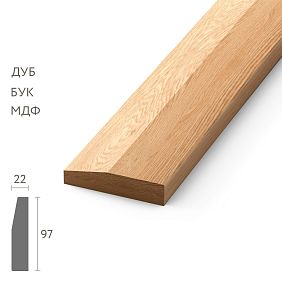
Simple rectangular profile with a chamfer—a minimalist option. The skirting has a rectangular cross-section (height 60-100 mm, thickness 15-22 mm), one or two chamfers (beveled edges at a 45-degree angle) on the top or bottom edge soften the transition, but there is no decoration. Suitable for modern, Scandinavian, loft interiors (where wood is used, but decorativeness is minimal).
Classical profile with a torus—traditional form. The skirting has a convex element (torus, bead) along the upper part, which protrudes 5-15 mm from the main plane, creates play of light and shadow, adds volume. The torus can be simple (semi-circular, without ornaments) or with fluting (grooves, beads along the torus). Suitable for classic, neoclassical, traditional interiors.
Carved profile with ornament—a formal option. The skirting is decorated with carved elements (dentils—teeth, egg-and-dart ornament, simplified acanthus leaves, meander—geometric pattern). Carving is done on CNC machines (for mass production, high precision, cost lower than hand carving) or by hand (for exclusive orders, each element is unique, cost is high). Carved wooden ceiling skirting boards cost 3500-8500 rub/m (depends on carving complexity, wood species), used in luxurious classic interiors (palace style, Baroque, Empire).
Combination of materials: wood + polyurethane
Why combine
Wooden ceiling skirting is beautiful, prestigious, durable, but expensive and heavy (requires reliable fastening, installation is more difficult than polyurethane). Polyurethane molding (rosettes, moldings, decorative overlays) is lightweight, moisture-resistant, easy to install, cheaper than wood by 2-4 times. Combination provides balance: wood where it is most noticeable and valuable (ceiling skirting around the room perimeter, floor skirting, door casings—elements you constantly see, which set the main tone of the interior), polyurethane where decorative volume is needed without high cost (rosettes under the chandelier, wall moldings, decorative overlays on doors).
Economically: if making all decor from wood (ceiling skirting, floor skirting, casings, carved wooden rosette under the chandelier, wooden wall moldings), the material cost for a 25 m² room will be 180,000-350,000 rub (depends on wood species, carving complexity). If combining (wood ceiling skirting, wood floor skirting, wood casings, polyurethane rosette, polyurethane moldings), cost 95,000-180,000 rub (saving 40-50%).
Stylistically: wood + polyurethane are compatible if the polyurethane is painted in a color that harmonizes with the wood. Natural oiled oak (beige-brown) + white polyurethane (classic combination, contrast of warm wood and cold white creates dynamics). Painted wood (skirting and casings white enamel) + white polyurethane (monochrome scheme, materials differ in texture, but not color). Tinted wood (gray oak, fashionable shade 2024-2026) + gray polyurethane (modern monochrome scheme).
Wooden skirting on the ceiling + polyurethane rosette under the chandelier
Composition logic: wooden ceiling skirting frames the ceiling around the perimeter (creates a frame, visually lowers the ceiling by 80-120 mm—makes a high ceiling cozier, less oppressive, highlights the wall-ceiling transition). The center of the ceiling remains empty (white paint, flat plane), but requires a focal point. The chandelier (hangs in the center or shifted to the dining area) creates a functional focus (lighting), but aesthetically needs support—polyurethane ceiling rosette moldingwith a diameter of 60-120 cm is mounted on the ceiling in the center, the chandelier is attached through the central hole of the rosette. The rosette creates visual support for the chandelier (the chandelier doesn't hang in emptiness, but 'grows' from a decorative element), adds architectural interest to the ceiling (relief, ornament, play of light and shadow), rhymes stylistically with the wooden skirting (if the skirting is classic with a torus, the rosette is also classic with a floral ornament; if the skirting is simple, the rosette is geometric).
Color combination: natural wooden skirting (light beige-brown oak) + white rosette (classic). Painted wooden skirting white enamel + white rosette (monochrome). Tinted wooden skirting gray + gray rosette (modern variant).
Technically: installation of wooden ceiling skirting is done first (skirting is attached around the room perimeter with screws or glue, corners are mitered at 45 degrees, joints are sanded, skirting is painted or oiled). After skirting installation, the ceiling is painted (white or colored paint). Then the polyurethane rosette is mounted (rosette is glued to the ceiling with polyurethane glue, the central hole is aligned with the electrical wiring exit point for the chandelier, the rosette is pressed for 1-2 minutes, glue sets in 10-15 minutes). After installation, the rosette is painted (white acrylic paint or to match the ceiling color), the chandelier is mounted through the central hole.
Installation of wooden ceiling skirting: step-by-step instructions
Surface preparation: walls and ceiling
Wooden ceiling skirting is mounted at the wall-ceiling junction, adhering to both planes simultaneously. Both surfaces must be level, clean, dry. Irregularities in the wall or ceiling create gaps between the skirting and the surface (visually unattractive, skirting holds weaker). Checking levelness: place a long straightedge or a straight batten 2.0-2.5 meters long against the wall along the line where the top edge of the skirting will be (usually at a distance of 80-120 mm from the ceiling), check if there are gaps between the straightedge and the wall. A gap up to 2-3 mm is acceptable (the skirting will press, glue or screws will compensate), a gap of 5+ mm requires leveling (plastering, wall putty before skirting installation).
The ceiling is checked similarly: the straightedge is placed against the ceiling along the line where the bottom edge of the skirting will be. Ceilings in old houses are often uneven (variations of 5-10 mm over a length of 3 meters), require leveling with putty or a suspended/stretch ceiling (which is initially level).
Cleanliness: walls and ceiling must be cleaned of dust, grease stains, remnants of old paint (if not a renovation from scratch, but an update). Dust is removed with a damp cloth or vacuum, grease stains (in the kitchen, where walls may be splattered with grease) are degreased with alcohol or a special degreaser. If walls/ceiling are painted with glossy paint (poor adhesion for glue), the surface is sanded with fine sandpaper (grit 120-180) to create roughness for the glue to grip.
Marking: where the skirting will run
Wooden ceiling skirting is mounted at the wall-ceiling junction, but the exact position depends on the skirting height. Skirting height 80 mm: part of the skirting adheres to the wall (e.g., 60 mm height along the wall), part to the ceiling (20 mm depth along the ceiling). Skirting height 100 mm: 75 mm along the wall, 25 mm along the ceiling. The proportion is approximately 3:1 (three-quarters of the skirting height goes along the wall, one-quarter along the ceiling).
Marking on the wall: measure down from the ceiling the height to which the skirting will descend along the wall (e.g., 75 mm for a skirting height of 100 mm), draw a horizontal pencil line along the entire wall at this height. The line shows where the bottom edge of the skirting will be. For precise horizontality, use a laser level (projects a horizontal line onto the wall, mark with pencil) or a water level (simple tool, accurate, cheap 300-600 rub). A regular bubble level 60-80 cm long works, but on long walls (4-6 meters) error accumulates.
Cutting corners at 45 degrees
How to miter wooden skirting at cornersfor ceiling—same technique as for floor skirting. Internal corner (90 degrees, room corner): two skirting planks are mitered at 45 degrees, meet in the corner so that their beveled ends adhere to each other. Left plank: miter from right to left (the upper part of the plank, adhering to the ceiling, is longer than the lower part adhering to the wall). Right plank: miter from left to right (mirror of the left).
Tool: miter saw (power tool with a circular saw on a rotating base, angle is set precisely, cut made in 3-5 seconds, cost 9000-25000 rubles for household models) or miter box (U-shaped tray with slots for 45 degrees, the skirting board strip is placed in the tray, cut with a handsaw through the slot, miter box cost 400-1200 rubles, fine-toothed handsaw 700-1500 rubles).
Cutting technique in a miter box for ceiling skirting board: the skirting board is placed in the miter box upside down (the part of the skirting board that will be against the ceiling is placed on the bottom of the miter box, the part against the wall is pressed against the far wall of the miter box). This is important: the skirting board lies not as it will be mounted on the wall, but inverted. You choose the 45-degree slot (right to left for the left strip of an internal corner), insert the handsaw, cut smoothly. You get an end with a 45-degree miter cut.
Joint check: before fixing the skirting board to the wall, you apply both strips (left and right) to the corner, see how the ends meet. The joint is tight, no gap — excellent. Gap 0.5-1.5 mm — adjust with sandpaper (sand the ends until they fit tightly). Gap more than 2 mm — recut.
Fixing with screws: reliability for solid wood
Wooden ceiling skirting board is heavy (a linear meter of solid oak with a cross-section of 100×20 mm weighs 1.3-1.6 kg), glue may not hold, especially if the walls are not perfectly even (gaps between the skirting board and the wall reduce the contact area, glue holds weaker). Screws — reliable fastening, proven for decades.
Screw selection: length 50-70 mm (so that the screw passes through the 20 mm thickness of the skirting board, enters the wall by 30-50 mm, ensuring reliable hold), diameter 3.5-4.0 mm (no need for thicker, they can split the skirting board when screwing in), with a countersunk head (conical head, sinks flush or deeper into the wood). Wood screws (coarse thread, go easily into wooden skirting board) or universal screws (suitable for wood and concrete/brick, if the wall is concrete).
Fixing technique: applied the skirting board strip to the wall (the top edge coincides with the marking line, the bottom edge fits against the ceiling), marked with a pencil on the skirting board the fixing points (spacing 40-50 cm: the first screw at a distance of 10-15 cm from the edge of the strip, the last at a distance of 10-15 cm from the other edge, intermediate ones evenly). Removed the strip, drilled holes in the skirting board at the marked points (drill bit diameter 2.5-3.0 mm, slightly smaller than the screw diameter, so the screw goes in with effort but the skirting board does not split). Applied the strip again to the wall, screwed in the screws with a screwdriver (the screw passes through the hole in the skirting board, enters the wall). The screw head sinks into the wood 2-3 mm below the surface of the skirting board (to later mask with a wooden plug or filler).
If the wall is concrete or brick (hard, the screw does not go in just like that), you pre-drill holes in the wall (after applying the skirting board and marking the fixing points, remove the skirting board, drill the wall with a 6 mm drill bit to a depth of 40-50 mm, insert 6 mm plastic dowels into the holes, apply the skirting board again, screw the screws into the dowels). If the wall is drywall (soft, holds poorly), use special drywall dowels (butterfly dowel or molly dowel, they open behind the drywall, create a wide support, hold more firmly).
Fixing with glue: cleanliness without visible fasteners
Glue holds the skirting board without visible screws (aesthetically cleaner: skirting board surface without holes, without plugs, without filler traces), but requires even walls and ceiling (if the gap between the skirting board and the surface is more than 2-3 mm, glue will not fill it, will not hold). Suitable for light species (pine, larch) and small skirting boards (height 60-80 mm, weight per linear meter up to 1.0 kg). For solid oak with a height of 100-120 mm, glue is used in combination with screws (glue ensures even adhesion along the entire length, screws hold the weight).
Glue selection: liquid nails (construction adhesive in 310 ml cartridges, applied with a caulking gun, holds wood on concrete, brick, drywall, plaster, sets in 15-30 minutes, dries completely in 12-24 hours, costs 220-550 rubles/cartridge). One cartridge is enough for installing 3-5 meters of skirting board (depends on the glue layer thickness). Polyurethane glue (special glue for moldings, squeezed from a cartridge, sticky, strong, sets quickly, costs 380-650 rubles/cartridge) is suitable for light wood (pine), less reliable for solid oak.
Fixing technique: apply glue to the back side of the skirting board strip (the one that will be against the wall and ceiling). Glue is applied in a zigzag or dots (not a continuous layer, so it does not squeeze out when pressing the skirting board, a 5-7 mm wide strip of glue along the edges of the skirting board that fit against the wall and ceiling is sufficient). Apply the strip to the wall (top edge along the marking line, bottom fits against the ceiling), press along the entire length (can be done by hand or with props — wooden blocks pressing the skirting board against the wall until the glue sets). Hold pressed for 2-3 minutes (for liquid nails) or 1-2 minutes (for polyurethane glue), the glue sets, the skirting board holds on its own. Remove props after 15-30 minutes, when the glue has fully set.
Excess glue that has squeezed out from under the skirting board (if too much was applied), wipe off immediately with a damp cloth (while the glue is not dry, it is easily removed with water; after drying, removal is more difficult, requiring solvent or mechanical scraping).
Masking fasteners: plugs and filler
If the skirting board was fixed with screws, the screw heads are sunk into the wood by 2-3 mm, leaving visible holes 4-5 mm in diameter. The holes need to be masked so the skirting board looks solid, without traces of fasteners.
Wooden plugs: turned on a lathe, cylindrical plugs 4-5 mm in diameter, 5-8 mm long, made from the same wood species as the skirting board (oak, ash, pine). The plug is placed on wood glue PVA into the hole above the screw head, tapped flush with the skirting board surface with light hammer blows. After the glue dries (12-24 hours), the plug is sanded with fine sandpaper (grit 220-320), painted or coated with oil/varnish along with the skirting board. A plug made from the same wood species blends with the skirting board, becoming almost invisible (visible only upon very close inspection). Wooden plugs are sold in hardware stores (pack of 50-100 pieces costs 150-450 rubles) or made independently (if you have a lathe or a Forstner bit to drill plugs from skirting board scraps).
Wood filler: paste in tubes or jars, color matched to the wood species (oak, walnut, pine, white). Filler is applied with a spatula or finger into the hole above the screw head, fills it, leveled flush with the skirting board surface. After drying (2-4 hours), sanded with sandpaper, painted or varnished. Filler is cheaper than plugs (200 ml tube costs 150-350 rubles, enough for 50-100 holes), easier to use, but less authentic (filler differs in texture from wood, visible upon close inspection). For skirting board that will be painted with white enamel (color will hide both plugs and filler), filler is optimal.
Polyurethane moldings: rosettes and moldings
Rosettes for chandeliers: size and style
polyurethane ceiling rosette molding— round or oval decorative element with a diameter from 30 to 150 cm, mounted on the ceiling in the center of the room or above the dining table, the chandelier is attached through the central hole of the rosette. The rosette serves two functions: decorative (adds relief, ornament, architectural interest to the ceiling) and utilitarian (covers the electrical wiring exit, masks the chandelier mounting).
Size selection: rosette diameter depends on the room size and chandelier. Small room (10-15 m²): rosette diameter 40-60 cm (larger will overwhelm the space, look bulky). Medium room (20-30 m²): rosette diameter 70-100 cm (standard for most living rooms, dining rooms). Large room (35-50 m²): rosette diameter 110-140 cm (scale corresponds to the room volume). Very large hall (60+ m²): rosette diameter 150 cm or several smaller rosettes (if there are multiple chandeliers).
Proportion: rosette diameter should be 1.5-2 times larger than the diameter of the chandelier shade (if the chandelier has shades forming a circle 50 cm in diameter, the rosette should be 75-100 cm). If the rosette is too small relative to the chandelier (rosette diameter 40 cm, chandelier 60 cm), the chandelier visually overwhelms the rosette, the composition is unbalanced. If the rosette is too large (rosette diameter 120 cm, chandelier 30 cm), the chandelier gets lost against the rosette, looks toy-like.
Ornament style: classic rosettes (floral ornament, acanthus leaves, laurel wreaths, rosettes — suitable for classic, neoclassical, empire interiors), geometric rosettes (concentric circles, radial lines, meander — suitable for art deco, eclectic interiors), baroque rosettes (lavish multi-layered ornament, shells, scrolls, cherubs — suitable for luxurious, palace interiors), minimalist rosettes (smooth with simple relief, without ornaments — suitable for modern, Scandinavian interiors where a rosette is needed functionally, but decorativeness is minimal).
Rosette mounting: centering and fastening
Centering: the rosette is mounted exactly in the center of the ceiling (if the chandelier hangs in the center) or offset towards the dining table, seating area (if the chandelier is offset). The ceiling center is found at the intersection of two diagonals (from corner to corner). Mark the diagonals with a pencil on the ceiling (or stretch two strings from corner to corner), the intersection point is the center. The center usually has the electrical wiring for the chandelier exiting (if the electrical work is done standardly).
Fitting: place the rosette against the ceiling (align the central hole of the rosette with the wiring exit point), see how the rosette looks (size fits, position is correct). Mark the contour of the rosette on the ceiling with a pencil (so after applying glue you know where to place it).
Applying glue: polyurethane glue (in a 310 ml cartridge, squeezed with a caulking gun) is applied to the back side of the rosette (the one that will be against the ceiling). Glue is applied in a zigzag or spiral (not a continuous layer, so it does not squeeze out, but enough for the rosette to hold firmly — approximately 30-50 grams of glue for an 80 cm diameter rosette). If the rosette is large (diameter 100+ cm, weight over 2 kg), more glue (50-80 grams).
Installation: place the rosette against the ceiling (central hole coincides with the wiring exit, rosette contour coincides with the pencil marking), press evenly over the entire surface (can be done with palms or props — a wooden batten with a soft pad, pressing the rosette to the ceiling). Hold pressed for 1-2 minutes, the glue sets, the rosette holds on its own. Remove props, leave the rosette for 12-24 hours for the glue to dry completely.
Excess glue that has squeezed out along the edges of the rosette, wipe off immediately with a damp cloth. If the glue has dried, cut it off with a knife.
Wall moldings: creating panels
Polyurethane moldings 60-100 mm wide are mounted on walls horizontally at a level of 80-120 cm from the floor (height is chosen so that the moldings divide the wall into proportional parts: the lower part from the floor to the moldings is approximately equal to the upper part from the moldings to the ceiling, or the lower part is slightly smaller). Moldings create frames (rectangular or square panels on walls), which are painted the same color as the walls, or a contrasting one (if the walls are light gray, the panels inside the molding frames are white — creating relief, structure).
Marking: measure the height from the floor where the top edge of the molding will pass (e.g., 100 cm), draw a horizontal line along the wall with a pencil (use a laser level for accuracy). Plan the panel dimensions (e.g., on a 4.5-meter-long wall, create three panels each measuring 1.2×0.8 meters, with 30 cm between panels and 30 cm from the wall edges to the panels). Mark the panel outlines with a pencil on the wall (rectangles).
Cutting moldings at 45 degrees: moldings form a frame, the frame corners are cut at 45 degrees (like baseboards). Four molding strips (two vertical 80 cm long, two horizontal 120 cm long) are cut at 45 degrees at the ends to form a rectangular frame. The cut is made with a miter box or miter saw (same technique as for baseboards).
Installation: apply glue to the back of the molding strip in a zigzag pattern, press the strip against the wall along the markings, hold for 1-2 minutes until the glue sets. Install all four strips of the frame (first vertical, then horizontal, or vice versa), ensuring tight joints at the corners without gaps. If a gap exists (0.5-1 mm), fill it with a thin layer of acrylic putty after the glue dries.
Painting: after installing all moldings, walls and moldings are painted (with white acrylic paint or a chosen color). Moldings create relief, but the color is unified—a monochrome scheme. Alternatively, moldings are painted white, walls gray, and panels inside the frames white—a contrasting scheme where panels stand out.
Classical furniture: integration into a wooden interior
Why classic rhymes with wood
Classic FurnitureSolid wood furniture with carved elements, upholstered seating with high backs and carved armrests, tables with turned legs, display cabinets with glazed doors—this is furniture that, in material, form, and decor, continues the logic of wooden ceiling baseboards and polyurethane moldings. Wood is the primary material of classical furniture (frames, legs, tabletops, cabinet fronts), so wooden ceiling baseboards fit organically, creating material unity. Carved elements on furniture (carved chair legs, carved cabinet cornices, carved armrests of armchairs) rhyme with the ornaments of polyurethane rosettes and moldings (if a rosette has acanthus leaves, carved table legs also feature acanthus leaves—a stylistic rhyme).
Proportions: classical furniture is massive, tall (sofas with high backs 90-110 cm from the floor, armchairs with high backs 100-120 cm, dining tables with thick tops and massive legs). Wooden ceiling baseboards 100-120 mm in height match this massiveness in scale (they don't get lost against large furniture, maintaining balance). If the baseboard is thin (40-60 mm), it appears insufficient in an interior with massive classical furniture, and the composition becomes unbalanced.
Color scheme: natural wood or painted finish
Scheme 1: all natural wood. Ceiling baseboard made of oak with oil finish (beige-brown), floor baseboard made of oak with oil finish, door architraves made of oak, classical furniture made of oak (tables, chairs, cabinets—frames and fronts in natural oak). Polyurethane rosettes and moldings painted white (contrast of warm wood and cool white). Walls light beige or cream (warm neutral background, rhymes with wood color). A classic, time-tested scheme that works flawlessly.
Scheme 2: painted wood + white plasterwork. Ceiling baseboard made of oak or ash painted with white acrylic enamel (wood retains strength but color is white), floor baseboard white, architraves white, polyurethane rosettes and moldings white. Classical furniture partially white (frames and legs painted with white enamel), partially with colored upholstery (sofas and armchairs with light gray, beige, or bluish upholstery). Walls light gray or light blue (cool neutral background). A monochrome architectural scheme (all decor white), with color introduced by furniture upholstery, textiles, and decor.
Scheme 3: stained wood + gray plasterwork. Ceiling baseboard made of oak stained gray (gray or gray-brown stain changes wood color while preserving texture), floor baseboard gray, architraves gray, polyurethane rosettes and moldings painted gray. Classical furniture with frames stained gray, upholstery gray or beige. Walls dark gray or graphite (modern monochrome scheme, relevant in 2024-2026). Suitable for modern interpretations of classic styles (neoclassical, eclectic), where traditional forms combine with contemporary color palettes.
Furniture arrangement: composition considering decor
Wooden ceiling baseboards and polyurethane moldings create architectural axes to consider when arranging furniture. A ceiling rosette is the center; it's logical to place a dining table under it (if the rosette is in the dining area) or a central seating group (if in the living room, with a coffee table underneath, surrounded by a sofa and armchairs). Wall moldings create panels (rectangular frames); inside panels, you can place paintings, mirrors, sconces (decor that emphasizes architecture), but large furniture (cabinets, dressers) should be placed next to panels without covering them (so moldings remain visible and function as architectural elements).
Symmetry: classical interiors favor symmetry. If a rosette is centered on the ceiling, place a table centered in the room. If there are three molding panels on a wall (horizontally aligned at the same height), place two armchairs symmetrically between the panels on the wall, and hang three paintings of the same size above the panels (symmetrical composition). Asymmetry is possible in eclectic interiors but requires a subtle sense of balance.
Frequently asked questions
Can wooden ceiling skirting be installed in a bathroom or kitchen where humidity is high?
Wood is a hygroscopic material (absorbs moisture from air, swells in high humidity, shrinks in low humidity). Bathroom humidity is 60-90% (after showers, baths), kitchen humidity 50-70% (cooking, dishwashing), which exceeds the comfortable 40-60% humidity for wood. Wooden ceiling baseboards in these spaces require protection: oil impregnation (linseed, tung oil penetrates deeply, creates a hydrophobic layer, repels water) or moisture-resistant varnish (yacht varnish, polyurethane varnish—forms a surface film, blocks moisture). Even with protection, wood in bathrooms is risky (moisture-resistant species like larch, teak hold up better, but they may darken or deform over time). Alternative: polyurethane cornice (wood imitation—polyurethane painted to resemble oak, ash, looks like wood but is completely moisture-resistant, doesn't swell or rot).
How to visually connect wooden ceiling baseboards with wooden floor baseboards in room corners?
Ceiling baseboards run along the top of the wall (at the wall-ceiling junction), floor baseboards along the bottom (at the wall-floor junction). In room corners, they don't physically connect (there's a vertical wall 2.5-3.0 meters high between them), but should rhyme visually. Rhyme by material: both from the same wood species (oak, ash), same finish (natural oil, gray stain, white paint). Rhyme by profile: if ceiling baseboard has a cavetto, floor baseboard also has a cavetto (profiles need not be identical but stylistically similar). Rhyme by height: if ceiling baseboard is 100 mm high, floor baseboard 100-120 mm (similar sizes create balance). Visually, the two baseboards frame the wall top and bottom, creating a frame.
Do polyurethane rosettes and moldings need painting if they come pre-primed white?
Polyurethane rosettes and moldings come pre-primed white (surface coated with primer, ready for finish painting, but can be left white if suitable). Painting is needed if: you want to change color (from white to gray, beige, black, gold); you want matte or glossy finish (factory primer is semi-matte, finish paint provides desired sheen); you want protection from dust and stains (paint creates a denser layer easier to clean). If left white, primer also works (lasts 5-10 years without peeling), but may yellow over time (especially in kitchens with grease vapors), so finish painting is recommended.
How to choose ceiling rosette size if the chandelier isn't purchased yet?
First determine room size: small room (10-15 m²) requires a rosette 40-60 cm in diameter, medium (20-30 m²) 70-100 cm, large (35-50 m²) 110-140 cm. Then choose a chandelier with diameter 1.5-2 times smaller than rosette diameter (if rosette is 80 cm, chandelier 40-55 cm). Or vice versa: if a chandelier is already chosen at 50 cm diameter, rosette should be 75-100 cm. If rosette is installed before chandelier purchase (common during renovation: decor first, then furniture and lighting), install rosette based on room size, then select chandelier to match rosette.
Can wooden ceiling baseboards be used with a stretch ceiling?
Stretch ceiling—PVC film or fabric stretched on profiles under the main (concrete) ceiling at a distance of 3-10 cm. Wooden baseboard on a stretch ceiling is not attached to the ceiling film (it's soft, can't support baseboard weight) but to the wall (baseboard fixed with screws or glue only to the wall, top edge abuts the stretch ceiling but isn't attached to it). Technically possible but requires precision: baseboard must be installed before stretch ceiling (baseboard on wall, then ceiling stretched, edge of ceiling film tucked into gap between baseboard and wall or covered with decorative insert). Simpler alternative: polyurethane cornice with lighting (special profile with groove for LED strip, cornice attached to wall, 10-15 mm gap remains between cornice and stretch ceiling, LED strip placed in gap for hidden ceiling lighting).
How to care for wooden ceiling baseboards: cleaning, refinishing?
Wood with oil finish (natural coating): dust wiped with dry cloth or vacuum with soft brush attachment (monthly). Stains (spots, fingerprints on baseboard in high-touch areas) removed with damp cloth lightly moistened with water and a drop of soap (not wet, to avoid water absorption). Oil finish requires refreshing every 3-5 years (wood surface becomes drier, dulls): apply new oil layer with brush or cloth, oil absorbs, refreshes color, restores protection. Wood with varnish finish: dust wiped similarly, stains removed with damp cloth. Varnish lasts 7-12 years (depends on varnish quality, conditions), then may dull or develop micro-cracks. Refinishing: sand old varnish with sandpaper (180-220 grit), apply new varnish layer (brush or spray). Painted wood with enamel: dust wiped, stains washed with damp cloth. Paint lasts 8-15 years, then may yellow (especially white), requiring repainting (sanding old paint, priming, new paint layer).
Conclusion: interior architecture as art
Multi-level decor—wooden ceiling baseboard (upper tier, framing ceiling), polyurethane moldings on walls (middle tier, wall structure), wooden floor baseboard (lower tier, framing floor), polyurethane rosettes (focal points on ceiling)—transforms an interior from merely furnished space into an architectural work. The gaze doesn't wander across flat painted walls but glides along lines, reads rhythm (horizontal lines of baseboards and moldings create rhythm, divide space into tiers), stops at focal points (rosette under chandelier, molding panels with paintings inside), admires details (carved profile of wooden baseboard, ornament of polyurethane rosette).
Combination of wood and polyurethane—balance of naturalness and practicality. Wood where prestige, warmth, tactile value matter (ceiling and floor baseboards framing space, setting the tone). Polyurethane where decorative volume is needed without high cost or complex installation (rosettes, moldings, overlays). Materials are stylistically compatible (if properly matched in color and profile), functionally complement each other.
Solid wood classic furniture completes the composition: the furniture continues the logic of wooden decor (same material, same carved elements, same proportions), tying the decor to function (baseboards and moldings are architecture, furniture is function, together they create a habitable space).
Company STAVROS has been operating in the interior solutions market for over twenty-three years, offering a full range of materials and products for creating multi-level classic interiors. Solid wood ceiling baseboards made of oak, ash, pine, larch — height from 60 to 140 mm (standard 80, 100, 120 mm, custom sizes available), profiles from simple (rectangular cross-section with chamfer, minimalist ogee) to classic (ogee + bead + grooves) and carved (dentils, egg-and-dart, acanthus leaves — hand-carved or CNC-carved), finish natural oiled (linseed, tung oil highlights wood grain, natural beige-brown color for oak, light yellow for ash, reddish for pine), tinted (gray, brown, wenge, black — stain changes shade while preserving grain), painted (white acrylic enamel, any RAL color — paint conceals grain, emphasis on shape and color). Baseboards supplied as planks 2.0-2.5 meters long, wood moisture 8-10% (dry material, won't warp after installation), planed, sanded, ready for installation. Cost 1200-3500 RUB/m depending on wood species (pine cheaper, oak more expensive), height, profile complexity, finish.
Polyurethane ceiling rosettes — over 200 models: diameter from 30 to 150 cm (compact 30-50 cm for small rooms, medium 60-100 cm for standard living rooms, large 110-150 cm for grand halls), styles from classic (acanthus leaves, laurel wreaths, floral patterns) to Baroque (opulent multi-layered compositions, shells, cherubs), from geometric (concentric circles, radial lines, Greek key) to minimalist (smooth with simple relief). Rosettes made from European polyurethane with density 180-220 kg/m³ (high density ensures whiteness, strength, sharp relief detail), supplied white primed (ready for final painting with acrylic paint). Weight of 80 cm diameter rosette 1.2-1.8 kg (lightweight, mounts with adhesive without additional fasteners). Cost 2200-18000 RUB/piece depending on diameter and ornament complexity.
Polyurethane moldings — over 100 profiles: width from 30 to 150 mm (narrow 30-50 mm for delicate frames, medium 60-100 mm for standard panels, wide 110-150 mm for large-scale compositions), profiles from smooth (rectangular cross-section, simple ogee — for contemporary interiors) to ornamented (dentils, beads, egg-and-dart, simplified acanthus leaves — for classic). Moldings supplied as planks 2.0-2.4 meters long, polyurethane density 0.7-0.8 g/cm³ (durable, won't crumble), moisture-resistant (can be installed in bathrooms, kitchens), lightweight (linear meter of 80 mm wide molding weighs 0.4-0.6 kg, mounts with adhesive). Cost 320-1450 RUB/m depending on width and profile complexity.
Solid wood classic furniture — collection includes sofas and armchairs (frames solid oak or beech, carved armrests and backs, upholstery velvet, jacquard, genuine leather, three-seater sofa cost 185000-450000 RUB, armchair 75000-180000 RUB), dining tables (tabletops solid oak or ash, extendable or non-extendable, legs turned or carved, sizes from 160×90 cm to 280×110 cm, cost 95000-320000 RUB), coffee tables (solid oak, tabletops with inlay, carved elements, sizes 90×60 cm - 140×80 cm, cost 48000-135000 RUB), display cabinets (carcass solid oak, glass doors with beveled edges, interior shelves with lighting, height 2.0-2.4 meters, width 1.2-2.0 meters, cost 185000-520000 RUB), dressers (solid oak, fronts carved or smooth with patina, hardware bronze or brass, cost 95000-280000 RUB). All furniture manufactured in-house or by partners with quality control at every stage, customization available (size changes, upholstery selection, finish color, carving type).
Comprehensive approach: STAVROS offers selection of wooden baseboards (ceiling and floor), polyurethane rosettes and moldings, classic furniture so all elements harmonize stylistically (unified style — classic, neoclassic, Baroque, eclectic), color-wise (natural wood + white molding, white wood + white molding, gray wood + gray molding), proportionally (baseboard height, rosette sizes, furniture scale balanced). Designer consultations (element selection, material quantity calculation, furniture layout development), technical support (installation instructions, tool and adhesive recommendations), quality guarantee (baseboards 24 months, rosettes and moldings 36 months, furniture 24-60 months depending on type).
Choosing STAVROS means choosing quality tested by time and the opportunity to create an interior where architecture and furniture work as a unified whole. Wooden ceiling baseboard + polyurethane rosettes and moldings + classic furniture = multi-level composition where every element is in its place, every detail is considered, every line guides the eye. Create interiors that inspire. With STAVROS, it's reality.