Article Contents:
- Buy furniture legs
- Which furniture legs to buy: logic of selection before catalog
- Types of furniture legs and supports
- Wooden furniture legs
- Adjustable furniture legs
- Decorative furniture supports
- Furniture legs and supports: what is the difference
- Which furniture are furniture legs suitable for
- For a Dresser
- For a side table
- For a Wardrobe
- For a sofa
- For Kitchen
- What affects the price of furniture legs
- How to choose furniture legs before buying: a checklist
- Mistakes when buying furniture legs
- Furniture legs as a system element: wood, handles, decor
- Where to buy furniture legs with quality guarantee
- FAQ: Answers to Popular Questions
Buy furniture legs
Try removing the legs from any piece of furniture — and all that remains is just a box on the floor. It sounds trivial, but that's exactly how this part works: it doesn't just hold the furniture at the right height, it sets its character, creates space under the body, determines the visual lightness or solidity of the piece. The leg is the signature under the silhouette.
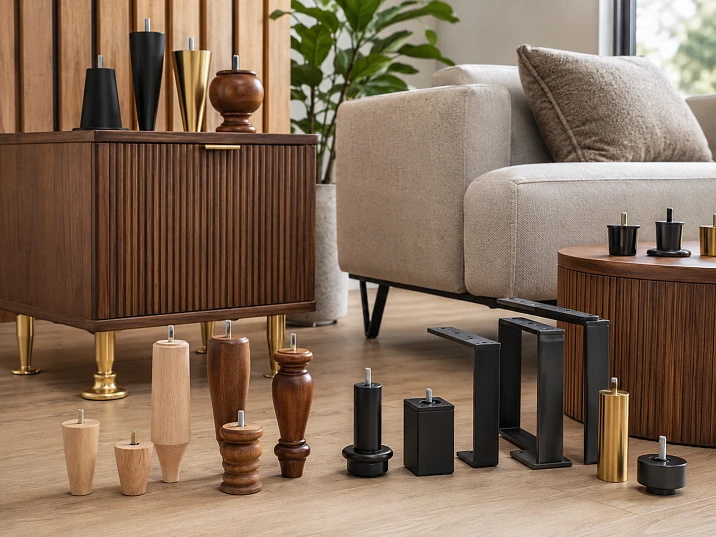
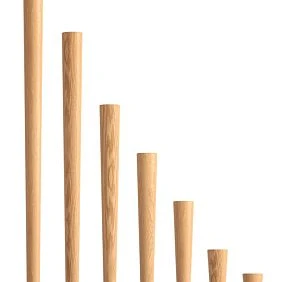
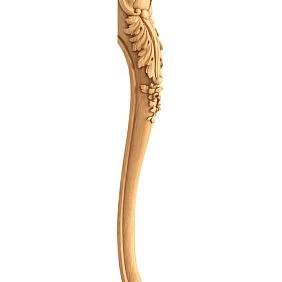
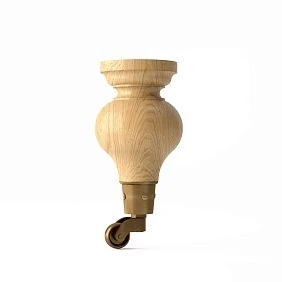
Buying furniture legs today is a task with an unexpectedly large number of variables. There are over a hundred shapes. Several types of wood. Heights — from 30 mm to 2100 mm. There are turned, carved, geometric, spherical, conical, straight legs, with metal decor. There are wooden and height-adjustable ones. There are legs for upholstered furniture and for heavy cabinet wardrobes. The choice is huge — and that's exactly why you need a system.
This article provides such a system. It contains all the practical information for those planning to buy furniture legs: what to consider when choosing, how to calculate the load, which shape suits which style, what affects the price, and why wooden legs outperform their counterparts in several key positions. Read on — and make an informed choice.




Which furniture legs to buy: the logic of choice before the catalog
Before opening the catalog and browsing models, answer five questions for yourself. They determine the right search direction and save you from typical buying mistakes.
First question: for what furniture? A sofa with upholstery, a TV stand, a kitchen set, a bedroom chest of drawers, a coffee table, a classic wardrobe, or a bar counter — each type of furniture has its own requirements for the shape, height, and load-bearing capacity of the leg.
Second question: what is the load? This is not rhetoric, but a real engineering parameter. Four legs under a dining table with a solid oak top carry a total load of 80–120 kg from the structure's own weight alone — plus dishes, plus people, if the table is meant for resting arms on. For a soft pouf, the load is a hundred times less. Different tasks — different legs.
Third question: what height is needed? The standard height of a dining table is 750 mm, a coffee table is 400–450 mm, and a bar counter is 900–1100 mm. The leg height is determined as the difference between the total height of the product and the thickness of the tabletop or body. This is arithmetic, but it needs to be calculated in advance, not after ordering.
Fourth question: what is the interior style? Classics require turned or carved shapes. Scandinavian minimalism — conical or geometric. Loft and high-tech — geometric metal or wooden with metal decor. Eco — simple turned from natural solid wood without coating.
Fifth question: how to attach? Tenon, bolt, mounting plate, threaded insert — each method has its own application. Incorrect fastening means a leg that will loosen after a month of use.
Only having answers to these questions does it make sense to move on to specific models. Buying furniture legs correctly means buying what will last a long time and look exactly as the interior was intended.
Our factory also produces:
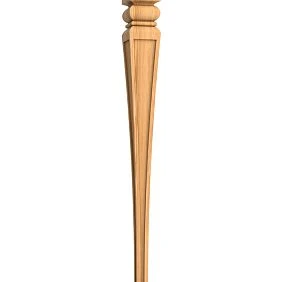
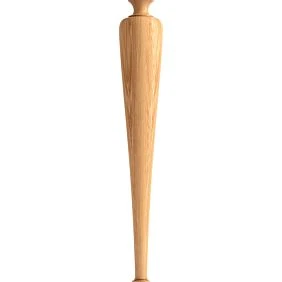
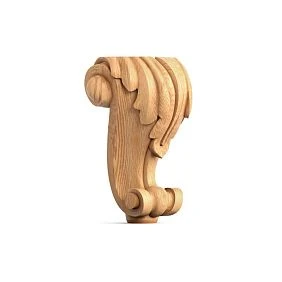
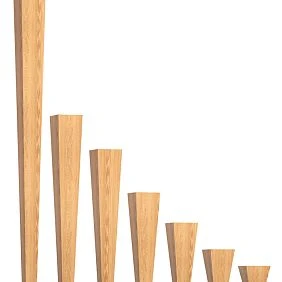
Types of furniture legs and supports
Get Consultation
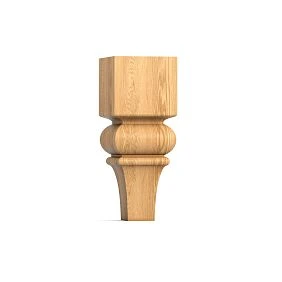
Wooden furniture legs
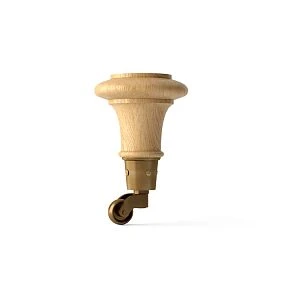
buy wooden furniture legs — means choosing a material that does not age conceptually. Wood in the interior has never been a "seasonal trend" — it was, is, and will be the main material for furniture that claims to have character. A wooden leg made of solid beech or oak gives furniture warmth, tactility, and durability that neither plastic nor light metal can reproduce.
You can buy wooden furniture legs today in several wood species. Beech is a dense, homogeneous wood with a minimum of knots. It is ideal for turning, gives a smooth profile without deviations, and accepts tinting and varnish well. A beech leg is precision of shape and reliability under moderate load. In the STAVROS catalog, prices for turned beech legs start from 430 rubles for the MN-222 model, making this option affordable even for large sets.
Oak is a different story. It is a hardwood with a density of 700–750 kg/m³, a pronounced annual ring structure, and natural resistance to loads. Buying wooden furniture legs made of oak means getting supports that do not deform under a heavy body, do not scratch from accidental impact, and look equally dignified both immediately after purchase and twenty years later.
Wooden furniture legs can be purchased in two basic finish options: without coating — for self-toning and painting to match a specific interior, and with coating — ready for installation, with a final varnish, oil, or enamel. The first option is universal: it leaves complete freedom in color selection. The second is convenient when you need to install quickly and forget about additional finishing.
It is especially worth buying wooden furniture legs carefully for those involved in restoration or custom furniture making. Unpainted solid wood allows for techniques such as staining, patination, an aged wood effect, or unique hand painting. It is this flexibility that makes unpainted wooden legs in demand among professional furniture makers and interior designers.
Adjustable furniture legs
Buying adjustable furniture legs is a solution for those facing a practical problem that cannot be solved with a beautiful silhouette: uneven floors. In most apartments and country houses, floors are not perfectly horizontal. A deviation of 3–5 mm per meter is standard. For a kitchen set, this is critical: cabinets start to "walk," doors do not close tightly, and facades separate.
Buying adjustable furniture legs means incorporating into the design the ability to compensate for floor unevenness without cardboard shims and other makeshift solutions. An adjustable leg has a threaded mechanism: by rotating the support, you raise or lower it by a few millimeters, leveling the entire furniture body horizontally.
Buying height-adjustable furniture legs is especially relevant for kitchen sets — lower cabinets, tall units, and table bases. Standard adjustment is 10–30 mm from the base height. This covers most real floor deviations in residential spaces.
It is worth buying adjustable furniture legs when furniture is installed on tiles with high seams, on parquet with differences, or on wooden floors with historically accumulated unevenness. In country houses where floors are made of floorboards, adjustment is not a luxury but a necessity.
When choosing adjustable legs, pay attention to the adjustment range, maximum load per support, and method of attachment to the body. For heavy cabinets with books or dishes, the load per leg can reach 80–100 kg — this needs to be checked in the model's technical specifications.
Decorative furniture supports
Furniture support — a broader concept than just a leg. A decorative support is an element that bears a functional load and simultaneously is part of the design. Here, form is as important as strength.
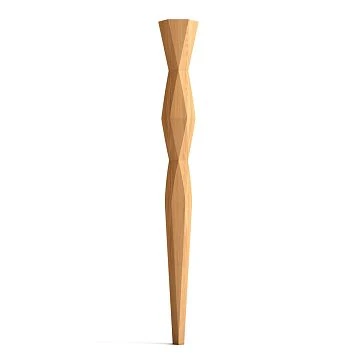
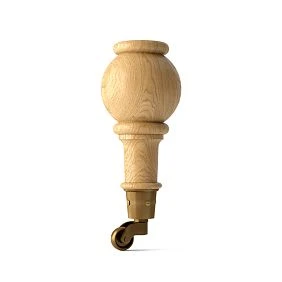
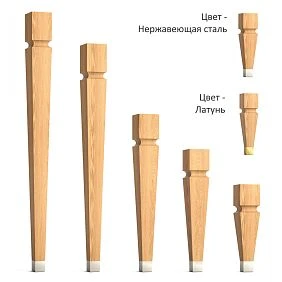
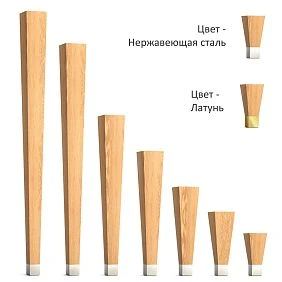
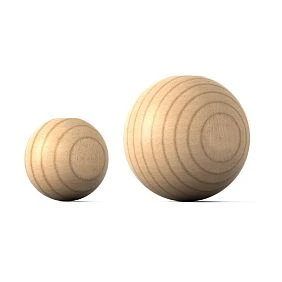
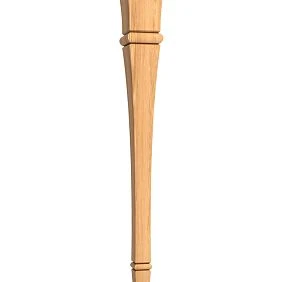
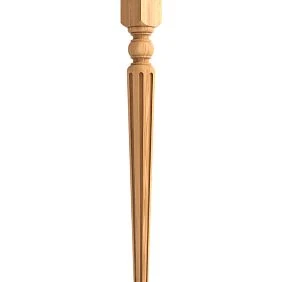
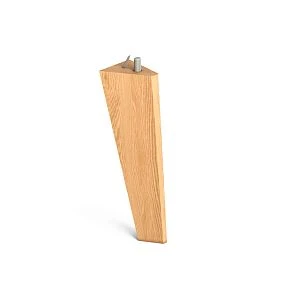
In the STAVROS catalog, decorative supports are presented in several categories. Spherical legs — model MN-235 starting from 9,230 rubles — are pure geometry: a sphere on a short neck that lifts a chest or nightstand off the floor with a lightness unattainable for straight forms. Geometric legs of the MN-186, MN-192, MN-193 series — conical and trapezoidal silhouettes from 660 rubles — work in modern interiors with straight lines and clean volumes.
Modern furniture legs of the MN-237, MN-238, MN-241, MN-243 series represent a different level of design: complex curved profiles, a combination of wood and metal, forms with a distinct author's concept. Prices here are higher — from 6,410 to 12,850 rubles — but the purpose is also different: these are supports for designer furniture, where every detail carries a semantic load.
Furniture Supports with metal decor — legs MN-148, MN-149, MN-152 — combine the warmth of solid wood with the clarity of metal inserts. This is a relevant solution for interiors that use metal frames, lamps with black fittings, or kitchen fronts with metal handles.
Furniture legs and supports: what's the difference
Buying furniture legs and supports is not the same thing, although the boundary between the concepts is often blurred. Let's try to distinguish.
A leg is a structurally visible element that determines the height of the furniture and is perceived as part of it. A leg has a shape, silhouette, character. It is looked at, noticed, and participates in creating the product's image. A turned leg of a chest, a conical leg of a coffee table, a spherical support of a pouf — all these are legs.
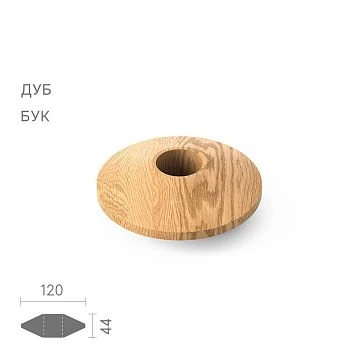
A support is a broader concept. furniture leg includes technical elements that are not always visible: adjustable supports hidden under the base of a kitchen unit, mounting pads, support platforms. A support can be decorative — and then it coincides with the concept of a leg — or it can be purely functional.
furniture legs in a broad sense — it's everything that lifts furniture off the floor. Wooden turned legs for a chest are both legs and supports simultaneously. Metal adjustable legs under the body of a kitchen unit are supports in a technical sense.
For the buyer, the practical conclusion is simple: when selecting, first decide whether the leg is visible in the final furniture look. If yes, choose based on shape, style, and material. If not, choose based on load, adjustment range, and attachment method.
| Parameter | Decorative leg | Technical support |
|---|---|---|
| Visibility | Yes, part of the furniture look | No or partially |
| Material | Solid wood, wood+metal | Metal, plastic, wood |
| Height adjustment | Rare | Often |
| Selection priority | Shape, style, breed | Load, range, fastener |
| Price | Wide range | Below average |
Which furniture are furniture legs suitable for
For a chest of drawers
A chest of drawers is a piece of furniture where legs truly shine. Several drawers arranged in a vertical row create a clear rectangular silhouette. It is the legs that add lightness and completeness to this silhouette.
For a classic chest of drawers in a bedroom or living room, turned legs 80–150 mm high with an expressive profile are optimal. They lift the body off the floor, create "air" under the piece, and make it visually lighter. Combined with furniture decor — overlay profiles and solid wood overlays — this creates a cohesive look without a single unnecessary element.
For a modern chest of drawers with straight fronts, geometric legs with a conical or trapezoidal profile are suitable. They continue the logic of the body's straight lines while introducing plasticity. It is important that furniture legs they are in the same tone as the body or create a deliberate contrast — for example, dark legs on a light body.
When choosing the height of legs for a chest of drawers, follow the proportion: the leg height should be at least 10% of the total product height. For a chest of drawers 900 mm high — a leg no less than 90 mm. A smaller value will give the feeling that the body is "pressed" to the floor.
For a side table
A bedside table is the most diverse type of furniture in terms of purpose: for a TV, bedside, shoe, under a sink. Each has its own requirements for legs.
A TV stand carries a moderate load but is constantly in view. Here, the shape of the leg is critical: a poorly chosen support ruins the entire look. For Scandinavian-style cabinets, use conical legs made of light beech. For classic ones, use turned legs with a pronounced profile. For loft style, use geometric legs with metal inserts.
A bedside table is small and light. Here, you can afford thin, elegant legs that create a feeling of weightlessness. Small-diameter spherical legs on a bedside table create an almost playful but elegant effect—especially in interiors with soft, rounded shapes.
For a cabinet
A wardrobe is the heaviest piece of cabinet furniture in an apartment. The load on four wardrobe legs with clothes can total 200–300 kg. This means each leg must withstand 50–75 kg—and the safety margin of solid oak or beech is more than sufficient.
For classic-style wardrobes, turned legs with a height of 100–180 mm are suitable. They give the body elegance and visually reduce its massiveness. In combination with wooden decor for furniture —cornice profiles, overlay panels—this creates an expressive classic look.
Built-in sliding wardrobes are typically installed without decorative legs—only on adjustable technical supports under the base. Swing wardrobes in the living room or bedroom are a different matter: here, legs work for the look.
For a sofa
Upholstered furniture with wooden legs is one of the enduring trends in modern interior design. Properly chosen sofa legs visually lighten the massive upholstered body, provide "air" under the piece, and simplify cleaning.
A sofa needs legs with a load margin: a sofa with two people sitting is 200–250 kg on the body, distributed over 4–6 legs. A wooden leg made of solid beech with a cross-section of 50×50 mm and a height of 150 mm can withstand a load of over 200 kg—with a large margin.
The height of sofa legs is one of the key parameters affecting seating. High legs of 150–200 mm provide a high seat, convenient for elderly people. Low legs of 50–80 mm provide a low, more relaxed seat. It is important to ensure that the leg height provides a comfortable leg angle when seated.
For Kitchen
In the kitchen, furniture legs are primarily adjustable technical supports under the lower cabinets. They are hidden behind the plinth and not visible, but are critically important for the correct geometry of the set: a level countertop, tightly closing doors, and aligned fronts.
In parallel, there may be visible legs in the kitchen — under a bar counter, under a kitchen island, or under a freestanding table. Here, the requirements are twofold: both load-bearing and aesthetics. For a classic-style kitchen island — turned or carved oak legs. For a modern kitchen — geometric legs with metal decor.
It is worth considering the compatibility of the legs with furniture handles: if the handles are wooden with a black finish, the legs should also be either black or a contrasting but logically justified color.
What affects the price of furniture legs
Furniture legs can be purchased at various prices — from 430 rubles to 45,000 rubles for a table base — this is the real market range. The difference is not random: it is backed by specific objective factors.
Material. Pine is cheaper than beech, beech is cheaper than oak. The difference between a pine and an oak leg of the same profile is 40–80% in price, with oak having roughly twice the strength.
Height. A 600 mm leg requires twice as much raw material as a 300 mm leg. All else being equal, a taller leg costs more.
Shape. A simple conical shape involves minimal operations: cutting, turning, sanding. A complex turned profile with multiple transitions, vases, and necks — multi-stage lathe work. The difference in cost is up to 60–80%.
Presence of decor. Legs with metal decor (series MN-148, MN-149, MN-199) require additional operations: manufacturing metal inserts, their installation, and joint finishing. This naturally raises the price.
Coating. An unpainted leg requires fewer processing stages. A leg with a coating — an additional operation of applying varnish, oil, or enamel with drying. The price difference is 10–20%.
Cross-section and diameter. The massive spherical leg MN-235 costs from 9,230 rubles — because it requires a significant volume of solid wood and the turning of a spherical surface is much more complex than a conical one.
Series complexity. The table base for tables STL-041 and STL-042 costs from 45,110–45,340 rubles — these are not four legs, but a ready-made support system with crossbars and complex geometry, made from solid wood.
Quantity in a set. When ordering a large set — for several pieces of furniture at once — the terms are often more favorable than when purchasing individually.
| Factor | Impact on price |
|---|---|
| Wood species (beech → oak) | +40–60% |
| Leg height | Proportional to material |
| Profile complexity | +30–80% to the simple shape |
| Metal decor | +20–40% |
| Finish | +10–20% |
| Spherical/volumetric shape | +50–200% to conical |
How to choose furniture legs before buying: a checklist
This checklist will save time and eliminate mistakes. Go through it before placing your order.
Determine the type of furniture. Sofa, chest of drawers, bedside table, wardrobe, table, bed — each type has its own requirements. Note the specific item.
Calculate the load. Weigh the furniture body (or use the manufacturer's specifications). Add the weight of the contents under normal use. Divide by the number of legs. This gives the load per support — compare it with the permissible load for the selected model.
Choose the height. Total product height minus body/tabletop thickness = leg height. Ensure this height is available in the selected model's range.
Check the mounting method. Tenon, M8/M10 bolt, mounting plate, threaded insert. The mounting method must match the furniture body material and its thickness.
Select the material based on load and style. For heavy furniture — oak or beech. For light decorative furniture — pine may be suitable. The interior style determines the shape.
Coordinate with handles and facades. Legs and Wooden handles with coating should be in the same tone or in a logically constructed contrast. Mismatched details ruin the look even with expensive base materials.
Decide on the coating. If you need to tint it yourself to a specific color — choose without coating. If you need quick installation — choose with coating.
Decide if adjustment is needed. If the floor is uneven or the furniture will be moved — choose adjustable supports.
Order spare legs. This is especially relevant when restoring or creating custom furniture. If a leg breaks in a year and the model is discontinued, you'll have to replace all four.
Mistakes when buying furniture legs
These mistakes occur regularly — among independent craftsmen, novice designers, and buyers who don't read technical specifications.
They buy legs without calculating the load. This is especially common for sofas and cabinets. A thin, elegant leg under 150 kg of a cabinet with books is an accident waiting to happen. The load must be calculated in advance.
They don't check the height. They pick a leg "by eye" — and end up with a table 20 mm higher or lower than needed. For a kitchen, this is critical: the wrong height of the work surface means chronic back pain.
They don't consider the mounting method. A leg with an M10 bolt, but the body has 16 mm furniture board. The bolt either doesn't screw in properly or tears through the board. You need to know the body thickness in advance and choose the fastener accordingly.
They choose the shape only from a photo. A photo doesn't convey scale. A leg that looks like an elegant detail on screen may turn out to be a massive support in reality — and vice versa. If possible, see samples in person.
They don't coordinate the legs with the rest of the hardware. Wooden legs and metal handles can be a combination, but it must be intentional. If the legs are light beech and the handles are dark brown, without a logic of contrast — that's a mistake.
They don't account for uneven floors. They install four identical legs — and one of them ends up in the air. The furniture wobbles. Solution: adjustable supports or felt compensating pads.
They compare only the price, not the material and lifespan. A leg for 100 rubles made of pine and a leg for 1,200 rubles made of oak — a fivefold difference in price, but a twenty-year difference in actual lifespan. For furniture meant to last for years, this is false economy.
They buy without a reserve. Every practicing master knows: it's better to have two extra legs in storage than to search for the exact same model three years later to replace a broken one.
Furniture legs as a system element: wood, handles, decor
A furniture leg never exists in a vacuum. It is part of a system that includes the body, facade, handles, overlay decor, and coating. And only when all these elements work in a unified manner—by material, tone, and character—does the furniture become a finished piece.
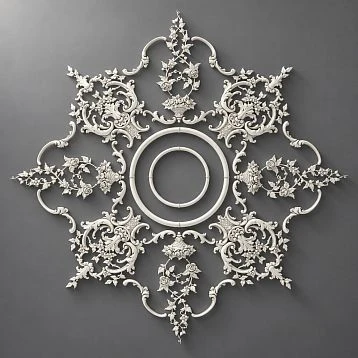
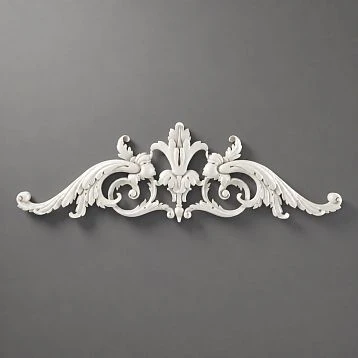
The ideal combination for a classic dresser: turned oak legs with clear oil + turned Furniture Handles oak legs of the same tone + overlay to buy, which will allow you to transform your furniture using carved wooden elements. You can use the C-003-3 decor set to decorate furniture, walls, doors, or any other surface. The C-003-3 decor set is made of oak or beech, known for their strength, durability, and beauty. You can buy the C-003-3 decor set at the Stavros decor store, which specializes in producing and selling decorative elements and hardware for furniture and interiors. At the Stavros decor store, you will find a wide selection of decor sets of various shapes, sizes, and styles. You can choose along the perimeter of the drawers. Everything from the same wood species, everything in the same coating—and the dresser transforms from a set of parts into furniture with a face.
For a modern TV stand: conical beech legs with black coating + handle brackets with black coating + white MDF facades. The contrast of black and white is intentional and deliberate. No detail stands out.
This is the professional approach to choosing hardware: not separate purchases for separate tasks, but a unified concept realized through material and form.
Where to buy furniture legs with quality guarantee
STAVROS is a Russian manufacturer of wooden products for furniture and interiors. The catalog features over 130 models of furniture legs from oak and beech arrays: turned, geometric, spherical, with metal decor, modern and classic shapes.
Prices start from 430 rubles for the turned model MN-222 and vary depending on the model, wood species, height, and profile complexity. The full range — from simple beech legs to complex oak underframes — covers any budget and any task.
furniture legs in the STAVROS catalog are supplied with fasteners, precise geometric parameters, and careful packaging that prevents damage during transportation. Delivery — throughout Russia and CIS countries. Pickup — from warehouses in Moscow and St. Petersburg. Order — from one piece.
For a cohesive furniture look, STAVROS recommends forming a kit right away: Furniture Supports, Furniture Handles, decor for furniture — everything from one source, from one wood species, in a single stylistic logic. This is how furniture becomes not a set of parts, but a whole.
FAQ: Answers to popular questions
Where to buy furniture legs?
Furniture legs made of oak and beech array — in the STAVROS catalog. Over 130 models, from 430 rubles, with Contact us to confirm shipping to your destination. Before purchasing, it is important to determine the type of furniture, load, height, shape, fastening, and coating.
Which furniture legs are best to choose?
For classic and natural furniture — turned wooden legs made of beech or oak. For kitchens and cabinets on uneven floors — adjustable supports. For designer furniture — geometric or modern shapes with metal decor. The choice is always determined by the type of furniture, load, and interior style.
How do furniture legs differ from supports?
Legs are a visible structural and decorative element of furniture. Supports are a broader concept, including technical adjustable elements hidden under the base. In practice, a wooden turned leg is both a leg and a support at the same time.
What affects the price of furniture legs?
Wood species (beech or oak), height, profile complexity, presence of metal decor, finish, and order quantity. The range is from 430 rubles for a simple turned leg to 12,000+ rubles for a designer model from the modern series.
Which furniture legs should I buy for restoration?
For restoration, legs without a finish are preferable: they can be precisely tinted to match the color of the existing furniture. The shape is chosen according to the style of the original piece. STAVROS supplies legs from one piece — convenient for replacing individual elements.
How to properly secure a furniture leg?
The attachment method depends on the model: a tenon into a pre-drilled hole, an M8/M10 bolt through a mounting plate, or a threaded insert into the body. When ordering from STAVROS, fasteners are included in the kit. You need to know the thickness of the furniture body in advance.
Can I buy furniture legs individually?
Yes. STAVROS supplies Furniture legs From one piece — this is convenient both for replacing a damaged leg and for a trial order before purchasing a full set.
Is a spare needed when ordering legs?
For restoration and custom projects — it is recommended. If the model is discontinued after a few years, finding an identical replacement is nearly impossible. One or two spare elements are a reasonable insurance.