Article Contents:
- Historical roots of stucco terminology
- Main groups of stucco elements
- Cornices — architectural crown of the room
- Moldings — universal composition elements
- Baseboards — functional elegance
- Pilasters and columns — vertical dominants
- Ornamental motifs of moldings
- Plant ornaments — breath of nature
- Geometric ornaments — strictness and rhythm
- Figurative elements — symbols and images
- Architectural orders and their elements
- Doric order — strength and simplicity
- Ionic order — elegance and harmony
- Corinthian order — luxury and refinement
- Modern terminology and materials
- Polyurethane stucco — technologies of the 21st century
- Gypsum stucco — classicism and individuality
- Wood Carving — Warmth of Natural Material
- Stylistic features of stucco decoration
- Classicism — symmetry and order system
- Baroque — dynamism and opulence
- Rococo — lightness and asymmetry
- Empire — Imperial Grandeur
- Modern — natural forms and asymmetry
- Art Deco — Geometry and Luxury
- Functional elements and their terminology
- Corner elements — problem of joints
- Ceiling rosettes — center of composition
- Cassons — volumetric geometry of ceiling
- Friezes and borders — horizontal divisions
- Installation terms and technologies
- Mounting stucco — adhesive, anchors, reinforcement
- Jointing and filling — invisible seams
- Painting and patination — finishing treatment
- Design of ornamental decoration
- Proportions and scale — the golden ratio
- Rhythm and repeat — repeating elements
- Symmetry and asymmetry — compositional principles
- Regional specifics of terminology
- French school — elegance and lightness
- Italian school — sculptural quality and drama
- Russian school — synthesis of traditions
- Errors and misconceptions in terminology
- What is 'ornament' and what it is not
- Stylistic hybrids and their terminology
- Ornament in modern interiors
- Minimalism — Plaster Without Ornament
- Eclecticism — mixing of eras and styles
- Neoclassicism — classicism for the 21st century
- Practical application of terminology
- Communication with architect and designer
- Ordering and quality control
- Self-education and development of taste
- Future of ornamental decoration and terminology
- New materials and technologies
- Revival of craftsmanship
- Education and popularization
- FAQ: Answers to Popular Questions
- Conclusion: STAVROS company and the art of ornamental decoration

The professional language of ornamental decoration is not just a set of terms. It is a living coordinate system that allows the designer, architect, and client to speak the same language. Understanding ornamental terminology opens up a world where every detail has a name, history, and purpose. Can you confidently say what distinguishes a modillion from a bracket? Or explain why a cornice is not just a strip under the ceiling, but a complex architectural structure with a centuries-old lineage?
When a client says 'I want beautiful ornament,' a professional understands: behind this lies a choice among hundreds of elements.Sculptural wall decorationIt may be a molding, panel, cartouche, rosette, or monogram. Each element carries its own meaning, sets the rhythm, expresses the style. And if you do not master the terminology, you lose control over the project. An architect may suggest 'Ionic capitals on the frieze,' but you won't understand that this refers to decorative egg-shaped elements that will impart classical expressiveness.


Historical roots of ornamental terminology
Why is it so important to know how ornamental elements are named? Because each name carries a cultural code. An acanthus leaf is not just a carved scroll. It is a symbol of ancient aesthetics, originating from Greek temples, where craftsmen carved a stylized image of the plant Acanthus mollis. Seeing an acanthus on a column capital, you instantly recognize: this is the Corinthian order, the highest level of classical architecture.
Names of ornamental elements are often associated with function or visual similarity. A modillion (or modular) is a small bracket supporting a cornice. The name comes from the Latin 'modulus' — 'measure,' because these elements are arranged with a specific rhythm, defining the scale of the entire composition. Denticles — from the Latin 'dens,' 'tooth' — indeed resemble a row of small teeth under the cornice.
Professional decorative terminology evolved over centuries. During the Renaissance, Italian architects systematized ancient heritage, creating treatises that described every detail of classical orders. Vignola, Palladio, Serlio — their books became reference guides from which modern terminology originates. When we say 'base', 'shaft', 'capital' in reference to a column, we use a language that is five centuries old.




Main groups of molded elements
Our factory also produces:


Cornices — architectural crown of a room
A cornice is a horizontal projection that finishes a wall. But behind this simple definition lies a vast variety of forms. There are ceiling cornices that mark the transition from wall to ceiling, and crowning cornices on facades that protect the wall from weather and complete the architectural composition.
Professional terminology distinguishes complex cornice profiles: cyma reversa (cove), cyma recta (gusset), quarter-round, flat molding, and drip. Each profile element has its own purpose. The drip is a projection on the lower edge of the cornice that prevents water from running down the wall. The flat molding creates a horizontal line that 'holds' the composition. Cyma reversa and cyma recta are S-shaped curves that create play of light and shadow.
Cornice height is calculated according to classical proportions. In Neoclassicism, the cornice constitutes one-eighth to one-tenth of the room's height. For ceilings 3.2 meters high, the cornice should be 32–40 centimeters tall. Modern minimalist interiors allow for lower cornices, but professionals always consider the room's scale.
Get Consultation
Moldings — universal composition elements
A molding is a profiled trim used for framing, dividing planes, and creating relief compositions.Wall finishing with moldings— a classic technique that allows creating boiserie, panel systems, framing doors and windows, and highlighting zones on walls.
Moldings are classified by width and profile complexity. Narrow moldings (15–30 mm) are used to frame pictures, mirrors, and create fine wall graphics. Medium (40–80 mm) form panel systems. Wide moldings (90–150 mm) become architectural details — they frame fireplaces, form pilasters and columns.
Professional terminology distinguishes moldings by placement: wall, ceiling, corner, and joint moldings. There are ornamental moldings — carved, with plant motifs, geometric patterns. There are smooth, minimalist moldings that rely solely on profile.
Baseboards — functional elegance
A baseboard protects the lower part of the wall from mechanical damage, covers the temperature gap between floor and wall, and hides the edges of flooring. But professionals see in a baseboard not only function, but also decorative role. Height, profile complexity, material — all of this affects the perception of the interior.
Classic interiors require baseboards 10–14 cm high, sometimes up to 20 cm in grand halls. Modern spaces are satisfied with 5–8 cm baseboards. Profile shape also evolves: from complex classical profiles with cyma reversa and cyma recta to minimalist rectangular sections.
There is a concept of 'baseboard box' that conceals cable channels within. This practical solution allows maintaining functionality without sacrificing aesthetics. Professionals know that baseboards must harmonize with door casings, cornices, and overall interior style.
Pilasters and columns — vertical dominants
A pilaster is a projection on a wall that imitates a column. It consists of a base, shaft (fust), and capital. Unlike a real column, a pilaster does not bear load — it is purely decorative. But visually, a pilaster organizes space, creates rhythm, and gives the interior a sense of scale.
The capital is the upper part of a column or pilaster that demonstrates affiliation with a specific architectural order. Doric capital — simple, strict, with a round echinus and square abacus. Ionic — with characteristic volutes, spiral scrolls. Corinthian — the most ornate, decorated with acanthus leaves, scrolls, rosettes.
The base is the foundation of a column or pilaster that ensures stability and creates a smooth transition from floor to shaft. The base can be simple — in the form of a round molding (torus) and ovolo. Or complex — Attic, alternating torus and scotia (grooves).
Ornamental motifs of moldings
Plant ornaments — breath of nature
Acanthus — king of molded decoration. This stylized leaf with characteristic serrated edges and scrolls decorates capitals, friezes, consoles, cartouches. The acanthus leaf can be interpreted differently: strictly and graphically in Neoclassicism, lush and voluminous in Baroque, flat and stylized in Art Nouveau.
Palmette — fan-shaped plant motif resembling an open palm or palm leaf. Palmettes are often arranged rhythmically on friezes, forming borders. This motif originated in Egyptian and Greek art, where it symbolized life and prosperity.
Garland and festoon — ornament imitating a wreath of flowers, leaves, fruits, intertwined ribbons. Garlands decorate friezes, hang between consoles, frame cartouches. This motif is characteristic of Baroque and Rococo, where opulence and decoration reach their peak.
Laurel wreaths, oak branches, grapevines, roses, lilies — each plant motif carries symbolic meaning and forms the atmosphere of the interior.Wall and ceiling decorative moldingWith plant ornaments, it creates a sense of abundance, luxury, and connection to nature.
Geometric ornaments — strictness and rhythm
Meander — geometric ornament in the form of a continuous line, bent at right angles. The name comes from the river Meander in Asia Minor, known for its winding bends. Meander symbolizes infinity, eternal motion, and often decorates friezes, borders, and frames.
Ionic — egg-shaped elements alternating with points (arrows). This motif is characteristic of the Ionic order, decorating cornices to create rhythmic, elegant patterns. Ionic elements are an example of how a simple geometric shape, repeated in rhythm, creates expressive decoration.
Beads (astylus) — ornament in the form of alternating spheres and disks. Often used to fill narrow profiles, create decorative bands. Kyma — border of stylized leaves that frames cornice profiles.
Rosettes — circular or polygonal decorative elements with symmetrical ornament radiating from the center. Rosettes decorate ceilings, friezes, coffers. They can be simple — with petals, radiating rays. Or complex — with multi-layered compositions of leaves, flowers, scrolls.
Figurative elements — symbols and images
Mask (maskaron) — a decorative element depicting a human, lion, satyr, or Gorgon's head. Masks adorn castle stones of arches, consoles, cartouches. They add drama and expressiveness to interiors, becoming visual accents.
Cartouche — a sculpted ornament in the form of a scroll, shield, or coat of arms. Cartouches are framed by scrolls and ribbons, creating decorative frames for inscriptions, monograms, and coats of arms. This is an element characteristic of Baroque and Rococo, where decorative elements reach their peak.
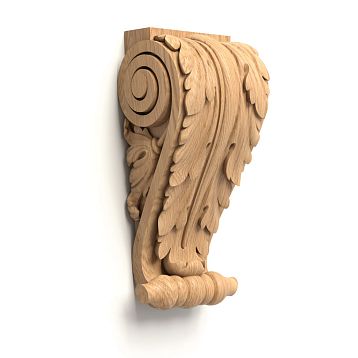
Brackets and consoles — projecting elements that visually 'support' cornices, shelves, balconies. A console may be a simple S-shaped form, or richly adorned with acanthus leaves, volutes, and maskarons. A modillion is a small console with carved decoration, creating rhythm on the lower surface of a cornice.
Architectural orders and their elements
Doric order — strength and simplicity
Doric order — the oldest and most austere of classical orders. The column has no base; the shaft is grooved vertically (flutes); the capital is simple — a round cushion (echinus) and a square slab (abacus). The frieze consists of alternating triglyphs (vertical rectangles with three grooves) and metopes (square panels that may be decorated with relief).
The Doric order symbolizes strength and masculinity; it was used in temples dedicated to male deities — Zeus, Ares. In interiors, the Doric order creates a sense of monumentality and reliability.Decorative wall finishingIn Doric style, it requires simplicity, strict proportions, and rejection of excessive decoration.
Ionic order — elegance and harmony
The Ionic order is more elegant and decorative. The column has a base; the flutes are thinner; the capital is adorned with volutes — spiral scrolls that create a recognizable silhouette. The frieze may be smooth or decorated with continuous relief.
The Ionic order was associated with feminine grace; it was used in temples of goddesses — Athena, Artemis, Hera. In interiors, the Ionic order creates an atmosphere of elegance and refinement. Volutes can be standalone decorative elements — they adorn consoles, cartouches, and frames.
Corinthian order — luxury and refinement
The Corinthian order is the most ornate and decorative. The capital resembles a basket from which acanthus leaves, scrolls, and rosettes grow. This is the pinnacle of classical decorative art, symbolizing luxury and refinement.
The Corinthian order was used in the most important, ceremonial buildings. In interiors, Corinthian elements create an atmosphere of palace luxury.Plaster ornament for walls and ceilingsWith Corinthian motifs, it suits classical, neoclassical, and Empire interiors.
Modern terminology and materials
Polyurethane molding — 21st-century technology
Modern molding is not only made from traditional plaster, but also from polyurethane. This material is lightweight, strong, resistant to moisture, and easy to install.Polyurethane wall claddingIt allows recreating any classical elements, but with less time and labor.
Polyurethane molding terminology includes the same concepts: cornices, moldings, rosettes, consoles. But specific terms are added: flexible molding (for curved surfaces), corner element (pre-made 90-degree angles), joint element. A professional must understand the difference between materials, knowing when plaster is appropriate and when polyurethane is.
Plaster molding — classic and individuality
Plaster — traditional molding material. It allows creating elements of any complexity, from mass-produced items to unique original works.Plaster wall finishingIt requires professional installation, but the result is a unique texture, play of light and shadow, and a sense of authenticity.
Plaster molding can be cast in molds or hand-carved. Hand-carving is the highest craftsmanship, when a sculptor creates a unique element based on a designer's sketch. Molded molding allows reproducing elements while preserving quality and detail.
Wooden carving — warmth of natural material
Wood — another material for creating molded decoration, though it is more accurate to speak of carved decoration. Wooden moldings, cornices, rosettes, cartouches create a special atmosphere of warmth, coziness, and connection with nature.Wooden wall claddingIt may include carved elements that functionally resemble molding.
Wooden carving terminology partially overlaps with molded decoration: the same moldings, baseboards, cornices. But there are also specific terms: ogee (rounded profile), stile (thin strip for glass fixation), dado (decorative strip dividing surfaces).
Stylistic features of molded decoration
Classicism — symmetry and order system
Classicism is the triumph of the order system, symmetry, harmony of proportions. Moldings in a classical interior are strictly regulated. Cornices follow classical profiles, moldings form symmetrical panel systems, rosettes are placed in the center of the ceiling, above the chandelier.
Classical ornamentation — meanders, Ionic motifs, acanthus leaves, laurel wreaths. The color scheme is restrained: white, ivory, with delicate gilding on the most important elements.Internal decorative wall claddingIn the classical style, a deep understanding of the order system, proportions, and symmetry is required.
Baroque — dynamism and opulence
Baroque — this is an explosion of ornamentation. Moldings become sculptural, volumetric, and dynamic. Cornices are interrupted by consoles, cartouches, garlands. Ceilings are adorned with chandeliers with molded frames, from which figures of angels, amours, and allegorical images emerge.
Baroque ornamentation — S-shaped and S-shaped scrolls, shells (hence the name of the style, from Portuguese barroco — 'irregularly shaped pearl'), lush garlands, mask-like faces with expressive features. Gold leaf is used generously, often on a colored background — red, green, blue.
Rococo — lightness and asymmetry
Rococo — this is baroque refined to delicate playfulness. Moldings become delicate, light, and asymmetrical. A characteristic motif — rocaille, a whimsical shell with scrolls. Rococo ornaments — delicate interweavings, garlands of small flowers, putti (plump baby angels), birds, musical instruments.
The color palette of rococo is delicate: pastel shades of pink, blue, pistachio. Gold leaf is thin, delicate, often patinated, creating an effect of antiquity.decorative wall finishingIn the rococo style, it requires jewel-like precision, understanding of asymmetrical compositions, and lightness of execution.
Empire — imperial grandeur
Empire — the style of Napoleon's empire — this is classicism enhanced with symbols of power and military strength. Empire moldings include military attributes: wreaths of oak and laurel leaves, crossed swords, shields, eagles, torches. Egyptian motifs — sphinxes, palmettes, lotuses — are characteristic as a echo of Napoleon's Egyptian campaign.
The color scheme is contrasting: white moldings on bright walls — magenta, emerald, blue. Gold leaf is abundant but strict, emphasizing symmetry and grandeur. Empire — this is the style of grand halls, offices, official residences.
Modern — natural forms and asymmetry
Modern rejected the order system and symmetry. Modern moldings — smooth, flowing lines reminiscent of plant stems, seaweed, women's hair. Ornamentation — stylized irises, lilies, poppies, dragonflies, butterflies.
Asymmetry — a key principle of modern design. Molded decoration does not form symmetrical panels but freely arranges on walls and ceilings, creating a sense of organic growth. The color scheme often includes complex shades — lilac, green-gray, ochre.
Art Deco — geometry and luxury
Art Deco — this is geometric modernism enriched with luxurious materials and exotic motifs. Art Deco moldings — stepped profiles, zigzags, sun rays, stylized fountains. Egyptian and African motifs are characteristic, but interpreted geometrically and graphically.
Art Deco materials are luxurious: gold leaf, silvering, mother-of-pearl inlay, rare wood species.3D Wall FinishingIt may include Art Deco elements to create expressive, luxurious interiors.
Functional elements and their terminology
Corner elements — problem of joining
Joining moldings and cornices in corners — one of the most complex installation tasks. Professional terminology distinguishes internal and external corners, right angles (90 degrees) and acute/obtuse angles. For classical joining, a 45-degree bevel is used, but there are also pre-made corner elements that simplify installation.
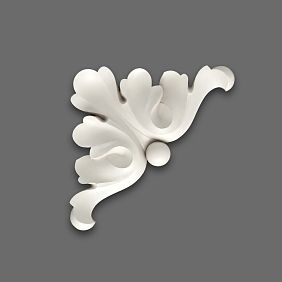
Corner rosette — a decorative element that covers the junction of moldings in a corner, transforming a technical necessity into a decorative solution. There are also internal and external corner elements for baseboards, cornices, and moldings.
Ceiling rosettes — compositional center
Ceiling rosette — a round or polygonal element placed in the center of the ceiling, above the chandelier. The rosette not only conceals the electrical outlet but also becomes a compositional center from which rays, garlands, and coffers radiate.
The size of the rosette is calculated based on the room size and chandelier. The classic rule: the diameter of the rosette should be 1.5–2 times larger than the diameter of the chandelier. Too small a rosette will be lost, too large — it will overwhelm the space.
Coffers — volumetric geometry of the ceiling
Coffer — a recess in the ceiling or vault, framed by moldings. Coffers form a regular grid of squares, rectangles, octagons. Each coffer can be adorned with a rosette in the center, creating a rhythmic, sculptural ceiling surface.
A coffered ceiling — a sign of high interior status. This solution requires high ceilings (at least 3.5 meters) and professional execution.Decorative wall and ceiling finishingUsing coffers creates an atmosphere of museum grandeur.
Friezes and moldings — horizontal divisions
Frieze — a horizontal band on the wall, usually below the ceiling, decorated with ornament. In classical order systems, the frieze is part of the entablature, located between the architrave and the cornice. In interiors, the frieze may be sculpted, painted, or carved.
Border — a narrow decorative strip that frames surfaces, creates frames, and divides zones. Borders can be ornamented — with meander, braided, or plant motifs. Or simple — in the form of a protruding shelf or molding.
Installation terms and technologies
Mounting plasterwork — adhesive, anchors, reinforcement
Installing plasterwork requires not only aesthetic sense but also technical knowledge. Lightweight polyurethane elements are mounted using special adhesive. Heavy plaster elements require additional mechanical fastening — anchors, screws, bolts.
For particularly heavy elements (large consoles, voluminous capitals), reinforcement is used — a metal frame is embedded within the element, which bears the load and transfers it to the load-bearing structure.
Jointing and spackling — invisible seams
Professional installation implies that seams between elements will be invisible. This is achieved through careful fitting, spackling joints, and sanding. Special spackling compounds are used, which are compositionally similar to the plasterwork material — gypsum for gypsum, acrylic for polyurethane.
After spackling, seams are sanded with fine-grit sandpaper (P180–P240), then primed and painted together with the entire plasterwork to create a unified surface.
Painting and patination — finishing treatment
Plasterwork can be white, painted to match wall or ceiling color, gilded, or patinated.Wall cladding for paintingIncludes sculptural elements that are primed and painted together with the main surface.
Patination — a technique of artificial aging, where dark paint is rubbed into the recesses of the relief, simulating the effect of time's patina. This creates an antique plasterwork effect, emphasizing the relief and adding depth.
Gilding can be real — using 24-karat gold on a special adhesive primer (mixture). Or imitation — using gold paint or gold leaf (imitation of 24-karat gold made from copper or aluminum). Real gilding is expensive and labor-intensive, but creates an irreplaceable luster.
Designing sculptural decoration
Proportions and scale — the golden ratio
Professional design of sculptural decoration requires understanding of proportions. Classical architecture uses the golden ratio — the ratio 1:1.618 — which creates harmonious proportions. The height of the cornice to the height of the room, the width of the molding to the width of the panel — all these ratios are calculated according to the laws of proportion.
Modular system — another design tool. A module is a basic unit of measurement from which all dimensions are derived. In classical architecture, the module is the lower radius of a column. All other elements are multiples of the module.
Rhythm and repeat — repeating elements
Repeat — a repeating ornament element. If a frieze is decorated with identical rosettes spaced at equal intervals, we refer to it as a repeat. Rhythm is created by repeating elements, but also by pauses between them.
A professional knows that rhythm can be uniform (identical elements spaced at equal intervals) or progressive (elements increase or become more frequent). Rhythm can be complex, alternating different elements.
Symmetry and asymmetry — compositional principles
Symmetry — the foundation of classical architecture. Symmetrical composition creates a sense of order, stability, and grandeur. Plasterwork is arranged mirror-symmetrically relative to a central axis — usually the center of the wall or ceiling.
Asymmetry — a principle of modern, rococo, and contemporary styles. Asymmetrical composition is dynamic and unexpected, requiring a refined sense of balance to avoid becoming chaotic.
Regional terminology characteristics
French school — elegance and lightness
The French school of sculptural decoration gave the world the styles of rococo and neoclassicism. French terminology is rich with names associated with royal palaces: rocaille (shell), cartouche (shield), console, garland. French plasterwork is distinguished by elegant proportions and refined ornamentation.
Italian school — sculptural quality and drama
Italy — the birthplace of baroque, and Italian plasterwork — is sculpture on walls. Italian terms: stucco (plasterwork made from gypsum, lime, and marble powder), grotesque (fantastical ornament with mythical creatures), maskron (mask). The Italian school teaches to perceive plasterwork as three-dimensional sculpture, not as a flat relief.
Russian School — Synthesis of Traditions
The Russian school of molded decoration synthesized European influences with its own traditions of wooden carving. Russian Empire style and Russian Classicism have their own characteristics — greater monumentality, love for gilding, vivid colors. Russian terminology borrowed European names but adapted them to its own realities.
Errors and Misconceptions in Terminology
What is "Molded Decoration" and What It Is Not
A common mistake is to call any protruding decoration "molded decoration." But molded decoration refers to items cast or molded from plastic materials (gypsum, polyurethane, papier-mâché). Wood carving, metal forging, stone carving are not molded decoration, although functionally they may be similar.
Another misconception is thinking that molded decoration is suitable only for classical interiors. Modern molded decoration includes minimalist profiles and geometric forms that fit perfectly into minimalism, Scandinavian style, and loft.Plank wall cladding— a modern trend that essentially performs the function of molded decoration, creating relief and division of planes.
Stylistic Hybrids and Their Terminology
Modern interiors often combine elements of different styles. This creates terminological problems: how to name a molding with a classical profile but painted in bright color? Or a rose that is baroque in shape but made of ultra-modern composite?
A professional understands that terminology describes form, origin, and function — but does not limit creativity. The key is to understand what you are doing, why you choose a particular element, and how it works in space.
Molded Decoration in Modern Interiors
Minimalism — molding without ornamentation
Can molded decoration be used in minimalist interiors? Yes, if it consists of minimalist profiles without ornamentation. A simple cornice with a clear geometric profile, smooth moldings forming strict panels — these are tools of minimalism.wall finishing with laths— a modern alternative to classical molding, creating rhythm and relief.
In minimalist molded decoration, color often blends with walls or ceilings; elements work with light and shadow, not ornamentation. This is a delicate game requiring precise calculation of profiles, lighting, and proportions.
Eclecticism — Mixing of Eras and Styles
Eclecticism allows combining classical molded decoration with modern furniture, baroque rose with industrial lighting. It is a game of contrasts requiring boldness and refined taste.Wall cladding optionsIn eclectic interiors, they may include both classical molded decoration and modern materials.
Eclecticism terminology — is terminology of all styles at once. A professional must freely master the language of Classicism, Baroque, Modernism, to consciously combine elements and create new meanings.
Neoclassicism — Classicism for the 21st Century
Neoclassicism is an adaptation of classical forms to modern lifestyle. Molded decoration in neoclassicism is more minimalist, proportions are lighter, ornamentation is restrained. But the foundation remains classical: symmetry, order system, traditional elements.Wall Finishing ElementsIn neoclassicism, they should be recognizably classical, but not museum-like.
Practice of Terminology Application
Communication with Architect and Designer
When discussing a project with a designer, knowledge of terminology changes everything. Instead of saying "I want something beautiful under the ceiling," you say: "I propose a cornice 15 cm high with a profile of cabochon-ledge-gusset, with dentils on the lower surface." The designer understands you are not a random client, but someone who knows what they want.
Or you say: "This room needs Corinthian order pilasters with 40 cm high capitals, fluted shafts, and Attic bases." This is not a request — it is a task that can be executed precisely.
Order and Quality Control
When ordering molded decoration, terminology allows you to precisely describe what you need. You can specify: "Molding 80 mm wide with Ionic ornament, element length 2.5 meters, material — high-density polyurethane, finish — primer for painting."
During acceptance, you can check: "Cornice joints in corners are mitered at 45 degrees, seams are spackled, rose is installed exactly in the center of the ceiling, capitals of pilasters are at the same level." This is not nitpicking — it is professional control.
Self-Education and Development of Taste
Studying molded decoration terminology is not rote learning. It is a path to understanding architecture, art history, aesthetics. When you know what an acanthus is, you begin to notice it in all museums, palaces, parks. When you understand the difference between Doric and Corinthian orders, you read architecture as text.
Professional terminology is the key to a world where every detail has meaning, every element its place and purpose.wall finishing materialsinclude stucco as one of the most expressive, profound, historically rich design tools.
The Future of Stucco Decoration and Terminology
New materials and technologies
3D printing already produces stucco elements. This opens new possibilities: you can print a unique rosette according to an individual sketch without creating a mold. Terminology is expanding: concepts such as 'printed stucco', 'digital ornament', 'parametric rosette' are emerging.
Composite materials combine the lightness of polyurethane and the strength of fiberglass. They allow creating thin-walled, yet large elements — consoles, capitals, brackets — that would have previously been too heavy.
The Renaissance of Craftsmanship
Paradoxically, but technological progress is reviving interest in handcrafted work. Author stucco, molded by a master according to an individual sketch, is valued as a work of art. This is bespoke work, where each element is unique.Wall finishing and decorationusing original stucco — a sign of the highest interior status.
Artisans restore forgotten techniques: stuccoing with stucco (gypsum with marble powder), stone carving, casting in artificial marble. Interest in historical authenticity is being revived — the restoration of palaces and mansions requires precise reproduction of original stucco.
Education and Popularization
Knowledge of terminology is no longer the privilege of professionals. Courses on architectural history, stucco workshops, online museum guides make professional language accessible. The more people understand what a modillion or an entablature is, the higher the culture of commissioning, the more demanding the clients become.
This leads to improved work quality. When a client understands the difference between a mass-produced polyurethane rosette and a unique gypsum piece cast in a historical mold, they are willing to pay for quality. Professionals receive commissions for complex, interesting projects.
FAQ: Answers to popular questions
What is stucco and what is it made of?
Stucco is decorative relief elements for interior and facade, made from gypsum, polyurethane, stucco, papier-mâché. Gypsum is a traditional material allowing creation of detailed, unique items. Polyurethane is a modern material, lightweight, strong, easy to install, suitable for mass-produced elements.
What distinguishes molding from a cornice?
Molding is a general term for any profiled trim used for framing, dividing, or decoration. A cornice is a molding located under the ceiling or at the top of a wall, finishing it. In other words, a cornice is a specific type of molding with a particular placement and function.
What does the term 'capital' mean?
A capital is the upper, decorative part of a column or pilaster. The shape of the capital determines the architectural order: Doric capitals are simple and strict, Ionic capitals have volutes, Corinthian capitals are richly adorned with acanthus leaves. The capital is not only decorative; it visually takes the load from the elements above.
Can stucco be used in modern interiors?
Yes, stucco is appropriate in any style, provided the form and scale are chosen correctly. For modern interiors, suitable are minimalist profiles without ornamentation, simple geometric shapes, monochromatic coloring.Decorative Wall Finishes Photoin modern interiors often includes minimalist stucco.
How to correctly say: 'stucco' or 'stucco decoration'?
Both terms are correct. 'Stucco' is a collective term for all stucco items. 'Stucco decoration' is a broader concept, including not only finished items but also the process, function, and artistic role of stucco in interiors. In professional speech, both terms are interchangeable.
What is boiserie?
Boiserie (boiserie) is a French term denoting wooden wall panels framed with moldings. Later, boiserie was made not only from wood but also using stucco. It is a system of panels forming a rhythmic, symmetrical composition on the wall.Internal decorative wall finishingcan be used as ready-made elements to create boiserie.
How to calculate the height of a cornice for a room?
Classic rule: the height of the cornice should be 1/8–1/10 of the room's height. For a room with a 2.7 m ceiling, the optimal cornice height is 27–34 cm. However, this rule can be adjusted: for minimalist interiors, the cornice may be smaller, for grand interiors — larger. It is also important to consider the scale of furniture and the size of the room.
Polyurethane or gypsum: which to choose?
Polyurethane is lighter, cheaper, easier to install, and resistant to moisture. Gypsum is heavier, more expensive, requires professional installation, but provides finer detailing, authentic texture, and the possibility of creating unique elements. For standard projects — polyurethane, for exclusive or restoration projects — gypsum.
Yes, you can paint stucco; it is a common practice. Acrylic or latex paints for interiors are used. First, the stucco is primed, then paint is applied in 2–3 layers. Possible options: white stucco on a colored wall (classic), stucco matching the wall color (modern approach), colored stucco (bold solution), gilding or patina.
Stucco does not require complex maintenance. Regular dry cleaning with a soft brush or vacuum cleaner removes dust. Wet cleaning is done with a well-wrung cloth without aggressive cleaning agents. Painted stucco is more resistant to moisture. Gypsum stucco should not be washed heavily — gypsum is hygroscopic. Polyurethane stucco is more resistant and can be wiped with a damp cloth.
How to care for moldings?
Conclusion: STAVROS and the art of stucco decoration
Conclusion: STAVROS Company and the Art of Handcrafted Decor
Mastering professional terminology of stucco decoration opens up a world of conscious choice for you. You stop being a captive of vague phrases like 'it’s nice' or 'I don’t like it' — you gain precise language to describe exactly what you want to see in your interior. Understanding the difference between Corinthian and Ionic capitals, between modillions and dentils, between cartouches and rosettes makes you an equal participant in dialogue with designers and architects.
Stucco is not just decoration. It is a language through which architecture tells its story. Each element carries meaning, tradition, aesthetic idea.Decorative wall panelingorDecorative wall finishing with wood— modern alternatives to classical stucco, but the principles remain the same: proportions, rhythm, scale, style.
Professional terminology is not an end in itself. It is a tool that helps create harmonious, expressive, individual spaces. Knowing the names of stucco elements, you begin to notice them everywhere: in museums, theaters, historical buildings, modern interiors. You learn to read architecture, understand the author’s intent, appreciate the craftsmanship.
STAVROS offers a full range of solutions for creating interiors using stucco decoration. The catalog featuresmoldings, cornices, baseboards— made of natural wood,Polyurethane Items— for ceilings, walls, facades. Professional consultants will help select elements to match your interior style, calculate the required quantity, and advise on installation nuances.
STAVROS is not just a materials store. It is a center of expertise in classical and modern decoration. Here work specialists who are fluent in professional terminology, know the history of styles, understand the subtleties of design and installation. By contacting STAVROS, you receive not only high-quality materials but also expert support at every stage of the project.
Racks for internal wall cladding, Decorative wall finishing price, Wall cladding in an apartment, Wall finishing in a house— all of this is available in STAVROS’s assortment. Natural wood, high-quality polyurethane, professional processing, precise dimensions, possibility of custom orders — the company offers solutions for any tasks and budgets.
Creating an interior is a creative process in which every detail matters.Wall finishing in a private house, Interior wall finishing in an apartment, Wall room finishing— each project is unique, each requires an individual approach. STAVROS provides tools to realize any design ideas: from strict classicism to bold modern solutions.
Mastering stucco decoration terminology makes you the architect of your space. You don’t just choose 'something nice' — you create a composition where each element is in its place, performs its function, contributes to the overall image. And STAVROS — your reliable partner on this creative journey.