








































Article Contents:
- Why wallpaper and stucco decor work well together
- What tasks does stucco decor solve on a wall with wallpaper
- Makes an accent wall truly expensive
- Breaks up a large wallpaper pattern
- Helps to design empty areas
- Creates the effect of decorative panels (boiserie)
- Main options for combining wallpaper and moldings
- Option 1: Wallpaper inside a frame of moldings
- Option 2: Moldings over solid-color wallpaper
- Option 3: Wallpaper only in the central area, moldings around
- Option 4: Lower part with moldings, upper part with wallpaper
- Option 5: Wallpaper and decorative polyurethane overlays
- What to choose: moldings, decorative elements, or a ready-made set
- Polyurethane moldings
- Decorative wall elements
- Decor for moldings
- Ready-made sets of stucco decor
- What comes first: wallpaper or moldings
- Where to use stucco decor with wallpaper
- Living Room
- Bedroom
- Hallway and corridor
- Office
- Dining area
- How to choose a decor style to match wallpaper
- Neoclassicism
- Neoclassical Light
- Jatoba
- Versailles Light
- Modern classicism
- How not to ruin a wall: mistakes when combining wallpaper and stucco
- Frames on active wallpaper are too small
- Too many different patterns in one room
- Moldings don't match the height of the furniture
- No symmetry relative to the sofa, bed, or table
- Molding is too thin on a large wall
- Forgot to connect moldings with the baseboard and cornice
- What to buy for a wall with wallpaper and stucco decor
- Frequently asked questions
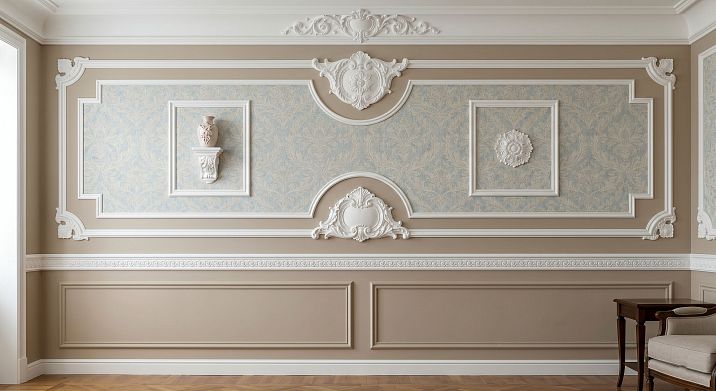
Wallpaper is coming back. After several years of minimalism's dominance with its painted walls and smooth surfaces, the interior world has rediscovered texture, pattern, depth. But wallpaper is not the solution. Wallpaper is half the answer. Beautiful, expensive, with an excellent pattern, they can look unfinished if the wall remains just a "wall in wallpaper."
It is hereStucco decor with wallpapermade of polyurethane becomes the element that takes the interior from the level of "well-done renovation" to the level of "thought-out space." Moldings add architecture where there is none: frames, verticals, horizontal bands, decorative panels. Wallpaper provides the background — bright, textured, lively. Together they create a wall that is examined, not just seen.
How does this work technically? What to do first — glue wallpaper or moldings? Which profiles to choose? These questions have specific, practical answers from the first paragraph to the last.
Want to decorate a wall with wallpaper and moldings without the hassle of matching details? In the STAVROS catalog you can choosePolyurethane wall decor, moldings and ready-made sets for any style and wall size.


Why wallpaper and stucco decor work well together
There is a simple design logic that is important to understand before moving on to choosing specific elements. Wallpaper and moldings solve different tasks — and that is why they complement each other so well.
Wallpaper works with the surface: it adds color, pattern, texture, character. Good wallpaper can set the mood of an entire room — warm, airy, graphic, luxurious. But despite all this, wallpaper remains a flat covering. It does not create architecture: the wall has no relief, no structure, no sense of depth in the space.
Moldings on the wall with wallpaper bring precisely that dimension. The profile is a relief protruding above the plane of the wall. A frame of moldings is an architectural element that creates zones, proportions, symmetry. A horizontal molding belt is a line that divides the wall into upper and lower parts, sets the scale, and structures the surface.
Why polyurethane and not plaster? Because itPolyurethane molding for interior weighs 5–8 times less than plaster. It is installed without wet solutions, without specialized tools, without plaster craftsmen. It is easily cut with a regular hacksaw, glued with mounting adhesive, and painted with the same acrylic paint as the walls. And at the same time — it is visually indistinguishable from plaster at a distance of one meter.
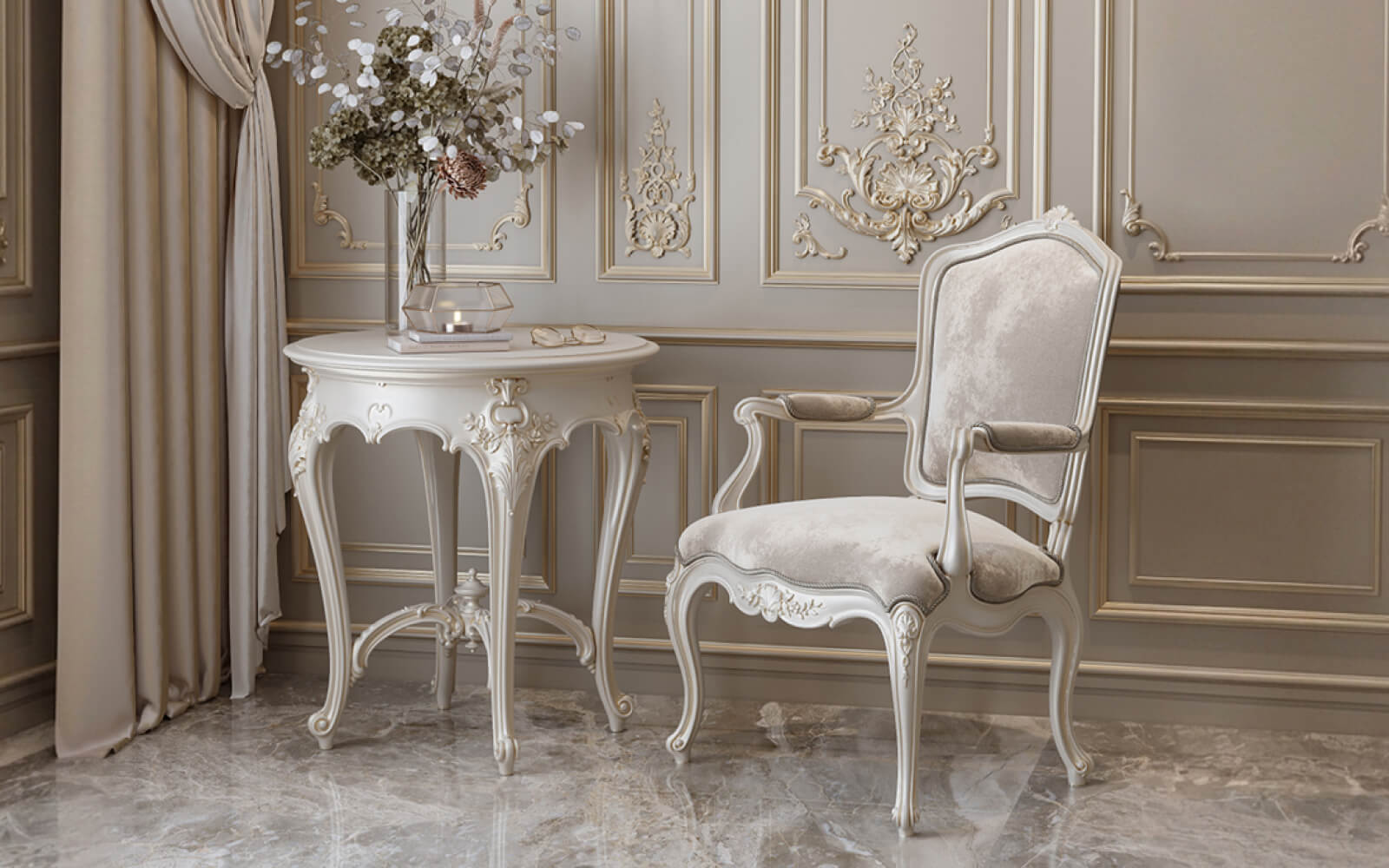
Decorating walls with moldings and wallpaperThis is a technique known since the boiserie era, from the interiors of 18th-century French palaces. Back then, walls were divided with wooden panels, and silk wallpaper was inserted between them. Today the principle is the same, but the materials are different and more accessible.




What problems does stucco decoration on a wall with wallpaper solve?
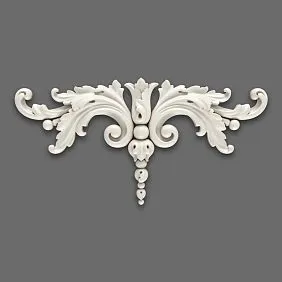
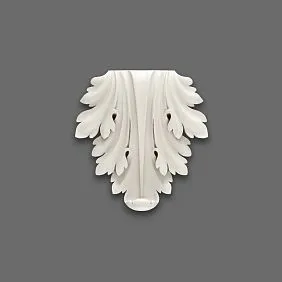
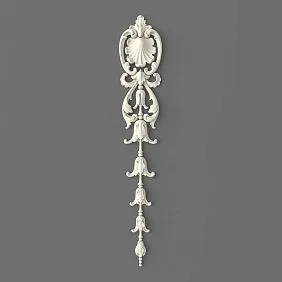
Our factory also produces:





Makes an accent wall truly luxurious
The most common scenario: one wall in the room is highlighted with wallpaper, the rest are neutral, painted. But an "accent wall with wallpaper" is not yet design, it's just a choice. It truly becomes an accent wall when it receives an architectural foundation.
Frames of moldings with wallpaperOn the accent wall: moldings around the perimeter, with wallpaper in the center. Or moldings defining several zones on a wide wall with different wallpaper inserts. Or verticals on the sides of the sofa with a horizontal above it, creating a "frame" for both the furniture and the wall.
polyurethane wall decor behind the sofaWith detailed diagrams of frame systems and scaling for different living room formats. The wall behind the sofa is one of the first things a guest sees when entering the room. It shapes the impression of the interior.
Get Consultation
Breaks up a large wallpaper pattern
Active wallpaper—with large floral prints, geometric patterns, or ornaments—can look chaotic on a large plane without structure. Moldings solve this problem: they divide the wall into zones, within each of which the wallpaper pattern works as a decorative insert rather than an endless background.
Wallpaper in a molding frameThis is not just beautiful. It is functional: the frame sets a boundary for the pattern, preventing it from "spreading" across the entire plane. The eye gets anchor points—the moldings—and perceives the wallpaper pattern as part of an organized system.
Helps to decorate empty zones
Not every wall in an apartment is an accent wall behind a sofa or bed. There are piers, narrow hallway sections, the area near a mirror, the wall by a console, side walls in the entryway — spaces that "exist" but don't know why they exist.
Decorating walls with moldings and wallpaper for such zones: a small frame of moldings, a wallpaper insert inside, a sconce or a small painting above the frame. This turns a random pier into a well-thought-out interior element.How to decorate an empty wall — with specific techniques for different types of empty surfaces.
Creates the effect of decorative panels (boiserie)
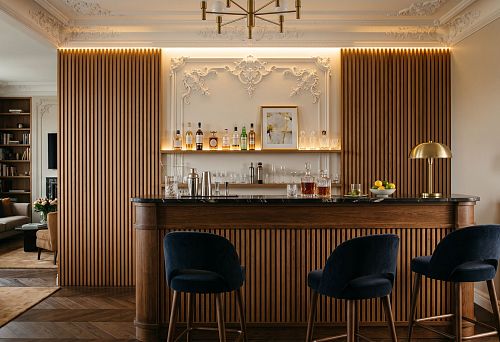
Boiserie is a classic technique for dividing a wall: the lower part is decorated with wooden or plaster panels, the upper part with wallpaper or fabric. In modern interiors, this principle is implemented using polyurethane moldings: a horizontal band at a height of 90–120 cm divides the wall into a "panel" lower zone and a "wallpaper" upper zone. The lower part is painted or with solid-color wallpaper, within frames of moldings. The upper part has patterned wallpaper.
polyurethane decorative wall panels — with an analysis of the boiserie system for entryways, dining rooms, and bedrooms.
Main options for combining wallpaper and moldings
Option 1: Wallpaper inside molding frames
This is the most commercially effective and visually compelling technique. The wall or part of it is divided by moldings into zones — frames. Inside each frame, wallpaper is applied: a meter-long piece of non-woven wallpaper, panels, photo wallpaper, textile wallpaper, or simple patterned sheet material.
Why does this work so well? The frame sets the scale, limits the pattern, and creates contrast: the clear geometry of the molding against the lively ornament of the wallpaper. This pair — geometry and ornament — works flawlessly in any style: from classic to contemporary.
Technically, the process looks like this. Moldings are mounted on a puttied wall, forming frames. Inside the frames, wallpaper is glued — in fragments of the required size, exactly along the perimeter. The moldings are painted in the color of the wall or in a chosen contrasting shade. You can also paint the areas outside the frames in one color, and inside the frames — cover with wallpaper. The result: a wall that looks like a piece of interior design.
Ready-made molding frames for the wall — if you don't want to calculate and cut profiles yourself: ready-made systems are already matched in size and proportions.
Option 2: Moldings over plain wallpaper
Plain wallpaper or wallpaper with a subtle texture (fabric-like, plaster-like, natural material-like) is an ideal background for moldings. They act as a "rich paint": the same smooth surface, but with depth and a tactile component.
Moldings on the wall with wallpaper in this option are glued directly over already applied wallpaper. Technically, this is possible: non-woven and vinyl wallpapers are dense enough for reliable adhesion of mounting glue. The main thing is a tight fit of the sheet to the wall without bubbles or peeling edges at the molding installation points.
For this option, the sequence issue is especially important: if the wallpaper is already glued — the moldings are installed on top. If the renovation is just starting — it's better to do the moldings first, then the wallpaper. More on this in the section on installation sequence.
Option 3: Wallpaper only in the central zone, moldings around
A large single piece of wallpaper or panel in the center of the wall, framed by moldings along the perimeter with an indent — this is the "picture on the wall" technique. The wallpaper panel becomes a decorative element, and the molding becomes its architectural frame.
This option works especially well with the wall behind the sofa, behind the bed, or behind the dining table. The central wallpaper fragment — with a botanical print, cityscape, abstraction, or geometric pattern — receives an architectural framing that transforms it from "glued wallpaper" into a "decorative panel."
Accent wall made of polyurethane — about the principles of building accent systems with various types of decor.
Option 4: Lower part with moldings, upper part with wallpaper
The classic scheme of horizontal wall division is one of the most stable and versatile techniques in interior design. A horizontal molding belt at a height of 90–130 cm (depending on ceiling height and furniture scale) divides the wall into two tiers.
Lower tier: solid color paint or neutral wallpaper in vertical frames made of moldings — "boiserie." Upper tier: patterned wallpaper that does not overload the space because it occupies only the upper half of the wall.
Decor of a wall with a mirror — with examples of wall division by a horizontal belt in hallways and corridors. It is in the hallway that this technique works most effectively: a narrow space, an accent wall opposite the entrance, a mirror in a molding frame.
Option 5: Wallpaper and decorative polyurethane overlays
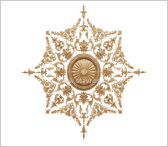
For classic interiors, neoclassicism, and Versailles Light — decorative overlays on top of wallpaper. A rosette, cartouche, small ornamental element in the center of the wall or along the axes of symmetry — this is "decoration" in the literal sense. The overlay fixes the point of attention, creating a decorative accent without a frame system.
Versailles Light stucco decor — a collection for traditional interiors with rich finishes: overlays with classic ornament, relief profiles, elements for building formal walls.
What to choose: moldings, decorative elements or a ready-made set
Polyurethane moldings
Moldings made of polyurethane — a basic tool for any frame system. The linear profile is cut to the required size and allows you to create frames of any configuration. The choice of profile depends on the style of the wallpaper and the format of the wall.
| Wallpaper type | Molding width | Style | Molding color |
|---|---|---|---|
| Calm solid colors | 20–28 mm | Minimalism, Japandi | Matching the wall |
| Textured (fabric-like, plaster-like) | 25–35 mm | Neoclassic Light | Matching or soft contrast |
| Patterned, muted | 30–40 mm | Neoclassical | White, cream |
| Active ornament, large print | 35–50 mm | Versailles Light | Contrast with wallpaper |
| Botanical, floral | 28–38 mm | Modern Classic | White or matching |
Important principle: the molding should be visible against the wallpaper background. A thin profile of 15–18 mm gets lost on busy wallpaper — it fulfills neither an architectural nor a decorative function. For most patterned wallpapers, the minimum profile width is 28–30 mm.
For frames with wallpaper, suitable options areMoldings made of polyurethane, and for a more expressive composition —Decor for Molding with corner inserts and accent elements.
Decorative wall elements
Polyurethane wall decor — overlays, rosettes, cartouches, panels with ornamentation. Used as standalone accent elements or as a complement to frame systems.
For walls with wallpaper, decorative overlays work in two scenarios. First: an overlay on top of the wallpaper — in the center of the frame, along the axis of symmetry, above the console. It is glued to the wallpaper with mounting adhesive; non-woven and vinyl wallpapers hold the weight of small overlays well. Second: an overlay on a painted surface next to the wallpaper area — at the junction of styles, as a transitional element.
Decor for moldings
molding decorative elements — corner inserts for frames, elements for joints and intersections of profiles. They are especially important for walls with wallpaper: a beautiful frame corner with a decorative insert is a detail that "reads" next to the wallpaper pattern and creates a feeling of a carefully thought-out interior.
Corner inserts come in square (classic, with ornamentation), round (rosettes), and geometric (for modern styles). For neoclassicism — square with relief ornamentation. For minimalism — simple squares or no inserts (45° angles).
Ready-made sets of stucco decor
Ready-made molded decor kits — the optimal choice for those who do not want to independently calculate the linear footage of moldings, select frame proportions, and coordinate corner inserts with profiles.
A ready-made kit is a pre-selected system: moldings of the required width, corner elements, decorative overlays — all in a unified style and proportions. This is especially convenient for walls with wallpaper: you know in advance what the result will look like, even before installation begins.
polyurethane decorative wall panels — about options for ready-made systems for different wall formats.
What comes first: wallpaper or moldings
This is a practical question that affects the entire installation process. There is no strict rule: both orders are possible, and each has its own advantages.
Moldings first, then wallpaper — this is the technically preferred option. Moldings are mounted on a puttied wall, forming frames. Then wallpaper is glued inside the frames — exactly along the perimeter of the profile. The joint between the molding and the edge of the wallpaper remains clean: the wallpaper butts up against the molding, and the border is even.
This order allows working with any type of wallpaper, including non-woven (which is difficult to trim flush without a guide). The molding serves as a "guide" when wallpapering.
After the wallpaper work is completed, the moldings are painted — either in the color of the wall outside the frames, or in a chosen contrasting color.installing polyurethane molding — with instructions for clean corners and hidden joints.
Wallpaper first, then moldings — this is a possible and common option, especially when the wallpaper is already applied and the decision to add moldings is made later. The moldings are glued directly onto the wallpaper. Conditions: the wallpaper must adhere tightly to the wall, without bubbles or loose edges. Non-woven wallpaper holds the molding well. Paper wallpaper — less so; here, installation needs to be reinforced with finishing nails or liquid nails with an increased glue application area.
The joint between the molding and the wallpaper in this case needs to be carefully treated with acrylic sealant to cover any possible gap.
installation of polyurethane molding — a practical guide considering various substrates.
Important regarding color: if the moldings should match the background outside the frames, painting should be done after all installation work, with one coat over the moldings and painted wall sections. This guarantees a perfect color match.
Where to use stucco decor with wallpaper
Living Room
The living room is the main arena for wallpaper with moldings. Four zones where this works convincingly:
The wall behind the sofa is the most popular and effective. Moldings create a "frame" for the sofa: a horizontal line above the sofa, verticals on the sides. Inside — wallpaper, outside — painted wall. Or: three large frames in a row, with wallpaper fragments inside.polyurethane wall decor behind the sofa — with detailed diagrams.
TV zone — moldings around the perimeter of the niche or symmetrical verticals on the sides of the panel. Wallpaper — in the area behind the panel or to the side of the TV unit.Polyurethane TV zone decor — with options for different formats.
Dining area — the wall behind the table. If the dining area is in the living room, the accent wall behind the table sets the tone for the entire space. Frames made of moldings + wallpaper with a botanical print or classic ornament.Wall decor in the dining area — about proportions and sizes of decorative systems for dining rooms.
Wall with a console and mirror — frames around the mirror, wallpaper in the area around the console, moldings creating an "architectural cabinet" without a cabinet.Decor of a wall with a mirror — with principles for designing mirror zones.
Bedroom
In the bedroom, work is done with two main zones. The wall at the head of the bed is the main decorative wall of the room. Moldings create a "frame" for the headboard: wider and higher than the bed itself, with a decorative wallpaper insert inside. The wallpaper in the headboard frame is delicate, with a soft pattern, in warm tones.
Decor of the wall near the bed made of polyurethane — with ready-made solutions for bedrooms of different formats and styles.
The wall opposite the bed often remains empty or occupied by a wardrobe. If the wardrobe is built-in, you can decorate the side surfaces or the visible wall next to it. If there is a free wall opposite the bed, it is ideal for a symmetrical system of frames with wallpaper inserts.
Hallway and corridor
The hallway works with the first impression. And here Decorating walls with moldings and wallpaper is especially effective because the space is small: one good move changes everything. A horizontal molding belt at a height of 100–120 cm — the lower zone in frames with a solid color, the upper zone with wallpaper or vice versa. The mirror area in a molding frame with wallpaper behind the mirror is a classic technique for the hallway.
In a long corridor, moldings create rhythm: equally spaced vertical profiles from the baseboard to the ceiling break up the monotony of a narrow wall, and wallpaper inserts between them add texture and color.
Office
The study is an area with its own aesthetic. Here, wallpaper with moldings works differently than in the living room or bedroom. Strictness, symmetry, relief without ornament — or, on the contrary, a "library" style with deep, rich wallpapers in classic frames.
The wall behind the desk: vertical moldings on the sides of the work area, a horizontal line above the monitor level, wallpaper in the lower part of the area or in the side frames.Accent wall made of polyurethane — with options for studies.
Dining area
The wall behind the dining table is a place that everyone present during meals "sees." It is the most viewed spot in the house. Here, it makes sense to invest maximum effort in decor: wallpaper with a rich pattern, moldings with moderate ornamentation, sconces on either side of a frame — and this wall will be the topic of conversation at every dinner.
How to choose a decor style for wallpaper
Neoclassicism
Neoclassical Stucco Decor — symmetrical frames, medium-width profiles of 35–50 mm, corner inserts with classic ornamentation. Wallpaper in neoclassical style: calm, with a moderate pattern, in soft shades — cream, dusty pink, gray-blue, warm beige.
Color of moldings in neoclassical style: white or cream on warm wallpaper. Or moldings matching the wall background, with wallpaper of a contrasting shade inside the frames.
Neoclassicism Light
Stucco decor Neoclassic Light — a more modern interpretation of classics. Thin profiles of 22–32 mm, frames without ornamentation or with minimal corner inserts. Wallpaper — textured, solid-colored, or with a barely noticeable pattern.
This style suits most modern apartments: it does not require high ceilings or grand scale, yet gives the wall architecturality and completeness.
Japandi
Moldings and decor in the Japandi style — this is absolute minimalism. Thin profiles of 18–25 mm matching the wall color. Wallpaper — natural shades: linen, gray-beige, clay, muted green. No pattern, no ornamentation. Only texture and silence.
In Japandi, moldings do not create "decor" — they create structure. Frames set proportions but do not claim to be decoration. This is the most restrained and the smartest of possible approaches.
Japandi wall decor — with principles and a collection for minimalist spaces.
Versailles Light
Classic polyurethane wall decor — for interiors with a traditional character. A more expressive profile with relief, decorative overlays, wallpaper with classic ornament inside frames. Venetian plaster or silk wallpaper — an ideal combination for this collection.
Modern classic
Moldings with a smooth rectangular or semicircular profile, large frames, solid or textured wallpaper. This is a style without quotes, without ornament, but with a clear sense of architectural thoughtfulness. Profile 28–38 mm, contrast between moldings and wallpaper is moderate or monochrome.
How not to ruin a wall: mistakes when combining wallpaper and stucco
Too small frames on busy wallpaper
Small frames on wallpaper with a large pattern: moldings "argue" with the ornament, neither dominates, and the wall looks overloaded. Rule: the busier the wallpaper, the larger the frames should be. One or two large frames on busy wallpaper are better than five small ones.
Many different patterns in one room
Busy wallpaper in frames + decorative overlays with ornament + complex molding profile = visual chaos. Each wall should have one "main character": either the wallpaper or the decorative ornament.stucco decor in the color of the wall or contrasting — about how to manage attention on a decorated wall.
Moldings do not match the height of furniture
A horizontal molding belt at a height of 90 cm with a sofa height of 85 cm — the molding gets lost behind the sofa back. The lower horizontal of the frame should be either below the furniture (it won't be visible, but that's fine) or noticeably higher — from 20 cm or more.
No symmetry relative to the sofa, bed, or table
If the sofa is not centered on the wall, but the molding frames are centered on the wall, an imbalance occurs. The frame system should be built relative to the furniture, not relative to the wall.symmetric polyurethane wall decor — with an analysis of spatial symmetry principles.
Too thin molding on a large wall
An 18 mm profile on a 4 m wide wall — it's a thread on a canvas. The molding simply doesn't read. For a large wall — a profile from 35 mm. For a wall with complex wallpaper — from 40 mm.
Forgot to connect the moldings with the baseboard and cornice
Molding frames in neoclassical style on the wall + plastic ceiling baseboard 35 mm + thin floor baseboard. This doesn't work: the details are not coordinated in scale and style.how to combine stucco decor with baseboards and cornices — a mandatory topic for those building a system, not just decorating one wall.
What to buy for a wall with wallpaper and stucco decor
Full commercial list:
-
polyurethane wall moldings — molding profiles for frames for any wallpaper and styles.
-
Polyurethane wall decor — overlays, sockets, decorative panels for use with wallpaper.
-
Decor for Molding — corner inserts and elements for frame systems.
-
Ready-made molded decor kits — for a quick start without self-calculation.
-
Collection "Neo-classic" — for walls with classic and patterned wallpaper.
-
Neoclassic Light collection — a universal collection for most modern apartments.
-
Japandi collection — for minimalist interiors with textured wallpaper.
-
Versailles Light Collection — for traditional and classic interiors.
If you don't want to calculate frame sizes and select elements by style yourself, use ready-made STAVROS collections. Each collection is a balanced system: profiles, corners, overlays in a single style.
Frequently Asked Questions
Can polyurethane moldings be glued onto wallpaper?
Yes. Non-woven and vinyl wallpaper are a reliable base for mounting adhesive. Paper wallpaper is possible, but additional fastening with finishing nails is recommended. The main condition: the wallpaper must adhere tightly to the wall without bubbles or peeling edges.
What to glue first: wallpaper or moldings?
Both options are possible. The preferred order for a clean result is moldings on a puttied wall, then wallpaper inside the frames. If the wallpaper is already glued, the moldings are glued on top, followed by treating the joints with sealant.installing polyurethane molding — step by step.
Which wallpaper looks best in molding frames?
Wallpaper with a moderate pattern, not too active ornament. Botanical prints, medium-saturated geometry, classic floral patterns, textured solid colors — all of this fits organically within frames. A very large pattern in a small frame works poorly: the scale doesn't match.
Can moldings be painted the color of the wallpaper?
Yes, if the wallpaper is solid or has a uniform texture. The moldings are painted with acrylic paint of the same shade — and the wall becomes monochrome but voluminous.stucco decor in the color of the wall or contrasting — with an analysis of this approach.
Are moldings suitable for photo wallpapers?
Yes, if the photo wallpaper covers part of the wall. Moldings around the perimeter of the photo wallpaper turn it from "glued photos" into a "decorative panel in a frame." The entire wall in photo wallpaper with moldings nearby works worse: it's harder to maintain the gap and create a frame.
How to design one accent wall with wallpaper and stucco molding?
Define the central element: sofa, bed, console, mirror. Around it — a frame system of moldings. Inside the frames or next to the central element — wallpaper. The rest of the wall — a painted neutral surface.Accent wall made of polyurethane— with principles of choosing scale and proportions.
Which moldings to choose for a bedroom with wallpaper?
Profile 28–38 mm, with a soft relief or smooth cross-section. In the tone of the wall for a delicate interior or white for neoclassicism. The main thing is the proportions of the headboard frame: frame width = bed width + 40–60 cm on each side, height — up to 150–180 cm from the floor.
What is better: to assemble the frames yourself or buy a ready-made kit?
Self-assembly — if you have non-standard wall sizes, specific proportions, or an individual concept. A ready-made kit — if you need a reliable and quick result without calculations: the elements are already selected and tested as a system.how to calculate moldings and stucco decor for a wall— if you chose the independent path.