








































Article Contents:
- Why the top zone of the wall is the most challenging area in interior design
- A problem overlooked during the planning stage
- Slats from floor to ceiling or with a gap: two approaches and their logic
- Slats from floor to ceiling: when it works
- Slats with a gap from the ceiling: lightness and air
- Selection principle
- Ceiling cornice above wooden slats: architectural completion
- Wooden ceiling cornice: continuation of the material
- Polyurethane cornice: profile precision and white contrast
- How to properly choose a cornice for slats: parameters
- Moldings as a border between slats and a smooth wall
- Molding on top above the slats: a horizontal line
- Molding on the sides of the slatted panel: a frame made of one material
- Polyurethane molding in the color of the wall: an invisible border
- Wooden molding in the color of the slats: a continuation of the material
- Wooden corner and block: trim for neat junctions
- Wooden corner: a clean end in the corner of the room
- Wooden block: a volumetric accent and structural element
- How trim helps to close all complex points
- How to connect the top and bottom: baseboard as the bottom frame of a slatted wall
- Wooden baseboard for natural slats
- White MDF baseboard to wooden slats
- High baseboard for classic interior with moldings
- Straight MDF baseboard for modern interior with slats
- Best combinations for the upper wall zone with slats
- Wooden slats + white polyurethane cornice
- Wooden slats + wooden ceiling cornice
- Slats in TV area + polyurethane moldings on adjacent walls
- Slats in hallway + high MDF baseboard
- Slatted wall + ceiling decor in ceiling color
- Wooden slats + thin molding at top and bottom
- Mistakes in designing the upper wall zone with slats
- Extend slats to the ceiling without a cornice
- Too massive cornice in a small room
- Several shades of wood without a system
- Not covering the ends of the slats
- Forgetting the baseboard
- Installing slats, moldings, cornice, and an active ceiling simultaneously without pauses
- Neglecting the precision of the molding's horizontal level
- Mixing polyurethane and wooden moldings in one line
- How to assemble a system for the upper wall zone: a practical algorithm
- What to choose from the STAVROS catalog for decorating the upper zone of the wall
- About the Company STAVROS
- Frequently Asked Questions

This is one of the most common situations in modern renovations. A person correctly chose wooden planks on the wall, correctly installed them, correctly chose the spacing and wood species — but did not think through how to complete the composition at the ceiling. And as a result, the most noticeable part of the wall — the upper zone, the junction point of the vertical wall and the horizontal ceiling — remained unanswered.
This article is about how to solve exactly this problem. How to decorate the upper part of the wall so that the slats, moldings, cornice, and ceiling speak the same language. How to use wood trim items, polyurethane moldings, and a ceiling cornice to create an architectural system, not a set of random details.


Why the upper zone of the wall is the most difficult place in the interior
The upper part of the wall is the place where two large planes meet: the vertical wall and the horizontal ceiling. Physically, it's just a right angle of 90°. Visually, it's one of the most loaded points in the interior. A person's gaze, when evaluating a room, inevitably moves along the perimeter: floor — wall — ceiling. And it is precisely the wall-ceiling transition that they perceive as the "completeness" or "abruptness" of the interior.
If this transition is not decorated in any way — the wall and ceiling look like two foreign elements that are simply "leaned" against each other. If decorated incorrectly — with a too massive cornice, an inconsistent molding, a random corner — there is a feeling of "as if something is wrong, but it's not clear what."
Decorating the upper zone of the wall competently means creating an architectural transition: smooth or sharp, laconic or expressive, wooden or polyurethane. But always well thought out.




A problem overlooked during the planning stage
Consider ceiling height, room size, interior style, and functionality.Decorative wooden plankspeople think about the middle of the wall: how the slats will look at eye level, what spacing and width, what type of wood, whether to tint or leave natural. The upper zone is left for later — "we'll figure it out on site."
"On site" turns out to be more complicated than expected. Because "covering the top of the slats" is not a technical issue, it's a design decision. It affects the entire vertical wall system: from the baseboard at the bottom to the cornice at the top.
Our factory also produces:





Slats from floor to ceiling or with a gap: two approaches and their logic
The first decision to make at the design stage: whether to runwooden slats from floor to ceilingor leave a gap at the top (and bottom)?
Get Consultation
Slats from floor to ceiling: when it works
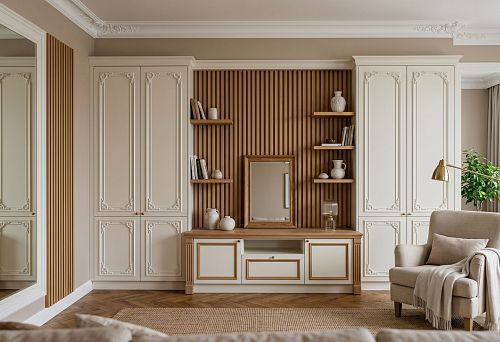
Slats that go all the way to the ceiling without stopping are a maximally architectural, strong technique. They create a sense of height: the eye moves vertically along the slats and "pulls" the ceiling upward. This is especially valuable in apartments with ceilings of 2.5–2.7 m, where every additional "centimeter" of visual height matters.
But slats from floor to ceiling are also the most demanding solution in terms of finishing. If a slat reaches the ceiling and simply butts against it without any trim, the ends are visible, along with possible gaps and installation inaccuracies. Without a finishing element — a cornice, molding, or corner — the top of the slat wall looks technical rather than architectural.
Slats from floor to ceiling are organic:
-
In the TV area of the living room — vertical lines behind the panel
-
In the hallway — a slatted «welcoming» wall
-
In the study — an accent work area
-
In the bedroom — a headboard decorated with slats from floor to ceiling
-
In the bathroom or toilet with wooden finish — a slatted area behind the sink
Slats with a gap from the ceiling: lightness and air
The second option — slats end 15–30 cm below the ceiling. This creates «air» between the top of the slats and the ceiling, making the interior lighter. Above the slats — a smooth strip of wall or a specially designed area with molding or cornice.
This technique works well:
-
When you need to «lighten» the slatted wall — not let it become too dominant
-
When lighting is planned in the upper zone of the wall: LED strip behind the slats from below creates contour light
-
When the ceiling is already decorated with complex decor and it's impractical to extend the slats up to it
-
When the interior is Scandinavian or Japanese: a delicate gap is part of the "empty space" aesthetic
Selection principle
| Parameter | Slats to the ceiling | Slats with a gap |
|---|---|---|
| Ceiling height | From 2.5 m | From 2.4 m |
| Style | Modern, loft, neoclassical | Scandinavian, Japanese, minimalism |
| Accent | Maximum | Delicate |
| Ceiling cornice | Essential | Optional |
| Top finish | Cornice, molding, corner | Thin molding or decorative strip |
Ceiling cornice above wooden slats: architectural finish
Ceiling cornice is the main tool for designing the transition from wall to ceiling. When the wall hasdecorative wooden slatsorRafter panels, the cornice acts as a "top frame": it covers the ends of the slats, hides the mounting joint, and creates an architectural horizontal line that "reads" as the completion of the vertical slat system.
Wooden ceiling cornice: continuation of the material
wooden corniceabove a slatted wall is the most organic solution in terms of material unity. If the slats are oak — a wooden cornice made of oak. If the slats are stained walnut — a cornice in the same stain. One material along the entire vertical creates the feeling that the wall "grew" from the floor and "went" into the ceiling as a single surface.
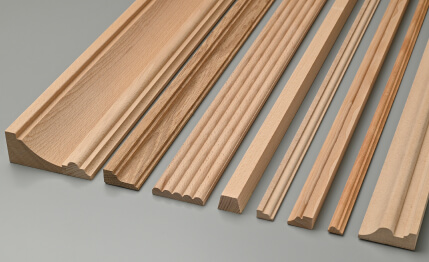
Wooden beamsin the STAVROS catalog are made of solid wood — oak, ash, pine, birch — with a milled or turned profile. The surface is ready for painting, tinting, or applying oil-wax. This means the cornice can be precisely matched to the tone of the slats: one finish, one shade, a unified material system.
What is important when choosing a wooden cornice for a wall with slats:
-
Cornice profile: no more than 60–80 mm with a ceiling up to 2.7 m. A massive cornice of 120+ mm in a standard apartment draws all the attention and disrupts the vertical rhythm of the slats.
-
Profile type: straight or rounded. An ornamental cornice with carvings next to minimalist slats is a style conflict. Slats say 'modern' — a carved cornice says 'classic'. These are two different languages on one wall.
-
Installation: the cornice is mounted horizontally on the wall, flush to the ceiling, overlapping the upper ends of the slats by 10–15 mm.
Polyurethane cornice: precision of profile and white contrast
An alternative to a wooden cornice — Moldings made of polyurethane in the form of a ceiling cornice. A polyurethane cornice above wooden slats creates a contrasting combination: warm natural wood of the slats + a clear white architectural line of the cornice. This is a 'Scandinavian' technique, very popular in modern interiors.
polyurethane ceiling decor offers another possibility: if molding frames or rosettes are planned on the ceiling above the cornice, a polyurethane cornice and ceiling decor from the same series will create a perfect unified system on top. Slats — warm, wooden, vertical. Cornice and ceiling — white, geometric, horizontal. Two languages, one system.
How to properly choose a cornice for slats: parameters
When choosing a cornice for a wall with wooden slats, four parameters need to be considered.
First is the height of the slats. If the slats are 60×20 mm, the cornice can be 50–70 mm. If the slats are massive, 80×30 mm, the cornice is 70–90 mm. The cornice should be comparable in "mass" to the slats, not thinner and not significantly thicker.
Second is the ceiling height. Up to 2.6 m — cornice no wider than 60 mm. 2.7–3.0 m — 60–80 mm. Above 3 m — a cornice up to 100–120 mm is possible.
Third is the style of the slats. Thin, minimalist slats 20×40 mm — a thin cornice with a straight profile. Wide slats with a chamfer or rounding — a cornice with a corresponding profile.
Fourth is the material. Wooden slats + wooden cornice — a single material. Wooden slats + white polyurethane cornice — contrast of materials.
Moldings as a border between slats and a smooth wall
A ceiling cornice is not the only way to finish a slatted wall at the top. In some cases, a more elegant solution is awooden decorative moldingorPolyurethane molding, which works not as a cornice joint between wall and ceiling, but as a border between two zones of the same wall.
Molding above the slats: a horizontal line
If the slats occupy the lower and middle part of the wall, and the upper zone is smooth (painted or wallpapered), the molding horizontally separates the slatted part from the smooth one. This is a technique of "panel division" of the wall: the lower panel is textured, the upper one is neutral. The molding is an architectural dividing line.
For this technique —decorative wooden moldingsorMoldings made of polyurethanea profile of 15–30 mm. The molding runs strictly horizontally at a given height. Below — slats. Above — a smooth surface. The transition is clear, architectural.
The height of the molding above the floor: usually at 2/3 or 3/4 of the total wall height. With a ceiling of 2.6 m — molding at a height of 1.8–2.0 m. The lower slatted zone occupies about 70% of the wall — this is the main, "speaking" part. The upper smooth zone — 30% — is a "pause."
Molding on the sides of the slatted panel: a frame made of one material
If the slats do not run across the entire width of the wall, but occupy a central accent zone, moldings on the sides (and top) create a frame — a "mat" of molding around the slatted insert.
wooden moldingin the color of the slats — a single material, the frame "dissolves" into the slats, creating the feeling of a monolithic panel. A white polyurethane molding around wooden slats — a contrasting option: the frame clearly "cuts out" the slatted insert from the wall, making it a separate architectural object.
Important: the molding frame around the slatted area should be at the same horizontal level as the ceiling cornice. If the cornice is 50 mm around the perimeter of the room, and the frame molding is 30 mm — the system visually "breaks." If the cornice and molding are of the same profile and same size — everything is tied into one.
Polyurethane molding in the color of the wall: invisible border
One of the most delicate techniques —Polyurethane wall decorin the form of a thin molding, painted in the exact color of the wall. The molding is practically invisible — it creates not a color, but a relief border. The eye perceives the horizontal line as a shadow, not as an element. The slats end behind this line — and everything looks complete without visible effort.
This is a technique of "quiet architecture": the boundary exists, but it does not shout. This approach is ideal for minimalist interiors, where any superfluous element disrupts the fragile balance.
Wooden molding in the color of the slats: continuation of the material
The opposite logic — a molding made of the same wood species as the slats, with the same tinting. It "continues" the slats horizontally, creating not a boundary, but a frame. Slats + molding = a single wooden block, inside which the slats create a vertical rhythm, and the molding creates a horizontal frame.
Wheninstalling polyurethane moldingsFor wooden molding, precision of the horizontal line is crucial: any deviation from the level, which is lost in perspective on a ceiling cornice, is immediately visible in the middle of the wall. A laser level is mandatory.
Wooden corner and block: trim for neat junctions
There are elements that are thought of last — and they determine whether the renovation will look like "done by a craftsman" or "done as it turned out." We are talking about corner and end elements of slatted cladding.
Wooden corner: clean end in the corner of the room
Wooden angleIt covers the external corners of slatted cladding — where the slatted panel goes into the corner of the room and its end is exposed. Without the corner, the end of the slat is visible: it is an unfinished surface, often with a not perfectly even cut. With the corner, the angle becomes an architectural detail, not a technical "tail."
The corner is mounted over the ends of the slats using acrylic glue or finishing nails. Important: the corner must be made of the same wood species and with the same surface treatment as the slats. A birch corner next to oak slats means different shades that cut the eye. Unity of material is a mandatory condition.
Wooden block: volumetric accent and structural element
Wooden block— a more voluminous linear element used in several scenarios:
-
As a horizontal "shelf" from which slats "grow" upward. The block is mounted horizontally on the wall at a given height — and the slats start from it as a base. This creates a structured bottom for the slat composition.
-
As a vertical divider between slat blocks. Two rectangular slat panels are separated by a vertical block — this creates a sectional wall structure.
-
As a volumetric frame around a slat insert: a block around the perimeter of a rectangular slat area provides a "heavier," sculptural framing compared to a thin molding.
The entire systemwood trim— slats, corners, blocks, moldings, baseboards, cornices — makes sense precisely as a system, not as a set of individual elements. When all are from the same series, same wood species, same finish — the interior gains what is hard to buy separately: material integrity.
How linear elements help cover all complex points
Complex points in slat installation are always transition areas: where slats meet another material, where they end in a corner, where they connect with a cornice or molding, where they adjoin a window slope or door frame. It is at these points that the quality of finishing "lives."
wooden elements for interiorsin the form of corners, blocks, thin moldings — these are technical solutions that, when properly selected, become decorative. A corner covers the angle and simultaneously creates a clear vertical line in the wall structure. A block covers the end and simultaneously creates a horizontal accent.
How to connect top and bottom: baseboard as the bottom frame of a slat wall
The upper zone of the wall is resolved: cornice, molding, corners. But the system is incomplete if the lower horizontal — the floor plinth — is not coordinated with the upper one. The plinth is the lower frame of the wall, symmetrical to the cornice. And it is no less important.
Wooden baseboard for natural slats
Wooden baseboardmade from the same wood species as the slats — this is a "through wooden thread" in the vertical section of the wall. Plinth at the bottom → wall (neutral) → slats in the middle or along the entire height → wooden cornice at the top. Wood appears on three levels — and the interior reads as architecturally designed, not randomly decorated.
Plinth height for wooden slats: 70–100 mm with a ceiling of 2.5–2.7 m. Profile — straight or with one or two chamfers, in the same style as the slats. If the slats have rounded edges — a plinth with rounding. If the slats have sharp chamfers — a plinth with a chamfer.
White MDF plinth for wooden slats
MDF Skirting Boardfor painting white — the second most common option for a slatted interior. Warm wooden slats + white floor plinth + white ceiling cornice: this is a classic combination where wood works as the "filling" and white lines as the "framing".
WhiteMDF Skirting Boardlightens the lower zone, visually expands the floor, and does not "weigh down" the space with wood on all sides. With dark slats (walnut, tinted oak), a white plinth is mandatory — dark slats from floor to ceiling with a dark plinth create a heavy "tunnel" effect.
High plinth for a classic interior with moldings
In classic and neoclassical interiors, whereSculptural wall decorationpolyurethane plinth is combined with wooden slats in separate zones, the plinth can be high: 120–150 mm, with a figured profile. It creates a pronounced lower "base" of the wall — an architectural foundation from which the main decorative system begins.
Proportional correspondence: a wide plinth of 120 mm should be combined with a cornice of 80–100 mm. A thinner cornice with a wide plinth creates the impression of an "inverted pyramid": a heavy bottom and a light top.
Straight MDF baseboard for modern interiors with slats
Baseboard MDFStraight profile — without chamfers, without rounding, strictly rectangular cross-section — is ideal for minimalist and modern interiors. Thin slats 20×40 mm + straight baseboard 60 mm = an interior where all lines are straight, all corners are sharp, everything is laconic.
Baseboard in the color of the wall — a technique where the lower horizontal line 'disappears': the eye sees only the floor and wall without a visible transition. This works in minimalist spaces where the goal is a minimum of visible elements. Slats in such an interior are the only active decorative element, and they get all the attention.
Best combinations for the upper wall zone with slats
Let's put together working schemes — those that give predictably strong results in different styles and room formats.
Wooden slats + white polyurethane cornice
Warm natural slats (oak, ash, light pine) + white polyurethane ceiling cornice 50–60 mm. The cornice with a clear horizontal line 'closes' the top of the slats and sets the transition to the white ceiling. WhiteMDF Skirting Board70–80 mm at the bottom symmetrically repeats the cornice. This is a modern classic system — strict, warm, architectural.
Wooden slats + wooden ceiling cornice
Oak slats, oak cornice of the same tint. Oak baseboard of the same tint. The wall between the elements is neutral, light. Complete material unity: wood appears on three levels, forming a 'wooden frame' of the interior. Inside this frame are neutral surfaces. This is a 'hunting lodge in the city' or an interior in the 'warm modern' style.
Slats in the TV zone + polyurethane moldings on adjacent walls
The central wall behind the TV panel is slatted. The side walls have molding frames made ofpolyurethane wall decor. A white polyurethane ceiling cornice runs along the entire perimeter of the room. A white MDF baseboard runs along the entire perimeter. The slats are warm, wooden. Everything else is white. This is a "zonal" system: an accent in one place, a neutral context around it.
Slats in the hallway + high MDF baseboard
In the hallway, slats often go the full height of the wall — from the baseboard to the ceiling. A white MDF baseboard of 100 mm creates a distinct lower horizontal line. A white cornice of 50–60 mm creates the upper one. Between them are the slats. A hallway with this solution looks architecturally thought-out at first glance.
Slatted wall + ceiling decor in the color of the ceiling
polyurethane ceiling decor in the form of molding frames above the slatted wall. The slats create texture on the wall, the ceiling frames create structure on the ceiling. Both elements are in different planes and do not compete. The cornice connects them along the perimeter. This is a solution for spacious rooms with a ceiling of 2.7 m or higher.
Wooden slats + thin molding at the top and bottom
The most concise option: slats across the entire width of the accent zone, a thin wooden molding of 15–20 mm at the top and bottom as horizontal "handrails". The moldings frame the slatted zone, clearly marking its beginning and end vertically. No cornice — only moldings. This is a solution for modern minimalist interiors where every extra element is unnecessary.
Mistakes when designing the upper zone of a wall with slats
Let's break down typical mistakes — those that turn a good idea into a disappointing result.
Bringing slats up to the ceiling without a cornice
The most common mistake. Slats butt against the ceiling, ends are visible, the joint is not covered. Slats from floor to ceiling is a strong technique, but only with a top finishing element: a cornice, molding, or corner piece. Without it, the top of the slatted wall looks like an unfinished renovation.
Too massive a cornice in a small room
A 120 mm cornice in a 4 m² hallway with a 2.5 m ceiling "eats up" the visible height around the entire perimeter. With a height of 2.5 m, a cornice over 60–70 mm is already a risk. Rule: the cornice should not take up more than 3% of the visible wall height. With a 2.5 m ceiling, that's a maximum of 75 mm.
Several wood shades without a system
Dark walnut slats, light pine cornice, birch corner piece, laminated MDF baseboard "wood-look" — four different "woods" on one vertical line. The eye searches for a unified tone and doesn't find it. Rule: one wood shade or a maximum of two — warm and neutral — with a clear application principle.
Not covering the ends of the slats
The end of a slat is an unfinished surface. A wood cut visible at an angle or when looking directly at a room corner destroys the sense of completeness.Wooden angle — this is exactly the element that covers the ends where slats meet a room corner, door frame, or window reveal. Installing a corner piece takes fifteen minutes of work. The difference in the result is fundamental.
Forget about the bottom baseboard
The top of the wall is finished: cornice, molding, corners — everything is thought out. But at the bottom — a thin random baseboard from a hardware store that has no connection to either the slats or the cornice. The system breaks at the bottom horizontal line. Selectionwooden baseboardorMDF Skirting Boardsmust be part of the overall concept, not an afterthought to it.
Install slats, moldings, cornice, and an active ceiling simultaneously without pauses
Four active decorative tools in one room is almost always an overload. If the wall is saturated with slats and moldings — the ceiling should be calm. If the ceiling is rich, with frames and a rosette — the wall should step back.polyurethane ceiling decorand a slatted wall can be in the same interior — but only with a clear distribution of roles: one dominates, the other supports.
Neglect the precision of the molding's horizontal line
A horizontal line of molding running across the wall is immediately visible with any deviation from level. The human eye detects horizontality with exceptional precision — a deviation of 3 mm over a length of 3 meters is perceived as an error. A laser level during installation of any horizontal element — molding, cornice, bar — is not an option, but a mandatory tool.
Mix polyurethane and wooden moldings in one line
A wooden molding to the left of the slatted panel and a polyurethane molding to the right — different surface texture, different reaction to painting, different visual 'weight'. Even painted the same color, they will look different. The entire molding contour around one slatted zone must be made of the same material.
How to assemble a system for the upper wall zone: a practical algorithm
To avoid getting lost among the options, follow a logical sequence when designing the finish.
Step 1. Define the boundaries of the slat zone. Slats across the entire wall or only on a part? From floor to ceiling or with an offset? The answer to this question determines all other decisions.
Step 2. Choose the top finishing element. Slats up to the ceiling — a cornice or corner piece is needed. Slats with an offset — a molding or a block as a horizontal "shelf" for the top finish is needed. SeeWooden beamsandMoldings made of polyurethane.
Step 3. Choose the material for the top finish. Wooden cornice — a unified material language with the slats. White polyurethane cornice — contrast, a "Scandinavian" technique.
Step 4. Close the corner joints.Wooden corner pieces — for external corners of the slat finish.wooden beams — for horizontal bases and transitions.
Step 5. Choose the baseboard. In the same system as the cornice: woodenSkirting to the wooden cornice, whiteMDF skirting boardto the polyurethane cornice.
Step 6. Check the proportions. The height of the cornice ≈ the height of the baseboard ± 20–30 mm. The thickness of the molding should not be larger than the "mass" of the slat.
Step 7. Ensure series consistency. All wooden elements are from the same wood species, with the same tint. All polyurethane elements are from the same line.polyurethane products.
What to choose in the STAVROS catalog for decorating the upper zone of the wall
To solve the task of "decorating the transition from wall to ceiling," the STAVROS catalog has a complete set of necessary elements.
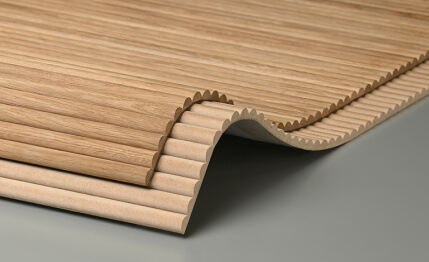
Wooden slats —buy wooden slatsmade of oak, ash, pine, birch. Various cross-sections: from 20×40 to 40×80 mm. Surface for painting, tinting, or oil.
Slat panels — ready-madeRafter panelswith a fixed slat spacing on the base. Installation is faster than individual slats — the spacing is already calibrated.
Wooden cornices — wooden corniceand the full range wooden cornicesof different profiles. For the top finishing of a slatted wall — cornices with a 40–80 mm profile.
Polyurethane cornices and moldings —Moldings made of polyurethanefor a white contour cornice above wooden slats. Lightweight, precise profile, ready for painting.
Wooden moldings — Decorative wooden moldingsfor horizontal dividers between slatted and smooth wall zones, for frames around slatted panels.
Polyurethane wall decor —polyurethane moldings and frameson neutral walls next to slatted zones.
Corners and strips —Wooden angleandWooden block— for neat junctions, ends, corner transitions.
Linear products —wood trim itemsin a unified series: slats, corners, bars, baseboards, cornices from the same wood species.
Baseboards —Wooden baseboardandMDF Skirting Boardfor the lower completion of the system. Height 60–150 mm depending on style and ceiling height.
About the company STAVROS
STAVROS is a Russian manufacturer of decorative interior products made from solid wood and polyurethane. The company produces a full range of elements for creating a cohesive architectural interior: wooden slats and slatted panels, baseboards from solid wood and MDF, wooden and polyurethane cornices, moldings, corners, bars, linear products — as well as polyurethane stucco decor for walls and ceilings.
All STAVROS products are manufactured with a uniform surface standard within each series, allowing you to select a set of materials — slats, cornice, baseboard, corners — from one line and achieve a system with a predictable, unified result. This is especially important when creating complex decorative walls, where every joint, every end, and every transition between materials must look like a designed detail, not a random on-site solution.
Frequently asked questions
How to finish wooden slats at the ceiling?
A ceiling cornice (wooden or polyurethane) is installed flush against the ceiling and overlaps the upper ends of the slats by 10–15 mm. An alternative is a thin molding mounted horizontally above the slats on the wall.
Which cornice to choose for a wall with wooden slats?
A wooden cornice of the same wood species — for a unified material language. A white polyurethane cornice — for contrast between warm wood and white architectural lines. Cornice width: 50–70 mm with a ceiling height of 2.5–2.7 m.
Can stucco be used next to wooden slats?
Yes. Stucco moldingPolyurethane wall decorworks on adjacent walls or as a frame around the slatted area. The main thing is not to place both materials on the same plane without a clear logic of separation.
How to cover the corner of wooden slats?
wooden corner piecefrom the same wood species and in the same tint as the slats. The corner piece is mounted over the ends of the slats with acrylic glue.
Is a baseboard necessary if the slats go from floor to ceiling?
Absolutely. The baseboard covers the joint between the slat and the flooring. Without a baseboard, this joint is technically and visually unfinished. For slats from the floor — a wooden baseboard of the same wood species or white MDF for contrast.
Slats to the ceiling or with a gap — which is better?
Slats to the ceiling — maximum visual accent, increase the feeling of height. Slats with a gap — lighter, more delicate, allow for backlighting. The choice depends on ceiling height, interior style, and room purpose.
How to choose a baseboard for a cornice?
Baseboard height ≈ cornice height ± 20–30 mm. Same material and tone: wooden baseboard to wooden cornice, white MDF baseboard to white polyurethane cornice.
What are linear products and why are they needed?
wood trim items— these are all long decorative profiles: slats, baseboards, cornices, moldings, corners, bars. They form the "framework" of the interior — horizontal and vertical lines that connect the floor, walls and ceiling into a single system.