










































































Article Contents:
- Why an office requires calm yet prestigious decor
- Wooden slats in the office: eight working scenarios
- The wall behind the desk: the main backdrop of the office
- Video call zone: a professional backdrop without extra words
- The wall behind the work chair: bookish depth
- The wall section next to the bookshelf: material rhyme
- A niche with shelves: built-in accent
- Relaxation area in the office
- Executive Office: Status Through Material
- Home Library: Slats and Shelves in a Unified System
- Stucco Decor and Moldings in the Office: Six Working Schemes
- Slats as an Accent, Moldings as a Background
- Stucco Frame Around the Work Area
- Moldings in Wall Color for a Subtle Relief
- Polyurethane Decor for the Upper Part of the Wall
- Moldings Around a Niche or Shelves
- Wooden Slats Next to the Library
- Ceiling Cornice for the Office: The Top That Holds the Space
- Why a cornice specifically in the study
- Wooden ceiling cornice matching the slats
- Polyurethane cornice in ceiling color
- Cornice in wall color
- Thin molding instead of a cornice
- Baseboard for the study: the lower line that defines a lot
- MDF baseboard for a modern study
- Wooden baseboard for a study with slats
- Wide wooden baseboard for a prestigious study
- Baseboard in wall color: invisible lower border
- Which baseboard to choose: a simple table
- Moldings, corners, and strips: clean lines in details
- Wooden corner: vertical precision
- Wooden strip: horizontal frame
- Molding products for covering joints
- Decorative baguette
- Ideas for five types of offices
- Modern office: precision and restraint
- Neoclassicism: relief and nobility
- Executive office: material as status
- Home library: wood and books in a unified system
- Living room workspace: zoning without a partition
- Typical mistakes when designing a home office
- Too active wall behind the workspace
- Slats without closed ends
- Massive cornice with a low ceiling
- Baseboard not connected to furniture
- Different wood shades in one space
- Overload with slats and molding at the same time
- No background for video calls
- About the Company STAVROS
- Frequently Asked Questions (FAQ)

There are spaces that say everything about a person — even before they have spoken a word. A home office is exactly that kind of place. It is not just a room with a desk and monitor. It is a concentration of character, profession, and taste in a few square meters. And while a living room can afford some eclecticism, and a bedroom can be soft without architectural strictness, a study requires something else: order, composure, and at the same time dignity.
Exactly thereforestucco decor for a home office, wooden slats in a home office, competently selectedMDF Skirting Boardand a ceiling cornice is not decoration for decoration's sake. It is the architecture of a workspace that makes it not only beautiful but also psychologically correct: setting the mood for concentration, creating a feeling of respect for work and for oneself.


Why an office requires calm but status-oriented decor
An open question: can you make an office beautiful without overloading it with details? The answer is unequivocally yes. And that is the whole point.
An office is a room with high cognitive load. Here people work, think, make decisions, read, and create. The space should not 'shout.' It should be a background — precise, well-considered, providing a sense of quality and comfort without unnecessary noise.
But 'calm' does not mean 'empty.' Bare painted walls without architectural lines, without a lower baseboard contour, without a cornice at the ceiling — that is not minimalism. It is incompleteness. This is precisely wherewooden slats for the work areaand moldings perform their main task: they create the architecture of the space without overloading it.
The wall behind the desk is your professional background. A video call, a photo on social media, an online meeting with a client — all of this is seen by other people. It should read as a well-thought-out environment, not as a random surface.Stucco decor for the work areaand vertical slats create this look effortlessly.
Bottom line —baseboard for the study— completes the space from below. The transition to the ceiling — the cornice — covers it from above. Joints, ends, corners —wood trim items. This entire system together creates an interior that doesn't "look for" missing details — it is complete.




Wooden slats in the study: eight working scenarios
Before discussing specific solutions, it's worth understanding:wooden slats for the studywork not only as decor. They structure the space, create zones, provide a sense of material and warmth in an environment dominated by screens, books, and technical surfaces.
Our factory also produces:





Wall behind the desk: the main backdrop of the study
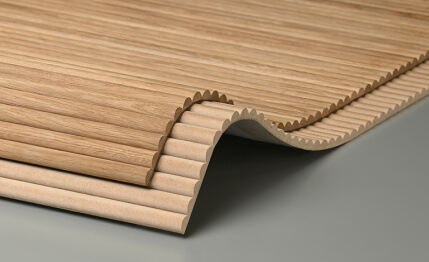
Wall decor behind the deskwith wooden slats is the most common and at the same time the most effective technique. Vertical slats on the central wall of the office create a professional background without overload: rhythmic texture, warm natural material, a sense of order.
Scale matters: slats 20–30 mm wide with a spacing of 30–50 mm create a dense, expressive rhythm. Wider slats — 40–60 mm with a spacing of 60–80 mm — create a calmer, "breathing" layout. For a small office, a moderate spacing is optimal. For a large one, you can afford rare, wide slats with clean gaps.
Height of the slatted area: full wall from baseboard to cornice — for strict, architectural interiors. Panel behind the desk up to a height of 120–140 cm — for modern offices where the wall above is light or has shelves.
Get Consultation
Video call zone: a professional background without unnecessary words
In the era of remote work and online meetings, the background behind you is part of your business image.Wall decoration with wooden slatsfor the video call zone is a solution that speaks about you restrainedly and convincingly. Natural wood on the wall reads on any screen as an expensive, meaningful choice.
Wall behind the work chair: bookish depth
Slats on the wall behind the chair are an option for those who sit facing the window. The background wall in this case is the rear one, it is visible when entering the office. The slatted texture on it creates a feeling of depth and coziness — especially if there is a bookcase or shelves nearby.
Pier next to the bookcase: material rhyme
The space between a cabinet and a wall or doorway is a narrow, often awkward plane.wooden slats for wall finishingin this area, they 'pick up' the furniture material, creating a visual rhyme. If the cabinet is wooden — slats in a matching tone. If the cabinet is white — slats can be chosen in contrasting colors.
Niche with shelves: built-in accent
If the study has a niche with bookshelves or work surfaces, the back wall of the niche is an ideal place for a slatted panel.Rafter panelson the back wall of the niche add depth, highlight the area, and give the built-in structure the character of expensive joinery furniture.
Relaxation area in the study
Many studies have a small armchair or sofa — a place for breaks and reading. The wall behind this spot is an area that can be slightly warmer and softer than the workspace. A slatted panel orDecorative wooden stripin a natural shade on this wall creates a 'reading nook' — intimate, cozy, distinct from the strict work area.
Executive study: status through material
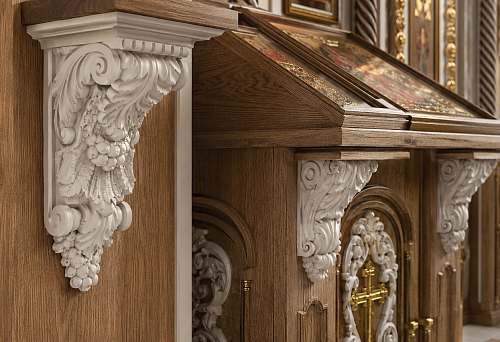
In the home study of a manager — director, lawyer, architect, doctor — decor carries a direct status function. HereWooden planks for decorationOak paneling on the main wall, complemented by moldings, a wide baseboard, and a wooden cornice — this is not just an interior solution. It is a signal: serious thought is given here.
Home library: slats and shelves in a unified system
A study-library is a special case. Here the walls are occupied by shelves, leaving less space for slats. But the piers between sections, the space above the shelves up to the ceiling, and the side walls — all these areas can be enhanced with slats.wooden planks on the wallIn the library, they create a unified natural backdrop for the book space.
Stucco decor and moldings in the study: six working schemes
Stucco decor for the studyWorks differently than in the living room or hallway. The study is an environment where decor should support, not distract. Therefore, the key word here is delicacy.
Slats as an accent, moldings as a backdrop
The first and most common scheme: vertical slats on the wall behind the desk as the main accent. On adjacent walls — moldings in the wall color. There is relief, but it is only perceived with peripheral vision — like a shadow from a profile. The result: a study with architecture, but without visual noise.Moldings made of polyurethaneIn the wall color — a precise tool for this task.
Stucco frame around the work area
A molding mounted in a rectangular frame around a slatted panel behind the desk is a high-end technique. The frame defines a "zone of concentration," highlighting the work surface of the wall as an independent architectural element.Polyurethane wall decorin this role, a frame molding with a profile of 30–50 mm looks like a complete composition.
Moldings in the color of the wall for a calm relief
A frame layout of moldings on all walls of the office in the exact color of the wall is a classic technique of expensive design. The relief is visible only due to the shadow from the profile. No color contrasts—only geometry and light. This technique turns an office with ordinary painted walls into an architecturally rich space without extra costs.
Polyurethane decor for the upper part of the wall
Polyurethane wall decorin the form of a frieze or horizontal strip in the upper part of the wall—between the cornice and the main work area. This technique "closes" the top of the wall and makes the office more proportionate. Especially relevant for tall rooms: a frieze at a height of 200–220 cm visually lowers the ceiling to a comfortable scale.
Moldings around a niche or shelves
Decorative wooden moldingsor polyurethane moldings around the perimeter of a niche with bookshelves—a technique that gives the built-in structure architectural status. A molding around the niche turns a utilitarian storage into a decorative element.
Wooden slats next to the library
The space next to the bookshelves—a side wall or partition—is played upvertical wooden slatsThe slats create a material connection between the wood of the shelves and the wood of the wall: the space acquires a unified natural logic.
Ceiling cornice for the study: the top that holds the space
The ceiling transition in the study is a detail that many ignore. The wall ends, the ceiling begins — and the boundary between them "hangs" without finishing. This is not critical in a bedroom. But in a study — in a space with architectural aspirations — the absence of a cornice reads as incompleteness.
Why a cornice specifically in the study
The cornice structures the top line of the space. For a study, where composure and order are important, this is not a decorative trifle — it is part of the system. Just as the bottom line of the baseboard "anchors" the wall at the floor, the cornice "completes" it at the ceiling. Without these two elements, the wall is perceived as an unfinished plane, placed in an interval without beginning or end.
Wooden ceiling cornice matching the slats
Wooden ceiling cornicemade from the same solid wood as the slats on the walls — a solution with internal logic. The material "passes through" the study in a single shade: slats on the wall, cornice at the ceiling, baseboard at the floor. Oak or beech at three points — this is not repetition, it is an architectural rhyme.
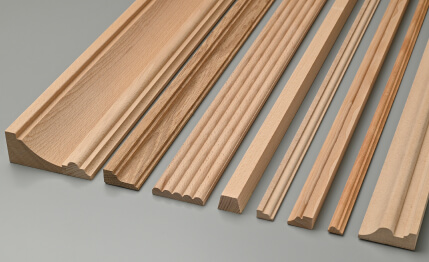
Wooden beamsfor the study are chosen with a moderate profile. In a modern study — straight, without ornament. In a study with a neoclassical character — with a profile that reads as an architectural cornice: ovolo, cyma reversa, shelf.
Polyurethane cornice in the color of the ceiling
For studies with white ceilings and neutral walls —polyurethane ceiling decorin white. The cornice disappears into the ceiling, creating a transition without a color accent. This is the most delicate option for a modern study: the architecture exists, but it does not assert itself.
Cornice matching the wall color
In studies with rich colored walls — dark green, dark blue, anthracite — a cornice in the color of the wall creates a monolithic, almost monumental upper perimeter. This is a bold technique, but it works precisely in a study where the character of the space is important.
Thin molding instead of a cornice
For small studies with low ceilings — 2.4–2.6 m — a thin molding (30–40 mm) instead of a cornice. It marks the boundary between the wall and ceiling without reducing the height.Moldings for walls and ceilingin this role — a practical and lightweight choice.
Baseboard for the study: the bottom line that determines a lot
The baseboard is the last element in the finishing system, often chosen hastily. In a study, this is a mistake. It is here that the baseboard is especially visible: the gaze, dropping from a bookshelf or monitor, inevitably fixes on the lower contour of the wall. And it is this contour that sets the feeling of neatness or carelessness.
MDF baseboard for a modern study
MDF Skirting Boardis a rational choice for a study with painted walls. Its smooth surface, stable geometry, and the ability to precisely cut at any angle make installation simple and the result clean.
White MDF Skirting Boardis a universal solution for light studies with white or neutral walls. It marks the bottom line without a color conflict with any wall shade.
— is a horizontal element that frames the room at the bottom of the walls where the wall meets the floor. Skirting boards perform several functions: they hide the technological gap between the wall and floor covering (necessary for thermal expansion), protect the lower part of the wall from mechanical damage, create visual completion, and may conceal wiring.— for designers and owners who want precise color according to a specific RAL or NCS code. MDF accepts any paint evenly and without surprises.buy MDF skirting boardfor painting means getting a blank that, after painting, is no different from an expensive solution.
Wooden baseboard for an office with slats
If the slats on the walls are made of solid oak or beech in a natural shade, thenWooden baseboardfrom the same species closes the bottom line as an organic continuation.with a classic profile creates a sense of solidity, reliability.matching the slats is a material consistency that makes the office cohesive.
Wide wooden baseboard for a prestigious office
Wide Wooden Skirting Board— from 80 to 120 mm — for offices with high ceilings and ambitions for a classic or neoclassical character. In an executive office, home library, or formal study in a country house, a wide oak baseboard sets the tone for the entire interior.
Baseboard in wall color: invisible bottom border
Paintable MDF Floor Skirting Boardmatching the wall color — for offices with rich colored walls where the bottom contour should "dissolve." This is a technique for modern, monochrome offices: the wall color continues to the floor without a visible boundary.
Which baseboard to choose: a simple table
| Cabinet type | Recommended skirting board |
|---|---|
| Modern light | White MDF baseboard, 60–80 mm |
| With colored walls | MDF baseboard for painting in wall color |
| With wooden slats | Wooden baseboard, same species |
| Classic / library | Wide wooden baseboard, 80–120 mm |
| Executive office | Wide wooden baseboard with profile |
| Work area in the living room | MDF baseboard matching the main baseboard color |
Moldings, corners, and strips: clean lines in details
In the study, every detail is visible. Monitor, books, papers — the gaze glides across the space for several hours a day. And it is here that the neatness of ends, joints, and corners is perceived more acutely than in any other room.
Wooden corner: vertical precision
Wooden angle in the study works where the slats cross an external corner, where the slatted panel meets the side wall, where the built-in wardrobe joins the slatted area. A corner matching the slats creates a clean vertical line at the transition — neat and logical.
A corner piece 15–25 mm wide is sufficient for most study tasks. Installation — with glue or liquid nails, followed by painting or in its natural finish.
Wooden strip: horizontal frame
Wooden block horizontally — above and below the slatted area — covers the ends of the vertical slats. This is a mandatory element for a neat study interior: without horizontal limiting strips, the ends of the slats are exposed — and each one is visible.
The block can also be a decorative belt: a horizontal wooden strip at a height of 80–90 cm divides the wall into two zones, giving the lower — slatted — and upper — smooth — parts an independent character.
Molding products for covering junctions
Trimming Items— this is a system that covers everything that is usually overlooked: joints at shelves, junctions of slats with window slopes, transitions from a slatted wall to a door, the corner between the floor and a built-in wardrobe. Without moldings, these places look "unfinished" — raw, incomplete. This is especially important in an office, where everything is visible.
Decorative molding
Wooden molding — a thin profile — is used in the office for framing mirrors, paintings, boards, cork panels, niches, and individual decorative zones. It creates a visible boundary — a frame — where a clear geometric line is needed.
Ideas for five types of offices
Modern office: precision and restraint
White or light gray walls.vertical wooden slatson the wall behind the desk — natural oak or light ash. No moldings. Thin polyurethane cornice in the color of the ceiling.White MDF Skirting Board— straight profile 60–80 mm.
Result: a clean, collected office where the slatted wood is the only natural accent. Nothing distracts. Everything is to the point.
Neoclassicism: relief and nobility
Walls in a neutral tone — cream, dusty gray, warm beige.Decorative wooden moldingsorMoldings made of polyurethanewith a frame layout on all walls — in the color of the wall. Wooden slats on one accent wall, matching the moldings or in a darker shade.wooden cornicewith a classic profile. Widewooden baseboard— 80–100 mm.
Result: a noble, calm office with architecture. Without excess, but with character.
Executive office: material as status
Dark green or anthracite walls.Wooden planksmade of dark oak on the wall behind the desk.wooden cornicefrom the same array — in the color of the slats.Wooden baseboardwide — 100–120 mm, the same oak. Polyurethane moldings in the color of the wall — a delicate frame layout.
Result: an office where every material speaks of a thoughtful choice. Status without vulgarity.
Home library: wood and books in a unified system
Walls are light or neutral. Bookshelves — the entire perimeter wall. On the side walls —Rafter panelsfrom floor to ceiling made of oak.wooden cornicearound the perimeter — modest but precise. Wide baseboard — natural oak.
Result: a warm library where wood is a full participant. Slats, cornice, and baseboard create a unified wooden system around the books.
Work area in the living room: zoning without a partition
Not everyone has a separate office — and that's no reason to give up a well-thought-out workspace. If the work area is in the living room,wooden slats behind the deskon the accent wall create a visual boundary: the area with slats is the workspace, the rest is the living area. This is zoning without physical separation.
— is a horizontal element that frames the room at the bottom of the walls where the wall meets the floor. Skirting boards perform several functions: they hide the technological gap between the wall and floor covering (necessary for thermal expansion), protect the lower part of the wall from mechanical damage, create visual completion, and may conceal wiring.runs across the entire room in the same color as the wall — without making accents or dividing the space with lower contrasting lines.
Typical mistakes when designing a home office
Too busy wall behind the workspace
Large stucco decor, bright patterns, rich frame colors — all this on the wall behind the desk creates an excessive background. The brain, perceiving an active image behind the screen, gets tired faster. Rule: the wall behind the workspace should be calm, rhythmic, and not contrasting.
Slats without closed ends
Open ends of vertical slats at the top and bottom are the most common 'minor' mistake. In a well-lit office, open ends are especially noticeable. Solution: a horizontalWooden blockat the top and bottom of the slat area.
Massive cornice with a low ceiling
A cornice with a projection of 80–100 mm with a ceiling of 2.4 m creates pressure from above. The cornice should be proportionate to the room height. For ceilings up to 2.6 m — a lightweight profile or molding.
Baseboard not connected to furniture
A white MDF baseboard with dark wooden parquet and dark furniture is a dissonance. The baseboard should be part of the room's material story: matching the furniture, floor, or walls.
Different shades of wood in one space
Slats are natural ash. Baseboard is dark walnut. Cornice is birch. In a study where everything is clearly visible, this feels like a mess. A single wood species or a single shade is a must.
Overload of slats and molding simultaneously
Slats on three walls plus active frame molding on the fourth plus a prominent cornice is too much. Principle: one main element. The rest is background.
No background for video calls
The best background is a wall with rhythmic slats in a neutral shade. The worst is a white smooth wall cluttered with shelves. Plan this specific wall in advance.
About the company STAVROS
For those who understand the difference between "just a study" and a space with character, STAVROS offers a full range of decorative elements for a workspace of any concept and scale.
In the STAVROS catalog, you will find everything needed for systematic study finishing:Wooden planksmade of solid oak and beech with precise dimensions and a clean surface, ready for installation and painting,Rafter panelsfor quick finishing of large surfaces,MDF Skirting BoardandWooden baseboardfor the bottom line,wooden corniceandWooden beamsvarious profiles for the upper transition to the ceiling, as well aswood trim items, Wooden corner piecesandstripsfor neat joints and junctions.
For classic and neoclassical offices —Decorative wooden moldings, Moldings made of polyurethane, Polyurethane wall decorandceiling decorwith precise relief and an ideal surface for painting.
All STAVROS products are made from certified solid oak and beech or from dense polyurethane with factory precision of the profile. A unified sizing system allows you to form a complete set for an office of any scale: from a small work area in an apartment to a formal executive office in a country house.
Detailed information aboutinstalling polyurethane moldings— with analysis of corners, joints, and painting rules — read in the STAVROS articles section.
Frequently Asked Questions (FAQ)
Which slats are best suited for the wall behind the desk?
Solid oak slats 20–30 mm wide with a spacing of 30–50 mm are a versatile option for most offices. For a more airy, modern look — width 15–20 mm, spacing 40–60 mm. For a warm, dense background — width 30–40 mm, spacing 25–35 mm.
Is a cornice needed in a small office with a 2.5 m ceiling?
Yes, but a lightweight one: a molding 30–50 mm wide instead of a cornice. It will mark the transition from wall to ceiling without reducing the height. A massive cornice with a large overhang with a 2.5 m ceiling is excessive.
Wooden baseboard or MDF for an office — which is better?
If the slats are wooden in a natural shade and there is a parquet floor — a wooden baseboard from the same species. If the walls are painted and color accuracy is important — MDF for painting. In modern light offices — white MDF, in classic and executive offices — solid wood.
Can wooden slats and moldings be combined in one office?
Yes, but on different planes. Slats — on one wall (usually behind the desk). Moldings — on other walls or on the same wall as a frame around the slat area. Slats and moldings on the same plane create overload.
How to design an office for video calls?
The wall behind you — vertical slats in a natural oak shade on a neutral background. No bright colors, no active patterns, no chaotic shelves. The slats create a rhythmic, professional background that reads well on screen.
Are wooden corners and trim needed in an office?
Definitely, if there are slats and transitions between planes. Without corner pieces, the open ends of the slats and the joints of the planes look unfinished. In an office where everything is clearly visible and where a professional image is created, details matter.
How to choose the width of a baseboard for an office?
60–80 mm is the standard for modern offices in apartments with ceilings of 2.5–2.7 m. 80–100 mm is for country houses and offices with ceilings from 2.8 m. 100–120 mm is for formal offices, libraries, and classic interiors. Rule: the higher the ceiling, the wider the baseboard can be.