








































Article Contents:
- Why technical zones ruin the interior — and how to fix it
- Map of technical zones: what and where is designed
- Radiator under the window
- Air conditioner on the wall
- Ventilation grille
- Heating and water supply pipes
- Technical niches and boxes
- Wooden slats for technical zones: three working roles
- First role: decorative screen
- Second role: side accent
- Third role: background slatted wall
- What matters: temperature regime of slats near the radiator
- Stucco decor and moldings for technical zones: integrate, don't hide
- Molding frame around the radiator zone
- Moldings on the wall sections next to the air conditioner
- Stucco frame around the ventilation grille
- Horizontal molding belt as a visual balancer
- Baseboard for the wall with radiator and technical elements
- Main task: continuity of the bottom line
- MDF baseboard for technical zone
- Wooden baseboard near technical zone with slats
- Wide baseboard for prestigious spaces
- How to properly join baseboard with decorative box
- Trim for technical zones: details that make all the difference
- Wooden corner: covering everything that cannot be left exposed
- Wooden block: load-bearing structure of decorative screen
- Wooden baguette as horizontal crosspiece
- Systematic approach to trim
- Ceiling cornice and upper zone above technical elements
- Wooden cornice as a horizontal line above the air conditioner
- Thin polyurethane profile for modern interior
- Molding belt at the height of the air conditioner
- Ready-made schemes for designing technical zones
- Scheme 1: Radiator under the window — slatted screen with baseboard and moldings
- Scheme 2: Air conditioner on the wall — moldings and horizontal belt
- Scheme 3: Ventilation grille — molding frame
- Scheme 4: Exposed heating pipes — slatted box with corner pieces
- Scheme 5: Study — wooden trim for a prestigious design
- Design of technical zones in different styles
- Modern minimalism
- Neoclassicism and classicism
- Loft and Industrial Style
- Jatoba
- Country house
- Decision table: which material for which zone
- Mistakes when designing technical zones
- Additional technical zones that are often overlooked
- Window pier
- Electrical panel zone
- Zone under the radiator in the bathroom
- FAQ: popular questions about designing technical zones
- STAVROS: everything for technical zones — from batten to cornice
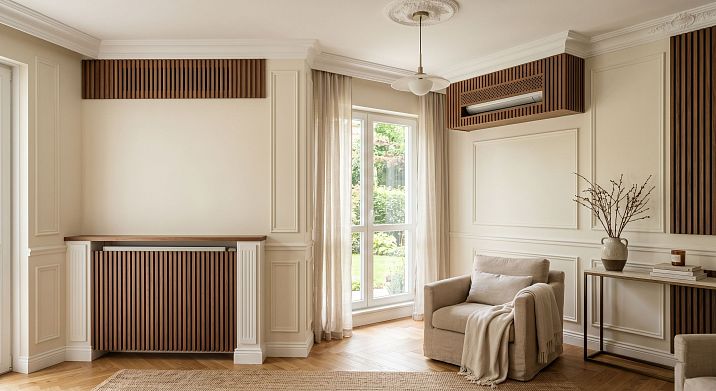
A radiator under the window. An air conditioner unit on the wall. A ventilation grille in the corner. Heating pipes along the baseboard. A decorative box hastily covered with drywall. Sound familiar? These are the very technical zones that exist in every apartment, every house — and stubbornly refuse to fit into a well-thought-out interior.
They cannot simply be 'covered up' with anything. The radiator must heat — so heat exchange is needed. The air conditioner must breathe — so access to filters is required. The ventilation grille must allow air to pass through. The pipes need maintenance. Each of these elements requires a solution that is simultaneously beautiful, functional, and technically sound.
This is exactly what this article is about. About howwooden slats for technical zones, stucco decor, moldings, proper baseboard, and trim turn an engineering problem into a design solution.


Why technical zones ruin the interior — and how to fix it
There is a paradox in any renovation: the more carefully the wall decor is thought out, the more noticeable the technical elements become. A beautiful slatted wall — and in the middle of it, a white air conditioner unit. Elegant moldings around the perimeter — and under the window, an awkward radiator with a random baseboard. A well-planned interior — and a pipe wrapped in insulation.
Technical elements are not ugly in themselves. They become ugly when they are overlooked during design — and left without a solution.
The task of the designer or apartment owner is not to hide the technical zone at any cost, but to integrate it into the interior. To make the radiator feel like part of the wall, the air conditioner like part of the architectural composition, the ventilation grille like a deliberate accent.
The tools for this are exactly what we are talking about: slats, trim, moldings, stucco decor, baseboard, cornice.




Map of technical zones: what and where to design
Each technical zone requires its own approach. Let's consider them separately.
Our factory also produces:






Radiator under the window
The classic location for a radiator is under the windowsill, between two slopes. It occupies exactly the zone that, with a good solution, can become an architectural accent of the window area. With a poor solution, it looks like a foreign object "inserted" into the wall.
The main limitation: convection must not be blocked. Heat should rise freely from the radiator upward. Any decorative screen or frame must have an open top or side gaps.
Get Consultation
Air conditioner on the wall
The indoor unit of an air conditioner is a rectangle of white or gray plastic, most often hung wherever is most convenient from the perspective of tubing routing. This rarely coincides with a decoratively advantageous location.
The main limitation: unobstructed air intake from the front and discharge of the cold stream downward are required. Decor around the air conditioner must not block airflows.
Ventilation grille
Ventilation grilles in the kitchen, bathroom, hallway, or living room are small rectangular or square openings in the wall. With the right approach, they can either be decoratively framed (a molding frame around the grille) or integrated into the overall decor system so that they appear as an intentional element.
Heating and water supply pipes
Open pipes along walls or in corners are a common situation in older homes.Wooden rails for decorationand decorative boxes cover the pipes, creating a neat vertical or horizontal accent. The slatted box remains partially open — with gaps between the slats — which provides air access and serviceability.
Technical niches and boxes
A niche under the riser, a box by the wall, a drywall protrusion for hiding utilities — all of this can be finished with slats, moldings, and trim, turning a technical solution into an architectural element.
Wooden slats for technical zones: three working roles
Wooden planksin a technical zone can play three completely different roles. It is important not to confuse them and to understand which one is needed in a specific case.
Role one: decorative screen
Vertical slats mounted in front of a radiator are a decorative screen. They partially hide the radiator, create a vertical rhythmic pattern, and do not block heat exchange: air freely passes through the gaps between the slats.
This is one of the best solutions for a radiator under a window.Wooden plank20–30 mm wide with a spacing of 15–25 mm creates a visually dense screen, but with sufficient gaps for convection.
Important: the top of the screen must be open or have wide gaps — otherwise warm air will accumulate behind the slats and not enter the room.
Second role: side accent
The slats do not necessarily cover the technical zone — they can frame it on the sides. Verticalwooden rails for wall decorationon both sides of the radiator or air conditioner create an architectural frame — like pilasters of a portal. The technical element remains visible but is perceived as part of a well-thought-out composition.
This technique is especially good for an air conditioner: it cannot be closed from the front, but can be framed on the sides and create a molding frame around the area.
Third role: background slatted wall
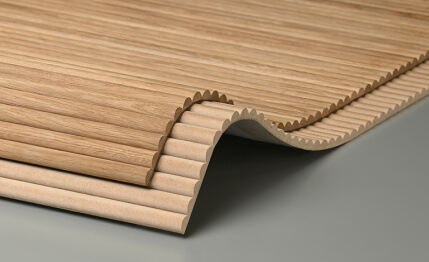
If the entire wall is finishedplank panels, technical elements on it simply fit into the slatted rhythm. An air conditioner on a slatted wall is perceived completely differently than an air conditioner on a smooth white wall: the textured background "absorbs" the technical object, making it less noticeable.
This is the principle of camouflage: the technical element is not hidden, but placed on a rich background where it loses its separateness.
What is important: the temperature regime of the slats near the radiator
Slats near a radiator operate under high-temperature conditions — up to 50–60°C at the surface of the device. For wooden slats, this means the need for proper coating: several layers of hard varnish or oil with wax to protect against drying out. Slats mounted directly in front of the radiator (5–10 cm away) require additional heat-resistant treatment.
Stucco decor and moldings for technical zones: integrate, don't hide
stucco decor for a wall with a radiator— sounds unexpected. But this is where moldings work with particular expressiveness. Their task is not to cover the technical element, but to create a decorative system around it, in which it is perceived as part of the wall, not as a random object.
Molding frame around the radiator zone
Moldings are mounted not around the radiator itself, but around the entire zone under the window — including the slopes, windowsill, and radiator as a single rectangular block.Moldings made of polyurethaneare ideal for this: they are not afraid of heat, lightweight, and can be painted any color.
The molding frame transforms the radiator zone into a niche — a deliberate architectural recess. The radiator no longer looks like an appliance and begins to read as an interior element.
Moldings on the wall sections next to the air conditioner
An air conditioner on the wall cannot be framed closely on the sides — an offset is needed for air intake. But the wall sections next to it are an excellent place for. Clear lines, created using modern technologies, emphasize the strict aesthetics of the room. Each decorative element harmoniously fits into the overall concept, creating a sense of order and thoughtfulness.. Molding frame panels on the side walls create an architectural context in which the air conditioner is perceived as part of a well-thought-out zone, not as a foreign appliance.
Stucco frame around the ventilation grille
A small ventilation grille in a molding frame made ofwooden decorative moldingsor polyurethane turns from a technical spot into a deliberate architectural element — a small decorative panel on the wall. This is the principle of 'if you can't hide it, decorate it.'
The molding is installed around the grille so that its frame overlaps the ends of the molding — resulting in a neat framing. The grille can be removed for cleaning without dismantling the decor.
Horizontal molding belt as a visual balancer
An air conditioner on the wall is a rectangular object at a height of about 2 m. It 'hangs' in the wall space and disrupts its visual balance. A horizontal molding belt at the same height, running across the entire wall, 'incorporates' the air conditioner into the horizontal line — it ceases to be a random object and becomes part of the horizontal architectural structure.
Moldings made of polyurethaneare the optimal choice for a horizontal belt: they are flexible, lightweight, mounted with adhesive, and allow perfectly level horizontal installation along the entire length of the wall.
Baseboard for a wall with a radiator and technical elements
It would seem, what could be complicated about a baseboard near a radiator? In reality, this is one of the most technically delicate nodes in this area.
Main task: continuity of the bottom line
The baseboard should run continuously along the entire wall — including under the radiator. If the baseboard breaks off before the radiator pipes or at the decorative screen, the lower line of the room is disrupted. This is immediately noticeable.
Solutions:
-
The baseboard runs under the radiator connection pipes (cutouts are made in it for this purpose)
-
The baseboard breaks off before the pipes, and the end is coveredwooden corner piece
-
The box around the connection pipes sits on the baseboard and continues its line
MDF baseboard for the technical zone
MDF Skirting Board— a practical choice for a wall with a radiator in a modern interior. MDF withstands temperature changes well, does not warp, and is easily replaced if damaged.— is a horizontal element that frames the room at the bottom of the walls where the wall meets the floor. Skirting boards perform several functions: they hide the technological gap between the wall and floor covering (necessary for thermal expansion), protect the lower part of the wall from mechanical damage, create visual completion, and may conceal wiring.allows it to be painted the same color as the wall or decorative screen — creating a single lower plane without accent lines.
White MDF Skirting Board— a universal neutral option for light interiors. It does not compete with the decorative radiator screen and does not draw attention.
Wooden baseboard at the technical zone with slats
If installed near a radiator or air conditionerwooden planks on the wall, the baseboard should be made of the same wood, with the same tint.to buy wooden baseboardof the required species — and the entire zone receives a unified material language: slats on the wall, baseboard at the bottom, corner pieces at the ends — all from the same wood.
Wooden baseboardfor a zone with wooden slats — this is not just a baseboard. It is the lower horizontal crossbar in a vertical slat system, which gives the entire structure completeness and weight.
Wide baseboard for prestigious spaces
For a study, hall, or living room with high ceilings — a widewith a classic profile creates a sense of solidity, reliability.from 80 mm creates a monumental bottom line that "holds" the entire decorative system, including the technical zone. A wide baseboard is proportionate to the ceiling height and the scale of the radiator — it does not get lost or look small.
How to properly join the baseboard with a decorative box
If the radiator connection pipes are covered by a decorative box — the baseboard should either go around the box along its contour, or go under it, or adjoin it throughWooden angle. There should be no gap between the baseboard and the box.
Trim for technical zones: details that make all the difference
If slats and moldings are the visible part of the solution, thenTrimming Items— this is what makes every joint neat. In technical zones, there are especially many joints, and each requires its own profile.
Wooden corner: covering everything that cannot be left open
Wooden angle— the main element for technical zones. The ends of the slatted screen at the baseboard? A corner. The external corner of a decorative box? A corner. The junction of a slatted panel with a window slope above the radiator? A corner. The joint of the baseboard with the side of a decorative box? A corner.
The corner is chosen to match the main trim. If the slats and baseboard are oak with mocha tinting — the corner is too. If everything is MDF for white painting — the corner is MDF for the same paint.
Wooden block: load-bearing structure of the decorative screen
Wooden blockis used as a frame element for a decorative slatted screen in front of the radiator. Horizontal blocks — the upper and lower crossbars — are the base to which the vertical slats are attached. The block must be straight, without warping, with correct geometry — otherwise the slats will twist.
Wooden blockis also used as a load-bearing frame for a decorative box over the radiator connection pipes.
Wooden molding as a horizontal crossbar
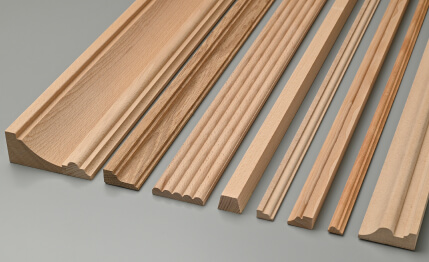
Wooden Picture Framewith a profile is used as a decorative horizontal crossbar at the upper edge of the slatted screen in front of the radiator. It covers the upper end of the slatted structure and creates a horizontal finishing line.
Systematic approach to trim
Rule one:wood trim items in the technical zone should be of the same tint and same species as the battens and baseboard. Molding is the connecting link between individual decorative elements. If it stands out in tone or material, the joints become noticeable, and the whole system falls apart.
Ceiling cornice and upper zone above technical elements
The air conditioner is located high. The ventilation grille is also high. The upper zone of the wall above these elements requires the same attention as the lower one.
Wooden cornice as a horizontal line above the air conditioner
wooden corniceorWooden beams — a horizontal profile on the wall at the height of the top edge of the air conditioner. It creates a horizontal line that visually 'integrates' the air conditioner into the architectural structure of the wall. Above the cornice is one zone (ceiling), below is another (main wall with the air conditioner).
This technique is from classic commercial design: this is how technical zones are styled in hotels and restaurants.
Thin polyurethane profile for a modern interior
For a minimalist or modern apartmentpolyurethane ceiling decor in the form of a thin profile at the joint of the wall and ceiling — a delicate solution. It marks the upper boundary of the space without unnecessary bulk. Above the air conditioner, this cornice runs continuously, 'embedding' the appliance into the horizontal line of the ceiling.
Molding belt at the height of the air conditioner
Horizontal belt made ofof polyurethane moldingsat the height of the lower or upper edge of the air conditioner — a technique that "aligns" the device in the horizontal system of the wall. The air conditioner stops "hanging" — it ends up in a frame between two horizontal lines.
Important: the molding belt should run along the entire wall, not just around the air conditioner. Otherwise, you'll get an even stranger frame — one deliberately drawn around the device.
Ready-made schemes for designing technical zones
Theory is good, schemes are better. Let's break down five specific scenarios.
Scheme 1: Radiator under the window — slatted screen with baseboard and moldings
Situation: a standard wall-mounted radiator in a living room, ceiling height 2.5–2.7 m.
-
Frame made ofwooden beams— horizontal crossbars the width of the radiator
-
VerticalWooden planks25–30 mm wide, 15–20 mm pitch — slatted screen
-
Upper horizontal lintel — open (for convection)
-
On the sides of the screen —Wooden corner piecesto close the ends
-
Bottom —MDF Skirting Boardcontinuously along the entire wall
-
On the adjacent walls —Decorative wooden moldings— framed panels in the same tint
Result: the radiator is hidden by a slatted screen integrated into the architectural system of the wall.
Scheme 2: Air conditioner on the wall — moldings and horizontal band
Situation: wall-mounted air conditioner in a bedroom or living room, minimalist interior.
-
Horizontal molding belt fromof polyurethane moldingsat the height of the lower edge of the air conditioner — across the entire width of the wall
-
On the piers on the sides of the air conditioner — verticalWooden planksas side accents
-
Along the ceiling — thinpolyurethane ceiling decor
Result: the air conditioner is integrated into the horizontal structure of the wall, perceived as a design element.
Scheme 3: Ventilation grille — molding frame
Situation: a 20×20 cm ventilation grille in a living room or kitchen.
-
Molding frame made ofof polyurethane moldingsaround the perimeter of the grille — as a small decorative panel
-
The molding is painted in the color of the wall — the frame is visible as a relief, but not as a color accent
-
The grille can be removed for cleaning without dismantling the molding
Result: the ventilation grille looks like a deliberate decorative element.
Scheme 4: Exposed heating pipes — slatted box with corner pieces
Situation: exposed pipes along the wall in older buildings or with open wiring.
-
Frame made ofwooden beamsalong the pipe contour
-
Rafter panelsor vertical slats with gaps — to cover pipes with ventilation
-
At the corners of the box —Wooden corner piecesfor neat edges
-
Bottom —Wooden baseboardmatching the slats
-
On top —wooden corniceas a horizontal finish
Result: the pipes are hidden in a slatted box that looks like an architectural vertical accent.
Scheme 5: Study — wooden moldings for a prestigious finish
Situation: a study with wooden cabinets and parquet flooring, a radiator under the window.
-
Slatted screen in front of the radiator made ofwooden stripsthe same wood as the cabinets
-
WideWooden baseboardaround the entire perimeter, including the radiator area
-
Buy wooden crownwith a profile — a horizontal accent above the slatted screen
-
Decorative wooden moldingson the piers — framed panels
-
All moldings are from the same wood species, with a unified stain
Result: the radiator area is organically integrated into the study's wooden system.
Designing technical zones in different styles
The approach to technical zones depends on the interior style.
Modern minimalism
In minimalism, technical elements are best "absorbed" by the background. A slatted wall with a built-in air conditioner is a minimalist solution. Molding should be only thin and in the color of the wall.White MDF Skirting Board— as neutral as possible. No accents around technical elements — only the right background.
Neoclassicism and classic
In classic interiorSculptural wall decorationaround the radiator area creates an architectural niche with molding framing.wooden corniceabove the area, a wide baseboard below, frame moldings on the sides. The radiator in this system is part of the architectural niche.
Loft and industrial style
In a loft, technical elements are often intentionally left exposed — it's part of the style. But even here,Wooden rails for decorationon the walls next to pipes and radiators create a warm contrast with metal and brick. Slats in a dark tint next to exposed pipes create an expressive industrial-natural dialogue.
Japandi
In Japandi, the technical zone is designed with minimal means: thin light slats of light oak in front of the radiator, a light baseboard without a complex profile. No moldings — only wood and emptiness.
Country house
A country interior allows for maximum presence of wood. A slatted screen in front of the radiator,Wooden baseboardmade of pine or oak,wooden corniceabove it, wooden corners — a complete wooden system around the technical zone.
Decision table: which material for which zone
| Technical zone | Slats | Skirting board | Moldings | Cornice/top |
|---|---|---|---|---|
| Radiator under the window | Slatted screen | MDF Skirting Board or wooden | Frame around the zone made ofpolyurethane | wooden cornice above the screen |
| Air conditioner on the wall | Accents on the sides | — is a horizontal element that frames the room at the bottom of the walls where the wall meets the floor. Skirting boards perform several functions: they hide the technological gap between the wall and floor covering (necessary for thermal expansion), protect the lower part of the wall from mechanical damage, create visual completion, and may conceal wiring. | Horizontal belt | Ceiling profile |
| Ventilation grille | Background wall | Around the room perimeter | Frame around the grille | Ceiling molding |
| Exposed pipes | Slat box | Matching the slats | On adjacent walls | Cornice above the box |
| Technical niche | Interior finishing | Baseboard around the perimeter | Opening frame | Molding above the niche |
Mistakes in designing technical zones
Completely covering the radiator without considering ventilation. A decorative screen with a closed top blocks convection — the radiator heats less efficiently, and heat accumulates behind the screen. The top of the screen should always be open or slotted.
Forgetting about access to utilities. Connection pipes, shut-off valves, air conditioner filters — they require periodic access. Decorative boxes and screens should have removable or hinged elements.
Not covering the ends of the slats.Wooden angle — a mandatory element for each open end of a slatted structure. Without it, the ends look unfinished.
Make the screen heavy and massive. A decorative screen in front of the radiator should not look like a cabinet. Light slats with gaps are the right solution. A massive structure made of thick bars creates the feeling of a cluttered wall.
Do not join the baseboard with the decorative area. The gap between the baseboard and the side of the slatted screen is an installation error that catches the eye. It is solved throughWooden angleor a neat cut of the baseboard at an angle to the box.
Do not use overly active slats near the air conditioner. Dark wide slats next to a white air conditioner create a sharp contrast that only highlights the appliance. Slats in the technical area should be neutral — or close in tone to the color of the appliance.
Choose a cornice that conflicts with the technical unit. A massive cornice with a profile above a small air conditioner creates disproportion. The scale of the cornice should match the size of the technical area.
Mix different wood shades without a common system. Slats made of dark oak, baseboard made of light pine, and corners made of ash — this is chaos. Uniform tinting of all wooden moldings in the technical area is a mandatory condition.
Additional technical areas that are often overlooked
Window pier
The pier between two windows or between a window and a wall is a place where a radiator is often located.wooden rails for wall decorationon this pier create a single decorative area, uniting the wall and the technical area of the radiator.
Vertical slats on the pier + a slatted screen in front of the radiator made of the same slats +Wooden baseboard from below = a full-fledged decorative system where the radiator is an organic part.
Electrical panel area
The electrical panel is another technical element that often "hangs" on the wall without a decorative solution. A molding frame made ofpolyurethane products around the panel turns it into a deliberate wall detail. Slats on adjacent surfaces create context.
Area under the radiator in the bathroom
In the bathroom or toilet, pipes often run along the wall.Wooden angle or a box made of moisture-resistant MDF with a lacquer coating covers the pipes, creating a neat vertical line along the wall. A baseboard in the same finish completes the lower part. Important: for the bathroom, choose materials with moisture-resistant treatment.
FAQ: popular questions about designing technical areas
Can wooden slats be used in front of the radiator — won't they be damaged by heat?
The wood withstands temperatures up to 60–70°C without deformation when properly coated. The slats in front of the radiator must be coated with heat-resistant varnish or oil with wax — 2–3 layers. The distance between the slats and the radiator surface is at least 5–7 cm for air circulation.
How to properly make an open top for a slatted radiator screen?
The upper horizontal crossbar of the screen is installed with a gap of 3–5 cm below the windowsill. Between the windowsill and the top of the screen, there is an open gap through which warm air rises into the room. Or the upper crossbar is made lattice-like — with wide slots.
Is it necessary to disassemble the slatted screen for radiator maintenance?
It is advisable to provide a removable design: the slats are attached to the horizontal crossbars with screws with decorative caps — they can be removed if necessary. Or the side walls of the screen are made removable for access to the shut-off valves.
How to design an air conditioner if you don't want it to be noticeable?
A slatted wall is the best solution.Rafter panelsacross the entire wall "absorb" the air conditioner — it stops standing out. Additionally: a molding horizontal belt at the height of the air conditioner across the entire wall visually "includes" the device into the structure.
Can polyurethane moldings be used near a radiator?
Yes. Polyurethane is thermally stable up to 80–90°C and does not deform at normal operating temperatures of the radiator.Moldings made of polyurethaneNear the radiator zone — a practical and striking solution.
How to choose the right width of wooden slats for a radiator screen?
Slats 20–30 mm wide with a spacing of 15–20 mm is the optimal range. Wider slats (40–50 mm) provide less efficient convection. Narrower ones (10–15 mm) look fragmented. The spacing between slats should not be less than 10 mm — otherwise, air cannot pass through.
Is it necessary to coordinate the tint of the baseboard in the technical zone with the baseboard throughout the room?
Absolutely. The baseboard must be of the same profile and same color around the entire perimeter of the room. The exception is technical zones where the baseboard is specially hidden in a box. But even in this case, all visible parts of the baseboard must match.
STAVROS: everything for technical zones — from slats to cornices
A technical zone is not an exception to design rules. It is a zone where the rules apply especially strictly. It is here that every inconsistency, every unfinished end, every mismatch in tints becomes noticeable.
That is why for technical zones it is especially important to work with a single supplier who offers a complete system of moldings — from slats to cornices, from corners to baseboards.
STAVROS is a Russian manufacturer of solid wood and polyurethane products. All catalog elements are coordinated in terms of tints, profiles, and materials — allowing for the creation of system solutions for any technical zones.
For designing technical zones in the STAVROS catalog:
-
Wooden planks— for screens, side accents, and slatted walls
-
Wooden plank— single slat with precise dimensions
-
Rafter panels— for background slatted walls
-
Wooden block— frame for decorative screens and boxes
-
Wooden angle— ends, corners, junctions
-
wood trim items— system solutions for joints
-
Decorative wooden moldings— frames and trims
-
Moldings made of polyurethane— for wet and warm zones
-
Polyurethane wall decor— framed panels near technical elements
-
polyurethane ceiling decor— cornices above technical zones
-
MDF Skirting Board— bottom line for modern interiors
-
Wooden baseboard— for wooden systems and country houses
-
wooden corniceandWooden beams— horizontal finishes above screens
Read about the correct installation of polyurethane moldings with clean corners and hidden joints in the articleinstalling polyurethane molding.
The technical zone is a test of interior professionalism. Radiator, air conditioner, pipes — they are in every home. How they are designed is the difference between "renovation done" and "interior created." Choose the latter.