








































Article Contents:
- Why the dining area needs its own decor
- Three tasks of a decorative wall near the table
- Wooden slats for the dining area: six application scenarios
- The wall behind the dining table: the main backdrop
- Pier between the kitchen and living room
- Area near the display cabinet or sideboard
- Vertical accent near the table
- Decorative panel behind a round or rectangular table
- Slatted fragment in a kitchen-living room
- Stucco decor and moldings at the dining table: five working schemes
- Moldings as a frame around the dining area
- Wooden slats in the center of the wall, moldings on the sides
- Stucco decor in the color of the wall: delicate relief
- Vertical moldings for an elongated wall
- Moldings around a mirror or painting above the table
- Ceiling cornice above the dining area: the top point of the system
- Wooden cornice matching slats
- Polyurethane cornice in ceiling color
- Molding instead of a cornice: a delicate solution for low ceilings
- Cornice in wall color
- Cornice as a continuation of the overall kitchen-living room line
- Baseboard for the dining area: a lower line with character
- MDF baseboard for modern interior
- Wooden baseboard for the dining area with slats
- Wide wooden baseboard for dining room and neoclassical style
- Choosing a baseboard by dining area type
- Molding, corners, and strips: perfect joints and ends
- Wooden corner for external corners
- Wooden strip as a horizontal frame molding
- Molding products for joints and transitions
- Decorative molding for mirrors and paintings
- Five dining area styles: specific solutions
- Kitchen-living room in modern style
- Classic style dining room
- Neoclassical interior
- Scandinavian and Japandi interior
- Interior with dark accent walls
- Seven mistakes when decorating a dining area
- Too frequent rhythm of slats on a small wall
- Large molding in a small kitchen
- Gap between wall and baseboard
- Lack of top finish
- Exposed ends of slats in view
- Mismatched wood tones
- Competition of three active elements
- About the Company STAVROS
- FAQ: Frequently Asked Questions
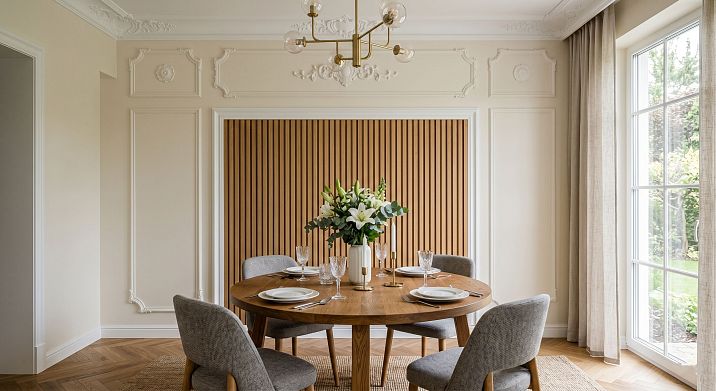
A dining table is not just furniture. It is a place where something important happens every day: morning coffee in silence, a noisy family dinner, a long conversation with a friend. And the wall that everyone sitting at the table sees is the backdrop for these moments. It either creates an atmosphere or destroys it.
The question is simple and at the same time not simple: how to make the wall near the table lively, cozy, and worthy — without overload, without extra costs, without mistakes? The answer that works in most modern apartments is:stucco decor for the dining area, wooden slats near the dining table, moldings, the right baseboard and ceiling cornice, which tie everything into a single system. Let's break this down without unnecessary words — clearly, to the point, with specific diagrams and examples.


Why the dining area needs its own decor
Open-plan layouts have changed everything. The kitchen flows into the living room, the living room into the dining room. The space gains in volume but loses in structure. Where does the kitchen end and the place for the table begin? Where is the boundary between the sofa and the dining group?
It is hereWall decor in the dining areabecomes not a decoration, but an architectural tool. It works without partitions and without extra square meters: wooden slats behind the dining table or a molding frame on the wall visually 'highlight' the place for the table — creating its boundaries without physical separation.
Moreover, the wall near the table is one of the most 'long-looked-at' surfaces in the apartment. During breakfast, lunch, and dinner, you look at it for hours each week. An unfinished, random, 'bare' wall in this context is not neutrality. It is a background irritation that intensifies with every meal.




Three tasks of a decorative wall at the table
First — zoning: the wall separates the dining group from the overall kitchen-living room space. Second — atmosphere: the natural texture of wood, the warm relief of moldings create a sense of coziness that cannot be achieved on a painted surface. Third — completeness: a baseboard at the bottom, a cornice at the top, slats or moldings on the wall itself — these are three points that make the wall a complete architectural object.
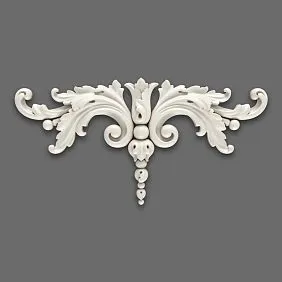
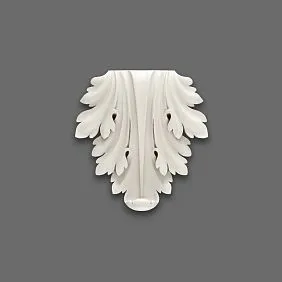
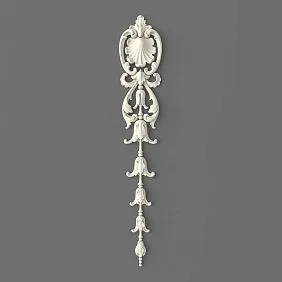
Our factory also produces:





Wooden slats for the dining area: six application scenarios
Get Consultation
The wall behind the dining table: the main backdrop
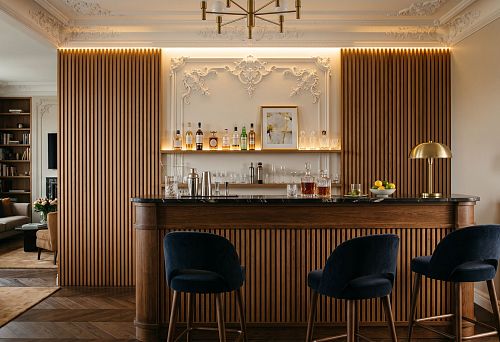
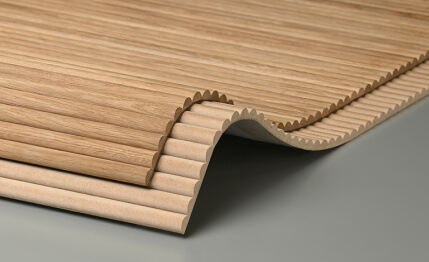
Wooden rails on the kitchen — and specifically on the wall behind the table — this is a scenario that works in apartments of any size. The vertical rhythm of the slats creates a sense of height and order. The natural texture of oak or beech brings warmth to a space where hard surfaces predominate: countertops, tiles, facades.
How to choose width and spacing? For a wall 2–3 m wide at the table, slats of 20–35 mm with a spacing of 30–50 mm are optimal. This is a "lively," rich rhythm that does not turn into chaos. For a wider wall — the spacing can be increased to 60–70 mm: the space between the slats becomes a full-fledged element of the composition.
The height of the slatted area depends on the concept. A full wall from baseboard to cornice — for minimalist, modern interiors. A panel up to a height of 140–160 cm — for spaces where you want to keep a light, "breathing" surface above.
The space between the kitchen and living room
In kitchen-living rooms, there is often a vertical pier — a narrow plane between the kitchen block and the dining area, or between the dining area and the sofa. This is a "transitional" wall without a specific function.Wooden slats in the kitchen-living room on this pier solve two tasks at once: they decorate the "no-man's" plane and create a visual boundary between zones.
Area near a display case or sideboard
If there is a sideboard, display case, or open shelves in the dining area, the wall section next to them is an ideal spot for a slatted accent.Wooden planks for decorationin the same shade as the furniture create a unified wooden field — the sideboard and wall become part of one wooden story.
Vertical accent next to the table
A full slatted wall is not always necessary. Sometimes a vertical accent fragment is enough — a narrow strip of slats to the right or left of the table. Such a detail works as a zone marker: it designates the table area without heavy decorative investments. It is especially suitable in small kitchen-living rooms, where a large slatted wall would overload the space.
Decorative panel behind a round or rectangular table
Rafter panelsmade of oak behind the dining table is a quick and effective solution. Ready-made panels with a fixed pitch are installed faster than individual slats and provide a more predictable result. For a round table — a slatted panel of the same width or slightly wider than the table diameter. For a rectangular table — a panel the width of the table or 15–20 cm wider on each side.
Slatted fragment in a kitchen-living room
A slatted fragment is a decorative island: a slatted panel of specific dimensions (e.g., 120×200 cm) mounted on the wall as an independent object. Without top or bottom constraints — just an expressive rectangle of wood on the wall. A modern, clean technique for those who do not want to cover the entire wall with slats.
Stucco decor and moldings near the dining table: five working schemes
A question many people have: can you combine wooden slats and moldings in one space without it looking cluttered? You can — if you know how.
Moldings as a frame around the dining area
A molding frame — a rectangular outline of profile tracing the wall near the table — is the most classic and universal technique.Moldings for the dining areain the role of a frame create an architectural "mat" for the space at the table. The frame says: "This is a zone. The table lives here." Everything else is the background.
Molding profile width: 30–50 mm for a small space, 50–80 mm for a high wall or spacious dining room.
Important detail: a molding frame in the color of the wall is "architecture without color." The frame is visible due to the shadow of the profile, not due to contrast. This is delicate and works in any style from modern to neoclassical.
Wooden slats in the center of the wall, moldings on the sides
The "sandwich" scheme: the central slatted area is the main accent. On its sides are vertical moldings marking the boundaries of the slatted panel. The moldings can be either wooden to match the slats or polyurethane in the color of the wall. In the first case — a unified wooden ensemble. In the second — a subtle architectural framing.
Decorative wooden moldingsmade of oak to match the slats create the effect of a built-in wooden panel — as if it were part of an expensive joinery interior.
Stucco decor in wall color: delicate relief
Polyurethane wall decorwith frame layout in the exact wall color — a technique of expensive design. The relief from the molding is visible only due to the side shadow: in daylight — barely noticeable, in directed evening lighting — expressive and rich. This solution works especially well in the dining area with a pendant light above the table: the evening cone-shaped light from the lamp creates a play of shadows on the relief moldings.
Vertical moldings for an elongated wall
If the wall at the table is elongated horizontally — long and low — vertical moldings visually correct its proportions. Narrow vertical profiles with a step of 50–80 cm create a rhythm that "stretches" the wall upward. In combination withwooden slats in the central zone— vertical moldings as side elements — the wall acquires a multi-layered structure.
Moldings around a mirror or painting above the table
A mirror, painting, or group of posters is often hung above the dining table.Moldings made of polyurethaneas a framing border around this decorative element create an "architectural accent within an accent." The mirror or painting acquires the status of a built-in architectural object — not just an item on the wall, but part of the interior system.
Ceiling cornice above the dining area: the top point of the system
A ceiling cornice in the dining area is an element that is thought about last. But it shouldn't be. It is the cornice that completes the vertical line of the wall at the table: slats or moldings "work" from below, the cornice covers them from above, creating a complete architectural vertical.
A wooden cornice matching the slats
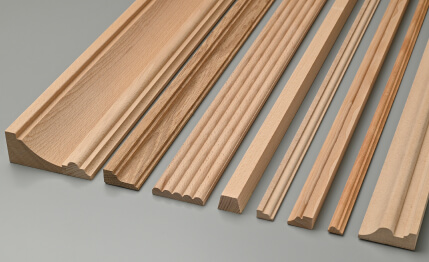
wooden corniceMade of solid oak above the dining area, it is a material rhyme to the slats on the wall. If the slats are natural oak, a cornice of the same oak creates a unified natural ensemble vertically.Wooden beamsFor dining areas, cornices are chosen with a moderate profile — without excessive ornamentation, but not completely straight either: a small ovolo or shelf gives the cornice an architectural character.
Polyurethane cornice in the color of the ceiling
polyurethane ceiling decorWhite cornices are a universal choice for most kitchen-living rooms. A white cornice on a white ceiling creates a clean transition without drawing unnecessary attention. This is especially important in the dining area: above the table, as a rule, hangs a light fixture — it is the main upper accent. The cornice in this case is an architectural background, not a competitor to the light fixture.
Molding instead of a cornice: a delicate solution for low ceilings
In kitchen-living rooms with a ceiling height of 2.5–2.7 m, a massive cornice is unnecessary.Moldings for walls and ceilingIn the format of a thin ceiling profile (30–45 mm), they delicately mark the transition from wall to ceiling without weighing down the space. This is especially relevant for kitchens: here the ceiling is often occupied by ventilation and technical ducts — extra cornice volume only adds to this burden.
Cornice matching the wall color
In dining areas with accent colored walls — dark green, anthracite, deep blue — a cornice in the color of the wall creates a monolithic upper perimeter. The wall reads as a single color field from baseboard to ceiling, with slats or moldings inside this field. This is a bold but very effective technique for dining rooms with character.
Cornice as a continuation of the overall kitchen-living room line
In open-plan layouts where the kitchen and living room form a single space, a cornice around the perimeter of the entire room connects all zones. In this case, there is no "separate" cornice above the dining area — it is part of the overall contour. This is an architecturally correct solution for large spaces.
Baseboard for the dining area: a lower line with character
The baseboard under the table is an element many consider insignificant. But it creates the lower contour of the wall at the table. And it is here that a small carelessness — wrong size, unsuitable color, poorly cut corner — catches the eye every time you sit down at the table.
MDF baseboard for a modern interior
MDF Skirting Board — a rational, technically flawless choice for most apartment kitchen-living rooms. Stable geometry, precise cutting for any angle, smooth surface for painting — all this makes installation simple and the result neat.
White MDF Skirting Board — for light dining areas with white or neutral walls. The white lower contour does not compete with wooden slats or moldings — it simply holds the lower line.
— is a horizontal element that frames the room at the bottom of the walls where the wall meets the floor. Skirting boards perform several functions: they hide the technological gap between the wall and floor covering (necessary for thermal expansion), protect the lower part of the wall from mechanical damage, create visual completion, and may conceal wiring. — for those who want an exact color according to RAL or NCS code. A baseboard in the color of the wall makes the lower contour "invisible": it exists but does not attract attention, leaving the main roles to slats and moldings.
Wooden baseboard for the dining area with slats
Wooden baseboard — from the same species as the slats — an organic continuation of the wooden theme at the floor. If the slats are natural oak, the baseboard is oak of the same tint. Wood below and wood on the wall — this is not repetition, it is a rhythmic rhyme that makes the space cohesive.
with a classic profile creates a sense of solidity, reliability. — in the dining area with parquet or solid wood flooring — the only correct solution: a baseboard made of the same material as the floor creates a seamless transition.
Wide wooden baseboard for the dining room and neoclassicism
Wide Wooden Skirting Board — 80–120 mm — for spacious dining rooms, country houses, kitchens with high ceilings and a classic character. The wide face plane of the baseboard gives the lower part of the wall solidity and scale — what in residential interiors is called a "luxurious sense of space."
In the manager's office, home library, or formal dining room — a wide wooden baseboard is not just a bottom line. It is an architectural statement.
Choosing a baseboard by dining area type
| Space type | Recommended skirting board |
|---|---|
| Modern kitchen-living room | White MDF baseboard, 60–80 mm |
| With colored walls | MDF for painting in wall color |
| With wooden slats, parquet | Wooden baseboard, same species |
| Dining room / neoclassical | Wide wooden baseboard, 80–120 mm |
| Japandi style | Thin wooden baseboard, 40–60 mm |
| Kitchen-living room with dark walls | MDF for painting in wall color |
Moldings, corners, and strips: perfect joints and edges
In the dining area, people sit close to the wall at the table. This means that details — joints, edges, corners — are much more visible than, for example, in the living room near the TV. It is here thatwood trim itemsthey perform their most important role: they make invisible what would catch the eye with careless installation.
Wooden corner for external corners
Wooden angleon external corners, where the slatted panel transitions to the adjacent wall — a clean vertical line covering the ends of the slats. In the dining area, where people come close to the wall, an unfinished corner with open ends looks rough.
A corner matching the slats creates the illusion of a monolithic wooden surface wrapping around the corner. A corner in white or a neutral color — a clear geometric boundary of the transition.
Wooden strip as a horizontal frame bar
Wooden blockat the top and bottom of the slatted area covers the ends of all vertical slats. Without it, the ends are open — in a well-lit dining area, especially with side lighting, this disrupts the impression of the decor. The horizontal strip also works as a decorative belt, separating the slatted area from adjacent planes.
A strip of the same width as the slats creates a unified "frame" for the slatted panel. A strip 40–60 mm wide with a profile — an independent horizontal accent.
Molding products for joints and connections
Trimming Itemsthey close all junctions of the slatted wall with adjacent surfaces: with the side wall, with the doorway, with the window slope, with the kitchen facade. In the dining area of a kitchen-living room, there are usually several such junctions. Each of them is a potential "gap" in the neatness of the interior.
Trim matching the slats creates a sealed system: wood on the outside, a technical gap with fasteners on the inside. No gaps, no exposed glue, no visible dowels.
Decorative molding for mirrors and paintings
Wooden molding — a thin frame profile — is used to frame a mirror, painting, or group of posters above the dining table. Combined with a slatted panel on the wall, the molding creates a unified wooden system: slats — texture, molding — frame. All from one material, in one shade, in one logic.
Five styles for the dining area: specific solutions
Kitchen-living room in a modern style
Light walls — white or warm light gray.Wooden slats in the kitchen-living roomon the wall behind the table — natural oak, width 25 mm, spacing 35 mm, full wall height. No moldings — only slats and clean planes.White MDF Skirting Board— 70 mm. Thin polyurethane cornice in white to match the ceiling.
Above the table — a minimalist metal pendant light. Result: a modern kitchen-living room where the wood of the slats is the only natural accent. Clean. Precise. Stylish.
Classic style dining room
Walls in a cream-beige shade.Decorative wooden moldingswith a frame layout — three to four rectangles along the entire wall near the table. Slats — on one wall, in a niche, or in the central rectangle of the frame.wooden cornicewith a moderate classic profile.Wide Wooden Skirting Board— 90–100 mm.
Above the table — a classic chandelier with incandescent or "retro" bulbs. Result: a cozy, noble dining room where every material speaks of solidity.
Neoclassical interior
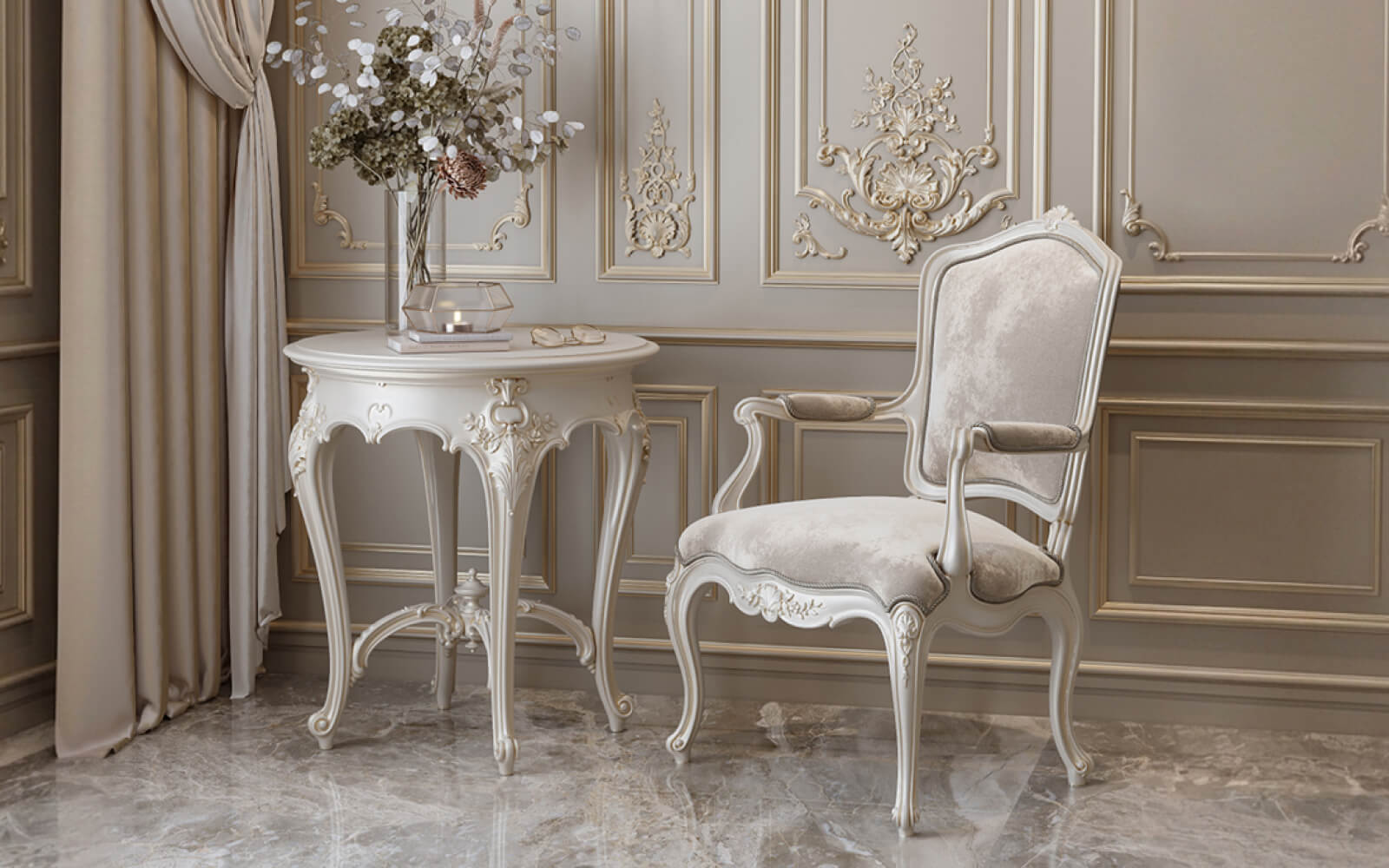
Walls in a rich neutral tone — dusty gray, warm beige, calm khaki.Polyurethane wall decorwith a frame layout in the wall color. Wooden slats — on the central wall, dark oak or walnut.wooden cornicewith an ovolo profile.Wooden baseboard— 80 mm, the same dark oak.
Result: a neoclassical dining area with the natural warmth of wood and the architectural restraint of moldings. Expensive, but without pretentiousness.
Scandinavian and Japandi interior
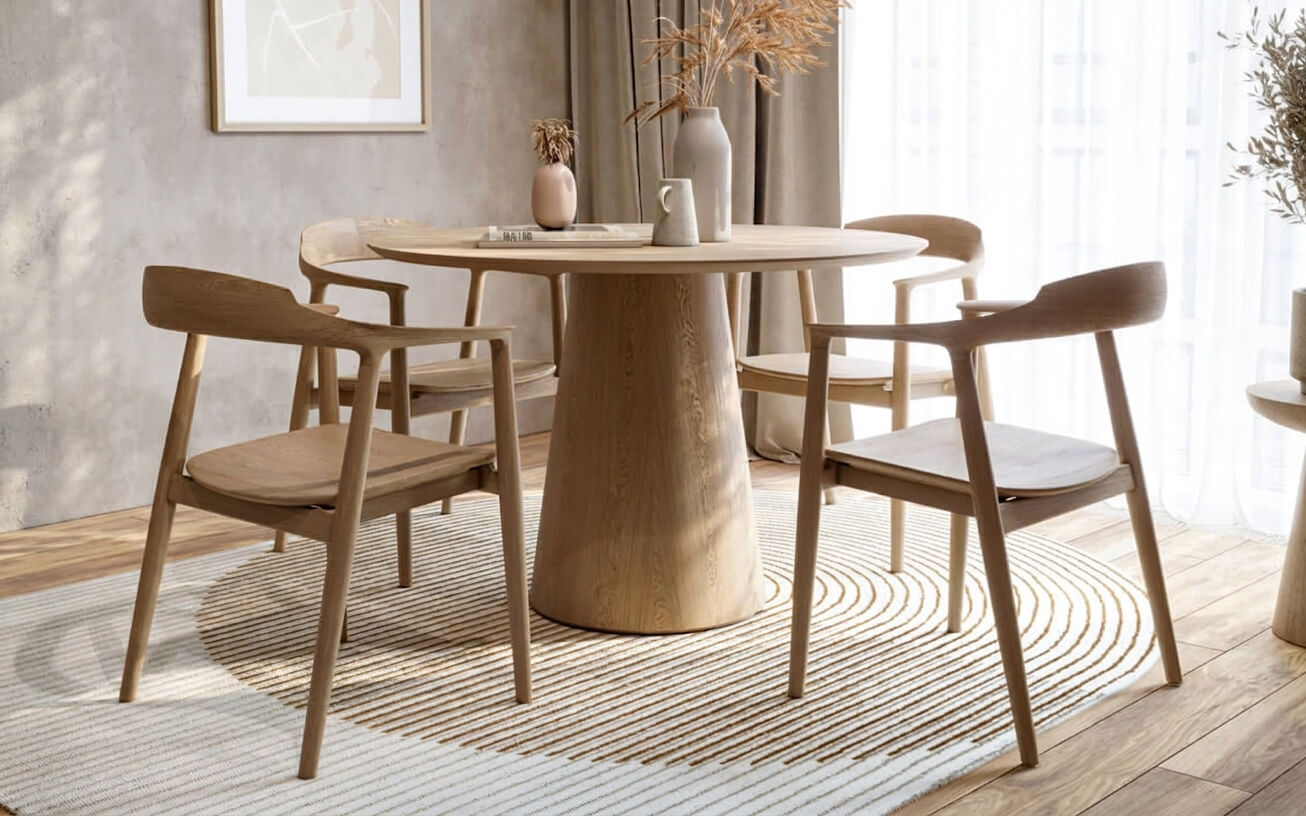
White walls, light oak parquet.Decorative wooden strip— bleached or natural light oak with a wide spacing: 30 mm slat, 50–60 mm spacing. No moldings, no stucco. A thin horizontal bar at the top and bottom of the slatted area.Wooden baseboard— 40–50 mm, light oak. Ceiling without a cornice or with a very thin 25 mm molding in white.
Result: a delicate, airy dining area. Minimum decor — maximum natural warmth.
Interior with dark accent walls
Dining area in dark green or anthracite color.vertical wooden slats— made of dark oak on the central wall — slats in the tone of the dark wall, almost blending into the background, but providing natural texture.Moldings made of polyurethane— with a frame layout in the wall color. Cornice in the same dark color.— is a horizontal element that frames the room at the bottom of the walls where the wall meets the floor. Skirting boards perform several functions: they hide the technological gap between the wall and floor covering (necessary for thermal expansion), protect the lower part of the wall from mechanical damage, create visual completion, and may conceal wiring.in the same shade.
Above the table — a matte lamp made of brass or copper. Result: a monolithic, dark, expressive dining area — bold, distinctive, memorable.
Seven mistakes when designing a dining area
Too frequent rhythm of slats on a small wall
Slats 15 mm with a step of 15 mm on a wall 1.5 m wide — this is a palisade. The space shrinks, the wall seems heavier. In a small kitchen-living room, increase the step between the slats — the space between them works for the wall's breathing.
Large stucco molding in a small kitchen
Polyurethane wall decorwith large ornamental elements — cartouches, garlands, rosettes — in a small kitchen-living room overload the space. For compact spaces: thin frame molding 30–50 mm, no voluminous decorative elements.
Gap between the wall and the baseboard
The lower edge of the slatted panel does not meet the baseboard — a strip of bare wall is visible between them. This is a rough installation error.Wooden blockfrom below, the slatted area should fit tightly against the top edge of the baseboard.
Missing top finish
The slats reach the ceiling — and just stop. Or they stop below the ceiling — without a limiting bar. In both cases, the top of the slatted area looks unfinished. A horizontal bar at the top or a ceiling cornice is a mandatory final element.
Exposed slat ends in view
In the dining area by the table, the open ends of the vertical slats — at the top, bottom, and sides — are visible to everyone sitting. This is not a small detail: it is precisely such details that create the feeling of an "unfinished" interior.
Mismatched wood shades
Light ash on the slats, dark walnut on the baseboard, and medium oak on the furniture — three different shades in one space. In a well-lit dining area, this looks like a set of unrelated materials. A single wood species or a single finish shade is the basic rule of material harmony.
Competition of three active elements
Large pendant light + active slatted wall + expressive molding stucco — three accents in one small area. Who is the main one? No one. The result is chaos. Choose one dominant element: either the slats, the stucco, or the light fixture. Everything else is background.
About the company STAVROS
For those creating a dining area — in an apartment, country house, or restaurant — STAVROS offers a full range of decorative elements capable of creating a cohesive, professional interior without extra investment.
In the STAVROS catalog for the dining area:Wooden planksfrom oak and beech array in various profiles and sizes,Rafter panelsfor quick installation,MDF Skirting BoardandWooden baseboardfor the lower contour of any style.
For ceiling finishing —wooden corniceandWooden beamsvarious profiles, as well aspolyurethane ceiling decorin a wide range. For architectural frames and relief —Decorative wooden moldings, Moldings made of polyurethaneandPolyurethane wall decor.
For precise and neat installation —Wooden angle, Wooden blockandwood trim items— everything needed for closing ends, corners, and junctions. The entire rangepolyurethane productsfor stucco decor — from thin moldings to decorative friezes.
About the technique of installing moldings — including complex corners and junctions in kitchen-living rooms — detailed in the article aboutinstalling polyurethane moldingson the STAVROS website.
FAQ: Frequently Asked Questions
How to highlight the dining area in a kitchen-living room without a partition?
Wooden slats on the wall behind the table are the most effective and affordable method. A slatted wall visually defines the "table area" without physically dividing the space. A molding frame on the same wall enhances the accent.Wooden baseboardorMDF and a cornice complete the vertical zone.
How many slats are enough for the wall behind the table?
For a wall 2–2.5 m wide — 40–60 vertical slats 20–25 mm wide with a spacing of 35–45 mm. For a wider wall, the spacing increases proportionally. Rule: the width of the slat and the width of the gap should be proportionate — then the rhythm reads clearly without creating chaos.
Can wooden slats and moldings be combined in the dining area?
Yes, with proper role distribution. Slats — on one plane (the main wall behind the table). Moldings — on adjacent walls or as a frame around the slatted area. They don't compete but complement: wood creates texture, moldings provide architectural order.
Which cornice is suitable for a small kitchen-living room?
A thin molding 30–45 mm in the color of the ceiling. It marks the transition from wall to ceiling without reducing the already low room height. A massive cornice with a 2.5 m ceiling is a mistake: it visually "lowers" the ceiling.
How to design the wall for a round table?
A slatted panel the same width as the table diameter, or slightly wider. A molding frame around the panel perimeter. Above the table — a round or oval pendant light with a diameter matching the table diameter or slightly smaller. The baseboard and cornice are uniform across the entire wall.
Do you need a special baseboard for the dining area?
Special — no. But a suitable one — definitely. In the area with wooden slats — a wooden baseboard in the same wood species. In the area with painted walls — an MDF baseboard for painting in the same color or white MDF. The main thing: the baseboard should be part of the system, not a random leftover of building materials.
How to close the ends of wooden slats in the dining area?
A horizontal block of the same solid wood — above and below the slatted area. On external corners — a wooden corner piece in the same tone. At junctions with adjacent walls, doors, facades — linear products in the same tone as the slats. These are three mandatory elements for a neat installation of a slatted wall.