








































Article Contents:
- The hall as a business card: why the decoration of common areas affects apartment prices
- Requirements for the decoration of public areas: beauty that lasts
- Wooden slats in the elevator hall: where and how they work
- The wall opposite the elevators: the main plane of the hall
- The wall at the elevator doors
- Entrance group of the residential complex: from the door to the elevator
- Waiting area by the elevator
- Corridor of a club house and apartment hall
- Wall with navigation and floor number
- Slat parameters for public areas: practical recommendations
- Stucco decor and moldings in the lobby: architectural language without overload
- Moldings in wall color: invisible depth
- Moldings around the elevator door area
- Moldings around the mirror
- Horizontal molding band
- Stucco decor for the upper part of the wall
- Ceiling cornice for the elevator lobby: upper boundary of the space
- Thin polyurethane cornice: a universal solution
- Wooden cornice for a club house
- Light shelf near the ceiling
- Cornice for low ceilings
- Baseboard for elevator hall: lower line under load
- MDF baseboard for public areas
- Wooden baseboard for a club house
- Wide wooden baseboard for a premium entrance group
- Molding in the elevator hall: durability built into details
- Wooden corner guard for protecting edges and corners
- Wooden block as a load-bearing base
- Linear products for the system
- Ready-made design schemes for public areas
- Scheme 1: Modern residential complex — slats near the elevator, MDF baseboard, lightweight cornice
- Scheme 2: Club house — wide baseboard, moldings, wooden cornice
- Scheme 3: Apartments — slats, mirror, moldings in wall color
- Scheme 4: Business center — strict slats, straight baseboard, minimal cornice
- Scheme 5: Premium entrance group — stucco decor, frames, high baseboard, perimeter cornice
- Material combinations: principles for public spaces
- Mistakes in elevator hall design: an honest review
- FAQ: questions and answers about designing elevator halls and entrance groups
- STAVROS: a system solution for elevator lobbies and entrance groups
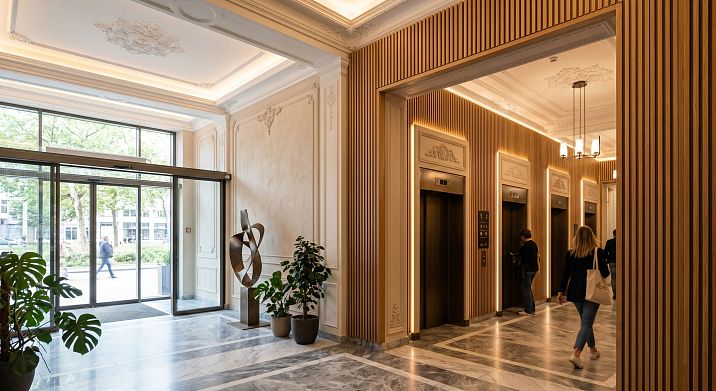
There are places that a person sees every day but does not notice. The elevator lobby. The corridor between floors. The entrance group of a residential complex. These spaces are not "no man's land." They are the first and last thing a resident sees when leaving for work and returning home. They are the backdrop that shapes the feeling of home — silently, day after day.
That is why developers, management companies, and club house developers have stopped treating common areas as a bare minimum. Today,wooden slats for the elevator lobby, moldings, baseboards, cornices, and stucco decor in the entrance group are an investment in the capitalization of the property, in resident loyalty, and in a competitive position in the real estate market.


The lobby as a business card: why MOP finishing affects apartment prices
The abbreviation MOP — common areas — has become an important term in developer marketing. The quality of MOP is increasingly cited in residential complex advertising materials as an argument for price class.
Why? Because a home buyer visits several properties during the selection process and reacts emotionally to entrance groups even before seeing the apartments themselves. A well-maintained, architecturally designed lobby is a psychological argument that shifts the buyer into a positive perception mode right at the doorstep.
For a club house, business-class apartments, or a residential complex aiming for the premium segment —Stucco decor for the entrance groupwooden slats in lobbies are not an option, but a standard.




Requirements for finishing public areas: beauty that lasts
Before talking about specific materials, it is necessary to establish the main difference between a public area and a living space: traffic. An elevator hall in a building with a hundred apartments sees several hundred passes per day. The entrance group sees even more. The decor here must withstand not only visual load but also physical wear.
Key requirements for finishing public areas:
-
Wear resistance: hard wood species, durable coatings, protected edges and corners
-
Repairability: ability to replace a single element without dismantling the entire system
-
Neutral decor: a style not tied to seasons, brands, or fashion trends — relevant for at least 10–15 years
-
Neat corners and joints: contact areas are coveredwooden corner pieceswith profiles
-
Unified system: slats, baseboards, cornices, and moldings are coordinated as a single solution
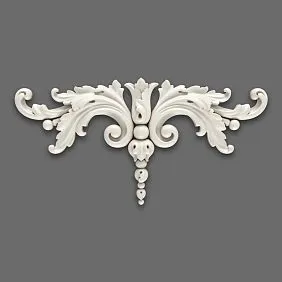
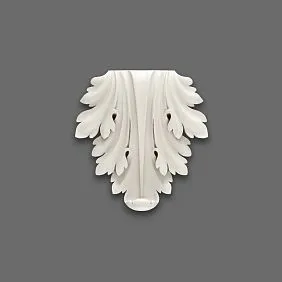
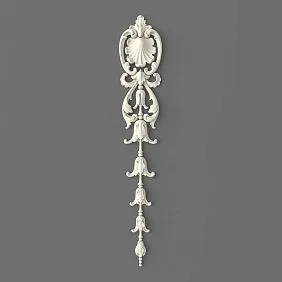
Our factory also produces:





Wooden slats in the elevator hall: where and how they work
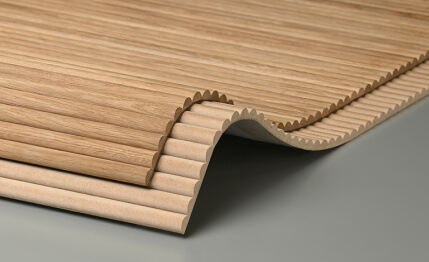
Wooden slats for the entrance group— the most sought-after decorative solution for common areas in modern residential complexes. Why? Because they provide a neutral yet textured backdrop that does not age, is not tied to a specific style, and is well received by people with different tastes.
Get Consultation
Wall opposite the elevators: the main plane of the lobby
The wall directly opposite the elevator doors is the plane that every person looks at while waiting. Here time passes more slowly—and the gaze lingers. This wall should be decoratively designed.
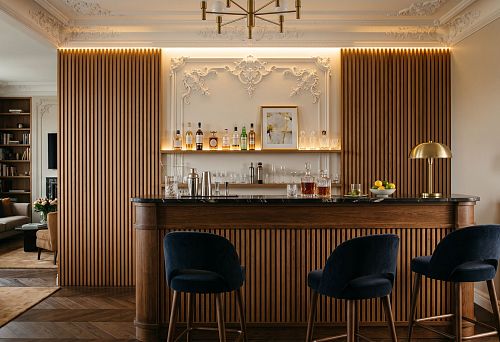
vertical wooden slatscovering the entire height of the wall opposite the elevator is a win-win solution. The rhythmic vertical structure calms the eye, creates a sense of height and order. A mirror in a molding frame in the center of the slatted wall adds space and an architectural focal point.
Wall near the elevator doors
The side walls near the elevator doors are subject to the greatest load: people lean against them, accidentally hit the corner, place bags.Rafter panelson the side walls near the elevator is a durable and decorative solution at the same time. The panels cover part of the wall, create structure, and reliably withstand everyday loads.
On the side walls, slatted panels are installed up to a height of 120–150 cm—the so-called kick zone. Above—a neutral painted wall or a molding scheme.
Entrance group of the residential complex: from the door to the elevator
The path from the entrance door to the elevator is a few meters that a resident walks several times a day. Consistency is key here: the decor of the entrance group should logically flow into the decor of the lobby.Wooden slats for the lobbyat the concierge area, by the wall with the information desk, near the niche with mailboxes — these are architectural accents that mark 'points of interest' within the space.
Waiting area by the elevator
In club houses and apartments, a small waiting area is often arranged near the elevator zone — an armchair or bench, sometimes a small table.Wall decoration with wooden slatsbehind the waiting area creates a warm, cozy backdrop — the functional space becomes a place where it is comfortable to be.
Corridor of a club house and lobby of apartments
A long corridor is an acoustically and visually unpleasant space.Wooden planks for decorationon the long walls of the corridor create a rhythm that visually 'breaks up' the monotony. The shadow stripes from the slats add depth to the flat wall. The corridor ceases to be just a passage — it becomes a space with character.
Wall with navigation and floor number
Navigation block — apartment number plates, floor plan, number — is often mounted on a separate panel.Wooden slats for the entrance groupas a background for the navigation block, the functional element becomes part of the interior design: the navigation is not "screwed to the wall" but integrated into the architectural context.
Slat parameters for public areas: practical recommendations
| Space type | Batten width | Step | Tinting | Finish |
|---|---|---|---|---|
| Elevator lobby of a mass-market residential complex | 30–40 mm | 15–25 mm | Light oak, neutral | Varnish, 3 coats |
| Lobby of a club house | 35–50 mm | 20–30 mm | Dark oak, walnut | Oil + wax |
| Business-class apartments | 40–60 mm | 25–35 mm | Oak, tobacco stain | Hard lacquer |
| Business center | 25–40 mm | 15–25 mm | Neutral, gray-beige | Matte varnish |
| Premium entrance group | 50–70 mm | 30–45 mm | Dark walnut, wenge | Oil, 4 layers |
Stucco decor and moldings in the lobby: architectural language without overload
A public space is a place where decor should work for a neutral architectural image, not for a bright artistic statement.Stucco decor for the elevator hallis more of an architectural system than an ornament.
Moldings in wall color: invisible depth
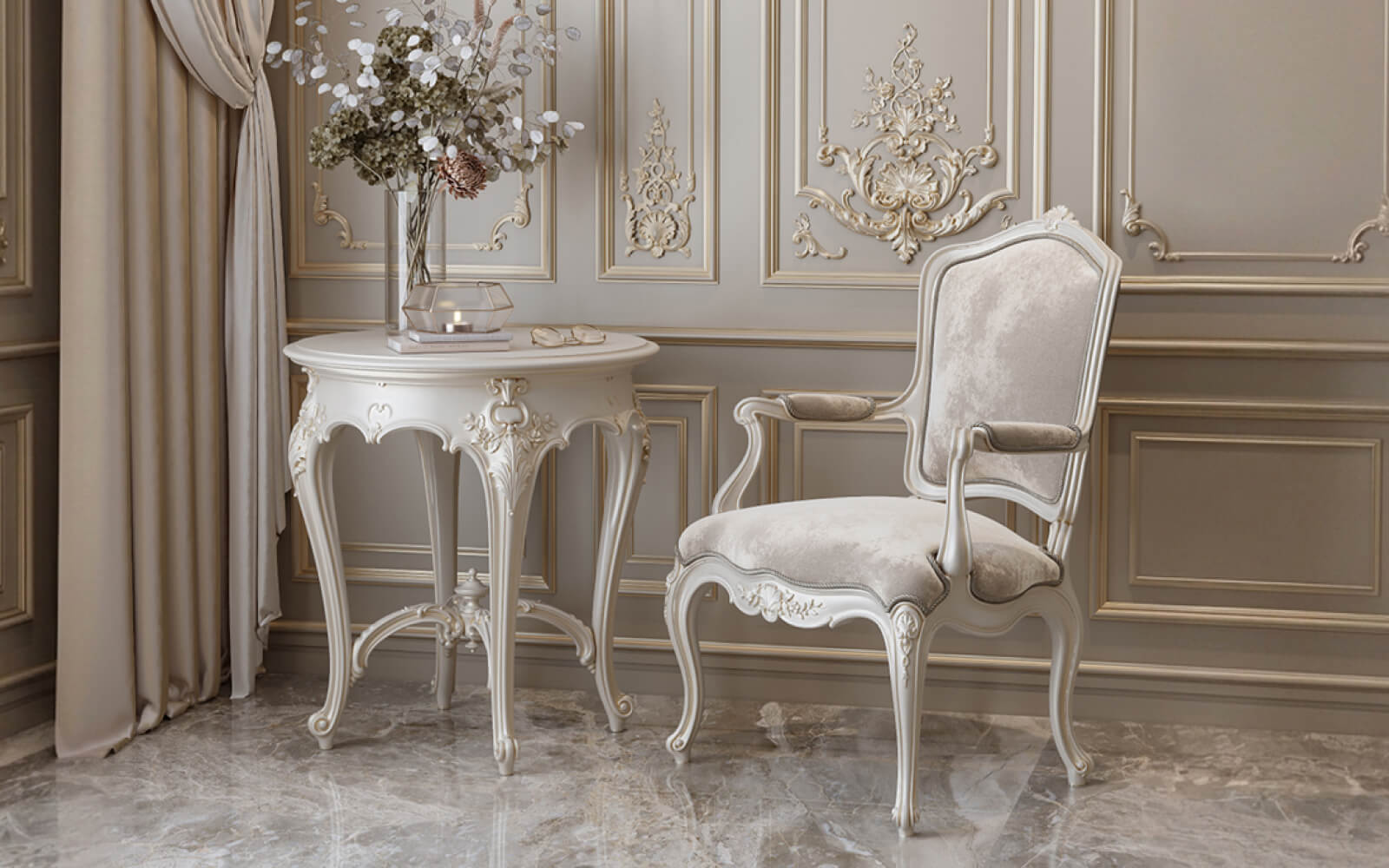
The main technique for public areas isMoldings made of polyurethanein the color of the wall. They create a relief pattern — frame panels, vertical stripes, horizontal bands — without color contrast. The wall is perceived as a three-dimensional architectural plane, not a flat painted surface.
For a hallway, this is ideal: there is decor, it is perceived as quality, but at the same time it does not distract or impose itself.
Moldings around the elevator door area
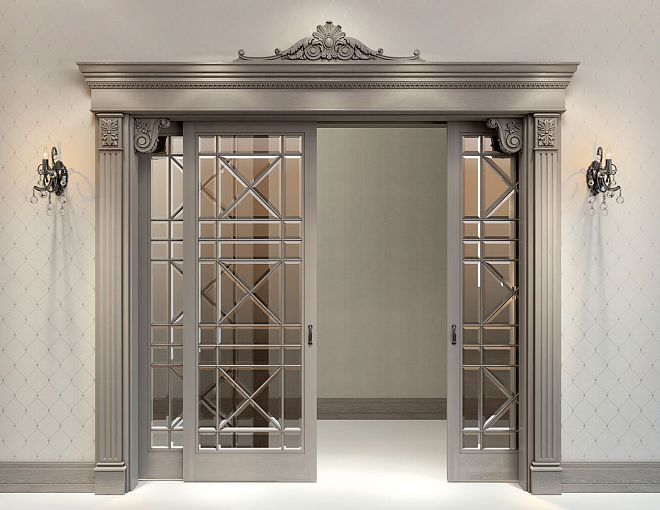
Moldings for the entrance grouparound the elevator doors — this is a portal frame. A molding frame around each elevator door turns a functional opening into an architectural element. Elevators are perceived not as technical objects inserted into the wall, but as part of a well-thought-out spatial composition.
The molding is chosen with a moderate profile — 30–60 mm, in the color of the wall or in a neutral contrast.
Moldings around the mirror
A mirror in the elevator hall is a standard element. A mirror in a molding frame is already an author's solution.Stucco decor around the mirrorin the hallway creates the main wall accent: an object with visual weight that attracts the eye and makes waiting for the elevator comfortable.
For a club house — a classic rectangular molding frame. For a business center — a minimalist thin profile.
Horizontal molding belt
A horizontal molding belt at a height of 120–140 cm divides the hall wall into a lower impact zone (where the finish experiences mechanical loads) and a clean upper zone (where loads are fewer). This is functionally justified decor: the lower zone can be finished with durable materials —plank panels, the upper zone with a molding scheme.
Stucco decor for the upper part of the wall
The upper part of the hall wall is an area of minimal mechanical loads, but an area of maximum visual expressiveness with high ceilings.Polyurethane wall decor in the form of frame panels in the upper frieze belt adds a sense of "height" architecture to the hall — especially effective with ceilings from 3 meters.
Ceiling cornice for the elevator hall: the upper boundary of the space
The transition from wall to ceiling in the elevator hall is one of the most noticeable horizontal lines of the space. Lighting changes constantly here (lamps, natural light through glazing), and this line is visible from any viewing angle.
Thin polyurethane cornice: a universal solution
polyurethane ceiling decorin the form of a thin cornice around the perimeter of the hall — the safest choice for most types of residential complexes. A profile 50–80 mm high, matching the color of the ceiling or wall, covers the joint and completes the space without unnecessary pomp.
A polyurethane cornice is installed quickly, requires no special tools, and paints well — which is important when needing to refresh the color during subsequent renovations.
Wooden cornice for a club house
wooden cornicein the hall of a club house or apartment — a continuation of the wooden slat and baseboard system.Wooden beamswith a profiled section are selected to match the tint of the slats — so the ceiling line becomes part of a unified wooden system, rather than a separate element.
For halls with ceilings from 3 m — a cornice with an overhang of 60–80 mm adds monumentality. For standard ceilings of 2.7–2.8 m — a lightweight cornice with a moderate profile.
Light shelf at the ceiling
In halls of apartments or club houses with hidden lighting —wooden cornicecan serve as a light shelf: an LED strip is hidden behind the cornice, illuminating the ceiling with soft diffused light. This creates atmospheric lighting in the hall without ceiling fixtures in the cornice area.
Cornice for low ceilings
For elevator halls with ceilings up to 2.7 m, a massive cornice is absolutely unsuitable. It visually "presses down" on the space and creates a feeling of crampedness. Only a thin profile of 30–50 mm or a complete absence of a cornice with neat puttying of the joint works here.
Baseboard for the elevator hall: the lower line under load
In the elevator hall, the baseboard is the zone of maximum contact. It is hit by suitcase wheels, carts with goods, children's bicycles and scooters, and cleaning equipment. A beautiful baseboard not designed for such a load will become unusable within a few months.
MDF baseboard for public areas
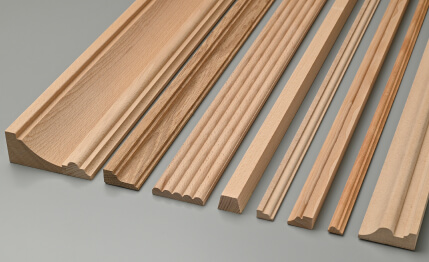
MDF Skirting Board — a practical and economically justified choice for most public areas of residential complexes. The main advantage is the possibility of painting: — is a horizontal element that frames the room at the bottom of the walls where the wall meets the floor. Skirting boards perform several functions: they hide the technological gap between the wall and floor covering (necessary for thermal expansion), protect the lower part of the wall from mechanical damage, create visual completion, and may conceal wiring. allows you to set the exact color, coordinated with the corporate finishing standard of the residential complex or the design concept.
White MDF Skirting Board — for bright halls with neutral walls. Creates a clear lower line without emphasis.
An important practical point: an MDF baseboard in a high-traffic area must have additional protective coating on the ends and in the area of contact with the floor — transparent polyurethane varnish in two to three layers.
Wooden baseboard for a club house
If the hall uses wooden slats for the elevator lobbyThe baseboard must be wooden — of the same species, the same tint.to buy wooden baseboardOak is the right choice for a club house: oak is hard, resistant to impacts and abrasion, and noble in appearance.
Wooden baseboardIn the hall with a wooden finishing system, it completes the vertical plane of the wall from below — just as a cornice completes it from above.
Wide wooden baseboard for a premium entrance group
Wide Wooden Skirting BoardFrom 80–100 mm in height in a hall with high ceilings and rich finishes — this is a monumental lower line that adds architectural weight. In premium entrance groups, a wide baseboard is the standard: it is perceived as a sign of quality and expensive finishing.
Molding in the elevator hall: durability is built into the details
In public areas, less attention is paid to details than in living spaces. And that's a mistake — it's the details that determine how long the finish will look "new."
Wooden corner piece for protecting ends and corners
Every exposed external corner in the elevator hall is a potential damage zone. The end of a slatted section, the corner of a decorative panel, the junction with a doorway — all of this needs protection.Wooden angleMade of hardwood, it is installed on all exposed ends and external corners of decorative wooden structures.
The corner must be of the same species and tint as the main wooden elements. Metal protective corners are an alternative for high-traffic areas (at the entrance door, near the elevator): they are stronger but coarser aesthetically.
Wooden block as a load-bearing base
Wooden block — a load-bearing system for installing slatted panels in a public area. Horizontal bars are attached to the load-bearing wall (considering engineering communications), and slats are fixed to them. A proper load-bearing system ensures precise geometry and the ability to remove a single slat for repair without dismantling the entire panel.
In a public area, the block must be made of a hardwood species — oak or birch — with an antiseptic impregnation: humidity in elevator lobbies is higher than in residential spaces, especially in winter when snow and moisture are brought in from the street.
Linear products for the system
wood trim items — this is all horizontal and vertical profile material that ensures clean junctions: between the slatted panel and the baseboard, between the panel and the molding, between the wall and the door frame.
Systematically selectedWooden trim — this is the difference between "done professionally" and "assembled from different materials." In a public area, this is especially noticeable: dozens of people a day see the joints and junctions, and their quality shapes the overall impression of the finish.
Ready-made schemes for designing public areas
Scheme 1: Modern residential complex — slats near the elevator, MDF baseboard, light cornice
For: comfort-class residential complexes, new buildings with a neutral design code.
-
Wall opposite the elevators:vertical wooden slatslight oak — covering the entire height of the wall
-
Piers at elevator doors:Rafter panelsup to a height of 140 cm
-
Skirting board:— is a horizontal element that frames the room at the bottom of the walls where the wall meets the floor. Skirting boards perform several functions: they hide the technological gap between the wall and floor covering (necessary for thermal expansion), protect the lower part of the wall from mechanical damage, create visual completion, and may conceal wiring.in the color of the walls — neutral lower line
-
Cornice: thinpolyurethane ceiling decorin the color of the ceiling
-
Ends of slatted panels:Wooden corner piecesin the tint of the slats
Result: a clean, modern lobby with a warm wooden accent. Neutral, timeless.
Scheme 2: Club house — wide baseboard, moldings, wooden cornice
For: club houses with 20–50 apartments, business-class housing, apartments.
-
Wall opposite the elevators: slatted section of dark oak with a mirror in awooden molding frame
-
Side walls of the hall: frame molding panels made ofof polyurethane moldingsin the color of the walls
-
Baseboard: widewith a classic profile creates a sense of solidity, reliability.of oak, 80–100 mm
-
Crown molding:wooden cornicearound the perimeter to match the tone of the slats and baseboard
-
Molding:Wooden corner pieceson all external corners,stripsas a load-bearing base
Result: a rich, prestigious hall with systematic wooden finishing — slats, baseboard, cornice in a unified tone.
Scheme 3: Apartments — slats, mirror, moldings in wall color
For: apartment complexes, rental buildings, serviced apartments.
-
Wall opposite the elevators:Rafter panelsof ash in neutral tinting
-
Mirror: built into the slatted section withpolyurethane moldingin the color of the slats
-
Corridor walls: molding frames in the color of the walls — boiserie without color contrast
-
Skirting board:Wooden baseboardof ash in the tint of the slats
-
Edges and junctions:wood trim items
Result: a minimalist, modern yet lively interior with natural materials.
Scheme 4: Business center — strict slats, straight baseboard, minimal cornice
For: office and commercial buildings, B+ and A class business centers.
-
Wall by the elevators:Wooden planksin a neutral gray-beige tint — a strict corporate look
-
Moldings: only around elevator doors — as a functional portal
-
Skirting board:MDF Skirting Boardin the same neutral tone — the cleanest bottom line
-
Cornice: thin polyurethane profile or absent
-
Slat ends:Wooden corner piecesor metal protective profiles
Result: a strict, professional lobby without excessive decor — maximum order, minimum ornament.
Scheme 5: Premium entrance group — stucco decor, frames, high baseboard, perimeter cornice
For: residences, penthouse floors, urban mansions, de luxe club real estate.
-
Walls:Polyurethane wall decor— frame panels in wall color, frieze belt at the top
-
Mirrors: in rich wooden frames made ofwooden decorative moldings
-
Elevator doors:stucco decor around— a molding portal with profiled framing
-
Baseboard: wideWooden baseboardfrom 100 mm of dark oak or walnut
-
Crown molding:Buy wooden crownwith a classic profile — along the entire perimeter, matching the baseboard and wooden details
-
Ceiling:polyurethane ceiling decor— a medallion or rosette in the central part
Result: a full-fledged architectural interior of the hall, competing with private homes in terms of finishing class.
Combination of materials: principles for public space
A few practical principles that work for all types of halls and entrance groups.
The principle of unified tinting. All wooden elements — slats, baseboards, cornices, corners, bars — must be of the same wood species and the same tint. Even a slight difference in shade in a high-traffic space is perceived as carelessness.
The principle of decreasing load. The lower zone of the wall (0–140 cm) experiences maximum mechanical load. Here — durable slats or slatted panels with a hard coating. The upper zone (above 140 cm) — moldings, decor, thinner elements.
The principle of neutral color. In common areas of residential complexes, the decor should be neutral: wood in a natural tone or with very moderate tinting, walls in light neutral shades. Bright colors quickly become tiresome with daily contact.
The principle of maintainability.Wooden planks, mounted onwooden bars, allow replacement of an individual element. This is important for common areas: over 10 years of operation, several slats may need replacement, and it should not turn into a full renovation.
Mistakes in elevator hall design: an honest analysis
Using too fragile finishes in a high-traffic area. Plaster moldings without additional protection, unprotected soft wood (pine without coating), thin MDF near the entrance door — all of this quickly deteriorates. In a common area, the hardness of the material is more important than its aesthetics.
Do not seal the ends of wooden slats. An open end of a slat in a high-traffic area is a zone that will start splitting within six months.Wooden angleSealing every open end is not an option, but a requirement for commercial operation.
Forgetting the baseboard near the elevator area. A wall without a baseboard in the hallway will show a dark strip at the base within a few months: dust, shoes, cleaning equipment. The baseboard covers this joint and allows easy cleaning of the floor-wall junction.
Installing a too-massive cornice with a standard ceiling. A classic profile cornice of 150+ mm in a hallway with a 2.7 m ceiling creates a feeling of a lowered ceiling. Here, a lightweight profile up to 60–70 mm is needed.
Mixing several shades of wood. Dark slats + light baseboard + another tint of the cornice — these are three 'wood stories' without consistency. In a public space seen by all residents, this looks like a lack of design concept.
Not coordinating doors, baseboard, slats, and cornice. If apartment doors are dark, slats are light, baseboard is white, cornice is gray, then the space falls apart into fragments. The design concept must consider all permanent elements of the hallway.
Making decor beautiful but inconvenient for cleaning. Deep slats with narrow gaps between them — beautiful but hard to clean. A massive cornice with a large relief near the ceiling — dust collects in the profile and is visible under overhead light. In a public zone, ease of cleaning is as much a requirement as aesthetics.
FAQ: Questions and answers about designing elevator halls and entrance groups
Which wooden slats are the most durable for an elevator hall?
Slats made of oak or ash with a hard varnish coating in 3–4 layers. Oak is the optimal choice in terms of hardness, aesthetics, and availability. The coating must cover all surfaces, including the ends.Buy wooden skirting boardmade of oak with a factory coating — a ready-made solution that does not require additional processing on site.
Is stucco decoration needed in a standard comfort-class residential complex, or is it only for premium housing?
Moldings made of polyurethaneavailable in wall color in terms of price and installation — and are quite applicable in comfort class. A thin molding as a frame around a slatted section or as a horizontal belt at a height of 140 cm is a small detail that makes the finish noticeably higher quality. Decoration does not have to be expensive to be appropriate.
Can wooden slats be used in an elevator hall without lighting?
Yes. Wooden slats work even without lighting — due to the texture of the wood itself and the shadows from the surface relief. Lighting enhances the effect but is not mandatory. If the hall has side or directional lighting, the slats will receive natural emphasis without additional costs.
How often does the finish in the elevator hall need to be updated?
With proper selection of materials and coatings — full restoration will not be required for 7–10 years. Wooden slats with hard varnish, oak baseboard, protected corner pieces at the ends — all of this is designed for a long service life. Cosmetic updates (touch-up painting of the baseboard, wiping the slats with special compounds) are carried out during routine work by the management company.
How to choose the right baseboard for the hall if the finish has not yet been determined?
Start with the wood species and tinting of the slats — the baseboard is selected to match them. If the slats are light oak —Wooden baseboardmade of light oak or— is a horizontal element that frames the room at the bottom of the walls where the wall meets the floor. Skirting boards perform several functions: they hide the technological gap between the wall and floor covering (necessary for thermal expansion), protect the lower part of the wall from mechanical damage, create visual completion, and may conceal wiring.in tone. If the design concept assumes a neutral background without accents —White MDF Skirting Boardand slats in a light neutral tint.
How to design the elevator door area with moldings without violating fire safety requirements?
Moldings made of polyurethaneand wooden moldings are mounted on the wall around the elevator opening — not on the elevator doors or inside the shaft. Fire safety requirements apply to elements inside the shaft and to the doors themselves, but not to the decorative wall finishing of the hall next to the doors. When developing the project, it is necessary to coordinate finishing solutions with the designer.
STAVROS: a system solution for the elevator hall and entrance group
An elevator hall is not a single element, but a system. Slats, slatted panels, moldings, baseboards, cornices, corners, bars, and linear profiles must be coordinated with each other. Disparate materials from different manufacturers yield different results — and this is always noticeable.
STAVROS produces a full range of wooden and polyurethane products for finishing public areas — in coordinated tints and profiles, allowing the creation of a unified decorative system from baseboard to ceiling cornice.
Everything needed for the elevator hall and entrance group:
-
Wooden planks— for accent walls, the area near the elevator, and corridors
-
Buy wooden skirting board— with a choice of wood species, cross-section, and tint
-
Rafter panels— for quick installation on large surfaces
-
Decorative wooden moldings— for frames, portals, and mirror trims
-
Moldings made of polyurethane— for boiserie and decor matching the wall color
-
Polyurethane wall decor— for panel frames and frieze bands
-
polyurethane ceiling decor— lightweight cornices to complete the top line
-
wooden corniceandWooden beams— for club houses and premium class
-
MDF Skirting Board— practical bottom line for most types of residential complexes
-
Wooden baseboard— for wooden systems and premium housing
-
Wooden angle— protection of ends and external corners
-
Wooden block— load-bearing base for slatted structures
-
wood trim items — system solutions for all joints and junctions
-
Polyurethane Items— the entire range of stucco decor
The entrance group and elevator hall are what people see every day without thinking about it. The task of good finishing is to make this space always look like "self-evident quality". STAVROS creates exactly this kind of quality — systemic, durable, and consistent.