








































Article Contents:
- Why a book wall requires a special approach to decor
- Where wall decor with a bookcase and shelves is used
- Home office: the library as an architectural statement
- Living room: a bookcase next to a sofa, TV area, or fireplace
- Bedroom: a small library and reading area
- Hall with shelves and display niches
- Children's and teen's room: lightness without heavy stucco
- Basic schemes for decorating a book wall with moldings
- Scheme 1. Perimeter framing of the bookcase
- Scheme 2. Background frames between open shelves
- Scheme 3. Top decorative line above the library
- Scheme 4. Vertical moldings on the sides of the shelving unit
- Scheme 5. Decorative panel behind open shelves
- Scheme 6. Design of the adjacent area next to the library
- How to choose moldings for a bookcase and shelves
- Table for selecting profile width
- Color solutions for moldings on a book wall
- Moldings in wall color
- Moldings in furniture color
- White moldings on a colored wall
- Dark walls and expressive moldings
- Contrasting moldings
- Styles for decorating a book wall with moldings
- Neoclassicism
- Neoclassic Light
- Jatoba
- English study
- Modern classicism
- Versailles Light
- Installation of moldings on a book wall: rules and sequence
- Before starting work
- Installation sequence
- Mistakes when decorating a wall with a bookcase
- What to buy for decorating a book wall
- Frequently Asked Questions
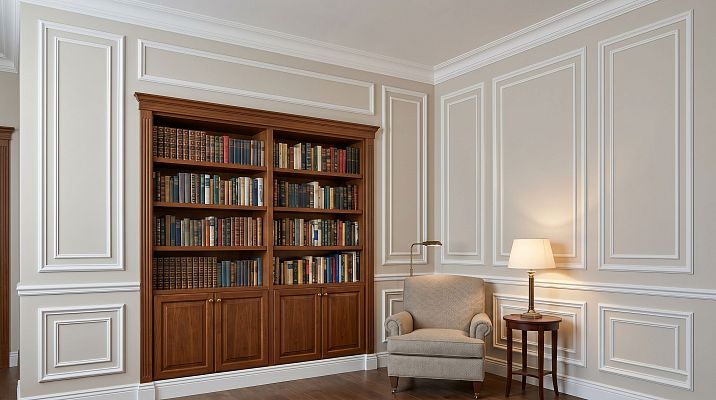
Books themselves are already decor. Spines of different shades, different heights of volumes, the lively rhythm of the shelving — all of this works. But there is a fundamental difference between a wall where there are just bookshelves and a wall where the library is part of the room's architecture. In the second case, the interior breathes differently — it has order, scale, intentionality. And it is polyurethane moldings that turn the first option into the second.
Stucco decor for a wall with a bookcase— это не дополнение к библиотеке, а архитектурный каркас, который удерживает всю зону: шкаф, полки, стену, плинтус, карниз, бра и кресло для чтения — в единой системе. Без этого каркаса даже дорогой встроенный шкаф остаётся предметом мебели. С ним — становится частью пространства.
Эта статья — практическое руководство по оформлению книжной стены полиуретановыми молдингами. Со схемами, размерами, цветовыми решениями и стилевыми разборами. Для кабинета, гостиной, спальни и холла.
Книжный шкаф, открытые полки или домашняя библиотека выглядят значительно дороже, если стена вокруг них оформлена не случайно, а как единая архитектурная композиция.Polyurethane wall decorSTAVROS помогает связать мебель, стену, плинтус и карниз в цельное решение.


Почему книжная стена требует отдельного подхода к декору
Задайте себе честный вопрос: почему одни библиотечные зоны смотрятся как интерьер из журнала, а другие — как просто полки с книгами? Ответ редко кроется в цене самого шкафа. Дело в контексте — в том, что происходит вокруг.
Книжный шкаф или открытые полки занимают, как правило, значительную часть стены — иногда всю её. Это означает, что стена перестаёт быть самостоятельным элементом: она поглощена мебелью. Но мебель — не архитектура. У неё нет связи с потолком, нет диалога с плинтусом, нет отношения к соседней стене. Она просто стоит.
Молдинги для стены с книжным шкафомустанавливают эту связь. Горизонтальный молдинговый пояс над шкафом продолжает линию карниза. Вертикальные профили по бокам стеллажа подчёркивают его высоту и дают стене архитектурные границы. Рамки из молдингов на незанятых участках стены — над шкафом, сбоку от него, на соседней панели — превращают всю зону в систему.
Полиуретан как материал для такой работы — выбор безусловный. Он лёгкий: погонный метр широкого профиля весит меньше 300 граммов. Он не деформируется от сухого воздуха — что важно именно в зонах с книгами, где воздух нередко суше, чем в остальном пространстве. Он клеится на монтажный состав без дюбелей, без штробления стен. И он красится в любой тон — от белого до антрацита, от тёплого беж-нуар до насыщенного оливкового.stucco decor behind furniture— about the architectural principles by which decorative systems work in tandem with furniture items.




Where is wall decor with a bookcase and shelves used?
Our factory also produces:





Home office: the library as an architectural statement
An office is a room where a bookcase not only stores books but sets the tone for the entire space. Here, the library is the main character of the interior, and the wall decoration around it should match this role.
Moldings for the book area in the officein the classic version, this is a vertical framing of the bookcase on both sides plus a horizontal cornice band above it. The bookcase seems to be built into the wall, receives an architectural frame — and ceases to be just furniture. Next to a desk and chair, this solution creates a space that one wants to call an "office" in the old, good sense of the word: a place for work and reflection.
For a dark English office — deep green or blue wall color, moldings in tone or with a delicate gold accent, a bookcase with glazed sections. This is an image that never goes out of style.Wall decor in the study— complete schemes for designing work areas with moldings, shelves, and decorative elements.
Get Consultation
Living room: a bookcase next to a sofa, TV area, or fireplace
In the living room, a bookcase most often occupies a side wall — not an accent wall. Without decorative framing, it remains functional but not expressive.Wall decor with a bookcase changes this balance: the library area gains architectural weight and becomes a full-fledged accent of the living room — no worse than a fireplace or a TV wall.
The scheme with vertical moldings on the sides of the cabinet and a horizontal belt above it — matching the wall tone — works especially effectively. The cabinet "melts" into the wall, the boundary between furniture and architecture disappears. Below — a baseboard of the same style, above — a cornice that continues around the entire perimeter. The result is a built-in library without a single repair intervention in the wall structure.
If in the living room the cabinet stands next to the sofa, then the adjacent wall behind the sofa can be decorated with a system of frames made of moldings — and this creates a unified decorative ensemble.Stucco decor for a wall with a console and a chest of drawers — about how wall decorative systems work in adjacent areas of the living room.
Bedroom: a small library and a reading area
In the bedroom, a book wall is, as a rule, a small library: several open shelves, an armchair nearby, a nightlight or a sconce. The area is intimate, personal, and moldings work here differently than in the study. Not monumental — delicate.
Moldings for a wall with shelves in the bedroom — a thin profile of 18–25 mm, matching the wall tone. A simple frame on the wall section between the shelves or vertical lines on the sides of the reading area. No pomp, no ornaments. Only geometry that organizes the space and gives it completeness.
Stucco decor and wall sconces — about how moldings combine with wall lights in reading areas and above bookshelves.
Hall with shelves and display niches
A hall with bookshelves or decorative niches is rare in small apartments, but a constant element of spacious country houses and city apartments. Here, the wall molding system works for grandeur: books and decorative items on the shelves — inside architectural frames, horizontal molding belts, vertical profiles along the axes. All together creates a gallery-like feeling — as if the corridor leads not just to rooms, but to something significant.
Children's and teenager's room: lightness without heavy stucco
In a children's room, moldings for a wall with shelves solve a pragmatic task: how to visually organize the book area without overloading the space.Thin polyurethane moldings for walls — profile 12–18 mm — create delicate geometry around shelves and a study desk without monumentality and pressure on the space. Can be painted in bright accent colors or white. This is a solution that grows with the child: at seven years old it looks playful, at fifteen — serious.
Basic schemes for decorating a book wall with moldings
Scheme 1. Framing the bookcase along the perimeter
The most architectural technique.Moldings around the bookcaseare mounted on four sides of the body — top, bottom, left, and right — with a small gap from the furniture (3–8 cm). The cabinet ends up inside a decorative frame. The boundary between furniture and wall disappears: the cabinet looks built-in, not freestanding.
The gap from the furniture body is crucial. If the molding is flush against the cabinet, it looks like a trim, which is not always desirable. A gap of 5–8 cm creates "breathing room" and makes the frame an independent decorative element that looks more expressive and expensive. The profile width for this scheme: 28–45 mm depending on ceiling height and cabinet width.
The bottom molding aligns with the baseboard or is installed above it — then the baseboard becomes part of the lower framing belt. The top molding transitions into the cornice or runs parallel to it.symmetric polyurethane wall decor— with an analysis of symmetry principles when framing large furniture pieces.
Scheme 2. Background frames between open shelves
When shelves are open and mounted directly on the wall, moldings are used as background frames — on wall sections between rows of shelves. This is a visual background that makes each book section a standalone "picture" format.
How it works in practice: shelves run in horizontal rows 30–40 cm apart. Between them are bare wall sections 20–30 cm wide. A horizontal molding frame is fitted into these sections — it frames both the upper and lower shelf simultaneously. Books end up inside an architectural system, not just on shelves.
Precision is important for this scheme: the frame width must match the shelf width. A frame narrower than the shelf will get lost. A frame wider will compete with the shelf. Perfect alignment or a minimal overhang (2–4 cm on each side) is a precise fit.Ready-made molding frames for the wall— about calculating frames for specific wall and furniture dimensions.
Scheme 3. Upper decorative line above the library
A universal, concise, and quick solution. One horizontal molding belt is mounted along the top edge of the bookcase or shelving unit — at the height of the furniture body. This belt acts as an architectural "overlap," connecting the book area with the ceiling.
If there is space between the top edge of the cabinet and the ceiling (30–60 cm), the molding belt can be shifted toward the ceiling, and the resulting space can be filled with a frame or decorative insert. This turns the "empty strip above the cabinet" into an expressive architectural element.
For connection with the cornice: if there is already a cornice in the room, the molding belt above the cabinet should use the same profile or one similar in size and style. Unity of profiles is a key principle of a professional approach.stucco decor in the color of the wall or contrasting— about color solutions for horizontal molding belts.
Scheme 4. Vertical moldings on the sides of the shelving unit
For tall cabinets and narrow library areas. Two vertical profiles are mounted on the sides of the shelving unit — from the baseboard to the cornice. They create an expressive vertical line that emphasizes the height of the furniture and gives the book area a monumental feel.
This scheme works especially well in a study and hallway — where the ceiling height allows vertical lines to "unfold" to their full potential. For standard 2.7 m ceilings — profile 28–38 mm. For ceilings 3 m and higher — 38–55 mm.
If there is space on the sides of the shelving unit — for example, the cabinet is not placed at the ends of the wall but in its middle — vertical moldings on the sides create the effect of architectural pilasters, and the cabinet appears "between columns." This is a strong classical technique that elevates the interior to a museum-level presentation.
Scheme 5. Decorative panel behind open shelves
The most complex and expressive scheme. Open shelves are mounted on a wall already decorated with a molding system. The moldings create a vertical-horizontal grid: the cells of this grid correspond to the shelf sections. Books end up inside the cells — like paintings in frames.
To implement this scheme, the reverse sequence is important: first, the entire molding system is fully installed, painted, and dried. Then the shelves are mounted — strictly along the marked axes. The shelves themselves do not touch the moldings or overlap them: they are mounted inside the cells.
The result is a decorative wall with shelves that resembles an expensive built-in library. And no construction work: just glue, moldings, and precise marking.Wall decor with shelves — all necessary elements for implementing the panel scheme.
Scheme 6. Decorating the adjacent area next to the library
Sometimes the best way to make a book wall more expressive is to decorate not the wall itself, but what is next to it. A reading chair by the adjacent wall, a sconce above it, a small molding frame around the light fixture or on a section of the wall — and the library behind becomes part of a unified interior scene.
For this scheme, useReady-made molded decor kits: a small frame, a horizontal molding belt, a decorative overlay above the sconce. Quick, proportional, beautiful.
For framing a bookcase and shelves, useMoldings made of polyurethane. If you need a more expressive classic composition, addDecor for MoldingandPU overlays.
How to choose moldings for a bookcase and shelves
This is not theory — it's practice. Seven rules that work in any project.
Rule one: tall cabinet — vertical lines. If a bookcase reaches the ceiling or a high molding belt (from 220 cm and above), vertical profiles on its sides are mandatory. They not only frame the furniture but also visually "hold" the ceiling.
Rule two: wide shelves — calm large frames. A wide shelving unit (from 150 cm) does not require division into small sections. One or two large frames on the sides of the central section create rhythm without chaos. Small frames on a large library wall look fussy.
Rule three: small room — no opulence. If the ceiling is 2.5 m and the room area is up to 15 sq. m, a lush ornamental molding of 55 mm is excessive. Use a profile of 18–25 mm, matching the wall color, without corner inserts. Lightness is synonymous with space.
Rule four: a study can be more expressive. In a study with a high ceiling, in English or classic style — a wide profile of 40–55 mm, corner inserts, contrasting or gilded molding color are quite appropriate. A study is a room where expressiveness works for the atmosphere, not against it.
Rule five: the color of the molding should match the color of the furniture. If the cabinet is white — moldings are white or matching the wall color. If the cabinet is made of dark wood — moldings matching the wall color or with a gold accent. Moldings that clash with the furniture color destroy unity.
Rule six: consider shelf attachments in advance. If shelves are attached to the wall with brackets or rails, moldings are installed strictly considering these attachment points. A rail passing through a molding is a mistake that is difficult to fix later.
Rule seven: do not install moldings where hinges, guides, sockets, and fasteners will be located. Before installing the decor, create a diagram: where exactly the furniture is attached, where the electrical wiring comes out, and where the cabinet doors open. The molding should bypass all these points — or be installed before they are determined.
Profile width selection table
| Room / furniture type | Ceiling Height | Recommended profile |
|---|---|---|
| Children's room, small bedroom | 2.5–2.7 m | 12–22 mm |
| Living room, bedroom, medium study | 2.7–3.0 m | 22–38 mm |
| Study, hall | 3.0–3.5 m | 35–50 mm |
| Grand hall, English study | from 3.5 m | 45–60 mm |
| Built-in wardrobe up to the ceiling | 2.7–3.0 m | 28–42 mm |
Color solutions for moldings on a book wall
The color of the molding is not a secondary detail. In a book area, where there is already a lot of texture (spines, wood of shelves, color of furniture), the color of the decorative system determines whether the interior will read as cohesive or overloaded.
Moldings in the color of the wall
An exemplary choice for a modern library. The relief of the molding is discernible in side light but does not dominate — the wall looks voluminous, but not 'decorated' in a literal sense. Books and furniture remain the focus. The molding is an architectural framework that does not assert itself.
For walls in warm neutral tones (beige, cream, gray-brown) — a molding of the same tone yields the most 'expensive' result.stucco decor in the color of the wall or contrasting — with a detailed breakdown of this solution for various spaces.
Moldings in the color of furniture
Works for built-in cabinets and shelving where furniture and moldings form a single surface. If the cabinet is gray — the moldings are gray. If the cabinet is laconic white — the moldings are white. The boundary between furniture and wall is erased, and the library looks like a monolithic architectural object.
White moldings on a colored wall
A classic of neoclassicism and modern classicism. A dark blue wall with white moldings and book shelves of light wood is an image that never gets boring. Warm emerald with white moldings and walnut-brown shelves — elegant and lively. White molding on a colored wall is confidence and clarity.
Dark walls and expressive moldings
Deep blue, anthracite, dark green, indigo — on these walls, the library looks as atmospheric as possible.polyurethane wall decormatching the dark wall creates an architectural relief that is visible in the reflected light of sconces and floor lamps. It is expensive, intellectual, and modern. A good option for a study and reading area.
Contrasting moldings
For graphic interiors — art deco, modern decorativism, glam with books. Moldings in the color of a decorative object on the shelf (gold, brass, copper) or matching the fabric of the armchair. This contrast works selectively — not on the entire wall, but in a specific area that needs to be highlighted.
Styles for decorating a book wall with moldings
Neoclassicism
Home library in neoclassicism — strict symmetry, frames around the perimeter of the cabinet, corner inserts made ofdecoration for moldings, a horizontal band above the furniture. The cabinet is between two "pilasters" (vertical molding profiles). Sconces on the sides — on a single horizontal line. An armchair by the cabinet — on a Persian rug or parquet floor.
Color: cream, ivory, light gray, dusty blue — moldings in the same tone. Or white moldings on a more saturated background. CollectionNeoclassical — with profiles and decorative elements for this style.
Neoclassic Light
Light wall decor with shelves — for modern apartments that want neither heaviness nor facelessness. Thin profile, clean rectangular frames without ornamental corner inserts (or with minimal ones). One horizontal belt above the cabinet. Moldings matching the wall color. Light cabinet, books neatly arranged — some decorative, some functional.
Neoclassic Light — the optimal choice for most modern interiors that need a touch of classic without heaviness and pomp.
Japandi
Japandi style library — minimalist shelves without closed sections, natural wood, books with neutral covers. The molding here is barely noticeable: profile 12–16 mm, matching the wall color, a simple horizontal line or a thin vertical accent on the sides of the shelves. No corner inserts, no overlays.
The STAVROS collectionJapandi — delicate profiles for exactly this task. The molding here is not seen — it is felt.
English study
A dark English study with books is one of the most atmospheric interiors overall. Wall in deep green or dark blue, cabinet made of dark walnut or mahogany, glazed sections, sconces with warm light, leather armchair.Moldings for an English-style study — expressive profile 40–55 mm, matching the wall color or with gilding. Corner inserts with classic relief. Horizontal frieze above the cabinet with decorative polyurethane overlays.
The key principle of an English study: everything should be rich, but not flashy. Saturation of color and material — yes. Gaudiness and randomness — no.
Modern classic
Floor-to-ceiling built-in cabinets, moldings matching the wall color, cornice, baseboard — all in a unified style. Books are hidden behind frosted or glazed fronts, decorative items are on open shelves.Stucco decor for a wall with a bookcasehere it does not decorate the cabinet, but creates an architectural context for it: a cornice at the top, molding bands horizontally, vertical profiles on free wall sections.
Versailles Light
Classic wall decor with a library— for formal interiors and spacious studies. Large frames with corner inserts andPU overlayson the frieze above the cabinet. Cornice with a relief profile. Vertical pilasters on the sides of the library area. This is solemn, prestigious — and yet not overloaded, because itVersailles Lightworks with modern proportions.
Installing moldings on a book wall: rules and sequence
Before starting work
A book wall is more complex than most other zones precisely because there are many attachment points — shelves, brackets, guides, cabinet door hinges. All these points need to be marked on the wall drawing — and strictly considered when laying out the molding system.
Electrical: if sconces are planned in the book wall area, the cable outlet must be ready before installing the moldings. A cable passing through a relief profile is not a solution.
Wall color: it is better to paint the wall before installing the moldings. After installation, paint the joints between the molding and the wall together with the molding. This will give a clean result without breaks along the profile line.installing polyurethane molding — with detailed instructions on surface preparation, glue selection, miter cutting, and final painting.
Installation sequence
-
Create a diagram of the book wall with exact dimensions — all cabinets, shelves, electrical outlets, and attachment points.
-
Apply markings on the wall using a laser level.
-
Check the markings twice: alignment with the furniture axis, symmetry, and offsets from fasteners.
-
Cut the profiles to size. Corner joints — at 45° or with a corner insert.
-
Apply mounting glue to the profile — along the perimeter and in the center. Press against the wall. Hold according to instructions.
-
Install corner inserts and PU covers.
-
Fill the joints between the profile and the wall with acrylic sealant.
-
Sand the joints, paint.
-
Hang shelves and secure the cabinet.
installation of polyurethane molding — a complete practical guide for craftsmen.
Mistakes when decorating a wall with a bookcase
Moldings interfere with opening the cabinet doors. The most painful mistake. The molding around the perimeter of a cabinet with hinged doors should have a sufficient offset — at least 3 cm from the edge of the door in the open position. Before installation, be sure to check the opening radius.
The decor does not match the width of the furniture. The molding frame is significantly narrower than the cabinet — and they exist as two unrelated objects. The width of the decorative system should be equal to the width of the furniture or slightly wider.
Frames are too small for a large book wall. Small frames on a 4×3 m wall with a cabinet get lost, are unreadable, and create an impression of randomness. The scale of the frames should match the scale of the space.
Shelf brackets not accounted for. A molding cut by a shelf bracket is technically and aesthetically unacceptable. All attachment points must be determined before starting the decor installation.
Lush stucco next to overloaded books. If the shelves have books from floor to ceiling, ornamental overlays and large medallions will add visual noise. In saturated interiors, moldings should be calm.
Moldings clash with the color of the furniture. A contrasting molding on a white cabinet is a deliberate decision that requires precise calculation. Random contrast destroys integrity.
No connection with the baseboard and cornice.Polyurethane molding for interior — this is a system: moldings, baseboards, cornices should belong to the same style family. Different profiles of different widths and different styles are not a system, but a set.
Moldings are placed randomly, without reference to furniture. A frame that is not aligned with the axis of the cabinet or the center of the shelf looks like a markup error. Always align with the furniture axis.
What to buy for decorating a book wall
Full list of STAVROS elements:
-
Moldings made of polyurethane — for frames, vertical cabinet framing, horizontal belts, and panel systems.
-
Polyurethane wall decor — decorative elements and ready-made systems for decorating the book area.
-
Decor for Molding — corner inserts, transitions, ornamental details for classic frames.
-
PU overlays — medallions, cartouches, rosettes for accent points above the cabinet or on the frieze.
-
Ready-made molded decor kits — systems with matched elements for quick decoration.
-
polyurethane interior items— full catalog: moldings, cornices, baseboards, decorative elements.
If you want to design a library area in a unified style without selecting elements yourself, use ready-made STAVROS collections:Neoclassical, Neoclassic Light, JapandiorVersailles Light. They help create a harmonious wall composition without random selection of elements.
Frequently asked questions
How to decorate a wall with a bookcase using moldings?
Basic scheme: vertical profiles on the sides of the bookcase — from the baseboard to the cornice or to the top of the cabinet, a horizontal band above the bookcase. Moldings are installed with a small gap from the cabinet (5–8 cm) — this creates "air" and makes the frame an independent decorative element. Profile — matching the wall or furniture color.symmetric polyurethane wall decor — with an analysis of symmetrical schemes for library areas.
Can moldings be used if the bookcase is not flush against the wall?
Yes. Moldings are installed strictly on the wall, regardless of the bookcase's position. However, it's important to consider that when rearranging furniture, the moldings will remain on the wall — and may not align with the new position of the bookcase. Therefore, the principle is: first determine the permanent location of the bookcase, then install the decor.
How to make a bookcase visually built-in using moldings?
Molding perimeter around the bookcase + moldings matching the wall color + upper cornice matching the room's cornice + lower baseboard of the same profile. These three conditions turn a freestanding piece of furniture into a "built-in" one — without a niche and without renovation.
Which moldings are suitable for a dark study with books?
For dark walls — a profile of 35–50 mm in the color of the wall or with a gold accent. Corner inserts with a classic relief. A horizontal frieze above the cabinet with a decorative overlay. Sconces with warm light highlight the relief and create an atmosphere.Stucco decor and wall sconces — about combining moldings with lighting fixtures in library areas.
Are moldings needed if the bookcase is built into a niche?
Especially needed. A niche with a cabinet without decorative framing looks like unfinished renovation. Moldings around the perimeter of the niche turn it into an architectural object — like a display case or an arch.Ready-made molding frames for the wall — about calculating trims for niches of various sizes.
How to design a wall with books in the Japandi style?
A thin profile of 12–18 mm in the color of the wall. One horizontal line above the shelves or a minimalist contour around the book area. Without corner inserts, without ornamental overlays. The collectionJapandi contains profiles specifically for this solution.
How not to overload a wall with books with stucco?
Principle one: the more books and items on the shelves, the simpler the molding should be. For rich book walls — molding in the color of the wall, minimal profile, only geometry without ornament. Here, stucco is an invisible architectural framework, not additional decor.