










































































Article Contents:
- Stucco molding in the apartment: how to choose a set of decor for walls, ceiling and openings
- What is stucco molding in the apartment and why is it needed
- How this article differs from other materials about stucco molding
- Which STAVROS elements are included in the stucco molding set for the apartment
- How to choose stucco molding for the apartment by zones
- Stucco molding on walls in the apartment
- Stucco molding on the ceiling in the apartment
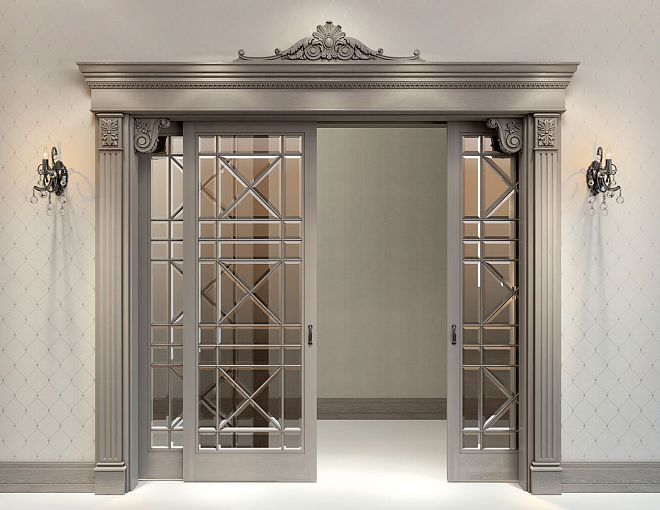
- Stucco molding for an arch in the apartment
- Floor and bottom wall line: baseboard as part of the set
- Stucco molding in a small apartment: how not to overload the space
- How to assemble a set of stucco molding for an apartment
- Option 1. Minimal set
- Option 2. Medium set
- Option 3. Full set for a classic apartment
- How to calculate the number of elements for an apartment
- How to choose a stucco molding style for an apartment
- Modern apartment
- Neoclassicism
- Classic apartment
- Apartment with high ceilings
- Mistakes when choosing stucco molding for an apartment
- Where to buy STAVROS stucco for an apartment
- FAQ: answers to popular questions about stucco in an apartment





Stucco in an apartment: how to choose a set of decor for walls, ceiling, and openings
There are apartments you enter and immediately feel the difference. Not because of expensive furniture or branded parquet. But because the space is "put together": walls live in dialogue with the ceiling, the lower line of the floor echoes the upper line of the room, openings don't gape with bare edges but are framed with dignity. This is stucco in an apartment — not a separate decorative detail, but a system.
Stucco for an apartment works precisely when it becomes a set: a ceiling cornice, wall moldings, a baseboard at the bottom, a rosette in the center of the ceiling, overlays in accent areas. It is this approach — not "one molding for beauty," but a meaningful set of interconnected elements — that turns a renovation into an interior.
Polyurethane stucco in an apartment — is a reality without dust and plastering work. STAVROS polyurethane products: moldings, cornices, baseboards, ceiling rosettes, PU overlays, wall decor — are mounted with glue, painted in any color, and require no special qualifications. If you are looking for how to choose and buy a set of stucco for an apartment, this guide is for you.




What is stucco in an apartment and why is it needed
A direct answer without lyricism: stucco in an apartment is a system of decorative elements made of polyurethane that form the architectural image of a room. Not one cornice. Not a separate rosette on the ceiling. It is a system — with logic, rhythm, and stylistic unity.
Why is it needed in an apartment? Not to make it "look like an old mansion." But because without architectural lines, an apartment looks like a box with furniture. A ceiling cornice separates the wall plane from the ceiling plane — and immediately a feeling of height and completeness appears. Wall moldings create rhythm — the room ceases to be monotonous. A baseboard establishes the lower line — floors don't "float." A rosette in the center of the ceiling fixes the gaze and the chandelier in the correct center.
Polyurethane stucco for an apartment is not about luxury or "rich renovation." It's about a well-designed interior. And in any style: from strict neoclassicism to modern contemporary.
It's important to understand that this article is not a review of "stucco ideas in the interior" and not an installation guide. It is a commercial guide for selecting a stucco set from real categories of the STAVROS catalog. Here are specific elements, specific application areas, specific links to product sections.
Our factory also produces:


How this article differs from other materials about stucco
Before moving on — a short but important reference point.
This article is not about walls separately. Not about the ceiling in a separate publication. Not an installation guide. Not a catalog of polyurethane products and not facade decor. This is a commercial guide for assembling a stucco set for an apartment: how to choose the necessary elements for each area, which ones combine with each other, in what quantity to calculate, and where to go in the STAVROS catalog.
If you need details on installation, read installation of polyurethane molding. If you need instructions on gluing — How to glue polyurethane molding. If the question is about glue — what to glue polyurethane molding with.
Here — only the selection of the set. From start to finish.
Get Consultation
What STAVROS elements are included in the stucco set for an apartment
For an apartment, you don't need "stucco in general," but specific products for specific areas. Here is the complete set composition.
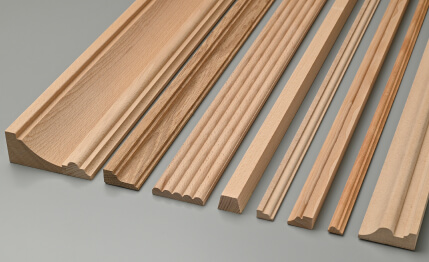
Moldings, cornices, and baseboards are linear profiles. Moldings go on walls (frame schemes, door/window framing), cornices go along the ceiling perimeter, baseboards go along the floor perimeter. All of this is in one section: Polyurethane moldings, cornices, and baseboards.
Polyurethane cornices separately — for those looking only for ceiling profiles. In the cornices section profiles with different cross-sections and projections are collected, from minimalist to elaborate classical forms.
Polyurethane baseboards — the lower architectural line of the room. The baseboards section includes items of different heights: from 60 to 200 mm. For an apartment with 2.7 m ceilings — baseboard height 80–120 mm. For 3 m and above — you can use 120–160 mm.
Ceiling rosettes — the central accent of the ceiling plane. Polyurethane ceiling rosettes are selected by diameter depending on the room area and chandelier size. The rosette diameter for a living room is typically 300–600 mm.
PU overlays are individual decorative elements for walls, openings, arches, and accent areas. PU overlays section — for accents on pilasters, above doors, in frame panels.
Polyurethane wall decor — for frame schemes, wall panels, and decorative belts. Wall Decor — section for decorating wall surfaces.
Molding decor — corner blocks, inserts, finials. Decor for Molding solves the issue of corner joints without complex cutting.
All elements are made of polyurethane, ready for painting. They are compatible with each other within the STAVROS style lines.
How to choose moldings for an apartment by zones
An apartment consists of several zones, each requiring its own approach. Let's break it down step by step: from floor to ceiling, from walls to arches.
Stucco molding on walls in an apartment
The wall is the largest surface in a room. And it is here that stucco molding works most expressively. Stucco molding on walls in an apartment is primarily molding frames: rectangular or square contours made of molding profile that divide the wall plane into fields.
The frame scheme on walls in an apartment can be of varying complexity:
-
One field across the entire wall — one frame around the perimeter of the wall with an indent of 200–400 mm from the edge. The most concise option.
-
Two fields vertically — the wall is divided into upper and lower zones. The lower one is paneled, the upper one is framed.
-
Horizontal row of frames — several rectangles in a horizontal row. Works well in the living room and hallway.
-
Grid of frames — several rows creating an architectural pattern on a large wall.
Polyurethane wall molding in an apartment — these are moldings for frame contours plus decor for filling the fields. In the center of the frame, you can place an overlay or leave the field clean.
For the living room: a framed wall with an accent overlay in the center behind the sofa — a classic, never-outdated technique.
For the bedroom: a frame behind the headboard of the bed — creates the feeling of a "canopy" without fabric.
For the hallway: a narrow molding along the perimeter of each wall section — fills the space with architecture without overwhelming it.
Wall moldings for an apartment — the main tool for frame schemes. Choose a profile with moderate relief: 25–45 mm wide for standard rooms.
Stucco on the ceiling in an apartment
The ceiling plane is what works as a background for the entire room. Stucco on the ceiling in an apartment includes two key elements: a cornice along the perimeter and a rosette in the center.
Ceiling cornice — a line that separates the wall from the ceiling. This is not just decor: the cornice visually "raises" the ceiling because it draws the eye to the upper zone of the room and creates a horizontal architectural pause.
Polyurethane cornices for an apartment — from minimalist to elaborate classical profiles. For a standard apartment with a ceiling of 2.7 m — a cornice 60–100 mm high. For 3 m — 80–120 mm. Choose a profile with an overhang (horizontal projection onto the ceiling): 40–80 mm.
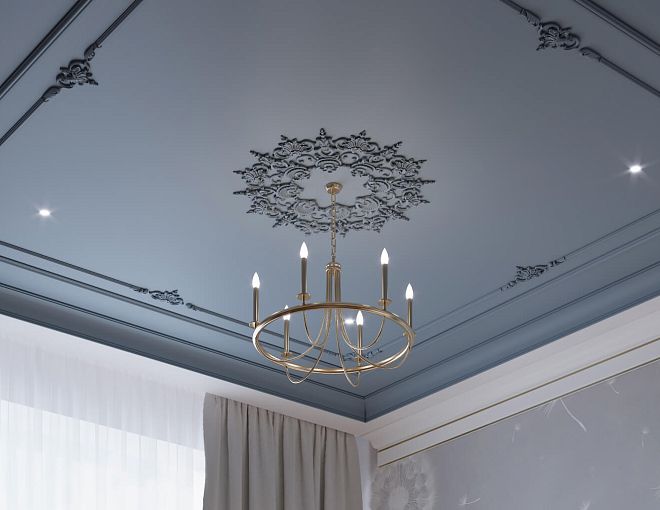
Ceiling rosette — this is the architectural center of the ceiling. It is installed where the chandelier is located and sets the axis of symmetry for the entire room. Select the diameter so that the rosette is 1.5–2 times wider than the base of the chandelier — then it visually "holds" the light fixture.
Polyurethane ceiling rosettes — diameter from 200 to 700 mm and more. For a room of 15–20 m² — a rosette of 350–450 mm. For a hall of 25–35 m² — 500–600 mm.
Ceiling and wall stucco in an apartment works as a system: the cornice and wall frame moldings must be from the same profile series. The rosette should be in the same style as the overlays.
An additional technique for a ceiling with stucco in an apartment: a rectangular or octagonal medallion made of molding around the rosette. This "integrates" the light fixture into the ceiling plane and creates a coffered feel.
Stucco for an arch in an apartment
An arched opening is one of the most characteristic elements of apartment layouts. And one of the most neglected: how many apartments with arches have the end of the opening simply painted, and the framing hastily done with a plasterboard slope without any decoration?
Stucco for an arch in an apartment is the decoration of the opening with moldings and overlays. Not a ready-made "arch kit" (such a product does not exist — and rightly so), but a set of elements from which the framing is assembled according to the shape of a specific arch.
For a rectangular arched opening, the scheme is as follows: molding along the contour of the opening on three sides (two verticals + top horizontal) + an overlay in the center of the top horizontal. This forms a casing with a keystone — a classic solution.
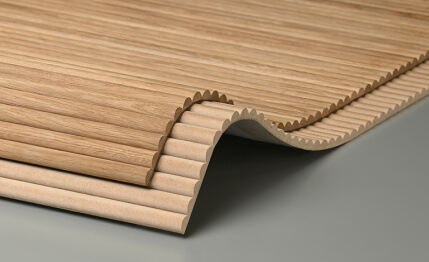
For a semi-arched (semicircular) opening — it's more complicated, but doable. Molding along the straight side sections + a decorative overlay in the arch keystone. For the radius section, you can use flexible molding or assemble an arc from short segments with trimming.
PU overlays — for the keystone and decorative accents on the sides of the arch. Moldings — for contour framing. Decorating an arch in an apartment with stucco should be connected to the wall decoration on both sides of the opening: if there is frame decor on the walls, the arch molding should be from the same profile.
An arch with stucco in an apartment is one of the most advantageous scenarios: a small budget, two or three elements — and the opening transforms from a construction hole into an architectural motif.
Floor and bottom wall line: baseboard as part of the set
A baseboard is an element that is thought of last and chosen on the principle of 'just to cover the gap.' This is a mistake. The baseboard is the lower architectural line of the room. It completes the wall from below just as a cornice completes it from above.
As part of a molding set for an apartment, the baseboard should be in stylistic unity with the cornice and moldings. This does not mean all three elements are the same height—but they should belong to the same stylistic series.
Proportion principle: baseboard height ≈ 50–60% of the ceiling cornice height. Cornice 100 mm → baseboard 55–65 mm. Cornice 80 mm → baseboard 50–55 mm. This visually 'holds' the room in balance.
Polyurethane Baseboards — from flat profiles of minimal height to tall classic ones with relief. For a modern apartment — baseboard 60–80 mm, smooth or with a chamfer. For neoclassicism — 80–120 mm with a moderate profile. For a classic interior — 120–160 mm with a break and relief.
Corner joints of the baseboard — must be corner blocks made of decoration for moldings or neat cutting at 45°.
Moldings in a small apartment: how not to overload the space
Moldings in a small apartment is a topic where one of two mistakes is most often made: either they completely abandon decor ('little space'), or they slap everything on in hopes of 'richness.' Both options are bad.
Modern moldings in a small apartment are built on the principle of architectural restraint:
-
A thin cornice along the perimeter of the ceiling — 50–70 mm, without complex relief. It visually "raises" the ceiling.
-
Molding along the perimeter of the walls — not frame schemes, but a single profile along the perimeter of each wall at a height of 900–1000 mm from the floor (analogous to a belt). This horizontal division splits the wall into two zones and creates a sense of order.
-
Baseboard — 60–80 mm, not higher.
-
Ceiling rosette — small, 250–350 mm, strictly under the chandelier.
No clutter of overlays. No wide cornices with developed relief in a room of 12–16 m². The principle of a small apartment: stucco works as an architectural line, not as a decorative ornament.
For a studio apartment, a special rule: decor should zone, not decorate. A molding or cornice transitioning from one zone to another is an architectural boundary marker that works better than any partition.
How to assemble a set of stucco for an apartment
Three working sets — from minimal to formal.
Option 1. Minimal set
For whom: modern apartment, neoclassicism, small spaces, first experience with stucco.
Contents:
-
Moldings — one profile, a frame around one accent wall, or a border along the perimeter of the walls
-
Ceiling Molding — along the perimeter of the ceiling
-
Skirting — along the perimeter of the floor
Investment budget is minimal. The result is that the room gains completeness and an architectural image. An excellent start.
Option 2. Medium set
For whom: living room, bedroom, study with a ceiling height of 2.7–3 m.
Contents:
-
Moldings — frame patterns on the walls
-
Cornice — on the ceiling
-
Skirting — on the floor
-
Ceiling rosette — in the center of the ceiling
-
PU overlays — accents in frames on walls or above doorways
This is already a full-fledged interior with an architectural language. The walls work in rhythm. The ceiling has a center. The floor has a clear bottom line.
Option 3. Full set for a classic apartment
For whom: classic-style apartment, spacious rooms, ceiling 3 m and higher.
Contents:
-
Moldings — complex frame schemes, two-level frames
-
Crown Molding — developed profile with an offset of 80–120 mm
-
Baseboards — high, 120–160 mm, with relief
-
ceiling rosettes — diameter from 450 mm, with rich relief
-
Wall Decor — wall panels, decorative belts
-
PU overlays — on pilasters, above windows, in accent zones
-
Decor for Molding — corner blocks, inserts
This is a formal classic interior with full architectural detailing.
How to calculate the number of elements for an apartment
| Zone | What to count | Where to go |
|---|---|---|
| Walls (moldings) | perimeter of frames, 15% allowance for trimming | Moldings |
| Ceiling (cornice) | room perimeter + 10% allowance | Crown Molding |
| Floor (baseboard) | floor perimeter − width of door openings + 10% allowance | Baseboards |
| Ceiling (rosette) | diameter = 1.5–2× chandelier width | Outlets |
| Accents (overlays) | by number of frames and accent zones | PU overlays |
| Corner joints | by number of internal and external corners | Decor for Molding |
Example calculation for a living room 5 × 4 m (ceiling 2.8 m):
-
Cornice: (5+4) × 2 = 18 lm + 10% margin = 20 lm
-
Baseboard: (5+4) × 2 − 0.9 m (door width) = 17.1 lm + 10% = 19 lm
-
Molding for frames on walls (two accent walls): approximately 24–28 lm depending on the scheme
-
Rosette: one, diameter 400–450 mm
-
Overlays: one in the center of each frame — 2–4 pcs.
Total for one room — about 40–50 linear meters of profile and several piece elements.
How to choose a stucco style for an apartment
Style is not a whim, but a system of rules. A violation of style in stucco is immediately noticeable: mismatched elements "argue" with each other and create a sense of chaos where order should be.
Modern apartment
Modern stucco in an apartment is restraint and precision. Thin profiles, smooth baseboards, moderate cornices. Principle: one line — one function. The cornice separates the ceiling. The molding defines the frame. The baseboard fixes the bottom. No ornamental clutter.
For modern style: molding 20–35 mm with a simple cross-section. Cornice 60–80 mm. Baseboard 60–80 mm. Rosette — simple, without relief ornament, diameter 250–350 mm.
A modern apartment with stucco is not a contradiction. It is architectural precision brought into decor.
Neoclassicism
Neoclassicism is the most popular style for stucco in modern apartments. Clear lines, moderate relief, strict symmetry. Wall moldings — rectangular frames with a profile of 35–55 mm. Cornice — with a small break and chamfer, 80–110 mm. Baseboard — 90–120 mm. Rosette — with geometric or floral relief, 350–500 mm.
For neoclassicism, symmetry is important: frames on the walls must be symmetrical relative to doors, windows, and the axis of the room. One asymmetrical frame destroys the entire ensemble.
Classic apartment
Classic is when stucco becomes architecture. Expressive cornices with a developed profile (120–160 mm), frame patterns on all walls, high baseboard, large rosette with rich relief, overlays on pilasters.
For an apartment in a classic style, it is recommended STAVROS Classic collection — a stylistically coordinated set of all elements. Or Collection of neoclassicism — for a monumental version with antique motifs. Versailles Collection — for the most lavish decoration.
Apartment with high ceilings
Stucco in an apartment with high ceilings (3 m and above) — a special scale. Here there are no restrictions on the height of the cornice and baseboard: 120–160 mm for the cornice, 140–200 mm for the baseboard — normal. Frames on the walls can be multi-level. Rosettes — with a diameter from 500 mm.
Principle: the decor should "fill" the height, not get lost in it. A thin cornice on a 3.5 m ceiling looks like a scratch. A wide cornice with a projection of 100 mm — like an architectural solution.
Mistakes when choosing stucco for an apartment
Nine mistakes that are made most often — and each of them can be avoided.
Buying one element without a plan. One molding on the wall without a cornice, baseboard, and scheme logic — this is not decor. Start with a kit plan, not with a single purchase.
Mixing styles. Baroque rosette + Art Deco molding + classic baseboard = decorative disaster. One style — one interior.
Not considering ceiling height. A cornice that is too high for a low ceiling "eats up" space. A profile that is too thin for a tall room gets lost.
Choosing decor that is too large for a small apartment. A 600 mm diameter rosette in a 12 m² room feels oppressive. A 160 mm cornice on a 2.5 m ceiling looks aggressive.
Forgetting about extra footage. Buying exactly the calculated amount means there won't be enough for trimming. Always add 10–15% to the calculated footage.
Not connecting the wall with the ceiling. The cornice and wall moldings should be from the same style series. Different styles on different planes of the same room create the feeling that the renovation was done by different people at different times.
Overloading a narrow hallway. In a hallway 120–140 cm wide, frame schemes on the walls feel cramped. For narrow spaces — a thin molding belt or vertical accents.
Not considering doors and windows. Frames on the walls should be symmetrical relative to door and window openings. A randomly placed frame overlapped by a door frame looks like a mistake.
Going to the wrong URL. URL stavros.ru/products/lepnina/ — not to set. The correct address for a general selection is izdeliya-iz-poliuretana, from where navigation by sections.
Where to buy STAVROS stucco for an apartment
For decorating an apartment with STAVROS stucco, there is a full set of real decorative elements: moldings for frames and trims, ceiling cornices, baseboards, ceiling rosettes, PU overlays, and wall decor. All items are made of polyurethane, ready for painting, with precise dimensions in product cards.
For general selection: Polyurethane Items.
For specific selection:
-
Walls: Moldings и Wall Decor
-
Ceiling: Crown Molding и Outlets
-
Floor: Baseboards
-
Accents: PU overlays
-
Joints: Decor for Molding
STAVROS company operates in the Russian market of decorative interior elements. The catalog features proprietary collections with well-thought-out style series, where moldings, cornices, rosettes, baseboards, and overlays are coordinated in proportions and relief. This is a fundamental difference from a random set of items: with STAVROS, you can assemble a set for an apartment, not just buy "something similar." Current prices, sizes, and availability are in product cards on the website.
FAQ: answers to popular questions about stucco in an apartment
What stucco is suitable for an apartment?
For an apartment, wall frame moldings, ceiling cornices, baseboards, ceiling rosettes, PU overlays, and wall decor are suitable. All items are made of polyurethane and mounted with glue. It is better to choose not a single element, but a set of style-coordinated products.
What to buy for stucco in an apartment?
Minimum set: moldings + cornice + baseboard. Medium: plus ceiling rosette and overlays. Full classic set: all listed elements plus wall decor and corner blocks for joints.
Can molding be used in a modern apartment?
Yes. Stucco molding does not contradict a modern apartment — if you choose restrained profiles without ornamentation. A thin cornice, a molding belt on the walls, a neat baseboard — and the apartment gains architectural completeness without a "baroque" touch.
How to choose stucco molding for a small apartment?
Thin moldings (20–30 mm), low cornice (50–70 mm), baseboard no higher than 80 mm, rosette diameter 250–300 mm. No clutter of frames and overlays. One or two accent elements — enough.
How to calculate stucco molding for an apartment?
Footage of cornice and baseboard = room perimeter + 10–15% reserve. Footage of moldings for frames = perimeter of each frame × number of frames + 15%. Piece elements (rosettes, overlays) — according to the layout scheme.
Is stucco molding needed in a studio apartment?
In a studio, stucco molding performs a zoning function: cornice and moldings divide the space into conditional zones without partitions. Changing the decor on the ceiling (different rhythm of frames or presence/absence of a cornice) works especially well as a marker of transition between zones.
What is important to check before ordering?
Exact room dimensions, ceiling height, location of doors and windows, layout of frame decor on walls (draw on a plan), chosen style. And only then — calculation of footage and ordering by catalog sections.