Article Contents:
- Anatomy of wall composition
- Simple frames: the foundation of compositional thinking
- Multiple frames: rhythm and modularity
- Molding templates: a system of patterns
- Accent walls: compositional center of space
- From frames to panels: complexity of composition
- Practical aspects of implementation
- Stylistic solutions
- Errors that destroy composition
- Conclusion

Bare walls are a clean canvas awaiting an artist. But unlike painting, where brushstrokes create an image, in interior design, the volume and relief of molding transform a flat surface into an architectural piece. The wall ceases to be merely a vertical surface — it gains depth, rhythm, character, becoming an active participant in space.
Wall molding has evolved from palace luxury to an accessible tool of modern design. Polyurethane element technology has democratized classical decoration — what once required months of plasterwork and astronomical budgets can now be realized over weekends by hand. Yet accessibility of the tool does not negate the need for understanding — how to transition from a simple molding frame to a complex multi-layered composition, how to use the modularity of elements, how to create an accent wall that becomes the compositional center of the interior.
The evolution of wall molding reflects the evolution of design thinking. Simple frames — structuring the plane, dividing into zones, creating order. Molding templates — a system of repeating elements forming rhythm, pattern, predictability. Complex panels — already sculpture on the wall, three-dimensional imagery telling stories. Each level of complexity requires its own approach, technical solutions, understanding of proportions and composition.
In this article, we will cover the entire path — from a basic rectangular frame to a multi-figure relief panel. You will learn to plan compositions on paper, transfer them to the wall with millimeter precision, select elements that create visual unity. You will understand how modularity simplifies complex projects, how repetition creates rhythm without monotony, how an accent wall gathers space around itself. You will receive specific composition schemes — from proven classical to bold modern designs.


Anatomy of wall composition
Before creating a composition, you need to understand its structural elements. Wall molding consists of several types of details, each with its own function.
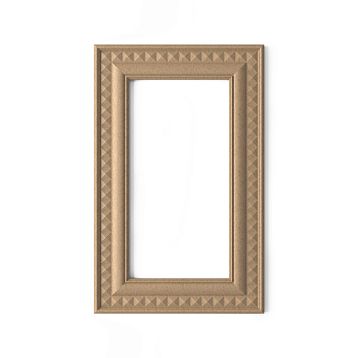
Frame moldings — the foundation of any composition.Moldings made of polyurethaneThey form the perimeter of panels, create zone boundaries, structure the plane. The width of the molding determines the scale of the composition — narrow 30-50 mm create delicate frames, wide 80-120 mm form monumental panels.
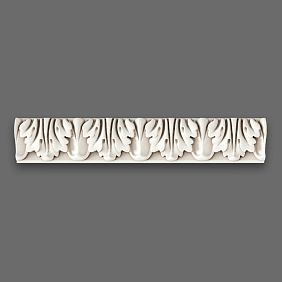
The molding profile sets the style. A simple rectangular profile suits modern interiors. Profiled with beads and scrolls — for neoclassicism. Ornamented with plant motifs — for classicism and baroque. All moldings in one composition must belong to the same style; otherwise, a visual conflict arises.
Corner elements — pre-made details for molding joints. They solve two tasks: simplify installation (no need for precise 45° trimming) and add decoration (a corner rose is richer than a simple joint). Corner elements transform a utilitarian corner into a compositional accent.
Central inserts — decorative details placed in the centers of panels. These can be rosettes, cartouches, ornamental compositions. A central insert draws attention, creates a focal point, adds vertical hierarchy — the frame is secondary, the center is primary.
Decorative panels — large pre-made elements with relief. They replace assembled compositions, save installation time, but are less flexible. A panel has a fixed size and ornament, adaptation is limited. Panels are suitable for standard solutions when speed is needed.
Pilasters — vertical elements imitating flat columns. They create vertical division of the wall, classical architectural rhythm, visually raise the ceiling. Pilasters consist of a base (bottom), shaft (center), and capital (top). They work in pairs, framing significant elements.
Reliefs and panels — sculptural compositions with three-dimensional imagery. A relief protrudes from the plane by one-third of its volume, creating moderate relief. A high relief protrudes more than half, some parts are completely detached from the background. These are the most complex elements, requiring professional execution.
Hierarchy of elements in composition is critical. The main element — the largest, most detailed, located in the compositional center. Secondary elements surround the main one, smaller in size. Tertiary elements — the smallest, fill gaps, add detail. Without hierarchy, the composition is flat, all elements compete for attention.




Simple frames: the foundation of compositional thinking
The simplest wall composition — a rectangular frame made of moldings. But even in this simplicity, dozens of nuances determine success.
Frame proportions follow the golden ratio or similar ratios. A square frame (1:1) is static, stable, suitable for symmetrical classical interiors. Vertical (2:3, 3:4) is upward-oriented, dynamic, visually raises the ceiling. Horizontal (3:2, 4:3) expands space, calms, suitable for low rooms.
The golden ratio (1:1.618) is considered ideal — such a frame is perceived as the most harmonious. For practical use: if the frame height is 1000 mm, the width should be 618 mm (vertical) or 1618 mm (horizontal). Precision to the millimeter is not mandatory — it is sufficient to approximate the ratio.
Frame size relative to the wall — a critical parameter. The frame should not occupy the entire wall from edge to edge — this creates a feeling of confinement. Optimal offsets: from wall corners 150-300 mm, from ceiling cornice and baseboard 200-400 mm. The frame should 'breathe', have space around it.
The molding width is proportional to the frame size. For a 600×900 mm frame — molding 40-60 mm. For 1000×1500 mm — 70-100 mm. For 1500×2000 mm — 100-150 mm. Rule: molding width is 6-8% of the shorter side of the frame. Too thin molding disappears; too thick molding suppresses the space inside the frame.
Mounting a simple frame begins with marking. Mark the center point of the frame on the wall — it should be on the wall’s axis of symmetry and at a height of 1400-1600 mm from the floor (eye level of a standing person). From the center point, measure half the height up and down, half the width left and right. Obtain the four corner points of the frame.
Connect the points with straight lines, using a level for verticals and horizontals. Check the diagonals — they must be equal; otherwise, the frame is not rectangular but rhomboidal. The marking must be perfectly accurate — an error of 5 mm at opposite corners will create a visible skew.
Molding installation order: first the top horizontal, then the bottom, then the verticals. This ensures that vertical posts are cut precisely to height between already installed horizontals. Joints at corners at 45° or using corner elements.
The frame filling determines the composition’s character. An empty frame on a painted wall — minimalist solution, relief visible only by shadow. Frame with wallpaper inside — classic, wallpaper contrasts with the wall. Frame with decorative plaster — textured solution. Frame with painting or photo wallpaper — artistic accent.
Our factory also produces:


Multiple frames: rhythm and modularity
One frame — accent. Several frames — system, creating rhythm, pattern, visual complexity. Multiple frames require understanding of modularity and repetition.
Horizontal row of three frames — classic scheme. Central frame is 1.3-1.5 times wider than side frames, creating hierarchy. All three at the same height, intervals between them equal 100-200 mm. This scheme suits long walls 3.5-5 meters, creating balance and symmetry.
Vertical row of two or three frames is rarely used due to limited wall height. But with high ceilings 3.5-4 meters, a vertical row creates upward movement, visually raising the space. Top frame is smaller than bottom, interval between them 150-200 mm.
Grid of six to nine frames forms a dense composition filling the entire wall. 2×3 grid (two rows of three frames) — most balanced. 3×3 grid (nine equal frames) — maximum density, suitable for large walls 4×3 meters and above. All frames in the grid are equal size, intervals identical 100-150 mm.
Modularity — key to complex compositions. Module — basic frame, size divisible. For example, module 500×700 mm. Composition assembled from modules: single module, double (1000×700 or 500×1400), quadruple (1000×1400). All intervals equal 100 mm. Modular system allows creating diverse configurations from standard elements.
Repetition creates rhythm without monotony. If all frames are absolutely identical — monotony arises. If all different — chaos. Balance — repetition with variations. For example, three frames of equal height but different widths in proportion 1:1.5:1. Or six frames, four horizontal, two vertical, placed asymmetrically but balanced.
Asymmetric compositions require visual balance. Balance — equality of visual weights. Large frame on the left balanced by two small ones on the right. Frame in upper wall section — balanced by frame in lower section. Dark filling — light. Achieving balance is more complex than symmetry, but result is more dynamic and modern.
Color solution for multiple frames enhances composition. All frames white — elegant restraint. Frames contrasting with wall — graphic clarity. Frames of different colors — bold authorial solution, requiring refined taste. Frame fillings may be monochromatic or varied, creating additional complexity.
Get Consultation
Molding cards: system of templates
Molding card — scheme of molding placement on wall, creating finished composition. Cards are developed by designers, reproduced, adapted to specific wall dimensions.
Classic molding card includes perimeter frame along wall edges and internal division into panels. Perimeter — wide molding 80-120 mm, set back from wall corners by 100-150 mm. Inside — grid of narrow moldings 40-60 mm forming equal panels. Panels may be filled with wallpaper, plaster, painting.
French card characterized by tall narrow panels stretched vertically. Panel proportions 1:2 or 1:2.5. Such card visually raises ceiling, creates elegance, typical for Parisian interiors. Used in bedrooms, living rooms, classic offices.
English card divides wall horizontally into two zones — lower (1/3 height) and upper (2/3 height). Lower zone — dark panel or wallpaper, upper — light. Boundary emphasized by horizontal molding at 900-1000 mm height. Typical for dining rooms, offices, corridors in English style.
American card — simplified classic, with large panels and minimal details. Usually 2-4 large panels on wall, wide moldings 100-150 mm, minimal small elements. Typical for American interiors, where restrained elegance without European opulence is valued.
Modern card rejects symmetry in favor of dynamism. Panels of different sizes, placed asymmetrically but balanced. Moldings may vary in width, creating hierarchy. Some panels may be empty, others filled. Modern card requires advanced compositional thinking.
Adapting card to specific wall — necessary step. Typical card developed for hypothetical wall 3000×2700 mm. Your wall may be different size. Adaptation done via proportional scaling — if wall is 20% wider, all card dimensions increased by 20%. Or by changing number of modules — instead of three panels, make four.
Design software for cards simplifies planning. Simple option — graphic editor (Photoshop, GIMP), where you draw wall to scale, overlay molding rectangles. Professional option — CAD programs (AutoCAD, SketchUp), where you model composition in 3D, see result with shadows.
Accent walls: compositional center of space
Accent wall — wall highlighted by decoration, color, texture, becoming room’s focus.Molding on the WallTransforms it into an architectural artwork.
Choosing wall for accent follows perception logic. In living room — wall behind sofa or opposite entrance, first visible. In bedroom — wall behind headboard, focal point upon entry. In dining room — wall behind dining table. Accent wall must be primary in space, not obstructed by furniture.
Decor density on accent wall is higher than on others. If other walls are smooth or minimally decorated (only cornice and baseboard), accent wall is fully covered with molding frames, panels, pilasters. Contrast in density creates hierarchy — accent wall dominates.
Symmetry on accent wall is mandatory for classic styles. Composition built relative to central vertical axis. If pilasters — in pairs at equal distance from axis. If panels — odd number (one, three, five), central one on axis. Symmetry creates solemnity, monumentality, classic harmony.
Color solution for accent wall enhances its role. Wall of contrasting color to others — visually pushed forward. Dark wall in light room — depth, drama. Light wall with dark moldings — graphic effect. Gilded or patinated molding — luxury, classic chic.
Accent wall lighting is critical. The wall must be well-lit so the relief of the molding is visible. Side lighting emphasizes the relief, creating expressive shadows. Use ceiling spotlights directed at the wall, or wall sconces illuminating from bottom to top. Even, diffused light obscures the relief—avoid it for accent walls.
Integrating functional elements into the accent wall composition makes it not only beautiful but also practical. A TV mounted on an accent wall is framed by molding, becoming part of the composition. A fireplace is surrounded by pilasters and cornices, transforming into an architectural portal. Shelves between pilasters create a functional storage system within the decorative composition.
From frames to panels: complexity of composition
Complex compositions are an evolution from simple frames. Each level adds layers, details, and depth.
Two-layer compositions use moldings of different widths. The outer frame is a wide molding 100-120 mm, the inner one is narrow 40-50 mm, parallel with a 50-80 mm setback. Between the frames is a contrasting field (different color, texture). This creates depth, multi-layering, and visual complexity using a simple mounting technique.
Three-layer compositions add another level. Three concentric frames of different widths with gaps form a complex structure. The outermost is wide, the middle is medium, and the innermost is narrow. Gaps 30-50 mm, painted in different tones of one color (lighter toward the center or darker). A three-layer composition is monumental and suitable for spacious rooms.
Combined compositions combine frames and pilasters. The central panel is framed by moldings, with pilasters on both sides from floor to ceiling. A horizontal frieze on top. This creates a classic portal—framing a significant element (mirror, fireplace, TV). Pilasters create a vertical accent, the frame a horizontal one, and the frieze a finishing touch.
Decorative panels—the pinnacle of complexity. The center of the composition is occupied by a relief panel with a three-dimensional image. The panel is framed by a multi-layered molding frame. Corners are adorned with ornamental appliqués. Horizontal friezes with ornamentation on top and bottom. Such a composition requires careful planning, professional installation, but the result is impressive.
3D panels create a volumetric texture filling the entire wall. Panels sized 500×500 mm or 600×600 mm are assembled like tiles, forming a relief pattern. The relief can be geometric (waves, facets, honeycombs) or abstract. 3D panels suit modern interiors, creating a dynamic texture.
Combining molding with other materials expands possibilities. Moldings frame mirror inserts—visual space expansion. Moldings frame wooden panels—warm texture in a classic frame. Moldings frame fabric panels—softness, acoustic comfort. Materials must harmonize in style.
Practical aspects of implementation
Theory is useless without understanding practical mounting and finishing nuances.
Wall preparation before mounting is critical. The wall must be flat—deviations no more than 2-3 mm over 2 meters. A curved wall will transfer curvature to the molding, making the composition look defective. Level areas with plaster or putty. Prime for adhesive bonding.
Composition marking is done with a laser level and straightedge. Mark the central axis of the wall. From it, symmetrically lay out composition elements. Check all vertical lines with a level, horizontal lines too. A 5 mm marking error will create a visible misalignment—check multiple times.
Mounting elements begins with main elements, then secondary. Start with outer frames, then inner ones. Start with pilasters, then horizontal elements between them. Use special polyurethane adhesive, apply sufficient amount, press evenly. Secure with painter’s tape for 6-8 hours.
Joint treatment determines the quality of the result. Joints are filled with acrylic putty and sanded with fine-grit sandpaper. An ideal joint is invisible—visually or to the touch. Spend time carefully treating each joint—it pays off with a flawless appearance.
Painting the composition completes the transformation. Prime the molding before painting for even color. Paint in two thin coats, covering all relief recesses. Painter’s tape protects edges. Molding color must harmonize with the overall interior palette.
Completion time depends on complexity. A simple frame—4-6 hours including marking and mounting plus one day for adhesive polymerization and painting. A complex composition of 10-15 elements—2-3 days of mounting plus one day for finishing. A relief panel with multi-layered frames—about one week of professional work.
Stylistic solutions
Wall molding adapts to any style with the right choice of elements and composition.
Classicism requires symmetry, clear proportions, restrained ornament. Rectangular panels in golden section ratio, framed by profiled moldings. Pilasters with Corinthian capitals on either side of the central panel. Color white or cream, possible light patina. Classicism is order, harmony, academicism.
Baroque requires opulence, abundance of details, curves. Oval and arched frames, wide moldings with rich ornament, three-dimensional cartouches in corners. Relief with vegetal motifs, putti, garlands. Gilding is mandatory—full or accent. Baroque is luxury, excess, theatricality.
Neoclassicism simplifies classicism, adapts to modern spaces. Classic forms, but smaller scale, restrained ornament. Moldings of medium width 60-80 mm, simple proportions, minimal decorative appliqués. Neutral colors—white, gray, beige. Neoclassicism is elegance without overload.
Art Deco combines geometry with luxury. Moldings form strict rectangles, trapezoids, hexagons. Ornament is stylized—sun rays, zigzags, stepped forms. Contrasting colors—black with gold, dark blue with silver. Art Deco is graphic and glamorous.
Modern style uses molding minimally. Simple baseboards and cornices, a few thin moldings creating geometric frames. Color matching wall tone or contrasting, but without ornament. 3D panels with abstract relief. Modernity is restraint, clean lines, functionality.
Errors that destroy composition
Knowing errors prevents disappointment.
Lack of a plan is the main error. Buying beautiful elements without understanding how they will compose a whole leads to chaos. Elements don’t match in style, sizes are not proportional, placement is random. Plan the composition on paper before purchasing.
Violation of proportions—element sizes don’t match wall size. Small moldings on large walls disappear. Large ones on small walls overwhelm. Follow proportion rules—molding 6-8% of framed panel size.
Asymmetry in classical style is a perception error. Classicism demands mirror symmetry. If a composition is asymmetrical, it must be modern with visual balance. Mixing symmetry and asymmetry without logic creates an impression of error.
Poor joints—technical defect. Gaps, misaligned ornament, height discrepancies ruin the impression. Spend time on precise trimming, use joint adhesive, carefully fill with putty.
Over-decorating—more does not mean better. Molding on all walls, numerous small elements create visual noise. Leave space for the eye to rest. Rule: 40-60% of surface is decorated, the rest is clean.
Conclusion
Wall molding is the language of space, where you can write a simple sentence or a complex poem. From an elementary rectangular frame to a multi-figure bas-relief panel — each level of complexity opens new expressive possibilities.
The path from simple to complex is logical and sequential. Start with one frame — master proportions, assembly, finishing. Move to multiple frames — understand rhythm, modularity, repetition. Study molding templates — a system of time-tested patterns. Create an accent wall — a compositional center that unifies space. Dare to create complex panels — the pinnacle of molding art.
Modularity and repetition — keys to controlled complexity. By developing a basic module, you can create infinite variations by combining modules in different configurations. Repetition with variations creates rhythm without monotony, predictability without boredom.
The implementation technology is accessible to everyone.Decorative polyurethane moldingfrom the company STAVROS — high-quality elements with precise geometry and clear relief.Moldingsof various widths and profiles, corner elements, decorative overlays, panels — everything needed to realize any composition.
STAVROS professional consultants will help you select elements for your project, calculate quantities, and recommend the optimal composition layout. The product quality ensures that elements will fit precisely, creating flawless joints.
Create a wall that becomes a work of architectural art. A wall you want to look at, one that defines the character of the space, one that tells the story of the owner’s taste. From simple frames to complex panels — all tools are in your hands.
Start planning today. Measure the wall, draw a composition layout, calculate proportions. Visit the STAVROS catalog, select elements matching your vision. Order with delivery or pick up in person. Implement your project over the weekend or within a week — depending on complexity.
Molding on the Wall— an investment in beauty that pays off for years of joy from contemplation. It is not a temporary trend, but timeless classic, relevant for centuries. It is a way to transform standard housing into a personalized space with soul.
STAVROS — your reliable partner in creating beautiful interiors. Wide assortment, professional consultations, guaranteed quality. Thousands of completed projects across Russia. Your project can become the next success.
Transform your wall. From a simple frame to a complex panel. From idea to realization.Decorative stuccoSTAVROS makes this possible. Start today.