Article Contents:
- Why it's worth assembling an interior as a set
- Polyurethane decor: what to buy for walls and ceilings
- Wall moldings: the foundation of any classic solution
- Cornice profile: the line between wall and ceiling
- Polyurethane baseboard: the bottom line of a classic room
- Decorative overlays: accent elements
- Decor for moldings: details visible up close
- Wooden decor: what to buy for furniture and interior
- Furniture legs and supports: the foundation of classic furniture
- Wooden handles: a touch to furniture
- Wooden cornice: the top line of furniture
- Wooden baguette and moldings: slats, profiles, frame elements
- Decorative overlays made of solid wood
- How to combine wood and polyurethane in a classic interior
- Walls — polyurethane; furniture — wood
- Uniform painting: the boundary between materials disappears
- Dark wood + white stucco: contrast as a technique
- Five sets for different rooms
- Classic living room set
- Bedroom set with decor behind the headboard
- Classic style hallway set
- English style study set
- Classic style built-in wardrobe set
- Table: what to use where in a classic interior
- Mistakes when assembling a classic interior
- Buying stucco without considering furniture
- Mixing different wood and polyurethane styles
- Not calculating material allowance
- Forget glue, primer, and paint
- Choosing too bold a relief for a small apartment
- Not connecting baseboard, cornice, and furniture
- Additional keys and relevant catalog pages
- Decor calculation for a classic living room: example
- FAQ: questions from Moscow buyers and detailed answers
- What to buy for a classic interior in Moscow?
- Can you combine wooden decor and polyurethane molding in one interior?
- What is better to buy first: furniture or molding?
- Which stucco decor suits classic furniture with dark wood?
- Is a ceiling rosette needed in every room?
- How to calculate the amount of molding for frames on walls?
- How to choose the height of a furniture leg for a classic chest of drawers?
- STAVROS: full range for classic interiors in Moscow
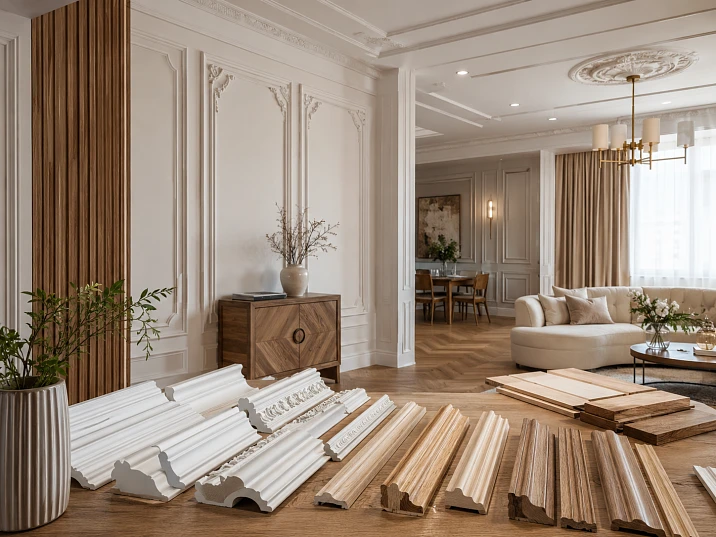
Moscow is a city where classic interiors are experiencing a steady renaissance. High ceilings in Stalin-era buildings, spacious living rooms in new residential complexes finished in neoclassical style, studies in the spirit of an English club — everywhere the same question arises: what exactly to buy, in what quantity, and how to avoid buying too much, then having to go back for more, or redoing what has already been installed.
The answer always starts not with stucco or handles. It starts with understanding how a classic interior works as a system. Walls, ceiling, furniture, hardware, and decorative elements are not separate purchases — they are one set. Polyurethane moldings for walls and ceilings, Wooden decoration for furniture, furniture legs, Wooden handles, Crown Molding — all of these are parts of one interior solution. And that's exactly how they should be purchased.


Why it's worth assembling an interior as a set
There is a common mistake: first, furniture is bought, then separately wall decor, then separately handles for cabinets, and in the end, it turns out that the moldings don't match the furniture in style, the handles are too thin for massive facades, and the cornice height is not related to either the baseboard or the interior doors.
A classic interior works through a system of proportions. The height of the baseboard, the width of the molding, the scale of the furniture, the shape of the handle, the relief of the overlay — everything must be coordinated. That's why the right approach is to first determine the style and scale, then select elements in the same style, and buy everything in one order.
This is more financially advantageous, logical from an installation perspective, and yields a result that looks like a designed interior, not a random set of details.




Polyurethane decor: what to buy for walls and ceilings
Polyurethane moldings — is a modern technology for producing classic decor. Polyurethane accurately reproduces relief, is not afraid of moisture, is easy to cut and paint, and weighs several times less than plaster stucco. For Moscow apartments — with their sometimes uneven walls, temperature changes and variety of bases — this is almost an ideal material.
Our factory also produces:



Wall moldings: the basis of any classic solution
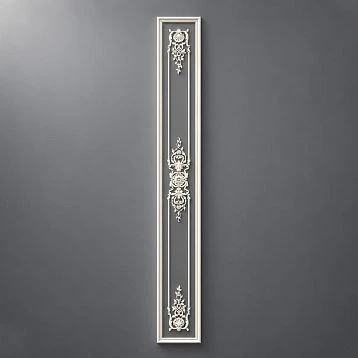
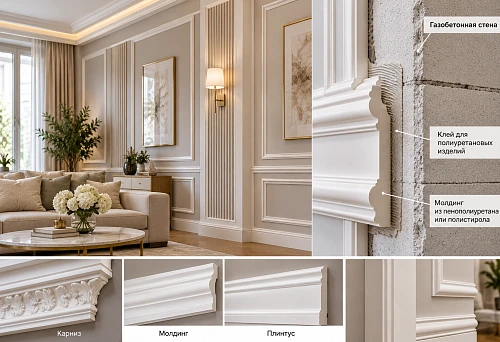
Moldings made of polyurethane — is a linear profile with decorative relief. On walls, they are used to create frame decor — "panels" that make a flat wall voluminous and architecturally rich.
Frame decor from moldings is the most effective way to give a classic character to any space without expensive plaster finishing. Four pieces of profile, joined at a 45° angle, create a decorative frame. Several frames in a row — and the wall takes on a look comparable to palace architecture interiors.
The choice of molding width depends on the ceiling height and frame size:
-
Ceilings 2.7–3.0 m: moldings with a face width of 25–40 mm
-
Ceilings 3.0–3.5 m: 40–55 mm
-
Ceilings above 3.5 m: 55–80 mm and more
on installing polyurethane molding — a separate detailed article with technology, angles and painting.
Get Consultation
Cornice profile: the line between wall and ceiling
A ceiling cornice is a profile along the upper perimeter of the room that separates the wall from the ceiling with a decorative line. In a classic interior, it is essential: without a cornice, the ceiling "falls," and the space loses its completeness.
In the section of polyurethane moldings, cornices, and baseboards — wide selection of cornice profiles: from modest single-profile to multi-tiered with developed relief. For a classic-style apartment with ceilings up to 3.0 m — a cornice width of 80–120 mm. For high ceilings — 150–200 mm or more.
Principle: the height of the cornice should be at least 1/30 of the ceiling height. With a ceiling of 3.0 m — minimum 100 mm.
Polyurethane baseboard: the lower line of a classic room
The baseboard completes the lower line of the walls and visually "places" the interior on the base. In classics, the baseboard is not a functional element to "close the gap," but a decorative detail with a pronounced profile.
Height of the baseboard in a classic interior: at least 80–100 mm. In a room with a ceiling of 3.0 m or higher — 120–150 mm. The relief of the baseboard should match the relief of the cornice: they work in pairs, creating the upper and lower decorative lines of the room.
Decorative overlays: accent elements
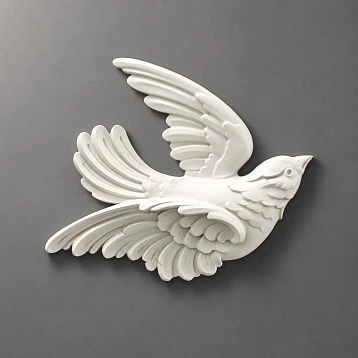
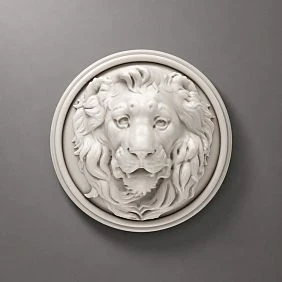
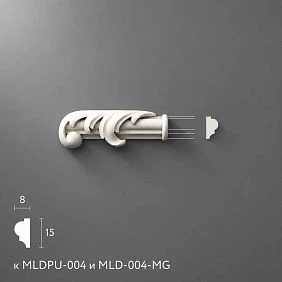
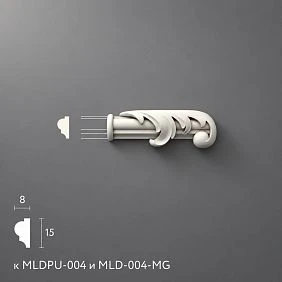
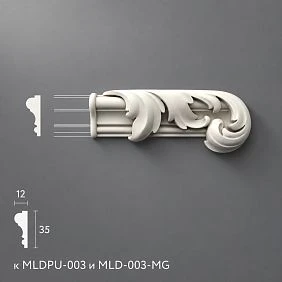
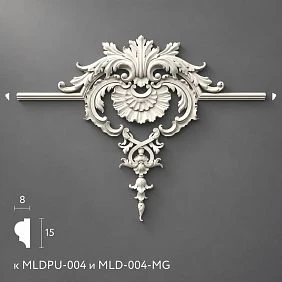
Polyurethane decorative appliques — these are three-dimensional elements that are installed at key points of the interior: in the center of the ceiling under the chandelier, in the corners of molding frames, above door portals, on furniture facades.
A ceiling rosette under the chandelier is a classic accent that immediately elevates the perception of the space. The size of the rosette is chosen proportionally to the diameter of the chandelier: the rosette should be wider than the base of the chandelier mount, but not exceed 1/5 of the smaller side of the ceiling.
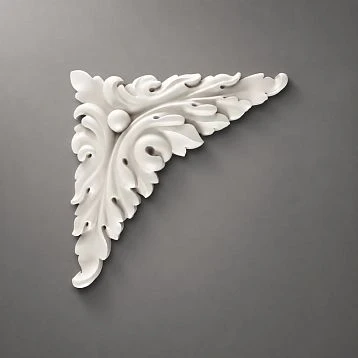
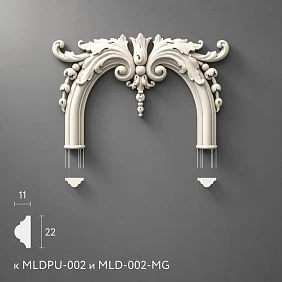
Corner overlays in molding frames eliminate the problem of 45° joints and add a decorative accent precisely at the frame's corner points. This solution is especially valuable where walls have irregularities and the corner joint is not perfectly accurate.
Decor for moldings: details that are visible up close
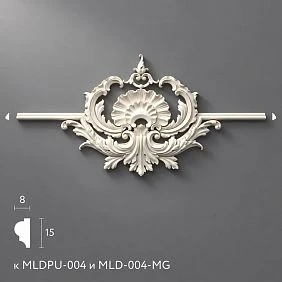
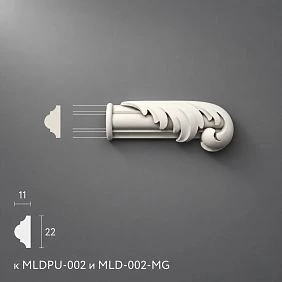
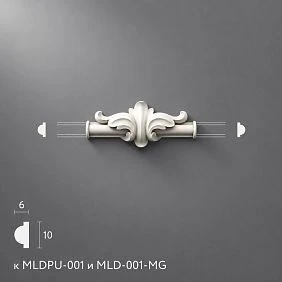
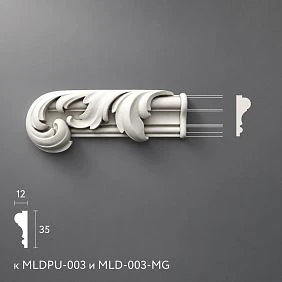
Decor for polyurethane moldings — corner elements, end caps, central rosettes for frames. These elements work up close and add jewelry-like detailing to decorative frames. They are noticed precisely when examining the interior in detail — and it is they that create the feeling of "everything is thought through to the end."
Wooden decor: what to buy for furniture and interior
Wood in a classic interior is not retro or archaic. It is a material that provides tactile warmth to the space. Cold polyurethane on the walls and warm wood on the furniture are not a contradiction, but a complement. They divide functions: polyurethane for architectural relief; wood for furniture structure, function, and touch.
Furniture legs and supports: the foundation of classic furniture
furniture legs made of solid wood — this is an element that determines the visual "weight" of furniture. A cabinet or table raised on turned legs looks light and classically correct. Furniture "on the floor," without legs, looks heavy and grounded.
In a classic interior, solid wood furniture legs are used on:
-
sofas and ottomans
-
coffee tables and consoles
-
on bedside tables and nightstands
-
on chests of drawers and sideboards
-
on bed frames
The leg shape defines the style. A straight tapered leg — neoclassical, strict. A turned baluster leg — Baroque, Rococo. A cabriole leg — French classic. A straight leg with fluting — Empire style.
Leg height affects proportions: for a cabinet 500 mm high, a leg of 80–120 mm looks proportional. For a sofa with a seat height of 440 mm, a leg of 100–150 mm.
Wooden handles: touching furniture
wooden furniture handles — the last detail touched by hands every day. That's why wood is irreplaceable here: it's warm, pleasant to the touch, and visually correct next to wooden furniture.
In a classic interior, handles are chosen to match the furniture style:
-
A turned knob handle with a round or oval shape — for chests of drawers and cabinets
-
A bracket handle with a curved crossbar — for wardrobes and sideboards
-
Long straight bracket with massive holders — for walk-in closets and large cabinet doors
Important principle: handles should match furniture legs in style. A turned leg and a curved bracket share a classic language. A straight leg and a geometric-based knob represent a stricter neoclassical style.
Wooden cornice: the top line of furniture
solid wood cornice — the finishing touch for any large furniture piece: sideboard, display cabinet, bookcase, built-in wardrobe. It is the cornice that creates the 'crown' of the furniture — the transition from the body to the ceiling or the upper space of the room.
For a built-in wardrobe that goes from floor to ceiling, the cornice is an element that unites the furniture with the room's architecture. A properly selected solid wood cornice with a ceiling molding of the same relief language creates the feeling that the wardrobe was designed together with the room — not placed into an existing space.
Furniture cornice width: from 40 mm for small cabinets to 100–120 mm for large wardrobes and sideboards.
Wooden baguette and moldings: slats, profiles, frame elements
solid wood millwork — slats, profiles, glazing beads, trims, baseboards, and cornice profiles made of natural wood. This section covers the need for molding materials for wooden furniture and interior finishing.
Wooden baguette is used:
-
as a frame element for mirrors and paintings
-
as a decorative layout on facades
-
as a profile for glass inserts
-
as an element of decorative panels on walls
For a classic interior, the right choice is millwork with a profile that matches the wall moldings. If the wall moldings have soft rounded edges, the wooden profile on the furniture should follow the same logic of shapes.
Decorative overlays made of solid wood
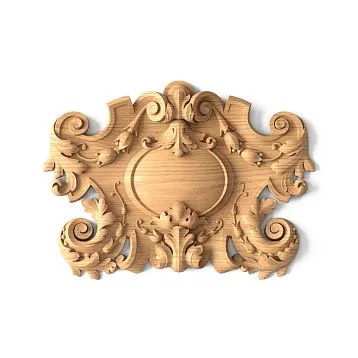
decorative elements for furniture made of solid beech and oak — overlays, rosettes, openwork elements for furniture facades. Unlike polyurethane overlays, wooden products can be tinted, stained, and varnished, leaving the wood texture visible.
Wooden overlays are used:
-
on horizontal crossbars of door frames
-
in the center of large facades of cabinets and sideboards
-
on side panels of cabinet furniture
-
as an accent element on the base or cornice line of furniture
How to combine wood and polyurethane in a classic interior
This is not a competition of materials — it's a distribution of roles. The rule is simple: wood where you touch and where strength matters; polyurethane where relief and quick installation are needed.
Walls — polyurethane; furniture — wood
Basic principle: wall decor from polyurethane, furniture detail — from wood. Molding frames on walls, ceiling cornice, baseboard — all polyurethane. Furniture legs, handles, cabinet cornice, overlays on facades — wood. This is the clearest and most logically justified division.
Uniform painting: the boundary between materials disappears
If furniture is painted to match the walls — polyurethane overlays and wooden handles are painted in a single color. The boundary between materials disappears, and the interior is perceived as a monolithic architectural space. This is the approach used in the best classic projects.
Technology: wood is sanded and primed with acrylic wood primer. Polyurethane is degreased and primed with adhesion primer for polyurethane. Then — a single finish paint. More details in the article what to glue polyurethane molding with.
Dark wood + white stucco: contrast as a technique
The second artistic approach: dark solid wood furniture (walnut, oak, wenge color) against a background of white walls with white polyurethane decor. This is an aristocratic contrast — warm dark wood of furniture and cold white architecture of walls. This solution is found in libraries and studies in the English style.
Five sets for different rooms
Set for a classic living room
Living room — a formal space. Here the decor should be the most saturated.
Walls and ceiling:
-
Moldings made of polyurethane for molding frames along the perimeter of the walls
-
Polyurethane cornice profile along the upper perimeter of the room
-
Polyurethane baseboard 100–120 mm high
-
Ceiling rosette in the center of the ceiling for a chandelier
-
Decor for Molding — corner elements in frames
Furniture:
-
Classic Furniture or custom furniture
-
wooden furniture handles — for cabinets, display cases, and bedside tables
-
Solid wood furniture legs — for coffee table, console, bench
-
wooden cornice for a sideboard or display cabinet
-
Polyurethane decorative appliques on solid facades
Consumables:
-
Assembly adhesive for polyurethane
-
Acrylic sealant
-
Wood primer, adhesion primer for polyurethane
-
Finish paint — white or colored
-
Acrylic putty for joints
Bedroom set with decor behind the headboard
Decor in the bedroom is about creating an accent zone behind the headboard. Molding frames on the wall behind the bed create a visual "altar" — an architectural completion of the sleeping area.
Wall behind the headboard:
-
Moldings made of polyurethane — one large frame or several vertical ones
-
Polyurethane decorative appliques — accent element at the center of the top part of the frame
-
Decor for Molding — corner elements
Furniture:
-
Bed with solid wood furniture legs — tapered or turned in a classic style
-
Nightstands with wooden knob handles
-
Decorative Inserts solid wood on the cabinet fronts
Additional Items:
-
Polyurethane baseboard in the same style as the living room
-
Glue, sealant, primer, paint
Classic-style hallway set
A hallway in a classic interior is the first impression. A small space, but rich in details.
Walls:
-
Moldings made of polyurethane — vertical frames along the hallway walls
-
Ceiling cornice — even in a narrow space, it sets the tone
-
Polyurethane baseboard
Furniture:
-
Console with furniture legs Solid wood
-
Mirror in a frame made of wooden trim or wooden cornice
-
Hanger or wardrobe with wooden handles
Study set in English style
Study — a space of strictness and concentration. Here, decor should be precise, without opulence.
Walls:
-
Moldings made of polyurethane with a straight profile — no baroque
-
Cornice — strict, without complex relief
-
Baseboard — tall (100–120 mm), without extra decorations
Furniture:
-
Desk with straight with matching legs — without curves
-
Wooden handles bracket type — horizontal, strict
-
Bookcase with with wooden cornices at the top
-
decorative elements for furniture — spotwise, without overload
Overall color: dark wood + white walls with white polyurethane decor — classic English contrast.
Set for built-in wardrobe in classic style
Built-in wardrobe in a classic apartment — not a storage room, but an architectural element. It should look like part of the wall, not like a piece of furniture placed in a niche.
Furniture decor:
-
wooden cornice along the top line of the cabinet — transition to the ceiling
-
Moldings made of polyurethane — molding frames on blank facades
-
Decorative Inserts — on the upper facades
-
Wooden handles — in the same style as the room's furniture
-
Pogonazh iz massiva — glazing bead if there are glass inserts
Wall decor nearby:
-
Continuation of the molding pattern from the room walls onto the side surfaces of the cabinet
-
polyurethane decor on the walls on the sides of the cabinet — for architectural unity
Table: what to use where in a classic interior
| Element | Where to use | Material | Section link |
|---|---|---|---|
| Moldings | Frames on walls | Polyurethane | Moldings made of polyurethane |
| Ceiling cornice | Top of walls | Polyurethane | PU moldings |
| Baseboard | Bottom line of walls | Polyurethane | PU moldings |
| Accent overlays | Walls, ceiling, furniture fronts | Polyurethane | PU overlays |
| Furniture legs | Sofas, cabinets, tables, beds | Solid wood | furniture legs |
| Handles | Cabinet, drawer, and box fronts | Solid wood | Wooden handles |
| Furniture cornice | Top of cabinets and sideboards | Solid wood | wooden cornice |
| Wooden overlays | Furniture facades | Solid wood | decor for furniture |
| Molding, baguette | Furniture, frames | Solid wood | Pogonazh iz massiva |
Mistakes when assembling a classic interior
Buying stucco without considering furniture
Polyurethane moldings are bought, walls are decorated — but then the chosen furniture turns out to be too light in scale. Thin legs, simple facades, minimal handles against the background of lush wall frames create dissonance. First, the furniture or at least its scale is determined, then the wall decor is selected.
Mixing different styles of wood and polyurethane
Baroque legs with a thin geometric molding is a stylistic conflict. All elements should speak the same decorative language: either soft classics with rounded edges, or strict neoclassicism with straight profiles.
Not calculating the material reserve
Reserve for moldings — at least 12%. For linear products and cornices — 10%. For overlays — 1–2 pieces above the calculation. Stucco is produced in batches, and buying the exact same profile a month later may be more difficult than it seems.
Forgetting glue, primer, and paint
These are consumables without which the decor cannot be installed. Mounting adhesive for polyurethane, acrylic sealant, wood primer, adhesion primer for polyurethane, finish paint — all of this is part of one order.
Choosing too active a relief for a small apartment
Wide moldings with deep relief, large overlays, heavy cornices — in a room of 12–14 m² this creates a feeling of overload. For small spaces — thin molding, modest cornice, spot overlays. Classics must be proportional to the space.
Not linking the baseboard, cornice, and furniture
An 80 mm baseboard and a 200 mm ceiling cornice are a disproportionate pair. The baseboard should be at least 1.5 times smaller than the cornice, but no less than 1/30 of the room height. The furniture cornice should echo the ceiling cornice in relief language — not necessarily match, but be "from the same family" of forms.
Additional keys and relevant catalog pages
A buyer who is looking for polyurethane molding in Moscow, is simultaneously interested in several related categories.
Furniture and interior items — ready-made classic solutions. The section classic furniture contains products that are already designed in the required stylistic language and are compatible with polyurethane decor.
Wooden furniture legs — Solid wood furniture legs in various shapes: conical, turned, figured, with a metal tip. They are used both in custom furniture manufacturing and in restoring existing pieces.
Uncoated handles — uncoated wooden handles for those who paint furniture themselves and want a uniform color for the facade and handle.
Polyurethane products — full section polyurethane products for those who assemble a set of decor for walls, ceiling, and furniture.
Decor calculation for a classic living room: example
Living room 5.0 × 4.0 m, ceiling height 3.0 m.
Ceiling cornice: perimeter 18 m, cornice 120 mm. With 10% margin: ~20 m.
Baseboard: perimeter 18 m minus doorways (~2 × 1.0 m = 2 m) = 16 m. With 10% margin: ~18 m.
Molding frames on walls (6 frames ~80×120 cm): perimeter of one = (80+120)×2 = 400 cm. 6 frames × 400 = 2400 cm = 24 m. With 12% margin: ~27 m.
Corner elements: 6 frames × 4 corners = 24 pieces.
Ceiling rosette: 1 piece.
Glue: ~7 tubes (based on 1 tube per 4 m).
Sealant: 3 tubes of acrylic.
Primer and paint: according to the finishing area.
Furniture supports: 4 pieces for the console + 6 for the coffee table = 10 pieces.
Handles: according to the number of facades.
These are not rough estimates — this is a real calculation for a typical Moscow living room.
FAQ: questions from Moscow buyers and detailed answers
What to buy for a classic interior in Moscow?
For walls — Moldings made of polyurethanecornice profile, baseboard, Decorative Inserts и Decor for Molding. For furniture — Wooden handles, furniture legs, wooden cornice, planks from solid wood. Plus consumables: glue, sealant, primer, paint.
Can you combine wooden decor and polyurethane molding in one interior?
Yes. This is standard practice in classic interior design. polyurethane decor — for walls, ceilings, and decorative frames. Wooden decoration — for furniture, handles, and structural elements. With a uniform color, the boundary between materials disappears.
What should you buy first: furniture or molding?
First — determine the style and scale of the furniture (or select specific items from the section classic furniture). Then — select moldings, cornices, baseboards, and decorative elements that match the furniture in style.
What stucco decor suits classic furniture with dark wood?
Strict moldings with moderate relief, without lavish baroque. Cornice profile with clear horizontal lines. Overlays are applied sparingly, without overload. The general principle: the decor should be quieter than the furniture, so as not to compete with the texture of dark wood.
Is a ceiling rosette needed in every room?
No. A ceiling rosette is needed where there is a chandelier or a large pendant light. In a bedroom with spot lighting, it is optional. In a living room with a formal chandelier, it is mandatory.
How to calculate the amount of molding for frames on walls?
Calculate the perimeter of each frame, sum them up, and add 12–15% for trimming. Don't forget corner pieces: 4 pieces per frame. It's better to buy with a reserve — molding from the same batch is easier to match in color when painting than one purchased later.
How to choose the height of furniture legs for a classic dresser?
Approximately: leg height = 15–20% of the total product height. For a dresser 800 mm — legs 120–160 mm. For a cabinet 500 mm — 80–100 mm. High legs make furniture light and elegant; low legs make it heavy and grounded.
STAVROS: full range for classic interiors in Moscow
STAVROS is a manufacturer of wooden decor and moldings from polyurethane with a wide range for creating classic interiors. The STAVROS catalog has everything you need to assemble a set from walls to furniture: Polyurethane moldings, cornices, and baseboards, Polyurethane decorative appliques, Decor for Molding, Wooden handles, Solid wood furniture legs, wooden cornice, Pogonazh iz massiva и wooden decorative elements.
STAVROS production is located in Saint Petersburg. Wooden products are made from solid beech and oak. Polyurethane products are manufactured using precision casting, preserving all relief details. Delivery across all of Russia, including Moscow and the Moscow region, as well as to CIS countries. Showrooms in Moscow and Saint Petersburg — for those who prefer to first see and feel the material, and only then make a decision about ordering.