Article Contents:
- Introduction: From Ancient Plaster to 21st Century Polyurethane
- Types of Molding: Ceiling, Walls, Facade
- Ceiling Molding: Cornices, Rosettes, Molding Strips
- Wall Molding: Pilasters, Panels, Overlays
- Facade Molding: Brackets, Archivolts, Capitals
- Polyurethane vs. Plaster vs. Polystyrene Foam
- Material Comparison Table
- Why Polyurethane Molding Wins in 2026
- Assortment of Decorative Molding
- Cornices and Molding
- Polyurethane Moldings and Cornices
- Molding Decor: Mascarons, Brackets, Consoles
- Molding in Interior Design: Styles and Application
- Classicism and Baroque
- Neoclassicism and art deco
- Scandinavian Minimalism with Molding Elements
- How to Install Polyurethane Molding
- Adhesive, Dowels, Surface Preparation
- Installation on Ceilings and Walls
- Facade Molding: Features of Outdoor Application
- Weather Resistance of Polyurethane
- Painting and Final Finishing
- Buying Molding: How Not to Make a Mistake When Choosing a Supplier
- Additional Topic Keywords: Expanding Horizons
- Polyurethane Products: A Broad Perspective
- Molding Decor: Completing the System
- FAQ: Answers to Popular Questions
- Conclusion: Why STAVROS is the Choice of Professionals
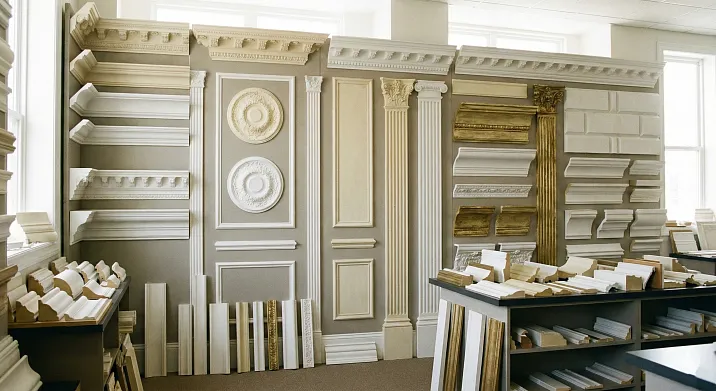
There are details that remain silent—and yet say everything. As soon as you enter a room where a finely crafted cornice runs along the perimeter of the ceiling, where pilasters frame the window, and a bas-relief glimmers above the doorway—you immediately understand: this is not just a renovation. It's a statement about taste, about character, about how a person relates to the space around them.MoldingsMolding has always been such a statement—ever since ancient masters first mixed alabaster and traced an ornament on the wall of a Greek temple.
Today, molding is experiencing a second golden age—and it's not linked to a revival of Baroque fashion, but to the emergence of a fundamentally new material: polyurethane. It achieved what seemed impossible: it took the luxury of classical architecture, removed tons of weight, the expense of manual labor, and the fragility of plaster—and offered the result to anyone who desires it.
This guide is about how to choose, apply, and correctly install molding in 2026. No fluff. Just the essentials.


Introduction: From Ancient Plaster to 21st Century Polyurethane
The first plaster decorations appeared more than two thousand years ago. In Ancient Greece and Rome, craftsmen used lime, gypsum mixed with marble chips, and terracotta. Acanthus leaves on capitals, meanders on friezes, Gorgon masks above entrances—all were created by hand, slowly, laboriously, and flawlessly.
During the Renaissance, plasterwork ceased to be a privilege of temples and moved into palaces. Leonardo da Vinci and his contemporaries developed projects in which plaster decor became part of a unified artistic concept. Baroque took this to the extreme: the ceilings of Versailles, the Winter Palace, and Viennese aristocratic mansions literally scream with gold and white plaster.
The 20th century was cruel to plasterwork. Constructivism, functionalism, Soviet asceticism—all swept ornaments from walls as bourgeois excess. But the nature of style takes its toll: already in the 1980s, postmodernism returned plaster details to elite construction, and in the 2000s, the broad market of finishing materials offered polyurethane.
Polyurethane changed the rules of the game. Light as foam, strong as plastic, moisture-resistant, frost-proof, and capable of taking any shape—it madepolyurethane moldingaccessible for an apartment in a panel building as well as for a mansion in a neoclassical style.




Types of plasterwork: ceiling, walls, facade
Our factory also produces:


Ceiling plasterwork: cornices, rosettes, moldings
The ceiling is the largest untouched surface in most interiors. That is whyCeiling moldingproduces the greatest effect: it works on the entire space at once, shaping its perception from the threshold.
Cornices and moldings are linear elements that run along the perimeter of the ceiling or frame its individual zones. A molding is essentially a decorative profile with a complex cross-section: it creates a play of light and shadow, conceals the joint between the ceiling and wall, and marks transitions between functional zones. The cross-section of a molding can be laconic (for Scandinavian and minimalist interiors) or rich in details (for classic and Baroque styles).
Ceiling rosettes are one of the most recognizable elements of a classic interior. They are installed in the center of the ceiling, around a chandelier or spot light. A rosette does not just hide wires and mounting holes—it creates a visual focus, a point of attraction for the gaze, and forms the main lighting zone.Ceiling moldingin the form of rosettes ranges from strict round shapes with a diameter of 20 cm to large multi-tiered medallions of 1.5–2 meters.
Decorative moldings and panels allow dividing the ceiling into coffers—rectangular or square frames with relief framing. A coffered ceiling—a tradition rooted in ancient architecture—is now realized with polyurethane moldings literally over a weekend.
Get Consultation
Plasterwork for walls: pilasters, panels, overlays
Walls are a space for the boldest experiments.Molding for wallscan be grand (when entire wall sections are covered with relief panels) and delicate (when a single molding divides the surface into upper and lower fields, instantly creating an effect of 'expensive renovation').
Pilasters are flat columns attached to a wall. They structure space, add verticality, and visually raise the ceiling. In a classic interior, pilasters flank doorways, windows, and bookshelves. In a modern one—they are used as a single expressive accent on a feature wall.
Decorative panels and frames turn simple walls into something resembling a 19th-century hall. Each 'frame' made of molding is an independent composition, inside which you can place a fresco, mirror, fabric, or simply leave a color accent.
Overlays and friezes work as a decorative belt—a horizontal strip of ornament dividing the wall approximately at picture level. A frieze can be geometric, floral, abstract—depending on the style of the room.
Plasterwork on the facade: brackets, archivolts, capitals
Stucco on the Facadeis a completely different story. There is no place for fragility here: the material must withstand freeze-thaw cycles, heavy rains, temperature fluctuations from −30°C to +60°C, and ultraviolet radiation.
Brackets are decorative console elements supporting a cornice or balcony. In classical architecture, they bore structural loads; today, in the vast majority of cases, they are purely decorative. Polyurethane brackets are attached with dowels and adhesive and are visually indistinguishable from gypsum or concrete counterparts.
Archivolts are decorative framings of arched openings. They turn an ordinary door or window opening into an architectural element worthy of a palace. At the same time, they are installed in a few hours.
Capitals are the top finishes of columns or pilasters. Ionic, Doric, Corinthian—each order has its own character. Polyurethane capitals reproduce the finest details of historical samples with precision unattainable in manual gypsum casting.
Polyurethane vs. gypsum vs. polystyrene foam
This is the main question asked by everyone who encounters the choice for the first time. The answer lies in the details.
Material comparison table
| Characteristic | Polyurethane | Gypsum | Polystyrene foam (EPS) |
|---|---|---|---|
| Weight | Very light (0.3–0.6 kg/m²) | Heavy (3–8 kg/m²) | Very lightweight (0.15–0.3 kg/m²) |
| Moisture resistance | High, does not absorb water | Low, swells and crumbles | Medium, surface is vulnerable |
| Frost resistance | Excellent (down to −40°C) | Poor, cracks when frozen | Satisfactory |
| Strength | High, resilient | Brittle, chips easily | Low, dents upon impact |
| Detailing | Highest | High | Medium |
| Installation | Simple, adhesive + anchors if needed | Complex, requires reinforcement | Simple, but not for facades |
| Painting | Excellent adhesion to any paints | Requires primer | Requires special compounds |
| Price | Medium | High (including installation) | Low |
| Application | Interior + facade | Interior only | Interior only |
| Service life | 30–50 years and more | 20–30 years | 10–15 years |
Why polyurethane stucco wins in 2026
Three words: versatility, durability, cost-effectiveness. PolyurethanePolyurethane Items covers absolutely all application scenarios — from a delicate medallion in a nursery to a massive cornice on a shopping center facade.
Plaster is beautiful, but it lives in warmth and dryness. A leak appears — and the expensive plaster ornament turns to dust. Foam is cheap, but is perceived precisely as foam: it leaves dents at the slightest mechanical contact, requires several layers of primer when painting, and doesn't work on facades at all.
Polyurethane is a European two-component compound that, after polymerization, becomes a material that is resilient under load and hard on the surface. A fist punch — it springs back, doesn't crack. A bucket of water — it runs off, isn't absorbed. Minus twenty degrees frost — no cracks. That's whyDecorative stucco made of polyurethane today is the standard, not an exotic choice.
Assortment of decorative stucco
Rosettes and medallions
Rosettes — one of the most popular elements in the categoryRelief DecorationTheir diameter ranges from 20 to 200 cm. Small rosettes serve as a delicate accent around a light fixture; large medallions become standalone works of art that draw the eye upward.
The ornamentation of rosettes encompasses the full diversity of architectural styles: laurel garlands, acanthus leaves, shells, geometric stars, agrafes. For modern interiors, there are rosettes with minimalist relief—almost devoid of details, just form and shadow.
The fundamental advantage of polyurethane rosettes is their reproduction accuracy. Every detail, down to the millimeter-thin veins on an acanthus leaf, is rendered with the highest clarity thanks to precise, European-made silicone molds.
Polyurethane moldings and cornices
Polyurethane moldingsin the form of moldings and cornices—this is the most 'workhorse' category of the assortment. Moldings are used everywhere: to form decorative frames on walls, to frame mirrors and paintings, to create coffered ceilings, to finish furniture fronts.
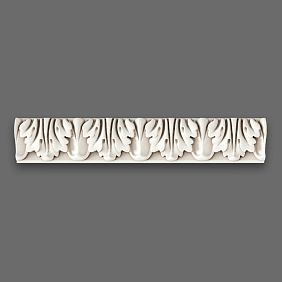
Cornices are larger profiles that perform an architectural role: they mark the transition between wall and ceiling, between floors, between functional zones. A cornice with a complex cross-section featuring several profiles (fillet, quarter-round, ovolo, reverse ovolo) is a condensed reproduction of a classical entablature, the language of order architecture.
Polyurethane Decorin the form of cornices is sold by the linear meter and can be cut to any angle using a miter box or corner template. Joints at corners become practically invisible after puttying and painting.
Stucco decor: mascaron, corbels, consoles
A mascaron—a mask with a human or fantastical face—is one of the most ancient architectural ornaments. It was hung above gates, keystones of arches, at building entrances. Today, a mascaron is a striking element that puts the finishing touches on a classical or eclectic interior.
Corbels and consoles serve the role of decorative 'supports'—under a shelf, under a balcony, under a window pediment. They lend a sense of weight and justification to horizontal elements. Without a corbel, a shelf 'hangs'; with a corbel—it is 'supported' by the entire architectural logic.
You can buy ready-made stucco matching the Baroque style. Calculate the quantity: linear meters of cornices and moldings, number of rosettes, pilasters, consoles, corner elements. Add a ten to fifteen percent allowance for trimming.in these formats is available today both in standard sizes and made-to-order—for non-standard architectural situations and custom projects.
Stucco in the interior: styles and application
Speaking ofstucco in the interior, it's important to understand: it is not a tool of just one style. Stucco works everywhere—you just need to choose the correct scale and plasticity of the ornament.
Classical and Baroque
This is the historical homeland of stucco. Lush acanthus leaves, putti (cherubs), coffered ceilings, gilded cornices—this is Baroque in full force. To recreate a classical interior, choose deep relief, complex multi-tiered cornices, rosettes with rich ornamentation.
The color scheme of classicism is white on white (monochrome stucco on a white ceiling) or gold on ivory. Contrasts are not appropriate here: Baroque works through an abundance of details, not through color shock.
A deep cornice 20–30 cm wide, installed around the perimeter of a room with ceiling heights from 3 meters, instantly returns the interior to the era of palace halls. And this can now be done not in a month of a master plasterer's manual work, but in one day of installing polyurethane profiles.
Neoclassicism and Art Deco
Neoclassicism is a more restrained version of the classical style. Fewer curls, cleaner lines, more geometry.Ceiling moldingin a neoclassical interior—these are straight moldings forming rectangular frames on ceilings and walls, elegant cornices without overloading details, rosettes with laconic relief.
Art Deco adds geometric sharpness to the neoclassical foundation: stepped cornices, zigzags, fan ornaments, graphic moldings with angular transitions. This is a style where luxury coexists with intellect, and decor is never accidental.
In Art Deco, contrasting solutions work excellently: dark walls with snow-white stucco or, conversely, white walls with tinted (black, gold, bronze) moldings.
Scandinavian minimalism with stucco elements
It would seem that stucco and minimalism are antonyms. But this is a common misconception. A thin molding—a 'cove'—around the ceiling perimeter, creating a barely noticeable shadow—that is minimalist stucco. One elegant rosette above the central light fixture. A simple baseboard with a laconic profile.
The Scandinavian approach is 'less, but more precise.' One expressive element instead of ten average ones. White on white, matte surface, no gold. The result is an interior that seems simple at first glance and incredibly thoughtful upon the second.
How to install polyurethane stucco
Adhesive, dowels, surface preparation
Installationdecorative moldingis a task manageable for anyone with basic construction skills. The main thing is to properly prepare the surface and choose the correct adhesive.
Surface preparation:
-
The wall or ceiling must be dry, cleaned of dust and loose coatings.
-
The ideal base is puttied and primed concrete or drywall.
-
If the surface is painted with oil-based paint—it needs to be sanded down to a solid layer or treated with an adhesion primer.
-
Textured wallpaper is not suitable — only smooth substrates
Adhesive selection:
For polyurethane moldings, specialized polymer adhesives such as 'liquid nails' for PU products or acrylic mounting adhesive are used. Silicone sealants are not suitable — they remain elastic and do not provide a rigid seam, which leads to sagging of large elements.
Dowels:
Large cornices and heavy decorative panels are additionally secured with dowel nails or self-tapping screws through pre-drilled holes. After installation, the fastener heads are filled with putty, the surface is sanded — and no trace of the dowels remains.
Installation on ceilings and walls
Step-by-step installation of cornice or molding:
-
Mark the installation line along the perimeter of the ceiling using a laser level or a chalk line
-
Cut the profile into the required lengths, make corner joints at 45° using a miter box
-
Apply adhesive in a zigzag strip to the back side of the profile
-
Press the profile against the surface, align it with the markings
-
Secure with painter's tape while the adhesive sets (15–30 minutes)
-
Fill the joints with acrylic sealant or finishing putty
-
After drying (24 hours), sand the joints with fine sandpaper and paint
Rosettes are mounted similarly: adhesive around the perimeter + 1–2 self-tapping screws in the center (hidden under the central element of the rosette). The center of the rosette must exactly coincide with the center of the ceiling or the chandelier suspension point.
Wall elements — moldings, frames, pilasters — are attached according to the same principle. Vertical alignment is checked with a level, horizontal alignment — with a laser or a stretched string.
Molding for facades: features of outdoor application
Weather resistance of polyurethane
Stucco on the Facade— these are completely different requirements compared to interiors. Facade decor lives outdoors: rain, snow, ice, sun, wind with sand. Plaster on the facade is archaic: it absorbs water, freezes, and deteriorates within just 2–3 seasons.
Polyurethane behaves fundamentally differently. The material has zero water absorption — water simply runs off the surface without penetrating the structure. When freezing, there is nothing to expand inside the product, meaning there is no destructive internal pressure. The operating temperature range is from −40°C to +80°C, covering the climatic conditions of most of Russia.
Ultraviolet radiation affects the surface layer of paint, but not the polyurethane itself. When using facade acrylic or silicone paint, the service life of the decor without repainting is 7–10 years; repainting is an easy job with a brush or spray gun without dismantling the elements.
Painting and final finish
Relief DecorationPolyurethane molding is supplied in white — and this is technically a finished state, ready for painting without primer (although primer improves adhesion and extends the life of the finish layer).
Finishing options:
-
White paint — the most common choice for classic interiors. The molding 'dissolves' into the white ceiling, creating a volumetric effect without color contrast
-
Tinted paint matching the walls — the effect of 'hidden' molding, noticeable only with side lighting
-
Contrasting color — white molding on a dark wall or, conversely, dark tinting on a light background
-
Patination — applying gold, bronze, or silver paste into the relief and then wiping it off the raised areas. The effect of aged metal, strikingly convincing
-
Stone imitation — using decorative plasters directly on the polyurethane base
Buying molding: how not to make a mistake when choosing a supplier
The molding market is huge, and like any large market, it has its pitfalls. Cheap products made from recycled materials, not resistant to environmental impact; unscrupulous suppliers selling polystyrene foam under the guise of polyurethane; incomplete orders — these are all real risks.
Stucco in St. Petersburgand other major cities is represented by dozens of brands. How to choose one you can trust?
Criteria for selecting a supplier:
-
Material — clarify: is it a two-component rigid polyurethane of European production or an imitation? Ask for the material's technical data sheet. High-quality PU does not burn with an open flame, is resilient when pressed, and does not leave white marks when bent.
-
Detailing — examine a sample in your hands. Every line should be clear, without blurred edges, flash, or bubbles on the surface. The back side should be even, without voids.
-
Assortment — a serious supplier offers the full spectrum: from rosettes and moldings to brackets, capitals, and facade archivolts. A narrow assortment is a sign of a small-scale reseller.
-
Service — availability of technical consultations, assistance in selecting elements for the project, possibility of custom manufacturing.
-
Delivery — products should arrive in reliable packaging, without deformations. Clarify delivery terms across Russia.
You can buy ready-made stucco matching the Baroque style. Calculate the quantity: linear meters of cornices and moldings, number of rosettes, pilasters, consoles, corner elements. Add a ten to fifteen percent allowance for trimming.with confidence in quality — means choosing a supplier with its own production, confirmed European materials, and a real assortment, not just pictures in a catalog.
Additional topic keys: expanding horizons
Polyurethane products: a broad perspective
polyurethane products— is not just stucco in the classical sense. It's a whole ecosystem of decorative elements: skirting boards with profile sections, corner overlays for protecting and decorating wall edges, window casings, door portals, decorative beams imitating natural wood.
Polyurethane decorative beams — a separate story. Hollow inside, lightweight outside, they create the illusion of a wooden ceiling that is indistinguishable from the original at arm's length. At the same time, they do not rot, do not deform from moisture, and weigh 10 times less than real timber.
Stucco decor: completing the system
Moldings decorationin 2026 — is a system, not a set of separate elements. Designers work with stucco as an architectural language: rosettes, cornices, moldings, pilasters are chosen from a single collection so that proportions and ornamentation match. Mixing incompatible styles (for example, a Baroque rosette with a minimalist cornice) destroys the integrity of the interior.
The rule is simple: choose a style — and stick to its assortment logic. Suppliers with a wide catalog, as a rule, offer a collection approach: all elements within one collection are developed in a unified scale and plastic language.
FAQ: Answers to popular questions
Can polyurethane stucco be installed independently, without a professional?
Yes. The low weight of the products and the simplicity of installation with adhesive make this work accessible to a person without construction expertise. Necessary: adhesive for PU products, a miter box, a level, painter's tape, and patience. Ceiling cornices and medium-sized rosettes can be installed by one person without assistants.
Can polyurethane stucco be painted with acrylic paint?
Yes, this is the preferred option. Acrylic water-based paint adheres well to polyurethane, does not clog fine relief when applied with a brush or spray gun, and dries quickly. Preliminary priming with acrylic primer improves adhesion and reduces paint consumption.
Is polyurethane stucco suitable for bathrooms and other wet areas?
Yes. Polyurethane is completely water-resistant. It is only necessary to use moisture-resistant adhesive and seal the joints with silicone. Special moisture-resistant acrylic paints are used in pools and saunas.
How long does polyurethane molding last?
With proper installation technology and periodic repainting (every 7–10 years for facades, less often for interiors) — 30–50 years. Many objects equipped with polyurethane decor in the 1990s look like new today after one repainting.
Are there environmental requirements for polyurethane stucco?
High-quality polyurethane after polymerization is chemically inert, does not emit volatile compounds, and is not a source of odor. For residential premises, it is important to choose products with certificates of conformity — European manufacturers always provide them.
How to cut polyurethane moldings?
With a hacksaw for metal or a sharp saw with fine teeth. Angled cuts at 45° are made with a miter box — a special template tray with slots for the required angle. The cut is smoothed with P120 sandpaper.
What is the difference between trim and overlay elements?
Trim — are linear products sold by the meter: moldings, cornices, trims, skirting boards. Overlay elements — are piece products: rosettes, medallions, brackets, mascaron, capitals. Both types are used in combination to create a complete decorative image.
Where to buy quality stucco in St. Petersburg?
Large suppliers with their own production work both in offline format (showroom + warehouse) and in an online store. Orders can be placed online with delivery across all of Russia.
Conclusion: Why STAVROS Is the Choice of Professionals
Molding is not a purchase of 'something for decoration.' It is an investment in the image of a space, in its character, in the impression it will make every day—on you, on guests, on residents. That is why the question of quality here brooks no compromise.
STAVROS is a company with an impeccable reputation in the Russian market for decorative polyurethane molding. All products are made from high-quality European two-component polyurethane—a material that ensures exceptional relief detail, durability, and resistance to all operating conditions.
The STAVROS catalog covers the full range of decorative elements: from ceiling rosettes and moldings to facade brackets, capitals, and archivolts. Each item is developed with attention to proportion and the historical authenticity of the ornament, allowing for the creation of interiors where all details speak the same language.
STAVROS works with designers, architectural firms, construction companies, and private clients—both in St. Petersburg and throughout Russia. Here, they don't just sell molding—they help create a space to be proud of.
If you want your project to be exactly like that—start with the right choice. Start with STAVROS.