Article Contents:
- Flexible slat panel PAN-007: which dimensions are confirmed by the product card
- Column Ø300 mm: what is the actual circumference
- Width allowance: how the solution changes with the actual diameter
- How the allowance changes if the actual diameter differs from 300 mm
- Maximum diameter for one panel: reverse calculation
- Column radius Ø300 mm: why R150 needs to be approved separately
- How to check the ovality of a column
- When you have to buy a second PAN-007 module
- Why the 23 × 8 mm profile affects the joint location
- MDF slat panel PAN-007 on a column: when it is more convenient under enamel
- One module or two: commercial decision table
- How to check the real stock of one panel after measuring
- MDF, beech, and oak: why one quantity calculation does not mean one technology
- What height allowance is needed on a 2300 mm column
- Commercial specification for one Ø300 mm column
- Decision tree: one PAN-007 or two
- If one panel is not enough: how to calculate the second module without errors
- How to document the 'one panel' decision in the working documentation
- What is the width of PAN-007?
- What is the rail profile?
- What is the circumference of a column with a diameter of 300 mm?
- How much remains from a 1010 mm panel?
- Is one PAN-007 enough for a full rotation?
- What is the radius of a Ø300 mm column?
- Can R150 be considered acceptable for any PAN-007 material?
- When is a second module definitely needed?
- Where is the best place to make a vertical joint?
- Will MDF 2670 mm fit a 2300 mm column?
- Will beech or oak 2400 mm fit a 2300 mm column?
- Can I take beech/oak 2400 mm for a column exactly 2400 mm?
- What is OPAN-007 for?
- What is more important: diameter or circumference?
- Can I measure only one diameter?
- If the column is oval, does the formula πD work?
- Do I need to buy a second panel as a backup?
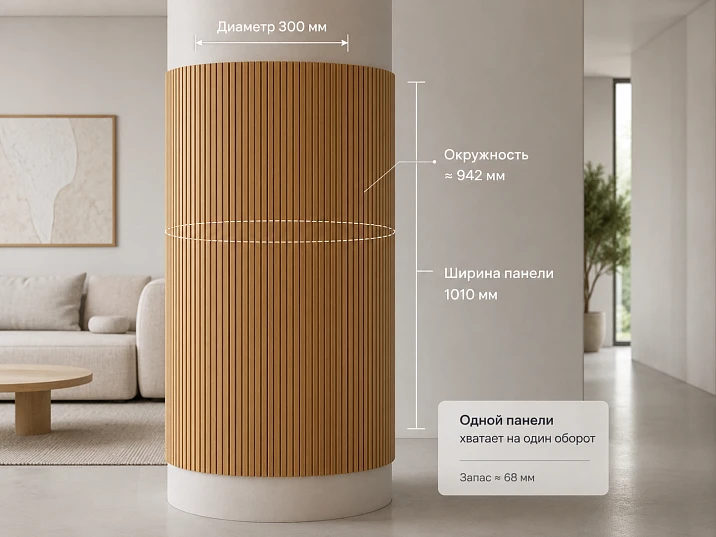
A round column is already prepared for finishing, its design diameter is 300 mm. For cladding, a flexible slat panel PAN-007 with a width of 1010 mm is selected. At the first calculation, everything looks simple: the circumference of a column with a diameter of 300 mm is approximately 942.5 mm, and the panel is wider — about 67.5 mm remains. So, by pure geometry, one module is indeed enough for a full turn.
But this is not enough to immediately place an order for one PAN-007. Four things need to be confirmed: the actual column diameter after puttying and final preparation; the allowable bending radius of the specific MDF, beech, or oak version chosen; the location and geometry of the vertical closing joint; the actual technological width after trimming. If at least one of these parameters eats up the entire 67.5 mm allowance, the preliminary calculation stops working.
Therefore, the correct answer is this: for a perfectly round column Ø300 mm, one PAN-007 with a width of 1010 mm is geometrically sufficient, but buying one module as guaranteed sufficient is possible only after a control measurement and confirmation of the bending radius of the selected material.
If the project is already calculated and the product is needed, you can Buy slatted panels for wall finishing in the general section and then go to the specific PAN‑007. But for a round column, the quantity must be determined not by the catalog width as a single number, but by the maximum actual circumference and the mounting joint node.
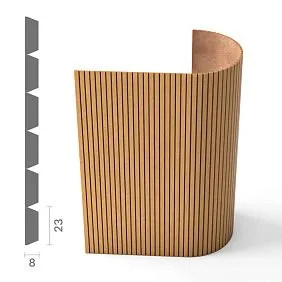
Flexible slat panel PAN‑007: which dimensions are confirmed by the card
PAN‑007 is a flexible slat panel on a fabric base with a pronounced vertical relief. The confirmed width A is 1010 mm, depth C is 8 mm, and the slat profile is 23 × 8 mm. The card directly allows use on columns, curved walls, radius posts, and other curved surfaces.
| Parameter | Current value | Why this is needed in a column project |
|---|---|---|
| Panel width A | 1010 мм | Compared with the column circumference |
| Depth C | 8 мм | Forms the relief and affects the outer diameter of the finished cladding |
| Slat profile | 23 × 8 mm | Determines the rhythm and visibility of the closing joint |
| MDF | 950 and 2670 mm | Selection by column height |
| Beech | 950 and 2400 mm | Natural wood, requires radius check |
| Oak | 950 and 2400 mm | Natural wood, requires radius check |
In the search index and old displays, MDF 740 mm is still found, but the current main card table shows 950 and 2670 mm for MDF and 950/2400 mm for beech and oak. For the article, the actual primary card is used.
After checking the column, you can slat panel PAN-007 for the column include it in the exact specification. The main question here is not just “is 1010 greater than 942.5?”, but “what is the working width after actual measurement and installation trimming?”




Column Ø300 mm: what is the actual circumference
The circumference of a round column is calculated using the formula:
C = π × D,
where D is the diameter.
For Ø300 mm:
3.1416 × 300 ≈ 942.5 mm.
Let's compare with the width of PAN‑007:
1010 − 942.5 ≈ 67.5 mm.
That is, with an ideal cylinder and no trimming losses, one module covers a full revolution and leaves about 67.5 mm of margin.
| Parameter | Value |
|---|---|
| Column diameter | 300 мм |
| Calculated circumference | ≈ 942.5 mm |
| Width of PAN‑007 | 1010 мм |
| Theoretical remainder | ≈ 67.5 mm |
This is a good preliminary result, but it does not prove that the same 67.5 mm will remain after finishing and trimming. The actual column may have a diameter of 302, 305, or 310 mm, and the closing joint may require technological trimming according to the batten rhythm.
Our factory also produces:

Width margin: how the calculation changes with the actual diameter
Get Consultation
How the margin changes if the actual diameter differs from 300 mm
For an order, it is useful to see the sensitivity of the calculation to a few millimeters. The closer the actual diameter is to the limit, the smaller the margin of one panel.
| Actual diameter | Circumference | Remainder from 1010 mm |
|---|---|---|
| 295 мм | ≈ 926.8 mm | ≈ 83.2 mm |
| 300 мм | ≈ 942.5 mm | ≈ 67.5 mm |
| 302 мм | ≈ 948.8 mm | ≈ 61.2 mm |
| 305 мм | ≈ 958.2 mm | ≈ 51.8 mm |
| 310 мм | ≈ 973.9 mm | ≈ 36.1 mm |
| 315 мм | ≈ 989.6 mm | ≈ 20.4 mm |
| 320 мм | ≈ 1005.3 mm | ≈ 4.7 mm |
| 322 мм | ≈ 1011.6 mm | One module is no longer enough even theoretically |
The table shows why you cannot rely only on the design Ø300 mm. If after leveling the column grows to 315 mm, the clearance decreases from 67.5 to 20.4 mm. At 320 mm, nominally less than 5 mm remains — practically this is already a borderline scenario requiring very precise verification.
Maximum diameter for one panel: reverse calculation
If you do not account for the technological allowance, the theoretical maximum diameter is calculated as follows:
Dmax = 1010 ÷ π ≈ 321.5 mm.
But such a calculation "to zero" is unsuitable for ordering. If you need to leave at least some reserve for trimming and joining, the allowable diameter decreases.
| Width reserve | Maximum theoretical diameter |
|---|---|
| 0 мм | ≈ 321.5 mm |
| 10 мм | ≈ 318.3 mm |
| 20 мм | ≈ 315.1 mm |
| 30 мм | ≈ 311.9 mm |
| 40 мм | ≈ 308.8 mm |
| 50 мм | ≈ 305.6 mm |
| 60 мм | ≈ 302.4 mm |
This table does not establish a mandatory reserve. It shows the logic: if the workshop says that for a specific joint and trimming, for example, 30 mm of working width needs to be preserved, the maximum diameter is no longer 321.5, but about 311.9 mm. The exact value of the technological reserve is determined by the installation scheme, not by a universal standard.
Why can't you immediately order one PAN‑007 based only on the calculation 942.5 < 1010
There are several reasons why one module may be insufficient or undesirable, even if the net circumference is less than the width.
The diameter may change after base preparation
Putty, leveling layer, decorative shell, or local repair increase the outer diameter. On a round column, even a few millimeters in radius give a doubled change in diameter.
The column may not be a perfect cylinder
One diameter of 300 mm at the bottom and 300 mm at the top does not guarantee that there is no thickening in the middle. For purchasing, the maximum circumference along the entire height is important.
The working width after trimming is less than 1010 mm
If the edge of the panel needs to be trimmed along a batten, fabric base, or another technological principle, part of the nominal width ceases to participate in the turnover.
The closing joint must fall into the correct rhythm
On the 23 × 8 mm profile, the visual step is large. Sometimes geometrically it is possible to close the circle, but the last batten turns out too narrow or the joint falls in an unfortunate place.
The bending radius of the selected material must be confirmed
The card directly requires checking the allowable bending radius for the specific material before radius installation. Ø300 mm means a radius of 150 mm. It cannot be automatically claimed that MDF, beech, and oak in PAN‑007 equally allow R150 just because the panel is called flexible.
Radius R150: separate check of PAN‑007 material
Column radius Ø300 mm: why R150 needs to be coordinated separately
For a column with a diameter of 300 mm, the geometric radius is:
300 ÷ 2 = 150 mm.
This is one of the main parameters of the request to the manager. The manufacturer confirms that PAN‑007 is suitable for columns and radius surfaces, but at the same time requires checking the allowable bending radius of the selected material.
Therefore, you cannot write: "PAN-007 definitely bends at Ø300 mm." The correct wording is: for a Ø300 mm column, a bend of approximately R150 is required, and its acceptability must be confirmed for the selected MDF, beech, or oak version before ordering.
If one material does not allow such a radius, the number of panels does not solve the problem. Two panels will not make a separate module more flexible. You need to either choose a different version or change the cladding design.
How to correctly measure a column before buying a slat panel
The design diameter is only a starting point. Before ordering, the column must be measured against the finished base.
Diameter at the bottom
Measured at the height where the panel begins. A plinth, base, or decorative foundation should not be included in this dimension if PAN-007 starts above it.
Diameter in the middle
This is where local thickening or ovality is often detected.
Diameter at the top
The upper part may differ after adjoining the ceiling or decorative cornice.
Actual circumference with a flexible tape measure
This is especially useful for ovality. The diameter in two directions may not give the full picture, but a flexible measuring tape immediately shows the real circumference.
Finished facing height
For a nominal column of 2300 mm, you need to determine which standard PAN‑007 length fits without a horizontal joint.
Location of the future vertical seam
The joint must be chosen before cutting, because its position affects the start and end of the slat rhythm.
The maximum actual circumference, not the average diameter, is used in the procurement calculation. If it is 942 mm at the bottom, 948 mm at the top, and 962 mm in the middle, you must calculate from 962 mm.
How to check column ovality
A column that looks round may be slightly oval. To check, measure the diameter in at least two mutually perpendicular directions at each height: conventionally 'north–south' and 'east–west'.
For example, in the middle you get 300 and 308 mm. This is no longer a perfect circle. It is better to measure the circumference directly with a flexible tape, because the simple formula πD with a single diameter no longer accurately describes the shape.
For the panel, what matters is not mathematical perfection, but the actual length of the surface that needs to be wrapped. Therefore, direct measurement of the circumference on the finished base is more important than the nominal diameter.
When one slat panel PAN‑007 with a width of 1010 mm is sufficient
One module can be considered a working option only if several conditions are met simultaneously.
- the maximum actual circumference is less than the working width of the panel after trimming;
- after forming the joint, a technological reserve remains;
- the selected material allows a radius of about R150;
- one vertical closing joint is visually acceptable;
- the selected panel length covers the column height;
- the installation technology does not require additional overlap or other width allowance.
If all points are confirmed, buying a second module just "in case" is not necessary. But the decision should be based on a specific scheme, not on general statements about the flexibility of PAN‑007.
When you have to buy a second PAN-007 module
The second module is needed not because the first panel is "bad," but when the actual geometry or technology requires more width.
The actual circumference has become larger than the calculated one
If after finishing the column has grown to 322 mm in diameter, the net circumference is already about 1011.6 mm. One module of 1010 mm is not enough even theoretically.
The column has a local thickening
The panel must pass the maximum circumference, not the average value. A local "barrel" in the middle can consume the entire allowance.
Significant technological trimming is required
If the edge needs to be removed according to the rhythm of the slats and the working width decreases by more than the available 67.5 mm, one module stops covering Ø300 mm.
The project requires a different position of the rhythm
Sometimes the designer wants the joint to run strictly between certain slats or to have a solid slat on the frontal axis of the column. This may require starting the layout not from the very edge of the panel and sacrificing part of the width.
Need a repair stock
The second module can be ordered not to cover the current circumference, but as a deliberate stock for a complex object, remote delivery, or several identical columns. But this is a separate commercial decision, not a mathematical necessity for one Ø300 mm.
Where to place the closing joint on a round column
The vertical joint inevitably becomes part of the pattern. On a smooth material, a thin seam can be made almost neutral, but with PAN‑007's large profile of 23 × 8 mm, you need to decide in advance where the last slat ends and the first one begins.
Do not automatically place it on the main front
If the column is located at the entrance, opposite the sofa, reception desk, or the main axis of the room, the seam on the frontal part will constantly be in the field of view.
Consider the side facing the wall
If the column is located close to the wall, the rear part is often more suitable. But you need to leave access for installation and not drive the seam into too tight a gap.
Less illuminated side
Side light emphasizes the relief and any step irregularities. In shadow, the joint looks visually calmer.
Side behind furniture
If part of the column is hidden by a console, stand, or sofa, the seam can be aligned with that sector. The key is not to hinder access for installation.
For the project, it is useful to draw a circle from above and mark 0°, 90°, 180°, and 270°. Then choose the main viewing direction and place the seam in the least visible sector.
Closing joint and slat rhythm PAN‑007
Why the 23 × 8 mm profile affects the joint location
PAN‑007 has a pronounced slat rhythm. The last zone before the seam should not look like a randomly cut half slat if this can be avoided.
Before cutting, decide:
- which slat will be first after the seam;
- which will be last;
- whether the equal spacing between slats will be maintained;
- on which side of the fabric is the trimming performed;
- is the fabric base visible in the seam;
- how the finish will work on the ends.
If the clean circumference is 942.5 mm, the reserve of 67.5 mm provides some freedom in choosing the trimming location. But the specific layout step needs to be checked on a real panel or sample, not calculated only by 23 mm, because the card indicates the slat profile but does not specify in this article the full repeating module with the inter-slat gap.
How to evaluate the joint without buying a whole panel
For this, a Sample slatted panel OPAN-007. The current sample card shows dimensions 184 × 8 × 310 mm and options of MDF, beech, and oak.
The sample does not replace a full radius test of the entire panel: its width of 184 mm is too small to wrap around a column of Ø300 mm. But it helps to check:
- the actual slat profile;
- the color and texture of the material;
- nature of the inter-slat space;
- finish;
- visual prominence of the trimmed edge;
- how the relief looks under side lighting.
If the designer is unsure where to place the seam, two samples can be placed edge-to-edge and the transition assessed.
Wooden slat panel PAN-007 made of oak or beech on a column
Beech and oak are available in long variants of 2400 mm. For a column 2300 mm high, this is nominally sufficient: 100 mm remains in length for trimming.
But the material affects not only the appearance. For a radius project, the allowable bending radius for the beech or oak version must be separately confirmed. Natural wood should not be automatically considered equivalent to MDF in flexibility.
Beech
Beech provides a calm wood texture. It can be considered for painting or light tinting if such a finish is provided for in the selected configuration.
Oak
Oak is chosen when the texture should be prominent. On a round column, the vertical seam is especially important to align by pattern: a sharp transition in shade or grain direction can highlight the joint more than the geometry itself.
If the task is a natural surface, the request to buy wooden slat panels for walls for interior finishing corresponds to this scenario, but the final choice is still made based on the specific PAN-007 and the confirmed radius.
MDF, beech and oak on a column: material, finish and radius
MDF slat panel PAN‑007 on a column: when it is more convenient under enamel
MDF is available in a long version of 2670 mm. For a column 2300 mm in height, 370 mm remains:
2670 − 2300 = 370 mm.
This allows covering the column with one vertical panel without a horizontal extension. MDF is also available in a primed version for subsequent painting.
For a project where the column must be painted in the exact color of the interior, MDF may be more convenient. But this does not cancel the radius check. The phrase "flexible MDF panel" is not a passport confirmation of R150.
The supporting query MDF slat panels for walls for interior finishing is appropriate in this material block, not as a separate article intent.
Column 2300 mm high: what length of PAN‑007 to order
In our scenario, the height is specially chosen so as not to repeat an existing article about a 2550 mm wall.
| Material | Available long version | Column 2300 mm | Remainder along length |
|---|---|---|---|
| MDF | 2670 мм | Overlaps | 370 мм |
| Beech | 2400 мм | Overlaps | 100 мм |
| Oak | 2400 мм | Overlaps | 100 мм |
Therefore, for a height of 2300 mm, the main issue is not the vertical extension, but the width for the wrap and the radius. This is what distinguishes the new publication from the 2550 mm wall scenario.
Column height and PAN-007 length
What to do if the column is higher than 2400 mm
If beech or oak is selected and the column is actually higher than 2400 mm, a separate horizontal joint appears or a different scheme is needed. Do not automatically transfer the solution from this article to a 2500–2600 mm column.
For MDF 2670 mm, the height margin is larger, but you also need to check the actual floor-to-ceiling mark and trimming. If the height is close to 2670 mm, a "flush" order requires the same caution as a width of 1010 mm with a circumference of about 1010.
How to measure column height correctly
Measure not just one vertical. The floor and ceiling may not be parallel. Take at least three values around the circumference: from the seam side, from the front, and from the opposite side.
If the difference is a few millimeters, the long panel is trimmed to the actual location. If the difference is significant, you need to decide in advance where the compensation will be: at the floor, ceiling, or in a decorative junction.
One PAN-007 or two: the final ordering logic
One module or two: commercial decision table
| Condition | One module | Second module |
|---|---|---|
| Circumference about 942.5 mm | Geometrically sufficient | Not needed only by length |
| Maximum circumference after measurement is less than working width | Yes, with a confirmed joint | No need |
| Circumference about 1005 mm | Borderline | May be needed |
| Circle larger than 1010 mm | No | Yes |
| Large trimming required for rack rhythm | Depends on the remainder | Possible |
| R150 not confirmed for the material | Quantity does not solve the problem | Also does not solve it |
| Repair stock needed | Main turnover is covered | Can be purchased as spare |
How to check the future seam on the room plan
For a round column, a simple top view is useful. Mark:
- the main entrance to the room;
- the main traffic route;
- sofa, table, counter, or reception desk;
- sources of side light;
- the nearest wall;
- the proposed position of the vertical joint.
If the joint falls on the main viewing axis, it is better to rotate the layout before installation. Moving the seam after gluing the panel is no longer possible without redoing the cladding.
Why one seam is better than two, but not at any cost
One vertical seam is usually visually calmer than two. Therefore, with a diameter of 300 mm, it is logical to aim to cover the circumference with one PAN-007. But if achieving a single seam requires using an unconfirmed radius, an overly narrow remainder, or an unsuccessful cut of the last slat, it is better to change the decision.
The commercial optimization of "buy one instead of two" should not degrade the technical and visual result.
What to check before cutting the first batten
Before irreversible cutting, you need to have:
- the maximum circumference of the column;
- the confirmed radius of the selected material;
- the exact location of the vertical joint;
- the layout of the first and last element;
- the height of the column at several points;
- the solution for the bottom and top abutment;
- the confirmed mounting material.
Only after this is the panel cut to width and length.
Base preparation and installation kit
Materials for installation and finishing: what not to choose in advance
Until the panel material, column base, and radius installation technology are confirmed, a specific adhesive or fastener cannot be assigned. Different bases and finishing systems require different solutions.
In the section Mounting and finishing materials you can look at the corresponding STAVROS products, but the specific composition is selected after checking compatibility with the PAN‑007 fabric base, the substrate, and the final finish.
Do you need to buy a second module as a backup
If the site is near a store and one panel can be easily purchased from the same batch, an extra module may be unjustified. If the column is in another city, repeat delivery is expensive, and tinted finishing requires the same batch shade, a repair stock becomes more reasonable.
This is especially relevant for oak: natural wood may differ in tone and grain. An additional panel from the same delivery is more useful than trying to match the shade months later.
When a second module is needed not as a spare, but for a second column
If there are two identical columns Ø300 mm in the room, each one by pure geometry requires one PAN‑007. Then two modules are a normal specification: one for each column. It cannot be assumed that the 67.5 mm remainder of the first panel will cover the second column.
For a series of identical columns, it is better to measure each one separately. If one has a circumference of 940 mm and another 970 mm, the general principle remains the same, but their remainder differs.
Multiple columns and repair stock
How to specify multiple columns
| Column | Maximum circumference | Height | Material | Quantity of PAN-007 |
|---|---|---|---|---|
| K1 | As per actual | As per actual | MDF/beech/oak | By calculation |
| K2 | As per actual | As per actual | the same or agreed upon | By calculation |
| K3 | As per actual | As per actual | the same or agreed upon | By calculation |
For natural material, it is reasonable to order all columns in one batch to reduce shade variation.
How to check the real allowance of one panel after measuring
After the column is measured with a flexible tape, use not the diameter, but the maximum circumference. The formula becomes very simple:
real allowance = 1010 mm − maximum circumference − technological losses.
Technological losses are not an abstract percentage. They include only actually confirmed operations: edge trimming, start alignment, preparation of the closing joint, and other actions required by the specific installation scheme.
For example, the maximum circumference after preparation is 958 mm. Net allowance:
1010 − 958 = 52 mm.
If the workshop confirms that the total technological loss will be no more than 20 mm, about 32 mm of working reserve remains. If 55 mm needs to be removed, one panel is no longer enough. This is exactly the check that should stand between measuring and payment.
Example: the column grew after puttying from 300 to 305 mm
The design diameter was 300 mm, but after leveling the actual one turned out to be 305 mm. Circumference:
π × 305 ≈ 958.2 mm.
Remainder of PAN‑007 width:
1010 − 958.2 ≈ 51.8 mm.
One module still geometrically covers the circumference, but the margin has decreased by approximately 15.7 mm compared to the original 67.5 mm. Therefore, even a slight change in diameter noticeably affects the trimming freedom.
Example: column Ø315 mm
Circumference:
π × 315 ≈ 989.6 mm.
Remainder:
1010 − 989.6 ≈ 20.4 mm.
This is already a very tight layout. Formally, one panel is sufficient, but almost all available reserve may be used for edge alignment and joint formation. Without a real installation solution, buying one module as guaranteed sufficient is not possible.
Example: column Ø320 mm
Circumference:
π × 320 ≈ 1005.3 mm.
The remainder is about 4.7 mm. This margin is too small to be considered a comfortable technological reserve. One module remains mathematically sufficient, but practical applicability depends on an almost perfect base and minimal trimming.
In a commercial article, it is important to show exactly this difference: "it fits according to the calculator" does not yet mean "you can safely order one piece."
When it is too early to buy PAN-007 for a column
It is better to postpone the order if:
- the diameter is known only from the design drawing, and the finished base is not ready yet;
- the column is noticeably oval;
- the radius R150 for the selected material is not confirmed;
- the location of the vertical seam is not determined;
- it is unclear how the first and last slats will be trimmed;
- the length by height is not selected;
- the method of mounting to the base is not defined;
- you need to get one perfect seam, but the rhythm sample has not been checked;
- the buyer expects to "stretch" the missing millimeters by stretching the base.
The flexible fabric base allows the panel to wrap around a radius, but this does not mean that its working width can be arbitrarily stretched to compensate for a shortfall. The width of 1010 mm should be treated as the actual product size.
When one PAN‑007 is truly sufficient and there is no need to purchase a second one
One module can be considered a justified order when:
- the maximum actual circumference is measured after preparation;
- after technological trimming, the working width remains greater than the circumference;
- the bending radius of the selected configuration is confirmed;
- the panel covers the column in height;
- the joint location and the rhythm of the slats are approved;
- the installer understands how to execute the seam;
- No repair stock is required per the project logistics.
Under these conditions, the second module will be redundant specifically for a single rotation. It can only be purchased as a spare or for a second column.
How to choose PAN-007 if radius R150 is not confirmed
If a manager or manufacturer reports that the selected version is not rated for R150, the problem cannot be solved by purchasing two panels. Each of them still has to bend along the same column.
Options for action:
- check another version of PAN-007;
- choose a different model of flexible slat panel with a confirmed smaller radius;
- modify the column cladding design;
- increase the base radius if the project allows it.
In such a scenario, it is useful buy slat panels for interior wall finishing already after comparing not only the design, but also the radius constraints.
Why you cannot reduce the radius by force during installation
If the panel resists bending more than expected, you cannot assume that additional adhesive or mechanical fastening will automatically solve the problem. Excessive bending can create stress in the slats, the fabric backing, and the adhesive bond between them.
The allowable radius must be confirmed by the manufacturer or technical instructions. Installation should not turn into a material test at the job site.
Location of the vertical joint and direction of light
The 23 × 8 mm profile shows side light well. If the light fixture or window is to the side of the seam, even a slight deviation in spacing can produce a noticeable shadow.
Therefore, before choosing the side of the joint, it is useful to look at the column in the morning, during the day, and under evening artificial lighting. Sometimes the back side, which is well lit during the day, is illuminated by a spotlight in the evening, making the joint more visible than expected.
How to make a full-size circle mock-up without a panel
If the column is not yet ready and the decision needs to be discussed with the designer, you can make a paper template 1010 mm long. On it, mark the calculated circumference of 942.5 mm and the remainder of 67.5 mm. Wrap the tape around a temporary cylindrical mock-up or the column itself after rough preparation.
Such a template does not test the flexibility of the material, but it shows where the joint will be and how much space will remain for trimming.
Do I need to divide the 67.5 mm allowance in half in advance?
No. When wrapping a column, it is not necessary to leave 33.75 mm on both sides. The panel has one starting edge and one closing edge, and the final trim is determined by the position of the battens and the seam.
The allowance is a general reserve in width, not a symmetrical margin like on a centrally installed decorative overlay. Its distribution depends on where the installer starts the layout.
How to choose the starting point for PAN‑007 layout
On a round column, the start and end coincide in one vertical seam. But the first batten determines the entire rhythm around the circumference. Therefore, before installation:
- choose the seam sector;
- apply the panel without adhesive;
- check which batten aligns with the main frontal axis;
- evaluate the last inter-batten section;
- if necessary, shift the starting point of the layout;
- only then mark the trim line.
This is especially important if the column is a central architectural element and is visible from all sides.
Can the joint be hidden behind a single batten?
This depends on the actual panel construction and installation technology. It cannot be universally promised that the last edge can always be "tucked under the batten" or joined without a visible transition. The solution needs to be verified on a real PAN‑007 or a working sample.
The 23 × 8 mm profile provides more visual structure, but at the same time makes rhythm errors more noticeable. Therefore, a hidden seam must be designed, not improvised.
MDF, beech, and oak: why one quantity calculation does not mean one technology
All three materials have a width of 1010 mm, so the clean circumference of Ø300 mm is calculated the same way. But radius applicability, finishing, and seam behavior differ.
MDF
Suitable for painted solutions and available in a long version of 2670 mm. For a 2300 mm column, this is convenient in height.
Beech
Natural wood with a calmer texture. The long version of 2400 mm covers the height of 2300 mm with a small margin.
Oak
The pronounced texture increases seam requirements: adjacent edges should ideally be visually matched. The panel is also 2400 mm in the long version.
The quantity across the width for Ø300 mm can be the same — one panel — but the radius decision must be confirmed separately for each configuration.
How to account for finish treatment in a radius project
If the panel is to be painted, you need to decide whether to finish it before or after installation. Pre-finishing is convenient on a flat surface, but bending and installation may require careful handling of the finished coating. Finishing after installation simplifies seam treatment but complicates access to the side edges of the slats.
There is no universal sequence. It depends on the chosen coating system and STAVROS technology. It is only important to include it in the project before cutting, because the seam and ends may require additional treatment.
What to check at the column base
Even perfect PAN‑007 geometry does not guarantee good installation if the base is loose, dusty, or uneven. Before cladding, check:
- surface strength;
- absence of peeling layers;
- levelness in height;
- local protrusions;
- humidity and compatibility with the adhesive system;
- top and bottom junctions.
If the column is clad with a different material, the installer must confirm the adhesive's compatibility with that substrate.
What height allowance is needed on a 2300 mm column
For MDF at 2670 mm, the clean allowance is 370 mm; for beech/oak at 2400 mm, it is 100 mm. However, you cannot automatically assume that all 100 mm of solid wood is freely available for any trimming: the top and bottom edges may require leveling, and the column may have varying heights around its circumference.
For beech and oak, 100 mm is a noticeable but not huge reserve. Therefore, before ordering, the height is measured at several points.
If the column is 2350 mm: what changes
Beech and oak at 2400 mm leave only 50 mm. MDF at 2670 mm leaves 320 mm. Both schemes can still work without a horizontal seam, but for solid wood, the requirements for precise vertical measurement become higher.
If the column is exactly 2400 mm
For beech and oak, the length matches the nominal panel length. Ordering 'to zero' without a control measurement is risky. Even a slight difference in floor or ceiling level can make a single length insufficient for final trimming.
In such a situation, either the actual height and technology are confirmed, or a different design is considered.
What to send to the manager before ordering PAN-007 for a column
Instead of the message "need one panel for a 300 mm column," it is better to send a full technical request:
- article PAN-007;
- material: MDF, beech or oak;
- actual height;
- diameter at the bottom, middle, and top;
- maximum circumference measured with a flexible tape measure;
- photos of the column;
- planned seam location;
- selected finish;
- number of columns;
- question about the allowable radius for a specific version;
- question about the recommended trimming and installation technology.
After confirmation, you can order flexible slat panel PAN-007 as an already calculated item, not as a trial purchase.
What to send to the manager and how to place an order
Photos for approval: what shots are needed
Take at least four photos:
- the column in full;
- a close-up of the base;
- a close-up of the top junction;
- zone of the proposed seam.
In one photo, it is useful to show a flexible tape measure around the column. Then the manager sees not only the stated Ø300 mm, but also the actual circumference.
Where to buy slat panels for a column and interior finishing
If PAN‑007 is already confirmed by radius, height, and width, the main route is the specific product card. If R150 is not suitable or the 23 × 8 mm profile looks too large, it is better to compare the category and choose another model.
For a general selection, you can use the section catalog of flexible slat panels STAVROS. There, it is worth comparing not only price and material, but also profile, length, and suitability for a specific radius.
For additional understanding of the technology, the material about Flexible Slatted Panels for Columns, but the new article does not repeat the general installation: its task is to solve a specific purchase of PAN‑007 for Ø300 mm.
What to check in the delivery of long PAN‑007
For a 2300 mm column, the customer needs a long module of 2400 or 2670 mm. Before payment, it is necessary to understand how it will be delivered, where it will be stored, and whether it can be brought into the premises without damage.
Before ordering, it is useful to open payment and delivery termsIf the object is located far away, the decision on repair stock should be made simultaneously with logistics: re-sending one module may be more expensive than the initial stock.
If the column has an inspection hatch, socket, or other built-in element.
The circumference of 942.5 mm remains the same in such a situation, but the cutting pattern becomes more complex. The panel has to be trimmed not only along the vertical closing seam but also around the local opening. This may reduce the ability to freely shift the start of the slat rhythm and move the joint to a less favorable sector.
Before ordering, the coordinates of all hatches, switches, sockets, sensors, and ventilation grilles must be marked on the column layout. If one of the elements falls on the boundary of the future seam, it is sometimes better to rotate the entire layout around the column than to make a complex joint simultaneously with a cutout.
It is especially important to check service access. The decorative PAN-007 should not block the cover or hatch that needs to be opened for maintenance of utilities. If a removable section of cladding is required, this is already a separate structural unit and cannot be solved by simply gluing the entire panel around the circumference.
If the bottom of the column is covered by a baseboard or metal plinth.
The height of PAN-007 is calculated not from the subfloor, but from the actual starting line of the cladding to the top junction. For example, with a column of total height 2400 mm and a separate plinth of 100 mm, the working height of the panel may be less. But this difference must be confirmed by a drawing, not by automatically subtracting the plinth height: the panel may extend behind it or adjoin differently.
Such local elements do not change the principle of "one or two panels per circumference," but they may change the convenience of cutting and the position of the vertical seam. Therefore, they should be included in the technical request to the manager simultaneously with the circumference and radius.
Errors when ordering PAN-007 for a Ø300 mm column
Error 1. Calculate only π × 300
The calculation of 942.5 mm is useful, but does not account for the actual circumference after finishing.
Error 2. Consider 67.5 mm as a guaranteed allowance
Part of the width may be used for trimming and forming the joint.
Error 3. Not checking R150
The card explicitly requires agreeing on the allowable radius for the selected material.
Error 4. Buying two panels if the material does not bend to the required radius
Quantity does not increase the flexibility of a single module.
Error 5. Measuring the diameter only at the bottom
The column may be thicker in the middle or at the top.
Error 6. Not measuring the circumference with a flexible tape measure
With ovality, two diameters may not give the exact surface length.
Error 7. Placing the seam on the main front
Large relief makes the rhythm error noticeable.
Error 8. Trimming the edge before determining the first batten
You can lose the correct rhythm around the column.
Error 9. Choosing material only by color
For a radius project, allowable bending is more important than visual preference.
Error 10. Ordering beech/oak 2400 mm for a column exactly 2400 mm without measuring
There is no allowance for height differences and final trimming.
Error 11. Not accounting for delivery of a long module
The panel may be calculated perfectly, but logistics will be a problem.
Error 12. Buying a second module only out of fear
If one module is confirmed by all parameters, an extra panel may be unjustified.
Commercial specification for one column Ø300 mm
| Parameter | What to record |
|---|---|
| Product | PAN‑007 |
| Width | 1010 мм |
| Material | MDF / beech / oak |
| Length | 2670 mm MDF or 2400 mm beech/oak for a height of 2300 mm |
| actual circumference | By measurement |
| Radius | approximately R150 for Ø300 mm |
| Radius acceptability | confirm with the manufacturer |
| Seam location | indicate on the plan |
| Working reserve | 1010 − actual circumference − trimming |
| Quantity | 1 pc. only after confirmation of all conditions |
| Finishing | for the selected material |
Decision tree: one PAN‑007 or two
To avoid returning to the same calculations, it is convenient to define the quantity as a sequence of filters. At each step, the project either remains in the “one panel” scenario or moves to an additional check or a second panel.
| Step | Check | Result |
|---|---|---|
| 1 | Is the maximum actual circumference less than 1010 mm? | If not — one panel is insufficient in width |
| 2 | After technological trimming, does the working width remain greater than the circumference? | If not, a second module or a different layout is needed. |
| 3 | Is radius R150 confirmed for the selected material? | If not, the number of panels does not solve the problem. |
| 4 | Is the height covered by one long panel? | If not, a separate horizontal joint appears. |
| 5 | Can the closing seam be placed in the allowable sector? | If not, the layout needs to be changed. |
| 6 | Is a repair allowance not required by the object's conditions? | If needed, the second module is purchased as a spare, not for rotation. |
For the original column Ø300 mm, the first step passes: 942.5 mm is less than 1010 mm. Further decisions depend not on the circle geometry, but on installation and material.
Why is this algorithm better than the rule "1010 is greater than 942.5"?
Because it separates three different types of constraints. First, geometric: whether the width is sufficient. Second, technological: how much width remains after trimming. Third, material: whether the selected PAN-007 can be bent at all to R150. One number does not answer all three questions at once.
PAN-007 check before payment
Column measurement checklist before purchase
For a commercial order, it is useful to save not only the final circumference but also the original measurements. This helps the installer and manager understand where the decision to buy one panel came from.
| Parameter | What to measure | Why |
|---|---|---|
| Diameter at the bottom | in two directions | check ovality |
| Diameter in the middle | in two directions | find local thickening |
| Diameter at top | in two directions | Check top junction |
| Circumference at bottom | with flexible tape | get actual circumference |
| Circumference in the middle | with flexible tape | find maximum value |
| Circumference at top | with flexible tape | check shape change |
| Height | minimum at three points | select panel length |
| Seam sector | on the room plan | do not place the joint in the main view |
If measurements differ significantly, do not average them. For width, take the maximum circumference; for height, take the maximum required length within the chosen trimming technology.
How to check the column after primer and before final payment
If the base is still being prepared, it is better to place the final order after final leveling, but before painting or decorative coating, which may complicate installation. A re-measurement after primer allows catching changes in diameter from putty and leveling.
For example, a rough column had Ø298 mm. After leveling, it became Ø304 mm. The circumference grew from about 936.2 to 955.0 mm — almost 19 mm. For a panel with a 67.5 mm allowance, this is already a noticeable part of the reserve.
Therefore, in the order specification, it is useful to write the date and stage of measurement: "circumference 955 mm after primer, base ready for cladding." This is much more reliable than writing "column about 300 mm."
Several identical columns: why you cannot multiply one specification by the quantity
In commercial interiors, there are often 4–8 columns of the same design. It seems logical to measure one and order as many panels as there are columns. But construction bases are rarely absolutely identical.
For each column, at least the maximum circumference and height should be measured. Then they can be grouped. For example:
| Group | Circumference | Height | Solution |
|---|---|---|---|
| K1–K3 | 940–950 mm | 2290–2300 mm | 1 panel each with confirmed R150 |
| K4 | 985 мм | 2300 мм | tight cutting, separate joint check |
| K5 | 1015 мм | 2305 мм | one panel is not enough in width |
So one "non-standard" column does not break the entire specification. For oak and beech, it is better to order all panels in one batch if the closeness of shades is important.
How to account for repair stock with multiple columns
For one column, buying a whole second module for a small repair may seem excessive. For ten identical columns, one additional module already serves as a common stock for the entire site.
This approach is especially useful with complex tinting: the remainder of the same batch can be kept for local repairs. But this decision is made separately from the main calculation of the quantity for turnover.
When it is better to place the seam not strictly at the back
The back side is not always the best sector. If the column stands almost flush against the wall, the installer may not have enough space for a neat cut and pressing the joint. In such a case, the seam can be shifted by 20–40° to a side where it is still less noticeable but accessible for work.
The same applies to columns in the center of a room: they have no "back" side. Then the sector is chosen based on the path of people's movement and light.
How to check the seam at a natural viewing distance
A sample or test joint should be viewed not only from 20 cm. In a real interior, a column is more often seen from 2–5 meters. Sometimes a slight difference in rhythm is noticeable up close but disappears at working distance. It can also be the opposite: a repeating vertical pattern makes a flaw clearly visible from afar.
Therefore, two distances are tested: the installation distance — about half a meter, and the interior distance — from the main viewing point.
How not to lose 67.5 mm of allowance due to incorrect work sequence
The most dangerous situation is to first cut the panel "roughly to the circumference," and then start choosing the seam position. The order should be reversed.
- Determine the seam sector.
- Set the starting line of the first batten.
- Wrap the panel dry.
- Mark the actual overlap or remainder.
- Check the rhythm of the last batten.
- Only after this, draw the final cut line.
This way, the allowance is used deliberately, rather than disappearing due to two consecutive trial trims.
When it is better to abandon PAN-007 for this column
PAN-007 should not be purchased just because its width aligns well with the circumference. Rejection or model change is reasonable if:
- R150 is not confirmed by the selected material;
- the 23 × 8 mm profile is visually too large for the column;
- the seam cannot be placed in an acceptable sector;
- the base does not allow reliable panel attachment;
- the height requires an unfavorable horizontal joint;
- trimming disrupts the slat rhythm.
In such a case, it is better to choose a different flexible panel than to buy two PAN-007s and try to compensate for incompatibility with quantity.
If one panel is not enough: how to calculate the second module without errors
When the maximum working circumference exceeds the available width of one PAN-007, a second module does not mean the column must be divided exactly in half. First, choose the position of the two vertical seams and the slat rhythm, then distribute the working width between the two panels.
For example, the actual circumference after preparation was 1035 mm. One panel of 1010 mm is short by at least 25 mm even before technological trimming. The second module covers the deficit, but using only a narrow strip from it without checking the slat rhythm may be visually unsuccessful. More often, it is wiser to redistribute the width so that both seams fall into less noticeable sectors, and the edge slats look intentional.
Why two seams need to be designed together
If the first seam is chosen at the back, the second will automatically end up in another sector. On the central column, it may come to the front. Therefore, with two modules, the layout is planned around the circle in advance, rather than adding a "missing piece" after installing the main panel.
Why the second module can provide a useful repair leftover
After cutting, a significant part of the second PAN‑007 may remain unused. For painted MDF, it can be kept as repair material. For oak and beech, the leftover from the same batch is especially valuable due to possible shade differences in future repurchases.
But this leftover needs to be stored properly and labeled with the article, material, finish, and order date. Otherwise, in a few years, it will be unclear which column and batch it belongs to.
How to record the "one panel" decision in working documentation
If all checks are passed and one PAN‑007 is indeed sufficient, it is useful to keep a short note for the installer. For example:
Column K1: maximum circumference 951 mm after primer; height 2300 mm; PAN‑007 MDF 1010 × 8 × 2670 mm; R150 confirmed; vertical seam — sector 210°; working reserve after agreed trimming — at least 25 mm; quantity — 1 pc.
Such a line is much more useful than "PAN‑007 — 1 pc." It records why one panel is sufficient and under what initial data. If on site the circumference suddenly became 980 mm or the seam was moved to the other side, the installer will see that the original calculation needs to be revised.
FAQ about PAN-007 on a Ø300 mm column
What is the width of PAN-007?
1010 mm.
What is the rack profile?
23 × 8 mm.
What is the circumference of a column with a diameter of 300 mm?
Approximately 942.5 mm.
How much remains from a 1010 mm panel?
About 67.5 mm before accounting for technological trimming.
Will one PAN-007 be enough for a full rotation?
By pure geometry — yes. For a real order, the actual circumference, trimming, and allowable radius need to be confirmed.
What is the radius of a Ø300 mm column?
150 mm.
Is R150 acceptable for any PAN-007 material?
No. The card requires checking the allowable bend radius of the selected material.
When exactly is a second module needed?
If the working width of one module after trimming is insufficient for the maximum actual circumference, or a second module is needed as a spare/for another column.
Where is the best place to make the vertical joint?
On the less visible side: against the wall, in the shade, or behind furniture, if it does not interfere with installation.
Will MDF 2670 mm fit a 2300 mm column?
In height, yes, leaving 370 mm before trimming.
Will beech or oak 2400 mm fit a 2300 mm column?
In height, yes, with a nominal remainder of 100 mm.
Can I take a beech/oak 2400 mm for a column exactly 2400 mm?
Only after precise measurement. Ordering to zero leaves no allowance for unevenness or trimming.
What is OPAN-007 for?
To assess the profile, material, color, and future seam. It does not confirm the flexibility of the full module on R150.
What is more important: diameter or circumference?
For purchasing panel width, the maximum actual circumference is more important.
Can I measure only one diameter?
No. It is better to measure several diameters and the circumference itself with a flexible tape.
If the column is oval, does the formula πD work?
One diameter is no longer sufficient. Use direct surface measurement.
Do I need to buy a second panel as a backup?
Not necessarily. The decision depends on logistics, finishing, and the acceptable risk of purchasing an additional one later.
Summary: for Ø300 mm, one PAN‑007 is sufficient in width, but the order is confirmed not by simple arithmetic in a single line.
A column with a diameter of 300 mm has a calculated circumference of about 942.5 mm. PAN‑007 with a width of 1010 mm leaves approximately 67.5 mm of theoretical reserve. Therefore, based on pure geometry, one module is enough for one full wrap.
But before payment, you need to measure the maximum actual circumference after base preparation, confirm the R150 radius for the selected MDF, beech, or oak, determine the location of the vertical joint, and understand how much width will be lost to trimming. If after these operations the working width remains greater than the circumference, a second module is not needed for one wrap.
For a column 2300 mm high, the long PAN‑007 made of MDF (2670 mm) and beech/oak (2400 mm) nominally covers the height without a horizontal joint. Therefore, the central decision in this article remains about width: one panel or two.
The correct purchasing sequence: measure → calculate the maximum circumference → confirm the radius → choose the seam location → check the working width after trimming → select the material and length → place the order. This is how you can consciously buy one PAN‑007, rather than hoping that 1010 mm will “roughly suffice.”