








































































Article Contents:
- How a classic kitchen differs from a modern one: recognizable features
- Facades with frames or panels
- Symmetry and Rhythm
- Wooden details and natural materials
- Decorative top line
- Connection with the rest of the space
- Which facades are suitable for a classic-style kitchen
- Paneled facades
- Smooth facades with decorative details
- Facades with moldings
- Facades with carved overlays
- Wooden handles for classic kitchens: shape, comfort and style
- Why a wooden handle suits a classic kitchen
- Types of handles for classic kitchens
- Handle coating for kitchens
- Matching handles with facades and interior
- Legs, supports and plinth: the bottom line of a classic kitchen
- Plinth and decorative baseboard
- Furniture legs for the kitchen
- Bottom line as a system
- Carved overlays and decor for kitchen fronts
- Central decorative overlays
- Corner elements and decorative frames
- The rule of decor "sufficiency"
- Kitchen cornice, moldings and top line of the set
- What the cornice does
- Moldings for facades and side panels
- Connection of the cornice with the ceiling decor
- Color of classic kitchen furniture: scenarios and logic
- White and milk kitchen
- Natural oak and beech
- Dark classic
- Painted facades
- Classic kitchen in an apartment and in a country house: different approaches
- Kitchen in a city apartment
- Kitchen in a country house
- How to combine a kitchen with a living and dining area
- Unified handles
- Unified wood tone
- Unified baseboard line
- Decor — dosed and systematic
- Mistakes when choosing classic kitchen furniture: a direct conversation
- What to buy for classic kitchen furniture: a practical checklist
- Algorithm: how to choose elements for classic kitchen furniture without mistakes
- About the Company STAVROS
- FAQ: Answers to Popular Questions
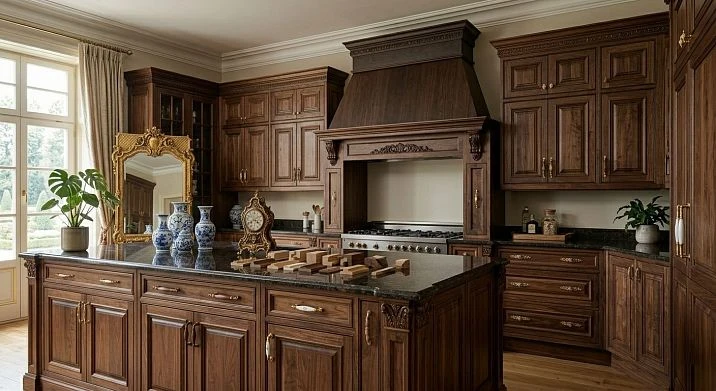
The kitchen is the most alive place in the house. Mornings begin here, evenings pass, family gathers. And that is why a classic-style kitchen is perceived differently than just a set of cabinets and drawers. Classic kitchen furniture is architecture inside the home: with rhythm, symmetry, wooden details that do not age but get better.
But here's the question: why does one person's classic-style kitchen look like an expensive project, while another's looks like a set of 'classic' details that don't get along? The answer lies in the system. Classic kitchen furniture is made up not only of the set — it consists of facades, wooden handles, legs, carved appliqués, molding, baseboards, trim and decor — of everything that creates a unified expressive space.
This article is a detailed practical analysis for those who want to make a classic-style kitchen not 'look like classic,' but truly cohesive.
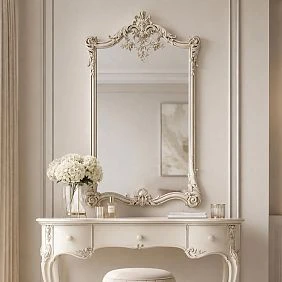
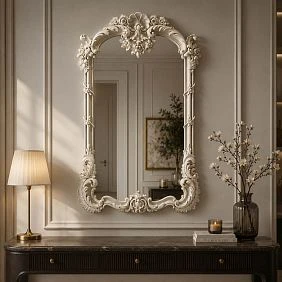
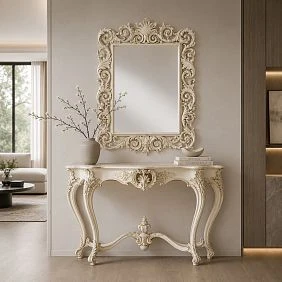
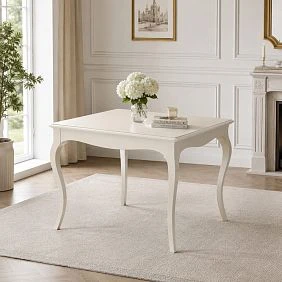
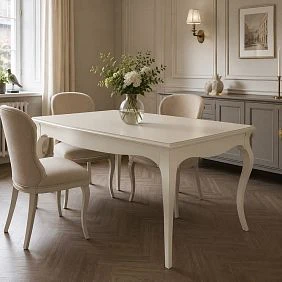
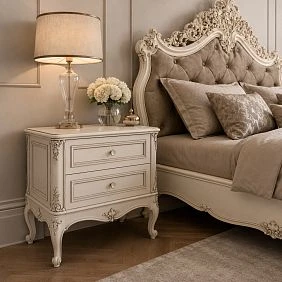

How a classic kitchen differs from a modern one: recognizable features
Many people think that classic cuisine is simply "not IKEA." In reality, it's more precise. A classic-style kitchen has specific, recognizable visual features, and each of them can be controlled.




Facades with frames or panels
The first and most characteristic feature. A classic facade is not a smooth slab. It is a structure with a frame and a central insert (panel) or an imitation of such a structure. The facade gains depth, chiaroscuro, and architectural quality.
Our factory also produces:
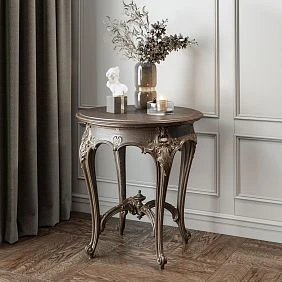
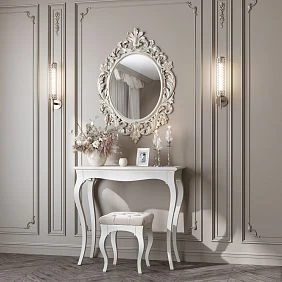
Symmetry and Rhythm
A classic kitchen is built symmetrically. Upper cabinets correspond to lower ones. Handles are positioned in the same plane around the entire perimeter. The cornice runs in a single horizontal line. Breaking symmetry in a classic kitchen is a mistake, not a design technique.
Get Consultation
Wooden details and natural materials
Classic loves wood. Wooden handles for the kitchen, Solid wood furniture legs, Wooden baseboard, Wooden moldings and cornices — these are details that bring the classic kitchen image together into a cohesive whole.
Decorative top line
The upper cornice closes the gap between the cabinets and the ceiling, simultaneously making the kitchen visually integrated into the room's architecture. Without a cornice, the kitchen "hangs" in space — with a cornice, it becomes part of the interior.
Connection with the rest of the space
A classic kitchen — especially in an open-plan kitchen-living room format — should converse with the rest of the interior. Skirting coordinated with the flooring. Trim made of solid wood supports the wall finish. Kitchen cabinet handles echo the style of furniture handles in the living room area.
Which cabinet fronts are suitable for a classic-style kitchen
The cabinet front is the face of the kitchen. It determines how convincing the classic look will be.
Paneled cabinet fronts
The most unambiguous choice for a classic and neoclassical kitchen. A frame made of wood or MDF with a central insert — this construction itself already carries the classic idea. It provides chiaroscuro, depth, and visual richness.
Paneled fronts work well in white, milky, and cream colors. They accept Wooden handle brackets and turned handles. They don't need much additional decoration — the shape speaks for itself.
Smooth facades with decorative details
For soft, modern classic or neoclassical style. A smooth facade is neutral in itself — it acquires a classic character through properly selected Wooden handles, carved appliqués и Moldings.
This is a good scenario for those who want to update an existing kitchen without changing the carcass: new handles, a few overlays and Trim around the perimeter of the facades change the look of the kitchen without major renovation.
Facades with moldings
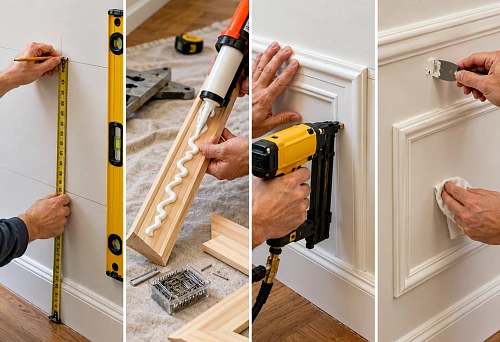
A molding glued or attached to a smooth facade creates an imitation of a frame. The effect is close to a paneled facade — at a lower cost. Solid wood moldings or profiles from millwork — a practical way to classify a facade.
Facades with carved overlays
For more expressive classics — Baroque, Russian style, country house kitchen. carved decorative overlays An ornamental layer is added to the center of the door or the corners of the facade. The main thing is proportionality: the overlay should be proportional to the facade and not overload it.
Wooden handles for a classic kitchen: shape, comfort and style
The handle is what hands touch every day. In the kitchen, handles work more intensively than on any other furniture in the house. Therefore, when choosing wooden handles for the kitchen, it is important to solve three tasks at once: visual style, grip comfort, and practicality of the coating.
Why a wooden handle is suitable for a classic kitchen
Wood is the main material of classics. Wooden handles for kitchen fronts make furniture warmer, more natural and visually more expensive. They pair well with wooden floors, wooden skirting boarddoors and any wooden decor in the space.
Metal handles are not a mistake for a classic kitchen, but they create a different mood: colder, more stately. A wooden handle is warmer, more pleasant to the touch, and more organic in an interior with natural materials.
Types of handles for a classic kitchen
Pull handles. The most versatile and practical choice. A wooden pull handle with two mounting points is convenient for daily use: the grip is natural, and the effort required to open is minimal. For a classic kitchen, pull handles with a turned or profiled body are suitable — not too minimalist, with a soft decorative accent.
Handles with shaped profiles. For a more expressive classic style — handles with a turned profile, slight relief, or rounded ends. They add a decorative accent without overwhelming the facade.
Long wooden handles. For tall cabinet facades — a horizontal long handle or pull handle with a center-to-center distance of 128–160 mm. It visually elongates the facade horizontally and creates an architectural rhythm.
Knob handles. For small drawers, spice racks, or decorative cabinet doors. Compact and proportionate to a small facade.
Finish of handles for the kitchen
In the kitchen, the finish is important. Wooden handles with a lacquer or oil-wax finish are resistant to moisture, grease, and frequent handling. They are easy to wipe clean, do not darken from oil, and maintain their appearance for years.
handles without coating — for those who want to tint the part themselves to match the exact color of the kitchen. This is a professional approach that provides perfect coordination but requires additional finishing.
Coordinating handles with facades and interior
Handles in the kitchen should match:
-
the color and wood species of the facades;
-
с wooden skirting board and doors;
-
the handles of furniture in the living area, if the kitchen is open-plan;
-
the countertop — by shade or contrast.
If the kitchen has wooden handles and nearby on a sideboard or console there are metal ones, this is not a mistake but requires a deliberate decision. Chaotic mixing of materials in handles is a loss of stylistic identity.
Legs, supports, and base: the bottom line of a classic kitchen
The lower part of the kitchen is one of the most frequently overlooked elements in design. Yet it determines how well the kitchen looks "seated" in the space.
Base and decorative plinth
The base covers the lower part of the kitchen between the cabinets and the floor. In the classic version, it is not just a technical cover but a decorative element.
Wooden baseboard For the kitchen baseboard, this is a part coordinated with the floor skirting board. When the kitchen baseboard and floor skirting board are made of the same material or in the same shade, the lower horizontal line of the room becomes architecturally complete.
Furniture legs for the kitchen
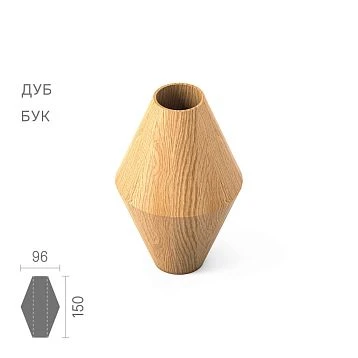
Solid wood furniture legs are used not for the main bodies of the kitchen set, but for freestanding modules: a kitchen island, sideboard, console, open shelf, or kitchen table.
For a classic kitchen — turned legs with a profile, legs with a neck and disc, possibly with a light ornament on the body. The height of the legs determines how "airy" the module looks: taller legs — lighter, shorter — more substantial.
The legs must match the weight of the product. Wooden supports made of solid wood — oak, beech, birch — handle the load well with the correct cross-section.
The bottom line as a system
The lower horizontal line of a classic kitchen is the baseboard + Wooden baseboard + transition to the floor skirting board. If they are coordinated in height, shade, and profile — the kitchen stands confidently in the space, like built-in furniture. If not — a boundary between the "kitchen" and the "floor" is visible.
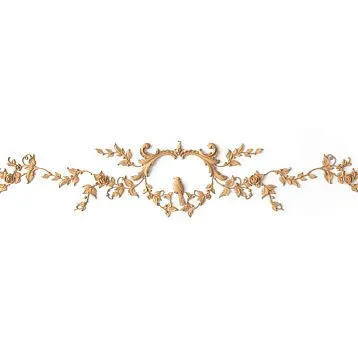
Carved overlays and decor for kitchen fronts
Carved decor in the kitchen is a fine-tuning tool. Overlays don't shout, they accentuate. They add a layer of expressiveness where a smooth front would be boring.
Central decorative overlays
Central carved overlays are placed in the geometric center of the door front. This is a classic technique: it adds a focal point and creates a sense of handcraft. It is especially appropriate on larger doors — the hood area, tall cabinets, tall units.
The size of the overlay should be proportionate to the front. A 10 cm overlay on a 100 cm high door is a point accent. A 40 cm overlay on the same door is an expressive decorative motif. Both solutions can be correct if the task is defined.
Corner elements and decorative frames
Corner overlays of four elements form a decorative frame on the front — an analogue of a frame structure in frame fronts. Wooden corner elements for furniture work well on smooth fronts, turning them into "quasi-classical" ones without changing the cabinets.
The "sufficiency" rule of decor
The main mistake when adding carved decor to a kitchen is overdosing. Carved overlays on every facade, ornament everywhere — and the kitchen starts to look like a display case, not a living space.
The optimal scenario: overlays on the hood area, corner tall cabinets, and central doors. The remaining facades — without overlays or with a molding frame. The balance of decor and surface cleanliness — that is the classic.
Kitchen cornice, moldings, and the top line of the cabinet set
The top part of the kitchen is no less important than the bottom. The cornice is what turns a set of cabinets into an architectural element.
What the cornice does
The cornice covers the gap between the upper cabinets and the ceiling, while simultaneously creating a finished horizontal line. Without a cornice, the kitchen looks "cut off" from above. With a cornice, it looks built-in, assembled, and well-thought-out.
Wooden cornice and solid wood moldings for the kitchen are chosen in proportion to the ceiling height. Low ceiling (up to 2.6 m) — a small cornice, without lavish profiles. High ceiling (3 m and above) — a larger-scale cornice, with a more expressive profile.
Moldings for facades and side panels
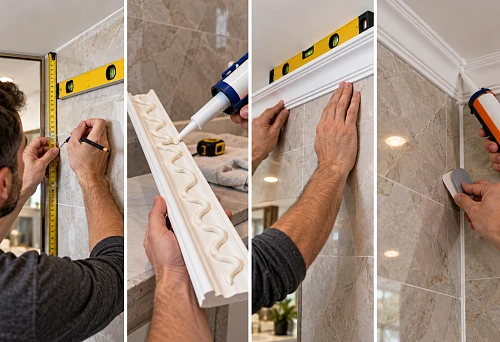
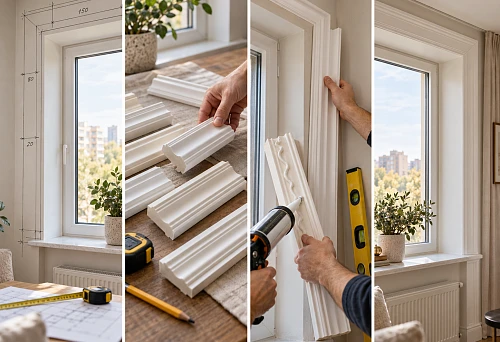
Pogonazh iz massiva how the molding is glued or attached to facades, side panels, decorative caps. It creates a frame, adds architectural rhythm, visually connects different parts of the set.
The molding line on the side end panel of the kitchen is a detail that distinguishes a design solution from a standard one. It is precisely such details that are seen and felt when the interior is already finished.
Connection of the cornice with the ceiling decor
If the kitchen has a ceiling wooden cornice or a profiled ceiling plinth, the kitchen cornice should be coordinated with it — in scale, wood shade, and profile. This is especially important in a kitchen-living room with a unified architectural ceiling solution.
Color of classic kitchen furniture: scenarios and logic
Color is the first thing a person notices when entering the kitchen. And in the classic style, color works by its own rules.
White and milky kitchen
The most popular scenario for a classic and neoclassical kitchen in an apartment. A white or milky facade is neutral, light, and easy to combine. Wooden handles and decor in a warm shade create the necessary natural contrast.
Advantage of a white classic kitchen: it does not age. A white facade remains relevant for decades — provided it is made with quality and equipped with the right wooden details.
Natural oak and beech
A classic warm option. A kitchen made of natural wood or with oak/beech facades creates a rich, lively, natural look. It looks especially organic in a country house, a dacha, or a large apartment with good lighting.
uncoated wooden handles in this scenario — are ideal: they can be tinted exactly to match the facade or chosen slightly darker for an accent.
Dark classic
Dark walnut, wenge, dark oak — a stately classic for spacious rooms. A dark kitchen requires good lighting: without it, it will feel oppressive. Wooden handles in the same shade create a monolithic look; handles in lighter wood provide an expressive contrast.
Painted facades
Gray-green, dusty blue, warm beige — for a soft neoclassical kitchen in an apartment. A painted facade with wooden handle brackets made of light wood — one of the freshest and most enduring stylistic techniques.
Classic kitchen in an apartment and in a country house: different approaches
Kitchen in a city apartment
An apartment is a limited space with fixed ceilings. A classic kitchen in an apartment has its own rules:
-
Light-colored facades expand the visual space.
-
Moderate decor — a few carved overlays on key facades, not everywhere.
-
A neat cornice — proportionate to the ceiling height.
-
Compact handles — handle brackets or knobs that do not overload the facade.
-
Unified Wooden baseboard — connects the kitchen with the rest of the apartment space.
Kitchen in a country house
A country house is a different scale and a different freedom. Here you can:
-
Use more natural wood in the details.
-
Add a kitchen island on solid wood furniture legs.
-
Place a sideboard or open display case with expressive carved inlays.
-
Use a larger and more voluminous cornice.
-
Choose larger handles — brackets or long wooden handles with a pronounced profile.
-
Connect the kitchen with the living room through Pogonazh iz massiva on the walls and ceiling.
How to combine a kitchen with a living and dining area
An open plan is both an opportunity and a challenge for a classic style. When the kitchen, living room, and dining area are in one space, they must speak the same language.
Unified handles
The easiest way to combine zones is to use wooden handles of the same type on kitchen fronts and on furniture in the living room or dining room. They don't have to be identical models — just the same style and a close wood shade.
Unified wood shade
Floor, Baseboards, doors, handles, Furniture Legs, Decorative Inserts — if all wooden elements are in one or logically consistent shade, the space is perceived as a single whole. Chaos from different wood shades in one open plan is one of the main visual failures of a classic interior.
Unified baseboard line
Solid wood floor skirting board should run as a continuous line through all zones of the open space. The kitchen plinth should be consistent with it. This is a low architectural solution that is subtle but strongly works for the integrity of the image.
Decor — dosed and systematic
If carved appliqués they are present on kitchen facades, they can be repeated — moderately — on a chest of drawers or console in the living area. This creates an architectural dialogue, not a monotonous repetition.
Mistakes when choosing classic kitchen furniture: a direct conversation
A good classic-style kitchen starts with the right decisions. But more often it is ruined by a few typical mistakes.
Buying facades without considering handles. The facade is chosen, ordered, installed — but the handles in the catalog don't fit either in size or style. Handles should be chosen simultaneously with the facades, not after.
Too much carved decor. Overlays on every facade, carved inserts everywhere — the kitchen stops breathing. Classic decor works in balance with clean surfaces.
Not considering ceiling height. A high cornice with a 2.5 m ceiling eats up space and visually presses down. The scale of the cornice and moldings should match the scale of the room.
A dark, heavy kitchen in a small apartment. Dark facades + dark handles + dark baseboards in a small kitchen — this is not classic, it's twilight.
Not coordinating the kitchen with doors and baseboards. Kitchen in warm wood, doors — white, floor baseboard — gray plastic. Three different worlds in one space.
Choosing modern metal handles for classic facades. A chrome bracket on a paneled facade is a conflict. Wooden or coordinated classic handles are the only right choice for convincing classics.
Mixing wood shades. Oak on the floor, cherry on handles, walnut on baseboards — three different woods without logic. Maximum two shades with a clear hierarchy.
Forgetting about the plinth. A kitchen without a finished plinth looks incomplete from below — as if something is missing.
What to buy for classic kitchen furniture: a practical list
-
Wooden handles for the kitchen — staples, buttons, long models.
-
Handles with Finish — ready for installation, with varnish or tinting.
-
handles without coating — for self-finishing to match the kitchen color.
-
Solid wood furniture legs — for island, buffet, console, open modules.
-
Carved overlays for kitchen fronts — central and corner elements.
-
Furniture Decoration from Wood — ornamental inserts and decorative elements.
-
solid wood baseboard — for the plinth and lower architectural line.
-
Moldings and cornices — for the upper line and facade design.
-
Pogonazh iz massiva — profiles for frames, side panels, transition zones.
-
Solid Wood Items — complete catalog of wooden parts for kitchen and interior.
Algorithm: how to choose elements for classic kitchen furniture without mistakes
1. Define the kitchen style more precisely: pure classic, neoclassical, baroque, Russian style, soft modern classic.
2. Choose the facade color: white, milky, natural wood, painted, dark.
3. Select Wooden handles by type, size, and finish — simultaneously with the facades.
4. Decide whether a decorative plinth or Wooden baseboard.
5. Select legs or supports for individual modules — islands, sideboards, consoles.
6. Choose applique и Moldings — determine which facades they are suitable for.
7. Coordinate all wooden details in shade with doors, floor, baseboard, and furniture in adjacent areas.
8. Go to the catalog solid wood STAVROS products and assemble a set of wooden details for your classic kitchen.
About the company STAVROS
Classic kitchen furniture gains character through details. STAVROS produces all wooden elements necessary for a classic kitchen: Furniture Handles (with and without coating, staples, buttons, long models), solid wood legs and supports, carved appliqués, decor for furniture, Wooden baseboard, Moldings and cornices, Pogonazh iz massiva and the entire range of solid wood.
STAVROS has been operating since 2002. Production in Saint Petersburg. Own turning, milling, and finishing workshop. Shipment from 1 piece. Delivery across all of Russia. Custom shapes, sizes, and profiles can be produced for your project.
FAQ: Answers to popular questions
What is included in classic kitchen furniture?
Facades, cabinet cases, base cabinets, display cabinets, handles, plinth, cornice, moldings, overlays, linear moldings, baseboard, and decorative wooden elements — all of this makes up a complete classic kitchen furniture set.
Which handles should I choose for a classic kitchen?
Wooden pull handles with a soft profile, handles with a turned body, or shaped handles. They should match the style of the facades and the color of the wooden details in the interior.
Can I make a regular kitchen more classic without replacing the cabinet set?
Yes. Often it is enough to change the handles to wooden ones, add moldings or decorative overlays to the facades, and finish the bottom plinth with a wooden baseboard — and the kitchen changes beyond recognition.
Which classic kitchen is best for a city apartment?
Light-colored facades, moderate decor, a neat cornice proportional to the ceiling height, compact handles, and a single wooden baseboard coordinated with the floor.
What should I buy together with kitchen facades?
Wooden handles, furniture legs for individual modules, carved overlays, moldings, cornice, wooden baseboard for the plinth and trim for frames on side panels.
Is it necessary to coordinate the kitchen with the living room in an open-plan layout?
Absolutely. Unified wood tones, coordinated handles, and a continuous line of baseboards unite different zones into a single architectural space.