








































Article Contents:
- Why Joints Are More Important Than They Seem
- Connection Points That Require a Solution
- What Most Often Needs to Be Connected: Key Combinations in Decorative Finishing
- Vertical Chain from Floor to Ceiling
- Horizontal Connections Across the Wall Width
- How to Close the Ends of Wooden Slats: Tools and Techniques
- Wooden Corner: The Primary Solution for Side Ends
- Wooden Block as a Decorative Framing Element
- Molding frame as an alternative to corner
- Painting the ends: a minimal solution
- How to connect wooden slats to a ceiling cornice: three schemes
- Scheme one: slats reach the bottom line of the cornice
- Scheme two: a smooth wall zone between the slats and the cornice
- Scheme three: slats transition to the ceiling
- How to choose a cornice for a slatted wall
- How to connect wooden slats to a floor baseboard
- Wooden baseboard for natural slats
- MDF baseboard for wooden slats: contrast and modernity
- Bottom joining technology: how to properly connect a skirting board and a batten
- MDF skirting board for painting: coordination with stucco decor
- How to join moldings and wooden battens on one wall
- Molding as the upper boundary of the batten zone
- Molding as a vertical divider
- Molding frame around the batten zone: how to make a neat joint
- Polyurethane stucco decor next to wooden battens: joint features
- How to finish corners: internal, external, door openings
- Internal corners of skirting board: miter cut and options
- External corners of skirting board
- Internal and external corners of cornices and moldings
- Junction with door opening and window slope
- How to connect polyurethane stucco and wooden trim
- Logic of separation: each material has its own plane
- Direct adjacency: when a polyurethane molding is next to a wooden slat
- Painting as a unifying tool
- How to choose materials for interior style: five working schemes
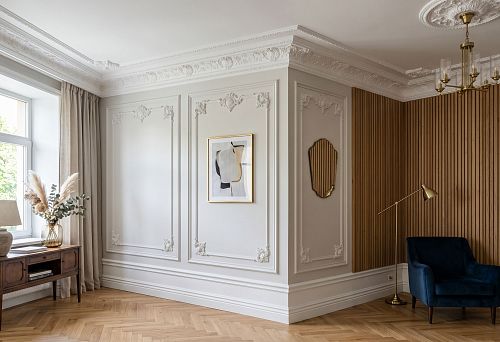
- Neoclassicism: moldings + high baseboard + wooden cornice
- Modern interior: slats + straight MDF baseboard
- Japandi: thin slats + minimal baseboard
- Classic: wooden cornice + wooden baseboard + decorative molding
- Commercial interior: slats for zoning + reliable baseboard
- Mistakes when connecting slats, moldings, and baseboards
- Open ends of slats
- Baseboard accidentally butting against slats
- Mismatched wood shades
- Mixing MDF, solid wood, polyurethane without logic
- Forgot about the lower height of the baseboard
- Did not plan corner miter cuts
- Rigid joint of wood and polyurethane without sealant
- What to buy in the STAVROS catalog for neat joints and junctions
- About the Company STAVROS
- Frequently Asked Questions

Because an interior is not a set of individual objects. It is a system of connections. And it is at the connection points — joints, corners, ends, junctions — that the question is decided: does the renovation look professional or not. WhereWooden planksthe baseboard meets, where the molding goes around a corner, where the cornice joins the decorative wall — in these places quality lives.
This article is dedicated specifically to them: joints, corners, and junctions. How to properly connect polyurethane stucco decor with wooden slats, how to close the ends of slats, how to join molding and baseboard, how to design internal and external corners — and which tools from thewood trimassortment are needed for this.


Why joints are more important than they seem
Imagine an expensive jacket with seams coming apart at the shoulders. The fabric is excellent, the cut is correct — but the seams are unraveling. And that's it. No 'expensive' impression. The exact same thing happens with an interior when there is a gap between the slats and the cornice, when the end of a slat is open at a corner junction, when the baseboard in a corner is cut with a skew.
Joints are the seams of an interior. A person may not be able to name what exactly is 'wrong,' but they feel it immediately. The eye catches open ends, random gaps, mismatched transitions — and the brain interprets this as 'cheap' or 'unfinished.' Even if each individual element — slat, cornice, baseboard — is chosen perfectly.
This is not an exaggeration. That is why professional finishers and designers separately work out every point of material connection even at the project stage. Not 'we'll see on site,' but specifically: here —Wooden angle... here — the molding as a border, here — the block as a transition element.




Junction points that require a solution
Let's list all the key joints that anyone doing decorative wall finishing will encounter:
-
Wooden slats and wall (side ends of the slat panel)
-
Slats and ceiling cornice (top end of the slats)
-
Slats and floor baseboard (bottom end of the slats)
-
Moldings and slat area (border of two decorative systems)
-
Polyurethane stucco and wooden trim (two different materials in one system)
-
Baseboard in the corner (internal and external corners)
-
Cornice in the corner (vertical joints of ceiling decor)
-
Joining trim to door frames and window slopes
Each of these points requires a well-thought-out solution. Let's consider them sequentially.
Our factory also produces:





What most often needs to be joined: main connections in decorative trim
Before examining each joint in detail, you need to understand the logic of the system as a whole.Wooden slats and moldingsare not isolated elements, but parts of the vertical 'frame' of the wall. Each element has its neighbors above, below, and on the sides.
Get Consultation
Vertical chain from floor to ceiling
A standard decorative wall with slats has the following vertical sequence:
Floor → floor baseboard → bottom end of slats → body of slat panel → top end of slats → ceiling cornice → ceiling
Each transition in this chain is a potential problem point. And each transition is solved by a specific element: the baseboard covers the joint between the floor and the wall, the cornice covers the joint between the wall and the ceiling, the corner piece covers the side ends, and the molding covers the boundary between zones.
Horizontal ties across the width of the wall
Horizontally, the slat panel has:
-
Left and right ends that meet a wall corner, door frame, or adjacent trim
-
Bottom and top edges that join with the baseboard and cornice
-
Side molding frames if the slat area is limited in width
All these ties need to be thought out before installation — otherwise, 'deciding on the spot' means improvising with an inevitably less neat result.
How to finish the ends of wooden slats: tools and techniques
The end of a slat is an unfinished surface. The cross-section of wood has different porosity, different color, and different texture compared to the face surface. If this cut is exposed, anyone looking at an angle at the room corner or the junction with a door opening will see it.
Wooden corner trim: the main solution for side ends
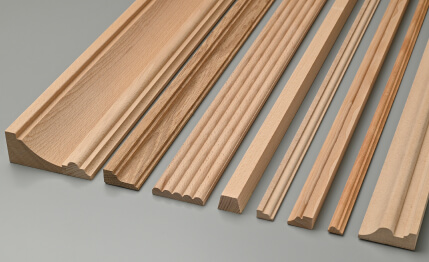
Wooden angle — the most technically correct element for closing the side ends of a slat panel. It is mounted over the end with acrylic glue and finishing nails, covering the unfinished wood cut and creating a neat vertical line at the corner point.
The corner for decorative slats should be:
-
Made from the same wood species as the slats. A pine corner next to oak slats results in different textures and shades, even with identical paint.
-
With the same surface treatment: if the slats are oil-stained, the corner should use the same oil. If the slats are for painting, the corner should also be for painting.
-
Proportional size: a 15×15 mm corner for 25 mm slats, a 20×20 mm corner for 40 mm slats. A corner that is too thin does not cover the end. A corner that is too thick protrudes and draws unwanted attention.
The entire rangewood trim in the STAVROS catalog — from unified wood species and with a unified surface treatment standard. This means that the corner, slats, and baseboard from the same series will react to staining and painting identically — the result is predictable.
A wooden block as a decorative framing element
Wooden block — a more substantial element that performs several functions at once: it covers the ends of the slats on the sides, creates a vertical "frame post," and adds volume to the corner joint.
If the slat panel is limited in width — for example, it occupies a central accent zone of the wall — a block on the left and right edges creates vertical frame posts. The slats are "inserted" between the two blocks, like in a window sash. This is an architectural technique that transforms the slat area from "nailed-on strips" into a complete decorative structure.
Block parameters: thickness 20–30 mm, width 30–50 mm depending on the scale of the slat panel. The block should be no thinner than the face surface of the slat itself — otherwise, it visually "sinks in" and does not create the desired framing.
Molding frame as an alternative to corner trim
Another option for closing the side ends — wooden moldingorPolyurethane molding, installed around the perimeter of the slatted area. The molding covers the ends on all four sides — top, bottom, left, and right — creating a finished frame.
This option works better than corner trim when the slatted area does not reach the wall and has space around it. The molding frame clearly defines the boundaries of the slatted panel as an independent decorative object — it is a design tool, not a technical one.
Painting the ends: minimal solution
If for some reason corner trim or a batten is not suitable, the ends of the slats can be treated with acrylic paint or a tint of the same shade as the front surface. This will not physically cover the end, but will make it less noticeable: a dark end on a dark slat blends into the shadow of the corner.
This solution is acceptable but not optimal. A painted end is still visible as an unfinished surface upon close inspection. Corner trim or a batten provides physical coverage that works at any viewing angle.
How to connect wooden slats to a ceiling cornice: three schemes
The transition of the top edge of the slatted panel to the ceiling is one of the most important and one of the most complex joints in decorative finishing. There are three fundamentally different schemes for solving it.
Scheme one: slats reach the bottom line of the cornice
This is the most common and most logical solution. Ceilingwooden corniceorPolyurethane molding is mounted around the perimeter of the room first — it sets the lower horizontal line to which the slats are brought. The upper ends of the slats are covered by the cornice: the slats go under the cornice by 10–15 mm.
With this scheme:
-
The gap between the slats and the ceiling is closed by the cornice
-
The upper end of the slats is not visible
-
The cornice creates an architectural horizontal line that completes the vertical rhythm of the slats
-
The joint between the cornice and the slatted surface is sealed with acrylic sealant and sanded
Installation order: first the cornice around the entire perimeter, then marking the lower line of the cornice, then installing the slats from bottom to top until they stop against the cornice.
Second scheme: between the slats and the cornice — a smooth wall area
The slats occupy the lower and middle part of the wall, and between the upper end of the slats and the ceiling cornice there is a smooth strip of wall 20–40 cm. In this scheme, the upper edge of the slats is finished with a horizontal molding that creates a clear "end line" of the slatted area.
Molding above the slats —wooden moldingor polyurethane — is mounted strictly horizontally. Above it is a smooth surface, painted or covered with wallpaper. Even higher is the ceiling cornice. Two parallel horizontal profiles (molding and cornice) create a "double line" along the top of the wall — this is an architecturally rich, expressive solution.
Scheme three: slats transition to the ceiling
The most radical option:Wooden planks for wall decorationrun vertically along the wall, at the junction with the ceiling they turn 90° and continue horizontally along the ceiling. The transition "wraps" the wall-ceiling corner with slats.
In this scheme, a ceiling cornice on this wall is not needed — the slats themselves serve as the transition element. The cornice may be present on the other walls of the room, creating a contrasting perimeter. The corner transition of the slats requires precise 45° miter cuts or a special corner element — a decorative joint made from the same wood as the slats.
How to choose a cornice for a slatted wall
When choosing a ceiling cornice for a wall with slats, one key rule applies: the scale of the cornice must match the scale of the slats. Wide slats 50×30 mm — cornice 60–80 mm. Thin slats 20×15 mm — cornice 30–50 mm.Wooden beamsin the STAVROS catalog cover a range of profiles from compact 30 mm to expressive 120 mm — a choice for any scale of slatted finish.
How to connect wooden slats to the floor baseboard
The lower joint of the slatted wall with the floor is no less important than the upper one. It is here that the most common issues arise: uncovered lower ends of the slats, a gap between the baseboard and the slatted surface, and inconsistency between the materials of the baseboard and the slats.
Wooden baseboard for natural slats
If the slats are made of natural wood — oak, ash, walnut — the ideal lower finish is a baseboardWooden baseboardmade from the same species. A single material across the entire vertical wall creates a sense of an architectural system: baseboard — slats — cornice all from the same wood.
buy wooden skirting boardfrom the same series as the slats — the optimal solution. One tint, one surface treatment, one reaction to use. After a year, such a baseboard will not look "different" compared to the slats on the wall.
Height of a wooden baseboard for a slatted wall: 60–100 mm with a ceiling up to 2.7 m. Profile — straight or with one or two chamfers. Rule of proportions: the height of the baseboard should not exceed the width of one slat by more than 2.5 times. Thin slats 20 mm — baseboard up to 50 mm. Wide slats 50 mm — baseboard up to 120 mm.
MDF baseboard for wooden slats: contrast and modernity
MDF Skirting Boardpainted — a working option for modern interiors where wooden slats are warm and rich in tone, and the lower line should be calm and "invisible." A white MDF baseboard does not compete with the slats, does not add another warm tone to an already rich wooden surface.
White MDF Skirting Boardstraight profile 70–80 mm next to oak slats — this is a "Scandinavian" technique where wood works as a warm accent, and white architectural lines (baseboard + cornice) create a neutral contour "frame." The space looks lighter, brighter, more spacious.
Technology of the lower junction: how to properly join the baseboard and slat
Key technical point: the baseboard is mounted on the wall and floor after the slats have been installed. The lower end of the slat must be cut strictly horizontally and be 3–5 mm above the final floor level (taking into account the flooring). The baseboard is mounted over this gap, overlapping the lower end of the slat by 10–15 mm.
If the baseboard is installed before the slats, the opposite situation occurs: the slats are joined to the already installed baseboard. In this case, the lower ends of the slats are cut exactly along the top line of the baseboard, and the joint is sealed with acrylic sealant of the desired color.
MDF baseboard for painting: coordination with stucco decor
If the interior walls featurePolyurethane wall decor— molding frames, stucco overlays — whiteBaseboard MDFcreates a material unity with polyurethane decor. Both elements are white, both are paintable with acrylic paint, both have a smooth surface. The bottom line and decorative frames on the walls form a single white system, inside which warm wooden slats work as a natural accent.
How to join moldings and wooden slats on one wall
A molding next to a slatted zone is the boundary between two decorative systems. The role of the molding in this capacity is to clearly indicate where one system ends and another begins, making this transition architectural rather than random.
Molding as the upper boundary of the slatted zone
A horizontal molding installed above the slats is the "ceiling" for the slatted panel. It covers the upper ends of the slats (if the slats do not reach the cornice) and creates a clear horizontal line ending the vertical rhythm. The molding must be at the same level across the entire width of the wall — strictly according to the laser level.
Moldings made of polyurethanefor a horizontal divider above the slats — optimal because they are easy to cut to the desired length, do not deform, and provide a precise profile. Wooden molding — if material unity with the slats is needed.
Molding as a vertical divider
If the slat panel occupies one part of the wall and the adjacent part is smooth with stucco decor, a vertical molding between them creates a clear boundary. It covers the side end of the slat panel and simultaneously "separates" the two decorative systems from each other.
The vertical divider molding must be of the same profile and size as the horizontal one. Or, if molding frames are used, the same profile as the sides of the frames. A uniform profile across all molding elements of the wall is mandatory.
Molding frame around the slatted area: how to make a neat joint
A molding frame around the slat panel is a full perimeter framing: top, bottom, left, right. The joint between the molding and the slat surface is the most visible part of this structure.
Technically: the molding adjoins the front surface of the slat or the wall next to the slat end. Between the molding and the slat, there is a 3–5 mm gap filled with acrylic sealant in the color of the molding or wall. This gap creates a "shadow" — a delicate line of depth that visually separates the molding and the slat. Without the gap, the two materials "stick together" — the sense of volume is lost.
Polyurethane stucco decor next to wooden slats: joint features
WhenPolyurethane Decor— molding frames, cornices, overlays — adjacent to wooden slats on the same or adjacent walls, it is important to understand: the two materials have different coefficients of thermal expansion. Wood "breathes" — expands and contracts with changes in humidity and temperature. Polyurethane practically does not deform.
This means that a direct rigid joint between a polyurethane molding and a wooden slat may develop a gap after six months. The correct solution: between them — an acrylic elastic sealant, not putty. The sealant allows micro-movement of materials without cracking the seam.
How to design corners: internal, external, door abutments
Corners are where most installers face real difficulties. An incorrectly executed corner is immediately noticeable and creates a depressing impression even with flawless quality of the rest of the finishing.
Internal corners of the baseboard: miter cut and options
An internal corner of the baseboard is where two baseboards from different walls meet at 90°. The classic solution is to miter each plank at 45° so that they form a smooth internal corner.
Miter cutMDF Skirting Boards at 45° is performed on a miter saw. Rules:
-
Precise tool angle: 45.0°, not 44 or 46. An error of 1° at a baseboard height of 100 mm creates a gap of about 1.5 mm — a visible defect.
-
Before installation — dry fit: planks are applied to the corner without glue, the accuracy of the joint is checked.
-
Gap in the joint — filled with acrylic sealant matching the baseboard color.
Alternative to miter cut forMDF Skirting Boards— ready-made corner elements, if available in the line. A ready-made corner is more precise than a manual cut and requires no tools.
External corners of the baseboard
External corner — the place where the baseboard goes around a wall protrusion or column. Here, the 45° cut is made in the opposite direction.Wooden baseboardon the external corner is especially vulnerable — the open end of the cut wood is visible under side lighting. Solution: careful painting or tinting of the end, and if available, a ready-made external corner element.
A protruding corner with a wooden baseboard can be coveredwooden corner piece: it is mounted over the junction of two baseboard strips and physically 'stitches' them together.
Internal and external corners of cornices and moldings
For a ceiling cornice, the logic is the same as for a baseboard, but the complexity is higher: the cornice often has a more complex profile, and the 45° cut must be precise in all three planes.
installing polyurethane molding— a detailed practical guide on how to achieve clean corners and hidden joints. Polyurethane is cut with a sharp knife or a thin jigsaw blade and gives a more precise angle than wood: no fibers, no chips.
Wooden cornice in the corner — cut on a miter saw at a precise angle. The joint after installation — acrylic sealant + sanding after drying. When tinting or painting — a single layer over the entire surface of the cornice, including the joint.
Adjacent to door opening and window slope
One of the most complex technical joints: where a slat panel, molding, or baseboard ends, meeting the vertical of a door frame or window slope.
Options:
-
The baseboard goes under the door frame by 5–10 mm (the frame is installed considering the baseboard thickness)
-
The baseboard ends flush with the frame: the joint is sealed with caulk of the same color
-
The slats end before the opening: the end is coveredwooden corner pieceor with a vertical bar that creates a frame-like 'post' for the opening
How to connect polyurethane molding and wooden trim
This is the most delicate task — to connect two fundamentally different materials into one visual system. Polyurethane is smooth, white, and light. Wood is warm, textured, with grain. How to make them work together?
The logic of separation: each material gets its own plane
The most stable solution — each material on its own plane.polyurethane ceiling decor— on the ceiling. WoodenRafter panels— on the walls. Wooden baseboard — at the bottom joint. Each material in its own "zone of responsibility" without direct adjacency.
Where they are supposed to meet — at the junction of the wall and ceiling — a cornice works between them. If the cornice is wooden, it smoothly transitions the wood of the wall to the ceiling. If the cornice is polyurethane, it transitions the white ceiling decor to the warm wooden wall. In this case, the cornice is a mediator between the two materials.
Direct adjacency: when a polyurethane molding is next to a wooden slat
IfPolyurethane moldingis used as a frame around the slatted area — a direct joint of molding and wood. The key rule here: there must be a gap of 3–5 mm (shadow) between them, which visually separates the two materials. Without the gap, they "stick together": white polyurethane at the edge of a dark slat looks dirty.
The gap is filled with acrylic sealant in the color of the molding (white) or in the color of the slat (tinted). Elastic sealant, unlike putty, does not crack during seasonal movements of the wood.
Painting as a unifying tool
In some interiors — Scandinavian, minimalism — slats and moldings are painted a single white color. In this case, the problem of joining two materials is eliminated: both are white, the difference in texture creates an interesting relief effect, but not a conflict.installation of polyurethane moldingand painting wooden elements in a single color is a strategy where all technical joints are hidden under a single layer of paint, and the interior gets a monolithic look.
How to choose materials for the interior style: five working schemes
Different interior styles require different solutions for joints and junctions. Here are proven combinations.
Neoclassicism: moldings + high baseboard + wooden cornice
A style emphasizing architectural symmetry and richness of detail. Here Polyurethane wall decor in the form of frames + wooden slats in the central zone of one accent wall + high wooden baseboard 100–120 mm + Wooden ceiling cornice 80 mm. All joints are mitered at 45° with putty and painting. Corners — without corner pieces (moldings allow going around a corner with a single piece or with minimal joint).
Modern interior: slats + straight MDF baseboard
Thin slats 20×40 mm in the TV area, straight Baseboard MDF 60 mm around the entire perimeter, thin polyurethane cornice 30–40 mm. All elements are laconic, without ornament. Baseboard corners — miter cut or ready-made elements. Slat ends — wooden corner piece 15×15 mm. Joints — white sealant. Color — white everywhere except slats.
Japandi: thin slats + minimal baseboard
Slats 15×30 mm from ash with oil impregnation. Baseboard straight wooden 40 mm from ash with the same treatment. No cornice — slats reach the ceiling. Slat ends in corners — wooden corner piece 10×10 mm from ash. All joints — thin acrylic sealant in wood color. Maximally laconic, no decor.
Classic: wooden cornice + wooden baseboard + decorative molding
High wooden cornice 100 mm made of oak. Wooden baseboard 120 mm made of oak. Wooden moldings — vertical frames on walls. Slats — in niches or behind doors as a background element. All joints — precise cutting, puttying, varnishing. Single wood tone throughout the system.
Commercial interior: slats for zoning + durable baseboard
In a cafe, office, or store, slats are used for zoning, and joints experience increased loads.buy MDF skirting boardstraight 80 mm with reinforced profile. Slats withplank panels — a ready-made structure that is mounted as a module. Ends — metal or wooden corners, resistant to mechanical impact.
Mistakes when connecting slats, moldings, and baseboards
Experience shows: most mistakes are made at the planning stage, but are discovered during final installation, when fixing them is already expensive.
Open ends of slats
The most common mistake: slats are installed, all surfaces are painted — but in the corners of the wall, cross-sections of wood are visible.Wooden angleIt should have been planned before installing the slats, not after. Afterward, it's either dismantling part of the slats or an unsightly overlay corner piece on top of an already painted surface.
The baseboard accidentally butts against the slats
When the baseboard is installed without considering the slat layout, it may align exactly with the end of a slat panel, making the seam visible. The correct sequence: first the slats, then the baseboard accounting for the slatted surface.
Mismatched wood shades
A pine wood baseboard + oak slats + birch wood cornice: three different shades and textures on one vertical line. Even when painted in similar tones, they look different due to varying wood porosity. Using the same wood species for all wooden elements is essential for a predictable result.
Mixing MDF, solid wood, and polyurethane without logic
MDF baseboard + wooden cornice + polyurethane molding: three different materials with no logical application. Each is appropriate in its own context, but together they create visual chaos. The principle: either all wooden elements are solid wood, or all white elements are MDF/polyurethane, or a clear division: white top + wooden bottom (or vice versa).
Forgot about the baseboard's bottom height
HighWooden baseboard150 mm with a 2.5 m ceiling takes up 6% of the visible wall height around the entire perimeter — that's a lot. The room visually 'shortens'. For ceilings up to 2.6 m, the baseboard should be no higher than 80–100 mm.
Didn't plan the corner cuts
Cutting baseboards and cornices at angles is not a given. Internal angles are rarely exactly 90° in real apartments. Before cutting, you need to measure the actual angle and divide it in half. The tool for this: a protractor or a special template for cutting baseboards. Cutting by eye at 45° in a room with an 88° or 92° angle results in a visible gap.
Rigid joint of wood and polyurethane without sealant
Direct abutment of a polyurethane molding to a wooden batten with acrylic glue without sealant: after six months, a crack appears along the seam. Wood breathes, polyurethane does not. Only elastic sealant in the seam keeps the joint crack-free during seasonal changes.
What to buy in the STAVROS catalog for neat joints and abutments
For a complete set of decorative elements and moldings needed when creating a seamless wall finish with battens, moldings, and baseboards, the STAVROS catalog offers:
Wall decorative battens —Wooden planksmade of oak, ash, pine, birch. Sections from 15×30 to 40×80 mm. The surface is ready for tinting, painting, or oil treatment.
Slat panels —ready-made slatted panelswith a fixed batten spacing on the base. Quick installation without individual marking of each batten.
Wooden corner —end cap for covering ends and corner joints. Sizes 10×10, 15×15, 20×20 mm. Same wood species as slats.
Wooden block — decorative block for vertical frame posts, horizontal bases, and dimensional accents.
Solid wood moldings — full section wood trim: slats, corner pieces, blocks, moldings, baseboards, cornices in a unified series.
Wooden moldings — Decorative wooden moldings for dividing horizontal lines, frames around slat zones, vertical dividers.
Wooden cornices — Wooden beamsandwooden cornicefor the top finishing of walls with slats. Profiles 30–120 mm.
Wooden skirting boards —with a classic profile creates a sense of solidity, reliability.in a unified series with slats and cornices. Height 40–150 mm.
MDF skirting boards —— is a horizontal element that frames the room at the bottom of the walls where the wall meets the floor. Skirting boards perform several functions: they hide the technological gap between the wall and floor covering (necessary for thermal expansion), protect the lower part of the wall from mechanical damage, create visual completion, and may conceal wiring.for modern and Scandinavian interiors. Straight profiles 50–100 mm.
Polyurethane moldings —Polyurethane moldings and cornicesfor white architectural lines next to wooden slats.
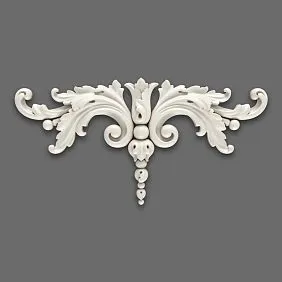
Wall decor —polyurethane molding framesfor neutral walls next to slatted areas.
About the company STAVROS
STAVROS is a Russian manufacturer of decorative products made from solid wood and polyurethane. All company products are designed as a single system: slats, baseboards, cornices, corner pieces, bars, and moldings are produced in unified series by wood species, dimensions, and surface treatment.
This allows you to selectwood trim itemsas a set: one wood species, one tint, a uniform result throughout the entire finish. STAVROS is a manufacturer that understands the interior as a system of joints and solutions, not as a collection of individual items.
Frequently asked questions
How to close the ends of wooden slats on a wall?
wooden corner pieceof the same wood species and tint as the slats. The corner piece is mounted over the end using acrylic adhesive. The size of the corner piece is proportional to the width of the slat.
How to connect slats to a ceiling cornice?
The cornice is installed first and overlaps the upper ends of the slats by 10–15 mm. The joint is sealed with acrylic sealant. A wooden cornice is for a uniform material. A white polyurethane cornice is for contrast with warm slats.
Which baseboard is suitable for wooden slats?
A wooden one of the same wood species is for a uniform material language. White MDF is for contrast and lightening the space. The baseboard height is 60–100 mm with a ceiling up to 2.7 m.
How to connect a polyurethane molding and a wooden slat?
A gap of 3–5 mm between them, filled with elastic acrylic sealant. A rigid joint without sealant will crack within six months due to seasonal wood movement.
How to cut an MDF baseboard in a corner?
With a miter saw at an angle equal to half the actual room angle. Before installation — dry fit. Gap in the joint — white acrylic sealant.
Is a wooden corner piece needed if the baseboard ends at an external corner?
It is advisable. A wooden corner piece on the external corner covers the junction of two baseboard planks and protects the corner from mechanical damage.
Can different wood species be used for slats, baseboards, and cornices?
Technically — yes. Visually — risky. Different species produce different shades and textures even with the same paint. It is recommended to use one species for all wooden elements in one room.