








































Article Contents:
- Why baseboard and cornice should be chosen together, not separately
- Three principles for coordinating baseboard and cornice
- What to consider before choosing baseboard and cornice: ten parameters
- Ceiling Height
- Interior style
- Presence of wooden slats
- Presence of moldings and stucco decor
- Color of walls and floor
- Door height and trim width
- Furniture material
- Will the baseboard be painted
- Type of floor covering
- Room seasonal mode
- MDF baseboard: when it works best with walls featuring stucco and slats
- Walls are painted and need a clean outline
- Modern or neoclassical interior
- MDF baseboard height: from 60 to 120 mm
- When MDF works better than wood
- Wooden baseboard: when natural solid wood is irreplaceable
- Wooden slats on walls — an argument for solid wood
- Parquet and engineered wood flooring: same species
- Wide wooden baseboard for classic and country homes
- Wooden cornice + wooden baseboard: a closed wooden system
- White wooden baseboard: a compromise solution
- Ceiling cornice: why walls with stucco and slats need it
- What problem does the cornice solve
- Ceiling cornice options
- How to combine baseboard and cornice by height: working logic
- The "1/10" rule
- Cornice: no larger than the baseboard
- Active wall: baseboard and cornice are "quiet"
- Classic wall with moldings: cornice and baseboard are more noticeable
- How to combine baseboard, cornice and wooden slats: five working schemes
- Scheme 1: Wooden slats + wooden baseboard + thin ceiling cornice
- Scheme 2: Wooden slats + white MDF baseboard + white cornice
- Scheme 3: Slats in accent area + baseboard in wall color
- Scheme 4: Slats from floor to ceiling + cornice only on adjacent walls
- Scheme 5: Slats up to the lower line of the cornice + molding as a junction
- How to combine baseboard, cornice and stucco decor on walls
- Moldings on walls + high baseboard
- Stucco frame + cornice in the same style
- Polyurethane moldings + MDF baseboard for painting
- Ceiling decor + baseboard in wall color
- Wooden baseboard + polyurethane molding in unified paint
- Baseboard and cornice color: nine options with application logic
- Baseboard in wall color
- White baseboard
- Baseboard in floor color
- Wooden baseboard in slat color
- Cornice in ceiling color
- Cornice in wall color
- Contrasting Cornice
- Monochrome white system
- Unified wood tone
- Role of trim, corners, and strips: finishing system
- Wooden corner: clean angles and ends
- Wooden beam: volumetric transitions and dividers
- Molding as a system: plan before installation
- Wooden elements as system-forming details
- Mistakes when choosing baseboard and cornice: eight cases with consequences
- Mistake one: baseboard too low for a high wall
- Mistake two: cornice too heavy for a small room
- Mistake three: wooden slats and baseboard of different shades without logic
- Mistake four: baseboard conflicts with architraves
- Mistake five: cornice breaks off at the decorative wall
- Mistake six: baseboard not joined with the slatted zone
- Mistake seven: moldings, baseboard and cornice of different styles
- Mistake eight: forgot about corners, miter cuts and junctions
- What to choose in the STAVROS catalog for a complete system of baseboard, cornice, slats and stucco
- MDF baseboards: from 60 to 120 mm
- Wooden baseboards: oak, ash, pine, birch
- Wooden cornices: classic profiles
- MDF cornices: for painting
- Wooden slats and slatted panels
- Wooden and polyurethane moldings
- Decor for walls and ceilings
- Molding: corners, strips, finishing system
- Consultation and system selection
- About the Company STAVROS
- Frequently Asked Questions

Imagine: you spent time, effort, and budget on decorative walls — chose wooden slats, selected polyurethane moldings, and carefully matched the paint tone. Then — you installed the first baseboard you found at the bottom and left the ceiling without a cornice. And that's it. The interior doesn't "come together." The walls hang in the air, the space looks unfinished, and the expensive decor feels like a random collection of materials.
Why does this happen? Because decorative walls are the content of the painting. The baseboard and ceiling cornice are its frame. Content without a frame is not perceived as a work of art. It is the baseboard and cornice that close the space vertically, creating a sense of architectural completeness.
How to choose this frame correctly — for walls with stucco, wooden slats, moldings, painted surfaces? How to coordinate the height, profile, color, and material of the baseboard with the cornice? And what mistakes should be avoided in advance? All of this — in detail, professionally, with ready-made solutions for different scenarios.


Why baseboard and cornice should be chosen together, not separately
Most people first do renovations, choose decor — and then, at the very end, buy a baseboard. "Something white, 60 mm." And the same goes for the cornice: if they think about it at all. This is a deep design mistake.
Wooden baseboardandwooden cornice — not a finishing touch that is "added at the end." These are two structure-forming horizontal elements that organize the space vertically. They work as a pair: the lower horizontal and the upper horizontal. And this pair must be coordinated — in proportion, style, color, and profile "weight."
When the baseboard and cornice are chosen correctly, something almost magical happens: the walls between them begin to "hold" — they are fixed by two horizontals and are perceived as an architectural system. When the pair is not coordinated, each element pulls in its own direction, and the interior looks like an unfinished renovation.




Three principles for coordinating baseboard and cornice
The principle of proportion. The height of the baseboard and the projection of the cornice should be correlated with the ceiling height. In a room with a 2.5 m ceiling — baseboard 60–70 mm and cornice 40–50 mm. In a room with a 3 m ceiling — baseboard 100–120 mm and cornice 60–80 mm. Violating this proportion creates an imbalance: a massive cornice "lowers" the ceiling, a thin baseboard makes the wall "baseless".
The principle of style. The profile of the baseboard and the profile of the cornice should belong to the same style register. A straight MDF baseboard next to a lush stucco cornice with ornamentation is a style conflict. A wooden baseboard with a chamfered profile next to a straight polyurethane cornice is a mild dissonance. Consistency of profiles does not necessarily mean identicality, but one "family" of forms.
The principle of color. White baseboard + white cornice — a single white frame. Wooden baseboard + wooden cornice — a single wooden system. Baseboard in floor color + cornice in ceiling color — classic "grounding". Mixing four different colors for two frame elements is a sure path to visual chaos.
Our factory also produces:


What to consider before choosing a baseboard and cornice: ten parameters
Before looking at specific profiles and materials, you need to honestly answer ten questions. They define the coordinate system for selection.
Get Consultation
Ceiling height
This is the first and main parameter. Up to 2.5 m — baseboard no higher than 70 mm, cornice minimal or absent altogether. 2.5–2.7 m — working range 70–100 mm for baseboard and 50–60 mm for cornice. 2.7–3.0 m — can be 100–120 mm and 60–80 mm respectively. Above 3 m — baseboard 120–150 mm and cornice 80–120 mm.
Interior style
Modern style, minimalism, Scandinavian — straight profiles without chamfers, without ornamentation. Neoclassicism — moderate profile with one or two horizontal lines. Classic, Empire, Baroque — developed profile with reverse curves, chamfers, shelves.
Presence of wooden slats
If the interior hasWooden planks for decorationon walls or ceiling, it is better to choose a baseboard from the same species. The cornice can be wooden or white polyurethane — depends on the ratio of warm and cold in the interior.
Presence of moldings and stucco decor
Polyurethane wall decorin the form of frames and moldings — this is already an active architectural system on the walls. The baseboard and cornice are selected as "quiet" elements: they frame without competing.
Wall and floor color
Dark walls require a more noticeable baseboard — it creates a lower "step." Light walls allow a baseboard in the wall color — it blends in. Floor color: dark floor + light baseboard = clear boundary. Light floor + white baseboard = unified lower zone field.
Door height and trim width
If doors are tall — from 2.1 m — the top line of the door frame does not align with the cornice line. A decision is needed: does the cornice run along the entire perimeter or only on free walls? The trim width should be correlated with the baseboard profile: they meet at a single point near the floor.
Furniture material
Massive wooden furniture in the interior is an argument for a wooden baseboard and wooden cornice. Furniture with white facades is an argument for a white MDF baseboard. Furniture with metal details calls for a neutral baseboard that does not overpower the texture.
Will the baseboard be painted
— is a horizontal element that frames the room at the bottom of the walls where the wall meets the floor. Skirting boards perform several functions: they hide the technological gap between the wall and floor covering (necessary for thermal expansion), protect the lower part of the wall from mechanical damage, create visual completion, and may conceal wiring.— this is a specifically prepared surface without wood texture, for acrylic or alkyd enamel. If painting in the wall color or a non-standard color is planned, MDF is mandatory. A wooden baseboard for painting can also be painted, but retains texture through the paint.
Floor covering type
Parquet or engineered oak flooring — it's logical to installwith a classic profile creates a sense of solidity, reliability. from the same species: the baseboard visually 'continues' the floor. Laminate or tile — both wooden andBaseboard MDF, the choice depends on the style.
Seasonal room mode
A country house with seasonal temperature fluctuations — a wooden baseboard requires acclimatization and proper installation with expansion gaps. A city apartment with a constant climate — a wooden baseboard behaves stably. In rooms with high humidity —MDF Skirting Board Buy with a moisture-resistant impregnation or use a wooden baseboard with oil treatment.
MDF baseboard: when it better suits walls with stucco and slats
MDF Skirting Board — this is not a 'cheap option,' as is commonly believed. It is a specialized product with specific tasks, which in a number of interiors works better than its wooden counterpart. Understanding when exactly means making the right decision.
Walls are painted and a clean outline is needed
Painted walls require a baseboard with a perfectly smooth surface for painting.— is a horizontal element that frames the room at the bottom of the walls where the wall meets the floor. Skirting boards perform several functions: they hide the technological gap between the wall and floor covering (necessary for thermal expansion), protect the lower part of the wall from mechanical damage, create visual completion, and may conceal wiring.This surface is ready without puttying: the front side has a primed layer, ready for enamel application. The result is a baseboard painted in the same color as the wall or white, looking like a single architectural detail rather than a glued-on strip.
Modern or neoclassical interior
White MDF Skirting BoardA straight profile is a laconic lower horizontal line without a "speaking" texture. It is this neutrality that makes it ideal in a modern interior: it does not compete with wooden slats, moldings, or parquet.
MDF baseboard height: from 60 to 120 mm
Popular formats:
| Height | Application scenario |
|---|---|
| 60 мм | Ceiling 2.4–2.5 m, Scandinavian, minimalism |
| 80 мм | Ceiling 2.5–2.7 m, modern, neoclassical |
| 100 мм | Ceiling 2.7–2.9 m, neoclassical, transitional style |
| 120 мм | Ceiling 2.9–3.0 m, neoclassical, country house |
MDF skirting board 80 mm— the most versatile format for apartments with standard ceiling heights.MDF skirting board 100 mm— for rooms with higher than average ceilings and neoclassical decor.MDF skirting board 120 mm— where architectural "heaviness" of the lower horizontal is needed.
When MDF works better than wood
-
The walls are painted in a non-standard color and the baseboard must match.
-
In an active interiorPolyurethane moldings— a wooden baseboard will add another material "story", MDF will remain neutral.
-
A clean, geometrically precise profile is needed: MDF does not have the color variations inherent in wood.
-
Budget is limited, but the area is large: MDF will be cheaper than solid wood with a similar external result in white.
Wooden baseboard: when natural solid wood is irreplaceable
Wooden baseboard— it's not just a "trim element." It's a material with character: living texture, the warmth of wood, the ability to be tinted and oil-treated, durability that MDF doesn't provide. In a number of interior scenarios, it is irreplaceable.
Wooden slats on walls — an argument for solid wood
When in the interiorwooden planks on the wallalready create a warm wooden atmosphere — a baseboard from the same species continues this logic. The lower horizontal line of solid wood "grounds" the vertical rhythm of the slats. The unity of material throughout the entire decorative system creates the feeling of a designed, rather than assembled, interior.
Parquet and engineered wood: a single species
wooden baseboardmade of oak next to oak parquet — an architectural pair. The eye flows from the floor to the baseboard without a seam: one material, one tint, one species. This technique is used in high-end housing, where the unity of natural materials is a key principle.
Wide wooden baseboard for classic and country homes
Wide Wooden Skirting Board120–150 mm made of oak or walnut — this is the architectural foundation of the wall. In a country house, in a manor interior, in a neoclassical space, a wide wooden baseboard creates a "plinth" for a decorative wall with moldings or slats. Without it, walls with active decor seem unstable, "floating."
Wooden cornice + wooden baseboard: a closed wooden system
wooden corniceat the top and a wooden baseboard at the bottom from the same species create a completely wooden horizontal system. This is a classic solution for interiors built on natural materials: a massive table, wooden frames, parquet, slats. All horizontals are made of wood. Wood organizes the space.
White wooden baseboard: a compromise solution
buy wooden skirting boardand paint it with white enamel — it's not an MDF baseboard. Under white paint, wood retains the mechanical strength of solid wood and a light texture. White wooden baseboard is a compromise between the naturalness of solid wood and the neutrality of white color.
Ceiling cornice: why walls with stucco and slats need it
Many people make beautiful decorative walls — and forget about the upper transition to the ceiling. The result: there is decor, but no "lid." The transition from wall to ceiling remains unfinished.Wooden ceiling corniceor a polyurethane cornice — it's the "top frame" of the decorative system.
What problem does the cornice solve
The first task is to close the transition from wall to ceiling. The joint line between wall and ceiling — in most apartments it is uneven: there are slight deviations from a right angle, there are traces of finishing. The cornice covers all of this at once.
The second task is to create a horizontal accent. A cornice around the perimeter of the room is a line that organizes the upper zone of the wall. The eye first sees the cornice, then the walls below it.
The third task is to complete the decorative system. Moldings, frames, slats on the walls — they work as an active zone. The cornice is a frame that "holds" this zone from above.
Ceiling cornice options
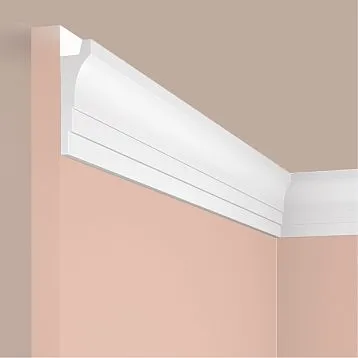
Polyurethane cornice made ofpolyurethane products — the lightest, most precise and cost-effective option. Installed with adhesive in a few hours. Can be painted any color. Unaffected by humidity.polyurethane ceiling decor covers a wide range of profiles — from thin 20 mm to classic 120 mm.
Wooden cornice made ofwooden cornices STAVROS — for interiors with massive furniture, wooden slats, and natural materials. A wooden cornice and wooden baseboard from the same species — the most architecturally convincing horizontal system.
MDF Crown — paintable, neutral, straight profile. Analogous to MDF baseboard in application logic, only at the ceiling.
Thin molding instead of a massive cornice — a delicate solution for small spaces or minimalist interiors. A 15–25 mm profile creates a horizontal line without excess bulk.
Without a cornice — if the interior is in loft, industrial, or radical minimalist style. The absence of a cornice should be a conscious decision, not a cost-saving measure.
How to match baseboard and cornice by height: working logic
Proportion is not mathematics. It is a feeling. But feelings have proven rules that work in most cases.
Rule "1/10"
The approximate height of the baseboard should not exceed 1/10 of the room height. With a ceiling of 2.5 m — no more than 250 mm (maximum size). In practice — 60–80 mm, i.e., about 1/30 of the height. This is a "moderate" proportion. An extended classical proportion is 1/20: with a ceiling of 3 m — a baseboard of 150 mm.
Cornice: no larger than the baseboard
A good basic principle: the "overhang" of the cornice (its visible width on the ceiling) should not exceed the height of the baseboard. If the baseboard is 80 mm — the cornice is no wider than 80 mm. If the baseboard is 60 mm — the cornice is 40–50 mm. Violation: a cornice of 120 mm with a baseboard of 60 mm creates a "heavy ceiling" with a light base — visual imbalance.
Active wall: baseboard and cornice "quiet"
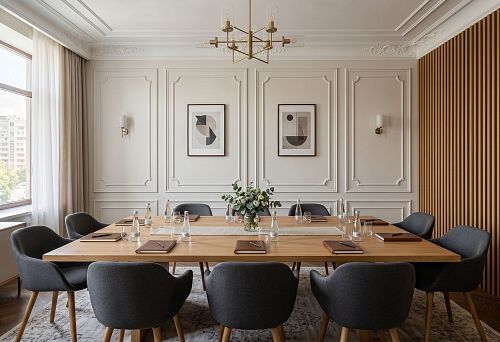
If the walls have wooden slats,with decorative wooden moldingsor stucco frames already create a rich decorative system — the baseboard and cornice are chosen as neutral, minimal. They are a frame, not a competitor. A straight-profile baseboard without ornament. A thin cornice in the color of the ceiling.
Classical wall with moldings: cornice and baseboard more noticeable
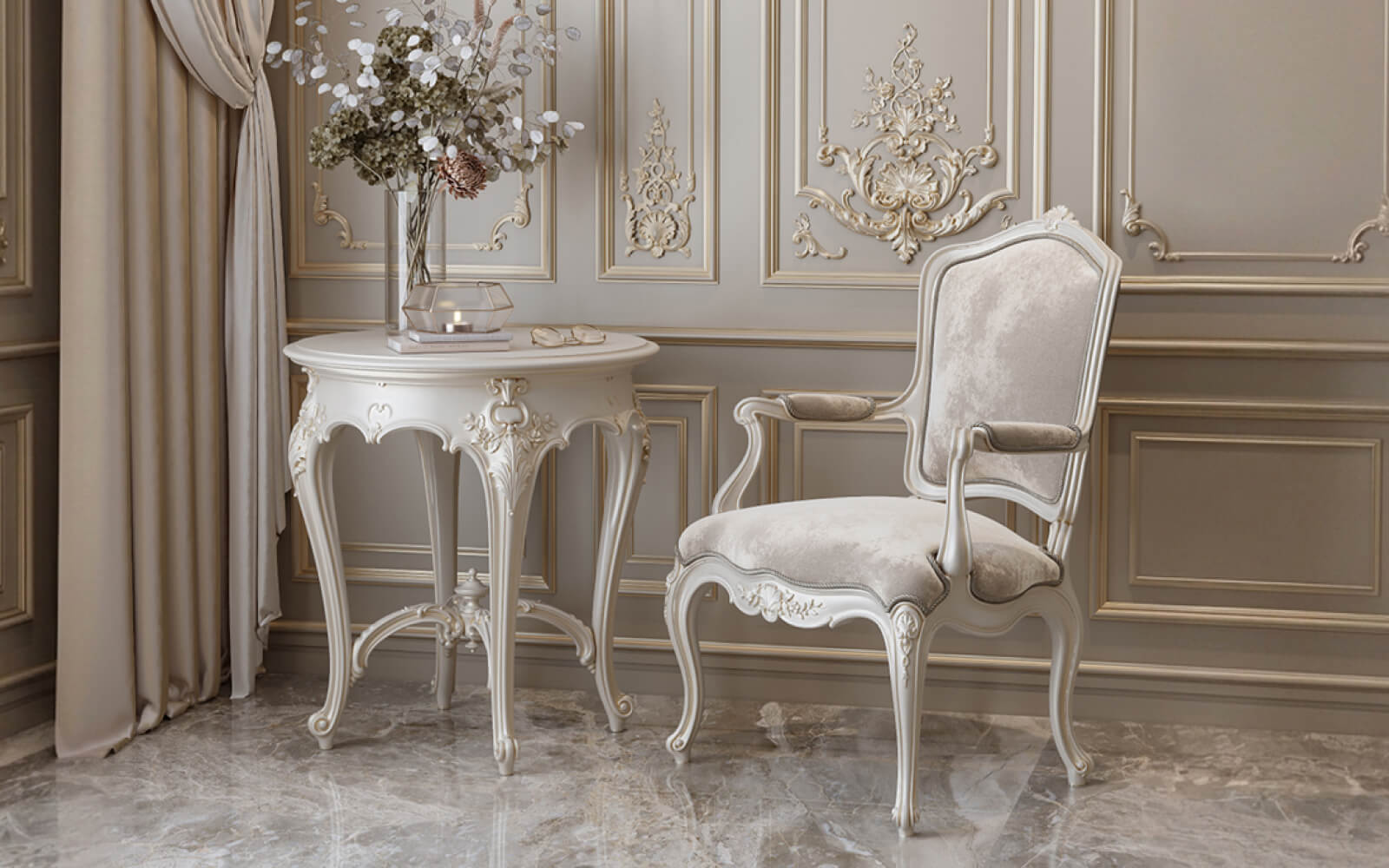
Polyurethane wall decorin the form of classical frames with ornament — this is an interior where a cornice with a developed profile is appropriate. A developed cornice supports the "richness" of the walls, rather than falling out of context.
How to combine baseboard, cornice, and wooden slats: five working schemes
Scheme 1: Wooden slats + wooden baseboard + thin ceiling cornice
Oak slats on the walls — warm, vertical.Wooden baseboard100 mm of the same species at the bottom. Thin polyurethane cornice 30–40 mm at the top in white — a delicate top line. Three materials, two colors: warm wood and white neutral. This is modern neoclassicism with a natural accent.
Scheme 2: Wooden slats + white MDF baseboard + white cornice
Wooden planktoned in a dark shade — charcoal, wenge, dark oak.MDF Skirting Board80 mm white. White polyurethane cornice 50 mm. Walls — neutral gray or linen. Strong contrast of dark wood and white architectural frame — a modern, designer scheme.
Scheme 3: Slats in the accent zone + baseboard in wall color
Rafter panelson the accent wall. The other walls are painted.— is a horizontal element that frames the room at the bottom of the walls where the wall meets the floor. Skirting boards perform several functions: they hide the technological gap between the wall and floor covering (necessary for thermal expansion), protect the lower part of the wall from mechanical damage, create visual completion, and may conceal wiring.painted in the same color as the walls: the bottom horizontal line 'dissolves'. The cornice is thin, in the color of the ceiling. All attention is on the slatted accent wall.
Scheme 4: Slats from floor to ceiling + cornice only on adjacent walls
Full slatted wall from floor to ceiling without cornice — slats go right up to the ceiling. On adjacent walls (non-slatted) — polyurethane or wooden cornice around the perimeter. Baseboard is uniform across all walls. Slatted wall is an "open field", the rest have a frame.
Scheme 5: Slats up to the lower line of the cornice + molding as a junction
wooden corniceinstalled first, its lower line is the horizontal to which the upper ends of the slats are brought. The transition from slat to cornice is covered by a horizontalwooden molding15–20 mm. Below — a wooden baseboard of the same species. The vertical slatted zone is "inserted" between two wooden horizontals. The most architecturally complete scheme for a wooden interior.
How to combine baseboard, cornice, and stucco decor on walls
Stucco decor is a different system than wooden slats. Polyurethane moldings, frames, rosettes, friezes — they create an architectural white relief on the walls. The baseboard and cornice for such decor are selected according to a different logic.
Moldings on walls + high baseboard
If the walls are decoratedpolyurethane moldingsin the form of panel frames or a horizontal frieze — the baseboard should be high enough to "hold" the bottom row of frames. Frames with a lower boundary at a height of 400–500 mm from the floor — a baseboard of 100–120 mm provides a base for the lower frame. A baseboard of 60 mm visually "cuts" the frame from below.
Stucco frame + cornice in the same style
Polyurethane frames on walls with an "Empire" profile require a ceiling cornice from the same style series. A cornice with a reverse curve and a shelf, frames with the same profile shape — a recognizable historical style.installing polyurethane moldingincludes the specifics of joining at 45° and preparing external corners — detailed in a separate article.
Polyurethane moldings + MDF baseboard for painting
White polyurethane moldings on walls + white MDF baseboard 80 mm — a unified white system. The moldings and baseboard are painted in the same color: it could be not white, but dusty green, dark blue, soot — any color, if the entire architectural layer is a single tone. The walls are a neutral background, the decor is active.
Ceiling decor + baseboard in wall color
polyurethane ceiling decorin the form of a ceiling cornice + baseboard in wall color. The upper horizontal is active, the lower is "quiet." All attention is on the ceiling. This is a working scheme for interiors with accent ceiling details.
Wooden baseboard + polyurethane stucco in a unified paint
Wooden baseboard + polyurethane moldings on walls, painted in the same color as the baseboard — a bold, non-trivial solution. A dark wooden baseboard + moldings in the same dark color = a unified "lower register" of the interior. The walls between the moldings are a light neutral background.
Color of baseboard and cornice: nine options with application logic
Color is often an underestimated parameter when choosing baseboards and cornices. It determines how the space is perceived as a whole.
Baseboard in wall color
When the baseboard is painted the same color as the wall, the lower boundary of the wall "dissolves." The room looks calmer, the space feels wider. This is the principle of the "invisible baseboard": the architectural element exists, but it does not divide the wall into parts.
White baseboard
White MDF Skirting Board— a classic Western tradition. A white baseboard next to any wall color looks clean and neat. It works especially well with light gray, linen, powder, and pastel walls. With dark walls, it creates a strong contrast — the lower horizontal line "stands out."
Skirting Board in Floor Color
Traditional classic scheme: the baseboard is an extension of the floor. An oak wooden baseboard next to oak parquet. Visually "raises" the floor, making the lower zone monolithic. A modern option is gray laminate and a gray MDF baseboard painted in the same shade.
Wooden baseboard matching the color of the slats
If the walls are decoratedwooden railsin a specific tint — a wooden baseboard of the same tint creates a unified wooden system along the lower and vertical surfaces. Three elements of the same tone: slats, baseboard, and possibly a cornice.
Cornice matching the ceiling color
The most common and "safe" choice for a cornice: it matches the ceiling and visually "raises" the upper horizontal line. The room appears taller. This is especially important for rooms with ceilings up to 2.5 m.
Cornice matching the wall color
The cornice is painted the same color as the wall: this creates a soft transition without a clear horizontal line. The boundary between the wall and ceiling is blurred. Suitable for neoclassical or modern styles when you want unity in the upper zone without an active accent.
Contrasting cornice
A dark cornice with light walls and a white ceiling is a deliberate design accent. This is a complex solution that requires a well-thought-out system: if a dark cornice is used, a dark baseboard at the bottom creates a "frame" for the room. Without a dark baseboard at the bottom, a dark cornice looks random.
Monochromatic white system
White baseboard + white moldings + white cornice + white ceiling = a completely white architectural system. Walls can be any color, active or neutral. The decor is "removed from color" into a white architectural layer. A very clean, modern scheme.
Single wood tone
Wooden baseboard + wooden moldings + wooden cornice + wooden slats from the same species — a completely wooden architectural system. This is a choice for interiors where wood is the main material leitmotif: a country house, study, hunting hall, Japanese style.
The role of trim, corners, and bars: the finishing system
Trim products are not "little things." They are a finishing system, without which any decor looks unfinished.wood trim itemsare part of the complete decorative system on par with slats, baseboards, and cornices.
Wooden corner: clean corners and ends
Wooden angleis used in three key areas:
-
Closing the side ends of the slat area — those unfinished cuts that disrupt the sense of quality.
-
Internal and external corners of the baseboard — where the baseboard turns around the corner.
-
Joints of the slat zone with door frames or slopes.
The size of the corner is proportional to the slat: a 15×15 mm corner for a 25 mm slat, a 20×20 mm corner for a 40 mm slat.
Wooden block: volumetric transitions and dividers
Wooden block applied:
-
As a horizontal divider of the slat zone — creates a "shelf" between the lower and upper parts of the slat field.
-
As a vertical frame post — a volumetric side border of the decorative zone.
-
As a decorative horizontal accent on the wall — a 30×40 mm block, painted to match the wall or the slats.
Molding as a system: plan before installation
A common mistake is to order molding elements after installation, "as you go." The correct approach is to plan the entire system: slats, corners, blocks, moldings, baseboards, cornices from a single series before purchasing. Only then can a predictable result be achieved.Trimming Items a single series guarantees the same wood species, the same tint, and a uniform result across all elements.
Wooden elements as system-forming parts
wooden elements for interiors — these are slats, corners, bars, moldings, baseboards, and cornices, considered as a single architectural system, not as a set of individual parts. It is the systematic approach that turns a set of materials into an interior.
Mistakes when choosing baseboards and cornices: eight cases with consequences
Mistake one: baseboard too low for a high wall
A 40 mm baseboard with a 3 m ceiling is a tiny detail against a huge wall. The lower horizontal does not hold the space. The wall "flows" to the floor without an architectural accent. For a height of 3 m — minimum 120 mm, optimally 140–150 mm.
Mistake two: cornice too heavy for a small room
A 150 mm cornice in a 12 sq m bedroom with a 2.6 m ceiling — the ceiling "fell". The cornice takes up 1/17 of the room height — that's a lot. In small rooms — cornice up to 50 mm, better 30–40 mm.
Mistake three: wooden slats and baseboard of different shades without logic
Oak slats "natural" and oak baseboard "American walnut" — two different warm tones. Together they create a feeling of error, not design. Uniform tinting across all wooden elements is a must.
Mistake four: baseboard conflicts with architraves
A 100 mm baseboard butts against a 60 mm wide casing — the lower corner of the baseboard protrudes beyond the casing. Either the baseboard is cut to fit the casing (crookedly), or you need to choose the baseboard height according to the casing width: baseboard = casing ± 10–20 mm.
Mistake five: the cornice breaks off at the accent wall
The cornice runs around the perimeter of the room and suddenly stops at a slatted accent wall — without finishing. The end of the cornice is visible at an angle. The correct solution: the cornice is brought to the side post of the slatted area (corner piece or block) and finished with a neat cut.
Mistake six: the baseboard is not joined with the slatted area
The baseboard runs along the entire perimeter, but at the meeting point with the slatted panels, a visible gap or overlap forms. Installation order: first the baseboard around the entire perimeter, then the slatted panels on top of it — the slats sit on the baseboard. Or vice versa: first the slats, the baseboard is brought tightly under them.
Mistake seven: moldings, baseboard, and cornice of different styles
A straight classic cornice + a minimalist baseboard + ornamental moldings on the walls — three different style languages. Result: the interior doesn't read. The system must be coordinated: either all classic, or all modern, or a conscious neoclassical with moderate profiles.Mistake eight: forgot about corners, cuts, and junctions
The baseboard and cornice are purchased, but no one thought about corner elements, 45° cuts, and the method of joining at corners. The result: crooked corners, visible gaps, messy joints. Corners are planned in advance: for polyurethane moldings — a 45° cut with a miter saw, for wooden ones — the same plus puttying the joint if necessary.
What to choose in the STAVROS catalog for a complete system of baseboard, cornice, slats, and stucco
For an interior with stucco decor and wooden slats, a comprehensive material system is needed where all elements are coordinated with each other. In the STAVROS catalog, this system is fully represented.
MDF baseboards: from 60 to 120 mm
MDF Skirting Boardin the STAVROS line — straight profiles without ornamentation for painting. Height: 60, 70, 80, 100, 120 mm. Plank length 2.4 m. The surface is primed, ready for applying acrylic enamel.buy MDF skirting boardcan be purchased either individually or as a set for the entire perimeter, accounting for trimming allowance.
Wooden baseboards: oak, ash, pine, birch
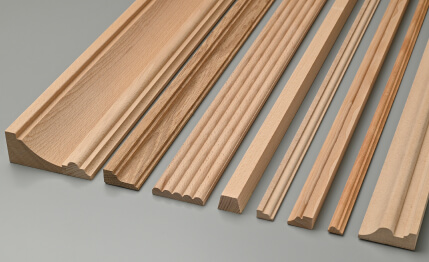
Wooden baseboardfrom solid wood in the STAVROS series — profiles with and without a bevel, height 60–150 mm. Ready for tinting, oil treatment, or painting.wooden baseboardmade of oak — this means durability of 30+ years with proper installation.
Wooden cornices: classic profiles
Wooden beamsin the profile range of 35–120 mm. Simple, with one shelf, with bevels — for different stylistic tasks.Buy wooden crownmade from the same wood species as the slats and baseboard — the main principle of a systematic approach.
MDF cornices: for painting
MDF Crown — an alternative to wood for interiors where a painted ceiling cornice without wood texture is needed. Profile straight or with one ledge, length 2.4 m.
Wooden slats and slatted panels
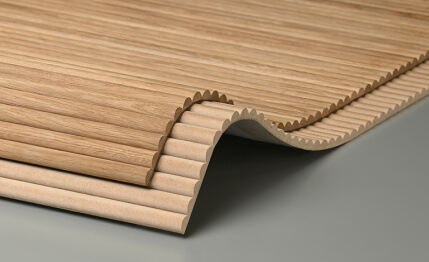
Buy oak wooden planks for walls width 20–60 mm, thickness 15–30 mm, length up to 3 m. Oak, ash, pine, birch. Ready-madeRafter panels with fixed spacing — for quick installation without marking.
Wooden and polyurethane moldings
Decorative wooden moldings — horizontal and vertical elements for frames and dividers on walls.Moldings made of polyurethane — white architectural profiles for walls and ceilings, from minimalist to classic with ornament.
Decor for walls and ceilings
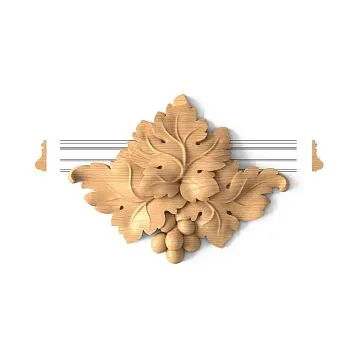
Polyurethane wall decor — panels, rosettes, corner elements, friezes.Polyurethane ceiling decor — ceiling cornices, coffers, rosettes, corner elements. Full rangepolyurethane products for creating classic and neoclassical interiors.
Molding: corners, strips, finishing system
Wooden angle — covering ends and corner joints.Wooden block — decorative dividers and frame posts. The entire systemwood trim in a unified series with slats, baseboards, and cornices.
Consultation and system selection
Installation of moldings, cornices, and baseboards requires precise technology. Details are covered in the materialinstalling polyurethane molding — clean corners, hidden joints, and proper painting.
About the company STAVROS
STAVROS is a Russian manufacturer of decorative elements made from solid wood and polyurethane for architectural interiors. The company produces a full range of linear products: slats, baseboards, cornices, moldings, corners, bars, as well as polyurethane stucco decor — everything needed to create a complete decorative system in one interior.
The main principle of STAVROS is to produce not individual parts, but material systems where each element is coordinated with the others. A single wood species for all wooden products, a single processing standard, and unified profile series for polyurethane — this guarantees a predictable result. When baseboards, cornices, slats, and moldings are ordered from one STAVROS series, they form a single architectural layer — not a set of parts, but a designed interior.
STAVROS works with designers, architects, construction companies, and private clients across Russia. Production is in Russia. Delivery is to any region. Consultation on system selection is free.
Frequently asked questions
How to choose the height of the baseboard relative to the ceiling height?
Use an approximate proportion: baseboard height = ceiling height / 30–35. For a 2.5 m ceiling — baseboard 70–80 mm. For 2.7 m — 80–100 mm. For 3 m — 100–120 mm. For classic interiors, it can be increased to a proportion of 1/20.
MDF baseboard or wooden — which to choose?
MDF — if the walls are painted and you need a baseboard for painting in the wall color or white, if the interior is modern. Wooden — if the floor has parquet of the same species, if the interior has wooden slats or solid wood furniture, if you want durability and natural texture.
Is a ceiling cornice needed if the walls have moldings?
Yes, it is needed. Moldings on the walls create a decorative system, the cornice is its top finish. Without a cornice, the moldings on the walls look unfinished, the transition to the ceiling is abrupt. The cornice covers this transition and creates a horizontal frame.
How to combine a wooden baseboard and a polyurethane cornice?
Leave the wooden baseboard natural with tinting or oil. Paint the polyurethane cornice white. The contrast of warm wood below and a white architectural cornice above is classic