Article Contents:
- Decoration Philosophy: From Idea to Implementation
- Wooden Solutions: Naturalness as the Foundation of Style
- Horizontal and Vertical Rhythms
- Relief Panels and Three-Dimensional Compositions
- Carving and Ornamentation
- Moldings: Architecture on Walls
- Creating Architectural Frames
- Vertical and Horizontal Division
- Ceiling and Floor Transitions
- Outlets and Covers: Point Accents
- Centering the Composition
- Corner and Boundary Elements
- Slat Systems: Modern Interpretation
- Parallel Rhythms
- Diagonal and Complex Patterns
- Color and Texture: Invisible Tools
- Monochromatic solutions
- Contrast Schemes
- Accent colors
- Wall Panels: Comprehensive Solutions
- Classic Panel System
- Full Cladding
- Accent Panels
- Installation Techniques: From Preparation to Finish
- Surface Preparation
- Marking and Planning
- Mounting methods
- Corner joints
- Finishing
- Polyurethane and Composite Materials: Modern Alternatives
- Advantages of Polyurethane
- Combining materials
- Decorative Lighting: Play of Light and Shadow
- Side lighting
- Hidden Lighting
- Accent Spotlights
- Style Solutions: From Classic to Contemporary
- Classic Interior
- Neoclassicism
- Scandinavian Style
- Loft
- Modern minimalism
- Space Zoning Through Decoration
- Highlighting Functional Zones
- Visual Proportion Correction
- Creating Focal Points
- Mistakes and How to Avoid Them
- Scale Mismatch
- Violation of Symmetry
- Ignoring the architecture of the room
- Incorrect Material Selection
- Insufficient Surface Preparation
- Practical Ideas for Different Rooms
- Living Room
- Bedroom
- Office
- Children's room
- Entry Hall
- Bathroom
- Budget and Planning
- Defining priorities
- Implementation Phasing
- Balance of DIY and Professional Assistance
- STAVROS: A Partner in Creating a Unique Interior
- Assortment and quality
- Custom solutions
- Comprehensive Projects
- Consultations and support
- Conclusion: Walls as a Canvas for Self-Expression

When it comes to decorating home walls, an endless space for creativity opens up before us. A wall is not just a vertical surface dividing rooms. It is an opportunity to tell a story, create a mood, and emphasize the character of a space. Decorating home walls transforms a bland room into a living, breathing space filled with individuality and style.
Why are walls so important in creating an interior? They occupy the largest visual area in any room. It is on them that the gaze falls when we enter a space. Well-decorated walls can visually change the proportions of a room, create an illusion of height or width, add depth or, conversely, coziness. They set the rhythm for the entire interior, becoming a backdrop for furniture and accessories or, conversely, acting as the main accent around which the entire composition is built.
The modern approach to wall decoration is characterized by flexibility and diversity. You can choose a minimalist path, limiting yourself to laconic architectural elements, or take the path of maximalism, creating multi-layered compositions with rich texture and ornamentation. The main thing is to understand the principles of working with space and know the possibilities of various materials.Wooden wall compositioncan become the central element of the entire interior, attracting attention and shaping the character of the room.


Decoration Philosophy: From Idea to Implementation
Before picking up tools, it is important to decide on a concept. What atmosphere do you want to create? Are you striving for the solemnity of a classic interior or do you prefer the relaxed atmosphere of a modern loft? Do you want the walls to be a neutral background or to turn into an art object?
DIY wall decoration begins with an analysis of the space. Assess the ceiling height, natural lighting, and existing architectural elements. High ceilings allow the use of large-scaleDecorative elements for wall finishingthat will not overload the space. In rooms with standard height, it is better to choose more delicate solutions that visually elongate the space.
Light plays a critical role. In rooms with abundant natural light, relief decoration creates a lively play of shadows that changes throughout the day. In rooms with insufficient light, it is better to use light shades and glossy surfaces that reflect artificial lighting.




Wooden Solutions: Naturalness as the Foundation of Style
Wood remains an unsurpassed material for wall decoration due to its versatility and visual warmth.Beautiful wooden wallscreate a sense of reliability, connection with nature, and authenticity of space. But working with wood requires an understanding of its characteristics and possibilities.
Our factory also produces:


Horizontal and Vertical Rhythms
The direction of wooden elements dramatically changes the perception of space. Horizontal lines visually expand a room, making it more spacious, but can simultaneously 'lower' the ceiling. Vertical placement, on the contrary, elongates the space upward, creating a sense of height and solemnity.
A combined approach can be used: decorate the main wall field with horizontal elements, and highlight accent zones with vertical inserts. Such a solution creates a dynamic, multi-level composition that is interesting to the eye.
Get Consultation
Relief panels and volumetric compositions
Decorative wall panelsmade of solid wood allow the creation of complex architectural compositions. Paneled constructions, traditional for classic interiors, consist of frame elements and infill. The frame is formed from profiled strips — moldings, glazing bars, baseboards. The interior space can be filled with a smooth panel, upholstered with fabric, wallpapered, or decorated with carved overlays.
Such a system allows for endless variations. Large rectangular sections give the interior monumentality, a fine grid of squares creates a more elegant, decorative effect. Asymmetric compositions with panels of different sizes add modernity to the classic scheme.
Carving and ornamentation
Carved wooden patternsturn a wall into a work of art. Carved overlays can be barely noticeable, creating a delicate relief, or deep, sculptural, dominating the interior.
Floral motifs — grapevines, oak leaves, floral garlands — are suitable for classic and neoclassical interiors. Geometric ornaments — meanders, rosettes, interlaces — are good in Art Deco and Modern styles. Abstract reliefs work in modern minimalist spaces.
Carved elements can be used pointwise, as accents in key zones — above the headboard, in the TV area, above the fireplace. Or create a continuous carved panel covering the entire wall. The first approach is more delicate and universal, the second is dramatic and requires support in the rest of the interior.
Moldings: Architecture on Walls
Wooden wall decoration with moldings— is a classic technique that never goes out of style. Molding is a profiled strip that can serve both decorative and functional roles.
Creating Architectural Frames
The simplest and most effective technique is creating rectangular frames on the wall. You mark a symmetrical grid, form frames from moldings, and paint them in a color that contrasts or matches the wall. The interior space can be left plain, covered with patterned wallpaper, or painted a different shade.
This system works in any style. In classic interiors, wide, richly profiled moldings with stucco details are used. In modern interiors — simple, concise rectangular-section slats. In Scandinavian style — thin white strips on a white background, creating a barely noticeable relief.
Moldings and cornices for furniturecan duplicate wall elements, creating a cohesive composition where walls and furnishings are visually connected by a unified architectural language.
Vertical and Horizontal Division
Moldings allow you to divide a wall into zones. A classic technique is horizontal division at about one-third of the height from the floor. The lower part is usually darker or more saturated in color, the upper part is light. This visually stabilizes the space, creating a sense of reliability.
Vertical moldings are used to create pilasters — decorative vertical elements imitating columns. They can frame door and window openings, highlight accent areas, and zone long walls.
Ceiling and Floor Transitions
Wooden cornicesat the junction of the wall and ceiling complete the composition, giving the interior a finished look. The cornice can be a simple triangular profile or a complex multi-level structure with several protrusions and recesses.
A wide cornice visually lowers the ceiling, creating intimacy and coziness. A narrow, delicate one emphasizes height and adds airiness. In modern interiors, a hidden cornice with lighting is often used — an LED strip is placed behind a protruding element, creating a floating ceiling effect.
solid wood skirting boardsat the boundary of the wall and floor is an equally important element. A high baseboard matching the wall color visually elongates the space. A contrasting baseboard creates a clear graphic line, structuring the interior.
Outlets and covers: point accents
Wooden Wall Finishing with Decorative Rosettes— is a way to add individuality to an interior without drastic changes. A rosette is a round or polygonal carved element placed at key points of the composition.
Centering the Composition
A rosette in the center of a wall becomes a focal point around which the rest of the decor is arranged. It can be small and delicate, or large and dominant. From the rosette, you can extend a symmetrical system of moldings, creating a classic centered composition.
On the ceiling, a rosette is traditionally placed at the point of chandelier attachment. The diameter of a ceiling rosette can reach 50-120 cm, creating an impressive decorative effect.
Corner and Edge Elements
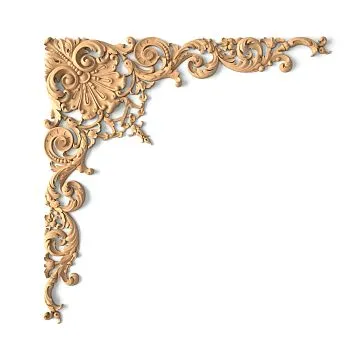
Corner overlays are used at the intersection of moldings, in the corners of frames, at the junctions of different planes. They can be simple — square rosettes — or complex, with floral motifs, scrolls, geometric patterns.
Wooden corner veneeris not only decorative but also functional — it covers the joint of two surfaces, protecting the corner from mechanical damage. Interior solutions use both equilateral and non-equilateral corner elements, selected for the specific task.
Slat Systems: A Modern Interpretation
Wooden slats are one of the main trends in recent years. They allow creating modern, dynamic compositions that work in minimalist, Scandinavian, and loft interiors.
Parallel Rhythms
Slats of the same width, installed parallel with equal spacing, create a rhythmic structure. The frequency of the rhythm affects perception: close spacing creates an almost solid surface with thin shadow lines, wide spacing creates a graphic structure with pronounced gaps.
Slats can be attached directly to the wall or mounted on a frame with a gap. The second option creates a more pronounced play of light and shadow, adding volume.
Diagonal and Complex Patterns
Diagonal placement of slats adds dynamism. Opposing diagonals create a herringbone or diamond pattern. Chaotic placement of slats of different lengths and widths forms an abstract composition.
You can create three-dimensional relief by varying the distance from the wall for different slats. Individual elements protrude more, creating a wavy or stepped surface.
Color and Texture: Invisible Tools
Wall decoration is not only about form but also color. Wooden elements can be left in their natural state, highlighting the texture with oil or varnish. They can be painted any color, creating a contrast with the main wall surface or, conversely, integrating the decor into the overall background.
Monochromatic Solutions
White decor on a white wall — this is purity, airiness, Scandinavian aesthetics. The relief creates barely noticeable shadows, adding depth without color aggression. This solution visually expands the space and is suitable for small rooms.
Dark decor on a dark wall — drama, intimacy, modern luxury. Black, graphite, deep brown shades create an enveloping atmosphere, suitable for bedrooms, studies, media zones.
Contrast schemes
Dark decor on a light background — classic, clarity, architectural expressiveness. Moldings and frames stand out as graphic lines that structure the space. Suitable for classic, neoclassical, art deco interiors.
Light decor on a dark background — elegance, softness, modernity. A less contrasting solution than the previous one, but no less effective. Works in modern, eclectic interiors.
Accent colors
Bright, saturated color of wooden decor turns it into the main accent of the interior. Deep blue, emerald, terracotta, burgundy — such solutions require boldness but create a memorable effect.
Wall panels: comprehensive solutions
Wall Panels— is a ready-made decoration system where all elements are selected and coordinated with each other. The panel system can cover the entire wall from floor to ceiling or only part of it — for example, the lower third (classic panel) or the central zone (accent panel).
Classic panel system
Traditional boiserie is wooden wall cladding with a frame-and-panel structure. The lower part of the wall is divided into rectangular sections, each framed by molding. The upper part can be painted, wallpapered, or also finished with wood.
The height of a classic panel is from 90 to 150 cm. The upper boundary is marked by a profiled strip — a dado rail, which can also serve as a functional element. In historical interiors, the dado rail was used for support when walking along the wall; today it is a purely decorative element.
Full cladding
A wall completely covered with wooden panels creates a sense of reliability, warmth, and solidity. Such a solution is suitable for studies, libraries, living rooms in a classic style.
Full cladding can be made from solid panels with a pronounced wood texture or from painted panel systems. In the first case, the emphasis is on the naturalness of the material; in the second — on the architectural structure and color.
Accent panels
Instead of cladding the entire room, you can highlight one accent wall.50 ideas for interior decoration with wooden elementsdemonstrate how one properly designed wall can completely transform a space.
An accent panel is placed behind the headboard in a bedroom, behind a sofa in a living room, in the TV area, behind a dining table. It creates a visual center around which the rest of the furnishings are organized.
Installation techniques: from preparation to finish
Successful DIY wall decoration requires not only aesthetic vision but also technical knowledge. Quality installation is the foundation of durability and appearance.
Surface preparation
The wall must be level, dry, and clean. Irregularities exceeding 3-5 mm must be leveled with filler. Dust and dirt are removed by wet cleaning. The surface is primed with a deep-penetration compound to improve adhesion.
If the wall has significant irregularities, installation is done on a frame. Wooden battens or metal profiles create a level plane independent of the base wall condition. This method takes more time but ensures a perfect result.
Marking and Planning
Precise marking is the key to symmetry and correct proportions. Use a laser level to establish horizontal and vertical lines. Mark the placement of all elements on the wall before starting installation.
Symmetry is important when creating frame compositions. Center the system relative to the wall axis. The side margins should be equal, as should the distances between frames.
Methods of mounting
Light elements — thin moldings, small overlays — are attached with adhesive. Use special wood mounting adhesive or a universal polymer compound. Apply adhesive to the back of the element with a notched trowel, press the part to the wall, and secure it temporarily with painter's tape or temporary supports while it sets.
Heavy elements — wide panels, massive cornices — require mechanical fastening. Use screws, countersinking the heads into the wood. The holes are filled with wood filler to match the material color.
A combined method — adhesive plus mechanical fastening — ensures maximum reliability.
Corner Joints
Moldings and baseboards are joined at corners at a 45-degree angle — this is a classic solution that creates a clean, professional look. The cut is made with a miter saw or miter box. Precision is crucial — even a slight deviation creates a noticeable gap.
Wooden layout for cornerscan use ready-made corner elements that eliminate the need for precise cutting. Corner overlays cover the joint, creating an additional decorative accent.
Final finishing
After installation, all joints, gaps, and fastener holes are filled with filler. After drying, the surface is sanded with fine-grit sandpaper until smooth.
If painting is planned, the surface is primed, then paint is applied in two to three coats. Between coats — intermediate sanding for perfect smoothness.
If the wood is left natural, a protective coating is applied — oil, wax, or varnish. Oil emphasizes the grain, creating a matte surface. Varnish provides gloss and stronger protection but can hide the subtleties of the grain.
Polyurethane and composite materials: a modern alternative
Natural wood is not always the optimal solution. In high-humidity rooms, on facades, and in high-traffic areas, it is better to use polyurethane decorative elements. They imitate wood or plaster stucco but lack the drawbacks of these materials.
Advantages of polyurethane
Polyurethane elements are not afraid of moisture, do not deform from temperature changes, and do not require complex maintenance. They are lighter than natural wood, which simplifies installation and reduces the load on walls. They can be painted, creating any color scheme.
Polyurethane imitates classic stucco with its complex profiles and ornaments well. Creating such elements from wood is labor-intensive and expensive; polyurethane allows achieving a similar result for less money.
Combining materials
Natural wood and polyurethane can be combined in one interior. Main large elements — panels, large moldings — are made of wood. Small stucco, carved overlays, ceiling rosettes — are made of polyurethane. This approach optimizes the budget without losing visual quality.
It is important to correctly select the shade and texture so that elements from different materials harmonize with each other. Painted the same color, they are perceived as a unified system.
Decor lighting: the play of light and shadow
Any relief on the wall is revealed through lighting. Flat light kills volume, making the decor flat and inexpressive. Proper lighting, on the contrary, enhances the relief, creates dramatic shadows, and adds depth.
Side lighting
Fixtures installed to the side of the decorated wall create grazing light, revealing every irregularity of the relief. This is the optimal solution for carved panels, relief overlays, and moldings.
Wall sconces directed along the wall or floor lamps providing light from bottom to top can be used. The second option is especially effective — it creates unusual shadows not found in nature, adding theatricality to the interior.
Hidden lighting
LED strip installed behind a cornice, behind a protruding panel, or behind a baseboard creates soft contour lighting. It does not illuminate directly but outlines boundaries, emphasizing architectural lines.
Hidden lighting can be white or colored. White light is universal and neutral. Colored light is a bolder solution, capable of radically changing the atmosphere. Warm yellow creates coziness, cool blue creates modernity, colored lighting creates creativity and dynamism.
Accent spotlights
Directional lights — spots, track systems — allow highlighting individual decor elements. A central rosette, a carved overlay, or a particularly beautiful panel fragment gets its own light source, becoming a visual accent.
Adjustable spots provide the ability to change the direction of light, experiment with effects, and create different lighting scenarios for different times of day and moods.
Stylistic solutions: from classic to contemporary
Decorating the walls of a house should correspond to the overall interior style. Let's consider how decor works in different stylistic directions.
Classic interior
Classic requires symmetry, proportionality, and richness of detail. Walls are divided into zones using moldings, creating framed compositions. Cornices, baseboards, pilasters, and rosettes are used. Ornamentation is floral and complex. Colors are noble — white, cream, gold, pastel shades.
In a classic interior, the decor should not be minimalist. Each element is elaborated, detailed, and adorned. But at the same time, balance is maintained — the decor does not turn into chaos; it follows a clear compositional logic.
Neoclassicism
A modern interpretation of classic is more restrained, laconic, but retains the main principles. Symmetry remains, but the decor is simplified. Moldings have simpler profiles, with less stucco and carving. Colors can be bolder — gray, graphite, deep blue.
Neoclassical combines natural materials and modern technologies well. Wooden panels coexist with smooth painted surfaces; classic forms are filled with contemporary content.
Scandinavian style
The Scandinavian approach is minimalism, light tones, natural materials, and functionality. Decor is present but maximally restrained. White or light gray moldings on white walls create a barely noticeable relief. Wooden slats, painted in light shades or left natural from light species — pine, birch, ash.
The texture of natural wood is important — it adds warmth to a strict minimalist interior. Simplicity of forms is compensated by the quality of execution and materials.
Loft
Loft aesthetics love contrasts — rough and refined, industrial and homely. Wood decor in a loft should look either deliberately rough — old boards, visible signs of aging, untreated texture. Or, conversely, contrastingly refined — carved elements against a backdrop of concrete and brick.
Slat systems made of dark wood on a white wall, old beams, exposed wooden structures — all of this works in a loft. The main thing is not to create a sense of excessive finish, to preserve some incompleteness characteristic of the style.
Modern minimalism
In minimalism, wall decor should be maximally restrained. Smooth panels without ornaments, simple rectangular moldings, strict geometry. Colors are neutral — white, gray, beige, black. Emphasis is on purity of lines, quality of surfaces, and play of planes.
Hidden fastening systems can be used, where panels are mounted without visible seams and joints, creating the illusion of a monolithic surface. Or, conversely, emphasize modularity — clearly mark the boundaries of each panel, making seams part of the composition.
Zoning Space with Decor
Decorating walls can be not only an aesthetic but also a functional technique — a way to zone space without partitions.
Defining Functional Zones
In an open-plan layout where the kitchen, dining area, and living room are combined, wall decor helps visually separate the zones. An accent wooden wall behind the sofa marks the living room. A tile backsplash and lack of decor define the kitchen. A system of moldings in the dining area indicates the dining room.
Different types of decor create different atmospheres in each zone, while the overall style maintains the unity of the space.
Visual proportion correction
Vertical decor stretches the space upward, suitable for rooms with low ceilings. Horizontal decor expands the space, good for narrow rooms. Large elements bring the wall closer, making the room feel smaller. Small elements push the wall away, making it feel larger.
Dark decor on a light-colored far wall visually brings it closer, making a long room more proportional. Light decor on dark side walls expands a narrow space.
Creating Focal Points
Wooden wall decorationscreate focal points around which the rest of the furnishings are organized. A carved panel above the fireplace, a composition of moldings behind the bed headboard, an accent slatted wall in the living room—all these are focal points that define the hierarchy of the space.
There should be only one focal point in each zone. Several equally prominent accents create visual conflict and scatter attention.
Mistakes and how to avoid them
DIY wall decoration is a creative but also technical process. Let's look at typical mistakes that can ruin the result.
Scale mismatch
Oversized decor in a small room feels oppressive and creates a sense of tightness. Too small decor in a large space gets lost and looks insignificant. The size of the elements should correspond to the area and height of the room.
Rule: in a standard room with a ceiling height of 2.5-2.7 m, the width of moldings is 5-10 cm, the height of the baseboard is 8-15 cm. In rooms with high ceilings, these values increase proportionally.
Violation of symmetry
In classical compositions, symmetry is critical. Unequal side margins, a shifted center, uneven spacing between elements—all this creates a sense of imbalance and carelessness.
Use careful marking. Check symmetry at each stage. It's better to spend an extra hour planning than to redo already installed decor.
Ignoring the architecture of the room
Decor should take into account existing architectural elements—windows, doors, niches, protrusions. A molding cut off by a doorway, a frame that doesn't accommodate an outlet—these are signs of a poorly thought-out composition.
Start planning with existing elements. Arrange the grid of moldings so that it harmonizes with the placement of windows and doors. Use openings as part of the composition, not as an obstacle.
Incorrect material choice
Natural wood in damp rooms quickly warps. Heavy elements on a drywall wall without reinforcement will fall off. Unpainted wood on a sunny southern side fades.
Choose materials suitable for the operating conditions. Use moisture-resistant species or alternative materials in bathrooms. Reinforce walls for heavy decor. Protect wood from direct sunlight.
Insufficient surface preparation
Installation on an uneven, dirty, unprimed wall leads to peeling elements, gaps, and deformation. Quality preparation is 50% of success.
Don't skimp on preparation time. Level the walls, clean them thoroughly, prime them. The result will justify the effort spent.
Practical ideas for different rooms
Each room requires its own approach to wall decoration. Let's look at specific solutions for different areas of the house.
Living Room
The main room of the house, a place for receiving guests and family gatherings. Here, decor can be most expressive. An accent wall behind the sofa or TV is a classic solution. Use large framed compositions of moldings, slatted systems, carved panels.
If there is a fireplace in the living room, the area around it requires special attention. A classic technique is a symmetrical composition with the fireplace at the center. Pilasters on the sides, a cornice on top, a decorative overlay above the firebox create a solemn frame for the hearth.
Bedroom
The relaxation area requires calm, soothing decor. Avoid excessive activity and aggressive contrasts. Soft tones, smooth lines, symmetrical compositions.
The bed headboard is a natural focal point of the bedroom. A soft wall panel, a carved wooden composition, a system of moldings creating an architectural frame—all these are suitable solutions. The decor can rise from floor to ceiling or occupy only the area directly behind the bed.
Office
The workspace requires seriousness, focus, and a sense of status. Classic wall panels, library shelves integrated into a molding system, dark wood—all this creates an atmosphere conducive to work.
You can highlight the work area with more formal decor, and the relaxation area (if the study is combined with a library or reading room) with softer, cozier decor.
Children's room
Decor in a child's room should be safe, eco-friendly, and not overwhelming for the child's perception. Natural wood painted in calm or cheerful colors is a good choice.
You can create themed decor—a ship, a castle, a forest. But remember that the child grows and their interests change. Too specific a theme will quickly become outdated. It's better to choose neutral solutions that can be adapted with accessories.
Entryway
The first impression of a home is formed in the hallway. This is often a small space without natural light, which creates its own challenges. Light colors, vertical decor, mirrors—all of these help visually expand and brighten the hallway.
Practicality is more important than aesthetics here. Use durable, easy-to-maintain materials. Decorative panels on the lower third of the wall will protect the finish from dirt and damage.
Bathroom
Humidity makes natural wood problematic but not impossible. Use moisture-resistant species—teak, larch. Protective treatments—oil, yacht varnish—are essential.
An alternative is moisture-resistant wood imitations, polyurethane elements, painted MDF panels. They provide a similar visual effect without moisture issues.
Budget and Planning
Wall decoration can be either a budget-friendly or a very expensive project. It all depends on the scale, chosen materials, and complexity of execution.
Priority definition
You don't have to decorate all walls at once. Start with one accent wall in the main room. Evaluate the result, how it fits into the interior, whether you are satisfied with the effect. Then continue.
Determine what is more important to you—the naturalness of materials or the visual effect. If the former, invest in quality wood but simplify the composition. If the latter, use more affordable materials but create a complex, expressive design.
Implementation Phasing
A large project can be broken down into phases, spreading it out over time and financially. First, basic elements—moldings, baseboards, cornices. Then—decorative overlays, carved elements. Then—finishing, painting, special effects.
This approach allows you to distribute expenses and, importantly, see intermediate results, adjusting the plan as you go.
Balance of DIY and Professional Help
Some tasks can be done independently—surface preparation, installation of simple elements, painting. For complex tasks—precise angled cutting, installation of heavy structures, wood carving—it's better to involve specialists.
Find a balance that matches your skills, time, and budget. Don't take on what you definitely can't do—poorly executed work will ruin the entire result.
STAVROS: A Partner in Creating a Unique Interior
When it comes to quality materials for wall decoration, STAVROS holds a special place in the market. It is not just a supplier of decorative elements, but a partner in creating an individual, well-thought-out, aesthetically perfect interior.
Assortment and quality
STAVROS offers a full range of wooden and composite elements for wall decoration. Moldings of all profiles—from minimalist slats to richly ornamented classic cornices. Carved overlays and rosettes with traditional and modern patterns. Wall panels and trim products. Baseboards, battens, corner elements.
All products are made from selected premium-grade wood—oak, beech, ash, walnut. Precision processing, adherence to geometry, and quality drying ensure durability and preservation of appearance for decades.
Custom Solutions
The standard catalog is the foundation, but not the limit. STAVROS fulfills custom orders based on client or designer sketches. A unique molding profile, an exclusive carved overlay, non-standard panel sizes—all of this is achievable.
This approach allows for creating interiors that cannot be replicated, where every element is specially designed for a specific space and concept.
Comprehensive projects
For large-scale projects—full decoration of an apartment, house, commercial space—STAVROS offers a comprehensive approach. On-site measurements, development of a design project with visualization, production of all necessary elements, delivery, professional installation.
The client receives a finished result from a single contractor, eliminating issues of element incompatibility, mismatches, and varying material quality.
Consultations and support
Choosing decor, planning compositions, calculating material quantities—all of this can be challenging for someone without specialized education. STAVROS specialists provide consultations, help with selection, calculate the project, and offer recommendations for installation and maintenance.
Such support is especially valuable for those implementing a project on their own but needing professional advice at critical stages.
Conclusion: Walls as a Canvas for Self-Expression
Decorating home walls is more than just finishing. It's a way to create a space that reflects your personality, supports your lifestyle, and evokes the desired emotions. Walls can be a neutral background or the main character of the interior. They can calm or inspire, create intimacy or a sense of spaciousness.
Modern materials and technologies offer incredible freedom. You can realize almost any idea—from historical reconstruction to futuristic experimentation. The key is to understand composition principles, feel scale and proportions, respect the material and space.
Working with wood requires patience, precision, and attention to detail. But the result is worth it. Natural, warm, living material creates an atmosphere that cannot be achieved with synthetic imitations. Every detail installed by your hands becomes part of the home, carrying a piece of your energy and care.
Don't be afraid to experiment, but remember balance. Too much decor turns into kitsch, too little—into blandness. Find your golden mean, that point where aesthetics and functionality, tradition and modernity, simplicity and complexity are in harmony.
And remember: the perfect interior is not one that matches magazine standards, but one where you feel comfortable, one that brings a smile every time you return home. Let your walls tell your story.