












































































Article Contents:
- Anatomy of a facade batten system: construction and materials
- Alternative materials: thermally modified wood and composites
- Entrance area cladding: creating a focal point of the facade
- Terraces and verandas: expanding living space outward
- From facade to interior: material continuity
- Hallway furniture: continuing the batten theme
- Spreading the batten aesthetic deeper into the interior
- Ceiling systems: battens as an architectural element
- Color and texture coordination: creating harmony
- Texture treatment: from smooth to brushed
- Practical Aspects: Installation, Maintenance, Durability
- Durability and lifecycle economics
- Psychology of perception: how the facade shapes expectations
- Conclusion: exterior and interior as a unified statement

The entrance group of a private house — an architectural and psychological threshold between the external world and personal space — forms the first impression of the dwelling, sets the emotional tone for perceiving the interior, and creates expectations regarding the style and quality of the interior finish.Facade strips imitation woodon the cladding of the entrance area, canopy, and terrace railings become a visual manifesto — they communicate a commitment to natural materials, modern aesthetics, and attention to detail. The vertical or horizontal rhythm of the battens, their color, texture, and installation method create the character of the facade, which logically continues into the interior throughEntrance Hall Furniture, wall panels, ceiling structures. A guest ascending the porch with facade cladding made ofwooden stripsenters the house already attuned to perceiving wooden surfaces inside — material continuity creates a sense of integrity in the architectural concept.
Facade batten cladding is not just a decorative technique, but a functional system that provides ventilation of the wall assembly, protection of insulation from moisture, additional sound insulation, and the ability to conceal defects in load-bearing walls. However, it is the aesthetic function that makes batten facades in demand in modern suburban architecture. VerticalWooden railson the entrance area visually elongate the building, creating a sense of slenderness and upward aspiration — especially valuable for single-story structures where height is limited. Horizontal battens widen, emphasize the building's sprawl along the ground, and harmonize with the landscape. Diagonal and broken layout schemes create dynamism, modernity, and experimentalism — an architectural statement declaring innovation.



Anatomy of a facade batten system: construction and materials
Facade batten cladding is a multi-layered structure where each layer performs a specific function. The load-bearing wall — brick, aerated concrete, frame panels — serves as the base. A vapor barrier membrane is attached over it, protecting the insulation from internal moisture. A layer of insulation 100-200 millimeters thick — mineral wool, basalt slabs — provides thermal protection, critical for the home's energy efficiency. A wind-moisture barrier membrane over the insulation allows vapor to pass outward but prevents atmospheric moisture from penetrating inside. A vertical lathing made of 40x50 or 50x50 millimeter battens spaced 600 millimeters apart creates a ventilation gap of 20-40 millimeters between the membrane and the cladding battens — this gap is critical for removing condensation and preventing wood rot.
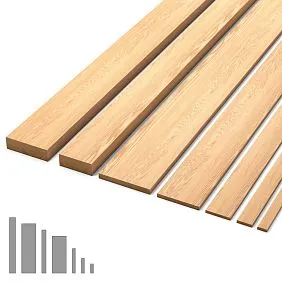
CladdingFacade strips imitation woodare attached to the lathing horizontally, vertically, or diagonally depending on the architectural concept. The cross-section of facade battens is typically 20-50 millimeters thick and 40-150 millimeters wide — more massive than interior battens to ensure rigidity with lengths up to 6 meters and to withstand wind loads. The gap between battens ranges from 10 to 40 millimeters — narrow gaps create an almost solid surface with minimal openings, wide gaps form a graphic rhythm alternating planks and voids where the substrate is visible.
Materials for facade battens require high weather resistance. Larch is the undisputed leader due to its high resin content, providing natural protection against moisture, fungi, and insects. A density of 650-700 kilograms per cubic meter, hardness of 2.6-3.0 units on the Brinell scale, and gum content up to 15 percent create wood capable of withstanding rain, snow, frost, and solar ultraviolet radiation for decades without protective coatings. The natural color of larch — from light amber to reddish-brown — acquires a noble silvery hue over time under the influence of ultraviolet light and oxygen. This natural aging process is valued by architects for the living dynamism of the facade, which changes over the years.




Alternative materials: thermally modified wood and composites
Thermally modified wood — pine, spruce, oak, ash, treated at temperatures of 180-220 degrees in an oxygen-free environment — acquires radically improved performance characteristics. Thermal treatment destroys hemicellulose — a component of wood responsible for hygroscopicity — reducing moisture absorption capacity by 40-60 percent. This minimizes swelling, warping, and cracking. Thermally modified wood acquires a uniform dark brown hue throughout its volume — not a surface tint, but a structural change. Biostability increases — fungi and insects cannot assimilate modified cellulose. Thermally modified oak and ash approach larch in weather resistance, allowing material selection based on aesthetic criteria — hue, texture — without compromising durability.
Wood-polymer composites — a mixture of wood flour (50-80 percent) and polymer binder — imitate wood texture while possessing absolute moisture resistance, dimensional stability, and zero biological susceptibility. WPC does not require protective coatings, does not fade under ultraviolet light due to stabilizer additives, and does not crack with temperature fluctuations. Disadvantages — an artificial appearance lacking the living variability of natural wood, a higher coefficient of thermal expansion requiring compensation gaps during installation, and brittleness at negative temperatures below minus 25-30 degrees. WPC is optimal for facades in regions with mild climates where minimal maintenance-free operation is important.
MetallicFacade strips imitation wood— aluminum or steel profiles with powder coating imitating wood texture — combine the aesthetics of wooden cladding with the absolute weather resistance of metal. Digital printing technology allows reproduction of oak, larch, teak textures with photographic accuracy. Metal battens do not burn, rot, or require maintenance, maintaining geometry under any climatic conditions. A drawback — tactilely and visually up close, the imitation is recognizable, lacking the aroma, warmth, and authenticity of real wood. For public buildings, commercial objects where fire safety and minimal maintenance are important, metal battens with a wood look are a rational choice. For a private home where naturalness and material authenticity are valued, real wood is preferable.
Our factory also produces:


Cladding of the entrance area: creating a focal point of the facade
The entrance group—porch, canopy, door portal, adjacent wall—is the functional and psychological center of the facade. The cladding of this zonewooden plankscreates an expressive accent that highlights the entrance even on a monochrome plastered facade. Vertical slats on the wall to the right and left of the door, running from the ground to the cornice, form a portal — an archetypal technique dating back to ancient temples, where columns marked the sacred passage. A modern interpretation replaces columns with slat cladding, preserving the psychological effect of solemnity and the significance of the entrance.
The canopy over the entrance is not only protection from precipitation but also an architectural dominant, visible from afar. The soffit of the canopywooden railswith gaps creates a rhythmic graphic pattern, especially expressive when viewed from below — the perspective of converging lines enhances depth. The orientation of the slats on the canopy can match the facade — vertical wall slats continue as vertical ones on the canopy — or contrast — horizontal canopy slats are perpendicular to the vertical wall ones — creating a dynamic intersection of directions. Undercanopy lighting with LED strips installed in the gaps between the slats creates evening theatricality — light breaking through the slits forms a light graphic, turning the canopy into a luminous object.
The porch with side walls clad in slats creates a three-dimensional volume preceding the entrance. High side walls, 1.5-2 meters tall with slat cladding, form an intimate space, protected from the wind, psychologically separated from the street — no longer outside, but not yet inside. This is a transitional zone where a guest removes outerwear in winter, shakes off snow, prepares to enter. The materiality of wooden slats at this stage creates a tactile anticipation — if there's wood outside, there will be even more inside.
Get Consultation
Terraces and verandas: expanding living space outward
Open terraces and covered verandas, adjacent to the entrance or being part ofthe entrance zone, are clad with facade slats to create a unified architectural ensemble with the house. Vertical slatted terrace railings, 900-1100 millimeters high, provide safety, create a semi-transparent screen that does not completely block the view but forms a spatial boundary. Gaps between slats of 20-40 millimeters allow air to circulate and light to penetrate, but visually separate the terrace from the adjacent area. This is intimacy without claustrophobia, privacy without isolation.
Covered verandas with slatted ceiling cladding create rhythmic graphics, especially effective under natural overhead lighting through a transparent roof. Parallel slats on the veranda ceiling with 30-50 millimeter gaps, through which daylight passes, form a dynamic pattern of light and shadow that changes throughout the day depending on the sun's angle. This light theater transforms a static architectural structure into a living organism that responds to natural phenomena. In the evening, hidden lighting in the gaps between the slats creates the reverse effect—light breaks through from the inside to the outside, the veranda glows, becoming a lantern.
Combining solid walls and slatted screens on the terrace creates functional zoning. The windward side with dense slat cladding and minimal gaps of 10-15 millimeters protects from prevailing winds. The opposite side with wide gaps of 40-50 millimeters or completely open provides a view of the landscape, garden, or water feature. Terrace corners with dense slatted screens create protected nooks for placing soft furniture sensitive to wind and rain.
From facade to interior: material continuity
A guest ascending the porch with facade slats, opening the door to the hallway where the wall opposite the entrance is clad with interiorwooden planksslats of the same species and shade, experiences a sense of material unity — the architectural concept does not stop at the threshold but continues inside. This is not literal copying — interior slats are thinner, more elegant, with smaller gaps, more meticulous surface treatment — but the material connection is evident. The larch of the facade cladding and the larch of the interior panel share a unified color palette, similar texture, and coordinated rhythm.
The entrance zoneof the interior — the hallway — is a critical space of first impression, where material dialogue with the facade is especially important. A wall panel of vertical slats opposite the entrance door, running from floor to ceiling, creates an architectural dominant, the first thing seen upon entering. This panel can be purely decorative or functional — with integrated hooks for outerwear, shelves for small items, a built-in mirror, a hidden niche for shoes. Functionality wrapped in the aesthetics of slat cladding creates dual-level value — beautiful and useful.
The hallway ceiling with slat cladding, perpendicular to the wall panel, forms a three-dimensional composition where slats work in two planes. Horizontal slats on the ceiling with gaps concealing LED strips create diffuse lighting without visible fixtures — light pours from the slits, the ceiling glows. This is a modern interpretation of classic coffered ceilings, where instead of deep recesses — minimalist gaps between slats.
Hallway furniture: continuation of the slat theme
Entrance Hall Furniture— console, shoe cabinet, coat rack, bench — executed using slat constructions, enhances the material unity of the space. A console table with a front of vertical slats, behind which a drawer for small items is hidden, repeats the logic of wall cladding on a furniture scale. A shoe cabinet with door screens of horizontal slats with gaps provides shoe ventilation, preventing odor and dampness, while creating visual lightness — not a solid cabinet, but a semi-transparent structure.
A coat rack with a back panel of vertical slats, to which hooks are attached, creates structural honesty — the slats are not just decor, but a load-bearing element. A bench with a seat and back of horizontal slats, analogous to garden furniture, brings exterior aesthetics inside — blurring the boundary between house and nature, characteristic of contemporary architecture. All these furniture elements, made from the same species and with the same finish as the facade slats, create a material symphony where each element plays a harmonious note.
A mirror in a frame of slat construction — vertical slats forming a wide frame, behind which the mirror glass is secured — becomes a functional-decorative object. The slats do not merely frame the mirror but form an architectural composition integrated into the wall cladding. The mirror does not hang on the wall but is built into the slat panel, becoming its organic part. Such integration is characteristic of Japanese aesthetics, where furniture and architecture merge into a single whole.
Spreading the slat aesthetic deeper into the interior
The slat theme, established by the facade and developed in the hallway, logically continues into adjacent rooms — living room, dining room, bedrooms. A living room with an accent wall ofwooden stripsslats behind the TV or sofa supports the material theme, not literally repeating the facade but preserving a genetic connection through material and form. The dining area with a slatted partition separating it from the kitchen without completely blocking visual contact uses the same technique of a semi-transparent screen as the facade slatted terrace railings.
A bedroom with a bed headboard of vertical slats running from floor to ceiling creates an architectural accent, turning a functional element — a support for pillows — into a sculptural dominant. The slats behind the headboard can be purely decorative or contain functional elements — built-in reading lights, shelves for books, a niche for chargers. The materiality of wood in the bedroom creates psychological comfort — natural material brings warmth, tactile pleasantness, aroma, and reduces anxiety.
Bathrooms are rarely clad with wooden slats due to high humidity, but an accent wall in the dry zone — behind the bathtub, opposite the entrance — made from moisture-resistant species or thermally modified wood, continues the material theme of the house. Larch with its natural hydrophobicity or thermally modified ash, which practically does not absorb moisture, are suitable for bathrooms, providing the aesthetics of wooden cladding without the risk of rot. Treatment with oil containing water-repellent additives enhances protection while keeping the texture visible.
Ceiling systems: slats as an architectural element
Slatted ceilings — suspended structures where slats are attached to a frame 100-200 millimeters below the main ceiling — create three-dimensional architecture, especially effective in rooms with high ceilings. Parallel slats with gaps concealing lighting create light strips that visually divide the space and set a rhythm. The direction of the slats determines the perception of room proportions — along the long side emphasizes length, across expands a narrow room.
Curvilinear slatted ceilings, where slats are curved along a radius, create wave-like forms imitating organic structures — water waves, fabric folds, natural relief. This is a high-tech solution requiring steaming or multi-layer gluing of thin lamellas to form the bend. Curvilinear ceilings are characteristic of commercial interiors — restaurants, hotels, offices — but are penetrating private architecture as a manifestation of individuality and willingness to experiment.
Two-level slatted ceilings, where some slats are positioned closer to the main ceiling and others are lowered, create a relief composition that accentuates functional zones. Above the dining table, lowered slats with integrated lighting form a luminous dome, visually highlighting the dining area in the combined kitchen-living space. Above the lounge area, raised slats create a sense of height and airiness.
Color and texture coordination: creating harmony
Natural larch facade slats have a reddish-brown hue, intense when freshly cut. Under exposure to ultraviolet light and oxygen over 6-12 months, the color changes to silvery-gray—a noble aging process valued for its patina of time. Interior slats, protected from UV light, retain their original warm hue for decades. This creates a color divergence—the facade is gray, the interior is reddish-brown. To preserve color unity, protective oils with UV filters are applied to facade slats to slow graying, or interior slats are tinted in gray tones to match the darkened facade.
Thermowood, tinted dark brown during processing, maintains its hue consistently both on the facade and in the interior. This simplifies color coordination—all slats are the same color regardless of location. Thermo-ash, thermo-oak, and thermo-pine have similar dark shades after treatment, allowing selection based on texture and price without color differences. This is especially valuable for projects requiring absolute color identity of all wooden elements.
Contrast strategy—using different wood species or shades for the facade and interior while maintaining the slat form and rhythm—creates visual dynamism. Dark facade slats made of thermowood contrast with light interior slats made of natural larch or ash, creating a transition from a dark exterior to a light interior. This technique is characteristic of Scandinavian architecture, where a dark facade protects against visual pollution from atmospheric precipitation, and a light interior compensates for the lack of sunlight in northern latitudes.
Texture treatment: from smooth to brushed
Smoothly sanded slats with a roughness parameter of Ra 1.6-3.2 micrometers create a modern minimalist aesthetic, where clean lines and absence of tactile irregularities are important. The smooth surface emphasizes geometry, rhythm, and the play of light and shadow without distracting with textural details. This is optimal for contemporary, minimalist, and high-tech architecture, where wood is used not as a natural material but as a structural element with defined properties.
Brushed slats—wood treated with metal brushes to remove soft fibers and emphasize texture—create tactile relief, visible up close and felt to the touch. Brushing is especially effective on larch with its contrasting structure—soft spring layers are removed, hard summer layers protrude, forming a rhythmic relief. Brushed surfaces retain less dust than smooth ones due to the absence of open pores filled with soft fibers. This combines practicality with the aesthetics of naturalness.
Charred slats using the yakisugi technique—a Japanese tradition of surface charring wood until the top layer (2-5 millimeters thick) is carbonized, followed by brushing—create a deep black or dark gray hue with emphasized texture. The charred surface is hydrophobic (water beads up), biostable (fungi do not affect the charred layer), and visually dramatic. Yakisugi is characteristic of modern facades, where black creates contrast with green landscapes, snow cover, or blue skies.
Practical aspects: installation, maintenance, durability
Facade slat installation is performed on a framework of wooden battens or metal profiles. Hidden fastening—screws are driven from the back at an angle or special invisible clamps are used—ensures a clean facade without visible fasteners but requires precision, as errors cannot be corrected without dismantling. Exposed fastening with face screws is faster and simpler, but the fasteners are visible—this can be an aesthetic solution if decorative screws with antique bronze or copper heads are used.
Expansion gaps between slat ends are mandatory for natural wood, which changes length with humidity fluctuations. A 3-5 millimeter gap per joint prevents slats from pressing against each other during swelling and avoids warping. For slats longer than 4 meters, an intermediate gap in the middle is required—longer slats change size more significantly than shorter ones. Thermowood and WPC (wood-plastic composite) require smaller expansion gaps due to dimensional stability.
Maintenance of facadewooden planksdepends on the coating. Untreated larch slats require no maintenance—natural graying is not considered a defect but a sign of authenticity. Slats treated with oils or stains require coating renewal every 3-5 years—the surface is pressure-washed, dried, and a new layer is applied. Painted slats require repainting when peeling occurs—every 7-10 years for high-quality paints.
Durability and lifecycle economics
Properly installed facade slats made of larch last 30-50 years without structural damage. Natural graying is not deterioration but a surface color change to a depth of 1-2 millimeters without loss of strength. After 20-30 years of use, surface sanding is possible, removing the grayed layer to reveal fresh wood of the original color—the facade is renewed without dismantling. Thermowood and charred slats last comparably, with more stable color.
WPC and metal slats have no service life limit—they do not rot, are not biologically degraded, and physical wear is minimal. However, their aesthetic aging is problematic—artificial materials do not acquire a noble patina but simply wear out. Scratches, dents, and faded areas appear as defects rather than signs of age. Repair is difficult—replacing a single plank while maintaining color matching with others is challenging due to inevitable batch differences.
Lifecycle economics considers not only initial cost but also maintenance expenses. Untreated larch slats are cheaper to install, require no maintenance, but change color. Slats with oil coatings are initially more expensive, require periodic renewal, but retain color. WPC is 30-50 percent more expensive than larch but requires no maintenance—over 30 years, savings on maintenance offset the premium. The choice depends on willingness to maintain and aesthetic priorities.
Psychology of perception: how the facade shapes expectations
A person approaching a house with wooden slat facade cladding subconsciously forms expectations about the interior. Natural wood on the facade signals a commitment to eco-friendliness, material quality, and modern aesthetics without the coldness of minimalism. Upon entering such a house and discovering the continuation of the wooden theme in the hallway, the guest experiences satisfaction from the alignment of expectation and reality—architectural honesty, where the exterior corresponds to the interior.
The opposite situation—a wooden facade and plastic interior—creates cognitive dissonance, a sense of deception where the facade is a mask hiding an incongruous essence. This is aesthetic dishonesty, subconsciously perceived as a lack of integrity. To create a harmonious impression, material continuity is critical—if the facade is wooden, the interior should contain wood in significant amounts, not necessarily identical to the facade, but materially related.
Gradation of materiality from rough on the facade to refined in the interior creates a natural transition. Facade slats—massive, with coarse sanding, naturally aging—represent wood in its exterior guise, resisting the elements. InteriorWooden railsin the hallway—thin, smooth, protected with tinted oil—demonstrate wood in a domestic context, protected and cared for.Entrance Hall Furnituremade from the same wood—the final level of refinement, where the material is transformed into a functional object. This gradation creates a narrative of material transformation from natural to cultural.
Conclusion: exterior and interior as a unified statement
Facade strips imitation woodat the entrance of a private house—is not merely a decorative solution but an architectural statement, forming the first impression and setting the material theme, which logically continues into the interior. Slat cladding on the canopy, side walls of the porch, and terrace railings creates rhythmic graphics, especially expressive against monochrome plastered facades.Wooden plankscommunicate a commitment to natural materials, modern aesthetics, and attention to detail—values the guest expects to find inside.
Material continuity from facade to interior is created through theentry zone—the hallway, where wall panels made ofwooden planksthe same species as the facade slats support the theme without literal copying. Interior slats are more elegant, smooth, and protected with a coating—this is wood in a home context, not resisting the elements.Entrance Hall Furniturewith slat constructions — consoles, shoe racks, hangers — completes the material symphony, where each element is coordinated by wood species, color, and rhythm.
STAVROS offers a full range ofwooden stripsfor facade and interior applications made from larch, thermowood of various species, with diverse surface treatment options — from smooth sanding to brushing and charring. Production on modern equipment ensures precise geometry, kiln drying to 10-12% moisture guarantees dimensional stability. Custom slat sections, lengths up to 6 meters, and application of protective coatings in production are possible.
STAVROS specialists advise on wood species selection considering regional climatic conditions, help calculate the required material quantity for cladding entrance groups and interior panels, recommend fastening methods, protective treatment options, and coordinate the color and texture of facade and interior slats to create a harmonious material transition. Create homes where architectural form and materiality work as a unified whole, where the exterior honestly foreshadows the interior, where every detail — from the facade slat to the furniture construction — is made from natural wood, processed with craftsmanship, serving for decades, aging nobly.


