Article Contents:
- Why a children's room requires different details than an adult bedroom
- The load in a children's room is of a different order
- A children's room grows with the child
- Safety and eco-friendliness are not just rhetoric
- Wooden baseboard for a children's room: protecting the lower part of the wall
- Why the baseboard in a children's room should not be random
- High or low profile: how to choose
- Which profile is suitable for a children's room
- How to match the baseboard with other room details
- Finish coating of the baseboard for a children's room
- Wooden slats on the wall in a children's room: where they are appropriate and where they are not
- Slats near the bed area: a warm accent behind the headboard
- Slats near the desk
- Slats in the play area: be careful
- Slats in a teenager's room
- How to choose the spacing of slats for a children's room
- Coating of slats for a children's room
- Furniture handles for children's room furniture
- Handles for children's wardrobe
- Handles for dresser: shape based on child's age
- Handles for nightstand and desk
- Uncoated handles: tint to match nursery interior
- Why wooden handles are better than plastic and metal in a nursery
- Furniture legs and supports for a children's room
- Legs for a dresser in a nursery
- Cabinet legs
- Furniture legs for a children's table
- Furniture supports in a nursery: when legs aren't enough
- Why legs affect cleaning under furniture
- Desk and workspace: legs or underframe
- When four legs are enough
- When an underframe is needed
- Tabletop legs: how to check compatibility
- How to match the table with other wooden elements in the room
- What is best not to use in a children's room
- Ready-made selection scenarios for different ages
- Preschooler's room (3–6 years)
- Schoolchild's room (7–12 years)
- Teenager's room (13–17 years)
- Play area (separate or in the children's room)
- How to match all details in one style
- One shade of wood is a basic requirement
- Same level of decorativeness
- Slats as an accent, not the main noise
- Connection with doors, floor, and furniture
- Where to buy wooden details for a children's room
- Frequently Asked Questions
- Which wooden baseboard to choose for a children's room?
- Are wooden wall slats suitable for a children's room?
- Which furniture handles are more convenient for a children's wardrobe and dresser?
- What to choose for children's furniture: legs or supports?
- Can a desk underframe be used in a children's room?
- How not to overload a children's room with wooden decor?
- Which wooden parts are better to buy in advance before renovating a children's room?
- About the Company STAVROS
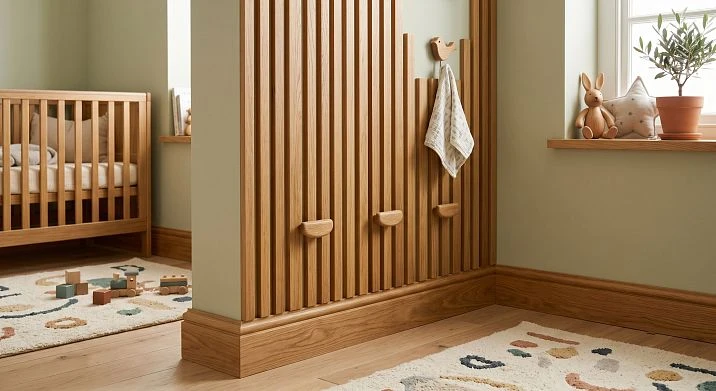
A children's room is not just a space. It is a territory that lives in constant motion. Here they jump, draw, build towers from construction sets, roll cars along the baseboard, pull the cabinet by the handle, lean on the table with all their weight. And it is here that it becomes obvious fastest that random interior details cannot withstand real use.
Wooden baseboard, wooden slats on the wall, furniture handles, legs and supports for children's furniture — these are not just decorative elements. These are working parts that must withstand daily contact, wet cleaning, children's energy, and changing interests from year to year. At the same time, they should look beautiful, coherent, and create a feeling of a cozy, meaningful space.
This article is a detailed practical guide for parents, designers, and everyone who is preparing a children's room and wants to choose solid wood parts not at random, but systematically and precisely.
Why a children's room requires different details than an adult bedroom
This question should be asked before browsing the catalog. An adult bedroom is a space of rest. A children's room is a space of activity. The difference is not only in the atmosphere. It is in the requirements for every finishing element.




The load in a children's room is of a different order
Imagine how a wardrobe is used in a children's room. A seven-year-old child opens it in the morning with a jerk because they are in a hurry. In the evening, they close it with effort because the clothes aren't fully put away. The wardrobe handle bears this load hundreds of times a month. A cheap plastic handle will loosen in three months. A good one Wooden furniture handle made of solid wood with proper fasteners is a different story.
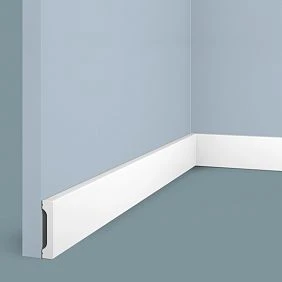
The same goes for the baseboard. In a children's room, toy cars ride along the lower part of the wall, blocks hit it, and a sofa bumps into it during rearrangement. A thin plastic baseboard here is a temporary solution. Wooden baseboard made of solid wood is protection that will withstand it.
Our factory also produces:


A children's room grows with the child
A preschooler's room turns into a schoolchild's room, then a teenager's room. The details you choose now will last at least five to seven years. If the baseboard is made of PVC, it will yellow in two years. If the handles are cheap, they will need to be replaced in a year. Solid wood details solve this problem: they last long and age beautifully, not pitifully.
Get Consultation
Safety and eco-friendliness are not rhetoric
In a children's room, it is especially important what the details the child touches are made of. Solid wood elements are a natural material without synthetic fillers. An oil or wax coating is not a source of volatile compounds. This is not a marketing gimmick, but a real difference from plastic and cheap MDF with aggressive varnishes.
Wooden baseboard for a children's room: protection for the lower part of the wall
Let's start with the foundation—with the lowest point of the wall. The baseboard in a children's room is an element that most parents choose last and as an afterthought. This is a mistake. It is in a children's room that the baseboard works as a protective bumper for the lower zone.
Why the baseboard in a child's room shouldn't be an afterthought
The bottom of the wall in a child's room is the most vulnerable area. Everything ends up here: toys, scooter wheels, chair legs, a bucket of water during cleaning, the cat and dog (if you have them). Under these conditions, a white plastic baseboard turns yellow, cracks, peels away from the wall, and starts looking shabby within a year or two.
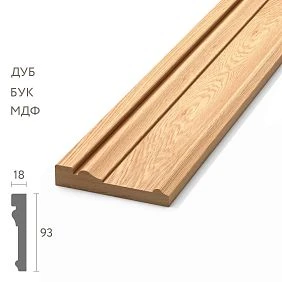
with a classic profile creates a sense of solidity, reliability. A solid wood baseboard in a child's room offers a different level of durability. Hardwoods like oak and beech withstand impacts that would destroy plastic. At the same time, a surface with a lacquer or oil finish is easy to wipe clean with a damp cloth.
High or low profile: how to choose
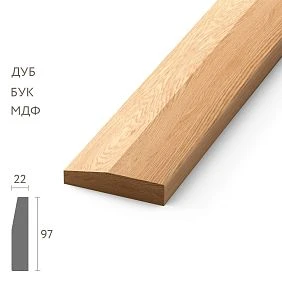
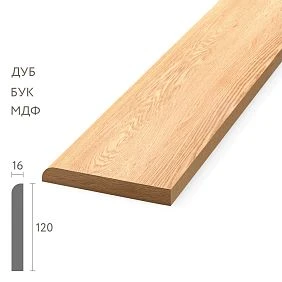
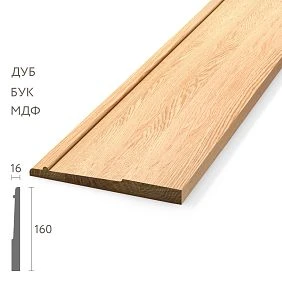
In a child's room — especially for preschoolers and elementary school children — it makes sense to choose Wooden baseboard a height of at least 80–100 mm. Such a baseboard covers a larger area of the lower wall and protects it from accidental bumps from toys.
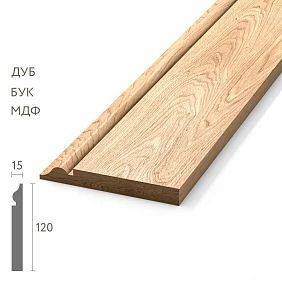
For a teenager's room, you can choose a more restrained profile with a height of 60–80 mm and a clean, smooth surface without decorative relief. A relief baseboard is inconvenient in a child's room: dirt accumulates in the profile's recesses, making it difficult to clean.
Which profile is suitable for a child's room
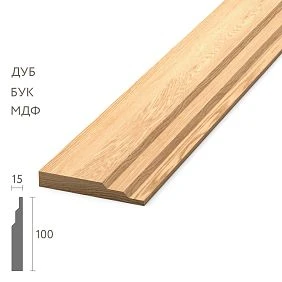
The rule is simple: the younger the child, the simpler the baseboard profile. A smooth surface without deep grooves or protruding fillets is easy to clean, easy to repaint if needed, and doesn't collect dust. For a preschooler, choose a baseboard with a straight or slightly beveled profile. For a school-age child or teenager, the profile can be a bit more expressive, with a slight chamfer.
How to coordinate the baseboard with other room details
Wooden baseboard should work in pair with door trims and flooring. If the room has light laminate — baseboard in the same shade or neutral natural wood. If the floor is dark — baseboard can be slightly lighter for a soft contrast.
An important point often overlooked: buy baseboard together with trims or after they are installed. Different wood shades on baseboard and trims in a children's room — a small detail, but it catches the eye every day.
Finish coating of baseboard for children's room
For children's room — only coatings that allow wet cleaning. Polyurethane varnish in 2–3 layers is the most practical choice. It forms a hard surface, resistant to abrasion, water-repellent, and washable with household cleaners. Oil-wax is a more tactile and natural-feeling option, but requires periodic renewal every 1–2 years under heavy use.
Wooden slats on the wall in a children's room: where appropriate and where not
wooden planks on the wall in a children's room — this is a topic that requires caution. Not because slats are dangerous. But because in a children's room, incorrectly placed decor quickly becomes either a drawing surface, a dust accumulation zone, or a source of extra noise upon contact.
Slats near the bed area: warm accent behind the headboard
The most organic place for slats in a children's room is the wall behind the bed. Vertical decorative wooden planks behind the headboard create a cozy background that visually unifies the sleeping area and adds warmth of natural wood. Height of the slat zone — from floor to 180–200 cm or from the bed headboard 80–100 cm upward.
Why this works well here: the bed is against the wall, and the child does not come into close contact with the slats during active play. The slats are in a calm zone of the room.
Slats at the desk
In a teenager's work area — Wooden wall decor in the form of vertical slats on the wall above the desk can serve as a backdrop for a bookshelf, a cork board, or decorative objects. This is a neutral background that does not hinder concentration and visually separates the work area from the rest of the space.
Slats in the play area: caution
The play area is a place of active contact with surfaces. Here, slats are undesirable for several reasons. Textured surfaces are harder to clean. Protruding slats can catch on clothing or cause minor bruises during falls. The space between slats quickly gets dirty.
If you want to add a wooden accent to the play area, it's better to do it through Wooden wall decor a frame layout or a horizontal decorative strip at a height inaccessible for active play — from 150 cm and above.
Slats in a teenager's room
A teenager is a different user. Their room is closer to an adult interior: slats behind the sofa or near the work area are entirely appropriate here. The choice of spacing and width depends on the style: Scandinavian, loft, modern classic. Slats in a teenager's room are a full-fledged design technique, not a child's decoration.
How to choose the spacing of slats for a children's room
For a children's room, the step is more free than in the living room. A dense slatted panel in a children's room creates the effect of a dust-trapping wall and a difficult surface to clean. The optimal step is 60–90 mm with a slat width of 20–30 mm. This creates a rhythm without overload and is easy to keep clean.
Slat covering for a children's room
A mandatory condition for a children's room: a covering that allows wet wiping. Varnish or oil with wax on the slat surface is protection from children's fingers, markers (if the child reaches them), and annual cleanings. Without covering, slats in a children's room are only acceptable if subsequent self-treatment is done.
Furniture handles for children's furniture
Furniture handles in a children's room are the part that is touched most often. The cabinet is opened ten times a day. The dresser drawer is pulled with a jerk. The desk door is pulled with one finger. That is why handles for children's furniture must meet requirements that differ significantly from adult scenarios.
Handles for a children's wardrobe
The wardrobe is the main furniture in a children's room. The handles on its doors and drawers should be comfortable for a child's hand — and a child's hand is smaller than an adult's. This means: the gap between the handle body and the facade is at least 30 mm so that fingers fit freely. The shape is a bracket with rounded ends without sharp edges. The bracket length is 96 mm for standard wardrobe facades of a preschooler, 128 mm for facades of a schoolchild and teenager.
Furniture Handles made of solid wood for a wardrobe in a children's room — this is both convenience and safety. A wooden handle does not heat up, does not get cold on a winter morning, does not slip in wet palms. This is a material with tactile comfort that is especially important in a children's room.
Handles for a dresser: shape according to the child's age
A dresser in a children's room is most often a place for storing clothes, toys, and books. The dresser drawers are opened repeatedly. A handle for a dresser drawer in a children's room — best of all, a knob handle or a short bracket with a center distance of 64–96 mm. Rounded shapes without sharp protrusions are a mandatory condition.
Wooden furniture handles For a dresser in a children's room, handles are chosen based on installation height: lower drawers — handles at 40–50 cm from the floor (preschool child level), upper ones — at the standard adult hand level.
Handles for a bedside table and desk
A bedside table, TV stand, desk drawer — here the handles are small. A round knob handle with a diameter of 30–40 mm is an ideal choice for small facades in a children's room. It is compact, easy to grip, does not protrude from the facade plane, and cannot catch on clothing.
Handles without coating: tint to match the children's room interior
Wooden furniture handle Without coating — this is an opportunity to create a perfect color match. In a children's room, where colored accents are often used, uncoated handles can be tinted to match the shade of doors, baseboards, or furniture facades. This allows for unity of wooden parts, creating a sense of a well-thought-out interior.
Why wooden handles are better than plastic and metal ones in a children's room
Metal handles are cold and may have sharp edges. Plastic ones are unreliable under heavy load, fade, and break. Solid wood handles are warm to the touch, durable, and eco-friendly. With proper coating, their surface withstands damp wiping. They do not slip in children's hands. They age gracefully, not sloppily.
Furniture legs and supports for a children's room
Legs and supports in a children's room are a matter of stability. A child may lean on a dresser, climb onto a bedside table, or pull a table along. Furniture must withstand this. That is why choosing legs for children's furniture is not just about aesthetics, but also safety.
Legs for a dresser in a children's room
furniture legs under the dresser in the children's room — height 60–80 mm, cross-section at least 35×35 mm. This height is sufficient to vacuum under the dresser, but not so much as to create instability. Fastening — through a threaded bushing screwed into the bottom of the dresser. This fastening is reliable and allows replacing the leg without damaging the body if necessary.
The shape of the legs for a children's dresser is simple, without sharp edges. Tapered legs with a slight bevel are an excellent option: they give the furniture a light appearance and have no sharp edges.
Legs for a cabinet
Legs for chests in the children's room — height 80–100 mm. A bedside table on legs is convenient for cleaning: it's easy to mop under it, and there is no dark corner where dust accumulates. This is important for a child: the children's room is cleaned more often, and every centimeter of accessible space under the furniture is one less hard-to-reach corner.
Furniture legs for a children's table
A small play or creative table for a preschooler is furniture with a special load. Things are placed, put, leaned on, and sometimes children try to climb on it. The legs for such a table should have a minimum cross-section of 30×30 mm, preferably 35×35 mm. Height — according to the child's age: for a preschooler aged 3–5 years — 45–50 cm final table height. For a younger schoolchild — 55–60 cm.
Furniture legs without coating, it can be tinted to the same shade as the tabletop — and get a cohesive look for a solid wood children's table.
Supports for furniture in the children's room: when legs are not enough
furniture leg — this is an element with a larger support area and increased load-bearing capacity. In the children's room, supports are needed for furniture that is heavily loaded: a shelf with books and toys, a wide console, a heavy cabinet.
A shelf in the children's room is furniture with a high center of gravity. Four supports under its base with a wide footprint provide stability that thin legs cannot ensure. For a shelf, the cross-section of furniture legs — at least 40×40 mm, height — 50–80 mm.
Why legs affect cleaning under furniture
A child's room is cleaned more often than an adult bedroom. Cleaning under furniture with legs is much easier. This is a practical argument in favor of legs, which parents appreciate a month after setting up the room. Furniture without legs requires moving during every deep cleaning, which means extra time and effort.
Desk and workspace: legs or underframe
A workspace in a child's room is one of the main areas starting from school age. A desk for homework, drawing, modeling, reading — this is furniture with serious daily use. And the question "legs or underframe?" is far from rhetorical here.
When four legs are enough
For a small desk up to 100 cm wide and 60 cm deep — buy legs for a table and installing them on a ready-made tabletop is a working solution. Leg cross-section — at least 45×45 mm. Attachment — via metal brackets to the underside of the tabletop. Final table height — according to the student's height: 55–60 cm for ages 7–9, 60–65 cm for ages 10–12, 70–75 cm for a teenager.
An important nuance: four legs without cross braces is an unstable structure under lateral load. If a child leans on the table from the side or moves it — without stretchers (horizontal braces) the structure will start to wobble.
When an underframe is needed
Buy table base — the right choice for a table 120 cm wide or more. An underframe is a frame with horizontal stretchers: it is rigid in construction and distributes the load evenly. For a teenager who will work at a wide desk daily for several hours — an underframe is mandatory.
Buy a pedestal from the array means getting a table base that will last without wobbling or creaking throughout the child's entire growing period. This is an investment that pays off by eliminating the need for repairs and replacements.
Legs for the tabletop: how to check compatibility
Legs for countertops are selected based on several parameters.
-
Leg height + tabletop thickness = final table height.
-
Center-to-center distance of legs = tabletop width minus 15–20 cm on each side.
-
Attachment method: metal brackets, screws, or dowel joints.
For a children's work area, there is no point in choosing decorative legs with turned details: they add visual noise that distracts. Straight or slightly tapered legs with clean lines are the best choice.
How to match the table with other wooden elements in the room
The table, baseboard, cabinet handles, and nightstand legs — all of them in a child's room should be in the same shade. If the floor is light laminate, all wooden details should be in light beech or natural oak. If the floor is dark, the details can be slightly lighter to avoid plunging the room into darkness. The table base or legs should be from the same wood species and tint as the baseboard. Then the room reads as a unified space, not a collection of random items.
What is better not to use in a child's room
An honest list of mistakes encountered when decorating children's rooms with wooden details.
-
Too sharp protruding elements at active play level. Moldings with sharp edges, slats with unsanded ends, cornices without rounding — all of this is dangerous at a preschooler's height.
-
Excessively relief slats on the entire wall. Slats around the entire perimeter of the children's room are a dust collector and a difficult surface to clean. Slats on only one accent wall are reasonable.
-
Too thin legs under heavy furniture. Legs with a diameter of 20 mm under a cabinet weighing 80 kg are a risk. The minimum cross-section for heavy furniture is 40×40 mm.
-
Handles of an inconvenient shape. Handles with sharp edges, too narrow a gap (less than 25 mm), or non-standard fasteners are an inconvenience every day.
-
Different wood shades without a common logic. Honey oak on the baseboard, gray ash on the legs, dark walnut on the handles — this is not eclecticism, it's chaos. In a children's room, chaos is especially noticeable.
-
Massive cornice in a small room. A cornice with a wide profile in a room of 12–15 sq. m will visually lower the ceiling. A lightweight corner profile is more appropriate.
-
Baseboard bought after the architraves. A different shade of the baseboard and architraves is visible at every entrance to the room.
Ready-made selection scenarios for different ages
Room for a preschooler (3–6 years old)
This is a space with maximum chaos of active play. Practicality is most important here.
Baseboard: wooden, height 100 mm, smooth profile without relief, lacquer finish.
Slats: only in the bed area, if present. Spacing 70–90 mm, lacquer finish.
Handles: round buttons or short brackets with a 30 mm gap, no sharp edges.
Legs: for a chest of drawers — 60–80 mm, for a bedside table — 80 mm, simple tapered shape.
Table: small, height 45–50 cm, four legs with a cross-section of 35×35 mm.
Schoolchild's room (7–12 years old)
A work area appears here. Decor becomes more expressive.
Baseboard: wooden, height 80–100 mm, can have a slight chamfer.
Slats: at the head of the bed or near the work area, spacing 50–70 mm.
Handles: brackets 96–128 mm for cabinet, knobs for dresser.
Legs: for dresser 70–80 mm, for nightstand 80–100 mm.
Table: width up to 120 cm — legs 45×45 mm with stretchers, from 120 cm — underframe.
Teenager's room (13–17 years)
The room increasingly resembles an adult space. Here, decor can be expressive.
Baseboard: wooden, 80 mm, stylish profile matching the interior.
Slats: accent wall behind the bed or at the work area, spacing 50–60 mm.
Handles: modern brackets 128–160 mm for cabinet, unified style throughout the room.
Legs: tapered or straight, 80–100 mm, matching handles in shade.
Table: wide, work area with underframe for stability.
Play area (separate or in the children's room)
This is an activity space where decor should be minimal.
Baseboard: wooden, tall — 120 mm, as protection for the lower wall area.
Slats: not recommended in the play area at active play level.
Handles: on shelves and drawers — round knobs without sharp edges.
Legs and supports: under shelves — wide supports with a large base.
How to choose all details in one style
A children's room looks good when its details speak the same language. This doesn't mean 'everything identical'. It means 'everything coordinated'.
One shade of wood is a basic condition
Choose one shade — and stick to it. Light beech is lightness, Scandinavian spirit, neutrality. Natural oak is warmth and a touch of classic. Tinted ash is modernity. One shade on the baseboard, handles, legs, and slats is a system that reads instantly.
Same degree of decorativeness
If the baseboard is simple and smooth, the handles are also simple, without carving or turning. If the slats are vertical and laconic, the legs are tapered or straight, without Baroque transitions. Unity of style is not a limitation, it is freedom: the room looks intentional, not assembled on a leftover basis.
Slats as an accent, not the main noise
In a children's room, slats are one accent, not the background for the entire interior. One wall with slats and neutral others is expressive. Slats on three walls is already overload, especially in a small room.
Connection with doors, floor, and furniture
Solid Wood Items work best when they are connected to the other materials in the room. Light ash doors — baseboard and handles in the same shade. Warm oak floor — legs and supports in a similar tone. Furniture with natural fronts — slats in a coordinated shade.
Where to buy wooden details for a children's room
The main argument in favor of a single source is compatibility. If Wooden baseboard, wooden planks on the wall, Furniture Handles и furniture legs purchased from one manufacturer — shades, species, and profiles are coordinated. You don't need to compare and adjust. You simply choose a line and get a system.
Buy with a small reserve: in a children's room, parts wear out more actively, and the ability to buy the exact same handle or leg a year later is a valuable advantage.
Frequently asked questions
Which wooden baseboard to choose for a children's room?
with a classic profile creates a sense of solidity, reliability. In a children's room — height 80–120 mm, smooth profile without deep relief, coated with polyurethane varnish for wet cleaning. Hard woods — oak or beech — are resistant to impacts from toys and furniture.
Are wooden wall slats suitable for a children's room?
Yes, with proper placement. decorative wooden planks They are appropriate in the bed area, near the desk, and in a teenager's room. In an active play area and at a level below 100 cm from the floor — not recommended.
Which furniture handles are more convenient for a children's wardrobe and dresser?
For a wardrobe — a bracket 96–128 mm with a gap of at least 30 mm, without sharp edges. For a dresser — a round knob or a short bracket 64–96 mm. Wooden furniture handles They feel warm to the touch and do not slip in children's hands.
What to choose for children's furniture: legs or supports?
For lightweight furniture (nightstand, bedside table) — legs 60–100 mm high. For heavy furniture (shelving unit, wardrobe, wide dresser) — Furniture Supports with a cross-section from 40×40 mm and a wide base.
Can the desk underframe be used in a children's room?
Yes, for a table width from 120 cm — Buy table base preferable to four separate legs. The frame structure of the underframe provides the rigidity that a schoolchild and teenager will load daily.
How not to overload a children's room with wooden decor?
The rule of one accent: slats only on one wall, baseboard — neutral, handles and legs — in a single style without excessive relief. Decor in a children's room should be a background for the child's life, not the main character.
Which wooden parts are better to buy in advance before renovating a children's room?
First of all — Wooden baseboard and trims at the same time. Then — handles for furniture. Legs and supports — considering the chosen furniture. Slats — last, when the furniture layout and accent wall are determined.
About the company STAVROS
All wooden parts for a children's room described in this article are produced by the Russian company STAVROS. Baseboards, slats, handles, legs, supports, and underframes — from solid oak, beech, and other species with a unified tinting system, precise dimensions, and coatings that allow wet cleaning.
STAVROS works with private buyers, children's room designers, and construction teams. Here you can select a complete set of wooden details for a nursery — from baseboards to desk legs — and be confident that they form a unified system, not a collection of random elements.
If you want the children's room to look thoughtfully designed and serve without loss of quality throughout all the years of the child's growing up — start with the STAVROS catalog. Details that withstand childhood.