Article Contents:
- What is a wooden knob handle and why a set is more important than a single piece
- Why one successful handle does not mean successful furniture
- When a knob is more convenient than a pull
- When a pull is more convenient than a knob
- When a recessed model is needed
- Why the set is calculated before drilling
- Quantity is related to furniture construction
- Location affects convenience
- Single batch affects appearance
- Stock helps with installation and repair
- Small facade
- Standard facade of a chest of drawers or cabinet
- Large facade
- Why a mockup is needed before ordering
- Grip check
- When ORB looks proportional
- Beech for enamel
- Oak for tinting
- Small Button
- Medium Button
- Large Button
- Can you mix three sizes
- Why Solea cannot be considered a classic button
- On which facades it is appropriate
- Why comparison is useful for the buyer
- When one button is enough
- When two buttons are useful
- When it's better to choose a bracket
- Why you can't decide after drilling
- Paired doors
- Tall wardrobe
- Mezzanine
- Paneled door
- Identical drawers
- Drawers of different heights
- Two small drawers side by side
- One wide bottom drawer
- Drawer and door
- Paired cabinets
- Overhanging countertop
- Upper cabinets
- Lower hinged fronts
- Pull-out drawers
- Pencil cases
- Why the kitchen requires a spare
- Measuring the facade
- Trial installation
- Protecting the front side
- Turning the button
- The old button was smaller
- The old button was larger
- Previously there was a bracket
- Old hole is misaligned
- Thread or material is damaged
- Beech for enamel
- Oak for tinting
- Why you cannot mix materials in one row
- When custom finishing is needed
- Test swatch
- Fixation during work
- Thread protection
- Sorting of oak
- Matte or glossy finish
- Count by groups
- Don't forget paired items
- Add a reserve
- Record dimensions separately
- When a shaped form is appropriate
- Identical or different shapes
- Scandinavian furniture
- Modern classicism
- Provence and vintage
- Modern colored facade
- Natural furniture made of solid wood or veneer
- Need to update the dresser without replacing the facades
- Need to design a new cabinet
- Need to assemble handles for the kitchen
- Need to select handles for two cabinets
- Need a large round accent
- Need to use one design on facades of different sizes
- Need handles in the color of furniture legs
- Knob and pull
- Knob and recessed handle
- Button and furniture profile
- Button and Solea
- Furniture button and door knob-button
- Counting furniture bodies instead of fronts
- Not determining one or two buttons on a wide drawer
- Choosing size only by name
- Mixing Button of different sizes without a map
- Calling Solea a button and drilling one hole
- Not checking screw length
- Paint handles one by one
- Leave wood without coating
- Do not order spare
- Try to fix a tight drawer with a large button
- Attach to a weak old hole
- Line and symmetry
- Reliability
- Comfort
- Finish
- Article and size
- Material
- Finishing
- Coordinates
- Fasteners
- One template for identical doors
- Separate template for drawers
- Template for buttons of different sizes
- Check before drilling
- Enamel
- Clear varnish
- Oil
- Toning
- Check the fastening
- Room inventory and identical bedside tables
- Lockers and changing rooms
- Showcases and retail furniture
- Children's institutions
- Check the size in hand
- Check the position
- Check the fasteners
- Check the finish
- Use the sample for a few days
- How is a knob different from a pull?
- Which model is considered a classic round knob?
- What sizes are available for Button HL-036?
- Is Solea HL-025 a knob?
- What size knob should I choose for a small drawer?
- Do I need one or two knobs for a wide drawer?
- Where should I place the knob on a cabinet door?
- Can I replace an old knob without drilling a new hole?
- Can I replace the bracket with a single button?
- What to choose for enamel — beech or oak?
- Can wooden handles be tinted?
- How to paint handles the same color?
- How to choose the length of the mounting screw?
- How many handles to order for the kitchen?
- Is a spare handle needed?
- Can different sizes of Button be used on the same piece of furniture?
- Is a button handle suitable for a kitchen drawer?
- Are shaped buttons suitable for a children's wardrobe?
- How to combine handles with wooden legs?
- Where to buy wooden knob handles as a set?
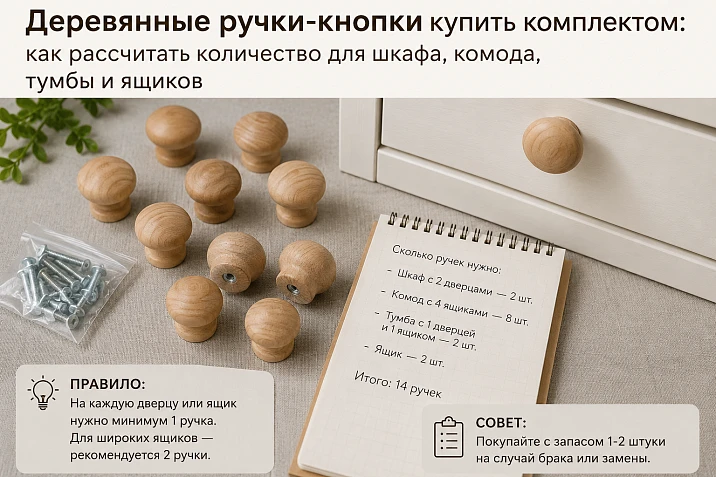
Buy wooden knob handles as a set more difficult than choosing one beautiful piece from a photo. On a single sample, almost any compact handle looks neat. On a kitchen, dresser, or cabinet, other questions become important: how many items are needed, where to draw the overall line, whether one knob or two is needed for a wide drawer, whether all parts will match in color, and whether the mounting screw length is sufficient for a specific facade.
A knob handle is attached at a single point and does not require two holes like a pull. This simplifies marking and replacing old hardware but increases placement requirements. One misaligned hole disrupts the entire row. A knob that is too small gets lost on a massive facade, while one that is too large interferes with opening the adjacent door. On a wide, heavy drawer, a single central handle may be inconvenient, while two require precise symmetry.
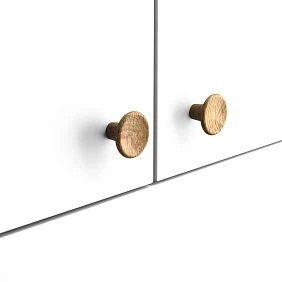
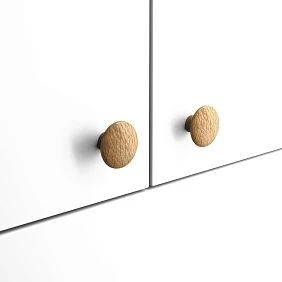
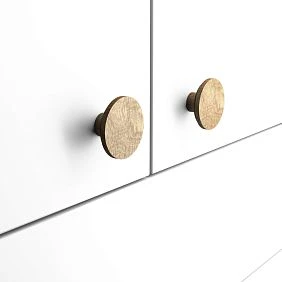
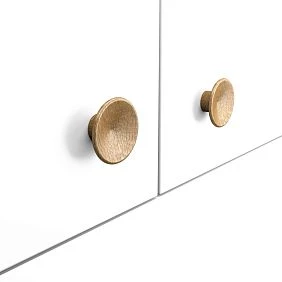
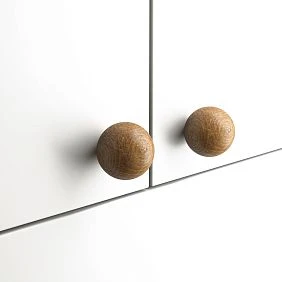
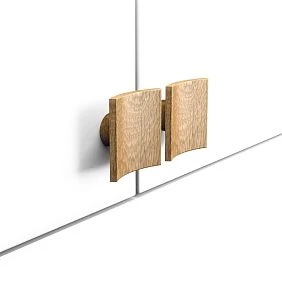
The STAVROS category features classic round, minimalist, and shaped models for cabinets, dressers, nightstands, kitchen facades, and children's furniture. For a detailed comparison, the ORB HL-002 and Button HL-036 are suitable. ORB measures 44 × 44 × 45 mm and has a pronounced rounded shape. Button is available in three sizes — 37 × 22 × 15, 53 × 27 × 18, and 74 × 29 × 25 mm. Both models are available in beech for enamel and oak for tinting, supplied without a ready-made coating, and the mounting kit is included in the price.
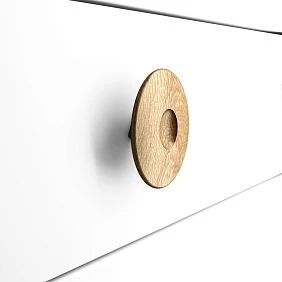
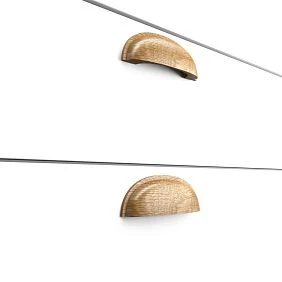
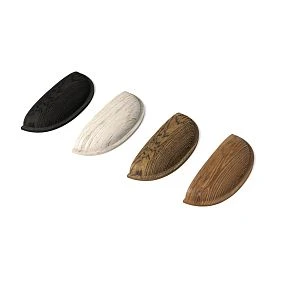
Solea HL-025 is considered separately. Externally, it creates a round composition but consists of two wooden semicircles and has a center distance of 64 mm. This is not a typical single-point knob. The comparison helps avoid confusing a compact furniture handle with a large decorative pair that requires two holes and different markings.
It is convenient to start the selection in the category where you can buy wooden knob handles for furniture and compare actual shapes. The rest of the article helps turn the model selection into a calculated set: determine the quantity based on doors and drawers, distribute handles across facades, choose the size, material, and finish, check old holes, and prepare a spare part.
What is a wooden knob handle and why the set is more important than a single part
A classic knob handle is a compact face fitting with a single fastening point. The screw passes through the facade from the inside and connects to the handle on the outside. The user grips the round, cylindrical, mushroom-shaped, or figured part with their fingers and pulls the door or drawer towards them.
Single-point fastening makes the handle universal for small facades. There is no need to maintain the center distance between two holes, as with a pull handle. During restoration, one existing hole is sufficient if it is in the right place and matches the diameter. But when purchasing a set, another task arises — all points must form a system.




Why one successful handle does not yet mean successful furniture
On a chest of drawers with six drawers, the handles work as a row. In the kitchen, they connect the upper and lower cabinets. On a wardrobe, they form a vertical line. If the size, height, or color differs, even an expensive facade looks randomly assembled. Therefore, the sample is evaluated not only in the hand but also in repetition.
Our factory also produces:
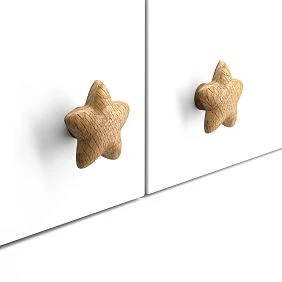
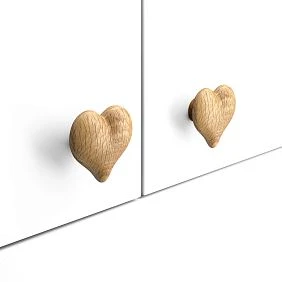
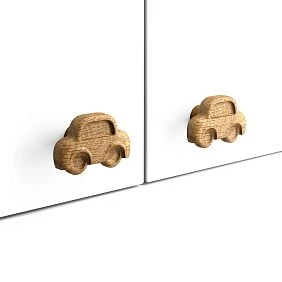
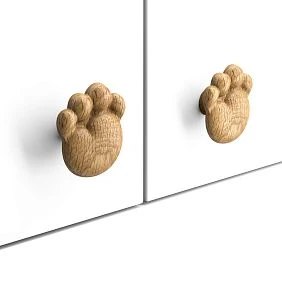
When a knob is more convenient than a pull handle
It takes up less space, is suitable for small doors, and requires one hole. A knob is easier to place on a narrow cabinet facade, mezzanine, or small drawer. On furniture with many identical sections, the compact form does not overload the surface.
Get Consultation
When a pull handle is more convenient than a knob
On a heavy, wide drawer, a pull handle can be gripped with the whole hand. Two fastening points reduce rotation of the fitting. If the drawer opens tightly, a larger handle is more convenient than a small knob. However, before changing the type, you need to check the guides: functional furniture should not require excessive force.
When a recessed model is needed
A recessed handle suits a facade where protruding parts are undesirable. It requires a prepared mounting spot and more complex processing. A knob is easier to install and remains a noticeable element on the surface.
Why the set is considered before drilling
The quantity determines all the markings. If on a wide drawer it is later decided to use two knobs instead of one, the central hole becomes redundant. If on paired doors the handles are bought unevenly, you have to mix batches or temporarily leave the facade without hardware.
Confirmed specifications of ORB, Button, and Solea
| Parameter | ORB HL-002 | Button HL-036 | Solea HL-025 |
|---|---|---|---|
| Type | Classic round knob handle | Minimalist knob handle in three sizes | Surface-mounted composition of two semicircles |
| Dimensions | 44 × 44 × 45 mm | 37 × 22 × 15; 53 × 27 × 18; 74 × 29 × 25 mm | 138 × 69 × 24 × 64 mm |
| Mounting | One point; the set is included in the price | One point; the set is included in the price | Two separate halves, center distance 64 mm |
| Material | Beech or oak | Beech or oak | Beech or oak |
| Preparation | Beech under enamel, oak under tinting | Beech under enamel, oak under tinting | Beech under enamel, oak under tinting |
| Sanding | «Prestige» | «Prestige» | «Prestige» |
| Supply | Without ready-made coating | Without ready-made coating | Without ready-made coating |
| Best scenario | Chests of drawers, bedside tables, cabinets and facades where a noticeable round button is needed | Sets with different facade scales and a laconic shape | Large decorative facade where a ring composition is needed |
The table shows the main difference: ORB and Button are suitable for a single-point system, while Solea requires a different approach. You cannot first drill one hole for a button and then replace it with Solea without reworking the facade. The models also differ in proportions: ORB is almost equal in three dimensions, Button becomes longer and lower as the size increases, Solea occupies a significantly larger area.
Why the set and placement need to be thought out in advance
A buyer rarely purchases a single handle-button in isolation. Even a bedside table may have a door and a drawer, a kitchen may have dozens of facades, a chest of drawers may have several rows of different widths. The practical task begins where you need to repeat the chosen model without errors.
The quantity is related to the furniture design
Count not the cabinets, but the opening elements. One kitchen module may include a door and two internal drawers. One chest of drawers — four drawers, but the widest one may require two knobs. A wardrobe with two doors requires a paired arrangement.
Location affects convenience
The knob on the door is located near the free edge, and on the drawer — in the center or at two symmetrical points. The installation height should be accessible and not conflict with hinges, frames, panels, and internal parts.
A single batch affects the appearance
Oak handles have a natural grain pattern. Enamel may vary in gloss when painted on different days. Ordering a set and finishing at the same time reduces the risk of visible differences on the same furniture line.
A spare helps with installation and repair
One extra handle serves for a test paint or to replace a damaged part. For a large kitchen, a reasonable reserve is especially useful: after a few years, the shade of a new batch may differ.
How to choose the size of a knob for a cabinet door
The size of a knob is evaluated simultaneously by three features: the area of the facade, the depth of grip, and the distance to neighboring elements. You cannot rely only on the diameter. A low wide Button and an almost spherical ORB are perceived differently even with a similar outer dimension.
Small facade
For a small drawer, a narrow cabinet door, or an internal furniture element, a compact Button 37 × 22 × 15 mm is suitable. It takes up little space and does not conflict with proportions. But the low projection needs to be checked by hand: a user with large fingers may find the next size more comfortable.
Standard facade of a chest of drawers or cabinet
Button 53 × 27 × 18 mm creates a more noticeable point and remains concise. ORB 44 × 44 × 45 mm protrudes more and provides a voluminous round grip. The choice depends not only on the door width, but also on whether the handle should almost blend with the facade or become a visible wooden element.
Large facade
Button 74 × 29 × 25 mm occupies a larger area and is suitable for wide doors if comfort is confirmed by a sample. ORB with a diameter of 44 mm may look more compact on a large surface, but its spherical volume remains clearly visible from the side. Solea 138 × 69 mm is no longer a button, but a large composition.
Why a mockup is needed before ordering
Cut out paper or cardboard shapes in real size and attach with masking tape. On a chest of drawers, place the entire row; on a cabinet, paired doors; in the kitchen, upper and lower facades. An isolated sample does not show how the handles look in repetition.
Grip check
A flat mockup evaluates scale, but not depth. A real sample is needed for the final choice. The user should grasp the button without touching the facade with nails and without excessive effort. On a kitchen drawer, it is worth checking the grip with a wet hand, without exposing unpainted wood to real dirt.
ORB HL-002: classic round shape
ORB has dimensions 44 × 44 × 45 mm. Almost equal sizes create a voluminous rounded shape that is easily readable on the facade and provides a noticeable protrusion for fingers. This option is suitable for chests of drawers, nightstands, cabinets, and kitchen doors where a round wooden handle is needed, rather than a thin flat button.
When ORB looks proportional
It works well on medium-sized facades, on paired doors and drawers where a single knob should be fairly noticeable. On a very narrow drawer, a 45 mm volume may look large. On a wide, heavy drawer, a single ORB in the center may be less convenient than two symmetrical ones.
Beech for enamel
The beech version is prepared for an opaque finish. It can be included in the overall painting of the kitchen or dresser. The color is checked on a sample because the same code looks different on wood and MDF.
Oak for tinting
The oak ORB is suitable for a translucent finish that preserves the texture. On a spherical surface, the pattern changes direction and reflects light differently. Therefore, a test on a flat board does not fully convey the future appearance.
For a classic rounded shape, you can buy a round wooden knob ORB HL-002, having previously selected the material and preparation for the future finish.
Button HL-036: one shape in three sizes
Button is convenient for sets where facades differ in size. The model has three confirmed versions: 37 × 22 × 15, 53 × 27 × 18, and 74 × 29 × 25 mm. The buyer can use one design in different sizes, but mixing sizes should be done deliberately.
Small Button
The size 37 × 22 × 15 mm is suitable for small drawers, narrow doors, and furniture where the knob should remain almost invisible. On a heavy facade with low projection, it may not provide enough for a secure grip.
Medium Button
Size 53 × 27 × 18 mm fits most standard furniture doors and drawers. It is more noticeable than the small one but does not become a large decorative element. For a chest of drawers set, this option often provides a calm row.
Large Button
Size 74 × 29 × 25 mm is designed for wider fronts and a striking accent. The flat elongated shape looks different from ORB. It may not fit on a narrow frame, so measure the free area around the hole.
Can you mix three sizes
Yes, if the furniture has a clear hierarchy. For example, small buttons on top drawers, medium ones on standard doors, and large ones on lower fronts. However, random alternation disrupts unity. Before ordering, create a model map for each front.
For a minimalist series, you can buy the Button HL-036 furniture knob in one or more sizes, maintaining the same shape and material.
Solea HL-025: when a round composition is not a button
Solea measures 138 × 69 × 24 × 64 mm and consists of two separate semicircles resembling horseshoes. The halves are made from a single wooden blank, so the grain and color are matched. When assembled, they form a large circular motif.
Why Solea cannot be considered a classic knob
It does not have a single attachment point or a single compact body. Installation requires two separate halves and marking with a 64 mm center distance. This is closer to a decorative pair handle than a simple knob.
On which facades it is appropriate
Solea requires a sufficiently wide, flat surface. It suits a large door, an expressive chest of drawers, or furniture where the circle becomes the main element. On a small drawer, the composition will be too large.
Why the comparison is useful for the buyer
In photos, the round ORB and the ring-shaped Solea may appear as variants of the same group. In reality, the installation, number of holes, and scale differ. If an old facade has a single central hole, Solea will not be a direct replacement.
For a large decorative form, you can choose the round wooden handle Solea HL-025, having first checked the size 138 × 69 mm and the center distance of 64 mm.
ORB, Button or Solea: comparison table
| Task | ORB HL-002 | Button HL-036 | Solea HL-025 |
|---|---|---|---|
| Need a classic button | Suitable | Suitable | Not suitable as a single-point button |
| Need size selection | One size 44 × 44 × 45 mm | Three sizes | One large size |
| Need a voluminous round grip | Main Scenario | Shape is flatter and more minimalist | Ring motif, not a button grip |
| Need one hole | Yes | Yes | No |
| Need a series for facades of different scales | One size for all furniture | Convenient thanks to three sizes | Only for large accent facades |
| Need a discreet option | Rather no | Small size fits | No |
| Need a large decorative circle | Compact volume | A large Button remains concise | Best suited |
One or two handles for a wide drawer
There is no single width threshold. The decision depends on the mass of the contents, guides, button size, and user habit. One central handle creates a simple look, but force is applied at a single point. Two handles distribute the grip, but require both hands or sequential movement.
When one button is enough
The drawer opens smoothly, the front is of moderate width, the contents are not too heavy, and the button is easy to grip. Central placement maintains symmetry and requires one hole.
When two buttons are useful
The front is wide, the guides are sensitive to misalignment, the contents are heavy, or one small button looks disproportionate. Two points are placed symmetrically relative to the center, not 'roughly at the edges'.
When it's better to choose a bracket
If the drawer is opened frequently and requires a firm grip with the whole hand, two buttons may be less convenient. A long bracket provides a single motion. This is especially important for kitchen drawers with dishes and wide dressers.
Why you can't decide after drilling
The central hole does not align with the pair of symmetrical ones. Adding a second button next to the first rarely looks right. The layout is chosen before manufacturing the facade or before repairing old holes.
| Scenario | One button | Two buttons | Alternative |
|---|---|---|---|
| Small cabinet drawer | Usually sufficient | Redundant | Small Button |
| Standard dresser drawer | Suitable for smooth travel | Needed on a wide surface | Medium Button or ORB |
| Wide heavy drawer | May cause misalignment | More convenient with symmetrical grip | Handle bracket |
| Kitchen drawer with dishes | Only with light travel | Possible, but require two points | Convenient bracket |
| Decorative wide front | Strong central point | Pair symmetry | Solea as a separate composition |
Where to place handles on a cabinet door
On a hinged door, the button is located near the free edge opposite the hinges. The exact height depends on the users' height, the size of the facade, and the overall furniture design. The main thing is that the handle is comfortable to grip and does not fall on a narrow frame, panel, or decorative profile.
Pair doors
Handles are placed mirror-symmetrically near the central gap. The offset from the edge and the height must match. Even a small difference is noticeable because the two buttons are close together. Marking is done with one template, not by measuring each door separately.
Tall wardrobe
On a long facade, a small button can visually get lost. ORB creates a more voluminous point, a large Button creates a calmer horizontal shape. The placement is checked at full scale and from a distance of several meters.
Mezzanine
The handle should be accessible without dangerous arm stretching. On tall doors, it is sometimes lowered below the geometric center. But a row of mezzanines requires a single line, so the decision is made for the entire wall.
Paneled door
The button is placed on a flat part of the frame where the base fully adheres. It cannot be mounted on a relief transition. For a large Solea, a particularly wide flat area is needed.
How to arrange buttons on a dresser
A dresser often combines drawers of different heights and widths. A simple central layout is not always suitable. Narrow top drawers may get one small Button each, while wide bottom drawers may get two or one larger handle.
Identical drawers
All buttons are placed on a single horizontal and vertical grid. The offset from the top edge is the same, even if the fronts differ slightly. The template is transferred to each drawer.
Drawers of different heights
Handles can be placed in the center of each front or with a consistent offset from the top edge. The first option emphasizes individual drawers, the second creates a more uniform row. The choice is tested with a paper mockup.
Two small drawers next to each other
Each needs its own button. They should be at the same distance from the center line of the dresser. Too close placement creates visual clutter, too far apart breaks the pair.
One wide bottom drawer
A single central ORB can become a noticeable accent, two Buttons can support symmetry. If the drawer is heavy, convenience is more important than a clean look. Check the slide movement and actual grip.
How to position handles on a nightstand
A bedside table can have one drawer, a door, or both elements. On a small piece, handles are close together, so mixing shapes is especially noticeable. It's better to use one model and one size, or a clearly explainable hierarchy.
Drawer and door
Handles can be aligned along one vertical line or placed each in the center of its facade. If the nightstand is narrow, an ORB may appear larger than a Button. A mockup helps check proportions next to the bed.
Paired nightstands
Left and right furniture should be mirrored. The number of handles is doubled, and the layout is kept common. It's useful to order a spare part because one replacement must match both nightstands.
Overhanging countertop
A knob should not be placed too close to the top edge if fingers hit the countertop. Apply a real sample and check the grip before drilling.
Knobs on the kitchen
The kitchen set includes the most fronts and shows errors more clearly. Upper cabinets, lower doors, drawers, tall cabinets, and internal sections require a general map. One model can be used throughout the kitchen, but size and orientation must consider function.
Upper cabinets
Knobs are placed at the lower free corner or at a comfortable height near the central gap. The user should not reach for the top of the door. On paired cabinets, the points are mirrored.
Lower swing fronts
The handle is usually placed closer to the upper free corner. It should be accessible to a standing person and not collide with the adjacent knob when opening.
Drawers
For light drawers, one knob is suitable. Wide sections with dishes require checking two knobs or a pull. If three Button sizes are used, the distribution is fixed in the specification.
Tall cabinets
A tall door may look too empty with a small knob. A large Button or ORB is more noticeable, but a single-point grip should remain comfortable. On a heavy tall cabinet, a pull is sometimes more practical.
Why the kitchen requires a spare
Handles are used daily and can get damaged. A spare part from the same batch helps avoid differences in texture and color. For a painted set, a finish sample is also kept.
How to check the thickness of the facade and fasteners
One hole does not mean any screw will fit. The length of the fastener must account for the thickness of the facade, washer, head recess, and thread depth in the handle. A screw that is too short does not create a reliable connection, while one that is too long hits the handle body or damages the wood.
Measuring the facade
Thickness is determined with a caliper or precise measuring tool on an open edge. You cannot rely solely on the furniture passport: the panel, frame, and central panel may have different values.
Trial installation
One handle is mounted on a sample or hidden facade. Check if the connection tightens fully, if the knob does not rotate, and if the screw does not protrude. After that, the fasteners for the entire batch are approved.
Protecting the front side
When tightening, do not scratch the facade or press in the handle base. The force should secure the hardware, not deform MDF, veneer, or solid wood. If necessary, use a suitable washer on the head side.
Button twisting
A single-point handle can rotate if the connection becomes loose. This is especially noticeable on Button, where the elongated shape should maintain orientation. After the first few days of use, the fastening is rechecked.
How to replace an old handle without new holes
The simplest scenario is that the old button was also mounted at a single point, the hole is in the correct place and undamaged. Then a new ORB or Button can use the existing node after checking the screw diameter and length.
The old button was smaller
A new handle can cover a mark on the facade, but the base should not mask a damaged hole. If the material is weakened, it is repaired before installation.
The old button was larger
After replacement, a visible outline, fading, or dent may remain. An unfinished wooden handle does not automatically fix the damage. Sometimes repair and repainting of the facade are needed.
There was a bracket before
Two holes cannot be replaced with a single button without restoring one of them. The central position of the new handle rarely aligns with the existing pair. On painted furniture, repair may require a full facade finish.
Old hole is misaligned
If it doesn't match the new line, it's better to fix the facade than to repeat the mistake on the entire set. On paired doors, the misalignment is especially noticeable.
Thread or material is damaged
Do not tighten the screw harder hoping to compensate for a weak hole. The craftsman evaluates the possibility of repair, installing a bushing, or another scheme. The structure must be reliable before finishing.
Beech or oak for a set of handles
Beech for enamel
Beech is suitable when the handles need to be white, black, colored, or completely match the facade. An opaque layer hides the grain. The main thing is to prepare and paint the entire batch at the same time.
Oak for tinting
Oak is chosen for visible texture. Stain, oil, or clear varnish emphasize the fibers. Each handle remains slightly individual, so the set is sorted before finishing.
Why you cannot mix material in one row
Beech and oak look different even under similar tinting. On a kitchen or dresser, the difference will be noticeable. If part of the batch is purchased later, the material and preparation are checked against the card and old order.
When custom finishing is needed
If the color must match the facade or countertop, you can buy unpainted wooden furniture handles and finish the entire set with one system. Handles cannot be left unprotected during constant use.
How to paint a set in the same color
Handles are processed simultaneously, not one by one on different days. For enamel, use the same primer, number of layers, and drying mode. For tinting, maintain the same application and excess removal time.
Test paintout
It is better to order one extra handle. On it, check the color, gloss, and how the coating applies to a rounded or flat shape. After approving the sample, paint the main set.
Fixation during work
Secure the handle by the mounting part or on a temporary holder to treat all visible surfaces. Do not hold the fresh part with your fingers and leave marks.
Thread protection
Paint must not get into the mounting hole. Cover it with a suitable plug or temporary screw, which is removed after drying without damaging the finish.
Sorting of oak
Before tinting, parts are sorted by tone and pattern. Similar handles are placed on paired doors and adjacent drawers. Natural differences will not disappear but will look consistent.
Matte or glossy finish
A matte surface is calmer and highlights minor marks less. Gloss enhances shape but shows fingerprints and scratches. In the kitchen, practicality is tested on a sample, not chosen just from a photo.
How to calculate the quantity before ordering
Make a list of all opening elements. For each, specify the type, width, number of buttons, and selected model. Such a table prevents errors when doors are counted but internal drawers or mezzanines are forgotten.
| Furniture element | Number of facades | Handles per facade | Total |
|---|---|---|---|
| Paired wardrobe doors | 2 | 1 | 2 |
| Four dresser drawers | 4 | 1 | 4 |
| One wide bottom drawer | 1 | 2 | 2 |
| Two bedside tables: drawer and door | 4 | 1 | 4 |
| Stock for test painting and repairs | — | — | 1–2 per project scale |
Count by groups
Divide the kitchen or furniture into upper doors, lower doors, standard drawers, wide drawers, and internal sections. For each group, select a model and size. This allows you to use three buttons consciously.
Don't forget paired items
Two cabinets, two wardrobes, or symmetrical dressers should receive the same set. When ordering one item at a time, it's easy to forget the other side of the room.
Add a reserve
For a small dresser, one spare handle is enough. For a kitchen or commercial project, the reserve is calculated based on scale and finish complexity. It is not needed to hide a counting error, but for testing and repairs.
Record dimensions separately
If using 37, 53, and 74 mm buttons, specify the quantity of each version. A general entry of "20 button handles" is insufficient for ordering.
Knob handles for children's furniture
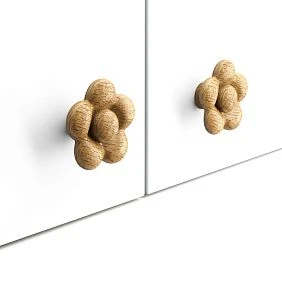
Shaped models like Heart, Star, Paw, Flower, Car, and others allow marking individual zones of a cabinet or dresser, making the furniture clearer for a child. However, the shape does not negate requirements for attachment, size, and coating. The handle must hold securely, have no damaged edges, and not interfere with opening the adjacent facade.
When a shaped form is appropriate
It suits a children's room, play furniture, garden cabinets, or small toy boxes. Different shapes can be used as visual markers, but too many different models on one facade creates clutter.
Identical or different shapes
An identical set looks calmer and is easier to replace. Different handles help a child remember the contents of drawers, but their size and protrusion should be comparable. Mixing is not allowed
Scandinavian furniture
Oak ORB under a clear finish adds natural material to a white or light gray facade. Button suits a more strict option. Handles should not be larger than necessary for a comfortable grip.
Modern Classic
ORB pairs well with framed facades, calm panels, and wooden legs. On a large dresser, two round buttons can support symmetry. The color is tied to the frame, countertop, or leg finish.
Provence and vintage
Buttons can be painted in a light color or tinted with a soft aging effect. Decorative finish should not impair grip and wood protection. Signs of aging create a surface over a durable compatible system.
Modern colored facade
Beech Button handles can be made in the color of the furniture or in a contrasting shade. In the first case, the size is chosen for convenience, in the second, the handle becomes a noticeable part of the design.
Natural furniture made of solid wood or veneer
Oak ORB and Button handles under tinting help connect the hardware with the wood grain. There will be no complete texture match, but the species and color can be coordinated.
Practical choice for different situations
Need to update a dresser without replacing the fronts
Measure the old hole, the number of drawers, and the width of each front. If single-point knobs were previously installed, ORB or Button can be a direct replacement after checking the screw. For old brackets, repair of the second hole will be required.
Need to design a new cabinet
Create a drawing of paired doors, determine the height and offset from the central edge. On a tall front, make a mockup of ORB and all three Button handles. Buy the set before drilling so that the layout accounts for the actual shape.
Need to select handles for the kitchen
Divide the fronts into groups and determine where a knob is truly convenient. For heavy drawers, compare a pull. For the rest, choose one material and one finish system, add a spare and a test sample.
Need to choose handles for two nightstands
Count both pedestals as one set. The arrangement should be mirrored, the color from the same batch. If each has a drawer and a door, decide in advance whether the handles will be the same size.
Need a large round accent
ORB remains a compact button. Solea creates a noticeable ring composition and requires two-point marking. The choice depends on the facade area and existing holes.
Need to use one design on facades of different sizes
Button offers three scales. Create a map: small size for small drawers, medium for standard doors, large for wide facades. Do not change sizes randomly within one group.
Need handles in the color of furniture legs
Match the wood species and finish. Beech handles and legs are convenient to paint with one enamel. Oak parts are tinted according to the sample, considering that the pattern on a small handle and a large support looks different.
What to buy together with knob handles
The main set includes the handles themselves and fasteners, if confirmed by the model card. For a finished result, you may need a facade sample, finishing materials, a marking template, and a spare handle. These items do not imply automatic inclusion: they are selected for the furniture project.
| What to add to the purchase | Why | For which scenario | What to Check |
|---|---|---|---|
| Spare handle | Test paint and future replacement | Kitchen, dresser, paired nightstands, commercial furniture | Same size, material, and preparation |
| Facade sample | Check scale, color, and fasteners | New furniture and restoration | Actual thickness and material |
| Layout template | Keep equal margins | Series of doors and drawers | Right and left orientation |
| Finishing materials | Protect the wood and achieve the desired color | Unpainted ORB, Button and Solea | Compatibility of primer, color, and finish |
| Suitable fasteners | Consider the thickness of the specific facade | Replacing old handles and new furniture | Screw length, washer and thread depth |
| Kit map | Do not confuse sizes and placement | Kitchen and furniture with different facades | Quantity of each model |
How not to confuse a knob with similar hardware
Knob and bracket
A knob has one attachment point, a bracket has two. A bracket is more convenient for gripping with the whole hand and for heavy drawers. Replacing one with the other often requires repairing holes.
Knob and recessed handle
A knob is mounted on the surface and protrudes. A recessed model requires a cutout in the facade. These are different technologies, and switching between them cannot be planned based solely on appearance.
Knob and furniture profile
A profile creates a long line along the facade and is usually attached along the edge or at multiple points. A knob remains a local element. On a large modern kitchen, a profile may be more convenient than many small details.
Knob and Solea
ORB and Button are single-point models. Solea consists of two semicircles and uses a 64 mm center distance. The round external motif does not make it a knob.
Furniture knob and door knob
The door model refers to locks and interior doors, having a different design and load. The article only concerns face furniture fittings for cabinets, dressers, nightstands, and drawers.
Mistakes when buying a set
Counting furniture bodies instead of facades
One cabinet may have several doors and drawers. As a result, there are not enough handles. Before ordering, make a list of each opening element.
Not determining one or two buttons on a wide drawer
After drilling the center hole, it is too late to change the layout. The decision is made based on the mockup and trial use.
Choosing size only by name
A "large" and "small" handle are perceived differently on a specific facade. Accurate dimensions and a full-scale mockup are needed.
Mixing Button of different sizes without a map
The hierarchy turns into random alternation. For each group of facades, one execution is fixed.
Calling Solea a button and drilling one hole
The model consists of two halves and requires different markings. Check the drawing before processing the facade.
Do not check the screw length
The included fasteners may need adaptation to a specific thickness. A screw that is too short or too long makes the connection unreliable.
Paint the handles one by one
Color and gloss differ. The entire set is processed with one batch of materials and in one cycle.
Leave the wood without coating
An unpainted surface absorbs moisture and dirt. The constant grip area changes especially quickly.
Do not order a spare
If damaged, you have to look for a new batch, which may differ in texture. One spare handle simplifies repair.
Trying to fix a tight drawer with a large knob
The problem remains in the guides, while the load on the fastening increases. First, repair the mechanism.
Fastening into a weak old hole
Tightening harder does not restore the material. The facade is repaired, then the hardware is installed.
Who the knob handle set suits
This choice suits furniture with small and medium facades, where a single-point grip is convenient. Knobs are useful for chests of drawers, bedside tables, cabinets, sideboards, mezzanines, children's furniture, and some kitchen doors.
The set is especially appropriate when you need to maintain a calm row, replace old single-point handles, or paint the hardware along with the furniture. Button helps work with different scales, ORB creates a pronounced round shape.
When it's better to choose another type
For a heavy wide drawer, a pull may be more convenient. For a smooth minimalist facade without protrusions, a recessed handle or profile. For a large decorative circle, Solea, but as a two-element composition.
A knob is not suitable if the existing two holes cannot be repaired, the facade is too weak for fastening, or the user cannot confidently grip a small part. An honest assessment of convenience is more important than the desire to use one type on all furniture.
How to check the kit after installation
Line and symmetry
Step back a few meters from the furniture. The handles should form even horizontals and verticals. On paired doors, the offsets are mirrored.
Reliability
Each button is lightly checked by hand. It should not rotate or come loose. After a few days, the fasteners are inspected again.
Convenience
Open all fronts with a normal motion. If fingers touch the edge, the button is too small or poorly positioned. On wide drawers, check for misalignment.
Coating
There should be no roughness, drips, or unpainted areas on the inner and outer surfaces. The fasteners do not damage the finish.
How to prepare a kit specification
For a small pedestal, a short entry is sufficient, but a kitchen or wardrobe requires a full table. It specifies the furniture module, facade type, handle model, size, material, finish, quantity, and installation coordinates. This specification links the product selection to the cabinetmaker's work.
SKU and size
The entry "Button" is insufficient because the model has three variations. You need to specify HL-036 and the exact dimension. For ORB, record 44 × 44 × 45 mm. For Solea, the size and center distance.
Material
Beech and oak are not mixed within one visible group without a special design intent. In the specification, write not just "wood", but the specific species and preparation for enamel or tinting.
Finishing
Record the system name, color, gloss level, and sample. The phrase "white matte" is not precise enough. For a repeat order, data is needed that allows the workshop to reproduce the result.
Coordinates
For a door, specify the offset from the free edge and the top or bottom edge. For a drawer, the center or two symmetrical points. On paired furniture, note the mirrored arrangement.
Fastening
Specify the facade thickness and the confirmed screw length. If the furniture has several types of facades, the fasteners may differ. They cannot be mixed in one box without marking.
How to prepare a marking template
A template helps transfer the same point to dozens of facades. It is made from a stable material and tied to two edges so that the position does not depend on tape measurement. For right and left doors, a mirrored side may be required.
One template for identical doors
In the kitchen, all upper doors of one group are drilled according to a common scheme. Before a series, the template is checked on a test facade. An error in the template will repeat on all furniture, so the first result is measured separately.
A separate template for drawers
Central placement and two points require different fixtures. Wide and narrow facades cannot be drilled with one template if the offsets differ.
Template for Button of different sizes
The attachment point may match, but the external dimension changes. The model and facade group are marked on the template so that a large handle does not accidentally end up on a small drawer.
Check before drilling
Glue paper mockups to all furniture and look at it from the usual entry point in the room. It is easier to correct the position on paper than to repair a hole.
How to care for wooden handles
The handle is touched more often than almost any other wooden furniture part. In the kitchen, water and grease remain on it, in the hallway — street dust, in the children's room — traces of constant use. Care depends on the chosen coating.
Enamel
The surface is wiped with a soft cloth and products compatible with the system. Abrasives alter the sheen, especially on dark colors. A chip is repaired before moisture penetrates the wood.
Clear varnish
It preserves the oak texture and creates a protective film. Do not leave the handle wet constantly. When a scratch appears, the repair method depends on the type of varnish.
Oil
The oiled surface retains natural tactility but may require renewal. The grip area wears out faster. The name of the compound and the application date must be preserved.
Staining
Pigment alone is not always a complete protection. It usually works within a system with oil or varnish. The buyer must understand the entire set of layers, not just the stain color.
Checking the fastening
If the button starts to rotate, do not continue using it with force. The facade is opened in another way, the fastener is checked and tightened without damaging the material. Constant rotation wears away the coating around the base.
How to store spare handles
The spare part is kept in a dry place separately from metal tools. A painted handle is wrapped in a soft material that does not stick to the finish. The label with the article number, size, wood species, and coating data is stored together.
It is useful to store an oak handle as part of a specific set. Even with the same article number, a new batch may differ in natural grain. A spare part after replacement will be less noticeable if it is purchased and tinted simultaneously with the others.
Sets for commercial furniture
In a hotel, salon, store, or cafe, handles are used by a large number of people. For such a project, repeatability, stock, and the ability to quickly identify the article number are important. A complex mix of different shapes makes repair difficult.
Room stock and identical bedside tables
Using one model for all items simplifies procurement. The reserve is calculated not for each bedside table separately, but for the entire batch. The finish is documented.
Lockers and changing rooms
The button should be comfortable for people with different hand sizes. A too small Button may be less practical for intensive use. A sample is tested before mass ordering.
Showcases and commercial furniture
ORB can become a natural volumetric element, while Button can maintain conciseness. The handle should not block price tags, locks, or adjacent doors.
Children's institutions
Shaped handles help designate sections, but the mounting and coating must match the project conditions. The stock of each shape is stored separately.
How to buy a set of button handles on STAVROS
First, open the push-button category and select shapes that match the mounting method. Then choose a real sample: ORB for a round volume, Button for a concise shape and scale selection. Consider Solea separately if you need a large two-element circle.
After selecting the model, compile a list of facades. Decide where there will be one button, where two, and where a bracket or other type of hardware is better. Record the quantity of each size and add a reserve. Only then proceed to place the order.
Before payment, check the material, finish preparation, dimensions, mounting kit, and current availability. For facades of non-standard thickness, clarify the screw length. If the handles must match the finished furniture, send the manager photos, dimensions, and a color sample.
Purchasing through a card with an exact article number is more convenient than random selection: the master gets verifiable dimensions, the buyer gets the ability to repeat the model and save data for repairs. This is especially important for Button, where one name combines three sizes.
What to Check Before Ordering
- whether the selected model is a single-point button;
- whether Solea is confused with a regular button;
- exact article number;
- size of each model;
- beech for enamel or oak for tinting;
- number of doors and drawers;
- one or two handles on a wide facade;
- location on double doors;
- installation height on the cabinet;
- finger access under the overhanging countertop;
- facade thickness;
- length of the mounting screw;
- condition of old holes;
- quantity of each Button size;
- spare handle for painting and repair;
- overall finishing system;
- color and gloss sample;
- marking template;
- current price and availability in the card;
- Possibility of consultation on a non-standard facade.
How to test the selected pattern on one test facade
Before drilling the entire kitchen or dresser, it is useful to assemble one full sample. A paper mockup shows the scale but does not answer questions about grip, button rotation, screw length, and coating behavior. The test facade should have the same thickness and material as the main furniture.
Check the size in hand
Install the selected ORB or Button and open the facade several times. Assess whether fingers touch the surface, whether it is comfortable to pull the door at a normal angle, and whether the handle seems too large. For the kitchen, several family members should test the sample.
Check the position
Temporarily install the facade on the furniture or hold it against the cabinet. A point that looks correct on the workbench may turn out to be too high, too low, or too close to the adjacent door. For paired facades, prepare a mirror paper mockup of the second handle.
Check the fastening
The screw should tighten without excessive force, and the handle should not rotate during normal use. If the screw head protrudes on the inside, interferes with the drawer, or presses against the contents, change the fastening scheme before starting the series.
Check the finish
The test handle is painted or tinted using the full technology. After drying, the color is evaluated next to the facade, ease of cleaning, and the condition of the area around the base. Only then are the material and finish approved for the entire set.
Use the sample for several days
Brief use reveals what is unnoticeable during the first fitting: weak tightening, inconvenient reach, fingerprints on the chosen gloss, and misalignment of a wide drawer. If the scheme requires adjustment, one test facade is changed, not the entire piece of furniture.
Frequently asked questions
How does a knob handle differ from a pull handle?
A knob is attached at one point and is grasped with fingers. A pull has two attachment points and allows gripping with the whole hand. For heavy wide drawers, a pull is often more convenient.
Which model is considered a classic round knob?
ORB HL-002 has dimensions of 44 × 44 × 45 mm and a pronounced round shape. It is suitable for cabinets, dressers, nightstands, and some kitchen facades.
What sizes are available for Button HL-036?
Three sizes are confirmed: 37 × 22 × 15, 53 × 27 × 18, and 74 × 29 × 25 mm. The quantity of each version is counted separately.
Is Solea HL-025 a knob handle?
Not in the classic single-point sense. It consists of two semicircles and has a center-to-center distance of 64 mm. It requires two-point marking.
What size button to choose for a small drawer?
Start with a paper mockup of a small Button and test the actual grip on the sample. The handle should not take up most of the front or be too low for the fingers.
One or two handles needed for a wide drawer?
The solution depends on the width, weight of the contents, and slides. One button is visually simpler, two can reduce misalignment. For a heavy drawer, it's worth comparing a pull.
Where to place the button on a cabinet door?
Near the free edge opposite the hinges, at a comfortable height. On paired doors, handles are placed mirror-symmetrically and drilled using a single template.
Can an old button be replaced without a new hole?
Yes, if the existing hole is in the right place, not damaged, and suitable for the new fastener. The front thickness and screw length are checked separately.
Can a pull be replaced with a single button?
Only after repairing one or both old holes. The new center point usually does not coincide with the center-to-center pair of the bracket.
What to choose for enamel — beech or oak?
For opaque enamel, beech is rational with appropriate preparation. Oak is more often chosen for translucent tinting with visible texture.
Can wooden handles be tinted?
Oak options for tinting are intended for translucent finishing. The specific system is tested on a spare handle, then the entire set is processed simultaneously.
How to paint handles the same color?
Use one batch of materials, the same number of layers, and a uniform drying mode. First, approve a test coating on the actual shape.
How to choose the length of the mounting screw?
Measure the thickness of the facade and account for the thread depth in the handle. The screw should securely tighten the connection without pressing into the wood or being too short.
How many handles to order for the kitchen?
Count each door and drawer separately, wide fronts with two buttons and internal sections. Add a reserve for test painting and repairs.
Is a spare handle needed?
Yes, especially with custom enamel or tinting. It helps approve the color and replace a damaged part from the same batch.
Can different Button sizes be used on the same piece of furniture?
Yes, if the sizes are distributed across clear groups of fronts. Random alternation looks like a mistake. A kit map is needed.
Is a knob handle suitable for a kitchen drawer?
For a light and smoothly operating drawer — yes. For a wide heavy front, compare two knobs and a pull.
Are decorative knobs suitable for a children's wardrobe?
Yes, if the size, mounting, and finish match the project. Different shapes can be used as markers, but the set must remain clear and maintainable.
How to combine handles with wooden legs?
Match the wood species and finish. Beech is easy to paint with one enamel, oak — to tint according to a common sample. The natural grain on different parts will not be completely identical.
Where to buy wooden knob handles as a set?
In the STAVROS category, you can choose single-point models, compare sizes, and go to the ORB and Button cards. The order is placed after calculating the fronts and checking the finish.
Conclusion: the set starts with a facade map
A wooden knob handle is convenient due to its compact shape and single attachment point, but a good result depends on the entire system. You need to count doors and drawers, determine one or two handles on a wide facade, draw straight lines, choose a size, and check the screw.
ORB HL-002 is suitable for a buyer who needs a voluminous round knob measuring 44 × 44 × 45 mm. Button HL-036 allows using one laconic shape in three scales. Solea HL-025 creates a large round motif but requires two elements and different markings.
STAVROS offers models made of beech for enamel and oak for tinting. Before purchasing, it is important to choose the material, approve a test color, order a reserve, and save the specification. This approach turns a set of individual handles into a cohesive set that is convenient to use, easy to repeat, and simpler to repair.