








































Article Contents:
- What is a vertical accent from floor to ceiling
- Difference between a vertical accent and a regular slatted wall
- Where to use a vertical accent: spaces and scenarios
- Behind the sofa: depth and intimacy
- TV area: focus and accent
- Hallway: meeting the interior
- Bedroom: headboard as an architectural object
- Study: seriousness and concentration
- Lobby, reception, commercial interior
- Corridor: rhythm and dynamics
- Why wooden slats work best vertically
- Three properties that make slats unique
- Slat parameters for vertical accent
- How to add stucco decor to wooden slats: five schemes
- Scheme one: moldings on the sides of the slat area
- Scheme two: stucco frame around wooden slats
- Scheme three: molding at the top and bottom as a finish
- Scheme four: polyurethane decor on adjacent walls
- Scheme five: stucco in wall color to avoid competing with wood
- How to design the transition to the ceiling: cornice, molding, or shadow gap
- Bring the slats to the bottom line of the cornice
- Leave an indent from the ceiling with a horizontal molding
- Use a polyurethane ceiling cornice
- Shadow gap for a modern interior
- Cover the top with molding without a cornice
- How to design the bottom of a vertical accent and choose a baseboard
- Wooden baseboard: an organic finish for natural slats
- MDF baseboard for painting: contrast and modernity
- Wide wooden baseboard for a prestigious interior
- Baseboard in wall color: invisibility as a technique
- Principle of matching the baseboard with the top element
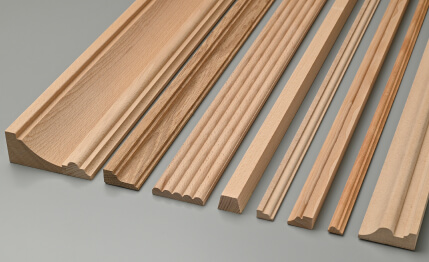
- Moldings, corners and strips: why they are needed for vertical accent
- Wooden corner: closing ends on the sides
- Wooden strip: volumetric vertical posts
- Horizontal strips as zone dividers
- Moldings as a system: unified series of all elements
- Best material combinations for vertical accent
- Oak slats + white polyurethane moldings
- Wooden slats + high MDF baseboard
- Slats from floor to ceiling + thin ceiling cornice
- Slats in the hallway + wooden corner for ends + wooden cornice
- Slats in the living room + moldings on adjacent walls
- Vertical slat area + baseboard matching wall color
- Wooden slats + stucco decor matching ceiling color
- Mistakes when designing a vertical accent
- Slats butting into the ceiling without finishing
- Baseboard accidentally breaks off at the slat area
- Slat ends on the sides are not covered
- Too frequent slat spacing in a small room
- Mixing several wood shades
- Moldings, slats, baseboard, and cornice compete
- Corners and junctions with the door or window are not thought out
- What to choose from the STAVROS catalog for a vertical accent from floor to ceiling
- About the Company STAVROS
- Frequently Asked Questions
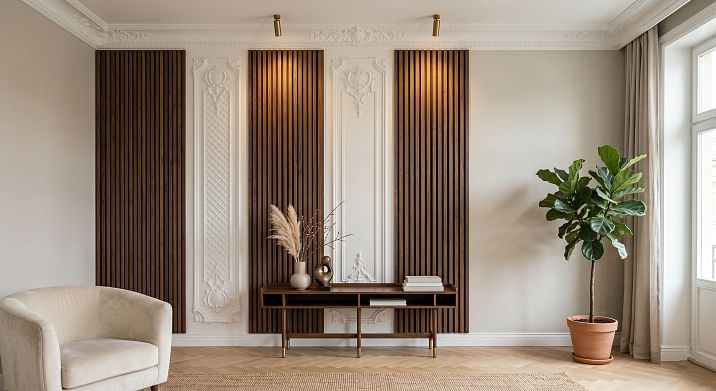
There are interior design techniques that always work — regardless of style, room size, or budget. One such technique is a vertical decorative zone from floor to ceiling. A wall with vertical wooden slats framed by molding at the top and bottom, a baseboard at the floor, and a cornice at the ceiling is not just a "beautifully decorated wall." It is an architectural answer to the question: how to make an ordinary room expressive without changing its layout.
A vertical accent from floor to ceiling draws the eye, stretches the wall upward, and sets the tone for the entire space. It can be behind a sofa or in a TV area, in a hallway, study, or bedroom. Materials —Decorative wooden strip, moldings, cornice, baseboard, corners, bars — are assembled into a system that looks expensive and professional.
This article is about how to do it correctly — without overload, without mistakes, with a clear understanding of each element.


What is a vertical accent from floor to ceiling
The concept of a "vertical accent" is broader than just "slats on the wall." It is an architectural technique where one wall or part of it is organized along a vertical axis: the decorative zone starts at the very floor — with a baseboard — and goes up to the ceiling, ending with a cornice or molding. The gaze does not just glide over the surface — it moves from bottom to top along with the vertical lines of the slats, and this movement "pulls" the ceiling upward.
The vertical rhythm of wooden slats is one of the most effective tools for visually increasing the height of a room. In a standard apartment with a ceiling of 2.5–2.7 m, slats from floor to ceiling with a spacing of 50–80 mm add a feeling of 20–30 centimeters of height — not due to illusion, but due to the active vertical axis created by the rhythm of the planks.
But the main thing is not the height. The main thing is architectural completeness. A vertical zone only works when it is finished: at the bottom —Wooden baseboardorMDF Skirting Boardlike a lower horizontal line, with a cornice or molding at the top as the upper one, and corners or strips on the sides as vertical frame posts. Without these elements, the slats remain "hanging" on the wall without support.




Difference between a vertical accent and a regular slat wall
A regular slat wall covers the entire wall plane with slats. A vertical accent is an area limited in width but extending from floor to ceiling across the full height. The difference is fundamental:
-
A slat wall covers everything — it is a background.
-
A vertical accent highlights part of the wall — it is an object.
An object requires a frame. That is whywood trim items— corners, strips, moldings, cornices, baseboards — are an integral part of the vertical accent, not optional decor.
Our factory also produces:







Where to use a vertical accent: spaces and scenarios
Understanding where exactly a vertical accent is needed means understanding the logic of the space. This is not a universal technique "for any wall." It has specific application scenarios, each solving its own problem.
Get Consultation
Behind the sofa: depth and intimacy
The wall behind the sofa is the first thing a guest sees when entering the living room. VerticalWooden boards in interior slats behind the sofa create a "backrest" for the lounge area: they psychologically separate it from the rest of the space, adding depth and warmth. Floor-to-ceiling slats here are the maximum scenario, where the sofa area becomes an independent architectural object within the living room.
TV zone: focus and accent
The wall behind the TV is a standard spot for accent decor. Vertical slats here work as a background that holds the gaze on the screen while giving the zone status: not just a "TV on the wall," but a decorative composition.Rafter panels in the TV zone is a ready-made solution with a predictable pitch, installed quickly and cleanly.
Hallway: meeting with the interior
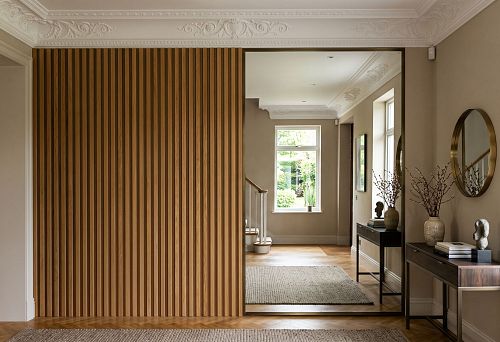
The hallway is where the first impression of the home is formed. Floor-to-ceiling vertical slats in the hallway, with a wooden corner on the sides and a cornice on top, are not decor—they are an architectural statement. The guest hasn't even entered the rooms yet but already understands that the interior is taken seriously here.
In a narrow hallway, vertical slats across the entire width of the end wall visually "open up" the perspective. The gaze follows the verticals into the depth, making the corridor seem wider.
Bedroom: The headboard as an architectural object
The bedroom is an intimate space where the accent at the headboard sets the entire mood. Floor-to-ceiling wooden slats behind the bed are a Japanese and Scandinavian technique where the bed is "embedded" in a vertical wooden niche. No complex construction—just slats, side bars, and a baseboard at the floor.
Study: seriousness and concentration
Vertical accent in the office — the wall behind the desk or a library wall. Here, slats serve as a backdrop for shelves, clocks, and artwork. Dark tinting of the slats — walnut, wenge, dark oak — creates intimacy and a "working" mood.
Hall, reception, commercial interior
In public spaces, a vertical accent made of wooden slats creates a recognizable brand environment. Slats at the reception desk or behind the waiting area instantly evoke a sense of class and attention to detail. In a commercial interior,wooden slats for zoningalso serve a functional purpose: they visually separate zones without physical partitions.
Corridor: rhythm and dynamics
In a long corridor, a vertical accent of slats on the end wall "stops" the gaze and creates a focal point. On the side walls — moldings or polyurethane frames as rhythmic decor. The system works: the corridor turns into a gallery.
Why wooden slats work best vertically
Before considering specific schemes, it is important to understand the nature of vertical rhythm in decor. Why do wooden slats — not wallpaper, not plaster, not panels — produce this effect most expressively?
Three properties that make slats unique
First — the living texture of wood. Each slat has its own grain pattern, its own shade, its own "story" of the tree. This is not a print, not an imitation — it is a material with a soul. Ten slats side by side create a surface that looks different under different lighting: morning sun, evening light from a floor lamp, direct diffused light — three different pictures.
Second — the play of light and shadow. There are gaps between the slats. Gaps create shadows. Shadows create depth. A wall with slats is not a flat surface, but a relief system of planks and shadows that "breathes" as lighting changes. This fundamentally distinguishes slats from any flat decor.
Third — geometric precision of the vertical. Wooden slats provide an absolutely clear vertical line — an impeccable strict rhythm. This rhythm is not random, not organic in the "living" sense — it is architectural. And that is why slats work alongside moldings, cornices, and baseboards: they speak the same language of precise lines.
Parameters of slats for vertical accent
Not every slat is suitable for a vertical accent from floor to ceiling. Parameters matter:
-
Slat width: 20–50 mm. Thin slats 20–25 mm — delicate rhythm, Japanese, Scandinavian. Wide slats 40–50 mm — architectural rhythm, neoclassical, modern interior.
-
Slat thickness: 15–25 mm. Thickness determines the depth of shadow in the gap: the thicker the slat, the deeper the shadow, the more relief the surface appears.
-
Spacing between slats: 30–80 mm. Frequent spacing (30–40 mm) — dense, rich surface. Rare spacing (60–80 mm) — light, airy. In a small room — rare spacing, in a large hall — frequent spacing is possible.
-
Wood species: oak, ash, pine, birch. Oak — status and durability. Ash — lightness and whitish texture. Pine — affordability and warmth. Birch — neutrality and even tone.
How to add stucco decor to wooden slats: five schemes
Stucco decor and wooden slats are two fundamentally different materials in character. Wood is alive, warm, with texture. Stucco is architectural, precise, white. Their combination works precisely because they complement each other: slats provide depth and warmth, stucco provides clarity and geometry.
Scheme one: moldings on the sides of the slatted zone
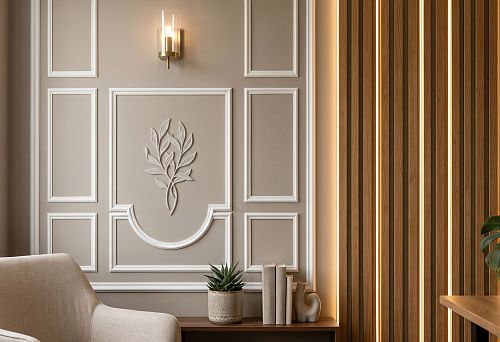
Moldings made of polyurethaneordecorative wooden moldingson the left and right borders of the slatted zone — vertical frame posts. They clearly define the width of the accent zone and create the feeling that the slats are "inserted" into a decorative frame.
The molding on the sides should be the same height as the slats — from the baseboard to the cornice. Molding profile: simple, rectangular. An intricate ornamental molding next to laconic slats is a style conflict.
Scheme two: stucco frame around wooden slats
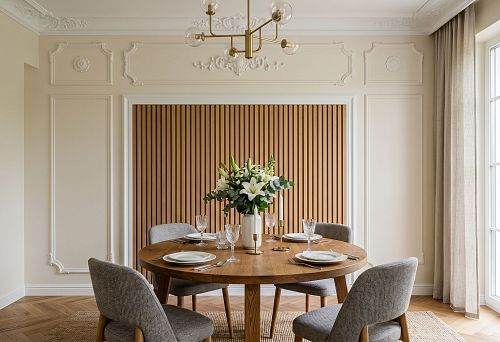
Polyurethane wall decorin the form of a frame around the perimeter of the slatted zone — a complete framing: top, bottom, left, right. The slats end up "in a picture" bounded by a white architectural contour.
This is a classic design technique where the slatted zone is perceived as an independent decorative object built into the wall. Width of the frame molding: 20–35 mm — no more is needed, otherwise the frame will start to dominate the content.
Scheme three: molding at the top and bottom as a finish
A horizontal molding above the slats and a horizontal molding below the slats (above the baseboard) create "upper" and "lower" architectural accents. The slats between them are like content between two lines. This scheme works especially well when the slats do not occupy the entire height of the wall, but its central part.
Scheme four: polyurethane decor on adjacent walls
Slat zone on the accent wall. Adjacent walls are smooth, withpolyurethane wall decorin the form of molding frames. The frames are painted in the wall color — they create an architectural rhythm without adding new color. The wooden accent zone remains the only warm textured element, everything else is a neutral background.
This ratio of "active" and "calm" is a classic design proportion where the accent works at its maximum.
Scheme five: stucco in the wall color to avoid competing with wood
If the slats are a rich, dark tone — tinted oak, wenge, walnut — polyurethane moldings next to them should be painted in the wall color. No white contrast — only relief. Dark slats + neutral relief moldings + dark wooden baseboard = a restrained, rich, "library" interior.
How to design the transition to the ceiling: cornice, molding, or shadow gap
The top finish of a vertical accent is what decides whether the interior looks "finished" or not. Slats extending to the ceiling without finishing look like incomplete installation. Slats finished with a cornice, molding, or intentional shadow gap look like an architectural solution.
Bring the slats to the bottom line of the cornice
Ceilingwooden corniceis installed first — it sets the horizontal line to which the top ends of the slats are brought. The cornice overlaps the ends by 10–15 mm: they are physically covered, no gap. This is the neatest and most reliable solution.
Wooden beamsSTAVROS are available in a range of profiles 35–120 mm. For a vertical accent with thin slats 20–30 mm — a cornice 40–60 mm. For wide slats 50 mm — a cornice 60–80 mm.
Leave a gap to the ceiling with a horizontal molding
The slats end 20–30 cm below the ceiling. Horizontally, at the level of the upper end of the slats — a molding. It creates a clear line for the end of the slat zone. Above — a smooth strip of wall, even higher — a ceiling cornice around the entire perimeter.
This scheme adds "air" to the upper zone of the wall. It works well in rooms with a rich wood tone of the slats: the smooth strip on top relieves the tension of the texture.
Use a polyurethane ceiling cornice
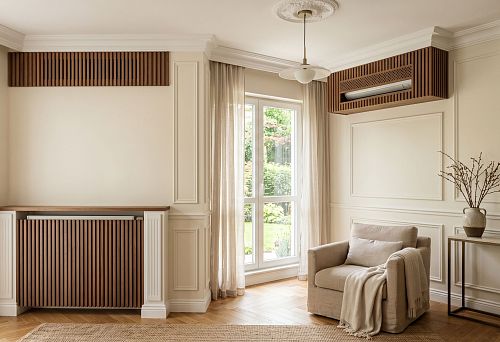
Moldings made of polyurethanein the format of a ceiling cornice — a white horizontal frame above warm wooden slats. The contrast of white and wood is one of the most winning techniques in modern interiors. The cornice does not overpower the slats but creates a clear upper boundary for them.
polyurethane ceiling decorin a single series with wall moldings — a full-fledged white architectural system into which the warm wooden vertical is "inserted".
Shadow gap for a modern interior
A shadow gap of 5–8 mm between the upper end of the slats and the ceiling is a minimalist technique. The slats seem not to touch the ceiling; they "float" on the wall. The dark shadow line along the upper edge emphasizes the boundary of the accent zone.
This technique requires a perfectly level ceiling: any deviation from the horizontal will make the gap uneven. A laser level is mandatory during marking.
Cover the top with a molding without a cornice
A narrow horizontal molding 15–20 mm, mounted on top of the upper ends of the slats — a delicate finish without a full cornice. This molding simultaneously covers the ends of the slats and creates a horizontal line for the top finish. Works well in Scandinavian and Japanese interiors, where the emphasis is on minimalism.
How to design the bottom of a vertical accent and choose a baseboard
The lower horizontal — the baseboard — is the foundation of the vertical accent. Like the foundation of a building: it is not explicitly visible, but without it, the structure 'hangs in the air.' A properly selected baseboard completes the vertical system from below and creates a sense of stability for the entire composition.
Wooden baseboard: an organic finish for natural slats
Ifwooden planks on the wallmade of natural oak or ash — it is logical to use as the bottom finishwith a classic profile creates a sense of solidity, reliability.of the same species. A unified material language throughout the vertical: baseboard → slats → cornice from the same wood. The interior is perceived as a designed system, not as a set of details.
Requirement for the baseboard: the same species, the same tint, the same surface treatment. If the slats are tinted with oil-wax, the baseboard should have the same oil. Different tints, even on the same species, will give different shades under the same daylight.
MDF baseboard for painting: contrast and modernity
Baseboard MDFa straight white profile next to warm wooden slats — this is a 'Scandinavian' or 'modern' technique. White baseboard + wooden slats + white polyurethane cornice on top — a single white architectural frame around the wooden vertical. Light, bright, airy.
buy MDF skirting boarda straight profile 60–80 mm high — the optimal choice for modern interiors with a vertical accent made of slats.
Wide wooden baseboard for a status interior
In a study, hall, country house —wooden skirting board purchase120–150 mm high. A wide baseboard creates a "heavy base" for the wall — a sense of architectural solidity. Slats from floor to ceiling + high wooden baseboard + wooden cornice — this is a classic neoclassical scheme in a modern interpretation.
Baseboard in wall color: invisibility as a technique
When a vertical accent of dark slats is the only decorative accent in the room,— is a horizontal element that frames the room at the bottom of the walls where the wall meets the floor. Skirting boards perform several functions: they hide the technological gap between the wall and floor covering (necessary for thermal expansion), protect the lower part of the wall from mechanical damage, create visual completion, and may conceal wiring.it is painted the same color as the walls. The baseboard "dissolves" — the lower horizontal line "disappears." There is only the vertical of the slats and a neutral background. Maximum focus on the accent area.
Principle of matching the baseboard with the upper element
A working rule: the baseboard and cornice form a single horizontal pair. Wooden cornice → wooden baseboard. White polyurethane cornice → white MDF baseboard. Baseboard height = cornice height ± 20–30 mm. Violating this proportion disrupts the visual balance of the entire vertical system.
Moldings, corners, and strips: why they are needed for a vertical accent
Many overlookwood trim itemswhen creating a vertical accent. It is they that turn a set of slats into a finished decorative structure.
Wooden corner: closing the ends on the sides
The right and left ends of the vertical slat zone are unfinished surfaces. The cross-section of the wood on the side ends of the outer slats is visible at an angle and ruins the feeling of quality.
Wooden angleof the same species is mounted over the side ends along the entire height of the slat zone — from the baseboard to the cornice. It creates a clear vertical line along the edges of the accent zone: the ends are closed, the accent line is clear.
Corner size: proportional to the slats. 15×15 mm corner for 25 mm slats. 20×20 mm corner for 40 mm slats.
Wooden block: volumetric vertical posts
Wooden blockon the sides of the slat zone — a more voluminous alternative to the corner. The block creates vertical "posts" of the frame: the slats are visually "inserted" between two wooden columns. This is an architectural technique where the slat zone is perceived as an independent structural element of the wall, not a decorative sticker.
Block parameters: thickness 20–30 mm, width 30–50 mm. It should be no thinner than the front surface of the slat.
Horizontal blocks as zone dividers
If the vertical accent of slats does not occupy the entire width of the wall, horizontal blocks or moldings along the upper and lower boundaries of the slat zone complement the vertical posts, creating a complete "frame" of blocks. The slat field inside the frame is like a painting in a frame.
Molding as a system: a unified series of all elements
wood trim itemsin a unified series — these are slats, corners, bars, moldings, baseboards, and cornices from the same wood species with a single processing standard. Buying them as a set gives a predictable result: the same stain applies evenly to all elements, and the shade is uniform across the entire vertical.
Best material combinations for a vertical accent
Oak slats + white polyurethane moldings
Oak stained "natural" or "light walnut" — warm, golden. WhiteMoldings made of polyurethaneon the sides and top. WhiteMDF Skirting Board70 mm. Walls — linen or milky shade. This is the most versatile and popular combination for living rooms and bedrooms.
Wooden slats + tall MDF baseboard
Dark-toned slats +Baseboard MDF100–120 mm high white baseboard. A tall white baseboard with dark slats creates a strong architectural contrast in the lower zone. The lower the baseboard height, the lighter the space. The higher it is, the more prestigious.
Slats from floor to ceiling + thin ceiling cornice
Slats go up to the ceiling, ending with a thin polyurethane cornice 30–40 mm. No gaps — maximum vertical movement. Walls are neutral. Baseboard is wooden, same species as the slats. Japanese or Scandinavian scheme with natural material.
Slats in the hallway + wooden corner for ends + wooden cornice
In a narrow hallway — slats on the end wall,Wooden angle on the side ends,wooden cornice on top, wooden baseboard at the bottom. All made of oak in the same tint. A hallway 3 m long with such an end wall looks like an entrance to an architecturally refined space.
Slats in the living room + moldings on adjacent walls
Slatted accent wall in the living room +Polyurethane wall decor on adjacent walls in the form of frames in the wall color. One wooden accent — it is the main one. Molding frames on other walls — a supporting background without competition.
Vertical slatted area + baseboard in wall color
Ash slats with white paint + white walls + white MDF baseboard matching the wall color. Monochrome scheme: the entire interior is white, with only the texture of the slats creating relief. A delicate, airy, minimalist space.
Wooden slats + stucco molding in the color of the ceiling
Slats in a rich wood tone + white polyurethane ceiling cornice matching the white ceiling +polyurethane ceiling decorsmall profile. The lower boundary —Wooden baseboardof the same wood species. Warm wooden verticals in a white horizontal frame — a classic of modern interior design.
Mistakes in designing a vertical accent
Mistakes in creating a vertical accent are almost always planning errors, not installation errors. They are easy to avoid if you know about them in advance.
Slats butting into the ceiling without a finish
The top ends of the slats are visible without a cornice, molding, or corner piece — the cross-sections are exposed. The eye registers incompleteness. Any finishing option is better than none: even a thin 15 mm molding covers the ends and creates a line.
The baseboard abruptly ends at the slat zone
The baseboard runs along the perimeter of the room and "butts" into the slatted panel without a well-thought-out solution. Either the baseboard should run along the front end of the slat (which requires a neat joint), or the slats should be mounted on top of an already installed baseboard. The installation sequence must be determined before starting work.
The ends of the slats on the sides are not covered by anything
The side ends of the outer slats of the vertical zone are open wood cuts. Withoutwooden corner or a block, they ruin the feeling of completeness. This is mistake #1 when installing slats yourself.
Too frequent spacing of slats in a small room
A slat spacing of 20–25 mm in a room of 12–15 sq. m makes the surface heavy, the wall "presses." Rule: the smaller the room, the wider the spacing between slats should be. In a room up to 15 sq. m, the spacing should be at least 50–60 mm.
Mixing several wood shades
Slats from one wood species, corner trim from another, baseboard from a third, cornice from a fourth. Even with the same paint, different species give different shades. A single wood species for all wooden elements of the vertical system is a mandatory condition.
Moldings, slats, baseboard, and cornice compete
Four active decorative elements on one plane is overload. The vertical accent works on the principle of "one main thing": either the slats dominate — then the moldings, cornice, and baseboard are neutral. Or the moldings are active — then the slats are delicate, thin, with wide spacing.
Corners and junctions with a door or window are not thought out
Where the slats end — at the door, window, or room corner — the most visible problems arise during poorly planned installation. The junction with the door frame, window slope, or wall corner — each point requires a solution: a corner piece, a block, a 45° cut, or a baseboard corner element.
What to choose from the STAVROS catalog for a vertical accent from floor to ceiling
To create a full vertical accent, a system of materials is needed — not just one product. The STAVROS catalog has everything included in this system.
Wooden slats —buy wooden slatsmade of oak, ash, pine, birch. Width 20–60 mm, thickness 15–30 mm. Ready for tinting, painting, oil treatment.
Slat panels —Rafter panelson a base with a fixed pitch. Installation is faster than individual slats — the pitch is verified by the manufacturer.
Wooden corner — Wooden corner bracketfor closing the side ends of the slat area and corner junctions. Sizes 10×10, 15×15, 20×20 mm.
Wooden block — decorative blockfor the vertical posts of the vertical accent frame.
Solid wood moldings —wood trim itemsof a single series: slats, corner pieces, blocks, moldings, baseboards, cornices.
Wooden moldings —Decorative wooden moldingsfor horizontal dividers, frames, and side trims of the slat area.
Polyurethane moldings —Moldings made of polyurethanefor white architectural frames and cornices over warm wooden slats.
Wall decor —Polyurethane wall decor— frames and molding panels on neutral walls next to a slatted accent zone.
Ceiling decor —polyurethane ceiling decorfor a ceiling cornice over a vertical accent.
Wooden cornices — wooden corniceandWooden beamsfor the top finish of a vertical slatted zone. Profiles 35–120 mm.
Wooden skirting boards —Wooden baseboardof the same series as the slats. Bottom finish of the vertical accent.
MDF skirting boards —MDF Skirting Boardstraight profile for painting — for the white bottom framing of wooden slats.
All STAVROS wooden products can be ordered in a single wood species and tint — and get a set of materials for a vertical accent with a predictable result. Details about installation — in the articleinstalling polyurethane molding.
About the company STAVROS
STAVROS is a Russian manufacturer of decorative products made from solid wood and polyurethane for creating architectural interiors. The company produces a full range of elements for vertical accents and any other decorative system: slats, slatted panels, moldings, corners, bars, moldings, cornices, and baseboards made from solid wood — as well as a full catalogpolyurethane productsfor ceiling and wall decor.
The main principle of STAVROS is to produce products in unified series so that each element of the decorative system works predictably with another: one wood species, one finish, one result. This makes STAVROS a manufacturer not of individual products, but of ready-made architectural solutions.
Frequently asked questions
How to decorate a wall with slats from floor to ceiling?
Mount the ceiling cornice along the top edge, bring the slats to the bottom line of the cornice. Close the side ends with a wooden corner or bar. The bottom finish is a wooden or MDF baseboard. All elements are from a single series of the same species.
What slat spacing should be chosen for a vertical accent?
In a room up to 15 sq. m — spacing 50–70 mm. In a large hall or living room — 40–60 mm. An accent zone up to 2 m wide — spacing 50–80 mm. Rare spacing — lighter and airier; frequent — richer and heavier.
How to connect wooden slats with stucco decor?
Slats — on the accent zone. Stucco moldings — on the sides, top, or adjacent walls. Moldings in the wall color — neutral background. White moldings — contrast. Direct joint of wood and polyurethane — with a 3–5 mm gap and acrylic sealant.
Which wooden or MDF baseboard to choose for slats?
Wooden of the same species — a unified material language. White MDF — contrast and lightness. Baseboard in the wall color — if the slats should be the only accent.
Is a cornice needed for a vertical accent from slats?
Desirable. Without a top finishing element, the slats look unfinished. Minimum — a horizontal molding 15–20 mm over the top ends. Optimal — a ceiling cornice, wooden or polyurethane.
How to close the side ends of the slats?
A wooden corner piece of the same species, mounted along the entire height of the slat zone. Or a 20×30 mm wooden block as a vertical frame post. Both options cover the unfinished edge and create a clear side line of the accent zone.
Is it possible to combine different wood species in one vertical accent?
It is strongly not recommended. Different species with the same stain produce different shades. A single species for all wooden elements — slats, corner pieces, blocks, baseboard, cornice — is a mandatory condition for a uniform result.