Article Contents:
- What is a coat rack made of wooden slats
- Decorative function
- Practical Function
- What is not included in the concept of "slats for a coat rack"
- RK-001 — solid wood and flexible layout
- RK-002 — large interior profile
- 15 × 5 mm
- 24 × 5 mm
- 40 × 5 mm
- 70 × 7 and 90 × 10 mm
- 60 × 23 and 80 × 23 mm
- 16 × 40 mm
- 22 × 60 mm
- 40 × 40 mm
- Width for three hooks
- Width for five to seven hooks
- Clear gap
- Centerline layout
- Example for RK-001 width 40 mm
- Example for RK-002 40 × 40 mm
- Height calculation
- Reserve
- Mounting through the slat into the wall
- Mounting through the slat into the substrate
- Embedded part in a frame wall
- Can a hook be attached directly to the slat
- Why mounting adhesive doesn't solve the problem
- One row
- Two rows
- Hooks near the mirror
- Above the bench
- Beech for enamel
- Oak for tinting
- MDF under enamel
- MDF with oak veneer
- With mirror
- With bench
- With shoe cabinet
- With door and trim
- With baseboard
- With lighting
- Small urban hallway
- Wide hall
- Country house hallway
- Family hallway
- Cloakroom at the entrance
- Commercial space
- Slat and ready-made hanger
- Slat and acoustic panel
- Slat and furniture board
- RK-001 and regular construction batten
- RK-002 and massive slat
- Decorative panel and load-bearing system
- Only need a background for light accessories
- A hanger for winter coats is needed
- Need a black panel
- Need natural oak
- Need to combine slats with doors
- Need to place children's hooks
- Need to integrate a mirror
- Need to furnish a rental property
- Buy slats before choosing hooks
- Attach heavy hook only to 5 mm slat
- Not accounting for wet clothes
- Choosing a shieldForgetting about switches and sockets
- Forgetting about switches and sockets
- Using a weak base
- Considering RK-002 as an oak array
- Expecting hooks in the kit
- Checking the base
- Panel marking
- Trimming
- Trial assembly
- Finishing Before or After Installation
- Material
- Quantity
- Fastening
- Finishing
- Checking the hooks
- Gradual increase of load
- Inspection after the first days
- Frequent panel from RK-001 24 × 5 mm
- Wide strips RK-001 90 × 10 mm
- Volumetric system RK-002 16 × 40 mm
- Square RK-002 40 × 40 mm
- Narrow base
- Wide base
- Hooks with hidden mounting
- Single and double hooks
- Can a hook be attached directly to the rail?
- Which rails to choose for a decorative background?
- Which rails to choose for a large panel?
- Is RK-001 or RK-002 better for a hanger?
- What spacing should be left between slats?
- How many rails are needed for the panel?
- Can a 5 mm rail be used for winter clothes?
- Which is better for a hallway: oak or beech?
- What to choose — MDF or oak veneer?
- How to protect rails from wet clothes?
- Can the slats be made black?
- Do I need to make a backing?
- How to position hooks for children?
- Can slats be combined with a mirror?
- Is RK-002 suitable for a narrow hallway?
- What is included in the slat kit?
- Can slats be installed on drywall?
- Where to buy wooden slats for a coat rack?
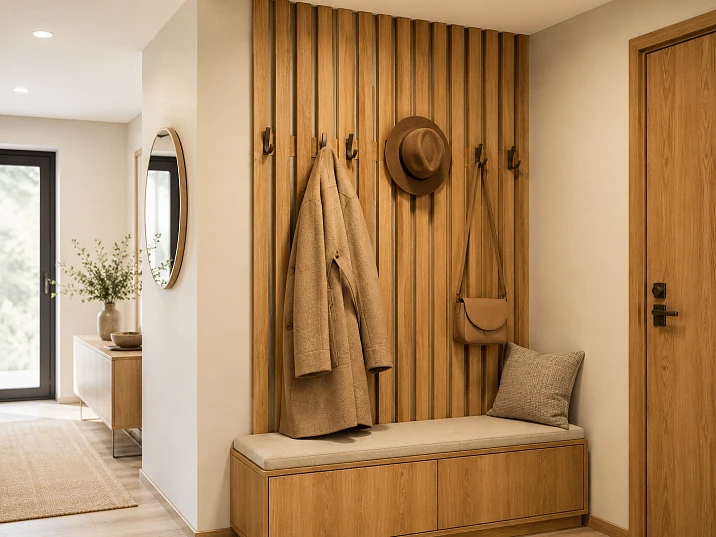
Buy wooden slats for a wall-mounted coat rack They want it not for another decorative wall, but for a practical storage area in the hallway. A slatted panel helps arrange hooks in a neat row, protect the wall finish from constant contact with clothes, connect the coat rack with a mirror, bench, and shoe cabinet, and at the same time make the entry area visually warmer. But such a project cannot be reduced to buying a few beautiful planks: you need to understand in advance what will be just decor and what should bear the load from coats, bags, and backpacks.
STAVROS offers slats RK-001 and RK-002, which can be used as a base or decorative background for self-assembling a wall-mounted coat rack. This is not a ready-made coat rack with hooks or a panel with pre-calculated load-bearing capacity. Hooks, fasteners, embedded parts, backing, and fixing method are selected separately. For heavy outerwear, it is safer to fasten through the slat into the wall, a sturdy backing, or a pre-prepared embedded part, rather than relying on a thin profile with a thickness of 5 mm as an independent load-bearing element.
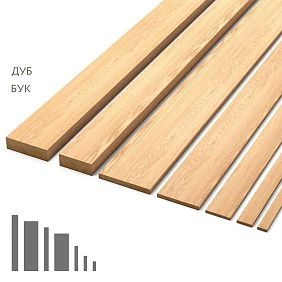
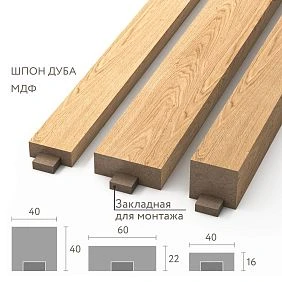
The choice between RK-001 and RK-002 depends on the task. RK-001 is a slat made of solid beech or oak, 2400 mm long, with seven cross-sections from thin 15 × 5 mm to massive 80 × 23 mm. It is suitable for precise layout, natural texture, painting, and combination with wooden furniture. RK-002 is an interior slat 2750 mm long made of MDF or MDF with oak veneer. Its profiles are larger: 16 × 40, 22 × 60, and 40 × 40 mm, and the design is intended for slatted panels and installation via embedded parts.
Before purchasing, you need to determine the panel width, height of the hook area, amount of clothing, position of the mirror and bench, wall material, and future finish. In the category you can buy wooden slats for a wall-mounted coat rackcompare both models and choose a profile that suits not only the appearance but also the scale of the hallway. Next, we'll look at which slats to use as a decorative background, which slats are more convenient for a large panel, and how to attach hooks without dangerously overestimating the capabilities of thin wood.
What is a coat rack made of wooden slats
A slatted wall-mounted coat rack consists of at least three independent parts: a decorative slatted surface, a system for attaching this surface to the wall, and hooks that hold the clothes. Sometimes a solid backing or frame is added between the slats and the wall. It levels the base, simplifies marking, hides fasteners, and helps transfer the load to a more durable material.
The main mistake is to assume that any beautiful slat automatically becomes a load-bearing board. In the photo, the thin panel and hooks look like a single product, but the actual structure may be arranged differently: a long screw passes through the decorative slat and backing into the wall; the hook is attached to hidden plywood; or a metal embedded part is used. Whether the coat rack can withstand a winter coat and bag depends on this, not just the name of the wood species.




Decorative function
The slats set the background, vertical rhythm, and proportions. They cover the section of the wall where traces from wet clothes and constant contact usually remain. The vertical layout visually increases the height of the hallway, while wide profiles make the panel more solid. Thin slats create a light pattern and pair well with a small mirror or narrow shoe cabinet.
Our factory also produces:





Practical function
The panel helps gather hooks on one plane and organize different storage levels: the top row for adult clothing, the bottom for children's jackets and bags. Between the slats, you can leave the wall background, a contrasting backing, or cover the entire area. It is important that there is room for reliable fastening behind the decorative solution.
Get Consultation
What is not included in the concept of "slats for a coat rack"
RK-001 and RK-002 are not sold as a ready-made coat rack. The product page does not include a set of hooks, a ready-made load-bearing panel, or universal fasteners for any wall. It cannot be guaranteed that one slat will hold any weight. The buyer purchases the profile, and the structural scheme is created independently or together with a furniture craftsman.
Confirmed characteristics of RK-001 and RK-002
| Parameter | RK-001 | RK-002 |
|---|---|---|
| Product type | Solid wood straight batten | Deep-milled interior batten with mounting insert |
| Material | Beech or oak | MDF or MDF with oak veneer |
| Length | 2400 мм | 2750 мм |
| Cross-sections | 15 × 5; 24 × 5; 40 × 5; 70 × 7; 90 × 10; 60 × 23; 80 × 23 mm | 16 × 40; 22 × 60; 40 × 40 mm |
| Sanding | «Prestige» | «Prestige» |
| Finishing | Beech under enamel; oak under tinting | MDF for enamel; MDF with oak veneer for clear or tinted finish |
| Main role in the coat rack | Thin trim, natural wood panel, frame, or solid profile | Large interior panel with pronounced depth |
| Limitation | Thin sections cannot be considered load-bearing without calculation and backing | Hooks and their fastening are designed separately from the decorative rail |
The table shows the main difference. RK-001 offers a wide choice of width and thickness, including almost flat decorative strips and more massive sections. RK-002 offers three large geometries that protrude more from the wall and create a ready-made interior rhythm. However, no model eliminates the need to check the wall base and hook load.
RK-001 or RK-002: what to choose for the hallway
RK-001 — natural solid wood and flexible layout
RK-001 is suitable when a project requires oak or beech, precise width selection, and the ability to create either a light decorative panel or a more massive frame. Seven cross-sections allow changing scale without switching to another product series. Thin options are convenient for a visual background, wide ones for noticeable verticals and areas where more wood is needed around the fasteners.
The length of 2400 mm is sufficient for most hallways if the panel starts from the floor or bench and ends above the top row of hooks. For a full vertical from floor to ceiling, you need to compare the length with the finished height of the room. If the ceiling is higher, it is better not to place the joint in the area of the hooks.
RK-002 — large interior profile
RK-002 is designed for slatted wall design and has a length of 2750 mm. Profiles 16 × 40, 22 × 60 and 40 × 40 mm create a voluminous panel that protrudes more noticeably from the wall. MDF is convenient to paint in the color of doors or walls, while oak veneer is suitable for a natural texture.
The card confirms installation via a mounting batten. This is important for a neat panel, but hooks still require a separate scheme. The mounting batten should not automatically be perceived as a universal load-bearing base for heavy clothing. The craftsman determines where the hook fastening passes and where the load is transferred.
| Criterion | RK-001 | RK-002 |
|---|---|---|
| Appearance | Natural straight slat with a wide selection of sizes | Large interior geometry with pronounced depth |
| Material | Solid beech or oak | MDF or MDF with oak veneer |
| For a small hallway | Thin and medium cross-sections are convenient | It's better to use fewer slats and control the depth |
| For a wide panel | You can create a frequent or sparse layout | Large profiles form a noticeable surface faster |
| For enamel | Beech | MDF |
| For a natural finish | Oak | MDF with oak veneer |
| Installation | The pattern depends on the cross-section and substrate | A mounting insert is provided; hooks are calculated separately |
How to choose the RK-001 cross-section for a slat coat rack
The cross-section determines not only the appearance, but also how much wood remains around the hole for the fastener. However, even a massive batten should not be perceived as a guarantee of load-bearing capacity. The hook may pass through it into the substrate or wall. In this case, the profile acts as a decorative cladding and a neat contact surface.
15 × 5 mm
The thinnest cross-section is suitable for light decorative layout. It helps create a frequent vertical pattern without great depth. Such a batten can frame the background around hooks, but should not independently hold heavy outerwear. If a hook is installed on such a strip, the fastener is driven further into a solid base.
24 × 5 mm
A width of 24 mm makes the vertical more noticeable while maintaining a thickness of 5 mm. The profile is suitable for a small hallway, a panel near a mirror, and a thin frame. For attaching a hook, the situation is the same: the batten is decorative, the load-bearing function is taken by the wall or embedded element.
40 × 5 mm
The 40 × 5 mm rail provides a calmer rhythm and is suitable for panels where fewer gaps are desired. It is convenient for enamel and tinting, but the small thickness limits independent retention of fasteners. The position of hooks is better linked to a hidden backing.
70 × 7 and 90 × 10 mm
Wide but relatively thin profiles create a solid surface. They are suitable for wall panels, mirror framing, and individual vertical strips. On a wide batten, the hook visually fits better, but a thickness of 7 or 10 mm still requires evaluation of the fastener. For winter clothing, a long screw must go into the wall or load-bearing layer.
60 × 23 and 80 × 23 mm
These are the most massive sections of RK-001. They provide enough material for deep relief, a noticeable frame, and more confident placement of a large hook. However, the profile size does not eliminate the need for calculation. If the batten is attached only with mounting adhesive to weak plaster, a heavy coat can tear off the entire element. Reliability is determined by the entire system.
To compare sections, you can choose a thin wooden batten for a wall panel and look at all seven options with a length of 2400 mm. Before ordering, it is useful to attach paper strips of the same width to the wall: on the screen, the difference between 24 and 90 mm seems small, but in a narrow hallway it completely changes the scale.
How to choose the RK-002 profile
16 × 40 mm
A narrow face width of 16 mm and a depth of 40 mm create a slender, voluminous vertical line. This profile is suitable for a frequent rhythm and a small panel. There is a lot of air left between the battens, but the surface noticeably protrudes from the wall. The hook must be chosen so that its base fits stably against the batten or passes through it into the substrate.
22 × 60 mm
The profile is wider and deeper, so it has a stronger impact on the interior. It is suitable for a prominent panel in a modern hallway. It is more convenient to visually place large hooks on it, but 22 mm of the front surface may be insufficient for some bases. The geometry of the hook is checked before purchase.
40 × 40 mm
A square batten provides the most solid vertical line. It is suitable for a wide wall, a commercial area, and a hallway with large furniture. The 40 mm surface is convenient for attaching a hook in the center if the structural fastening goes into a solid base. The panel turns out to be deep, so you need to check the passage and the position of the door.
For large geometry, you can buy the interior batten RK-002 for the hallway and choose MDF under enamel or MDF with oak veneer. The length of 2750 mm allows you to design a high vertical without a joint in most rooms.
How to choose the panel width and the spacing between battens
The panel width depends on the number of hooks, the dimensions of the wall, and the furniture nearby. The slatted coat rack should not accidentally cover a switch, door, mirror, or passage. First, mark the useful storage area on the wall, then distribute the vertical lines within it.
Width for three hooks
For a small family, a compact panel is sufficient. The hooks are placed so that the clothes do not completely overlap each other. Three wide battens can create a pattern that is too sparse, while ten thin ones can be excessively fragmented. Usually, the distance between the hooks is fixed first, and then the rhythm of the profiles is adjusted.
Width for five to seven hooks
A large panel must account for the volume of winter clothing. Hooks on one line quickly create a dense row. It is useful to place some lower for bags and children's items. The slatted layout helps connect levels but should not turn into a random grid of holes.
Clean gap
The distance between slats affects transparency and cleaning. A small gap creates an almost continuous surface but makes cleaning more difficult. A large gap leaves the wall visible and makes the panel lighter. If there is a contrasting substrate behind the slats, the gap becomes part of the design.
Axial scheme
For precise marking, the distance between the centers of the slats is used. It is convenient when repeating identical profiles. However, when switching from RK-001 24 mm to RK-002 40 mm, the axial pitch cannot be left unchanged without checking: the visible gap will change.
| Scenario | Suitable profile character | What to Check |
|---|---|---|
| Narrow hallway | Thin RK-001 or RK-002 16 × 40 mm | Projection from the wall and clear passage |
| Wide entrance area | RK-001 70–90 mm or RK-002 40 × 40 mm | Scale relative to shoe cabinet and door |
| Panel next to mirror | Medium or thin profile | To prevent slats from overlapping the mirror and light |
| Family coat rack | Combination of top and bottom hooks on a wide panel | Load and distance between clothes |
| Commercial hallway | Large RK-002 or massive RK-001 | Usage intensity and maintainability |
How to calculate the number of battens
For the calculation, you need the panel width, the width of one slat, and the clear gap. If the panel is bounded by two edge offsets, they are also taken into account. The formula looks like this: total width equals the sum of the widths of all slats, the gaps between them, and the edge margins.
Example for RK-001 with a width of 40 mm
A panel 800 mm wide can be assembled from ten slats of 40 mm with nine gaps of 30 mm. The slats will take up 400 mm, the gaps 270 mm. The remaining 130 mm are distributed along the edges or the spacing is increased. This is only a geometric example, not a ready-made recommendation.
Example for RK-002 40 × 40 mm
On the same width, eight slats will take up 320 mm. With a gap of 50 mm, seven gaps will give 350 mm. 130 mm will remain. The panel will be more voluminous and sparse. At the same time, the depth of 40 mm has a stronger effect on the passage.
Calculation by height
RK-001 with a length of 2400 mm can be trimmed to a panel of 1800–2200 mm without a joint. RK-002 with a length of 2750 mm is suitable for verticals almost up to the ceiling. The leftovers can be used for a short frame or test finishing, but first check the cutting economics.
Allowance
For a simple vertical layout, a small reserve for trimming and errors is needed. For a complex panel with a mirror, sockets, and slats of different heights, the allowance is increased. An extra slat is useful for a test paint and future repairs.
How to attach hooks to a slat panel
The hook experiences a point load. When a coat, bag, or backpack is hung on it, the force is transferred to two or three screws. If they are only held in a thin batten, the connection can pull out. Therefore, the design is chosen based on weight and wall type.
Fastening through the batten into the wall
This is a common scheme for heavy clothing. The hook is installed on top of the batten, and long fasteners pass through the profile and enter a solid base. The type of dowel depends on the wall. The thickness of the batten is considered when choosing the screw length.
Fastening through the slat into the backing
Behind the profiles, there may be plywood, a furniture board, or another designed base. The hooks are secured into it, and the slats form the surface. This approach is convenient if the wall is uneven or if precise attachment points need to be prepared in advance. The thickness and material of the backing are determined by the craftsman.
Embedded element in a framed wall
On a drywall partition, a heavy coat rack is best designed before sheathing. An embedded element is installed between the studs, into which the screws later go. If the wall is already finished, the positions of the frame profiles are checked with a tool, or a special solution is chosen after consultation.
Can a hook be attached directly to the batten
For light keys, a scarf, or a decorative hanging, this may be acceptable with sufficient thickness and suitable fasteners. For outerwear, it is safer not to rely solely on the batten. This is especially true for sections of 15 × 5, 24 × 5, and 40 × 5 mm.
Why mounting glue does not solve the problem
Glue can hold the rail on the wall, but the load from the hook acts in tension. Even a strong connection depends on the quality of the base. If the plaster is weak, its layer will tear off. Therefore, decorative panel attachment and load-bearing hook fixation are considered separately.
At what height to place the hooks
The height depends on the users' height, the length of the clothes, and the furniture below. The top row should be accessible to an adult, and the coat should not lie on the bench. Lower hooks are convenient to allocate for children, but they are positioned so that clothes do not touch the floor.
One row
Suitable for a small hallway and infrequent use. The hooks are placed at the same height, and the rails create a calm background. The distance between hooks should account for the volume of clothes.
Two rows
The top row is used for coats, the bottom row for bags, children's jackets, and leashes. The panel should have sufficient height so that the rows do not interfere with each other. It is better to place the hooks with an offset rather than strictly one below the other.
Hooks near the mirror
Clothing should not cover the mirror. Leave a gap between the edge of the hook and the frame. If the mirror is illuminated, check the wiring before drilling.
Above the bench
The bottom edge of the clothing should remain above the seat. A bench helps with putting on shoes but should not turn into a shelf for hanging coats. The distance is checked on the longest item.
Material and finish for the hallway
Beech for enamel
Beech RK-001 is suitable for white, gray, black, and colored enamel. An even color ties the panel to the doors and baseboard. The enamel must be designed for regular contact and wet cleaning. Edges after trimming are treated separately.
Oak for tinting
Oak is chosen when a natural texture is needed. It pairs well with a wooden door, shoe cabinet, and bench. Tinting helps match the overall shade, but the sample should be evaluated next to existing furniture. Untreated solid wood should not be left under wet clothing.
MDF under enamel
RK-002 made of MDF provides a smooth surface and stable geometry. It is convenient to paint in the color of the wall or doors. In the hallway, protection of edges and surface from moisture is especially important. Choose the appropriate coating system before installation.
MDF with oak veneer
Veneer provides a natural pattern with a stable base. This option is suitable for a modern hallway where an oak look is needed without a fully solid profile. The surface can be tinted and coated with transparent compounds within the confirmed technology card.
If natural solid wood is needed, you can buy a wooden slat RK-001 made of oak or beech and choose a finish for enamel or tinting. For a solid large panel, MDF RK-002 is often considered.
How to combine a slatted coat rack with the hallway interior
With a mirror
The mirror and slats are better perceived as a single system if their edges match in height or the panels are separated by a clear gap. Thin RK-001 are suitable for a light frame around the mirror. Large RK-002 creates an independent zone nearby. Do not place hooks too close: clothes will cover the reflection and dirty the surface.
With a bench
The panel can start from the top edge of the bench or go down to the floor behind it. The first option is easier to clean, the second creates a solid vertical line. If the slats pass behind the furniture, check that they do not interfere with a tight fit and do not create a gap where dust will accumulate.
With a shoe cabinet
A wide panel above the shoe cabinet allows combining shoe and clothing storage. Hooks are placed so that long items do not cover the countertop. The color of the slat can be repeated in the facades or handles. Natural oak connects furniture elements, enamel connects doors and walls.
With a door and architraves
A slat coat rack near the door must account for the door swing and handle. The thick RK-002 40 × 40 mm noticeably protrudes from the wall. If the door opens toward the panel, contact is possible. The color of the slats can be coordinated with the architrave, but its shape does not have to be repeated.
With a baseboard
The bottom edge of the panel either stops above the baseboard, or the baseboard is trimmed as part of the project. Placing a slat over a protruding baseboard without resolving the joint is not allowed: the vertical line will pull away from the wall. For a unified design, you can buy wooden molding for hallway decoration and select a baseboard, architrave, or other profile in an agreed-upon material.
With lighting
Side lighting emphasizes the volume of RK-002 and the gaps between the slats. But wiring and the power supply are designed before installation. The light fixture should not heat the wood or MDF, and hooks should not block the light line.
Application in different types of hallways
Small urban hallway
Here, every centimeter of passage matters. Thin RK-001 15 × 5, 24 × 5, or 40 × 5 mm hardly increase the wall depth. The panel can be limited to the hook area, rather than running from floor to ceiling. Light enamel or a color close to the wall reduces visual heaviness.
Wide hallway
A large panel made of RK-002 or wide RK-001 holds the scale well. Several rows of hooks, a bench, and a mirror can be unified by a common layout. Natural oak or oak veneer makes the entry area expressive without additional decor.
Entryway in a country house
There is usually more heavy clothing, bags, and seasonal items here. The load-bearing structure is especially important. Hooks are attached to the wall or a prepared base. The panel can be wider, and the profiles more massive. The finish must withstand wet jackets and temperature changes near the front door.
Family entryway
It is convenient to provide two levels for adults and children. The lower row should not interfere with the shoe cabinet and passage. Slats help visually unify different heights, but the fastening of each hook is calculated separately. Labels, color accents, or different hook shapes can be added without changing the main panel.
Cloakroom at the entrance
If an open coat rack is located in front of a closed wardrobe, the slatted panel can be used for everyday clothing. In this case, it does not need to be made too wide. A few hooks and a mirror solve the task faster than a full slatted wall.
Commercial space
In a salon, office, cafe, or showroom, the coat rack is used more intensively. The fasteners must withstand repeated loads, and the coating must withstand frequent cleaning. RK-002 creates a large modern background, RK-001 made of oak is suitable for a representative interior. For maintenance, it is useful to keep a spare slat and a sample of the finish.
What you don't need to do from scratch if you have ready-made STAVROS slats
A standalone coat rack does not mean you need to saw a board, calibrate each plank, achieve uniform thickness, and sand long workpieces by hand. Ready-made RK-001 and RK-002 already have confirmed dimensions and a treated surface. The buyer can focus on layout, trimming, finishing, and reliable fastening.
There is no need to look for random slats with different moisture content and geometry. Even a slight deviation in a row is noticeable: one plank protrudes, another bends, gaps become uneven. A serial profile helps achieve a repeatable size.
Do not turn a thin decorative rail into a load-bearing element. The correct commercial route looks like this: choose RK-001 or RK-002 → calculate the panel → prepare the wall or substrate → select hooks and fasteners → perform finishing → install the structure. The finished rail simplifies the decorative part, but safety remains a project task.
What to buy together with the slats
For a finished coat rack, elements that are not in the RK-001 and RK-002 cards are needed: hooks, fasteners, possible substrate, mounting materials, and protective coating. They are selected based on the wall, weight of clothes, and finish. In the article, links are used only for confirmed STAVROS pages, so random products are not added.
| What to add to the purchase | Why this is needed | For which scenario | What to Check |
|---|---|---|---|
| Hooks | Place clothes, bags, and accessories | Any wall-mounted coat rack | Base size, number of attachment points, and permissible load |
| Fastening to the wall or embedded element | Transfer the load through the rail to a solid base | Coats, bags, backpacks | Wall material and sufficient screw length |
| Carrier substrate | Level the wall and hold the hooks | Drywall, uneven surface, hidden fastening | Thickness, material, and method of fixation |
| Materials for enamel or tinting | Protect the surface from wet clothes and dirt | Beech, oak, MDF, or veneer | Compatibility of the coating with the chosen material |
| Additional batten | Make a test swatch and keep a reserve | Large panel, complex cutting, natural oak | Same size, material, and surface preparation |
| Coordinated linear molding | Match the hanger with the baseboard, trim, and mirror frame | Comprehensive hallway design | Scale and material match |
How not to confuse the slats for the coat rack with similar products
Slat and finished coat rack
The finished coat rack includes hooks, fasteners and a calculated base. RK-001 and RK-002 are profiles for creating a decorative panel. The buyer assembles the set themselves. The price of the slat is not the price of the entire coat rack.
Slat and acoustic panel
An acoustic panel typically includes a base and slats designed for sound absorption. RK-001 and RK-002 are sold as separate profiles. They may look similar but do not confirm acoustic properties.
Slat and furniture board
The board creates a solid base into which hooks are easier to attach. Slats form a relief. Sometimes it makes sense to combine them: a sturdy substrate bears the load, while the profiles provide the appearance.
RK-001 and a regular construction batten
A random batten may have a different cross-section, moisture content, and finish. In an interior panel, the differences are immediately visible. RK-001 offers repeatable dimensions and a choice of beech or oak.
RK-002 and a solid slat
RK-002 is made of MDF or MDF with oak veneer, not solid wood. This is important for finishing and fastening. It cannot be chosen as an "oak slat" if it refers to veneer on an MDF base.
Decorative panel and load-bearing system
A beautiful row of slats does not prove the ability to bear a load. The load-bearing part is hidden in the wall, backing, or fasteners. This distinction needs to be established before purchasing hooks.
Practical choice for specific tasks
Only a background for light accessories is needed
Thin RK-001 are suitable for keys, scarves, and decorative hooks if the mounting is already designed. The panel can be made narrow, and the slats frequent. A massive profile would be excessive.
A coat rack for winter coats is needed
The main parameter is not the width of the rail, but the load-bearing scheme. Hooks are passed through the profile into the wall or substrate. Wide RK-001 or RK-002 are suitable for a visual base, but the master calculates the load.
Need a black panel
Choose RK-001 beech or RK-002 MDF for enamel. Dust and scratches are noticeable on black, so the coating must suit the hallway. A test paint helps choose the matte finish: too dull a surface may be harder to clean.
Natural oak is needed
RK-001 from oak provides massiveness, RK-002 with oak veneer provides a stable base with natural face texture. For a small panel and thin sections, RK-001 is suitable. For a large volume, RK-002 can be considered.
It is necessary to combine slats with doors
Compare the shade, trim height, and profile depth. Enamel can match the door color, oak can match its wood grain. Full matching is not necessary; it is enough to coordinate the shade temperature and gloss level.
Need to place children's hooks
Add the bottom row and protect sharp edges. The mount must withstand a jerk because a child may pull on clothing. The rail must not rotate or pull away from the wall.
Need to install a mirror
First, determine the size of the mirror and its safe mounting. Place rails around or nearby. Do not place hooks in the reflection area. For a thin frame, RK-001 is convenient; for a deep side field, RK-002.
Need to furnish a rental property
A full slat panel requires mounting and can damage the finish. It is worth assessing whether holes are acceptable and whether a removable backing can be made. Do not assume that mounting adhesive will allow easy removal without traces.
Mistakes when buying and installing
Buying slats before choosing hooks
The base of the hook may be wider than the front surface. It will not fit on RK-002 16 mm, but will protrude on RK-001 24 mm. First, choose the type of hook and mounting, then the cross-section.
Attaching a heavy hook only to a 5 mm slat
Thin wood does not provide enough depth for the screw. The connection may tear out. The fastener must go into the wall or backing.
Do not account for wet clothing
Raw wood and MDF edges are sensitive to moisture. The surface is protected with a suitable coating. Water should not accumulate at the bottom edge of the panel.
Choosing shaForget about switches and sockets
The batten may overlap the electrical fitting frame. Moving it after installation increases the budget. All obstacles are marked on the plan.
Using a weak base
If the plaster is peeling, a loaded panel cannot be attached to it. The base is restored or the load is transferred deeper into the wall.
Considering RK-002 as solid oak
The oak veneer option has an MDF base. This is not a drawback, but the material must be understood correctly when finishing and fastening.
Expecting hooks in the kit
Batten cards do not mean a ready-made hanger. The buyer selects hooks, backing, and fasteners separately.
Who is a slatted wall coat rack suitable for
This solution is suitable for those who want to combine storage and decorative wall finishing. A slatted panel is especially appropriate in a hallway without a ready-made furniture wall, where hooks, a mirror, and a bench are needed, but there is no desire to install a bulky wardrobe. It helps organize the vertical space and make open storage neater.
The project is suitable for owners of a new apartment, designers, furniture makers, and those updating an existing entry area. RK-001 is convenient for custom cutting and natural wood. RK-002 is suitable for a large modern panel with a clear depth and long vertical line.
When it's better to choose another solution
A slatted coat rack does not replace a closed wardrobe if outerwear must be completely hidden. It is also not suitable for a wall that cannot reliably bear the load and where it is impossible to install a backing. In a very narrow passage, the bulky RK-002 together with hooks and clothes may take up too much space.
If a coat rack is needed temporarily, it is easier to choose a ready-made floor-standing model or a compact bar with hooks. If maximum load-bearing capacity and intensive use are required, a ready-made furniture panel with a factory mounting system may be more rational than a DIY project.
How to prepare the wall and slats for installation
Checking the base
The wall must be dry, strong, and sufficiently level. Peeling paint and loose plaster are removed. On drywall, the position of studs or embedded elements is determined. On brick and concrete, fasteners are selected according to the material. A mistake at this stage is more dangerous than any inaccuracy in spacing.
Panel layout
Mark the extreme boundaries, rail axes, hook height, and furniture position on the wall. It is useful to stick strips of masking tape at full width. A few days with this layout will show whether the panel interferes with the door and whether the hooks are convenient to use.
Trimming
All verticals of one panel must have the same length, unless the design includes a stepped edge. After cutting, the ends are sanded and protected. For RK-002, it is important not to damage the geometry and the mounting insert. For a veneered slat, the cut must maintain a neat front edge.
Trial assembly
Before final fixation, lay out the rails on the floor or temporarily attach them to the wall. Check the quantity, gaps, hook locations, and joints with the baseboard. This stage is cheaper than rework after painting.
Finishing before or after installation
It is more convenient to paint some profiles in advance, but after trimming, the ends require additional treatment. If enamel is applied after installation, protect the wall and gaps. The technology is chosen based on the material and fastening method.
How to care for the panel in the hallway
The hallway receives more dust, moisture, and accidental touches than the living room. Wipe the rails regularly with a soft cloth. Use a narrow vacuum cleaner attachment for the gaps. Aggressive agents can damage the enamel, varnish, or oil, so care is tied to the specific coating.
The lower part is checked after wet cleaning. Water should not flow under the slats or accumulate at the ends. The hooks are periodically inspected: play indicates not only the fastening but also possible damage to the backing or wall.
If the panel is tinted, a coating sample is preserved. A small scratch is easier to repair when the composition and shade are known. For a commercial area, a spare slat reduces repair time.
How to calculate the total budget
The cost of the project consists not only of the price of the slats. It is necessary to account for the number of whole planks, hooks, fasteners, backing, finishing, trimming, and installation. Thin RK-001 may be more affordable per piece, but a frequent step will increase the quantity. Large RK-002 is more expensive, but for the same panel width, fewer verticals may be required.
Material
Oak and oak veneer are chosen for their natural texture. Beech and MDF are rational under opaque enamel. Overpaying for visible wood under thick paint is not always worthwhile.
Quantity
The estimate is built based on whole slats. Leftovers after trimming can be used for a sample, a short frame, or repairs. But you should not assume every leftover is useful in advance: its length and edges may not be suitable.
Mounting
A wall made of concrete, drywall, or aerated concrete requires different solutions. Sometimes the backing and professional installation cost more than the hooks themselves, but they ensure reliability.
Finishing
The budget includes a test coat, primer, enamel, varnish or oil, and the craftsman's work. The large area of the side edges of RK-002 requires more material than the almost flat RK-001 40 × 5 mm.
| Budget item | How to count | What is often forgotten |
|---|---|---|
| Rails | Based on whole planks 2400 or 2750 mm | Allowance, leftovers, and test coat |
| Hooks | By number of users and storage levels | Base size and fastener length |
| Backing and embedded elements | By panel area and wall type | That the decorative batten does not replace the load-bearing base |
| Finishing | Materials and work on all visible edges | Protection of ends and bottom part |
| Installation | By number of battens, hooks, and base complexity | Marking, drilling, and electrical maintenance |
How to buy battens for a hanger on the STAVROS website
First, open the battens category and compare RK-001 and RK-002. If you need a natural batten with a wide choice of width and thickness, go to RK-001. If large interior geometry, length 2750 mm, and an MDF option with oak veneer are important, look at RK-002.
Before ordering, prepare a simple specification: panel width and height, selected cross-section, spacing, number of battens, material, finish, and number of hooks. Separately specify the wall type and expected weight of clothing. This will help avoid mixing decorative calculations with load-bearing ones.
The current price, availability, and delivery times are checked in the specific configuration card. Do not rely only on the starting price: RK-001 has seven cross-sections and two wood species, RK-002 has three profiles and two material types. The final line is selected according to the project.
For a compact natural panel, you can reopen the RK-001 card and verify the selected cross-section. For a tall volumetric wall, use the RK-002 card. It is useful to send a diagram to the STAVROS manager, especially if the order includes many planks or a uniform shade is needed.
What to check before payment
- RK-001 or RK-002;
- exact profile cross-section;
- length 2400 or 2750 mm;
- material — beech, oak, MDF or MDF with oak veneer;
- option for enamel or for transparent finish;
- number of whole slats;
- allowance for trimming and test painting;
- panel width and pitch;
- depth of protrusion in the passage;
- size of hook base;
- path of the fastener into the wall or substrate;
- position of switches and wiring;
- joint with the baseboard and trim;
- protection from wet clothing;
- possibility of local repair.
How to check the finished coat rack before daily use
After installation, do not immediately fill all hooks with winter clothes. First, inspect the panel without load. The slats should remain straight, not pull away from the wall, and not wobble when lightly touched. There should be no gaps between the profile and the base that increase when pressed.
Checking the hooks
Each hook is lightly loaded separately. If the base moves, the screw turns, or the slat begins to bend, stop using it. Tightening the fastener does not always solve the problem: it may not have entered a solid layer or the backing may be too thin.
Gradual increase of load
The load is increased within the limits agreed for the selected fastening. Start with a light jacket, then a heavier item. Jerks and attempts to "test to the max" do not provide useful information and may damage the panel. For a family coat rack, it is important to test several hooks simultaneously because the load is distributed across the entire area.
Control after the first days
After a few days, the screws, backing, and joints are checked. If a new gap, creak, or shift appears, the cause is determined before further use. In a commercial hallway, such an inspection is carried out regularly because visitors may hang heavy bags and pull clothes sharply.
Examples of layouts for different profiles
Frequent panel from RK-001 24 × 5 mm
Thin slats can be installed with a moderate gap on a contrasting backing. Hooks are placed at individual reinforced points passing through the profile. This scheme is suitable for a small hallway and creates a light vertical pattern. It requires more slats and more precise marking.
Wide strips RK-001 90 × 10 mm
Several wide verticals give an almost panel effect. Hooks are visually placed on the front surface, but the fastening must still go into the wall or backing. Enough space is left between the strips for cleaning and so that the surface does not look like a solid heavy slab.
Volumetric system RK-002 16 × 40 mm
A narrow front and large depth create a strong shadow. The panel looks light from the front but protrudes noticeably from the wall. This option works well with side lighting. Before ordering, check the depth of the hook base: it may be wider than 16 mm.
Square RK-002 40 × 40 mm
Square verticals create a calm, large rhythm. They suit a wide wall and large hooks. However, the panel takes up more space. In a narrow corridor, a layout of boxes or bars helps understand the actual protrusion better than flat markings on the wall.
How to store and transport slats before installation
Long profiles cannot be transported with a large free overhang. RK-001 with a length of 2400 mm and RK-002 with a length of 2750 mm are supported along the entire length to avoid bending and damage to the ends. The veneered surface is protected from scratches and contact with metal tools.
Before installation, slats are stored horizontally on a flat surface with several supports. They are not placed near a heating appliance or left in a damp room. Before cutting, check the straightness, material, and cross-section of each plank.
If panels are painted separately, parts are marked according to their installation location. After finishing, slats of similar size can be easily confused. A label on the hidden end or a layout diagram helps maintain an even spacing and use the correct profile near the hook.
How to prepare a technical specification for the craftsman
A short specification prevents most errors. It includes the slat model, cross-section, material, length of finished parts, number of verticals, spacing, panel height, and position of each hook. Separately, note where the fasteners should go: into concrete, brick, frame stud, or backing.
The drawing shows the door, baseboard, mirror, bench, switch, and outlets. For RK-002, note the profile depth and mounting insert. For RK-001, specify which slats are purely decorative and which cover the load-bearing backing.
In the finishing section, color, gloss, material, and sample are recorded. Phrasings like "natural oak" or "black matte" are not precise enough for reordering. The saved color sample and coating data help restore the panel after damage.
How to preserve the possibility of future repairs
After installation, leave a diagram, photos of hidden fasteners, and one short test piece. If the hook later loosens, the craftsman will see where the embedded part runs and what length of screw was used. This reduces the risk of unnecessary drilling.
For a large panel, it is useful to buy one spare batten of the same material and cross-section. Oak and veneer may differ between batches, and enamel changes shade over time. The spare allows replacing a damaged vertical without redoing the entire wall.
Repairability also depends on the installation method. A fully glued panel is more difficult to disassemble than a system with removable elements. If the hallway is used intensively, this issue is discussed before installation, not after the first breakage.
How to choose hooks for the width and depth of the slat
The hook cannot be selected separately from the profile. Its base must fully rest on the front part of the slat or on a prepared backing. If the mounting platform is wider than the slat, the edges will hang in the air, the fastener will work in bending, and cracks or dents may appear around the screws.
Narrow base
Compact hooks are suitable for thin RK-001 and narrow RK-002 16 × 40 mm. But even a small base does not make the fastening safe by itself. The screw length must account for the thickness of the batten and the penetration into the wall or embedded part.
Wide base
Large double hooks look better on RK-001 70–90 mm, massive sections 60 × 23 and 80 × 23 mm, or on RK-002 40 × 40 mm. Before purchasing, compare not only the width of the platform but also the distance between the holes. They should not fall too close to the edge of the wood.
Hooks with hidden mounting
The hidden platform keeps the panel looking clean but requires precise fitting. The craftsman must understand where the backing runs and whether there is enough space for the mounting plate. On deep RK-002, sometimes the protrusion and access to the locking screw need to be considered.
Single and double hooks
A double hook allows separating a jacket and a bag but creates a greater total load on one point. For a family hallway, it is safer to distribute items across several mounts than to overload one element. The distance between adjacent hooks is checked with bulky winter clothing.
How to adapt a coat rack for seasonal storage
In summer, light jackets, hats, and bags hang on the panel; in winter, the load increases several times. Designing the mount for a summer scenario is dangerous. The load-bearing system should be calculated for the heaviest seasonal set, including wet clothes and backpacks.
It is useful to provide free hooks. A fully filled panel looks messy and forces you to hang several items on top of each other. It is better to store some seasonal clothes in the closet, leaving the slatted area for everyday use.
The lower part of the panel can be used for children's items and bags, and the upper part for long clothes. This separation reduces accidental tugs and helps distribute the load more evenly. When changing seasons, inspect the mounts and clean the gaps between the slats.
How to check proportions before ordering
Make a mockup from cardboard strips or painter's tape at full size. Mark the panel height, slat width, gaps, and hook positions. Then place a bench nearby, open the door, and hang the longest jacket. This simple test shows whether the clothing blocks the mirror, obstructs the passage, or makes the chosen section look too bulky.
The mockup is especially useful when comparing RK-001 and RK-002. A flat tape shows the width, but for RK-002, you should add a volumetric template with a depth of 40 or 60 mm. The actual depth changes perception more than the image in the product card.
How to check a finished estimate before ordering
Check that the number of slats is calculated by whole planks, not just by linear meters. Separately verify the number of hooks, fastener length, backing material, coating consumption, and reserve for a test coat. This control helps to see hidden costs before payment and avoid stopping installation due to one missing part.
Frequently asked questions
Can a hook be attached directly to the slat?
For light items, it depends on the thickness and fasteners. For coats and bags, it is safer to run a screw through the slat into the wall, backing, or embedded element.
Which slats to choose for a decorative background?
Thin RK-001 15 × 5, 24 × 5, or 40 × 5 mm are suitable. They barely increase the depth but should not independently bear heavy hooks.
Which slats to choose for a large panel?
You can consider RK-002 22 × 60 or 40 × 40 mm, or wide RK-001. The choice depends on the size of the hallway and free passage.
Which is better for a coat rack: RK-001 or RK-002?
RK-001 provides a mass of beech or oak and more cross-sections. RK-002 creates a volumetric interior panel from MDF or MDF with oak veneer.
What spacing should be left between the slats?
It depends on the profile width, wall size, and hooks. First, make a full-scale layout and check the convenience of cleaning.
How many slats are needed for the panel?
Divide the usable width by the sum of the slat width and the selected gap, then adjust the edge offsets. The order is calculated based on whole planks.
Can a 5 mm slat be used for winter clothing?
As a decorative layer — yes. As the sole base for a screw — usually not. The fastener must go deeper into a solid base.
Which is better for a hallway: oak or beech?
Beech is convenient under enamel. Oak is chosen for visible natural texture under tinting, varnish, or oil.
What to choose — MDF or oak veneer?
MDF is suitable for a smooth opaque paint finish. MDF with oak veneer is chosen when a natural face texture is needed.
How to protect the slats from wet clothing?
All visible surfaces and edges are coated with a system suitable for the chosen material. Water should not accumulate at the bottom edge.
Can black slats be made?
Beech RK-001 or MDF RK-002 can be chosen for enamel. A test sample is made before ordering and painting.
Is a backing required?
Not always, but it is useful for leveling the wall, concealed mounting, and transferring load from hooks. The decision depends on the base.
How to position hooks for children?
The bottom row is placed at an accessible height, but so that clothes do not touch the floor. The mounting must withstand jerks.
Can slats be combined with a mirror?
Yes. First, the mirror is secured safely, then the slats and hooks are calculated so that clothes do not block the reflection.
Is RK-002 suitable for a narrow hallway?
Not always suitable. A depth of 40 or 60 mm together with hooks and clothing can narrow the passage. It is better to check the size with a mock-up.
What is included in the rail kit?
The card refers to the profile. Hooks, fasteners, backing, and a ready-made support system are not automatically included in the wall-mounted hanger.
Can the rails be installed on drywall?
It is possible with calculated fastening into studs, embedded elements, or a suitable system. Heavy clothing should not be hung on weak sheathing without verification.
Where to buy wooden rails for a coat rack?
In the STAVROS category, RK-001 and RK-002 are presented. Before purchasing, check the cross-section, material, length, and method of attaching hooks.
Conclusion: a beautiful panel should remain a reliable coat rack
Reiki RK-001 and RK-002 help assemble a wall-mounted coat rack for a specific hallway, rather than adapting to the size of a ready-made panel. RK-001 offers beech and oak wood, seven cross-sections, and a length of 2400 mm. RK-002 provides large interior geometry, a length of 2750 mm, and a choice between MDF and oak veneer.
The main thing is to separate the decorative and load-bearing parts. A thin rail can be an excellent background, but a hook for a heavy coat must transfer the load to the wall, embedded element, or sturdy backing. The spacing, finish, and number of planks are calculated together with the position of the mirror, bench, and door.
STAVROS allows you to choose ready-made profiles with precise dimensions and not waste time calibrating random blanks. After selecting the model, all that remains is to prepare the project, choose hooks and fasteners, protect the surface, and assemble a coat rack that simultaneously organizes storage and decorates the entry area.