








































Article Contents:
- How an architrave differs from a molding and why they work together
- What is a molding
- What is an architrave in wall application
- Why they work together
- Where wooden architraves and wall moldings are used
- Decorative Panels and Boiserie
- Accent Walls
- Halls and corridors
- Bedrooms
- Living Rooms
- Classic studies and libraries
- What types of wooden moldings and architraves for walls exist
- Smooth (fascias)
- Profiled
- Carved
- Narrow (15–30 mm)
- Medium (40–80 mm)
- Wide (from 80 mm)
- Modern minimalist
- Classic decorative
- How to choose moldings and trims for walls by interior style
- Classic
- Neoclassicism
- Art Deco
- Modern interior with wooden accents
- Calm interior solutions without clutter
- How to choose by profile, thickness, and scale
- Narrow wall
- High wall
- Large decorative fields
- Thin relief vs pronounced profile
- How not to make the wall heavy
- How to combine wooden architraves and moldings together
- Frame + inner molding
- Vertical wall division
- Rectangular panels
- Symmetry and Rhythm
- How to combine with doors, cornices and baseboards
- Wooden wall frames: step-by-step logic for creating a panel composition
- Which materials are better: wood and its advantages
- Living texture and naturalness
- Durability
- Ability to accept any covering
- Universality of application
- How wooden profile wins visually over polyurethane and plaster
- Mistakes when choosing and arranging moldings and trims on walls
- Too complex profile on a small wall
- Too many frames
- Inconsistency in thickness
- Incompatibility with baseboard and cornice
- Mixing different styles on one wall
- Practice: specific solutions for different rooms
- Neoclassical living room
- Scandinavian style bedroom
- Study in Classical Style
- Hall in a modern interior
- Where to buy wooden moldings and architraves for walls
- Ready-made profiles from the catalog
- Kit for the entire space
- Why it's important to look at the system, not just a single element
- Custom order by profile
- Quantity calculation: how to calculate the footage of molding for wall panels
- FAQ: answers to the most common questions
- STAVROS: a system of wooden decor for walls, doors, and the entire interior

There is a state of interior that designers call a "faceless wall." Everything is done correctly: high-quality plaster, even paint, good furniture. But the space still looks flat, unfinished, somewhat institutional. There is nothing for the eye to catch onto, no rhythm, no depth, no sense of a "lived-in" interior. This is where the role of wooden architraves and wall moldings begins.
Wooden architraves and wall moldings are a tool with which a flat surface turns into an architectural detail. A frame of molding divides the wall into fields with character. An architrave frames an opening or accent area, giving them completeness. Together, these elements form what in professional design is called a "working wall" — a surface that participates in the interior composition, rather than just being a background.
But here lies the main trap: decorative architraves and wall moldings are very easy to apply incorrectly. Too many frames — and the wall suffocates. Too heavy a profile — and a small room shrinks. A mismatch in width — and the composition falls apart. This article is about how to avoid all of the above and create wooden wall decor that works for the interior, not against it.


How an architrave differs from a molding and why they work in pairs
Before talking about selection, you need to understand the terminology. These two words are often used as synonyms, although each has its own semantic niche.




What is a molding
A molding is a decorative profiled strip used for dividing and structuring surfaces: walls, ceilings, furniture facades. A molding does not cover a technical gap — it adds relief. Its task is visual: to create shadow, divide the plane into zones, set rhythm, mark a boundary.Wooden wall moldings is a decorator's architectural tool with which a wall gains structure and depth.
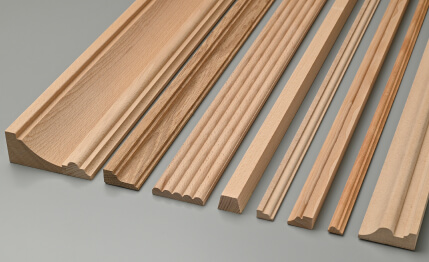
Moldings come in narrow (15–30 mm) — for fine graphics, medium (30–80 mm) — for decorative frames and wall panels, and wide (from 80 mm) — for boiserie, fireplace surrounds, architectural accents.
Our factory also produces:


What is a platband in wall application
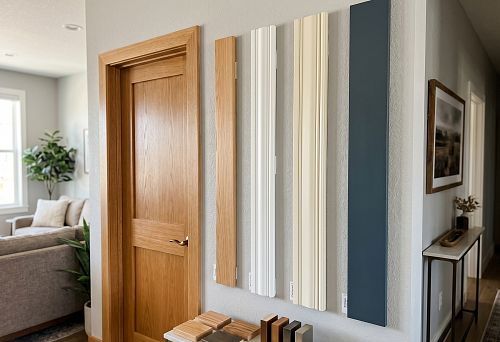
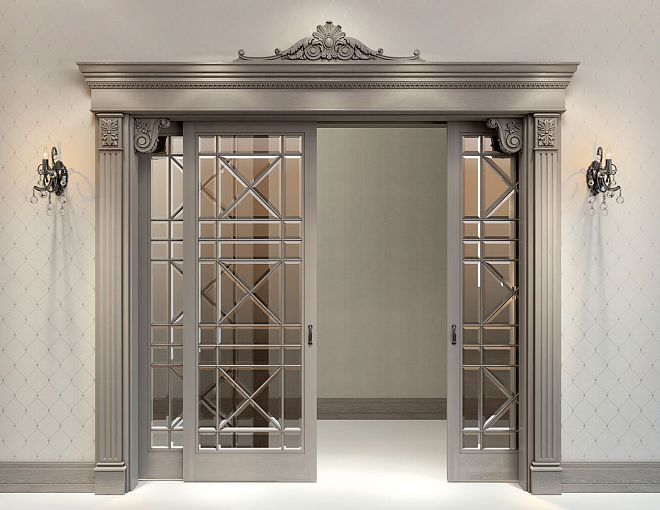
A platband is a profiled strip originally designed for framing door and window openings. But in interior decor, its application is broader: the platband is used as a frame element for accent zones, decorative panels, niches, and mirrors. When a platband is installed on a wall without an opening, it works as a "frame" that highlights a section of the surface.
The main difference between a platband and a molding is in the cross-section and function. A molding is a line, a border, an emphasis. A platband is a frame, the framing of a closed zone.
Get Consultation
Why they work together
In wall compositions, molding and platband often complement each other: the platband forms the outer frame of the panel, the molding forms the inner contour or additional division within the frame. Together, they create that very boiserie, wall panels with relief, which are associated with the French classical interior—and which, when executed skillfully, work perfectly in a modern context as well.
Wooden moldings for walls — how to choose a decorative profile— this material from STAVROS describes in detail the typology of profiles and their application, and it is worth studying alongside this article.
Where wooden platbands and moldings for walls are used
The list is much broader than one might assume.
Decorative panels and boiserie
This is a classic application—and perhaps the most impressive. The wall is divided into rectangular fields using platbands and moldings that form a frame. Inside the frame is a smooth or textured surface, fabric, wallpaper, or paint. Such a composition turns an ordinary wall into an architectural element of the interior.
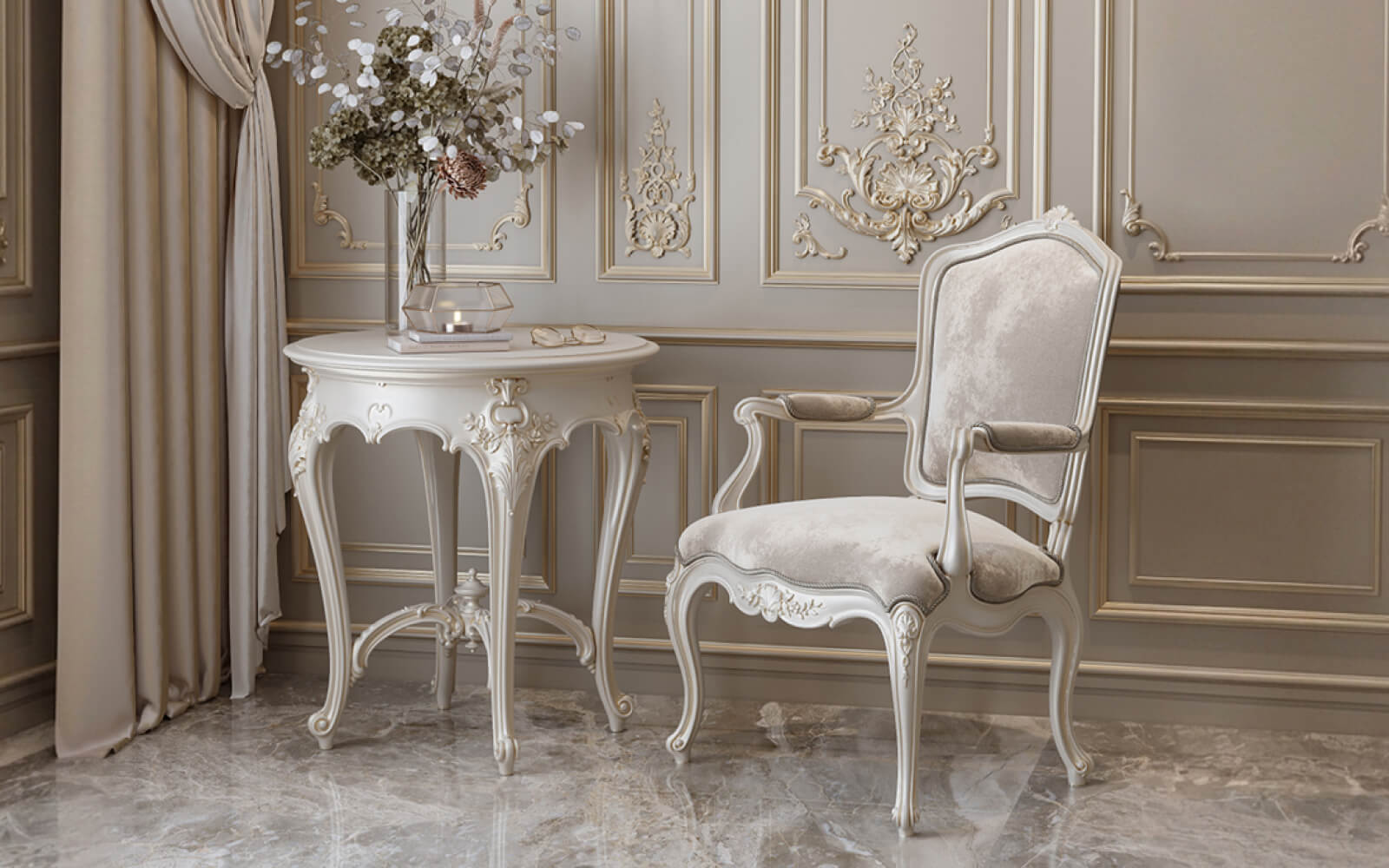
Boiserie is a French word for wooden wall cladding with decorative frames. In the Russian tradition, the equivalent is coffered walls with a set of profiled slats. In both cases, wooden moldings and trims for walls are the main tool.
Accent walls
One wall in a room is highlighted with color, texture, or decor. Wooden moldings on such a wall create additional relief, enhancing the accent without resorting to bulky structures. This works especially well in a bedroom behind the headboard.
Halls and Corridors
A corridor is a transit space where walls experience mechanical stress: impacts from moving furniture, hand touches, contact with bags. Moldings on the lower part of the wall (at waist level) protect it from damage and simultaneously create an interesting horizontal division.
Bedrooms
In a bedroom, wooden trims and moldings for walls create coziness and intimacy. Panel cladding on the lower part of the wall, frames around the headboard, vertical division of the wall behind the wardrobe are ways to add depth and individuality to the bedroom without rearranging furniture.
Living Rooms
The living room is the main public space of an apartment or house. Here, decorative wall decor made of wood creates a representative, lived-in character. Frames of moldings on the wall opposite the sofa, framing the TV area, decorative panels on either side of the fireplace are architectural solutions that make the living room expressive.
Classic Studies and Libraries
A study is a space of seriousness, concentration, and status. Walls clad with wooden frames of trims and moldings set exactly this tone. In a classic study, such design is perceived as the norm — without it, the wall would look unfinished.
What types of wooden moldings and architraves for walls are there
The variety of profiles is huge, but it can be organized into several logical categories.
Smooth (fascia)
A rectangular strip without relief. The most neutral option — ideal for modern interiors, Scandinavian style, minimalism. A smooth molding adds structure without decorative noise. Width: from 15 to 60 mm.
Profiled
A strip with one or more relief transitions: shelf, scotia, ogee, radius. This is the most common type — universal, suitable for classic, neoclassical, and moderately modern interiors. A profiled molding creates a play of shadows that makes the wall "alive."
Carved
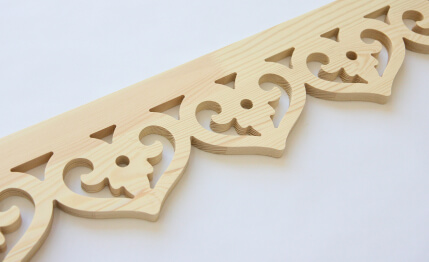
The ornament is applied to the surface of the strip by router or by hand.wooden moldings for furniture, walls, and ceilings — here you can see the assortment, including carved options for designer interiors. A carved molding is appropriate in interiors with a pronounced historical or designer character.
Narrow (15–30 mm)
A thin line on the wall. Used to mark boundaries, create a graphic pattern of straight lines, and divide the wall horizontally or vertically. In modern interiors, a narrow molding is one of the most sought-after tools.
Medium (40–80 mm)
Working width for most decorative tasks: frames on walls, boiserie panels, niche framing. At a width of 40–80 mm, the molding reads as an architectural element but does not yet overwhelm the wall.
Wide (from 80 mm)
Architectural molding with pronounced relief. Used for boiserie, fireplace framing, and large decorative panels. Requires high ceilings and a spacious room—in a small space, a wide molding will feel oppressive.
Laconic modern
Thin profile with minimal relief or geometric chamfer. Works perfectly in modern classic, japandi, and Scandinavian interiors. Here, wood is a delicate accent, not a dominant decor.
Classic decorative
Historical profiles: ogee, cyma reversa, astragal, cyma recta. These sections have been used in architecture for centuries—and that is why they are perceived as "correct" in a classical context.Wooden cornices and casingsA profile like this is an architectural detail with history.
How to choose moldings and architraves for walls according to interior style
Style is the main selection criterion. Not size, not color, not price — it is style that determines which profile will be appropriate.
Classic
Classic is the richest environment for wooden wall decor. Figurative profiles are appropriate here: ogee, reverse ogee, astragal, astragal with leaves. Architrave frames are divided into upper and lower fields — of different heights, with different profiles. A cornice completes the wall at the ceiling, a baseboard at the floor. All this forms a complete architectural shell of a classic interior.
Color — white, cream, ivory. Painting on wood. The profile is pronounced, with clear shadows. Molding width for decorative frames in classic style — from 50 mm.
Neoclassicism
Modern classic is more restrained, without unnecessary details. Profiles are cleaner: one or two relief transitions, without complex historical ornaments. Frames on the walls — but without division into small fields. Molding width — 35–60 mm.
Neoclassicism also allows the natural color of wood — oak or ash under oil on a white wall creates a modern and at the same time noble solution.
Art Deco
Geometry, symmetry, luxury without pomp. In Art Deco, wooden wall decor is built on regular rectangles, clear horizontals and verticals. Smooth fascias, geometric frames, minimum profile — but maximum precision. Dark wood species: stained oak, walnut, wenge.
Modern interior with wooden accents
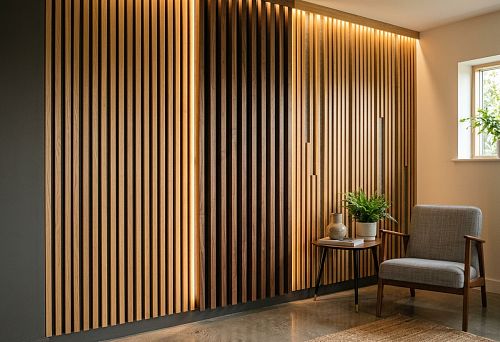
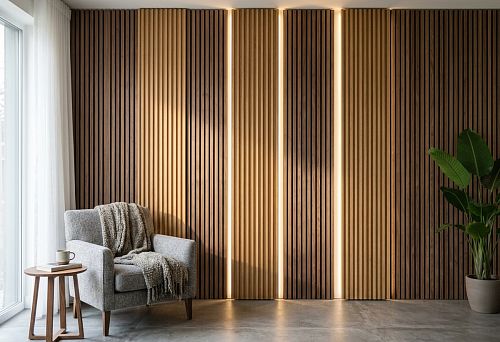
Here, wooden moldings work as a warm accent on a neutral background. A narrow molding (15–25 mm) creates fine graphics on a white wall. Wooden vertical slats form a rhythmic pattern — and at the same time do not overload the space.
Calm interior solutions without overload
For those who value coziness without decorative noise — smooth wooden molding 30–40 mm, simple rectangular frames, natural wood color. This is a solution that adds depth without pretension — and that is why it works in a wide variety of contexts.
How to choose by profile, thickness, and scale
Even the right profile can ruin the result if its scale doesn't match the room.
Narrow wall
A narrow wall — for example, the end wall of a small room — cannot tolerate wide moldings. A wide profile will visually compress it even more. Here, choose narrow moldings (20–35 mm) and only one frame — without splitting into multiple fields.
Tall wall
A tall wall (from 3 meters) is both an opportunity and a challenge. Horizontal division works well here: the lower field with a wider profile, the upper one with a narrower profile. This "breaks up" the wall vertically, making it proportionate to a person.
Large decorative fields
If large panel fields are created (height 1,500–2,000 mm, width 600–1,200 mm), a molding of sufficient width is needed so the frame is noticeable. A too-thin profile on a large field gets "lost" — the frame is not readable.
Thin relief vs. pronounced profile
This is a choice between delicacy and emphasis. A thin relief (profile height 8–12 mm) creates a subtle shadow — for bedrooms, studies, interiors in a restrained classic style. A pronounced profile (height 18–30 mm) is for formal living rooms, halls, interiors aiming for architectural grandeur.
How not to make a wall heavy
Three rules:
-
The total area of moldings and architraves should not exceed 15–20% of the wall area — otherwise the decor starts to "eat up" the surface;
-
There should be enough "breathing" space between the frames — at least 100–150 mm;
-
If the ceiling height is less than 2,800 mm, avoid wide moldings and full-height boiserie — work only with the lower field of the wall.
How to combine wooden architraves and moldings with each other
This is the most subtle topic — and it is here that mistakes are most often made. A beautiful result comes not from a single successful profile, but from the right system.
Frame + inner molding
Classic scheme: an outer frame made of an architrave (a wider profile), an inner molding along the perimeter of the field (narrow, delicate). Two levels of relief create a sense of depth that cannot be achieved with a single profile.
Example: a 60 mm architrave with a cyma profile forms the outer frame, and a 15 mm astragal molding forms the inner contour. The distance between them is 40–60 mm. This is a classic boiserie scheme that works flawlessly.
Vertical division of the wall
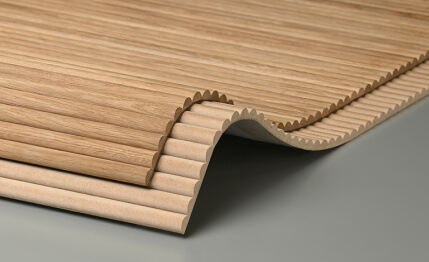
Vertical wooden slats or moldings create a rhythmic pattern on the wall — similar to wood panels, but in a lighter execution. The spacing between slats should be uniform. The width of the slat is 30–50 mm. This solution works well in bedrooms and hallways.
Rectangular panels
The wall is divided into rectangular fields using moldings. Each field is a complete unit. Fields can vary in height (upper narrow, lower wide) — this is a classic scheme. They can be identical — this is a more modern interpretation.
The aspect ratio of the rectangular field is important: the golden ratio (1:1.618) gives the most harmonious result. Square fields feel heavier. Vertically elongated fields "raise" the ceiling.
Symmetry and Rhythm
Symmetry is the foundation of any classic wall composition. The central axis of the wall should correspond to the symmetry of the fields, moldings, and casings. A door or window is the axis of symmetry from which the entire scheme is built.
Rhythm is more important than variety. Identical fields at identical intervals create a sense of order. Breaking the rhythm is only allowed if there is a design logic.
How to combine with doors, cornices, and baseboards
Wooden wall casings should be coordinated with door casings — not necessarily identical, but related in profile and width. The cornice at the ceiling and the baseboard at the floor complete the vertical system.Materials for finishing and millworkSTAVROS is precisely a system catalog from which you can select a coordinated set for the entire space.
Wooden wall frames: step-by-step logic for creating a panel composition
Practical section for those who want to create wall panels themselves or competently assign the task to an installer.
Step 1: Define the application area. The entire wall, the lower field (up to table or windowsill height), the accent area behind the sofa or bed — choose the format.
Step 2: Draw a diagram. Mark the axis of symmetry. Determine the number of fields. Calculate the width of each field and the intervals between them.
Step 3: Choose the profile. For a classic composition — a shaped casing 50–70 mm. For a modern one — a smooth or minimally profiled molding 30–40 mm.
Step 4: Determine the color. Matching the wall — the frames become a relief, not a color accent. Contrasting molding — the frames become a graphic element.
Step 5: Purchase the kit. Casings and moldings from the same series, one material, one coating. Reserve — 15%.
Step 6: Installation. Marking by level. Fastening with liquid nails or finishing nails. Filling joints with acrylic sealant matching the coating color.
Which materials are better: wood and its advantages
Several materials are available on the wall molding market: wood, polyurethane, plaster, MDF. Why wood?
Living texture and naturalness
Wooden molding is the only material with its own unique texture. Under a clear varnish or oil, the grain of oak, ash, or beech creates a visual depth that cannot be replicated synthetically. This is felt not only by the eye but also tactilely.
Durability
High-quality wooden molding made from hardwood—oak or beech—will last for decades without losing its shape or character. If damaged, it can be restored: sanded, repainted, or toned.
Ability to accept any finish
Wood can be painted, toned, varnished, oiled, or waxed. This gives complete freedom in choosing the final look—from natural light to dark stained, from matte to glossy.
Universality of Application
The same wooden molding can adorn walls, ceilings, and furniture—and look organic everywhere. This allows you to create a truly cohesive interior where all wooden details come from one system.
wooden moldings for furniture, walls, and ceilings— STAVROS's wide range allows you to choose molding for any task.
How wooden profile wins visually over polyurethane and plaster
Polyurethane and plaster are good imitators. But upon close inspection and tactile contact, wood always 'gives itself away'—in the best sense. Its weight, surface temperature, texture—all of this creates a different feel of space. Wooden molding is a warm interior accent, while polyurethane is a neutral element.
Mistakes when choosing and arranging moldings and trims on walls
Too complex profile on a small wall
The smaller the room, the simpler the profile should be. A shaped trim with a heel and ogee in a 12 sq. m room is overload. A smooth or minimally profiled molding of 25–35 mm is the right solution.
Too many frames
The desire to fill the entire wall with frames leads to the wall turning into packing cardboard. Decorative fields should breathe: the distance between frames should be at least 120–150 mm, and the total area of the molding should not exceed 20% of the wall area.
Mismatch in thickness
If moldings of different thicknesses (e.g., 8 mm and 20 mm) are mixed in one wall composition, the eye cannot focus on them. This creates a feeling of incompleteness. One wall — one level of relief, one profile thickness.
Incompatibility with baseboard and cornice
Wooden moldings on walls should be consistent in style with the baseboard and ceiling cornice. If the baseboard is simple and smooth, while the wall panels have ornate figured molding, it is a dissonance that is felt even without an architectural education.
Mixing different styles on one wall
A classic casing and a geometric molding in the Art Deco style are not eclecticism, but a conflict. The wall reads as inconsistent only when different style elements coexist randomly.
Practice: specific solutions for different rooms
Living room in neoclassical style
The lower field of the wall (height 900–1,000 mm) is decorated with rectangular panels made of 45 mm molding with a "heel" profile. The distance between frames is 150 mm. Above the molding is a horizontal dividing rail — a "belt". The upper part of the wall is smooth, painted. The color of all wooden elements is white enamel. Result: a classic, restrained, cozy living room.
Scandinavian-style bedroom
Wall behind the headboard: three vertical oak slats 30 mm wide, height from baseboard to ceiling, spacing 250 mm. Natural wood color with oil finish. Wall is white. No frames, only the rhythm of vertical lines. Result: calm, warm, modern.
Study in classic style
Wall behind the desk: the lower section (up to desktop height) is finished with square panels made from 70 mm profiled trim. Above — a horizontal belt. The upper part of the wall is smooth with bookshelves. Color — dark walnut. Result: representative, serious, with character.
Hall in a modern interior
Horizontal molding belt at a height of 1,000–1,100 mm around the entire perimeter of the hall. Below — textured wallpaper or a painted wall in a darker tone. Above — a lighter color. Molding — smooth, 30 mm, white. Result: visual expansion of space, feeling of a "high" ceiling.
Where to buy wooden moldings and trims for walls
Ready-made profiles from the catalog
The fastest way is to choose from the available assortment.wooden moldings for furniture, walls, and ceilings in the STAVROS catalog — a wide selection of profiles, wood species, and sizes in stock.
Kit for the entire space
To decorate an entire room, it's more convenient to order a set: wall moldings, baseboard, cornice, door trims — from the same series and material.wood trim itemsSTAVROS — a full range for assembling a coordinated system.
Why it's important to look not at an individual element, but at the system
One wooden molding bought without considering the other interior elements is a risk of mismatch. Thickness, profile, wood species, color — all of this must be coordinated in advance.How to assemble a complete door unit— the principle from this material also applies to wall panels: a system is always better than a set of random parts.
Custom order by profile
If a non-standard size or profile is needed, STAVROS manufactures according to a drawing or sample. This is relevant for restoration projects, designer interiors, and rooms with non-standard proportions.
Calculating the quantity: how to calculate the footage of molding for wall panels
The calculation is simple but requires attention.
For one rectangular frame:
Field perimeter = 2 × (height + field width). Add 10–15% to the perimeter for corner trimming.
For the entire wall:
Sum the perimeters of all frames + the length of dividing belts (if any). Add 15% reserve to the total.
Example: wall 4,000 × 2,700 mm, lower field 1,000 mm high, three rectangles 900 × 900 mm.
-
Perimeter of one frame: 2 × (900 + 900) = 3,600 mm = 3.6 m;
-
Three frames: 3 × 3.6 = 10.8 m;
-
Dividing belt at a height of 1,000 mm: 4.0 m;
-
Total: 10.8 + 4.0 = 14.8 m + 15% = ~17 linear meters.
FAQ: answers to the most common questions
What is better for walls: architrave or molding?
Depends on the task. Molding is better for dividing the surface and creating panel frames. Architrave is for framing specific areas: niches, openings, decorative inserts. Most often in wall compositions they work together.
Can I use both on the same wall?
Yes, and this is a classic solution. The casing forms the outer frame, the molding forms the inner contour or additional division.
Which profile should I choose for a small room?
A smooth or minimally profiled molding 20–35 mm wide. No shaped profiles with deep relief — they will overwhelm the space.
What to choose for a classic interior?
Shaped profiles with historical cross-sections: ogee, cyma recta, astragal, cyma reversa. Painting in white or cream. Two-level frames — lower and upper fields. Baseboard and cornice in matching profiles.
How to combine moldings with walls, doors, and ceiling?
Unified system: door casings and wall moldings — same series, same material. Cornice at the ceiling — a profile from the same system or harmoniously larger. Baseboard — in the same tones and related profile.
Do I need to paint wooden moldings on walls?
Not necessarily. Natural oak or ash under clear oil is a full decorative solution. Painting is appropriate for classic and neoclassical styles where all wood is white.
Which molding should I choose for an accent wall?
For an accent wall, one element is enough: either vertical slats or one large frame made of a 60–80 mm casing. There is no need to create a complex panel composition on an already highlighted wall.
How are wooden moldings attached to the wall?
Use liquid nails for lightweight profiles or finishing nails/screws with wall plugs for heavier ones. After installation, fill all joints with acrylic sealant matching the coating color.
Can wooden moldings be installed on wallpaper?
Yes, provided the wallpaper is well-adhered and not peeling. Glue the molding with liquid nails. On textured wallpaper, adhesion is worse — installation on a smooth painted or plastered surface is preferable.
Which wooden molding will not overload the interior?
A smooth fascia 20–30 mm in the color of the wall. This solution adds structure without decorative noise — you feel it but don't explicitly notice it.
STAVROS: a system of wooden decor for walls, doors, and the entire interior
When an interior requires a systematic wooden decor — moldings, casings, baseboards, and cornices from one material and in one style — STAVROS meets this demand with a full production range.
STAVROS produces wooden moldings and wall casings from oak, beech, pine, and other species — in a wide range of profiles: from smooth fascia to shaped classical sections. Standard items are in stock. Custom profiles and sizes are available by special order. A complete set of trim for an apartment or house — from one system, one manufacturer, without compromises in tone and profile.
Wooden wall decor is not just a single molding or a separate frame. It is a solution built systematically: from choosing the profile to coordinating with the door, baseboard, and cornice. This is exactly the approach practiced by STAVROS — and this is what distinguishes a result you want to show off from a result you want to redo.