Article Contents:
- What are decorative wall battens
- How battens differ from moldings, panels, and baseboards
- Why wooden battens are perceived as more expensive and warmer
- Where decorative battens are used in interior design
- Accent wall in the living room
- TV wall area
- Bedroom Headboard
- Hallway and corridor
- Kitchen-living room zoning
- Home office and commercial spaces
- What tasks do wall battens solve
- What materials are decorative slats made from
- Solid wood
- MDF
- Veneered slats
- When to choose oak and when beech
- How to choose decorative wall slats
- By width
- By thickness
- By length
- By wood species
- By finish type
- How to select slat size for a room
- For small rooms
- For high ceilings
- For narrow corridors
- For accent inserts
- Decorative slats and interior styles
- Modern style and minimalism
- Japandi
- Scandinavian Style
- Neoclassicism
- Loft
- Classic Interior
- Wall decoration ideas with decorative slats
- Vertical Layout
- Horizontal Layout
- Combination with a painted wall
- Lighting between slats
- Transition from Wall to Ceiling
- Niches and built-in zones
- Decorative slats for space zoning
- Entry Hall
- Kitchen and living room
- Work zone
- Relaxation zone in the bedroom
- Light compositions instead of partitions
- How to combine slats with other materials
- Installation of decorative slats on the wall
- Foundation Preparation
- Marking
- Spacing Between Slats
- Adhesive or hidden fasteners
- Mistakes during DIY installation
- Common mistakes when choosing slats
- How to care for wooden slats
- Cleaning
- Coating protection
- Humidity Regime
- In high-traffic areas
- Who are decorative wall slats suitable for
- What is important to know before purchasing
- FAQ: Answers to Popular Questions
- Conclusion
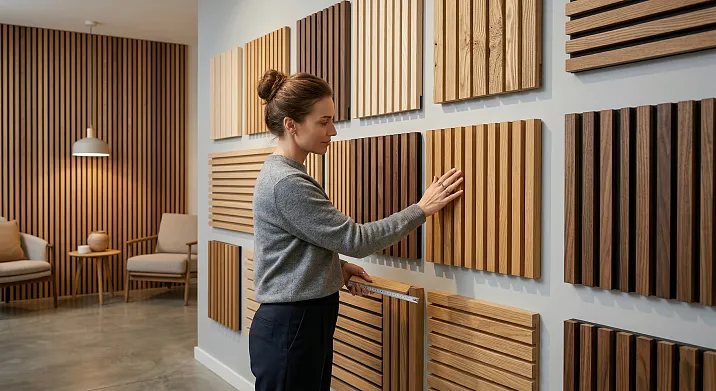
There are details that turn an ordinary renovation into a designer interior. One such detail isDecorative planks for walls in interior designThin vertical lines on an accent wall, a rhythmic pattern in the niche behind the TV, a neat arrangement at the head of the bed—all of this creates that very sense of thoughtfulness for which an expensive interior differs from simply a beautiful one.
Wall slats are not a new technique. Designers have been using it for several decades, but right now it is experiencing a real boom. The reason is simple: modern interiors are increasingly turning to natural materials, geometry, and texture. And wooden slats provide all of this at once—both natural warmth, clear rhythm, and visual depth.
In this article—a detailed guide to the selection, application, and installation of decorative wall slats. No fluff, just specifics.


What are decorative wall slats
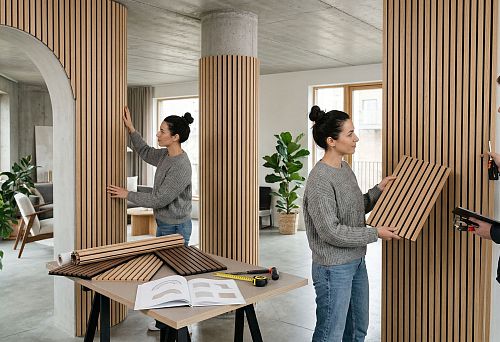
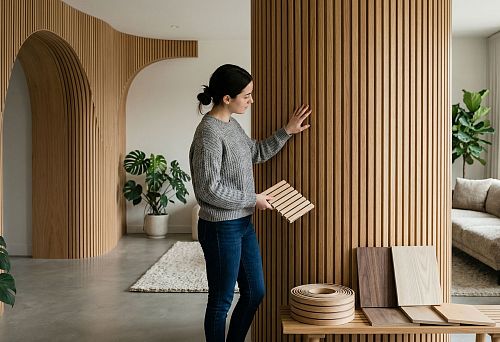
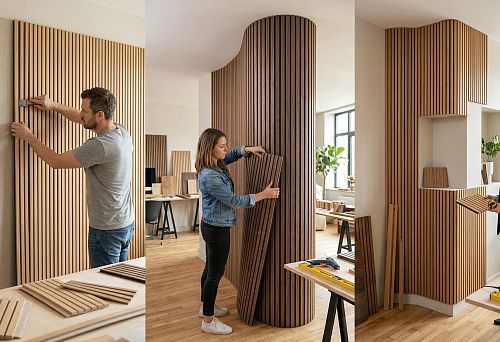
First of all—let's define the concept. A decorative wall slat in interior design is a narrow, linear element of rectangular cross-section that is attached to a wall surface (less often—a ceiling) at a certain interval, forming a rhythmic visual pattern. The slat does not bear a structural load—its task is purely aesthetic and functional-spatial.
This is precisely where the confusion begins, which costs many buyers extra money and disappointment.




How slats differ from moldings, panels, and baseboards
Wooden moldingsare profiled elements with a relief cross-section. They frame openings, create transitions, and emphasize architectural details. A molding always has a pronounced cross-sectional shape: concave, convex, stepped.
A slat is a rectangle. Pure, geometric, laconic. It is precisely this simplicity that makes it so versatile.
A wall panel is a flat or textured shield that covers a significant surface area. A batten, on the other hand, is a linear element; it does not cover the wall but complements it, creating a play of shadow and light between itself and the base.
A baseboard is installed at the junction of the wall with the floor or ceiling and serves a strictly functional purpose. A batten is purely decorative.
Understanding these differences allows you to correctly select an element for a specific task and avoid overpaying for what you don't need.
Our factory also produces:






Why wooden battens are perceived as more expensive and warmer
Natural wood is a living material. Even an enamel-coated oak batten retains a barely perceptible texture and tactile response that no synthetic analogue can imitate. In an interior, this reads as 'real'—and the human brain instantly interprets this signal as a sign of quality and cost.
MDF battens are cheaper, easier to install, and do not react to humidity. But to the touch, they are plastic. Under a glance with side lighting, they are lifeless. If the goal is to create an interior with character and a premium feel, the choice in favor of solid wood is inevitable.
Get Consultation
Where decorative battens are used in interiors
The question 'where to use battens?' is much better replaced with another: 'where are they inappropriate?'. The range of application is truly wide.
Accent Wall in Living Room
The living room is the main stage of the apartment. This is where battens work most effectively, especially on the wall behind the sofa or opposite the entrance. A vertical layout with a small pitch creates a rhythmic background that is perceived as an architectural element, not glued-on decor. If desired, the wall between the battens can be painted in a contrasting or similar tone—the effect will be multiplied many times over.
Area behind the TV
A TV wall requires a special approach. The battens here serve a dual function: they visually 'frame' the screen and simultaneously hide wires in the space between the batten and the wall. Often, strip lighting—warm or neutral—is added in this very area, illuminating the gaps between the slats to create depth.
Headboard in the bedroom
A bedroom requires a balance between coziness and style.Wooden Planks for WallsIn the headboard area, they replace or complement the bed's headboard, forming a soft background pattern. This looks especially beautiful in Japandi and Scandinavian styles—light battens on a light wall with a barely noticeable difference in tone.
Hallway and corridor
A narrow hallway is one of the most challenging tasks in apartment design. Vertical battens here work as a visual stretch: the gaze slides upward, making the space seem taller. At the same time, the battens can be placed only on one—the end—wall, which creates perspective and doesn't overload the already cramped space.
Zoning a kitchen-living room
An open floor plan requires clear zoning without physical partitions. A slatted wall is the perfect tool: it visually demarcates the space without taking away light or creating a feeling of tightness. The battens can be arranged vertically on the wall behind the dining area or form a half-partition between the kitchen island and the lounge area.
Cabinet and commercial spaces
In home offices, battens create a sense of concentration and structure. In restaurants, boutiques, and office meeting areas—they are read as a design standard.modern wooden moldingsSolid beech or oak here looks far more convincing than synthetic counterparts—and this is perceived by clients and visitors.
What tasks do wall battens solve?
Wooden slat room divider
Decorative wall battens are not just about beauty. They are a set of specific architectural tools.
Visual height extension. Vertical lines guide the eye to move from bottom to top. Even with a 2.6-meter ceiling, properly chosen battens create a sense of 3.2 meters in height. This is not magic—it's the geometry of perception.
Proportion correction. A wall that is too wide visually 'narrows' with a vertical layout. One that is too narrow 'expands' with a horizontal layout. Battens are one of the most subtle tools for spatial correction.
Creating rhythm and depth. Even spacing between battens forms a musical rhythm in the visual space. The wall ceases to be flat—it gains relief, a play of shadows, and liveliness.
Zoning without partitions. A batten wall is not a partition, but it functions as a boundary. Psychologically, a person reads it as a spatial marker: here begins another zone.
Masking joints and defects. Battens cover cracks, unevenness, transitions between different finishing materials. Especially relevant during partial renovations when not the entire apartment is being updated.
Forming a premium appearance. Battens made of natural wood instantly elevate the visual class of an interior. This works in both budget housing and commercial spaces where an impression needs to be made.
What materials are decorative battens made from?
The market offers three main material categories: solid wood, MDF, and veneered products. Each has its own advantages and limitations.
Solid wood
Solid or laminated wood offers maximum tactile quality, pronounced texture, and durability. An oak solid wood batten literally glows from within under side lighting—the fiber texture creates a soft volume that cannot be reproduced synthetically. The downside is a higher price and sensitivity to sharp humidity fluctuations.
MDF
Affordable material, easy to paint, does not deform under normal humidity changes. Ideal for enamel — smooth surface provides flawless coating. However, not suitable for MDF tinting: no texture, no surface pattern, wood imitation looks artificial.
Veneered slats
Compromise between solid wood and MDF: base made of technical wood or MDF, front surface — natural veneer of valuable wood species. Visually indistinguishable from solid wood under proper lighting. Maintain geometry well. But if mechanically damaged, the veneer cannot be restored.
When to choose oak, and when beech
Oak — more pronounced texture, dark veins, noble 'heaviness' in perception. Works well in interiors with warm palette, with leather, metal, concrete. Beech — softer in texture, lighter, more neutral. It is organic in Scandinavian and Japandi style, where lightness and airiness are needed.Wooden Rail RK-001from STAVROS is available in these two species — oak and beech — with enamel or tinting finish, allowing to choose an option for any concept.
How to choose decorative wall slats
Choosing slats is not an intuitive process. It's a calculation based on room parameters, style, and task.
By width
Width is the main parameter determining the visual weight of the slat. Narrow slats 15–25 mm create a light, airy rhythm — ideal for minimalism and Japandi. Slats 30–50 mm give a more pronounced pattern, suitable for classic and neoclassic. Elements wider than 60 mm are closer to cladding than to decorative accent.
For standard apartments with ceilings 2.7–3 meters high, the optimal slat width is 20–40 mm. This is the gold standard that works in most situations.
By thickness
The thickness of the slat determines the depth of the shadow and the volume of the wall relief. Thin slats of 8–12 mm create a flat, barely noticeable pattern. A thickness of 15–20 mm provides a well-defined shadow under side lighting. Over 25 mm results in a pronounced volume that can compete with furniture.
By length
The standard length is 2000–3000 mm. For rooms with ceiling heights up to 2.7 meters, a two-meter slat is sufficient. For ceilings 3 meters and higher, an element of corresponding length is needed—or a joint, which must be carefully planned.
By wood species
As already mentioned—oak or beech. But there are nuances: oak is heavier, denser, and requires more powerful fasteners for long spans. Beech is easier to work with and maintains its geometry better under temperature changes.
By finish type
For enamel—the slat is primed and painted in the desired color. The surface is smooth, matte, or glossy. Perfect for modern and neoclassical interiors.
For tinting—the natural wood grain is accentuated with stain or oil. Suitable for Japandi, Scandinavian style, and loft with wooden accents.
How to choose the right slat size for a room
This is perhaps the most common question asked by designers and buyers. And the correct answer always starts with taking measurements.
For small rooms
In a room up to 15 sq. m., slats should be light — no wider than 25 mm, with a spacing of 40–60 mm. An accent wall made of thinwooden slats for interior finishingdoes not weigh down the space, but on the contrary — structures it, making it feel more organized.
A major mistake is using wide slats of 50–70 mm for a small room. The wall turns into a fence, and the space feels compressed.
For high ceilings
With ceilings above 3 meters, slats can be wider and more substantial — 30–50 mm. The distance between elements can be reduced, forming a dense rhythmic grid. This adds grandeur and 'fills' the vertical space.
For narrow corridors
Here, the principle of one wall applies. Slats on the end wall — narrow, vertical, with small spacing. This creates perspective and visually elongates the corridor. It's better to leave the side walls neutral.
For accent inserts
In niches, openings, behind the TV, slats can be any size — space is limited here, and going beyond standard parameters is acceptable. Often in such areas, 20×40 mm slats with 30–50 mm spacing are used — this creates a dense textured surface without a sense of overload.
Decorative slats and interior styles
There is no style where slats would be inappropriate. But in each style, they work differently.
Modern style and minimalism
Thin slats under enamel in the color of the wall — or slightly lighter. Even rhythm, uniform spacing. No decor, only geometry. This works precisely because a monochrome wall with a barely perceptible relief creates a restrained, expensive feel.
Japandi
Natural beech without painting, light tinting in gray or warm ash. Narrow slats 15–20 mm, spacing 40–50 mm. Integrated lighting — warm white. Specifically for this stylethin wooden slats and minimalismdeliver maximum effect: simplicity of forms creates an expensive interior.
Scandinavian style
Light slats made of ash or beech, white or light gray walls, unobtrusive rhythm. Here, slats are perceived as an element of 'nature in the home'. Horizontal layout in the kitchen area adds calmness and stability.
Neoclassicism
In neoclassicism, slats are combined withwooden moldingswith cornices, baseboards. They can be part of a more complex composition: vertical slats between molding frames create a paneled wall effect—a classic technique of English mansions.
Loft
Dark tinting, pronounced texture, wide spacing between slats. In a loft, slats can be combined with metal, brick, concrete. Oak with a 'walnut' or 'wenge' stain is the perfect option for this style.
Classic interior
Wide slats for enamel in the wall color, integrated into a system of molding frames—this is classic in the literal sense. This technique was used as early as the 18th century for cladding palace halls.
Ideas for wall decoration with decorative slats
This is where the most interesting part begins—application options that turn slats into a design tool, not just 'glued-on planks.'
Vertical layout
A classic of the genre. Slats run from floor to ceiling, forming a strict vertical rhythm. This works in any style and any room. The key is the correct spacing.
Horizontal layout
A less obvious but very effective technique. Horizontal slats visually expand the space and add a sense of stability to the area. Works well in an open-plan kitchen-living room in the dining zone.
Combination with a painted wall
Slats are attached to a painted wall, creating color and texture contrast. Dark wall + light slats—this is classic high contrast. Light wall + tinted slats—a soft, nuanced technique.
Lighting between slats
LED strip behind the slats or built into a niche—one of the most effective techniques. In the evening, the wall begins to 'breathe' with light. With warm lighting, the wood acquires an amber hue; with neutral lighting, the fiber texture is emphasized.
Transition from wall to ceiling
The slats transition from the wall to the ceiling without a break — this creates an effect of continuous space. Especially relevant for small rooms: the volume appears larger, the ceiling — higher. For this, they usewood trim items with the same cross-section so that the transition looks organic.
Niches and built-in zones
Decorating a niche with slats is one of the most popular techniques. The slats cover the back wall of the niche, creating a textured background for shelves. With added lighting, the niche turns into a full-fledged display area.
Decorative slats for zoning space
Zoning is one of the most in-demand tasks in modern apartments with open floor plans. And slats handle it more elegantly than most alternatives.
Entryway
Even in a small hallway, a slatted wall (or a fragment of it) clearly marks the 'entry point' and sets the tone for the entire interior. Slats on the end or side wall form the first impression — and it, as we know, is the strongest.
Kitchen and living room
The boundary between the kitchen and living areas is a risk zone. Here it's important to create a visual barrier without blocking the light. A slatted 'wall' made of wide vertical elements with gaps solves this task perfectly: the space is divided but not enclosed.
Work zone
Slats on a desk or in an office area serve as a psychological boundary. They 'tell' the brain: this is work, this is concentration. One accent wall with wooden slats can turn a corner of the living room into a full-fledged home office.
Rest area in the bedroom
In the bedroom, slats behind the headboard create a separate 'island'—an intimate rest area. Especially relevant for spacious bedrooms where the bed doesn't lean against a wall: a slatted panel provides visual support.
Lightweight compositions instead of partitions
Slats for zoning space—is an alternative to solid partitions where there's no possibility or desire for major renovations. A slatted screen on a metal frame, a freestanding slatted structure—it's easy, beautiful, and reversible.
How to combine slats with other materials
Slats rarely exist alone in an interior. They always interact with other surfaces—and here it's important to build the right combinations.
Paint. The most accessible background. Slats on a painted wall work with any combination. Monochrome or contrast—both options are viable.
Veneer. Slats on a veneered wall—a complex, sophisticated technique. It's important that the textures don't compete. Either slats from the same wood species or a contrast in tone.
Stone and decorative plaster. Natural stone or concrete plaster + wooden slats — this is a bipolar rhythm that works in loft and modern styles. Wood softens the rigidity of stone.
Soft panels. The combination of soft upholstered panels and wooden slats is a fashionable technique in bedrooms. Softness + structure, coziness + geometry.
Glass and metal. In commercial interiors, slats often neighbor metal frames and glass partitions. Wood here brings warmth, 'enlivens' cold high-tech.
Installation of decorative slats on the wall
Installation quality is what distinguishes a professional result from an amateur one. There are no small details here.
Foundation Preparation
The wall must be level, dry, and clean. Any irregularities exceeding 3 mm are a problem, especially with vertical layout: the slat will 'float' and disrupt the unity of the pattern. If the wall is uneven, it is leveled with putty or the slats are mounted on a frame.
Marking
Marking is the most critical stage. A laser level is used. The first slat sets the direction for the entire composition: the slightest deviation will multiply by the number of elements.
Spacing between battens
The optimal spacing depends on the width of the slat and the task. For narrow slats of 20 mm, a spacing of 40–60 mm gives a light rhythm. For slats of 30–40 mm, a spacing of 50–80 mm is more spacious. The rule: the spacing should be a multiple of the slat width or the gap width — this creates a harmonious proportion.
Adhesive or hidden fasteners
Two approaches to installation:
-
Liquid nails / construction adhesive — fast, reliable, but removal is difficult. Ideal for lightweight slats of small length.
-
Hidden fasteners with screws — more durable, allows replacement of individual elements. Requires precise marking.
For solid oak slats over 1.5 meters in length, a combination is recommended: adhesive + screw with plug at the top and bottom points.
Errors during self-installation
-
Not checking the vertical alignment of each slat — result: a 'diverging fan' pattern.
-
Gluing without primer — slats fall off after a year.
-
Not accounting for thermal expansion — slats deform seasonally.
-
Not calculating the number of elements in advance — end up with a 'cut-off' pattern at the wall edge.
-
Installing without a template for spacing — gaps become uneven.
Common mistakes when choosing slats
The best way to avoid a mistake is to know about it in advance. Here's a list that will save you money and nerves.
Too massive slats for a small room. A 50×30 mm slat in a 12 sq. m. room is a disaster. The space will shrink and the wall will turn into a fence. The rule: the smaller the room, the thinner and narrower the slat.
Inappropriate spacing between elements. Too frequent spacing creates a 'grille', too sparse creates chaotic single planks. Neither creates the desired effect.
Ignoring the overall style of the room. Dark oak slats with pronounced texture in a white minimalist interior create dissonance. Every element should continue the visual language of the space.
Incorrect choice of wood shade. The tone of the slat must be selected in conjunction with the floor, doors, and furniture. If the floor is light oak, a dark walnut slat will create conflict. The solution is to choose a tone 1–2 shades lighter or darker than the floor.
Poor wall preparation. Any stains, grease marks, peeling paint are enemies of the adhesive. Installation without preparation means redoing it in six months.
Excess of slats in the interior. When slats are everywhere — in the living room, hallway, bedroom, kitchen — they cease to be an accent. The principle works: no more than one or two accent surfaces with slats in the entire apartment.
How to care for wooden slats
Natural wood is a living material, and this requires a certain operating regime.
Cleaning
Slats under enamel are cleaned with a slightly damp cloth. Slats under tinting or oil — only with a dry or barely damp cloth. Aggressive detergents, solvents, abrasives are prohibited.
Coating Protection
It is recommended to renew the coating every 2–3 years: tint or oil. Enamel is more durable, but requires spot touch-ups if chipped.
Moisture Regime
Optimal air humidity for wooden slats is 40–60%. Excessive dryness causes wood to crack. Excess moisture causes deformation. This is especially relevant near heating radiators: it's better to move slats away from direct heat flow.
In high-traffic areas
In corridors and hallways, slats are subject to mechanical impact. It's better to choose harder wood species — oak, ash — and enamel finish: it withstands accidental impacts better.
Who decorative wall slats are suitable for
Decorative slats are a universal solution, but different user categories value them differently.
Apartment owners get an accessible tool for interior transformation without major renovation. An accent wall made of slats — one day of work and years of results.
Interior designers value slats for predictable results and wide range of applications. Solid wood slats are a material with character that doesn't require complex technical manipulations.
Architects use slats as a tool for architectural accent: creating rhythm, defining proportions, playing with light.
Renovation studios value slats for their quick installation and obvious visual result: the client immediately sees the transformation.
Commercial properties—restaurants, boutiques, hotels, offices—use slats as a branding tool: natural materials create a sense of attention to detail that customers instantly perceive.
What to know before buying
Buying slats is not an impulsive choice. Here is a checklist to help you avoid mistakes.
Define the task. Zoning, accent, decor, concealment—each task has its own slat parameters.
Measure the wall. Height, width, presence of niches, outlets, protrusions—all this affects the calculation of quantity and spacing.
Choose the material. Solid wood—for premium results. MDF—for painting in budget projects.
Decide on the finish. For enamel or for tinting—these are different processes and different final appearances.
Order with a surplus. At least 10–15% extra for breakage, fitting, and marking errors.
Check the geometry of the product. Straight edges, precise cross-section, absence of warping—these are signs of a quality product. A slat with even a slight bend will ruin the entire wall plane.
FAQ: Answers to popular questions
What are decorative wall slats in interior design?
These are narrow, rectangular-section molding elements made of wood or MDF, attached to the wall at a set interval to create visual rhythm, zoning, or accent decoration.
Why are wooden slats better than MDF?
Natural wood has a living texture, tactile quality, and durability. MDF does not work at all for tinting. In premium interiors, solid wood is irreplaceable. MDF is only good for enamel in budget solutions.
Where is it better to use slats — in the living room, bedroom, or hallway?
Everywhere — but with different logic. In the living room — an accent wall. In the bedroom — behind the headboard. In the hallway — a vertical visual accent on the end wall.
What size slats are suitable for a small room?
For rooms up to 15 sq. m — width 15–25 mm, spacing 40–60 mm. Thickness — no more than 12–15 mm.
Can slats be used for zoning?
Yes — this is one of their key applications. A slatted wall or half-partition visually separates zones without blocking light.
How to attach battens to a wall?
Liquid nails for light, short battens; a combination of adhesive and hidden fasteners for long, massive elements. Preliminary level marking is mandatory.
What is considered the optimal spacing between battens?
Equal to the width of the batten itself or 1.5–2 times the batten width. A spacing smaller than the batten width creates a dense texture; a spacing of 2–3 times the width creates a light, airy rhythm.
Can wooden battens be painted?
Yes. Battens for enamel are primed and painted. Solid wood battens are also suitable for tinting — with stain or oil.
Which interior styles best combine with battens?
Almost all: minimalism, Japandi, Scandinavian, neoclassical, loft, contemporary. In each case — its own format and finish.
How to care for wooden panels?
Wipe with a dry or slightly damp cloth. Renew the coating every 2–3 years. Maintain air humidity at 40–60%. Avoid direct heat exposure.
Conclusion
Decorative wall battens are not a trend that will disappear with the next season. They are an architectural tool, tested for centuries and reinterpreted by modern design. They work because they meet a basic human need — to see order, rhythm, and warmth in a space. Vertical lines of natural wood provide all of this at once.
Correctly chosenwooden elements for wall finishingtransform an ordinary room into a space with character. It's not expensive — if you know what to choose. It's not difficult — if you understand the logic.
The company STAVROS offersdeorative solid wood battens— made of oak and beech, in two finish options (for enamel and for tinting), with precise geometry and high-quality surface treatment. The RK-001 batten is a proven solution for those who want not an imitation, but real wood. In the STAVROS catalog, you will find not only battens but the entire rangewood trim— moldings, baseboards, cornices, corner pieces — everything you need to create a cohesive, well-thought-out interior with natural materials.
When a detail is made of real wood — you can feel it. Always.