Article Contents:
- The philosophy of decorative molding: why complicate the simple?
- Relief as a play of light
- Space structuring
- Historical context and cultural code
- Typology of decorative elements: a dictionary of forms
- Appliqués: accents and detailing
- Medallions: round accents
- Corner elements: finishing joints
- Borders and friezes: horizontal divisions
- Corbels and Brackets: Function and Decoration
- Cartouches: frames for inscriptions and images
- Pilasters and Half-columns: Vertical Accents
- Application strategies: from point accents to continuous decor
- Minimalist approach: one accent
- Moderate approach: panels and frames
- Maximalist approach: total decor
- Wall molding: techniques of compositional solutions
- Symmetrical panel composition
- Asymmetric composition with a focus
- Vertical division with pilasters
- Horizontal division with a border
- Color and texture: painting molding
- Monochrome painting: molding in the color of the wall
- Contrast painting: white molding on a colored wall
- Gilding and Patination
- Color Moldings
- Material matters: polyurethane versus alternatives
- Polyurethane vs. gypsum
- Polyurethane versus polystyrene foam
- Polyurethane vs. Wood
- Installation: from wall to finishing
- Surface Preparation
- Composition marking
- Adhesive Application and Installation
- Joint sealing
- Painting
- Stylistic contexts: from classicism to futurism
- Classicism: measure and harmony
- Baroque: theatricality and excess
- Modern: Natural Lines and Asymmetry
- Art Deco: Geometry and Luxury
- Neoclassicism: modern classic
- Scandinavian style with classic
- Frequently Asked Questions
- Can polyurethane molding be installed over wallpaper?
- What is the adhesive consumption for a standard room?
- How does molding affect room acoustics?
- Can molding be painted multiple times?
- How to Care for Moldings?
- Is molding compatible with underfloor heating and heated walls?
- Can Moldings Be Used in a Children's Room?
- How long does it take to decorate a room with molding?
- How does molding affect property value?
- Conclusion: architectural language is accessible to everyone

What transforms bland wall and ceiling planes into living, breathing surfaces? What makes one stop, look closer, and admire the craftsmanship?Decorative stucco— that is the answer to this question. Not just decoration, not a random addition to the interior, but an architectural language through which space tells its story. Relief, rhythm, ornament, symmetry—these components turn an apartment into a work of art, where every detail matters, where nothing is accidental. ModernDecorative polyurethane moldingopens access to this language for a wide audience. What was once the privilege of palaces and mansions is now available in an ordinary city apartment. Lightweight, durable, moisture-resistant, easy to install, affordable price—polyurethane has solved all the historical problems of plaster molding while preserving its aesthetics. How to use this tool wisely? What elements exist, where to apply them, how to combine them? Let's dive into the world ofMoldings decorationin all its multifaceted nature.


Philosophy of decorative molding: why complicate the simple?
Minimalism teaches us that beauty lies in simplicity. Empty walls, smooth surfaces, absence of excess. But humans are built differently. We need details that catch the eye, where the gaze can pause, rest, latch onto. An absolutely smooth wall is a visual desert. After a week, it stops being perceived, becomes a background the brain ignores.Polyurethane decorative molding for wallscreates that very richness of detail that makes space interesting to perceive.




Relief as a play of light
A flat painted wall reflects light uniformly. It looks the same in the morning, afternoon, evening—static, unchanging. A wall withdecorative polyurethane elementslives its own life. Morning oblique light creates long shadows in the recesses of the relief, emphasizing volume. Daytime diffused light softens contrasts, the relief becomes delicate. Evening artificial lighting, especially spot lighting, creates dramatic shadows, enhancing expressiveness. The same wall looks different depending on the time of day and type of lighting. This is dynamics that enlivens the interior.
Our factory also produces:


Pilasters divide walls into vertical sections, create rhythm, organize space. Positioned around the perimeter of rooms, they form an architectural frame. Framing door and window openings, they emphasize the importance of these elements. Highlighting fireplaces, niches, panels, they transform them into focal points. A pilaster is a vertical accent that sets scale, proportions, and rhythm.
An empty wall gives the eye no reference points. Where is its center? Where are the boundaries? How does it relate to the furniture?polyurethane decorative elementsstructure the wall, give it logic. Moldings create frames that define zones. Appliques mark composition centers. Borders draw horizontal lines, dividing the wall by height. A structured wall is perceived as thoughtful, organized, professionally designed.
Get Consultation
Historical context and cultural code
Molded decor carries a cultural code. Acanthus leaves refer to antiquity, to Greece and Rome, to the cradle of European civilization. Lush Baroque ornaments recall the royal palaces of the 17th-18th centuries. Geometric Art Deco elements—to the era of jazz and skyscrapers in the 1920s-30s. By usingpolyurethane decorative elements, we are not just decorating a wall, we are integrating it into a historical and cultural context, making it part of a larger narrative.
Typology of decorative elements: a dictionary of forms
Decorative elements made of polyurethane—is an extensive family of products, each with its own purpose and application area.
Appliqués: accents and detailing
Appliques—compact individual elements with relief ornamentation, ranging from 5×5 cm to 60×80 cm. This is the most numerous and diverse category ofpolyurethane decorative elements.
Applique formats vary. Square appliques 8×8 cm, 12×12 cm, 20×20 cm—symmetrical elements for creating rhythmic rows or grids. Vertical rectangular 10×30 cm, 15×40 cm—for vertical compositions that visually elongate space. Horizontal rectangular 30×10 cm, 40×15 cm—for horizontal friezes encircling a room. Round and oval with diameters from 10 to 50 cm—medallions, rosettes, creating focal points. Corner—special L-shaped for decorating corners of molding frames.
Applique ornaments cover all styles. Floral—acanthus leaves, grape clusters, roses, laurel wreaths. Geometric—meanders, braids, chevrons, diamonds. Figurative—putti (winged infants), mascaron (faces), animals, mythological creatures. Abstract—scrolls, volutes, spirals.
The application of appliques is diverse. In the center of panels formed by moldings on the wall—a central applique creates a focal point. In the corners of such panels—corner appliques decorate molding joints, enhancing decorativeness. Above door and window openings—horizontal applique-friezes create architectural framing. On furniture fronts—small appliques (10-15 cm) turn a smooth facade into a decorated one. On fireplace mantels—large appliques (40-60 cm) emphasize the significance of the fireplace as the room's center.
Medallions: round accents
Medallions are large round or oval overlays (30-80 cm in diameter) with rich ornamentation. Unlike small overlays, a medallion is a self-sufficient element that works solo, requiring no additions.
A central medallion on the wall above the sofa in the living room replaces a painting or panel, creating a classic accent. A medallion above the headboard in the bedroom is a symmetrical element that establishes the room's axis. A medallion on the ceiling is an alternative to a ceiling rose for a chandelier in spaces where a chandelier is absent but ceiling decor is desired.
Medallion ornamentation is typically concentric—the pattern radiates from the center to the edges. Classical medallions feature laurel wreaths, acanthus, and rosettes. Baroque ones have lush garlands, putti, and mascaron. Modern ones feature simplified geometric concentric circles.
Corner elements: finishing joints
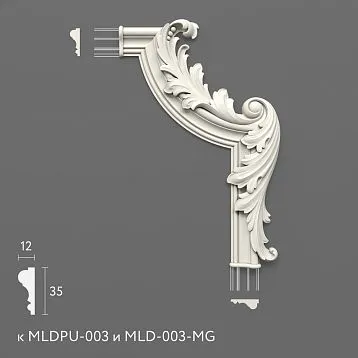
Corner elements are specialized L-shaped overlays for installation in corners. Sizes range from 5×5 cm to 20×20 cm (size is indicated for one side of the corner).
Internal corner elements are installed in the corners of molding frames on the wall. The molding forms a rectangular frame, with corner elements glued in its four corners. This creates completeness and elegance, eliminating the need for precise 45-degree miter cuts of the moldings (moldings join at a right angle, and the corner element covers the joint).
External corner elements are installed on external wall corners (in room corners, on pilasters, columns). They protect the corner from damage while simultaneously decorating it.
Borders and friezes: horizontal divisions
A border is a narrow linear element (3-10 cm in height) running horizontally along the wall. A frieze is a wider element (10-30 cm in height) with developed ornamentation.
A border at 2/3 of the wall height (approximately 180-200 cm from the floor) visually divides the wall into two parts—lower and upper. Below the border, the wall can be painted one color; above, another. Or below—wallpaper, above—paint. The border creates a visual boundary, structuring the vertical space.
A frieze under the ceiling (20-40 cm from the ceiling) creates a horizontal ornamental strip encircling the room's perimeter. This is a characteristic element of classical interiors, especially Empire and Neoclassical styles.
Ornaments of borders and friezes are rhythmic and repetitive. Meanders (broken lines forming rectangular scrolls), palmettes (stylized fan-shaped leaves), dentils (tooth-like elements), egg-and-dart (egg-shaped elements with arrows).
Consoles and brackets: function and decor
A console is a projecting element fixed at one end to the wall, with the other end free. A bracket is the same but with additional support from below. Consoles and brackets can be functional (supporting a shelf, cornice, beam) or purely decorative.
A decorative console under a shelf creates the impression that the shelf is supported by an elegant carved element, even though it is actually held by hidden fasteners. The console adds classic nobility to a simple shelf.
Consoles under ceiling beams (if decorative beams are used in the interior) create visual support, mimicking structural logic. The beam appears not to be hanging in mid-air but resting on consoles, which is architecturally correct.
Console ornamentation—plant scrolls, acanthus, volutes. Console sizes vary from 10×15 cm to 30×50 cm depending on the scale of the element they 'support'.
Cartouches: frames for inscriptions and images
A cartouche is a decorative frame of oval or shield-like shape, often with ornamentation around the perimeter and a smooth central field. Historically, cartouches were used to place coats of arms, monograms, inscriptions.
In modern interiors, a cartouche can frame a small mirror, a family coat of arms (if available), the owners' initials, a commemorative inscription. A cartouche also works as a standalone decorative element—installed on the wall without filling the central field, creating an elegant accent.
Cartouche sizes range from 20×30 cm to 50×70 cm. Ornamentation—Baroque scrolls, rocaille (shell-like ornament), garlands.
Pilasters and half-columns: vertical accents
A pilaster is a flat vertical projection of rectangular cross-section, imitating a column but not freestanding, rather attached to the wall. A half-column is half a column, also attached to the wall.
A pilaster consists of three parts: capital (upper part with ornamentation), shaft (vertical central part, smooth or with fluting—vertical grooves), base (lower part, support).
Polyurethane pilasters and half-columns are used for vertical wall division, creating rhythm, framing door and window openings, highlighting the fireplace area. Pilaster height from 150 to 280 cm, width from 10 to 25 cm.
Application strategies: from accent points to full decor
Decorative polyurethane moldingcan be used sparingly or abundantly, depending on the desired effect and interior style.
Minimalist approach: one accent
In modern interiors where restraint is valued, molding is used sparingly—one or two elements for the entire room. A central ceiling rose for the chandelier—and that's it. Or a medallion above the sofa on an accent wall—the only decorative element. This approach creates a subtle hint of classicism without overloading the space.
Effect: modernity with a light touch of classicism, elegance without pretentiousness, airiness with a detail that catches the eye.
Moderate approach: panels and framing
More active use—creating wall panels using moldings. The wall is divided by moldings into rectangles (usually 3-6 panels per wall), inside the panels—contrasting wallpaper, paint, plaster. At the panel corners—corner overlays, in the center of some panels—central overlays. The ceiling is decorated with a perimeter cornice and a central rose.
Effect: classic elegant interior, structured, rich in details, but without excess.
Maximalist approach: total decor
Historical styles (Baroque, Rococo, Empire) require abundant decor. Walls are covered with molding panels, each panel has overlays. The frieze under the ceiling encircles the room. Pilasters divide the walls into vertical sections. Door and window openings are framed with ornamented architraves. The ceiling has a cornice, a rosette, possibly coffers with additional rosettes. The fireplace (if present) is adorned with a portal featuring columns, consoles, and a frieze.
Effect: luxury, formality, museum-like quality, palatial atmosphere. Suitable for spacious rooms with high ceilings (from 3.5 m), in compact spaces it will create a feeling of overload.
Wall molding: techniques of compositional solutions
The wall is a canvas on whichPolyurethane decorative molding for wallscreates a composition.
Symmetrical panel composition
A classic technique is dividing the wall into symmetrical panels. For a wall 4 meters wide: three vertical panels approximately 120-130 cm wide each, separated by vertical moldings. The panels are positioned at a height from 30-50 cm from the floor to 200-220 cm (not up to the ceiling, leaving an upper strip of wall). Inside the panels — wallpaper with a classic pattern (damask, stripe, monograms). At the corners of each panel — corner overlays measuring 10×10 cm. In the center of the middle panel (central on the wall) — a medallion with a diameter of 40 cm.
Effect: strict classical elegance, rhythm, structure. Suitable for living rooms, studies, libraries.
Asymmetrical composition with a focal point
A modern approach — asymmetry with highlighting a focal zone. On an accent wall (e.g., behind a sofa), one large panel of moldings measuring 150×120 cm is created, shifted from the center of the wall to the left or right. Inside the panel — contrasting coloring (if the wall is white, inside the panel — gray). In the center of the panel — a large overlay or medallion. The rest of the wall remains smooth.
Effect: dynamism, modernity, accent without overload. Suitable for modern and eclectic interiors.
Vertical division with pilasters
For rooms with high ceilings (from 3.0 m) — vertical division of the wall with pilasters. At the corners of the room and at intervals of 120-150 cm along the length of the wall, polyurethane pilasters are installed from floor to ceiling (or up to the frieze, if present). Pilasters create a vertical rhythm, visually elongating the space upward. Sections are formed between the pilasters, inside which there can be molding panels, mirrors, paintings.
Effect: monumentality, classical architectural quality, grandeur. Suitable for formal halls, lobbies, large living rooms.
Horizontal division with a border
The wall is divided horizontally by a border at 2/3 of the height (approximately 180 cm from the floor). The lower part of the wall (from the floor to the border) is painted a dark color or covered with dark wallpaper. The upper part (from the border to the ceiling) — light paint or light wallpaper. The border — contrasting (e.g., gold at the junction of the dark bottom and light top).
Effect: visual expansion of the room (dark bottom grounds, light top lightens), classical proportionality. Suitable for dining rooms, living rooms, corridors.
Color and texture: painting the molding
Polyurethane elements are supplied white (primed), ready for painting. The choice of color radically changes the perception.
Monochromatic painting: molding in the color of the wall
The molding is painted the same color as the wall. Effect — soft relief, which is revealed only by light and shadow. This is a solution for interiors where structure is needed without active color contrast. Modern classic, neoclassical, Scandinavian style with classical elements.
Contrast painting: white molding on a colored wall
A classic solution — white molding on a wall painted a color (gray, beige, blue, green). The contrast emphasizes the relief, making the molding an active element of the composition. The darker the wall, the stronger the contrast. White molding on a dark blue wall — dramatic effect, on light beige — delicate.
Gilding and patination
For luxurious interiors — gilding the molding. Acrylic gold paint is applied to the protruding parts of the relief (with a brush or sponge), the recesses remain white. Effect — Baroque luxury, palatial quality. Alternative — patination: a thin layer of gray, brown, or gold paint is applied with a sponge to white molding, then partially wiped off, remaining only in the recesses. Effect — aged look, noble patina of time.
Colored molding
A bold modern solution — molding painted an active color (black, blue, green) on a contrasting wall. Black molding on a white wall — graphic, daring effect. Blue molding on a white wall in a nautical interior — thematic solution. Requires confidence in the choice, suitable for modern eclectic interiors.
Material matters: polyurethane versus alternatives
Why has polyurethane become the material of choice for modern decorative molding?
Polyurethane vs. plaster
Gypsum is the traditional molding material, used for centuries. But it has critical drawbacks: weight (load on structures, difficulty of installation), fragility (easily cracks and chips), hygroscopicity (absorbs moisture, cannot be used in bathrooms and kitchens), high price (hand labor of master plasterers).
Polyurethane is lightweight (8-10 times lighter than plaster), durable (elasticity absorbs impacts), moisture-resistant (suitable for any interior spaces), and affordable (industrial production).
Polyurethane vs. Foam
Foam (expanded polystyrene) is the cheapest material for molding. However, it is of extremely low quality: loose, coarse-grained structure (visible even after painting), zero strength (crumbles under light pressure), deforms from heat (near incandescent lamps, radiators), and melts from many adhesives and paints.
Polyurethane is dense (180-350 kg/m³ vs. 15-25 kg/m³ for foam), durable, thermally stable, and compatible with any adhesives and paints.
Polyurethane vs. wood
Wooden carved molding represents the pinnacle of craftsmanship but is only available in the premium segment. The price of hand carving is measured in tens of thousands of rubles per element. Wood requires humidity control (deforms), is susceptible to biological damage (beetles, fungus), and is heavy.
Polyurethane visually imitates carving (modern forms are copied from wooden samples), costs 5-10 times less, is biologically inert, and lightweight.
Installation: from wall to finishing
Installationdecorative polyurethane elementsrequires care but is feasible for DIY.
Surface preparation
The wall must be level (irregularities exceeding 3 mm per meter must be corrected with plaster), clean (free of dust, grease, peeling coatings), and dry (humidity not exceeding 4%). Old wallpaper is removed; old paint is removed if peeling. The surface is primed with a deep-penetration acrylic primer to strengthen and improve adhesion.
Composition Marking
On the wall, mark symmetry axes, molding installation lines, and overlay placement centers with a pencil. Use a long level or laser level to ensure horizontality and verticality. Marking is a critical stage; errors at this stage will lead to skewed frames and misaligned elements.
Applying Adhesive and Installation
Use polyurethane mounting adhesive or liquid nails. Apply adhesive to the back of the element in dots (for small overlays) or strips (for moldings, large elements). Place the element against the wall according to the markings and press firmly for 30-60 seconds. Light elements set quickly; heavy ones (large medallions, pilasters) require temporary fixation with painter's tape or supports until the adhesive fully dries (24 hours).
Excess adhesive that squeezes out from the edges of the element should be immediately removed with a damp sponge.
Joint sealing
After the adhesive dries, joints between elements (where moldings connect at frame corners, where overlays meet moldings) are filled with acrylic putty. Apply putty with a rubber spatula, smoothing it flush with the surface. After drying (2-4 hours), sand with fine sandpaper for a perfectly smooth joint.
Painting
The molding is primed with acrylic primer (if painting in a color other than white is desired). Then paint with acrylic paint in 2-3 coats with intermediate drying. Apply paint with a brush (for detailed relief painting) or a roller (for smooth elements). If gilding is planned—first apply a base white coat in 2 layers, then apply gold paint with a sponge or fine brush only to the raised parts.
Stylistic contexts: from classic to futurism
polyurethane decorative elementsadapts to any style with the correct choice of forms and coloring.
Classicism: measure and harmony
Restrained proportions, symmetry, moderately lush plant ornamentation. Moldings with simple profiles, overlays with acanthus and rosettes, white or cream coloring, minimal or no gilding. Wall panels are rectangular, rhythmic. Ceiling with cornice and central rosette. Effect: noble restraint, classic elegance.
Baroque: theatricality and excess
Opulence, dynamism, complex forms. Wide moldings with rich profiles, large overlays with putti and garlands, abundant gilding, possible multicolor painting. Panels of complex shapes—ovals, octagons. Pilasters with twisted fluting. Ceiling with coffers, each coffer containing a rosette. Effect: luxury, palace-like grandeur, drama.
Art Nouveau: Natural Lines and Asymmetry
Smooth curves, stylized natural forms (irises, lilies, dragonflies), asymmetrical compositions. Moldings with wavy profiles, overlays with floral motifs, coloring in pastel natural tones (lilac, pale green, peach). Panels are curvilinear. Effect: grace, naturalness, fluidity.
Art Deco: geometry and luxury
Geometric forms, stepped profiles, zigzags, chevrons. Straight-line moldings, overlays with geometric patterns, contrasting coloring (black with gold, silver with black). Panels—strict rectangles, squares. Effect: graphic quality, urban luxury, jazz age.
Neoclassicism: modern classic
Simplified classical forms, minimal ornamentation, light palette. Moldings with simple profiles, overlays with delicate ornamentation or geometric patterns, white or gray coloring. Panels are laconic, number of elements reduced. Effect: modernity with classical notes, airiness, luminosity.
Scandinavian style with classic
Minimal decor, white molding on white walls, one or two elements per room. Ceiling cornice with a simple profile, one panel on an accent wall. Effect: Scandinavian simplicity with a light classical accent.
Frequently Asked Questions
Can polyurethane molding be installed on wallpaper?
Yes, but with nuances. The wallpaper must be firmly glued, not peeling. Heavy elements (large medallions, long moldings) may pull the wallpaper off the wall over time. For reliability, it is better to glue molding onto a painted or plastered wall. If wallpaper is already applied—use only light elements (small overlays, narrow moldings) and high-quality adhesive.
What is the adhesive consumption for a typical room?
For a 20 m² room with cornice installation around the perimeter (18 linear meters), 6 wall panels made of moldings (approximately 30 linear meters of molding), 6 corner overlays, and 2 central overlays, you will need: 2-3 tubes of mounting adhesive at 310 ml each (approximately 800-1000 ml), and 1 tube of joint putty at 300 ml.
How does stucco affect room acoustics?
A textured surface scatters sound, slightly improving acoustics (compared to smooth walls that reflect sound like a mirror, creating echo). The effect is small but noticeable in rooms with high ceilings and hard surfaces. Molding does not solve serious acoustic problems but adds comfort to the sound environment.
Can molding be painted multiple times?
Yes, polyurethane accepts paint multiple times. Old paint, if firmly adhered, serves as a base for new paint. It is enough to lightly sand the glossy surface with sandpaper to improve adhesion and apply a new color. If there are many old layers (5-7 coats) and they have filled the fine relief, they can be removed with paint stripper, but this is usually not needed for decades.
How to care for stucco?
Dust is removed with a dry soft cloth, a long-bristled brush (for painting the recesses of the ornament), or a vacuum with a soft attachment every 3-6 months. Stains (grease in the kitchen, spots) are removed with a damp sponge and a mild soap solution. Do not use abrasive cleaners, stiff brushes, solvents—they will damage the paint. Painted molding lasts for decades without special care.
Is molding compatible with underfloor heating and warm walls?
Yes, polyurethane is thermally stable in the range from -40°C to +80°C. The surface temperature of the wall with warm walls rarely exceeds 30-35°C, which is far from the limit. The molding does not deform or peel off. The only nuance is that the adhesive must be heat-resistant (polyurethane mounting adhesive is such).
Can stucco be used in a children's room?
Yes, polyurethane is environmentally safe, does not emit harmful substances, and is hypoallergenic. But note: protruding relief can be a safety hazard during active play (a child may hit a corner of a pilaster, console). In a child's room, it is better to use molding on the ceiling (rosette, cornice) and on the upper parts of walls (above the level where a child may hit), avoiding protruding elements at the child's head level.
How long does it take to decorate a room with molding?
For a 20 m² room with installation of cornice, paneling from moldings, overlays: wall preparation (cleaning, priming) — 1 day, marking — 2-3 hours, installation of elements — 1 day, adhesive drying — 24 hours, sealing joints with putty and sanding — 4-6 hours, painting in 2 coats — 1 day (including drying between coats). Total: 4-5 days for DIY work, 2-3 days with a professional team.
How does molding affect property value?
Quality molding increases the perceived value of the interior, especially in classical and neoclassical styles. An apartment with decorative molding is perceived as more expensive and prestigious. When selling, this can add 3-7% to the price (compared to a similar apartment without decoration) in the comfort segment and above. In the economy segment, the effect is smaller. For rental — the rate is 10-15% higher.
Conclusion: architectural language is accessible to everyone
Decorative polyurethane moldingPolyurethane has democratized architectural decor. What for centuries was the privilege of palaces and mansions is now available in an ordinary apartment. Lightness, strength, moisture resistance, ease of installation, affordable price — polyurethane has solved all the problems of traditional materials while preserving aesthetics and variety of forms.
The widest assortmentpolyurethane decorative elements— overlays, medallions, corner elements, borders, consoles, cartouches, pilasters — allows the realization of any design idea. From a minimalist accent (one rosette on the ceiling) to total decor (walls covered with panels and overlays, ceiling with coffers, pilasters around the perimeter) — each level of decor intensity has its own aesthetics and application.
Adaptability to styles — from strict classicism to bold art deco, from natural modern to geometric minimalism — makespolyurethane decorative elementspolyurethane a universal design tool. A competent choice of forms, scale, and coloring allows molding to be integrated into any interior, enhancing its character rather than conflicting with it.
Company STAVROS — leader of the Russian market in decorative polyurethane molding. 24 years of experience, own full-cycle production, highest quality European raw materials — guarantee of premium-class products at a reasonable price.
STAVROS assortment includes over 2000 itemsDecorative elements made of polyurethane— overlays sized from 5×5 cm to 80×100 cm in dozens of styles (classic, baroque, modern, art deco, minimalism), medallions with diameters from 20 to 100 cm, corner elements for internal and external corners, borders and friezes with various ornaments, functional and decorative consoles and brackets, cartouches for framing, pilasters with heights from 150 to 280 cm. Each element is made of polyurethane with a density of 180-350 kg/m³ (depending on the series), ensuring strength, clarity of relief, and durability.
STAVROS production is equipped with modern European equipment, molds are made from handcrafted master models, each batch undergoes multi-stage quality control. The result — products with perfect geometry, without cavities or deformations, with detailed ornamentation of each element.
STAVROS stock program ensures availability of popular items for immediate shipment. An order placed today will ship tomorrow. Delivery to Moscow and St. Petersburg — 1-3 days, to Russian regions — 3-10 days depending on distance. Professional packaging (bubble wrap, cardboard boxes, filler) protects products during transportation.
STAVROS consulting support helps at all project stages. Company designers will develop a room decoration concept considering interior style, proportions, budget, propose composition options, and select elements. Technical specialists will calculate material quantities, recommend adhesives and paints, and provide installation instructions. The STAVROS website features video tutorials on molding installation and a photo gallery of completed projects for inspiration.
Custom manufacturing is available for exclusive projects. Need an overlay with a unique ornament from a designer's sketch? Reproduction of a historical element from an old estate? A pilaster of non-standard height? STAVROS will create a master model, make a mold, and cast the product. Production time 4-8 weeks.
STAVROS warranty — 5 years on interior molding. This is a commitment to the customer, documented. If during the warranty period the product deforms, changes color, or deteriorates (with proper use) — STAVROS will replace it free of charge. But in 24 years of operation, warranty cases are few — the products are truly durable.
STAVROS installation services are available in Moscow, St. Petersburg, and regions. Experienced craftsmen will install molding quickly, neatly, with a work guarantee. Installation cost from 300 rubles per linear meter of molding, from 200 rubles per overlay. Comprehensive order (materials + installation) — with a discount.
ChoosingMoldings decorationChoosing polyurethane molding from STAVROS, you choose quality tested by time and thousands of customers. You create an interior with character, where every detail is thought out, where beauty is not accidental but inevitable. You turn a house into a space that delights, inspires, and reflects your impeccable taste. STAVROS — your partner in creating interiors that last for decades and remain relevant. Quality without compromise. Beauty without borders.