Article Contents:
- Turned furniture leg MN‑233: what is actually confirmed by the product card
- Wooden leg and furniture support: why tilt changes the calculation
- Turned legs MN‑233: how to choose one of four heights
- Furniture leg at a 10° angle: what the FUR‑017 plate provides
- M8 stud and hardware for wooden legs: what to include in the order
- Wooden legs for furniture: price calculation for four inclined supports
- Beech or oak: how to order legs and plates of the same wood type
- Furniture support MN‑233: how to check plate fit before purchase
- Four legs outward: how to set the same direction for a 10° angle
- Why a single "10°" mark on the drawing is not enough
- 10° tilt: how to estimate the horizontal offset without inventing MN‑233 dimensions
- What to measure after constructing the offset
- How to check the final furniture height with a tilted MN‑233
- FUR‑017 on the base: how much space is needed under one plate
- Furniture base: why solid wood, plywood, MDF, and particleboard require different solutions
- Why the general FAQ "100 kg per leg" does not solve the MN‑233 task at 10°
- Coffee table with four MN-233 198 mm
- Nightstand with MN-233 247 mm and a drawer
- Tall cabinet on MN-233 443 or 635 mm
- One of the four plates does not fit
- Furniture stands against the wall
- Error 1. Order four legs and forget four plates
- Error 2. Buy four complete FUR-001 together with four FUR-017 without checking
- Error 3. Consider the 10° angle decorative and not account for it in the dimension
- Error 4. Orient the plates one by one
- Error 5. Assign plate fasteners for 26 mm thickness
- Error 6. Transfer the general FAQ about vertical load to the inclined scheme
- Error 7. Calculate the finished height as body + size A
- Error 8. Start painting before dry assembly
- Error 9. Mix beech and oak in a visible set without a design reason
- Error 10. Buy a tall MN-233 only by the name of the furniture item
- Square cabinet or table
- Rectangular coffee table
- Narrow console or cabinet
- Why you can't copy one coordinate to all four corners
- When the vertical scheme is more rational
- When FUR‑017 makes sense
- Why FUR‑001 is not a replacement for FUR‑017 in the tilted scheme
- Uneven floor
- Open drawer
- Load on the edge of the tabletop
- High center of gravity
- Why you shouldn't do a homemade "100 kg test"
- Under covering enamel
- For tinting
- Full-size template for four FUR-017: how to make it without CAD
- How to mark four identical legs and plates
- What to check upon receiving MN-233, FUR-017, and studs
- Why a prototype is important for mass-produced furniture
- Can MN-233 be installed at an angle?
- How many sizes does MN-233 have?
- Will a height of 635 mm work for a dining table?
- What is included in FUR-017?
- Do you need four plates for four legs?
- What stud is needed?
- Do I need to buy the FUR‑001 kit together with FUR‑017?
- Can the plate be secured with any self-tapping screws?
- What to choose — beech or oak?
- Can MN‑233 be shortened after purchase?
- How can I check if FUR‑017 will fit?
- Why can't the total weight be divided by four?
- Where can I find other wooden furniture supports?
- What to check upon receipt?
- Will the furniture width increase due to the 10° angle?
- Do all four FUR‑017 need to be installed the same way?
- Can FUR‑017 be used on a thin cabinet bottom?
- Is the mounting hardware for FUR‑017 to the cabinet included in the kit?
- Can FUR-017 be replaced with a homemade wedge-shaped shim?
- What matters more when choosing — height or shape of MN-233?
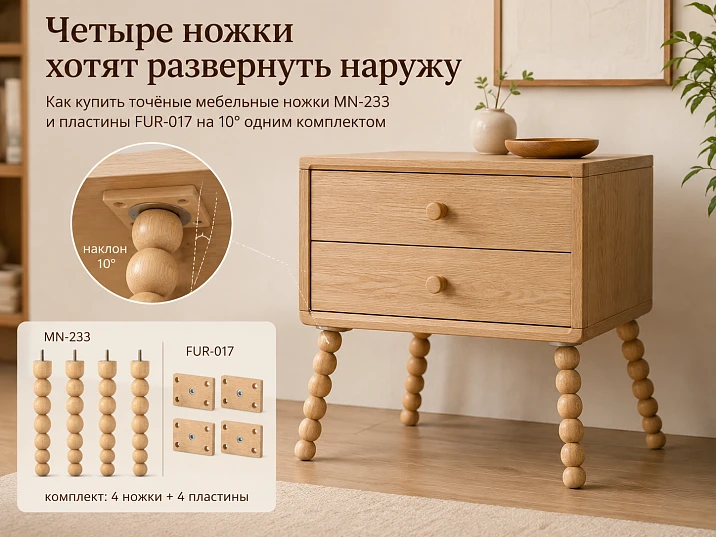
A turned leg placed at an angle changes furniture more than it seems on a sketch. The body visually becomes lighter, the supports form an expressive silhouette, and the repeating wooden spheres of MN-233 turn into a noticeable part of the design. But placing an order for just four beautiful legs is not enough. For angled installation, you need identical mounting plates, compatible studs, a suitable base, and a pre-verified load. If at least one element of the assembly is chosen after receiving the goods, the project easily stalls during assembly. Therefore, the right question is not "do I like the shape of MN-233," but "is the entire assembly of leg, stud, plate, and furniture base ready." Before you buy a turned furniture leg MN-233, you need to choose a specific height, determine a vertical or angled scheme, check the working load, and calculate all components for four supports.
Turned furniture leg MN-233: what is actually confirmed by the product card
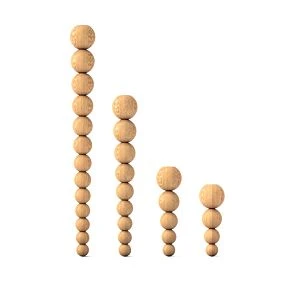
MN-233 is a cone-shaped wooden support with a rhythm of decreasing spheres. The main cross-sectional dimension B × C is 72 × 72 mm, parameter D is 36 mm. The model is made from beech and oak with "Prestige" sanding quality and is offered in four heights: 198, 247, 443, and 635 mm. The product card states several fundamentally important things. First, the support is intended for frameless constructions. Second, it is designed for light loads. Third, it can be installed vertically and at an angle; the lower spherical part allows preserving the characteristic silhouette when tilted. Fourth, the manufacturer shows recommended hardware, including the FUR-017 plate at 10°. This information sets the project boundaries. MN-233 cannot automatically be assigned as a leg for a heavy dining table just because a 635 mm height option appears in the catalog. Height and load capacity are different characteristics. Likewise, the possibility of angled installation does not mean that any angle, any tabletop, and any fastener are acceptable without calculation.




Wooden leg and furniture support: why tilt changes the calculation
With vertical installation, the main force is directed along the leg's axis. With tilt, additional components appear: the assembly tends not only to transfer the load downward but also to shift relative to the base. Requirements for plate fastening, body material thickness, leg placement, and resistance to loosening increase. That is why the general answer from the FAQ about furniture leg load cannot be mechanically applied to a specific angled construction. The MN-233 product card separately mentions light loads. The FUR-017 card does not specify the allowable load of the assembly. Also not specified are the minimum base thickness, the number and type of screws for fixing the plate, the allowable dynamic load, and the maximum leg overhang. Before purchasing, you need to request written confirmation from the manufacturer or designer for the chosen scheme. In the request, specify:
- exact size MN-233;
- material of the leg and plate;
- weight of the body or tabletop;
- expected operational load;
- furniture dimensions;
- distance between mounting points;
- material and thickness of the base;
- presence of a reinforcing frame or embedded inserts;
- vertical installation or via FUR-017;
- number of supports.
Without this data, the phrase "four legs must support" remains an assumption. The load is not always divided into four equal parts: uneven floor, shifted center of gravity, a person leaning on the edge, and body misalignment increase the force on individual supports.
Our factory also produces:

Turned legs MN‑233: how to choose one of four heights
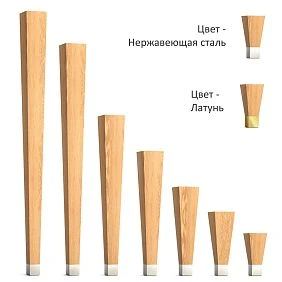
The size is chosen not by the name of the furniture item, but by the final height of the structure. A simple formula looks like this: final height = leg height vertically + thickness of the body or tabletop + intermediate layers. For a vertical leg, its vertical height roughly corresponds to size A. For an inclined support, the vertical projection will be less than its full length. You cannot simply add 198, 247, 443, or 635 mm to the body and consider the calculation complete. Additionally, the FUR‑017 plate has its own geometry of 112 × 70 × 26 mm, which affects the mounting joint. The practical procedure is as follows:
- set the required height of the finished product;
- measure the body together with the tabletop and lower technological layers;
- build the joint with a real angle of 10°;
- obtain the vertical projection of the leg from the drawing or CAD model;
- account for the plate and the actual connection point;
- check the clearance from the lower sphere to the floor;
- only after this, choose option A.
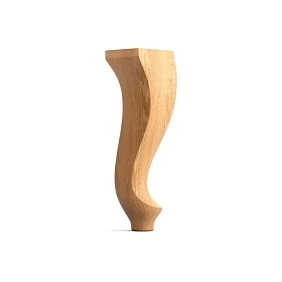
Size 198 mm is suitable for low items only when the calculation confirms a convenient final height. Option 247 mm noticeably raises the body more. Sizes 443 and 635 mm require especially careful stability checks: the higher the structure and the further the supports spread outward, the more important the base width, body rigidity, and center of gravity position. If MN‑233 does not fit in height, you should not order it with the expectation of subsequent shortening. The manufacturer states in the general FAQ that cutting or trimming to size service is not provided. It is more rational choose unpainted solid wood furniture legs with suitable factory geometry.
Get Consultation
Furniture leg at a 10° angle: what the FUR‑017 plate provides
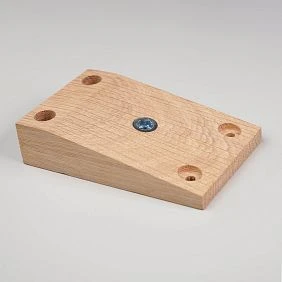
FUR‑017 is a wooden mounting plate measuring 112 × 70 × 26 mm with a built-in metal M8 insert. The tilt angle is 10°. The plate is designed for quick mounting of a support with a screwed-in metric M8 stud to the furniture body or tabletop. For four identically tilted supports, four identical plates are needed. If the project involves turning the legs outward, each plate is oriented relative to the center of the furniture according to a single scheme. An error in rotating even one part will result in noticeable asymmetry: one leg will face the wrong direction or have a different offset. Important: fasteners for attaching the plate to the furniture base are not included. Therefore, ordering a wooden mounting plate FUR‑017 at 10° does not mean getting a fully ready mounting kit. The project separately specifies the quantity, diameter, length, and type of screws, edge distances, allowable drilling depth, and the need for an insert. Screws cannot be selected based only on plate thickness. They work in the material of the body or tabletop, and its properties can vary greatly. Solid wood, plywood, furniture board, MDF, and particleboard require different solutions. If the base is thin or weakened by cutouts, an additional distribution part or a design change is needed.
M8 stud and hardware for wooden legs: what to include in the order
To connect MN‑233 with the FUR‑017 plate, an M8 metric stud is required. The one recommended by the FUR‑001‑1 card has a size of M8 × 60 mm: 30 mm of threaded part and 30 mm of metric part. For four legs, four studs are needed. For the project, you can buy the M8×60 FUR‑001‑1 stud individually. Composition of the tilted kit:
| Position | Quantity per piece of furniture with four supports |
|---|---|
| MN-233 of the same size and the same wood species | 4 pcs. |
| FUR-017 at 10° of the same wood species | 4 pcs. |
| FUR-001-1 M8 × 60 | 4 pcs. |
| fastening plates to the base | as calculated, not included in the FUR-017 set |
| Layout template | 1 pc. or digital drawing |
The FUR-001 set consists of an M8 × 60 stud and an M8 × 13 metal insert. It is useful for another scheme where the insert is installed directly into the furniture structure. When using FUR-017, the M8 metal insert is already in the plate itself, so buying four full FUR-001 sets without checking the contents is not recommended: it may turn out that additional inserts are not needed. For the vertical option, you can separately Buy FUR‑001 mounting kit, but the scheme is still coordinated with the designer.
Wooden furniture legs: price calculation for four inclined supports
The calculation below shows the cost of four MN‑233 units, four FUR‑017 units, and four FUR‑001‑1 pins at card prices verified on 28.08.2026. Fastening of plates to the base, finishing, delivery, and installation are not included in the total. Prices change, so they need to be re-verified before payment.
| Height of MN‑233 | Beech set | Oak set |
|---|---|---|
| 198 мм | 10,168 RUB | 12,728 RUB |
| 247 мм | 11,648 RUB | 14,648 RUB |
| 443 мм | 16,848 RUB | 21,488 RUB |
| 635 мм | 22,448 RUB | 29,568 RUB |
For example, a beech set of 198 mm is calculated as follows: four legs at 2,140 RUB each give 8,560 RUB; four FUR-017 plates at 330 RUB each — 1,320 RUB; four FUR-001-1 pins at 72 RUB each — 288 RUB. Total 10,168 RUB excluding plate fasteners, finishing, delivery, and labor.
For the oak version of 443 mm: four legs at 4,830 RUB each cost 19,320 RUB; four oak plates at 470 RUB each — 1,880 RUB; four pins — 288 RUB. Total 21,488 RUB.
The table is needed not to fix the price forever, but to check the completeness of the cart. If the estimate includes only four MN-233, the cost of the inclined scheme is underestimated: it does not include four FUR-017, four pins, and separate fasteners for attaching the plates to the base.
Beech or oak: how to order legs and plates of the same wood species
If furniture is painted with opaque enamel, beech with gluing for enamel is often chosen. If the project relies on visible texture and translucent tinting, it makes sense to consider oak and clarify the grade for tinting. However, you cannot choose the wood species only by a general rule: the card of a specific combination must confirm the available gluing. For a visible inclined joint, it is important that the leg and plate look like part of one solution. Beech with an oak plate or an oak support with a beech plate may accept stain and varnish differently. Even parts of the same species differ in shade and grain, so for transparent finishing it is advisable to order the entire set at once and request matching of blanks within the available grade. Before placing an order, it is useful to check the quality of the wood under enamel or tinting. The wording "Prestige" refers to the quality of sanding, not to the finished topcoat. An unpainted leg needs to be prepared and finished on all sides, including less visible areas, to reduce the risk of uneven moisture exchange.
Furniture support MN-233: how to check the plate fit before purchase
The FUR-017 plate has a width of 70 mm and a length of 112 mm. It requires a continuous area where fasteners can be safely placed. You cannot rely only on the external dimension of the tabletop: underneath there may be a chamfer, a recess, drawer guides, a connecting seam, a cable channel, or a decorative frame. Before ordering, a bottom plan of the furniture is made and the following is marked:
- contour of each plate 112 × 70 mm;
- axis of the M8 bushing;
- slope direction 10°;
- intended mounting holes;
- safe clearances from edges;
- zones of drawers, doors, and mechanisms;
- leg trajectory to the floor;
- outer contour of the furniture in plan;
- wall baseboard and other obstacles.
After this, a side view is constructed. An inclined leg takes up more floor space than a vertical one. If the furniture stands close to the wall, the rear supports may approach the baseboard; if the legs are directed outward along the entire perimeter, the front ones will increase the actual width of the base. This overhang must be compared with the passage and the cleaning area. Thin tabletops are checked especially carefully. The plate must not be secured with a screw that will come out on the front surface. But too short fasteners also cannot be assigned without calculation. The correct solution depends on the base material and the required holding capacity.
Four legs angled outward: how to set the same 10° angle direction
A 10° angle by itself does not indicate which way each leg faces. For four supports, you need to set the tilt direction in the plan view. If the furniture is rectangular, different layouts are possible: legs can spread diagonally from the center, two front and two rear can go in opposite directions along the short axis, or each can follow its own local diagonal. These schemes differ visually and structurally.
For the stated scenario of "four legs wanting to turn outward," it is safer to start with one common coordinate system. On the bottom plan of the body, draw the longitudinal and transverse axes, mark the geometric center, and place an "outward" arrow on each FUR‑017. After that, lay out all four plates simultaneously. Do not orient them individually "by eye": an error in one plate is immediately visible after installing the spherical MN‑233.
For a square body, it is convenient to check symmetry along the diagonals. For a rectangular one, additionally measure the distances from the centers of the bushings to the corresponding edges. If the layout must be mirrored, paired dimensions must match.
Why a single "10°" mark on the drawing is not enough
The angle defines the tilt in the vertical plane, but not the azimuth in the plan view. The working drawing must include simultaneously:
- the outline of each FUR‑017, 112 × 70 mm;
- the axis of the built-in M8 bushing;
- the tilt direction arrow;
- the position number: front left, front right, rear left, rear right;
- control dimensions to the body edges;
- assumed outer contour of the leg at the floor.
Such a drawing eliminates the situation where all four plates are formally installed at 10°, but one leg points inward rather than outward.
Tilt 10°: how to estimate horizontal offset without inventing dimensions for MN‑233
For a tilted leg, the bottom point shifts relative to the top mounting point. For any straight axis of length L, the geometry is defined by the formulas:
vertical projection = L × cos 10°
horizontal offset = L × sin 10°.
These formulas are useful as a principle, but in the article you cannot automatically substitute dimension A for L until the drawing of a specific variant confirms that A is the length along the exact axis from which you need to calculate. MN‑233 has a complex turned shape and a spherical base, so the final offset should be taken from the drawing or CAD model of the assembly.
The practical meaning is simple: when tilted, the furniture base becomes wider. The longer the support, the more noticeable the shift of the bottom point. Therefore, variants 443 and 635 mm are especially important to check in the room layout: the leg may extend into a walkway, come close to a wall baseboard, or interfere with cleaning.
What to measure after building the offset
After modeling, record:
- the overall external furniture dimension across the legs;
- the distance from the extreme point of the leg to the wall;
- distance between adjacent legs at the floor;
- passage next to the furniture;
- position of open doors and drawers;
- possibility to bring in a robot vacuum or a regular nozzle;
- alignment of the visual extension of all four supports.
This turns the 10° angle from a decorative idea into verifiable geometry.
How to check the final height of furniture with an inclined MN-233
In a vertical scheme, the buyer often simply adds the leg height to the body height. With an incline, this is a rough approximation. The top and bottom points of MN-233 are not on the same vertical line, so the actual height must be obtained from the assembly drawing.
For a preliminary check, it is useful to divide the height into three parts:
- height of the body or tabletop;
- vertical component of the leg node;
- height/geometry of the mounting plate and seating.
You cannot automatically add all 26 mm of FUR‑017 thickness to the height of the finished furniture: part of the plate may work differently in a specific seating node. The exact mark is determined by the side assembly view.
This check is especially important for the coffee table and the cabinet, where even a difference of a few centimeters is noticeable in use. For the 635 mm variant, the error is even more critical: the furniture may shift to another ergonomic class.
FUR‑017 on the base: how much space is needed for one plate
The FUR‑017 dimension is 112 × 70 mm. This does not mean that it is enough to find a rectangle of exactly 112 × 70 mm on the bottom of the body and screw the plate flush to the edge. In addition to the plate itself, a safe zone for fasteners is needed, and its minimum offsets depend on the base material and the specific screw.
Therefore, the following are drawn on the bottom plan:
- the contour itself of 112 × 70 mm;
- the edge of the body;
- zones of chamfers and radii;
- shield seams or MDF;
- drawer guides;
- hinges, cable channels, and fasteners for other parts;
- intended plate holes after receiving the actual product/drawing.
If at least one FUR-017 falls into a void, cutout, or thin edge, you cannot "slightly" shift only that plate. Shifting would break the symmetry of the four legs. It is more correct to recalculate the entire layout.
Furniture base: why solid wood, plywood, MDF, and particleboard require different solutions
The FUR-017 card explicitly states that fasteners for attaching the plate to the body or tabletop are not included. This means the manufacturer does not specify a universal screw for all bases.
Solid wood holds threads with wood fibers, but near the edge it may split if pre-drilling is incorrect. Plywood has a layered structure and usually distributes forces better, but a thin sheet is not equal to a thick furniture panel. MDF is homogeneous but sensitive to repeated re-tightening and to holes placed too close to the edge. Particleboard requires especially careful design of the fastening zone due to the coarse material structure.
Therefore, in an order for four FUR-017 units, it is not enough to write "need screws." The installer is given the exact material, base thickness, and working drawing. If the body is thin, an internal insert or load-distributing part may be needed, but it cannot be invented without calculation.
Why the general FAQ "100 kg per leg" does not solve the MN-233 task at 10°
On page MN-233 in the general FAQ, it is stated that STAVROS furniture legs withstand a vertical load of at least 100 kg. However, the description of MN-233 itself separately states that this model is designed for light loads and allows inclined mounting.
These two messages cannot be combined into the conclusion "four inclined MN-233 legs withstand 400 kg." First, the FAQ refers to vertical load. Second, inclination changes the operation of the fastening assembly: horizontal components and moment appear. Third, the permissible load of the entire piece of furniture is limited not only by the leg, but also by FUR-017, plate fasteners, the cabinet base, and its geometry.
Therefore, for an inclined structure, written confirmation of the specific application is needed. The request should specify the MN-233 size, four FUR-017 units, base material, furniture weight, expected operational load, and the leg orientation scheme.
Turned wooden legs: why a mock-up is needed first
MN‑233 has an active shape of decreasing spheres. When installed vertically, the pattern is perceived as a calm column. At an angle, the same spheres create movement and visually widen the base. On a small cabinet, the effect may be successful, but on a narrow body, it may be excessive. The most reliable way to check is a 1:1 scale mock-up or an accurate 3D model. In the mock-up, the 72-millimeter transverse dimension of the leg, the height of the chosen option, and the 10° angle are noted. The furniture needs to be viewed from the front, side, and diagonally, not just in a frontal render. Four questions are checked:
- Does the large spherical rhythm conflict with the handles and the facade?
- Does the body look too small relative to the supports?
- Does the lower part of the leg extend into the walkway?
- Does the furniture remain stable when a drawer or door is open?
If MN-233 turns out to be too expressive, you can buy wooden legs for furniture of a different geometry. Changing the model before payment is cheaper than reworking four seating positions after installation.
Installation of the wooden leg MN‑233: procedure without random marking
Work begins not with drilling, but with an approved template. It shows the position of all plates and the direction of the slope. The central axes are transferred to the furniture base, after which the diagonals and symmetry are checked again. Assembly sequence:
- Inspect the legs, plates, and studs, verify the quantity and wood species.
- Perform a trial dry assembly of one support without final tightening.
- Check M8 thread compatibility and stud insertion depth.
- Apply the template to the base and mark all four plates.
- Ensure that the holes will not hit an edge, void, or mechanism.
- Select fasteners according to the material and thickness of the base.
- Secure the plates in a uniform orientation.
- Install the legs without using the spherical surface as a lever for over-tightening.
- Place the furniture on a flat surface and check for rocking.
- Perform inspection under the design load without impact.
Exact diameters and depths of holes for plate fasteners cannot be universally specified: the FUR‑017 card does not define them, and the fasteners are not included in the kit. The installer must rely on the drawing, the base material, and the fastener manufacturer's recommendations. Before finishing work, it is worth studying tips on finishing and installing wooden products. If the coating is applied after a trial fit, the parts are marked so that each leg returns to its place.
Practical scenarios for angled installation of MN‑233
Coffee table with four MN‑233 198 mm
Low furniture is the most natural scenario for the short MN‑233, but even here, a full assembly is built first. Suppose the coffee table body is already designed, and the four legs should spread outward symmetrically.
First, four FUR‑017 plates are placed on the bottom plan. It is checked that each plate fits entirely and does not intersect with the tabletop or lower shelf fastening. Then, the same direction of 10° outward from the center is set. After that, a side view is built, and the actual height is checked.
If the layout shows that spherical legs widen the base too much, do not reduce the angle yourself: FUR‑017 specifies 10°. Adjust the position of the plates or choose a vertical scheme/another model.
nightstand with MN‑233 247 mm and a drawer
The main hidden conflict of the cabinet is the guides and the drawer bottom. From the outside, it seems there is enough space in the four corners for the plates. But metal guides, screws, or reinforcements may run under the bottom.
Before ordering FUR‑017, build a bottom plan with the actual drawer hardware. The 112 × 70 mm plate must not overlap the mechanism. At the same time, check the overhang of the bottom sphere: when the drawer is open, the center of gravity shifts forward, and the actual load on the front and rear supports becomes uneven.
Therefore, the phrase "four legs mean the weight is divided by four" is especially inaccurate here.
tall cabinet on MN‑233 443 or 635 mm
The higher the leg, the more important the furniture's stability. For a tall cabinet, console, or light table, check the base width, center of gravity, and tipping when loaded at the edge.
If the cabinet is narrow and the four supports spread outward, the base may visually become more stable, but the FUR‑017 fasteners simultaneously play a larger role. Do not use the tall MN‑233 option for a heavy stone countertop just because the wood looks massive.
For such heights, a 3D model with real masses and base dimensions is especially useful, not just a front render.
one of the four plates does not fit
Suppose three FUR-017 units fit freely in the corners, and the fourth lands on a guide rail or cable channel. It cannot simply be shifted 20 mm inward while leaving the others in their original positions: the bottom point of this leg will end up in a different place, and the furniture will visually become asymmetrical.
There are three normal ways:
- change the placement of all four plates symmetrically;
- relocate the conflicting mechanism, if the design allows it;
- choose a different support system.
Randomly shifting one leg is not a solution.
furniture stands against the wall
If the rear MN-233 legs are tilted outward toward the wall, their bottom spheres may come closer to the wall baseboard than the cabinet body. Therefore, when planning the room layout, you need to account for the actual footprint based on the legs, not just the width of the tabletop or cabinet.
If there isn't enough clearance, a different orientation of all four supports is possible, but it must be re-checked for symmetry and stability. Turning only the rear pair the other way for the sake of the wall should be done as a separate project, not as an improvisation during installation.
Mistakes when ordering four MN-233 with FUR-017
Mistake 1. Ordering four legs and forgetting the four plates
MN‑233 allows inclined installation, but the angle itself is created not by "screwing on" the stud, but by the corresponding mounting system. For four identical inclined supports, four FUR‑017 are needed.
Mistake 2. Buying four complete FUR‑001 together with four FUR‑017 without checking
FUR‑001 contains a stud and a separate M8×13 insert nut. In FUR‑017, the M8 insert nut is already built in. For an inclined scheme, separate FUR‑001‑1 studs are usually sufficient, but the final composition is confirmed according to the project.
Mistake 3. Considering the 10° angle decorative and not accounting for it in the overall dimension
The inclination increases the outer footprint of the supports at the floor. In a narrow passage, a leg may end up where the furniture body does not yet obstruct.
Mistake 4. Orienting the plates one by one
All four FUR‑017 must be laid out simultaneously according to a single template. Otherwise, different overhang and rotation of the legs appear.
Error 5. Assign plate fasteners for 26 mm thickness
26 mm is the thickness of FUR‑017, and the fastener works in the furniture base. Its length and type depend on the material and thickness of the body.
Error 6. Transfer the general FAQ about vertical load to an inclined scheme
For MN‑233 under 10°, verification of the specific joint is required. Summing conditional "kilograms per leg" without considering plates and base is incorrect.
Error 7. Calculate the finished height as body + size A
When inclined, the vertical projection differs. A side view per the drawing is needed.
Error 8. Start painting before dry assembly
After finishing, it may turn out that one plate conflicts with the guide or the legs are turned asymmetrically. First a trial fit, then the finish.
Error 9. Mix beech and oak in a visible set without a design reason
With a transparent finish, the difference in wood species is obvious. Even under enamel, it is better to specify four legs and four visible plates with one consistent specification.
Error 10. Buying a high MN-233 only by the name of the furniture item
The 635 mm option does not automatically become a "dining table leg." The card directly limits the model to small loads; the purpose is verified by the project.
Decision tree: is the project ready to order four inclined supports
Before payment, you can go through seven control questions:
| Question | If "yes" | If "no" |
|---|---|---|
| Is the exact size MN-233 selected? | Moving on to the height | First, we choose the geometry |
| Is the final height calculated with the angle? | Checking the base | Building a side view |
| Are four FUR-017 placed symmetrically? | Checking the fasteners | Changing the scheme |
| Are the material and thickness of the base known? | Selecting fasteners | Obtaining structural data |
| Is the direction of all four legs specified? | Checking the overhang | Making a template |
| Is the load of the specific furniture confirmed? | You can proceed to checkout | Requesting calculation/confirmation |
| Are the legs and plates of the same wood/finish? | Final specification | We agree on the set |
If at least one critical point remains unknown, the order is not ready yet. This is not a reason to refuse MN-233, but a reason not to drill or pay for an incomplete mounting kit.
Square and rectangular body: how the scheme of four inclined legs changes
Four identical FUR-017 legs are easiest to perceive on a square body: the center of the furniture is one, the four corners are symmetrical, and the legs can be directed outward along the diagonals. On a rectangular body, this principle is also applicable, but the distances along the long and short sides differ, so the visual protrusion of the front pair may be perceived differently than the side one.
Square cabinet or table
On a square, first draw two diagonals and two axes. The centers of FUR-017 are placed mirror-symmetrically relative to these lines. If each plate is oriented outward along its diagonal, the lower points of the legs form a wider square. This silhouette is easy to check with a top-view mockup.
The main risk is too strong visual expansion of the base. MN-233 has a noticeable spherical rhythm, so four inclined supports can become the main object of the composition and "pull" attention away from the body. If this is not intended, it is better to check vertical installation or another model before purchasing.
Rectangular coffee table
In a rectangle, two sides are longer. If all legs are directed along diagonals from the center, the protrusion component along the long and short axes will differ. In plan, this is normal, but the final outer contour on the floor needs to be checked.
For a narrow table, the short axis is especially important: the legs may protrude outward more than expected visually and increase the actual passage width. Therefore, on the room plan, not only the tabletop is drawn, but also the extreme lower points of all four legs.
Narrow console or cabinet
The narrower the cabinet, the harder it is to fit the FUR-017 measuring 112 × 70 mm with safe mounting zones. If guides, hinges, or reinforcements run inside, free space quickly runs out. The tall MN-233 on a narrow base also requires particularly careful stability checks.
In such a scenario, you cannot reason: "the plate is only 70 mm wide, so it will fit." First, you need a bottom plan with actual structural layers, and then a check of the center of gravity and overhang.
Why you cannot copy one coordinate to all four corners
If the base is asymmetric due to a drawer, apron, cable channel, or back panel, four identical offsets may fall into different structural zones. Therefore, the symmetry of the appearance and the symmetry of the mounting base must be coordinated simultaneously. If one corner is structurally weak, the solution is changed for the entire assembly, not just for one leg.
Vertical MN-233 or 10° tilt: what changes in the kit
The same MN-233 allows vertical and tilted installation, but these are two different mounting schemes. They cannot be compared only by appearance.
| Parameter | Vertical scheme | 10° tilt via FUR-017 |
|---|---|---|
| Support direction | Along the vertical axis | Offset by 10° |
| Floor clearance | Closer to the housing envelope | Increases due to overhang |
| Mounting hardware | FUR‑001 scheme or another recommended one may be used | FUR‑017 + M8 stud |
| Threaded insert | In FUR‑001, separate M8×13 | Built into FUR‑017 |
| Mounting to the base | Determined by the scheme | Selected separately for FUR-017 |
| Height calculation | Simpler | Vertical projection of the node is needed |
| Load on the connection | Predominantly axial under ideal conditions | A pronounced horizontal component appears |
When a vertical scheme is more rational
Vertical installation is better suited if the furniture stands close to the wall, the passage is narrow, the base is small, or the designer does not need a strong outward spread of the legs. It also simplifies control of the final dimension.
But a vertical scheme does not mean that load and fastener checks can be skipped. It is just that the direction of forces and the geometry of the joint are different.
When FUR-017 makes sense
The 10° plate is needed when the tilt is a deliberate part of the design and the body can accept four identical mounting points. It is convenient precisely because it sets a repeatable angle. This is especially important for serial furniture: four legs on each unit must have identical geometry.
Why FUR-001 is not a replacement for FUR-017 in a tilted scheme
FUR-001 includes a stud and a separate insert, but it does not form a wooden platform with a 10° angle. Therefore, buying FUR-001 and installing it "slightly askew" is not equivalent to the standard tilted plate. If the project requires 10°, the intended system should be used, or another solution must be calculated separately.
Load and stability: four legs do not work as four independent identical supports
Even with perfect symmetry, the load in real furniture is rarely divided strictly into four equal parts. The reason is usage. The floor may not be perfectly level, the user opens a drawer, leans on the edge of the tabletop, or places a heavy object closer to one corner.
Uneven floor
If one leg barely touches the floor, the other three temporarily bear most of the load. Therefore, checking for rocking after assembly is mandatory. One cannot compensate for a marking error by over-tightening a single leg.
Open drawer
A pull-out drawer shifts part of the mass forward. In a small cabinet, this noticeably shifts the center of gravity and increases the load on the front supports. If the legs are tilted outward, the base appears wider externally, but stability must still be confirmed by calculation.
Load on the edge of the tabletop
A person can place a heavy object near the edge or briefly lean on it with a hand. At that moment, one pair of legs is loaded more than the other. This is especially critical for tall versions of MN-233 and narrow tabletops.
High center of gravity
The body on legs of 443 or 635 mm rises noticeably higher. If there is a heavy tabletop on top, the center of gravity of the entire structure becomes higher. Tilted legs widen the base but do not automatically guarantee stability. Specific dimensions and mass need to be checked.
Why you should not do a homemade “100 kg test”
Sitting on the table or loading it with random heavy objects is dangerous and uninformative. Such a test does not show the long-term performance of the threads, FUR‑017 fasteners, and the base. The correct check is calculation and control under the design operational load without impact effects.
Beech, oak, and the visible FUR‑017 plate: how to achieve a unified external joint
With angled installation, FUR‑017 may be more noticeable than with vertical mounting: the plate is between the body and the leg, and the angle makes the joint more open to side view. Therefore, the plate material should be chosen together with the leg.
Under an opaque enamel
If the furniture is fully painted with opaque enamel, beech is often convenient as a neutral base. But more important than the species name is the identical preparation of all eight wooden parts: four MN‑233 and four FUR‑017.
First, a dry assembly is performed, positions are marked, then the set is disassembled for finishing. This prevents the situation where, after painting, the plates are swapped and a slight difference in fit is discovered.
Under Tinting
If the texture should remain visible, oak is logical to consider together with the corresponding re-gluing for tinting. The legs and pla
This way the buyer sees why the price of "four legs" and the price of "four finished inclined nodes" differ. This is the main commercial meaning of the topic.
How to check the symmetry of four MN‑233 units after dry assembly
After installing four legs without final finishing, the furniture is placed on a level surface and checked not only for rocking. The main task is to ensure that all four supports indeed have the same visual and geometric rotation.
From above, measure the distances from the extreme lower points of the legs to the projections of the body edges. In a symmetrical layout, the corresponding dimensions on the left and right sides must match. From the front, compare the angle of the front pair; from the side, compare the front and rear legs on one side. If one support visually "stands straighter," first check the orientation of FUR‑017 and the seating depth of the pin, rather than trying to compensate for the error with tightening force.
It is useful to take four photos from the same height: front, back, left side, right side. In photos, slight asymmetry is often more noticeable than when walking around the furniture. For a serial product, these shots can be saved as a reference sample.
Then check the actual external footprint on the floor. It must match the design outline and not interfere with a passage, wall baseboard, or the opening path of adjacent furniture. Only after such a dry check are the parts marked, disassembled, and sent for final finishing.
If asymmetry is detected, do not drill new holes immediately. First, find the cause: different plate orientation, template shift, incomplete pin seating, or an uneven base. The correction must preserve the overall geometry of all four nodes.
When it makes sense to buy the turned furniture leg MN‑233
MN‑233 is justified when its spherical shape is part of the design, not a random replacement for a regular support. The purchase seems reasonable if:
- one of the four factory sizes is selected;
- final height is calculated taking into account the angle;
- the furniture belongs to the permitted use;
- the load of the entire structure is confirmed;
- four identical plates are provided for four supports;
- the base accommodates FUR‑017 measuring 112 × 70 mm;
- the fastening of the plates is determined;
- the outer overhang of the legs is checked;
- one wood species is agreed for the legs and visible plates;
- the finish is tested on a sample piece.
Good candidates are light frameless furniture, magazine and coffee tables, small cabinets, and designer decorative items, but only within the confirmed load and stability limits.
It is too early to order the wooden support MN-233
The order should be postponed if the buyer only knows the appearance of the leg. Warning signs of an unfinished project:
- the exact height is not selected;
- the final height is calculated without the vertical projection of the inclined leg;
- the mass of the furniture is unknown;
- a heavy stone tabletop is assumed without approval;
- there is no diagram of the undermount body;
- the plate does not fit on the bottom surface;
- fasteners are planned to be selected "on site";
- the extension of the supports into the passage has not been checked;
- four plates can be oriented differently;
- the buyer plans to shorten the finished legs;
- a general phrase about load capacity was accepted instead of calculating a specific node.
In these situations, the cart does not solve the problem. First, a drawing and written confirmation of technical parameters are needed.
Test assembly of four inclined supports before ordering and finishing
Full-size template of four FUR-017: how to make it without CAD
If there is no 3D model, the working diagram can be checked on paper or cardboard. At a 1:1 scale, four rectangles of 112 × 70 mm are cut out — the dimensions of FUR-017. On each, the center of the threaded insert is marked according to the actual drawing/part and the arrow indicating the direction of tilt.
On a sheet equal to the lower plane of the housing, edges, axes, and mechanism zones are marked. Then four templates are laid out simultaneously. After achieving symmetry, control dimensions to the edges and between centers are fixed.
The advantage of such a mockup is that it shows the actual area of the plates. On a small cabinet, four rectangles of 112 × 70 mm can occupy a noticeable part of the base, and this is discovered before purchase.
After receiving the hardware, the paper template must be checked against the actual FUR-017. The printed scale or initial drawing should not be the only source for holes.
How to mark four identical legs and plates
After dry assembly, it is convenient to assign positions:
- FL — front left;
- FR — front right;
- RL — rear left;
- RR — rear right.
Marking is applied to a hidden area or temporary tape without damaging the finished surface. The same marking is placed on the plates and template.
This is especially useful if natural wood differs in grain. After a trial layout, the designer can choose which side of each leg will face outward. After sanding and finishing, the parts return to their original positions.
What to check upon receiving MN‑233, FUR‑017, and pins
Before painting and drilling, verify:
- four identical sizes of MN‑233;
- one wood species;
- four FUR-017 of the same agreed species;
- four FUR‑001‑1;
- absence of damage to M8 thread;
- geometry of plates;
- the quality of sanding;
- selected re-lamination for enamel or tinting;
- actual prices and completeness according to the waybill.
If one plate is of a different material or one leg is of a different size, there is no need to "hide it at the back." The set must be uniform before finishing.
Why a prototype is important for serial furniture
If MN‑233 is planned for use in a series of cabinets or tables, first assemble one prototype. On it, check not only the appearance, but also:
- actual final height;
- uniformity of the angle of the four legs;
- rocking on a flat floor;
- operation of drawers and doors;
- overall dimensions across the lower spheres;
- ease of cleaning;
- condition of fasteners after several operational cycles.
Only after this is the template fixed and the series ordered. For natural oak or beech, it is better to place a serial order as one batch if visual similarity of parts is important.
How to order four MN-233 and not forget the hardware
Before payment, it is convenient to send one specification to the manager. For example: "We need four MN-233 measuring 247 × 72 × 72 × 36 mm made of beech, four beech FUR-017 at 10°, four studs FUR-001-1 M8 × 60. Please confirm compatibility, lead time, the same batch of wood, suitability for our structure, and the list of fasteners for attaching the plates to the base." Attach a sketch of the body, weight, base material, and tilt direction to the specification. The manager should see not only the list of article numbers but also the task. After confirmation, check the cart line by line, price, production time, and shipping city. If the specific shape has not yet been approved, first compare the catalog rather than mixing random items. A commercial request "buy wooden legs and wooden furniture supports" implies selection not only by pattern but also by purpose, height, and mounting system. Before final payment, you need check payment and delivery terms. Four tall turned legs require careful packaging; upon receipt, inspect each part, verify the article number, size, wood species, and quantity of hardware before starting finishing.
Specification checklist for wooden furniture legs
In an invoice or custom specification, a line like "MN-233 - 4 pcs" is not enough. Such an abbreviation does not record the size, wood species, or mounting scheme. Before payment, the buyer should see a separate line for each item and check the mutual compatibility of the set. A complete specification contains:
- article number MN-233 and exact dimensions A × B × C × D;
- quantity four pieces;
- beech or oak;
- "Prestige" sanding quality;
- available re-gluing under the selected finish;
- four FUR-017 plates of the same wood species;
- four FUR-001-1 M8 × 60 studs;
- a note that fasteners for attaching the plates to the base are purchased separately;
- production time or confirmed warehouse stock;
- shipping city;
- packaging requirements;
- a written response on the acceptability of the selected purpose and load.
The drawing according to which the order was approved is stored separately. If the manager confirms compatibility in correspondence, the message is attached to the project documentation. This helps the installer not to replace FUR-017 with a random straight plate and not to change the angle already on site. For serial furniture, it is reasonable to first assemble one prototype. On it, check the height, stability, direction of all four supports, operation of doors and drawers, visual symmetry, and behavior of joints. Only after this check is an increased batch ordered. Differences in shades between batches of natural wood are possible, so it is better to place a batch order as a single set, especially under a transparent coating.
Frequently asked questions about the turned leg MN-233 and plate FUR-017
Can MN-233 be installed at an angle?
Yes, the product card allows vertical and inclined installation. For a 10° angle, the recommended hardware includes the wooden plate FUR-017. The admissibility of a specific load and the geometry of the entire piece of furniture must be confirmed separately.
How many sizes does MN-233 have?
Four: 198 × 72 × 72 × 36, 247 × 72 × 72 × 36, 443 × 72 × 72 × 36, and 635 × 72 × 72 × 36 mm.
Will a height of 635 mm work for a dining table?
One height is not enough for an answer. You need to consider the tabletop, final ergonomics, stability, weight, and that the MN-233 card indicates light loads.
What is included in FUR-017?
It is a wooden plate 112 × 70 × 26 mm with a built-in metal threaded insert M8 and a 10° angle. Fasteners for attaching the plate to furniture are not included.
Are four plates needed for four legs?
Yes, if all four MN‑233 units are installed via FUR‑017. Each support requires a separate plate.
What stud is needed?
The MN‑233 card recommends FUR‑001‑1 — a metric stud/self-tapping screw M8 × 60 mm. Compatibility and installation depth are checked before mounting.
Do I need to purchase the FUR‑001 kit together with FUR‑017?
Not automatically. FUR‑001 includes a stud and a separate insert, while in FUR‑017 the M8 insert is already built in. For the angled assembly, separate FUR‑001‑1 studs are usually calculated, but the final composition is confirmed by the manufacturer.
Can the plate be secured with any self-tapping screws?
No. The type, length, and quantity of fasteners depend on the material, thickness, and structure of the base. A universal recommendation without this data is unsafe.
What to choose — beech or oak?
Beech is suitable for opaque enamel, oak — for projects with visible texture and semi-transparent finishes. You need to check the available veneer of the specific item and order legs with plates of the same wood species.
Can MN‑233 be shortened after purchase?
This would violate factory proportions and may affect the seating or lower spherical section. Additionally, the manufacturer does not offer cutting to size. It is better to choose a different factory height.
How to check if FUR-017 will fit?
On the lower plan of the base, place a 112 × 70 mm contour, the axis of the bushing, and mounting holes, then check clearances from edges, facades, guides, and cutouts.
Why can't the total weight be divided by four?
The actual load can be uneven due to floor misalignment, an open drawer, pressure on the edge, and a shifted center of gravity. Tilt additionally stresses the fasteners in shear and loosening.
Where to look for other wooden furniture supports?
In the general section of legs and supports and in the subsection of unpainted models. First filter by purpose and height, then by shape and wood species.
What to check upon receipt?
Article number, size of each leg, wood species, number of plates and pins, absence of damage, thread condition, and matching of parts per order. Finishing begins after a full trial fit.
Will the width of the furniture increase due to the 10° angle?
Yes, the lower points of tilted legs shift relative to the upper mounting points. The exact increase in dimensions depends on the length and axis of the specific MN-233, so it is determined from the drawing or model, not from a single angle.
Do all four FUR-017 need to be installed the same way?
If the project requires a symmetrical outward deployment — yes, the orientation must be aligned according to a single template. Each plate gets its own mirrored position relative to the center of the furniture.
Can FUR‑017 be used on a thin cabinet bottom?
Without data on the material and thickness, it cannot be answered. The 112 × 70 mm plate transfers the load through separate fasteners, which must be rated for the base. With a thin bottom, structural reinforcement may be required.
Is the fastener for attaching FUR‑017 to the cabinet included in the kit?
No. The card clearly states that the fastener for attaching the plate to the furniture is not supplied. It is selected separately.
Can FUR‑017 be replaced with a homemade wedge-shaped shim?
Such a solution would already be a different mounting system and requires a separate calculation. A homemade wedge cannot be considered equivalent to the standard plate with a built-in M8 insert.
What matters more when choosing — height or shape of MN‑233?
First, the purpose and structural compatibility, then the final height, then the visual shape. A beautiful silhouette does not compensate for an unsuitable load or lack of space for FUR‑017.
Bottom line: you need to buy not four legs, but four complete assemblies
MN‑233 creates expressive furniture precisely due to its shape and the possibility of angled installation. But a commercially correct order does not consist of four legs chosen from a photo. It includes four identical MN‑233, four FUR‑017 plates, four M8 studs, calculated plate fasteners, and a confirmed base. First, the height is chosen and the geometry is built at a 10° angle, then the load and mounting area are checked, after that the wood species and finish are agreed upon, and only at the end is the cart finalized. This sequence allows for a symmetrical structure without missing hardware and without the risky assumption that a beautiful wooden leg automatically fits any furniture.