





























 In stock
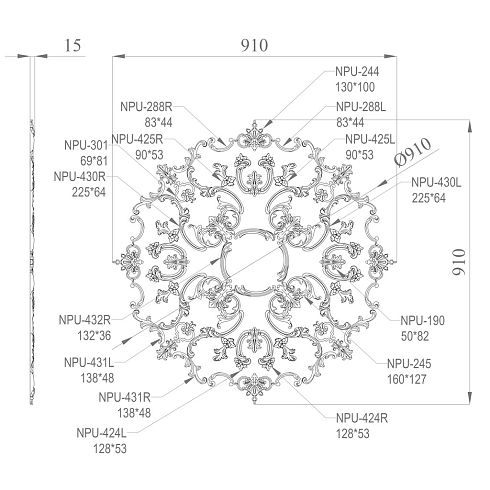
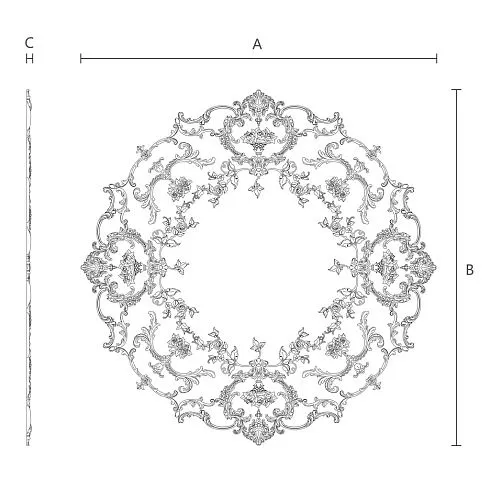
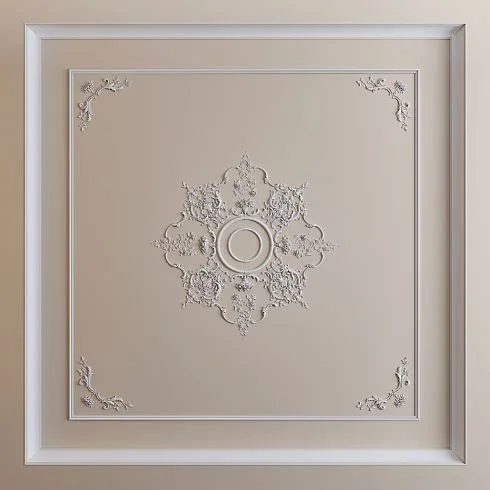
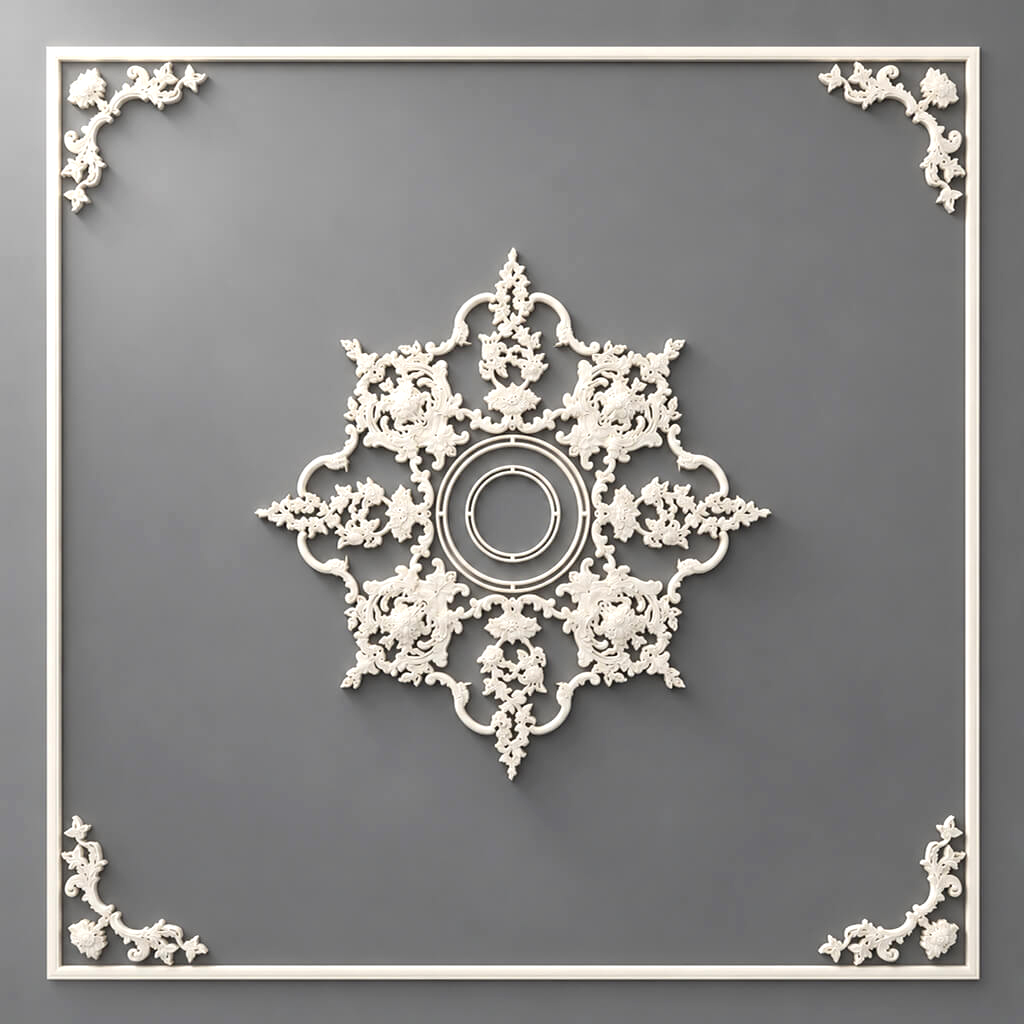
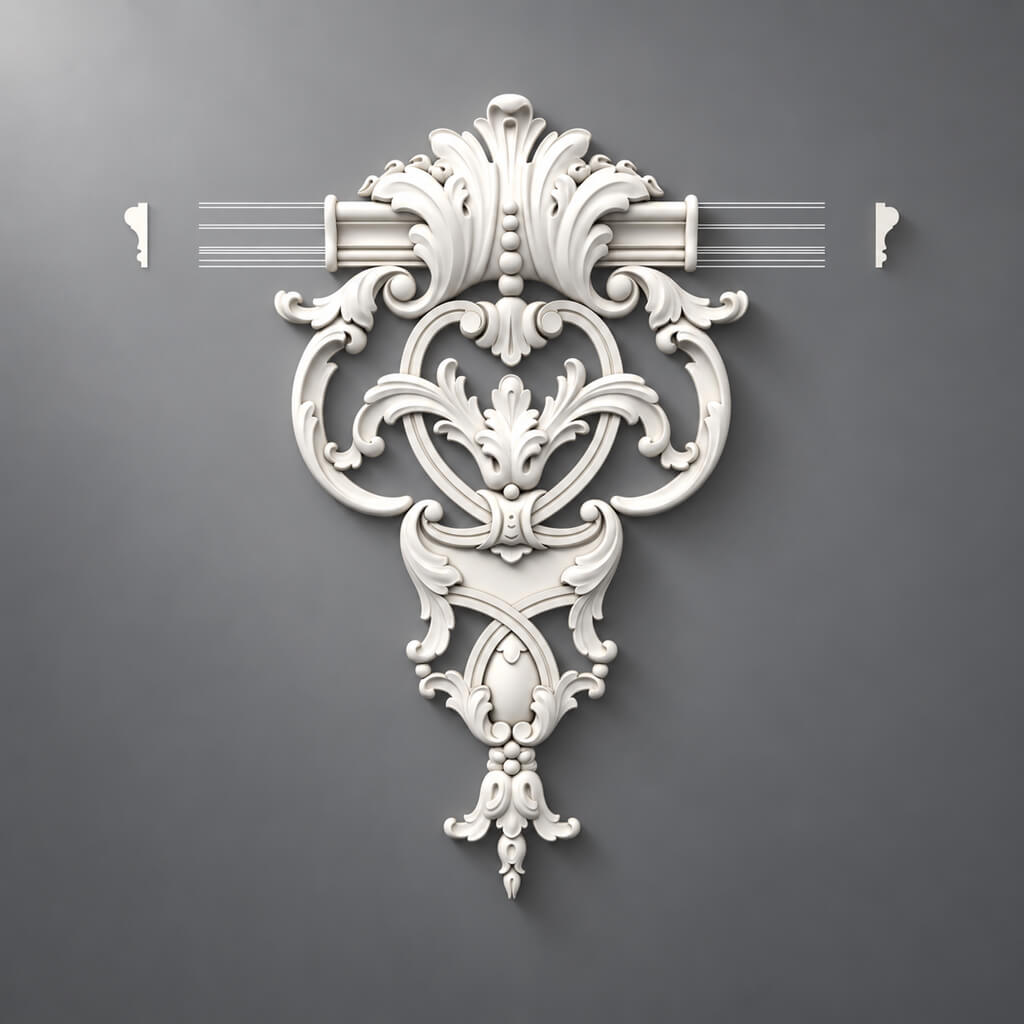
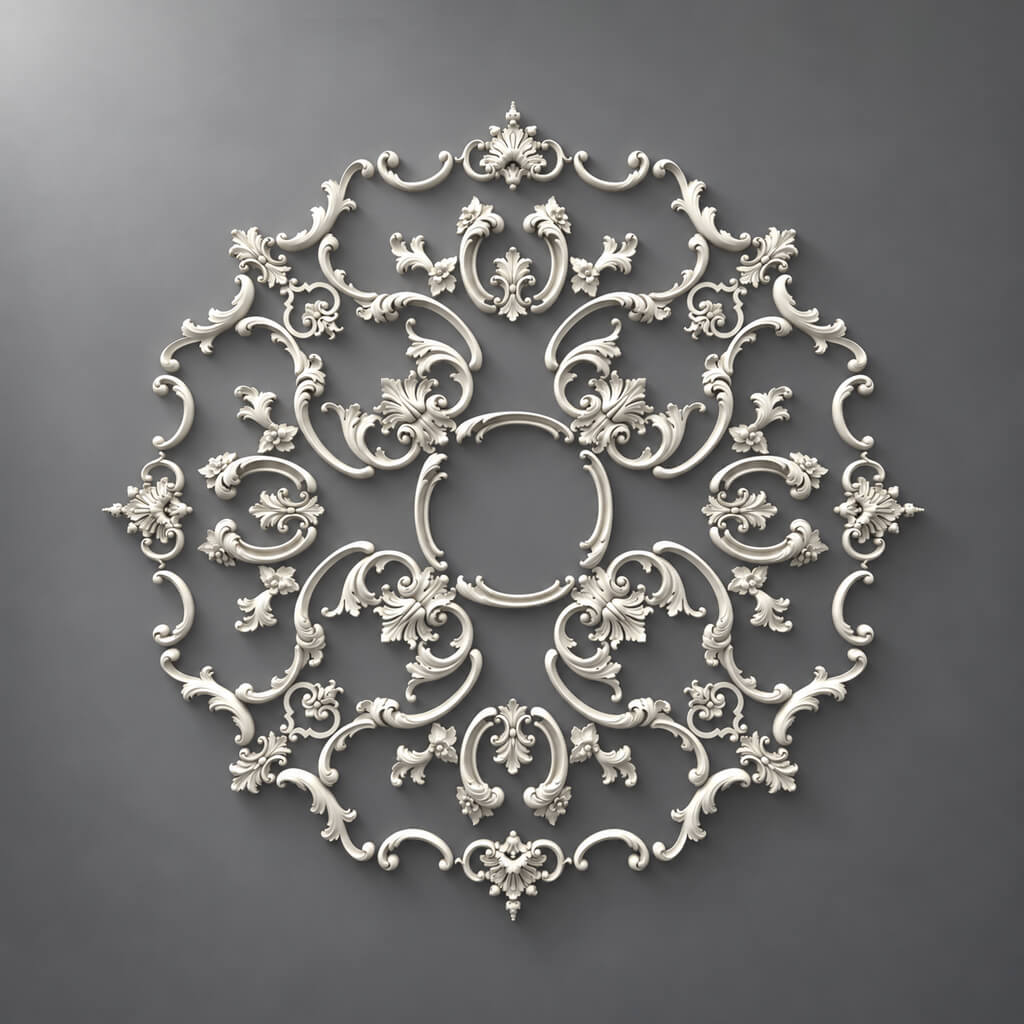
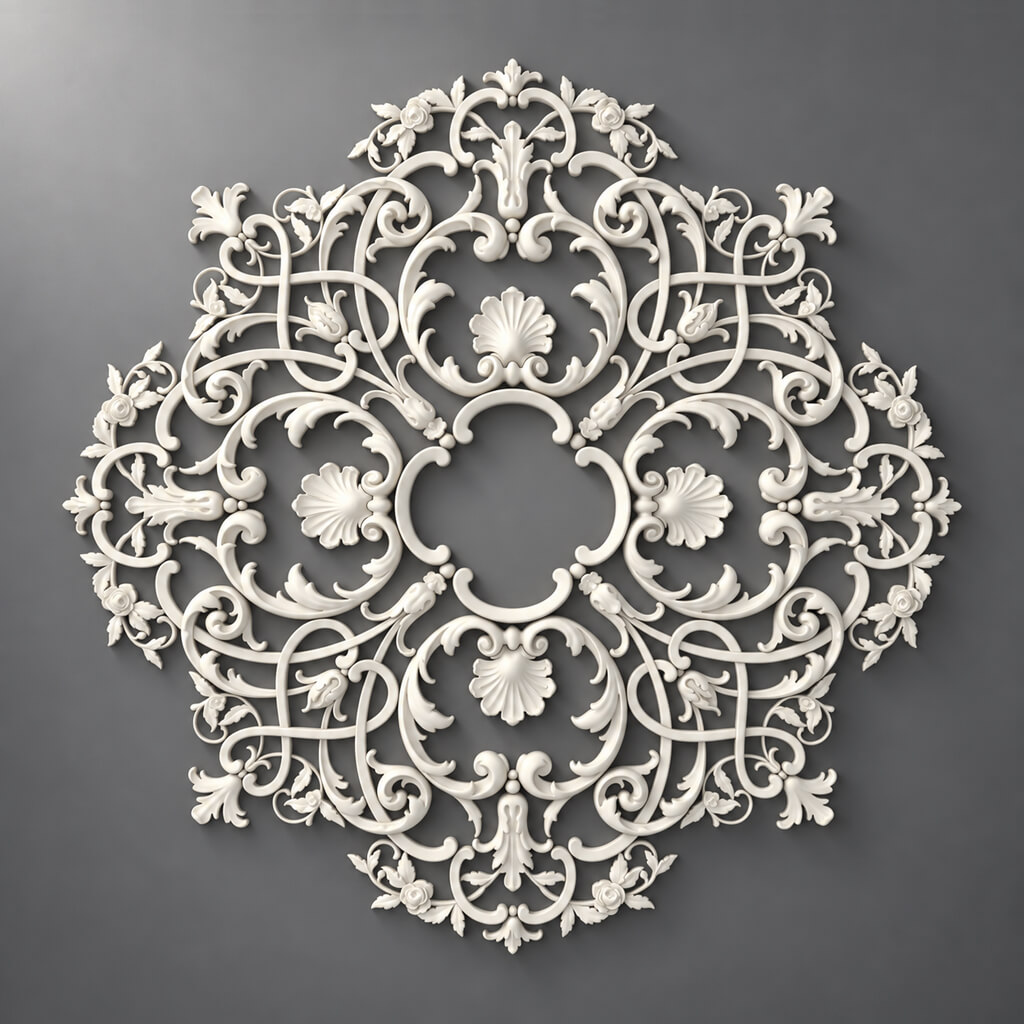
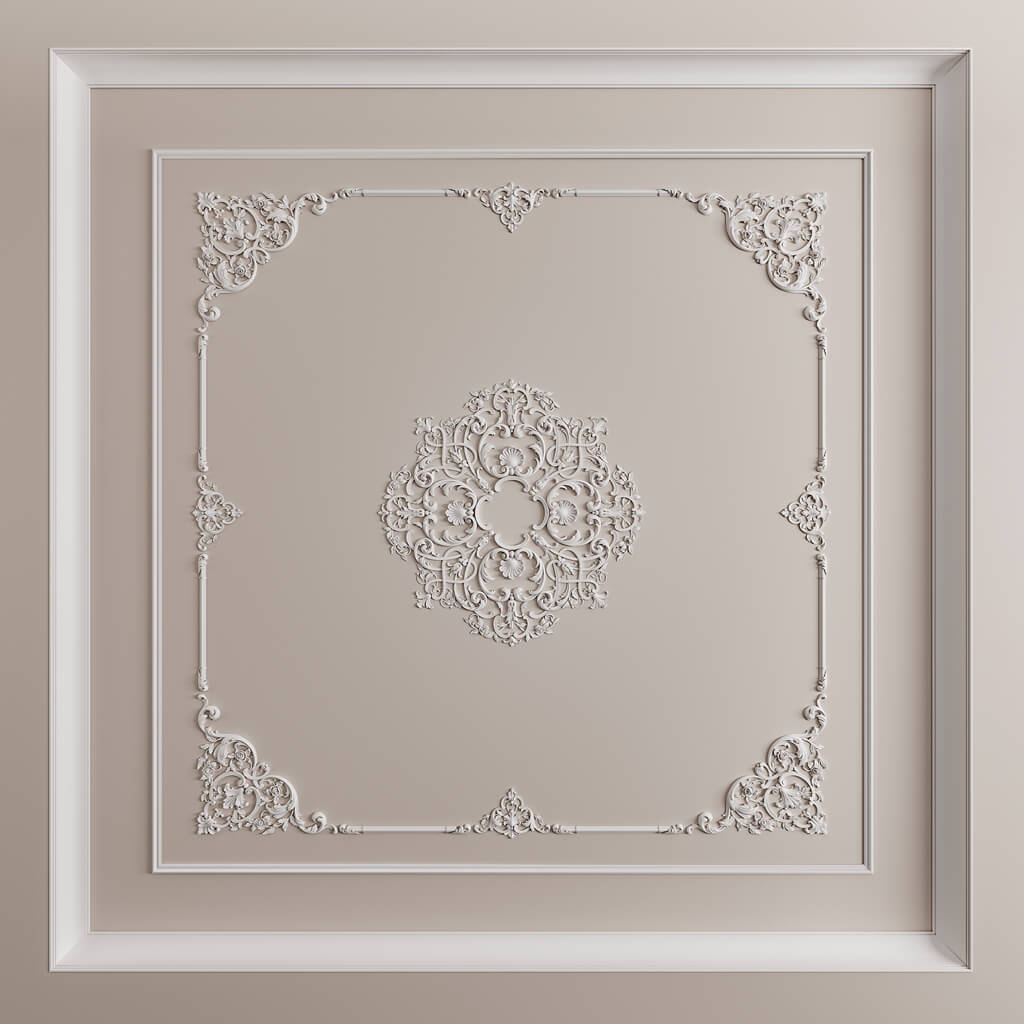
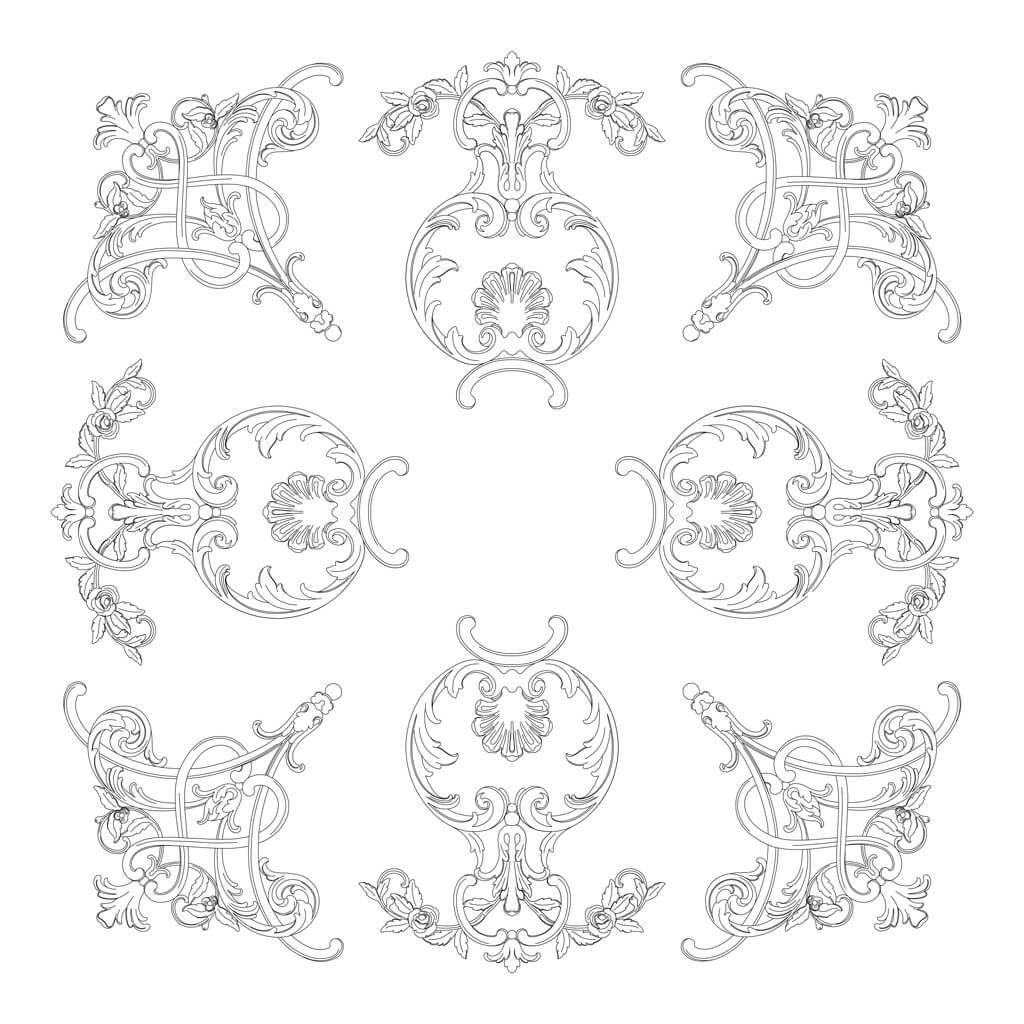
RPU.VRS-001 — a composite ceiling rose measuring 911 × 911 × 18 mm, assembled from eight separate parts: four NPU-507 and four NPU-508. The elements form a large-scale symmetrical composition with an open center, so the ornament feels lighter than a solid one-piece rose and leaves space for a light fixture.
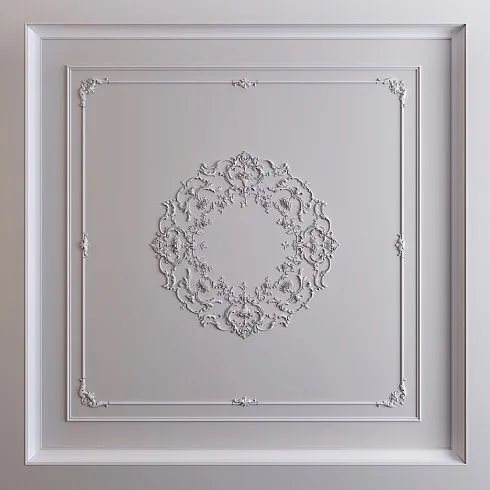
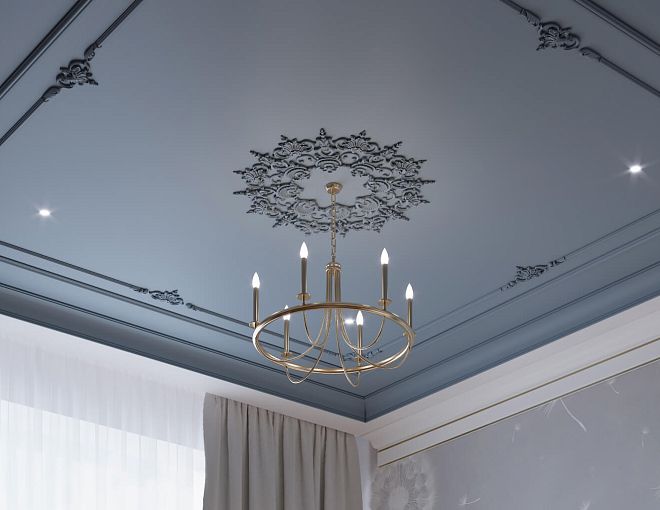
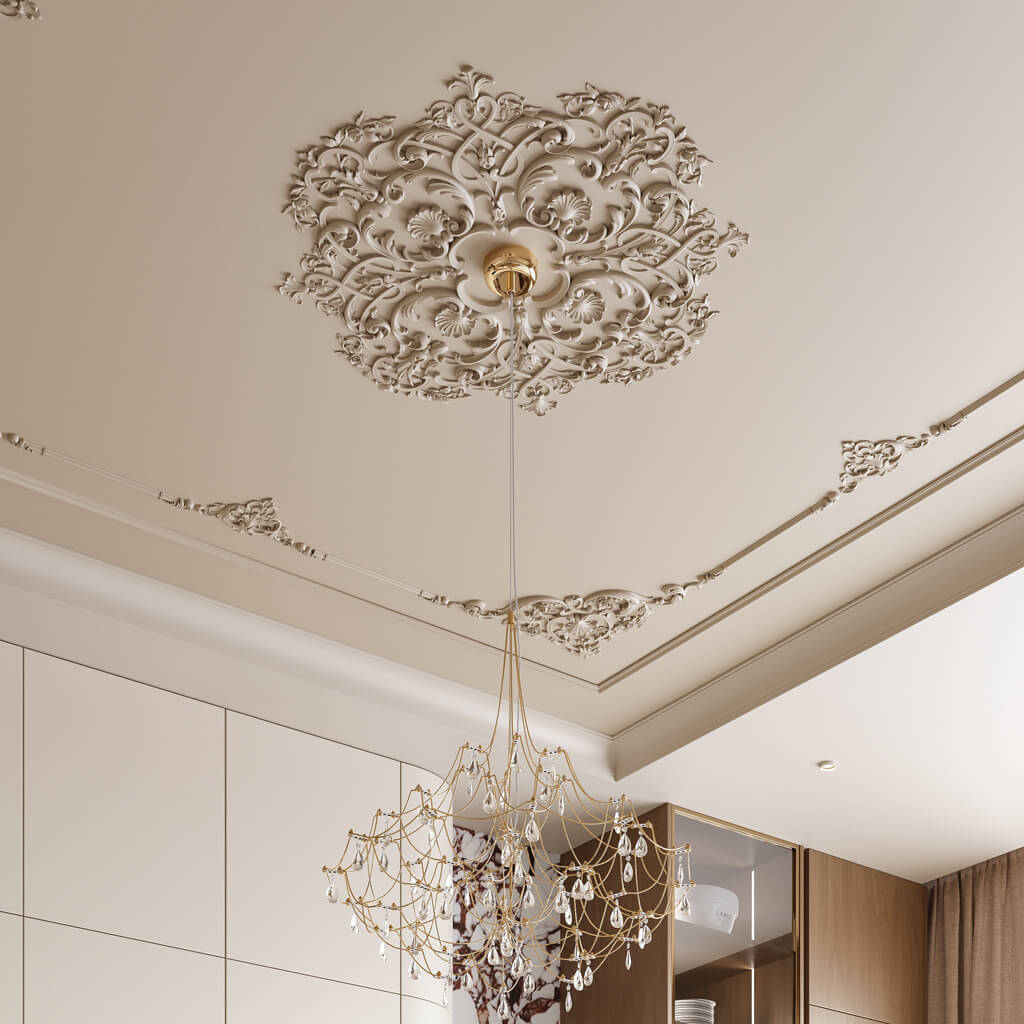
The format is designed for decorating a ceiling center, including the area around a chandelier. The rose works well in a spacious living room, hall, or reception room, where large stucco decor can become the basis of the central composition.
For precise and convenient installation of the ceiling socket CRPU-069, you can additionally purchase a paper one mounting template.
It will help you correctly mark the placement of elements on the surface and assemble the composition according to the intended scheme. The template is purchased separately.
We have been on the market for over 20 years and are ready to offer you the best combination of aesthetics, quality, and practicality. Our polyurethane is not just a material, but a reliable foundation for flawless details, resistance to moisture and cracks, as well as convenient and quick installation. The company's success began in 2002, when two artists – Andrey Ragozin and Evgeny Tsapko – created a small creative workshop for making carved wooden products. The work of the craftsmen was quickly noticed, and within a year they were invited to participate in the reconstruction of the Konstantinovsky Palace in Strelna.
Every product in our range is the result of years of experience, thoughtful technology, and attention to detail. We constantly update our collections, follow and shape trends in interior design ourselves. From elegant neoclassicism to bold Art Deco, you will find the perfect accent for the interior of your dreams.
Choose durable polyurethane decor STAVROS — beauty proven by time and real projects, not just words.
We save your time, peace of mind, and budget
We solve your tasks with maximum speed
Streamlined process reduces all risks
Quality service regardless of order volume
Reliable partner — the foundation of your business
Our showrooms are located in Saint Petersburg and Moscow. Production is located in Saint Petersburg.
Moscow contacts: /contacts_all/
Contacts of Saint Petersburg: /contacts_all/
Send us the product codes, quantities and delivery destination. Contact our team to confirm availability and order details.
Please contact us to confirm shipping availability, costs and delivery times for your destination.
Delivery cost depends on the size, weight of the item, and delivery address.
Please ask our team to confirm shipping costs and delivery arrangements for your destination before placing an order.
Prices and availability of items on the website are always current. Data is updated daily.
Note: items in stock are stored on the warehouse in unpolished form and shipped within 3 working days.
If the item is not in stock, average production time: 5–10 working days.
This is the quality of polishing of the items.
Standard — machine polishing, at a more attractive price.
Prestige — detailed hand polishing, items do not require further work.
More details: /information/kachestvo/
This is the type of veneer of the items.
Under enamel: produced by gluing wooden laminates without color and texture matching. Contrast tonal and textural differences are noticeable. This blank should be chosen if the item is intended for opaque coating.
Under tinting: produced by gluing wooden laminates with color and texture matching. Tonal and textural differences may occur. This blank should be chosen if the item is intended for semi-transparent finish.
More details: /information/kachestvo/
Beech — dense, non-porous wood, most often used for items covered with enamel.
Oak — dense, porous wood with clearly visible natural grain. Due to its strength and decorative properties, it is often used in items with semi-transparent coating, highlighting the wood pattern.
Custom-made, if non-standard items are required, we can produce products from other types of wood, including blanks provided by the customer, manufactured according to our technical specifications.
All our furniture legs can withstand a vertical load of at least 100 kg.
Average production time for custom-made items: 5–10 working days.
Most items are stored on the warehouse in unpolished form. We need time to polish and pack orders.
Yes, we manufacture non-standard items according to individual projects, but we only accept orders with a minimum quantity.
We can manufacture items of the desired size, but we only work with bulk orders. For details, please consult the sales department manager.
Yes, some of our products can be used outdoors. For example, polyurethane items, as well as carved door casings made of pine.
Other items are produced to order using PUR glue, if minimum quantity is available. No warranty is provided for such products, as outdoor conditions are considered aggressive.
Please contact our team to confirm available finishes, minimum quantities and a quotation for your order.
More details: /information/sovety/
Apply adhesive to the decor. Place it on the surface and press briefly. Then, lift the decor from the surface and leave it open for 3–5 minutes. Press the decor firmly onto the surface and hold for 5–10 seconds.
More details: /information/sovety/
Ideally, you should prepare a design project before placing an order.
You can do this yourself by downloading drawings of our products from our website, or you can order a project from us.
If the number of decorative elements and fittings is small, our company's manager can assist you with selection.
Unfortunately, this service is not provided.
The packaging method depends on the type of items, but in each case, we ensure sufficient protection for safe transportation.
We most often use corrugated cardboard and stretch film. Fragile items are additionally secured on a rigid base to prevent damage during transport.
Please confirm the minimum order quantity for your selected products and finishes with our team.
Please contact our team to discuss measurement and installation requirements for your project and destination before ordering.
4290
4273
3624
2905
347
244
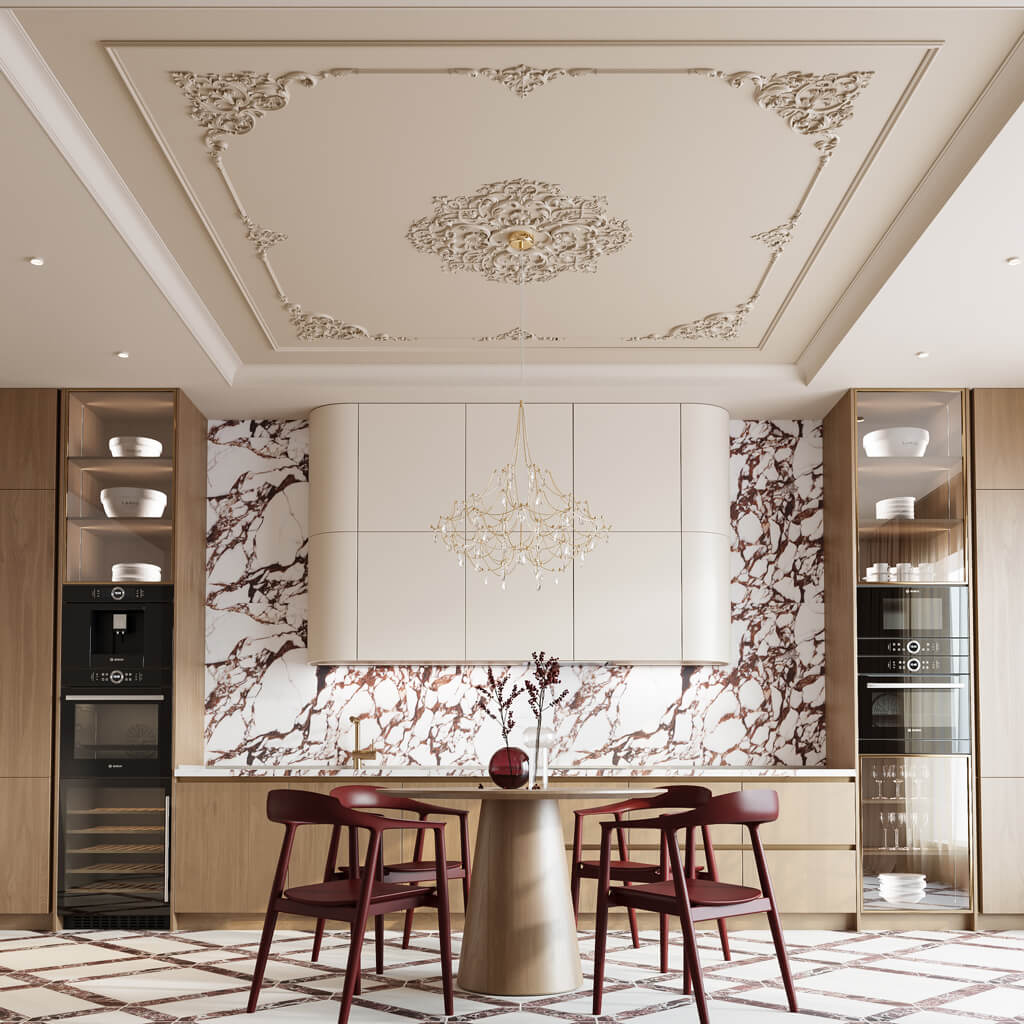
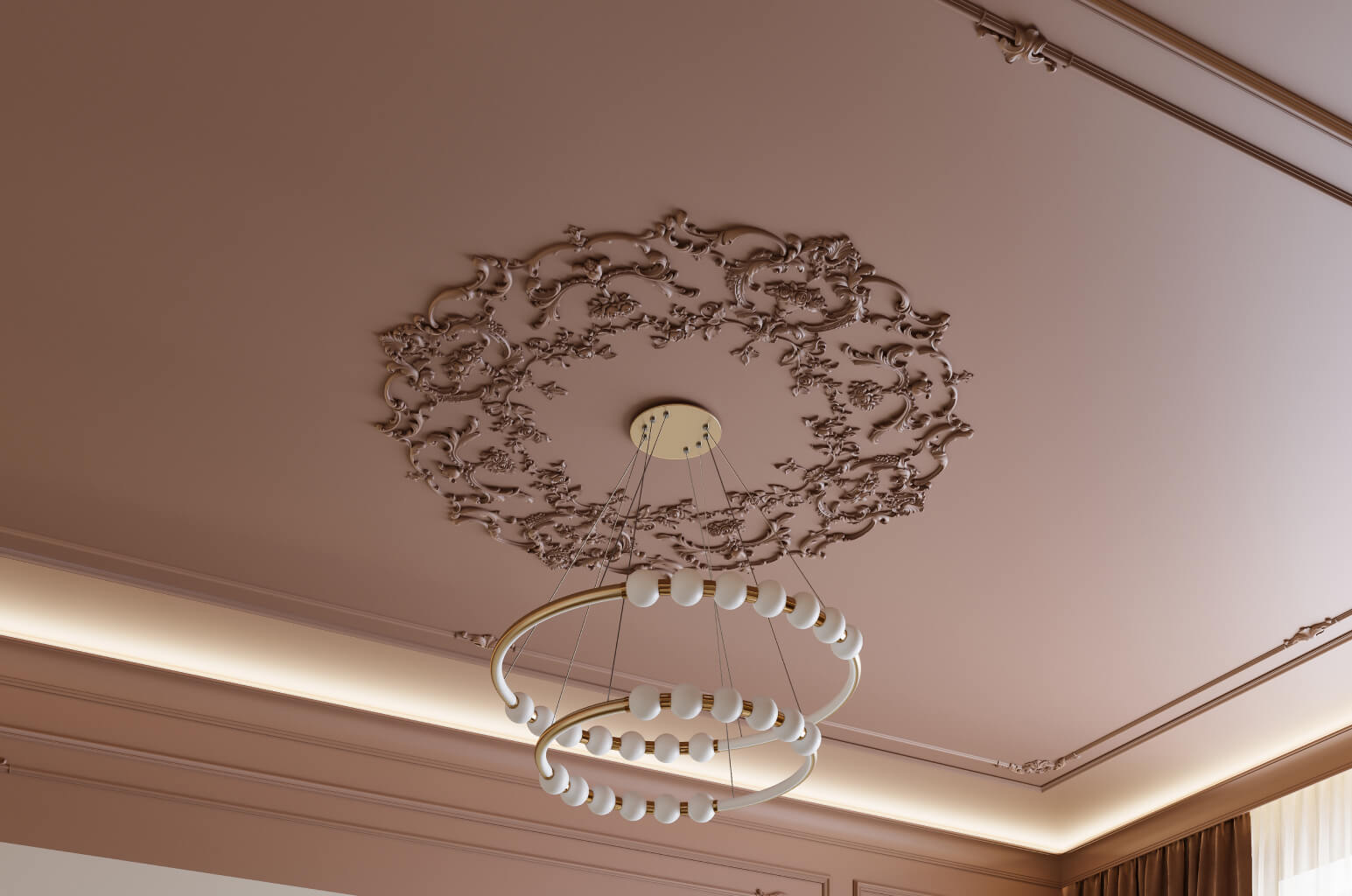
Ceiling rosette RPU.VRS-001 — a large-scale stucco decor made of polyurethane, designed to decorate the central area of the ceiling. The composition creates an expressive frame for a chandelier, pendant light, or a standalone ceiling medallion and helps connect the lighting with the interior architecture.
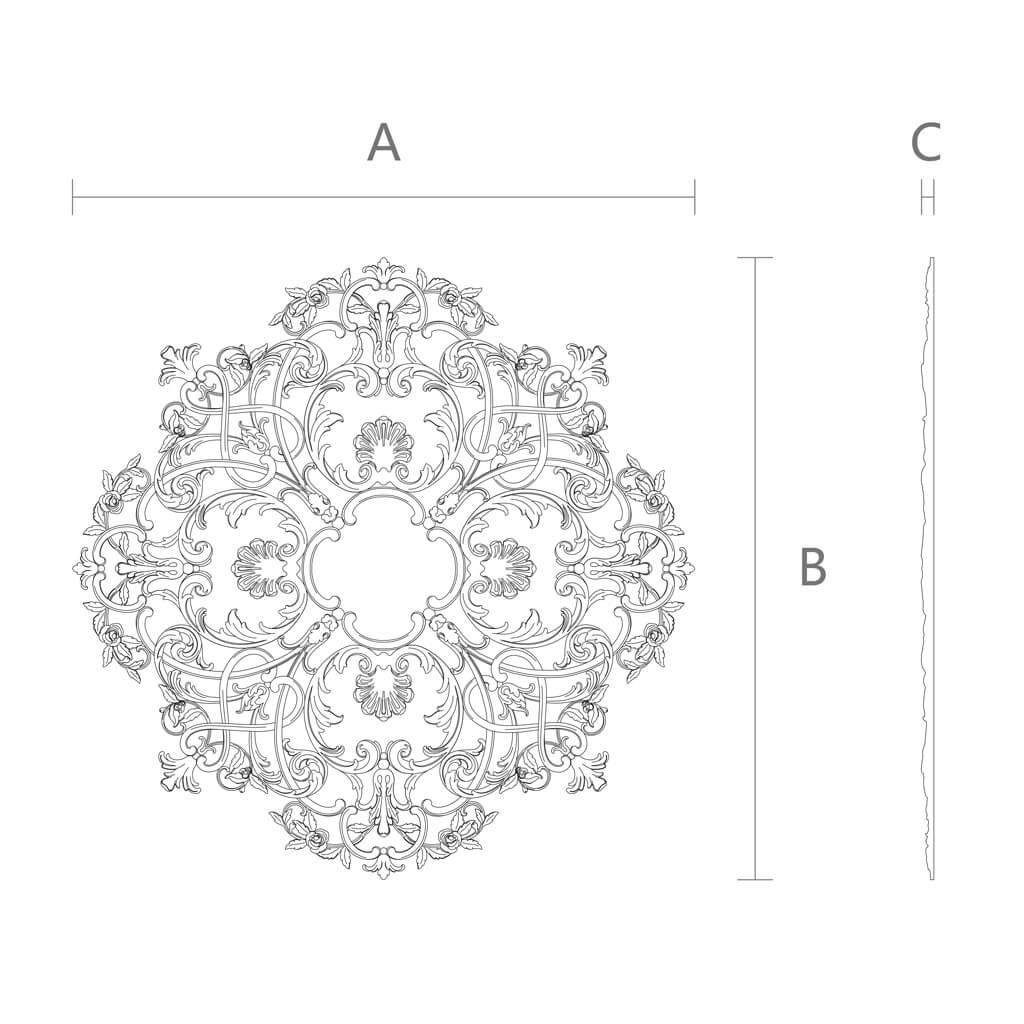
The finished rosette measures 911 × 911 × 18 mm. With a width and height of over 900 mm, it is clearly visible in a spacious room, does not get lost next to a large chandelier, and can become one of the main decorative elements of the ceiling.
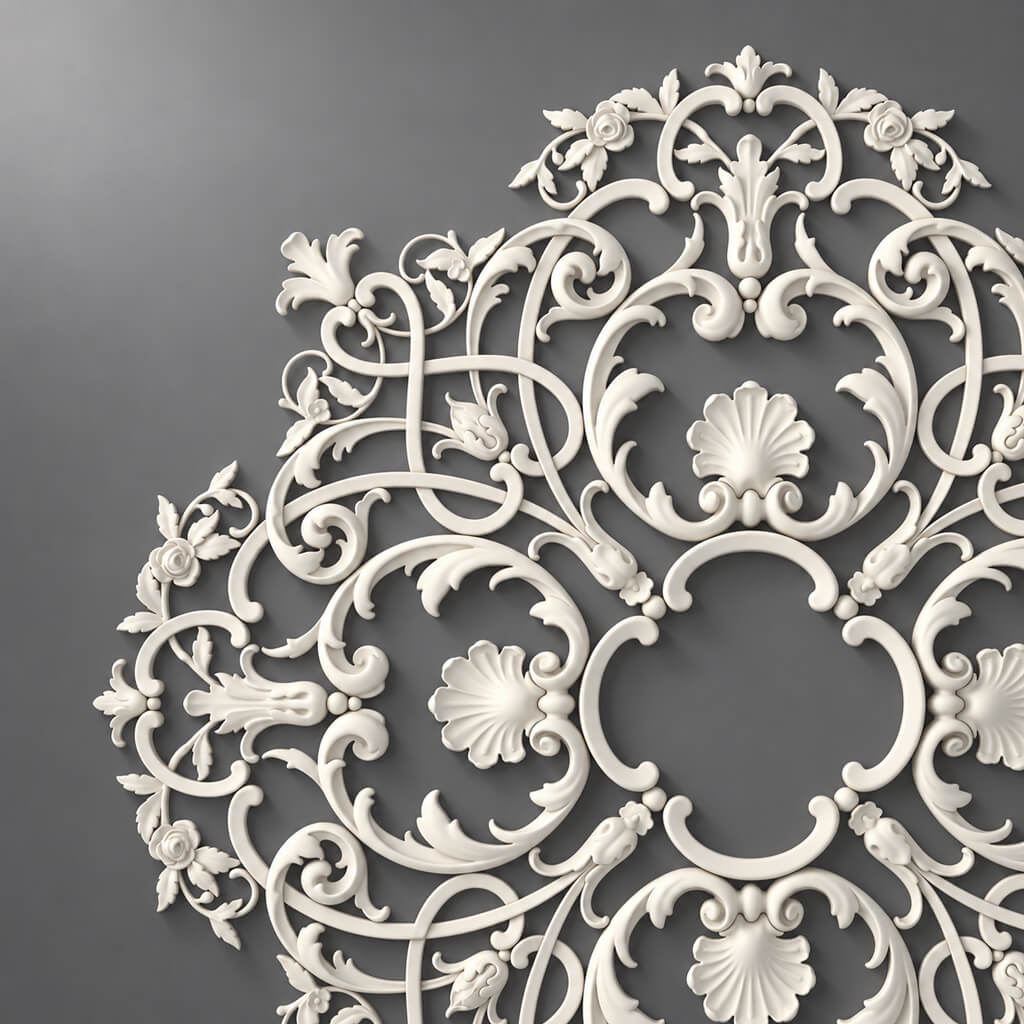
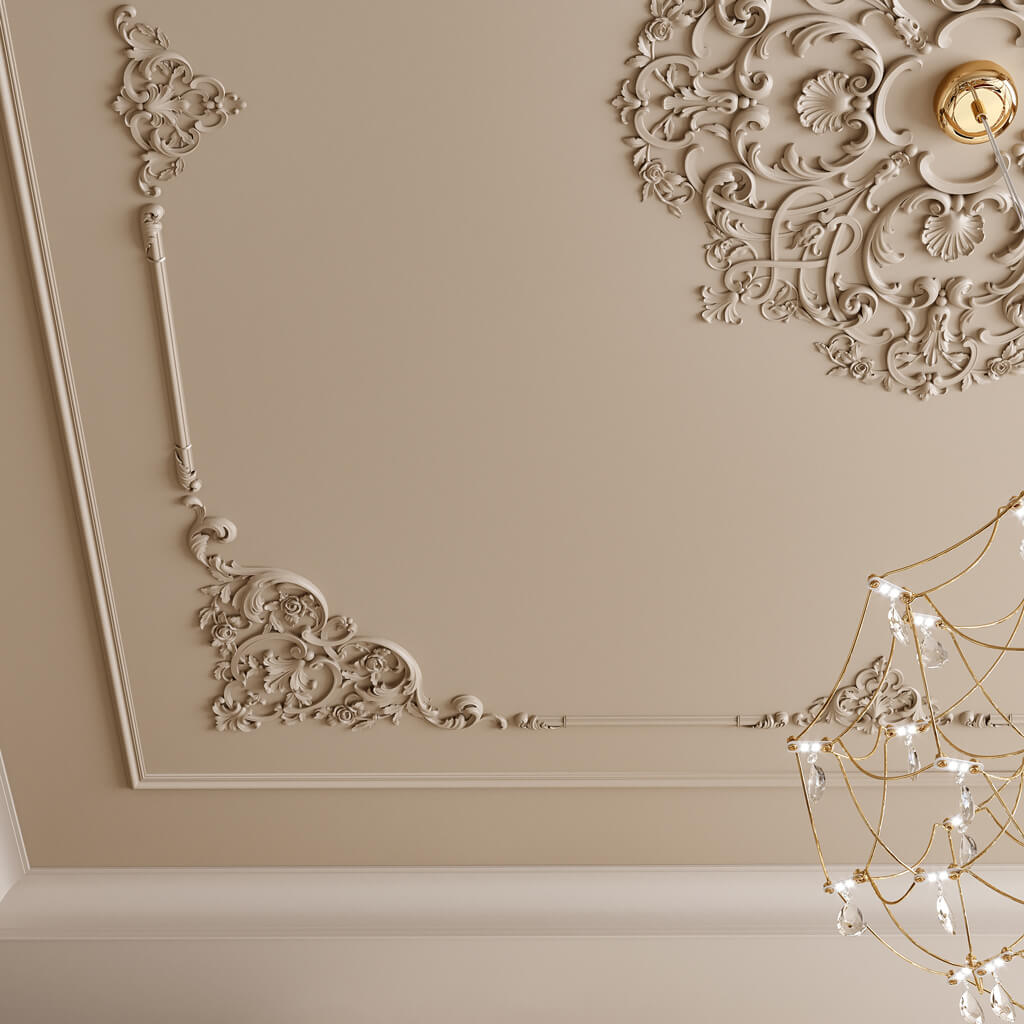
The pattern is based on radial symmetry. The composition repeats roses, leaves, shells, volutes, buds, and smoothly intertwining plant lines. Open areas are preserved between the relief details, through which the ceiling surface is visible. Due to this, the large ceiling rosette looks openwork and is not perceived as a heavy solid panel.
RPU.VRS-001 is a composite rosette. It is assembled from eight separate elements:
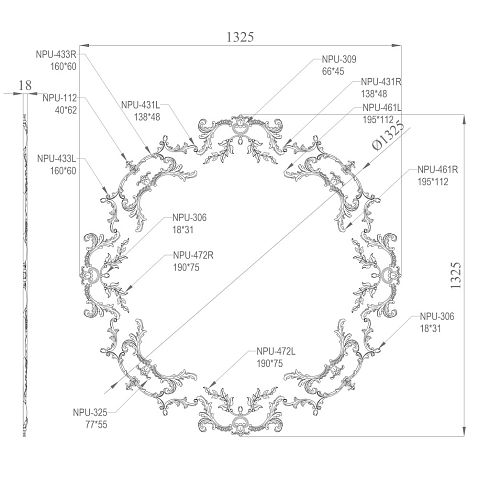
After precise layout, individual overlays form a single ornament measuring 911 × 911 mm. The modular design allows you to gradually build the composition on the ceiling, check the axes, and adjust the position of each element before final fixation.
Name: ceiling rosette RPU.VRS-001.
Material: polyurethane.
Size of finished composition: 911 × 911 × 18 mm.
Type: composite stucco ceiling rosette.
Number of elements: 8 pieces.
Composition: four NPU-507 and four NPU-508.
Ornament character: floral, openwork, symmetrical.
Main motifs: roses, leaves, volutes, shells, buds, and intertwining stems.
Application: decor around the chandelier, ceiling medallion, design of a coffered or central ceiling panel.
Finish: the product can be included in projects for painting, patination, gilding, and other compatible decorative solutions.
The size 911 × 911 mm must be considered at the lighting design stage. It is advisable to choose the rosette simultaneously with the chandelier to coordinate in advance the diameter of the ceiling bowl, cable routing, mounting plate or hook, and free space in the center of the composition.
RPU.VRS-001 is formed from two types of polyurethane stucco decor. Each element has its own complete pattern, but within the rosette it performs a specific compositional function.
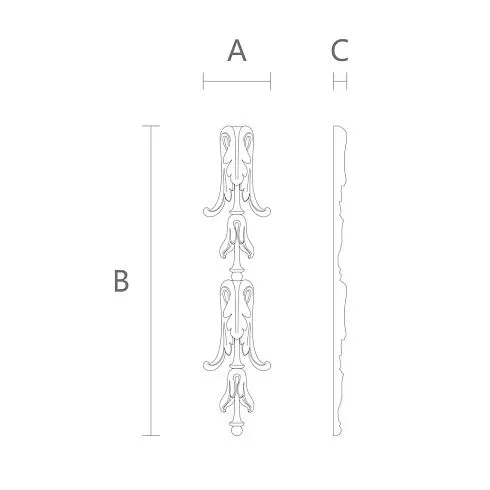
The set includes four NPU-507 overlays measuring 392 × 336 × 18 mm.
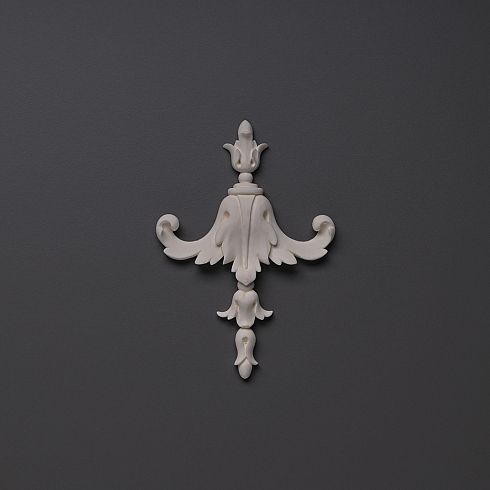
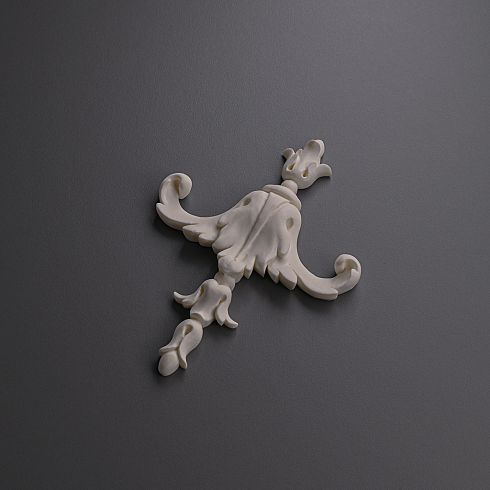
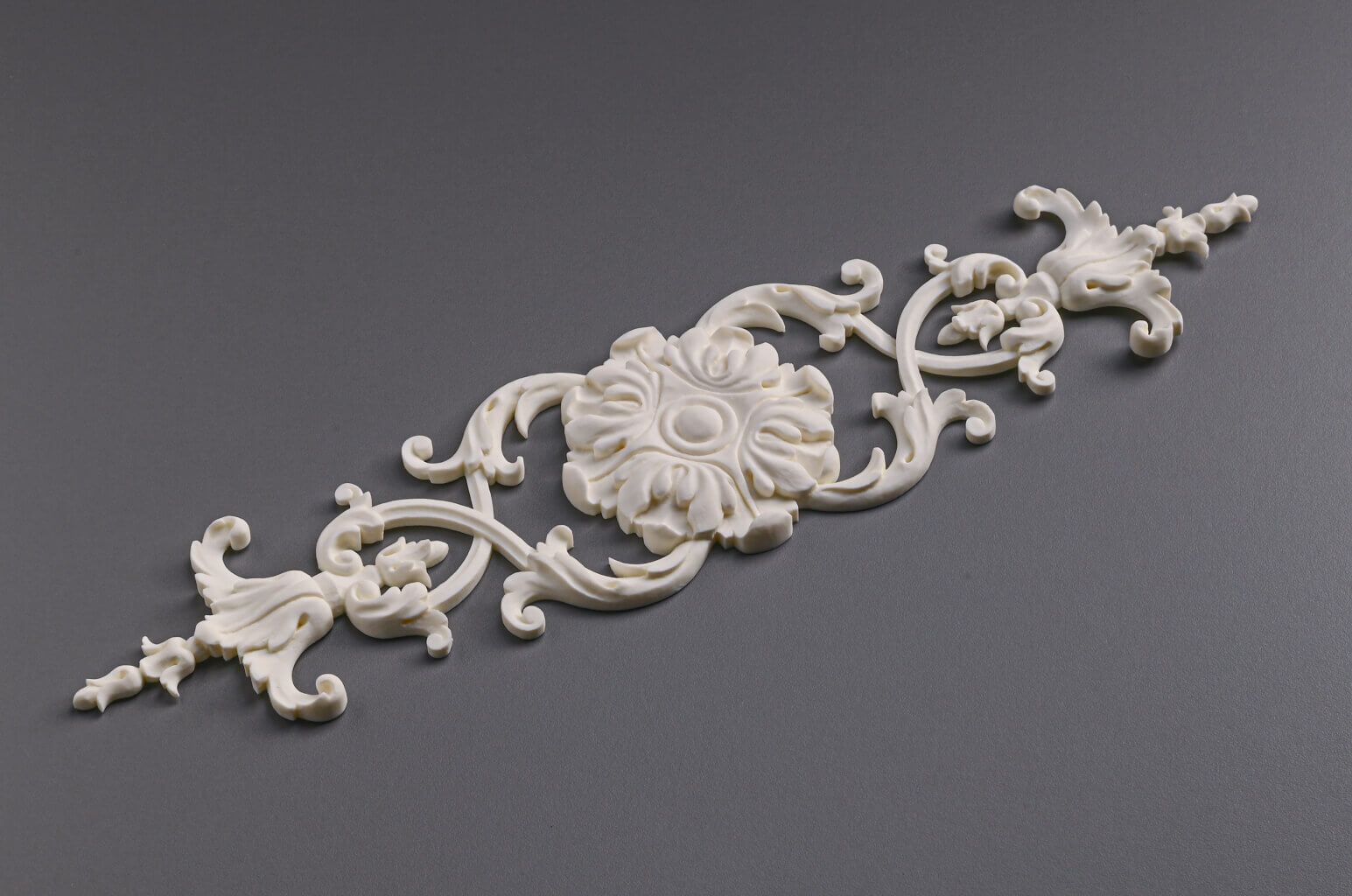
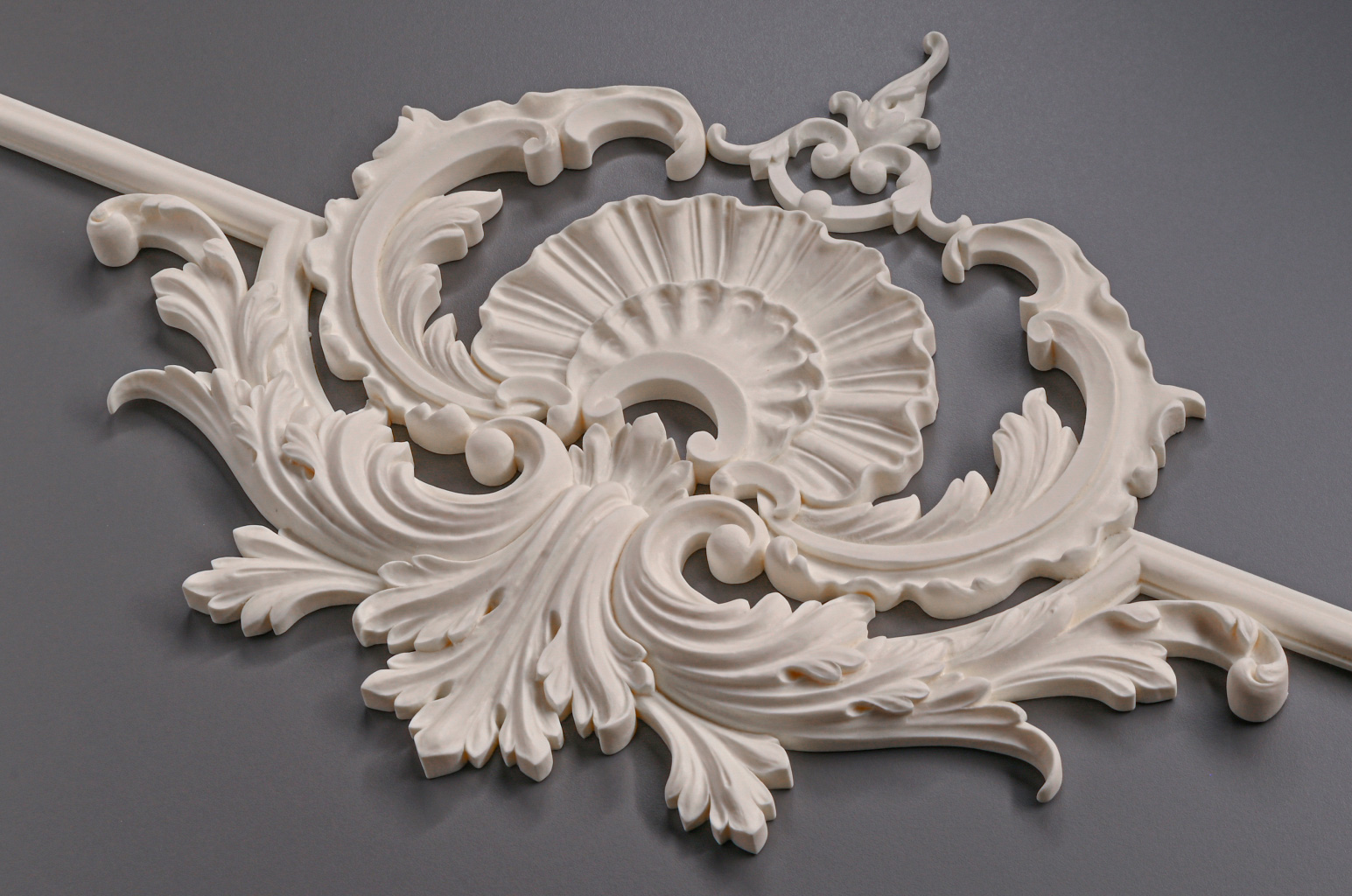
NPU-507 has an elongated vertical composition. At the top are two roses with leaves and a central floral finial. Below are large volutes transitioning into a rounded area with leaves and a decorative shell.
In the finished rosette, four NPU-507 are positioned along the main directions:
These elements form the main vertical and horizontal axes. Their rounded parts create the inner petals of the overall composition, while roses and leaves participate in the design of the outer contour.
Each NPU-507 is rotated relative to the center of the rosette. Therefore, identical overlays create four coordinated ornamental fields directed toward a common central point.
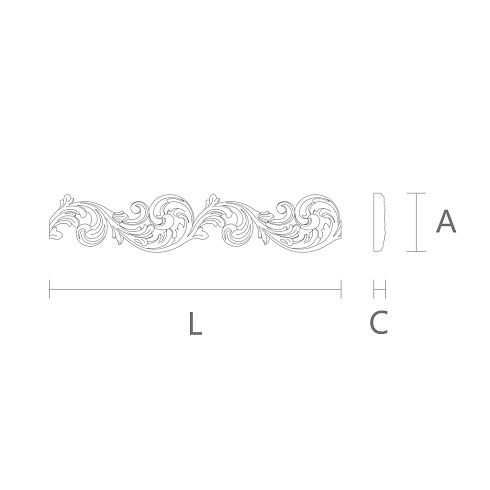
The set also includes four NPU-508 overlays measuring 369 × 419 × 18 mm.
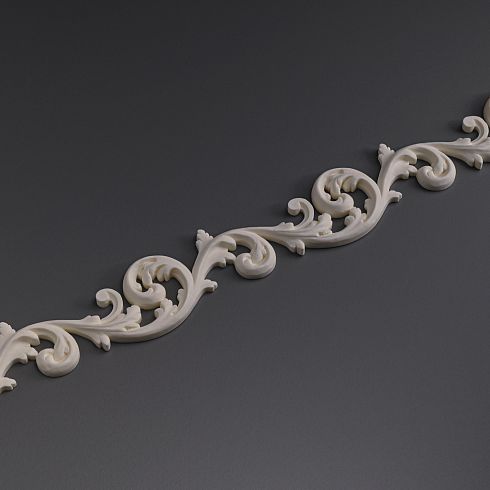
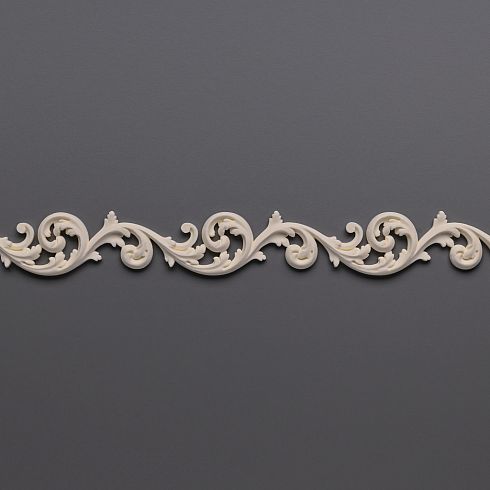
NPU-508 has a wider openwork structure. Its pattern consists of intertwining lines, side volutes, leaves, a palmette, and an elongated central finial.
In the RPU.VRS-001 composition, NPU-508 elements are placed diagonally. They fill the space between the four main NPU-507 overlays and unify the composition into a single circular ornament.
The intertwining lines of NPU-508 create a complex external pattern. Thanks to them, the rosette does not look like four repeating medallions, but like a solid openwork system with continuous movement of stems and volutes.
The main feature of RPU.VRS-001 is the thoughtful combination of two different ornaments.
NPU-507 creates large rounded motifs with shells and floral details. NPU-508 adds elongated lines, diagonal movement, and numerous openwork weaves. When laid out correctly, the patterns continue each other and form a cohesive radially symmetrical composition.
An open field of complex shape remains in the center. It is not overloaded with relief and can be used to place a chandelier ceiling cup, if its dimensions match the actual free area. The exact diameter and shape of the available space must be checked against the full-size layout, as the specific size of the central field is not specified in the characteristics.
Around the center, four large rounded ornaments are located. Further, the pattern expands with volutes, plant shoots, and intertwining ribbons. The composition is completed along the outer contour with roses, leaves, buds, and palmettes.
The rosette has no heavy solid frame. Its border is formed by the plant elements themselves. Therefore, RPU.VRS-001 softly transitions into the ceiling plane and retains a sense of openwork even at a size of almost one meter.
The main purpose of RPU.VRS-001 is to decorate the chandelier installation area.
A chandelier without a decorative frame can be perceived as a separate technical object, especially on a large smooth ceiling. A stucco ceiling rosette creates a transition between the light fixture and the room's architecture, emphasizes the center, and helps unify the lighting with cornices, moldings, doors, and wall panels.
RPU.VRS-001 is suitable for:
Before ordering, it is necessary to check the dimensions of the ceiling cup. A cup that is too large may overlap part of the central ornament or press against the internal elements of the rosette. A cup that is too small may look disproportionate against a composition measuring 911 × 911 mm.
You cannot rely solely on the diameter of the chandelier itself. The following also matter:
It is advisable to design the electrical and decorative parts simultaneously. If you install the chandelier first and then try to place eight molding elements around it, you may encounter misalignment of axes or insufficient free space.
RPU.VRS-001 can be used not only around a chandelier. Thanks to its complete design, the composition is also suitable for creating a self-standing ceiling medallion.
This application is possible:
If the rosette is used without a chandelier, the central field can be left open and painted together with the ceiling. In this case, attention is completely focused on the floral ornament.
Another option is to place a decorative ceiling insert or a small medallion inside the composition, provided by a separate project. Before such an addition, it is necessary to ensure that the new detail does not overlap the volutes and maintains symmetry.
In the living room, the rosette can be placed above the coffee table, seating group, or the compositional center of the room.
RPU.VRS-001 looks particularly expressive in an interior where the following are already used:
If the living room is combined with the dining room, a rosette can highlight a specific functional area. In this case, the center of the composition is determined not only by the boundaries of the room but also by the arrangement of furniture.
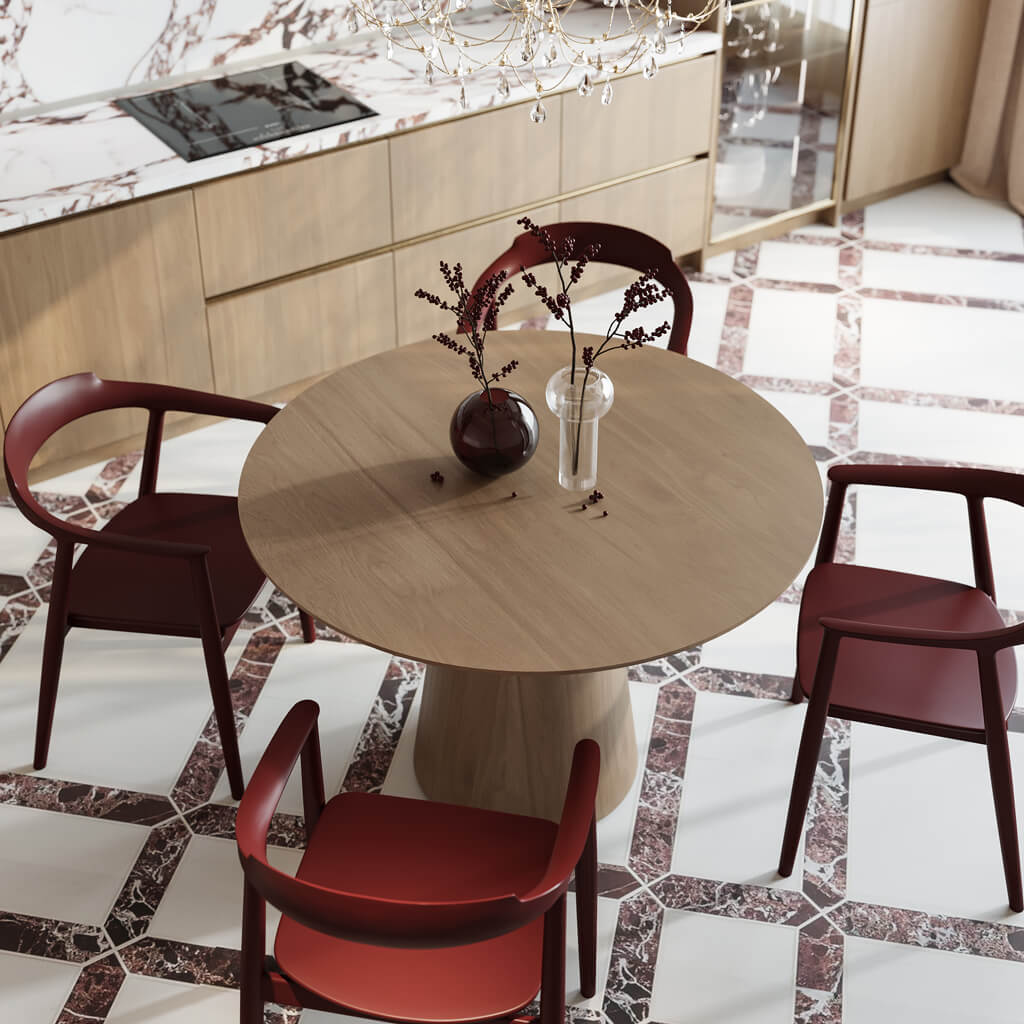
The radial structure of RPU.VRS-001 pairs well with a round or oval table. The chandelier and ceiling rosette form a single vertical composition above the dining area.
With a rectangular table, it is necessary to check whether the square rosette looks too compact relative to the length of the tabletop. In some projects, it can be complemented with an elongated molding frame that connects the central decor with the proportions of the room.
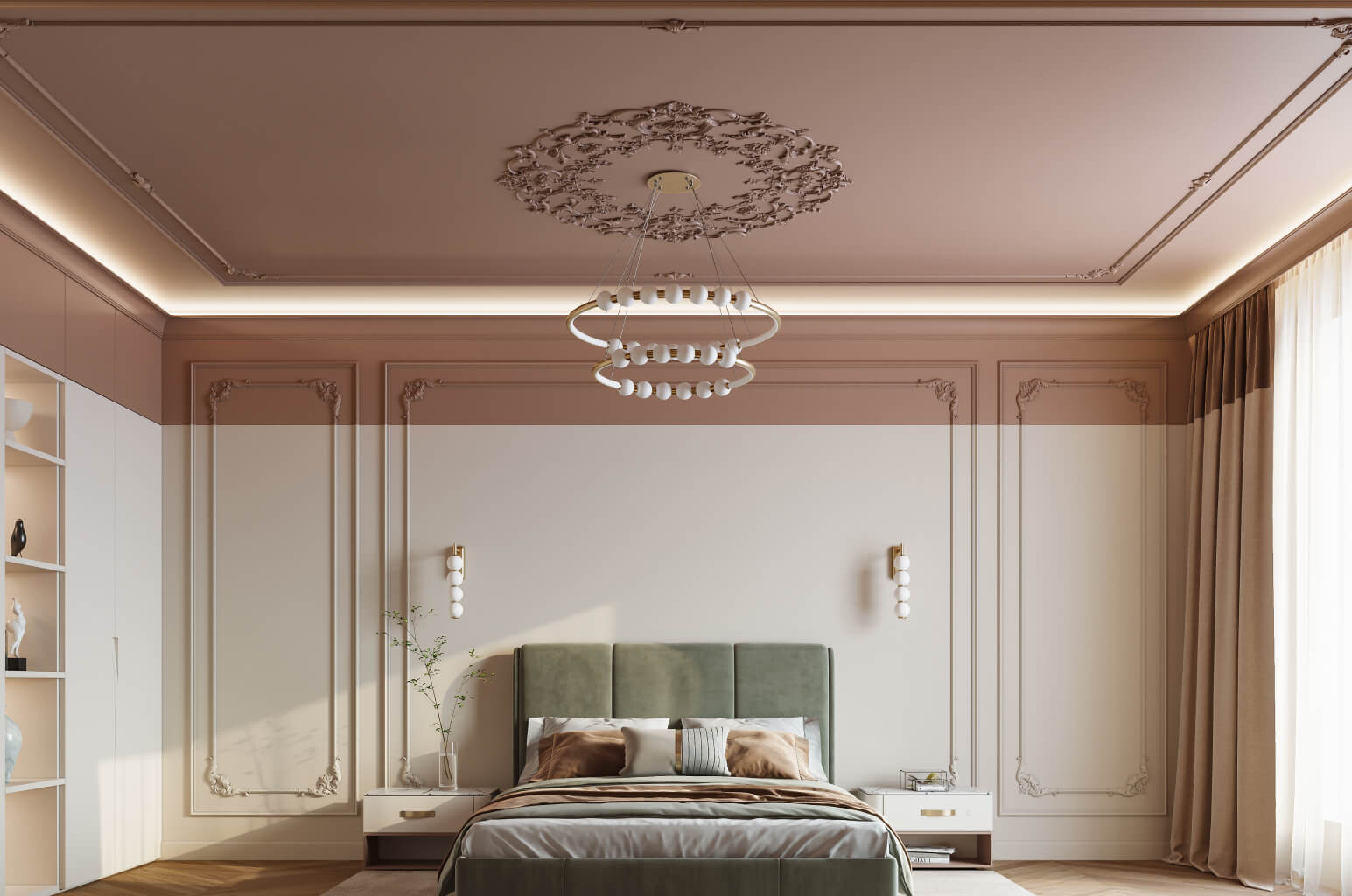
In the bedroom, RPU.VRS-001 can be used above the central chandelier or in the bed area.
Monochrome painting in the color of the ceiling makes the complex ornament more subdued. The rosette retains its volume but does not create an overly bright accent.
For a more decorative interior, individual shells, roses, and volutes can be highlighted with a soft patina or a light metallic effect.
In the study, a ceiling rosette can complement classic cabinets, wall panels, a desk, and decorative doors.
For a restrained interior, painting it the color of the ceiling or a darker monochrome option is suitable. With side lighting, openwork details will create a noticeable play of shadows.
In a spacious hall, RPU.VRS-001 helps define the ceremonial center. It can be combined with a large chandelier, door portals, a staircase, and an expressive ceiling cornice.
In a room with high ceilings, the size 911 × 911 mm is especially useful: small decor could visually get lost, while a nearly meter-long composition remains readable even when viewed from below from a great distance.
Ceiling stucco helps create a recognizable interior for a public space. RPU.VRS-001 can be used in a restaurant hall, hotel lobby, salon, showroom, or executive meeting room.
When installing several identical rosettes, it is necessary to prepare a general ceiling plan in advance. The centers should be aligned with the arrangement of tables, light fixtures, doorways, and architectural axes.
Roses, shells, leaves, and volutes correspond to traditional classical ornamentation. RPU.VRS-001 can be combined with ceiling cornices, moldings, paneled doors, and a classic chandelier.
The most versatile solution is painting it the color of the ceiling with a delicate emphasis on the relief.
In a neoclassical interior, the intricate pattern is usually styled restrainedly. A white, milky, light beige, or gray-beige rosette becomes part of the ceiling architecture.
A monochrome coating reduces the decorative activity of the ornament but preserves its volume and symmetry.
For a Baroque interior, more expressive solutions are suitable:
RPU.VRS-001 contains enough details to become the central element of a formal composition.
Roses, flexible stems, and associatively light weavings well support the Rococo style.
Light shades, soft gold, creamy enamel, and delicate patina without sharp dark contours are suitable for this design.
A composite rosette can be used in interiors with high doors, thin wall moldings, light furniture, and classic light fixtures.
The smooth outer contour allows it to be combined with delicate perimeter decor without creating a rigid boundary.
RPU.VRS-001 can also be used in a modern space as a contrasting classic element.
For example, a complex white rosette can be on a smooth colored ceiling, with a minimalist modern light fixture in the center. This technique is based on a deliberate contrast between ornament and simple geometry.
Monochrome finishing is the most versatile way to incorporate a large polyurethane ceiling rosette into an interior.
When RPU.VRS-001 and the ceiling are painted in the same shade, the individual overlays visually merge. The composition is perceived as a cohesive architectural molding, not as a set of details.
Suitable for monochrome design:
On a light ceiling, the ornament looks lighter. On a dark base, the relief becomes more graphic, especially with directional lighting.
It is important to monitor the thickness of the finishing coating. RPU.VRS-001 has many thin leaves, grooves, flower petals, and narrow openwork openings. An excessive layer of primer or paint can visually smooth out small details.
The rosette can be highlighted relative to the ceiling.
Possible combinations:
The contrast emphasizes the openwork outline and allows the composition to be seen from a great distance.
When choosing a color, the chandelier must be taken into account. The shade of the rosette can match the metal of the fixture, its ceiling bowl, furniture hardware, or other decorative details.
Patina helps enhance the depth of a complex relief.
On a light base, gray, beige, brown, gold, or bronze shades can be used. The compound remains in the recesses between petals, around leaves, and inside volutes.
The pattern becomes more readable, but moderation is important. RPU.VRS-001 already contains a large number of lines. If each recess is darkened too much, the composition may appear fragmented.
For a soft effect, patina is used only in the deepest areas or the protruding edges are slightly highlighted with a dry brush.
Before processing the full set, it is advisable to test on a separate sample of compatible material.
Ceiling rosette RPU.VRS-001 is suitable for full or partial decorative gilding.
A fully gold ornament is appropriate in formal and palace interiors. In a more restrained design, only individual elements can be highlighted:
Instead of a golden effect, you can use:
Partial gilding is especially expressive on a white, green, blue, burgundy or graphite base.
RPU.VRS-001 can be used independently or within a more complex ceiling layout.
The composition is combined with:
A square or round frame can be formed around RPU.VRS-001.
The square frame supports an overall dimension of 911 × 911 mm. The circular one emphasizes the radial development of the ornament. In both cases, free space must be left between the outer rosettes and the molding.
If the profiles are placed too close, the outer leaves and curls will visually collide with the frame. The rosette will lose its openwork quality and begin to look cramped.
It is difficult to correctly assess an almost meter-long composition from an on-screen image. Before ordering, it is recommended to transfer the size to the ceiling.
For a preliminary check, you can:
It is especially important to assess the distance to the ceiling cornice. The outer contour of RPU.VRS-001 has protruding roses and leaves, so the free field is measured from the farthest points of the ornament.
On a large ceiling, the rosette may look more compact than expected. In a small room, the same size can become dominant. The decision is made based on the actual layout, not just the numbers on the product card.
The ceiling must be level, strong, clean, and suitable for the chosen method of fixation.
Before starting work, it is necessary to check:
If the ceiling has noticeable unevenness, individual elements may fit differently. This will disrupt the overall pattern and create uneven shadows. The base is prepared before marking the rosette.
Do not use the existing wire as the only guide. The electrical outlet may be offset relative to the furniture or architectural center of the room. First determine the design point, then check the electrical alignment.
For a composite rosette, the installation template is especially important.
It must indicate:
First, perform a dry layout without final fixation. All elements are applied to the ceiling or laid out on a full-size horizontal surface.
This allows you to check:
Only after verification can you proceed to installation.
It is convenient to start with NPU-507 elements that form the main axes.
First, you can install:
After that, four diagonal NPU-508 are placed between them.
A different order is possible if a common stencil or temporary mounting scheme is used. The main thing is to recheck symmetry after fixing each element.
You cannot first install four parts "by eye" and then try to fill the remaining gaps. An error at the initial stage will lead to misalignment of diagonal elements and a change in the outer contour.
The specific fastening method is selected considering the polyurethane, base material, socket location, and operating conditions.
Installation materials must be compatible:
Thin openwork parts cannot be used as strong pressure points. Pressure is distributed over wider and more stable areas of the ornament.
During installation, it is necessary to ensure that the compound does not get on the front surface and does not fill narrow openings. Excess is removed before final drying according to the technology of the selected material.
Since the work is performed overhead and includes eight large elements, a reliable work platform is required. Installation by two people usually allows for more accurate holding of the overlay and checking it against the markings.
Both options are possible.
Pre-finishing is convenient if you plan:
Each overlay can be rotated and painted at a convenient angle. However, after fixing, local treatment of joints and masking of attachment points may be required.
This method is suitable for a monochrome socket matching the ceiling color.
After installation, the eight elements and the base are painted together, making the composition appear seamless. The joints become less noticeable.
The drawback is difficult access to the inner sides of the openwork curls. Care must be taken to ensure paint does not accumulate in the lower parts of the relief.
Hard-to-reach edges can be pre-treated, elements installed, joints finished, and a final topcoat applied.
The order of work is determined in advance to avoid damaging the finished decorative finish during installation.
The thickness of the socket is 18 mm. The relief is well revealed by light and shadow.
With uniform diffused lighting, the composition appears softer. Side lighting emphasizes volutes, leaves, and intertwining lines more strongly.
If the chandelier directs light primarily downward, the ceiling stucco may remain less illuminated. In this case, additional lighting of the cornice or ceiling panel helps reveal the details.
The direction of light must be considered before choosing the finish. For example, deep patina in low light can make the ornament too dark, while a light monochrome coating will preserve readability.
The image does not reflect the actual scale of 911 × 911 mm. Full-size marking must be done before ordering.
The ceiling bowl may overlap the central ornament or be too small relative to a large rosette.
Eight elements cannot be installed correctly without vertical, horizontal, and diagonal markings.
The cable outlet does not always align with the center of the room or furniture composition.
Outer roses, leaves, and palmettes require free ceiling space.
Different distances between identical elements immediately disrupt radial symmetry.
Excess primer or paint hides petals, recesses, and fine weaves.
Narrow decorative lines cannot be used as main pressure points.
Peeling coating does not provide reliable fixation of ceiling decor.
If eight parts are painted in separate batches, the shade and gloss level may vary. For a cohesive result, a single technology is used.
The ceiling socket can be used by:
RPU.VRS-001 is especially suitable for projects where a large ready-made ornament is required, but using a single solid panel is undesirable. The composite system creates a complex pattern while preserving openwork sections of the ceiling.
RPU.VRS-001 is suitable if you need:
The model may not be suitable for a very small space, low ceiling, or a project where ornamental elements are completely excluded. The decision is made after checking the actual scale.
The size of the assembled ceiling rosette is 911 × 911 mm. The maximum relief thickness is 18 mm.
All elements of the kit are made of polyurethane.
The socket is assembled from eight overlays: four NPU-507 and four NPU-508.
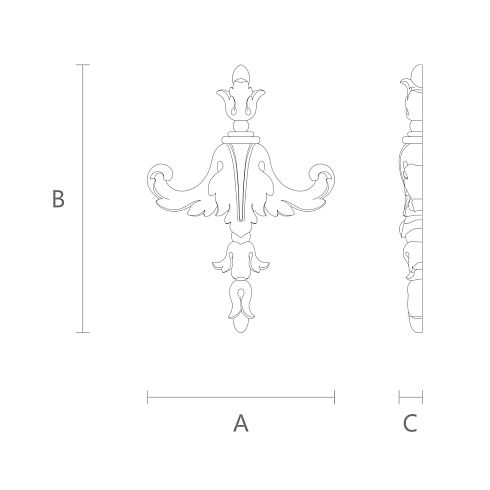
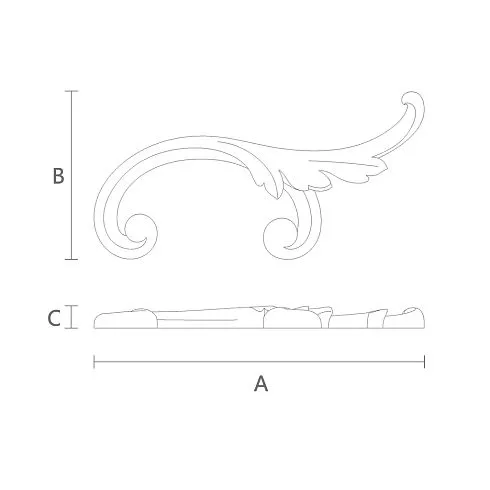
The size of one NPU-507 element is 392 × 336 × 18 mm.
The size of one NPU-508 element is 369 × 419 × 18 mm.
No. RPU.VRS-001 is a composite ceiling composition. Individual parts are installed according to a prepared scheme.
Yes, this is one of the main purposes of the model. The size of the ceiling bowl and the position of the light fixture mounting must be checked before installation.
The center is formed by the arrangement of eight separate elements. The size of the free field must be determined based on the actual layout and compared with the chandelier.
Yes. The composition can function as an independent ceiling medallion.
The rosette can be included in the project for painting. The preparation and finishing system must be compatible with polyurethane and the base.
Yes. A monochromatic design visually unifies the individual elements into a cohesive architectural composition.
Yes. Full or partial decorative gilding is possible, as well as the use of bronze, silver, or other metallic effects.
For a composite rosette, a full-size template is extremely important. It helps to correctly position the eight elements and check the chandelier.
A significant change in gaps will affect the size and proportions of the ornament. Any adjustment must first be checked on a full-size layout.
Yes, provided that the central cell is of sufficient size and there is a free field around the outer contour.
The sequence depends on the design of the light fixture and the installation technology. It is important to maintain access to the electrical connection and the chandelier mounting.
The composite composition requires precise marking and reliable ceiling mounting. Professional installation is preferred to achieve an even, symmetrical pattern.
Ceiling rosette RPU.VRS-001 is designed for projects where the ceiling should become a full part of the interior architecture. The size 911 × 911 × 18 mm allows the composition to be used around a large chandelier, inside a coffer, or as a standalone decorative medallion.
The rosette is assembled from four NPU-507 elements and four NPU-508 elements. After proper layout, eight separate overlays form a complete radially symmetrical ornament with roses, shells, leaves, palmettes, and intertwining volutes.
The openwork structure preserves open areas of the ceiling, so the large decor appears lighter than a solid panel. The polyurethane construction allows the composition to be included in a project for solid color painting, contrasting finish, patination, or gilding.
Before ordering, it is necessary to check the room dimensions, ceiling height, chandelier parameters, electrical outlet position, and distance to cornices. A full-size installation diagram will help accurately position each element and maintain symmetry.
RPU.VRS-001 is suitable for living rooms, dining rooms, bedrooms, studies, halls, restaurants, hotels, and other interiors that require large-scale ceiling decor, classic floral ornament, and expressive central zone design.
Our manager will contact you within 5 minutes