Article Contents:
- Why a mirror wall without a substantial skirting board looks 'unfinished'
- The problem of visual lightness
- Lack of scale
- Loss of functionality
- High floor skirting board + large framed mirror panels: the formula for a boutique interior
- Skirting board: height 120–200 mm
- Mirror Panels: Size and Layout
- Unity of Material and Finish
- Technique: making mirror frames and skirting board profiles from the same wood species
- Choice of wood species
- Profile coordination
- Unity of finish
- How to create a 'boutique' feel through skirting board height and mirror size
- Scale as a sign of status
- Proportions: balance between skirting board height and mirror size
- Rhythm and Repetition
- Bottom lighting: LED strip along the skirting board + reflections in mirrors
- Technology: hidden LED strip
- Light color selection
- Control and adjustment
- Color solutions: dark wood + warm light, light wood + cool light
- Dark wood + warm light = classic luxury
- Light wood + cool light = modern elegance
- Neutral wood + neutral light = universal harmony
- Where this technique works best: dressing room, hallway, corridor, showroom
- Dressing room: mirrors as function + decor
- Entryway: First Impression
- Corridor: visual expansion
- Showroom: product presentation
- Where the technique does NOT work
- Bedroom: excess of reflections
- Living room: competition with the TV
- Kitchen: practicality above all
- Frequently Asked Questions
- Conclusion: luxury is in the details

Step into a luxury brand boutique — and you immediately feel: this is expensive, this is premium. What creates this impression? Not just the branded clothing on hangers. It's the interior that speaks the language of architecture: floor-to-ceiling mirrored walls reflecting space and light,tall wooden baseboardscreating a powerful 'architectural base,' lighting that transforms ordinary surfaces into glowing planes. This technique — combining a mirrored wall with a tall baseboard — can be recreated at home, creating a boutique feel in an entryway, walk-in closet, or hallway.
Why does this work? Because a mirror without architectural framing looks unfinished, as if hanging in a void.high baseboardcreates a foundation, a visual platform on which the mirror 'stands.' This is not just a functional element protecting the wall-floor junction — it's the architectural foundation of the composition, transforming the mirror from an accessory into an interior event.


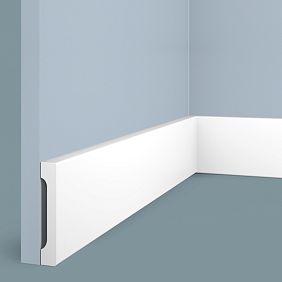
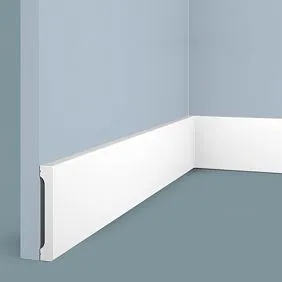
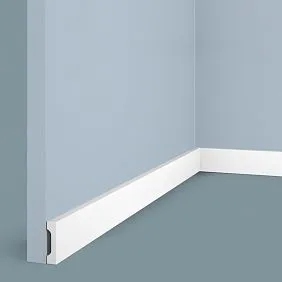
Why a mirrored wall without a substantial baseboard looks 'unfinished'
Imagine a painting without a frame. The canvas hangs on the wall, the colors are bright, the composition is expressive, but something is missing. It lacks a frame that separates the artwork from the surrounding space, creates a boundary, and focuses attention. The frame doesn't just decorate — it completes the painting, giving it the status of an art object.
The same goes for a mirrored wall. A large mirror or several mirror panels covering a wall from floor to ceiling is an impressive solution. The mirror reflects light, doubles the space, creates a play of reflections. But if at the bottom of this mirror there's a standard thin baseboard 60–70 mm high — the composition falls apart.




The problem of visual lightness
A mirror is a visually light, almost weightless material. It reflects the surrounding space, dissolves into it. A mirror has no inherent mass, materiality, or weight. This is good when lightness is needed, but bad when solidity is required.
A thin baseboard under a mirrored wall doesn't provide sufficient visual support. The mirror seems to float, lacking a foundation. This looks unstable, unfinished, like a building without a plinth. The brain reads this composition as incomplete, lacking architectural logic.
Our factory also produces:


Lack of scale
In expensive interiors — boutiques, hotels, residences — elements have scale. Doors are tall (2.4–2.7 meters), baseboards are wide (120–200 mm), moldings are large. This scale creates a sense of grandeur, spaciousness, luxury.
Standard elements (2-meter doors, 60 mm baseboards) create a feeling of a typical apartment, budget housing. When a mirrored wall — a premium element — appears in such a space but is surrounded by standard details, dissonance arises. The mirror tries to say 'luxury,' while the thin baseboard says 'economy.' The conflict ruins the impression.
Get Consultation
Loss of functionality
A mirrored wall is not just decor, but also a practical solution. Mirrors reflect light, making a room brighter. But if the baseboard is thin, light-colored, inconspicuous — it doesn't participate in this play of light. The possibility of lighting is lost because there's nowhere to integrate the lighting.
A wide baseboard120–150 mm high has sufficient depth for concealed installation of an LED strip. Light directed upward along the mirrored wall reflects, doubles, creates a glowing effect. This transforms an ordinary mirror into a light object, the focal point of the composition.
Tall floor baseboard + large framed mirror panels: the formula for a boutique interior
The secret to the boutique feel lies in the combination of element scale. Not just a mirror, but a large mirror or a composition of several mirror panels. Not just a baseboard, buthigh wooden baseboardthat creates a powerful foundation.
Baseboard: height 120–200 mm
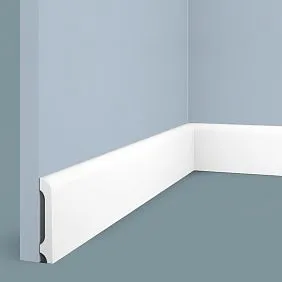
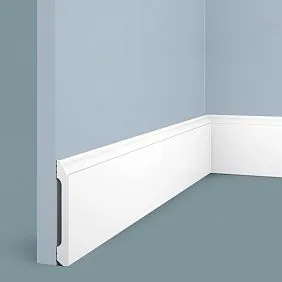
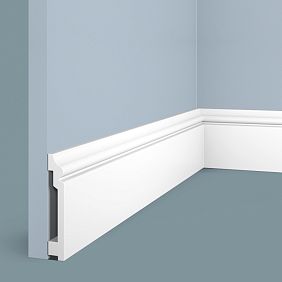
For a boutique effect, the baseboard must be tall — at least 120 mm, optimally 140–160 mm, in high-ceilinged rooms (ceilings 3+ meters) up to 200 mm. This height creates a visual 'plinth,' an architectural foundation on which the entire wall composition is built.
The baseboard profile can be simple (a rectangular plank with a bevel) or complex (multi-stepped with coves, as in classic interiors). The choice depends on the style: for a modern minimalist boutique — a simple profile; for a classic one — a figured profile.
Material — solid wood. No MDF, no polyurethane. Only natural wood — oak, ash, beech. Wood creates a sense of quality, durability, status. In expensive boutiques, they don't skimp on materials, and neither should your interior.
Mirror panels: size and layout
A mirrored wall can be executed in two ways:
Single sheet: One large mirror covering the entire wall (or a significant part of it) from baseboard to ceiling. This creates the maximum space-expanding effect, a continuous reflection. Technically more challenging (a large mirror is heavy, requires sturdy mounting), but visually the most impressive.
Panel composition: Several mirror panels (usually rectangular, vertical) placed side by side, creating a mirrored wall. Each panel has a frame made of wood of the same species as the baseboard. This is a more architectural solution: the frames create rhythm, division, and structure the wall.
The size of panels for a boutique effect should be large: width 60–80 cm, height 180–220 cm (depending on ceiling height). Small mirrors create fragmentation and lose scale.
Unity of Material and Finish
Key point:mirror framesand the baseboard should be made from the same wood species, the same color, and preferably the same profile (if the baseboard is shaped — the frames should be too; if it's simple — the frames should be simple). This creates visual unity, harmony, and a sense of thoughtfulness.
Imagine: a baseboard made of dark oak with matte oil, 140 mm high, with a classic profile. Above it — three mirror panels in frames made of the same dark oak, with the same profile as the baseboard. The frames and baseboard are visually connected, creating a unified architectural composition. This looks like a specially designed solution, not a random set of elements.
Technique: making mirror frames and the baseboard profile from the same wood species
This technique is used by professional designers in premium interiors. Material unity of elements creates harmony that the brain perceives as a sign of quality and thoughtfulness.
Choice of wood species
Oak: A classic in premium interiors. Dense, hard, with expressive texture. Color ranges from light golden (natural oak) to dark brown (fumed oak, stained oak).oak baseboardand frames made of oak — a choice for classic, neoclassical, and English interiors.
Ash: Lighter than oak, with a more pronounced annual ring pattern. Density comparable to oak. Ash is good for modern interiors where lightness is needed without losing material expressiveness.
Beech: Pinkish hue, uniform texture without pronounced pores. Beech creates a calm, neutral background. Good for interiors where wood plays a secondary role, not competing with other elements.
Walnut: Dark, noble, with characteristic contrasting veins. Walnut is a choice for luxurious interiors where every detail should speak of status.
Profile coordination
Ifthe baseboard has a shaped profile(stepped, with beads, with carved elements) — mirror frames should repeat this profile or its elements. Exact copying is not necessary, but a visual connection should be present.
For example: a baseboard with two steps and a rounded top edge. The mirror frame — with the same rounding and a similar step. This creates rhythm, repetition, and harmony.
If the baseboard is simple (a flat plank with a bevel) — the frames should also be made simple and laconic. No carved frames with a simple baseboard — this is a style conflict.
Unity of finish
The color and type of coating for the baseboard and frames must match. If the baseboard is coated with dark oil (oil emphasizes the wood texture, creates a matte surface) — the frames are coated with the same oil. If the baseboard is painted with white enamel — the frames are also white.
Mismatched finishes destroy unity. A baseboard with glossy varnish + frames with matte oil — this is visual dissonance, even if the wood species is the same.
How to create a 'boutique' feel through baseboard height and mirror size
A boutique feel is a sense of space, quality, and attention to detail. It is created not by a single element, but by a combination of parameters.
Scale as a sign of status
In standard apartments, everything is standardized: doors 2 meters, baseboards 60 mm, ceilings 2.6 meters. This is a product of mass construction, where economy is important, not individuality.
In premium interiors, the scale of elements is increased. This signals: no expense was spared here, the result is important. A tall baseboard (120+ mm) is one of the markers of premium quality. It requires more material, more work, and costs more. But it creates an impression.
Large mirrors (180+ cm in height) are also more expensive than small ones. A large mirror requires high-quality glass without distortions, sturdy mounting, and precise installation. But it creates scale, grandeur, and a sense of spaciousness.
Proportions: balance between baseboard height and mirror size
The baseboard and mirrors should be visually balanced. A too-high baseboard (200 mm) with small mirrors (height 120 cm) will create a feeling that the baseboard dominates, 'swallows' the mirror. A too-low baseboard (80 mm) with huge mirrors (250 cm) will create a sense of fragility, insufficient support.
Optimal proportion: the baseboard height is 6–8% of the mirror height. A 200 cm mirror — baseboard 120–160 mm. A 240 cm mirror — baseboard 140–180 mm. This creates a visual balance where the baseboard is powerful enough to be a foundation, but not so much as to draw excessive attention.
Rhythm and Repetition
If a mirrored wall consists of several panels, the rhythm of their placement is important. Panels of equal width, placed at equal distances — this creates order, structure, architectural logic.
The distance between panels (the width of the pier) is usually equal to the width of the mirror frame. If the frame is 8 cm wide — the pier is also 8 cm. This creates a harmonious rhythm where the frame and the pier are visually equivalent.
Bottom lighting: LED strip along the baseboard + reflections in the mirrors
Lighting is a powerful tool for creating atmosphere. In boutiques, lighting is always multi-layered: general, accent, decorative. Baseboard lighting is one of the decorative lighting techniques that turns a utilitarian element into a light object.
Technology: hidden LED strip
high baseboardallows creating a hidden channel for the LED strip. Technically, this is done in several ways:
Option 1: The baseboard is mounted with an offset from the floor (by 3–5 cm). Behind it, on the wall — an LED strip, directed downwards. The light comes from under the baseboard, creating a 'floating' baseboard effect. Mirrors reflect this light, doubling it, creating a halo around the base of the wall.
Option 2: The baseboard has a special profile with a recess in the upper part, where the LED strip is mounted, directed upwards. The light runs along the wall (and the mirror surface), creating a light strip. Mirrors enhance this effect by reflecting the light.
Option 3: Combined lighting: LED strip both from below (under the baseboard) and from above (in the baseboard recess). This creates a maximum lighting effect, where the baseboard seems to glow from all sides, and the mirrors reflect this light, doubling it.
Light color selection
Light color is critical for the atmosphere:
Warm white (2700–3000K): Creates coziness, intimacy, a homey atmosphere. Good for bedrooms, dressing rooms, hallways in classic interiors. Pairs well with dark wood (oak, walnut).
Neutral white (4000–4500K): A universal option, suitable for most interiors. Not warm, but not cold either. Good for corridors, hallways, commercial spaces.
Cool white (5000–6500K): Creates a sense of cleanliness, modernity, technological sophistication. Good for minimalist, high-tech interiors. Pairs well with light wood (ash, bleached oak) or white painted elements.
Control and adjustment
Modern LED systems allow adjusting the brightness and color of the light. A dimmer (brightness regulator) makes it possible to create different scenarios: bright lighting during the day, subdued in the evening, night lighting (minimum brightness for orientation in the dark).
RGB strips (multicolored) allow changing the lighting color depending on mood, event, season. This is a more playful option, suitable for creative interiors, but not for classic ones.
Color solutions: dark wood + warm light, light wood + cool light
The combination of wood color and light color determines the atmosphere of the space.
Dark wood + warm light = classic luxury
Baseboard and mirror frames made of dark oak (fumed, stained in wenge, chocolate). Lighting — warm white light (2700–3000K). This is a classic combination that creates a sense of luxury, coziness, intimacy.
Dark wood itself is noble, status-enhancing. Warm light emphasizes this nobility, creates golden reflections on the wood, makes the space cozy. Mirrors reflect this warm light, double it, creating an atmosphere similar to expensive hotels, restaurants, private clubs.
This combination is ideal fordressing rooms, bedrooms, classic hallways, where the atmosphere of seclusion, luxury, comfort is important.
Light wood + cool light = modern elegance
Baseboard and frames made of light ash or bleached oak. Lighting — cool white light (5000–6000K). This is a modern combination, creating a sense of cleanliness, freshness, space.
Light wood visually expands, does not create heaviness. Cool light enhances this feeling of lightness, makes the space bright, graphic. Mirrors reflect the cool light, creating a sense of infinity, depth.
This combination is ideal for minimalist interiors, Scandinavian, modern hallways and corridors, where lightness, air, visual spaciousness are important.
Neutral wood + neutral light = universal harmony
Baseboards and frames made of oak or beech in natural color (untinted, with clear oil). Lighting — neutral white light (4000K). This is a universal combination that works in most interiors, without creating a pronounced atmosphere, yet not conflicting with the style.
Natural wood is warm, but not overly so. Neutral light doesn't feel cold, but doesn't feel excessively warm either. This is a balance suitable for eclectic interiors where different styles are mixed, or for interiors that frequently change decor, accessories, and textiles.
Where this technique works best: wardrobe room, hallway, corridor, showroom
A mirrored wall with a high baseboard and lighting is not a technique for every room. There are spaces where it works perfectly, and spaces where it is inappropriate.
Wardrobe room: mirrors as function + decor
Wardrobe room— a place where mirrors are functionally essential. You need to see yourself at full height, evaluate clothing, put together an outfit. A mirrored wall in a wardrobe room is not just decor, but a necessity.
A high baseboard in the wardrobe room protects the lower part of the mirror from scratches by shoes and bags.mirror framesmade of wood complement wooden cabinets and shelves, creating material unity. Lighting along the baseboard illuminates the floor, helping to see shoes and clothing details.
A boutique-like feeling in the wardrobe room — the sensation of a personal boutique where you are both the client and the owner. This enhances the value of the space and makes the daily ritual of choosing clothes more pleasant.
Entryway: first impression
Hallway — the first thing guests see upon entering the home. The impression is formed within the first seconds. A mirrored wall with a high baseboard, lit from below — this is a wow-effect that immediately communicates: the interior here is well-considered, quality is valued here.
Functionally, a mirror in the hallway is necessary: to check your appearance before leaving, to assess your overall look. A mirrored wall (rather than a small mirror) allows you to see yourself at full height, which is convenient.
A high baseboard protects the wall from shoes, umbrellas, and bags, which inevitably brush against the lower part of the wall in the hallway. Practicality is combined with aesthetics.
Corridor: visual expansion
Corridors are often narrow, dark, and unwelcoming. A mirrored wall along one long wall of a corridor visually doubles its width. If a corridor is 1.2 meters wide — the mirror creates the illusion of 2.4 meters. This is psychologically more comfortable.
Lighting along the baseboard in a corridor serves as night lighting. There's no need to turn on bright overhead lights if you're going to the bathroom or kitchen at night — the baseboard lighting is sufficient, softly illuminating the path without straining the eyes or fully waking you up.
Showroom: product presentation
If you have a showroom at home (a space for displaying a collection of clothing, shoes, accessories, or works of art) — a mirrored wall with a high baseboard is essential. This creates the atmosphere of a professional space where the merchandise is presented appropriately.
Mirrors reflect the exhibits, visually doubling their quantity, creating an effect of abundance. Lighting draws attention and creates a play of light. A high baseboard made of expensive wood signals: premium items are sold here, no expense is spared on details.
Where the technique does NOT work
Bedroom: excess of reflections
In a bedroom, a mirrored wall can be problematic. Many people feel uncomfortable when the bed is reflected in a mirror. This creates a sensation of being watched, that someone else is in the room. From a feng shui perspective, a mirror opposite the bed is prohibited.
If you really want a mirror in the bedroom — it's better not to have a mirrored wall, but rather one large mirror on a side wall that does not reflect the bed.
Living room: competition with the television
In a living room, a mirrored wall can conflict with the television. If the mirror is opposite the TV — it reflects the screen's light, creates glare, and interferes with viewing. If the mirror is on the same wall as the TV — visual competition arises between the two dominant elements.
A mirror in the living room is possible, but not as a mirrored wall; rather as an accent element — above the fireplace, behind the sofa, but not covering the entire wall.
Kitchen: practicality above all
In the kitchen, a mirrored wall is impractical. The mirror quickly gets dirty with grease splatters, water, and cooking droplets. Cleaning a large mirror daily is tiresome. The kitchen is a functional space where aesthetics are important, but not at the expense of practicality.
Frequently asked questions
How much does it cost to implement such a technique?
Depends on area, materials, and complexity. A high baseboard made of solid oak (140 mm) costs from 3000–5000 rubles per linear meter. A mirror in an oak frame (size 60×200 cm) — from 25000–40000 rubles per piece. LED strip with a power supply — from 2000–5000 rubles for 5 meters. For a hallway of 3×2 meters, the total cost — from 80000 to 150000 rubles depending on material choices.
Can MDF be used instead of solid wood for the baseboard?
Technically yes, but visually MDF lacks the depth of texture, tactility, and nobility of solid wood. For a boutique effect, the naturalness of the material is important. MDF is a compromise if the budget is limited.
How to care for a mirror wall?
Wipe mirrors with glass cleaner once a week or as needed. Use a soft cloth (microfiber), not abrasive materials. Wipe wooden skirting boards with a dry or slightly damp cloth, renew the oil coating once a year.
Is a large wall mirror safe?
Yes, if the mounting is done professionally. Mirrors weighing more than 30 kg should be mounted with anchor fasteners into a load-bearing wall. Using tempered glass or laminated glass reduces the risk of injury in case of accidental damage.
Will the lighting be blinding?
No, if the LED strip is hidden behind the skirting board or in a profile recess. The light is directed not into the eyes, but along the wall (upwards or downwards). The reflection in the mirror is soft, diffused, and does not cause discomfort.
Can the lighting be made multi-colored?
Technically yes, using RGB strips. But for a classic boutique effect, it's better to stick to one light color (warm, neutral, or cool white). Colored lighting is appropriate in modern, creative, playful interiors.
Will a high skirting board visually reduce the room?
No, on the contrary. A high skirting board creates a clear horizontal line that visually expands the space. Combined with a mirror wall, the expansion effect is enhanced.
Where to order quality skirting boards and frames?
Contact trusted manufacturers with experience in solid wood, such as STAVROS. Quality of execution, precision of profiles, and proper wood drying are critical for durability and appearance.
Is it necessary to have unity in the profiles of the skirting board and frames?
For the maximum boutique effect — yes. Unity of material and profile creates a sense of a well-thought-out design solution, not a random set of elements. But if finding exactly matching profiles is difficult — matching the wood species and color is sufficient.
Conclusion: Luxury in the details
A boutique feel in an interior is not the result of huge investments, but the result of attention to detail, understanding how elements work together.Mirror wallis impressive on its own. But without an architectural foundation —a high wooden skirting board— it looks unfinished, hanging in a void.
A high skirting board creates a visual foundation on which the mirror 'stands'.mirror framesmade from the same wood species as the skirting board create material unity. Lighting along the skirting board turns a utilitarian element into a light object that mirrors reflect, double, and amplify.
This composition — skirting board + mirrors + light — works as a system where each element enhances the other. The result is a space that looks more expensive than it cost to create. A space where attention to detail, thoughtfulness, and quality are felt.
The company STAVROS has been producing solid wood products for interiors where quality, naturalness, and precision of execution are valued for over two decades. The STAVROS range includeshigh skirting boardsof all sizes (from 80 to 200 mm), numerous profiles (from simple to complex figured with beads and carvings), all popular wood species (oak, ash, beech, walnut) and finishing options (natural oil, tinting, painting).
STAVROS mirror frames are made from solid wood with mortise and tenon joints, ensuring strength and durability. Frame profiles are developed in accordance with skirting board profiles, allowing for compositions with complete material and visual unity. Each frame can be made to custom sizes for a specific mirror.
STAVROS technicians help develop a solution for a specific project: calculate the optimal skirting board height based on room height, select a profile that harmonizes with the interior style, recommend wood species and finish. For projects with lighting, special skirting board profiles with recesses for LED strips are developed, ensuring hidden installation and correct light direction.
STAVROS production is equipped with European machinery that allows wood processing with precision to tenths of a millimeter. This is critical for high skirting boards: any curvature, any deviation in geometry over a length of 2.5–3 meters will be noticeable, especially in combination with mirrors, which mercilessly reveal all defects.
STAVROS skirting boards and frame wood undergoes chamber drying to 8–10% moisture content, ensuring stability. High skirting boards are particularly demanding in terms of drying quality: under-dried wood at a height of 140–160 mm can cause the skirting board to warp into an arc, creating unacceptable gaps between the skirting board and the wall.
STAVROS finishing — natural oils, waxes, water-based enamels — highlights the wood grain, protects it, and preserves its naturalness. For projects where a specific color palette is important, STAVROS offers tinting to any shade based on a sample or the RAL catalog.
The STAVROS quality control service checks every skirting board and every frame before shipment: geometry (straightness, absence of curvature), surface smoothness (no chips, tears, roughness), coating uniformity (color, gloss, absence of drips). Only products meeting the highest standards are shipped to customers.
STAVROS logistics ensures careful delivery throughout Russia. Every skirting board, every frame is packaged in protective film and reinforced corrugated cardboard to prevent damage during transportation. Long-length items (skirting boards 2.5–3 meters) are packaged in wooden crates for maximum protection.
The STAVROS consulting service works at all stages of the project: from material selection to installation. Specialists help calculate the amount of material, taking into account waste for trimming, select accessories (corners, connectors, fasteners), and recommend installers with experience working with solid wood and mirrors.
STAVROS works with both private clients (apartment and house owners) and professionals (designers, architects, construction companies). For designers, STAVROS provides material samples, CAD drawings of profiles, and consultations on product application in projects. For construction companies — wholesale prices, deferred payment, priority in production of urgent orders.
STAVROS is not just a manufacturer of skirting boards and frames. It is a partner in creating interiors where details create an impression, where natural wood works for luxury, where architectural elements turn ordinary housing into a space with character, style, and a boutique-like sense of premium quality.
Contact STAVROS — and we will help create an interior where Mirror wallwitha high wooden baseboard and thoughtful lighting becomes the centerpiece, the hallmark of the space, that element that makes guests say: 'How beautiful it is here!'. An interior where details create the impression of an expensive boutique, where every element of natural wood works for the overall idea of luxury without vulgarity, quality without compromise, beauty without excess.