Article Contents:
- Mounting plate FUR-031: what information has already been confirmed
- Why the line 1 × 1 × 1 mm is not an "approximate size"
- Card size, part dimensions, and mounting diagram are different things
- Why the dimensions of a similar plate are not suitable
- Why you cannot measure a part from the screen
- What should be on the drawing
- What to do if you were only sent a photo with a ruler
- What to do if the drawing exists but the article number is not specified
- What to do if the drawing and the card diverge
- How the angle affects the lower contour of the table
- Why the error only appears after assembly
- The tilt changes the offset from the edge
- For a wall console, the direction is especially critical
- First, they draw not the holes, but the axes of the legs
- Each part is assigned a designation
- Mirror orientation is not always obvious
- Dry layout before drilling
- The template must have a front side
- M8 does not automatically mean M8 × 60
- Why thread pitch also matters
- The leg must have a prepared seat
- The head diameter must match the plate
- The screw length depends on the base
- Countertop material changes installation
- The number of holes cannot be guessed from a photo
- Thin countertop
- Countertop with bevel
- Solid wood tabletop
- Panel material
- Hollow or lightweight construction
- Coffee Table
- Wall console
- A small bedside table
- Light bench or pouf
- Dining table
- Work Desk
- What is transferred from the plate drawing
- What is added from the furniture project
- Why the template cannot be made only by the outline
- Template control before the countertop
- Wording for the invoice
- Wording for the furniture maker
- With a regular straight plate
- With a metal washer
- With a mounting plate for the cabinet
- With the mating part of a furniture tie
- With a decorative overlay
- With a wooden plate FUR-017 or FUR-020
- Is a spare plate needed
- Do you need to order one plate for a trial
- Step 1. Stop drilling
- Step 2. Fix the article number
- Step 3. Get the current drawing
- Step 4. Confirm the angle
- Step 5. Check the leg
- Step 6. Check the tabletopError 18. Not making a test template
- Error 18. Not making a test template
- Error 19. Printing the drawing not to scale
- Error 20. Not checking the revision number
- Error 21. Ordering the plate before confirming the load
- Error 22. Use FUR-031 for the seat without calculation
- Error 23. Move the plate to adjacent holes
- Error 24. Consider yellow zinc as decorative finish
- Error 25. Paint over M8 thread
- Error 26. Tighten the leg by the wooden part with excessive force
- Error 27. Not checking the distance between lower points
- Error 28. Not accounting for the baseboard behind the console
- Error 29. Mixing plates of different models in one set
- Error 30. Removing packaging before verifying the article number
- Can I use the 1 × 1 × 1 mm size from the card?
- What is the angle of FUR-031 — 12° or 0°?
- Can the plate be ordered before receiving the drawing?
- What should be indicated on the drawing?
- Is FUR-031 suitable for four legs?
- Can all plates be installed the same way?
- Is the M8 stud included in the set?
- Are self-tapping screws included?
- What screws are needed?
- Will an M8 × 60 pin fit?
- Can FUR-031 be used for a dining table?
- Is the plate suitable for a bench?
- Can FUR-031 be attached to MDF?
- Can the plate be attached to solid wood?
- What to do if the tabletop is already drilled for a different plate?
- Can a template be made from a photo?
- Will a drawing of a similar M8 plate fit?
- How to check the scale of a printed drawing?
- Is it necessary to obtain the actual plate before drilling?
- How to mark the left and right plate?
- Why is the position of the M8 thread important?
- Does the thickness of the metal affect the marking?
- Can the plate be painted?
- What is the yellow zinc coating for?
- Can FUR-031 be used outdoors?
- How many plates are needed for a table with three legs?
- Is a spare plate needed?
- When to choose FUR-017 instead of FUR-031?
- When to consider FUR-020?
- How to formulate an order?
- What to check upon receipt?
- First, the marking and quantity are checked
- Then the outer contour is compared
- The angle is checked separately
- The thread should work without effort and misalignment
- The coating and metal are inspected
- The result of incoming inspection is recorded
- Situation one: the craftsman asks for dimensions, but the product has not been ordered yet
- Situation two: four plates have already been received, the tabletop is not drilled
- Situation three: the tabletop is drilled according to a different model
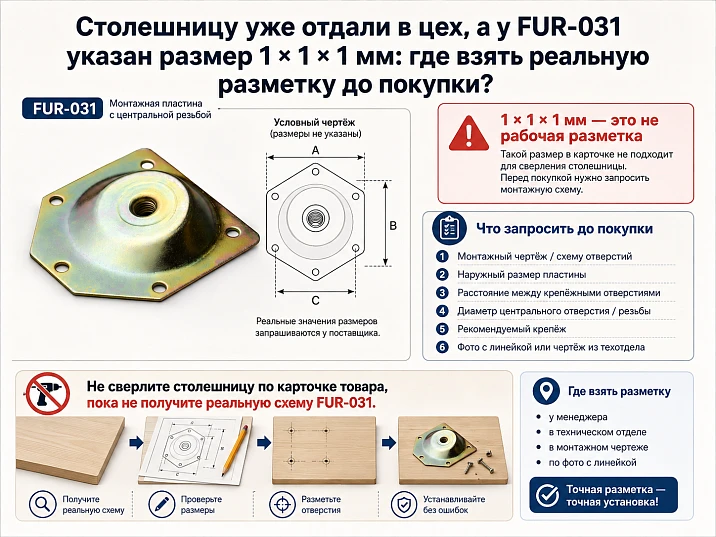
The tabletop is already lying in the workshop. The legs are chosen, the table shape is approved, the furniture maker asks to send the dimensions of the mounting plate to make holes today. The buyer opens the FUR-031 card and sees the line 1 × 1 × 1 mm. Should it be passed to the workshop? No. Should the master be given the estimated size from a photo? Even more dangerous. Should a drawing of a similar plate be taken? That is exactly how finished tabletops are ruined, the symmetry of the legs is broken, and a connection is obtained that has to be redone after finishing.
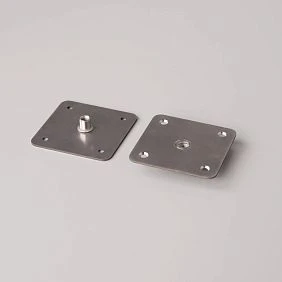
The mounting plate FUR-031 belongs to furniture fittings for installing wooden legs. The card confirms an M8 threaded seat, leg connection via an M8 stud, plate attachment to furniture with self-tapping screws, steel with yellow zinc plating, and use in light furniture structures — for example, in coffee tables and wall consoles. Self-tapping screws are not included. At the same time, the published size of 1 × 1 × 1 mm cannot serve as a working layout for a real metal part.
There is also a second discrepancy. The product card states a tilt angle of 12°, while another STAVROS material for FUR-031 mentions a value of 0°. For the buyer, this is not a minor editorial inaccuracy. A straight plate and an angled plate set different positions of the leg relative to the tabletop. An error in the angle changes the outer contour of the furniture, the distance between the lower points of the supports, the offsets from the edge, and the drilling direction.
Therefore, the direct answer is uncompromising: before paying for FUR-031 and before any drilling, it is necessary to obtain the current technical drawing of this exact model. It must include the full dimensions of the plate, metal thickness, number and diameters of holes, center distances, hole offsets from edges, position of the M8 threaded seat, actual angle, tilt direction, and orientation scheme of the part on the furniture. Until this data is available, the tabletop cannot be marked out according to the card.
After receiving and approving the drawing, you can buy the FUR-031 mounting plate in the required quantity. But first, you should make sure that the selected plate actually matches the leg, base thickness, intended angle, and load of the specific furniture.
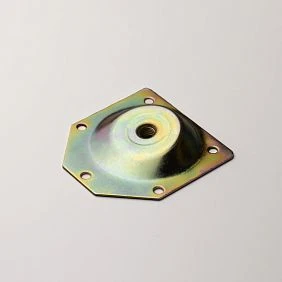
Mounting plate FUR-031: what information has already been confirmed
Even with the erroneous dimension line, the card contains several important characteristics. They can be used for preliminary configuration, but they do not replace a working drawing.
| Parameter | Confirmed information | What this gives the buyer |
|---|---|---|
| Article number | FUR-031 | Allows you to request a drawing of a specific model |
| Part type | Metal mounting plate for furniture legs | Defines the product group and purpose |
| Threaded mounting point | M8 | The leg must have a compatible stud |
| Connection to the leg | Via M8 stud | The stud length and seating depth need to be checked |
| Attachment to furniture | With self-tapping screws | Separate fasteners must be selected |
| Self-tapping screws included | Not included | They cannot be expected inside the product packaging |
| The stated angle in the product card | 12° | Requires confirmation due to discrepancy with other material |
| Another published value | 0° | Cannot be considered valid without an actual drawing |
| Material | Steel | Confirms the metal structure |
| Finish | Yellow zinc | Relates to the plate surface |
| Stated application | Coffee tables, wall consoles, and other light structures | Does not confirm suitability for heavy furniture |
| Size in the table | 1 × 1 × 1 mm | Not suitable for marking and drilling |
| Actual dimensions | Require confirmation | Must be obtained before sending to the workshop |
| Center distances of holes | Not published in confirmed data | Without them, a template cannot be made |
| Metal thickness | Not confirmed | Needed to understand fit and protrusion |
| Recommended screws | Not confirmed | They are selected after checking the base and the drawing. |
This table has one task: to separate facts from unknown parameters. The M8 thread is confirmed — it can be entered into the preliminary list. The size 1 × 1 × 1 mm is published, but it cannot be used. The angle of 12° is specified in the card, but the conflict with the value of 0° does not allow the issue to be considered closed.
This approach is especially important when the tabletop is already manufactured. An error in the card text can be fixed in a minute. An error in drilling solid wood, MDF, plywood, or a finished painted part is harder to fix: holes have to be filled, the plate shifted, symmetry recalculated, and sometimes the base has to be made anew.




Why the line 1 × 1 × 1 mm is not an "approximate size"
A technical dimension has no intermediate status. It either refers to specific lines on the drawing or is not used in production. The entry 1 × 1 × 1 mm cannot be rounded, increased "by eye," or interpreted as a conditional placeholder without official confirmation. For the workshop, it is simply three numbers that do not describe a real plate.
The buyer sometimes reasons like this: it is obvious that a metal part is larger than one millimeter, so the craftsman will understand that the size is erroneous. The craftsman will indeed understand. But then he will still need precise marking. The product photo does not convey scale, perspective distorts proportions, and the position of holes in the image cannot be transferred to the tabletop with the necessary accuracy.
Our factory also produces:
The card size, the product dimensions, and the mounting diagram are different things
In an online store, several types of sizes may be encountered:
-
dimensions of the product itself;
-
dimensions of the packaging unit;
-
conditional size for the accounting system;
-
size of one component of the kit;
-
technical parameters linked to letters on the drawing;
-
temporary value that got into the table when filling out the card.
The buyer cannot independently choose the most convenient interpretation. For FUR-031, the line 1 × 1 × 1 mm contradicts the purpose of a metal mounting plate, so it is not suitable for drilling, checking the mounting seat, or making a template.
Get Consultation
Why the dimensions of a similar plate are not suitable
Suppose another mounting plate with a clear drawing is found in the catalog. It seems similar in appearance: four holes in the corners, threads in the center, rectangular contour. Its dimensions cannot be transferred to FUR-031.
Another model may differ in:
-
overall length;
-
width;
-
steel thickness;
-
number of holes;
-
hole diameter;
-
center distances;
-
location of the threaded socket;
-
angle of inclination;
-
bend direction;
-
distance from thread to edge;
-
permissible load;
-
compatible stud;
-
recommended screws.
Even a difference of a few millimeters can shift the fastener to the edge of the tabletop or drive the screw into an insufficiently strong zone. And if the angle differs, the leg after assembly will not be where it was expected to be.
Why you cannot measure a part from the screen
In a photo, the scale is unknown. The image could be cropped, stretched, taken at an angle, or processed. A ruler placed against the monitor measures the picture, not the product.
If an M8 pin is visible nearby, this also does not provide an exact scale: the perspective, distance to the camera, and position of parts relative to the lens are unknown. This method is only suitable for a rough understanding of the shape, but not for a production template.
Where to get the real layout before purchasing FUR-031
A reliable source is the current technical drawing provided for the specific article. Not a promotional photo, not an old comparison table, and not a diagram of a similar bracket, but a document that directly states FUR-031.
It is better to send the request before payment and before passing the dimensions to the furniture maker. In the letter or message, you need to explain that the data is required for drilling the tabletop. Then the response will not be limited to the general phrase "the plate is standard."
What should be on the drawing
A working drawing of a metal plate should allow making a template without guesswork. The minimum set of data:
-
overall length;
-
overall width;
-
metal thickness;
-
outer contour shape;
-
number of mounting holes;
-
diameter of each hole;
-
center distances along length;
-
center distances along width;
-
distances from hole axes to edges;
-
position of M8 threaded socket;
-
socket offset relative to geometric center, if any;
-
direction of inclination;
-
actual angle;
-
height of protruding parts;
-
side adjacent to furniture;
-
leg installation side;
-
Recommended orientation at the left and right corner;
-
permissible fastening;
-
Version designation or document validity date.
If part of the dimensions is given as a chain, the master must unambiguously restore the position of all holes. If the angle is shown graphically, a numerical value must be placed next to it.
What to do if only a photo with a ruler was sent
A photo can help verify the overall dimension, but it does not replace a full diagram. It is difficult to see precise center distances and tilt direction in it. Ask to supplement the image with a drawing or a dimension table.
What to do if there is a drawing but no article number is specified
Do not send it to the workshop until you receive confirmation that the document refers to FUR-031. In catalogs, different models may have similar shapes. The file name is also not always sufficient: it is better to get written confirmation from the manager.
What to do if the drawing and the card differ
For production, it is necessary to determine which document is current. Ask to specify the revision date and confirm that the supplied batch corresponds exactly to this drawing. You cannot silently choose a more convenient number.
Angle 12° or 0°: why this is not an editorial trifle
If the plate is straight, the axis of the leg with a standard fit is oriented differently than with an inclined plate. At an angle of 12°, the lower point of the leg moves outward or inward relative to the attachment point — depending on the orientation of the part. Not only the appearance changes, but also the area occupied by the furniture.
In the FUR-031 card, 12° is stated. In another STAVROS material, 0° is found. Until the current drawing is confirmed, both values should be considered unsuitable for the final project.
| Source within the site | Published value | How to proceed |
|---|---|---|
| FUR-031 card | 12° | Use only after confirmation by drawing |
| Another comparative publication | 0° | Do not transfer to the project automatically |
| Current drawing FUR-031 | Required to obtain | Consider as working basis after confirmation |
| Written response regarding the supplied part | Required to obtain | Record together with the order |
How the angle affects the lower contour of the table
Let's consider not a specific FUR-031, but a general geometric scheme. If the axis of a leg of length H deviates by an angle α, the horizontal displacement of the lower point is approximately determined by the formula:
S = H × tan α
This is not a calculation for FUR-031 and not a recommendation for its installation. The formula shows why the difference between 0° and 12° is fundamental. At zero angle, the calculated displacement is absent. With inclination, it grows with the length of the leg.
For illustration: with a conditional leg length of 400 mm and a confirmed angle of 12°, the geometric displacement of the lower point axis would be approximately 85 mm. The actual position depends on the leg shape, reference point, plate design, and thread connection depth. But even this example shows: 12° cannot be considered a decorative trifle.
Why the error only appears after assembly
On a flat tabletop, four incorrectly oriented plates may look symmetrical. After screwing in the legs, one pair will go outward, another inward, or all supports will tilt to one side. Correction will require removing the hardware and making new markings.
The tilt changes the offset from the edge
The closer the plate is to the corner of the tabletop, the more carefully the direction must be considered. A leg extending outward increases the overall footprint of the table. A leg directed inward reduces the distance between supports and can worsen visual proportions.
For a wall console, the direction is especially critical
For a console, the rear area is limited by the wall. A leg tilted backward may hit the baseboard or prevent the cabinet from being pushed close. A forward tilt will change the support contour. Therefore, the word "console" in the product description does not replace the specific construction diagram.
Furniture hardware for table legs: how to orient four plates
Four identical parts are not always installed with the same side facing out. If FUR-031 indeed sets a tilt, each plate must get its own position: front left, front right, rear left, and rear right. For a round tabletop, clockwise numbering can be used instead of sides.
The main mistake is laying out the plates with the threaded sockets in one direction and transferring the holes without checking the leg axes. Symmetry of the outer contour of the part does not mean symmetry of the tilt.
First, draw not the holes, but the leg axes
The furniture maker must know where the support axes will pass after assembly. To do this, on the top view, mark:
-
the tabletop contour;
-
its geometric center;
-
axes of symmetry;
-
assumed upper points of the legs;
-
direction of inclination;
-
calculated lower points;
-
safe margins from the edge;
-
zones where stretchers, fasteners, or hidden elements pass through.
Only then are the contours of the plates and holes for self-tapping screws placed over the layout.
Each part is assigned a designation
It is convenient to use marking on the template and on the plates themselves:
-
PL — front left;
-
FR — front right;
-
BL — back left;
-
BR — back right.
For a round table, numbers 1–4 are suitable. Marking must be preserved until final assembly.
Mirror orientation is not always obvious
If the tilt is set by the shape of the threaded socket or the bend of the metal, rotating the plate 180° changes the direction of the axis. Rotating 90° can direct the leg along the other side of the tabletop. Without an assembly drawing, any rotation cannot be considered permissible.
Dry layout before drilling
Having received the actual plates, lay them out on the underside of the tabletop without fastening. Screw a compatible stud into each or install a test leg if the design allows. Check the direction of the supports, distance to the edge, and symmetry.
Such a trial fit does not replace the drawing, but helps to detect an orientation error before drilling.
The template must have a front side
A paper, plastic, or plywood template is easy to flip over. If the holes are asymmetrical, the mirrored marking will be incorrect. On the template, write:
-
"to the tabletop";
-
"to the leg";
-
"to the outer edge";
-
corner number;
-
tilt direction.
Plate with M8 thread: what a confirmed mounting seat means
The designation M8 refers to metric thread with a nominal diameter of 8 mm. For the buyer, this is an important starting point, but not the full answer about the connection.
To connect the leg and the plate, you need to check:
-
that the leg actually has an M8 stud installed;
-
that the thread pitch is compatible;
-
that the threaded part length is suitable;
-
that the stud is securely fixed in the leg;
-
that after screwing in, the required seating depth remains;
-
that the leg reaches the design position;
-
that the connection does not bottom out prematurely;
-
that the thread is not contaminated with paint or glue.
M8 does not automatically mean M8 × 60
In the catalog you can buy an M8 × 60 stud for a furniture leg, however, the M8 thread itself does not prove that the 60 mm length suits any leg and FUR-031 in a specific assembly. Part of the stud goes into the wood, part works in the plate, and the depth depends on the support design.
Before ordering a kit, you need to agree not only on the diameter, but also on the length of the stud, the type of its opposite part, the depth of installation into the leg, and the required protrusion.
Why the thread pitch is also important
The same nominal diameter does not exclude a different pitch. Incompatible parts may start to screw in, but will quickly jam or damage the threads. The documentation must include the full thread specification.
The leg must have a prepared seat
If the wooden support is sold without a stud, the mounting assembly is designed separately. You cannot simply screw a metal stud into any end without checking the wood thickness, grain direction, and hole depth.
For a furniture project, you can buy wooden legs for furniture and agree on the fastening in advance. An unpainted part is convenient because the hole and stud can be prepared before final finishing, but the compatibility of each model is still checked against the drawing.
Screws are not included in the kit: how not to turn this into a random choice
The card directly states that the plate is attached to the furniture with screws, and the screws themselves are not included in the kit. This means that the line "FUR-031 — 4 pcs." does not describe a ready-made mounting set.
The selection of screws depends on:
-
diameters of plate holes;
-
hole shapes;
-
presence or absence of countersinking;
-
tabletop thickness;
-
base material;
-
distance to edge;
-
safe screw-in depth;
-
calculated load;
-
number of holes;
-
hardware manufacturer requirements.
The head diameter must match the plate
A head that is too small may not cover the hole. One that is too large will not fit into the designated area or will interfere with the leg. If the hole has a countersink, a compatible head shape is required.
The length of the screw depends on the base
Short fasteners will not provide sufficient holding depth. Ones that are too long can come out on the front side of the countertop. It is especially dangerous to choose the length based on the total thickness without accounting for recesses, cutouts, decorative overlays, and the surface profile.
The countertop material changes the installation
Solid wood, plywood, MDF, particleboard, and combined constructions hold fasteners differently. The article should not assign a universal screw for all bases. The recommended type and size must be obtained together with drawing FUR-031 and confirmed with the furniture maker.
The number of holes cannot be guessed from a photo
Even if four holes are visible in the image, the final specification is built from the drawing and the actual part. In the invoice or installation sheet, it is better to indicate the total number of screws after verification.
Metal plate and countertop thickness
The leg attachment does not work on its own. The force from the support is transferred through the plate and screws into the base. If the base is too thin or loose, a high-quality steel part will not fix a weak structure.
Before drilling, you need to determine:
-
actual thickness of the tabletop in the mounting area;
-
presence of facing;
-
internal voids;
-
location of reinforcements;
-
distance to the edge;
-
direction of solid wood grain;
-
possibility of installing an insert;
-
intersection with a crossbar or frame.
Thin tabletop
With small thickness, the length of self-tapping screws is limited. The plate may require additional reinforcement, but the specific solution should be developed by a furniture maker. You cannot add a random pad without calculation.
Countertop with bevel
The overall thickness in the center may be sufficient, but at the edge it is less due to the bevel. If the plate is located close to the bevel, some screws will go into the thin zone.
Solid wood tabletop
The layout is aligned with the direction of the grain and the distance to the end. Holes that are too close increase the risk of splitting, especially when screwing without pre-drilling.
Panel material
For MDF or particleboard, density, thickness, and reuse of holes are critical. Moving the plate after an incorrect layout can be more difficult than on solid wood: adjacent holes weaken the panel.
Hollow or lightweight construction
A thick countertop may have internal hollowing. A screw that goes into a void will not provide the required holding. Before marking, a drawing of the countertop itself is required.
For which furniture does the card offer FUR-031
Confirmed application examples include coffee tables, wall consoles, and other lightweight furniture structures. The word "lightweight" cannot be ignored. It limits the area of confident choice.
Coffee table
Here, angled legs can form an expressive silhouette and a stable visual contour. But before ordering, you need to check the weight of the countertop, the length of the legs, the position of the lower points, and the actual angle of the plate.
Wall console
With a console, part of the load may be taken by the wall mount, but the design depends on the project. It cannot be assumed that wall fixation automatically relieves the legs to a safe level. The scheme is calculated by the furniture manufacturer.
Small bedside table
Applicability is not confirmed by size similarity alone. The cabinet may be light when empty but heavy after filling. Additionally, the leg tilt affects the opening of the lower drawer and the distance to the wall.
Light bench or ottoman
Such furniture is subject to human load, so simply classifying it as a "light structure" is insufficient. Without a confirmed permissible load and mounting scheme, FUR-031 cannot be recommended.
Dining table
The table may have a heavy top and experience lateral forces. The card does not confirm that FUR-031 is designed for any dining model. A separate calculation is needed.
Desk
The weight of equipment, user support on the edge, and daily load change the requirements. Application must be coordinated.
Main principle: the example in the card helps understand the type of product but does not replace the calculation for specific furniture.
Working drawing and drilling template: why these are not one document
The drawing describes the part. The template helps transfer hole positions to a specific countertop. Between them, there is another stage — the furniture assembly scheme.
The technical drawing FUR-031 answers the question: where are the holes and the threaded socket located relative to the edges of the plate. The assembly diagram answers a different question: where should the plate itself be located relative to the tabletop, leg, edge, and adjacent elements. The template combines this information into actual marking.
What is transferred from the plate drawing
From the document, they take:
-
outer contour;
-
hole axes;
-
hole diameters;
-
position of the thread center;
-
direction of inclination;
-
contact side;
-
control dimensions.
What is added from the furniture project
From the assembly diagram, they add:
-
plate offset from the tabletop edge;
-
rotation angle relative to the furniture axis;
-
leg number;
-
direction of inclination;
-
apron position;
-
safe zone for self-tapping screws;
-
symmetry relative to the center.
Why the template cannot be made only along the contour
If you trace the actual plate with a pencil, the holes can be marked through the metal. This method is suitable for a single fitting, but it does not replace orientation checking. By flipping the plate, the craftsman will get a mirror layout.
For a series of identical products, it is better to make a rigid template with guide holes, control marks, and side designation.
Template check before the tabletop
First, the template is applied to a sheet of waste material, a test pattern is drilled, and the plate is installed. Then check:
-
whether all holes match;
-
whether the part has shifted;
-
whether the thread direction is correct;
-
whether the screw head covers an adjacent element;
-
whether the tilt matches the project.
Only after such a check is the template approved for the finished countertop.
How to record FUR-031 in the technical specification
The short line "FUR-031 — 4 pcs." is suitable for a rough shopping list, but not for production. It does not specify the angle, drawing version, compatible leg, pins, and screws.
A safer entry looks like this:
| Specification field | What to specify |
|---|---|
| Name | Mounting metal plate |
| Article number | FUR-031 |
| Material and coating | Steel, yellow zinc coating |
| Threaded socket | M8 |
| Actual angle | Per agreed current drawing |
| Drawing version | Document number or date |
| Quantity | By number of legs |
| Compatible leg | Article number and dimensions |
| Screw | Type, thread, and length |
| Self-tapping screws | Type, diameter, length, and quantity |
| Orientation | PL, PP, ZL, ZP, or numbers 1–4 |
| Base | Tabletop material and thickness |
| Status | Approved before drilling |
Wording for the invoice
It is desirable to see at least the following in the invoice:
Mounting plate FUR-031, thread M8, quantity 4 pcs.
Technical dimensions and angle may be included in the approved drawing, but the link between the document and the order must be recorded. For example: "supply according to drawing FUR-031 dated ___"
Wording for the furniture maker
The master is sent not a screenshot of the card, but a set:
-
current drawing;
-
orientation scheme;
-
countertop data;
-
leg article number;
-
stud specification;
-
confirmed screws;
-
note about trial assembly.
Message to the manager that covers the main risks
The buyer can send the following text:
I ask to confirm the technical characteristics of the mounting plate FUR-031. The product card specifies a size of 1 × 1 × 1 mm, which cannot be used for marking, and on different STAVROS pages there are angle values of 12° and 0°.
To prepare the countertop, I ask to provide the current drawing of FUR-031 with full dimensions, metal thickness, diameters and center distances of mounting holes, position of the M8 threaded socket, actual angle and direction of tilt.
Also, please specify the recommended screws, confirm compatibility with the leg ______, and explain the orientation of the four plates: front left, front right, rear left, and rear right.
Drilling of the tabletop will not be performed until the drawing is received and approved.
The text does not blame the seller and does not require guessing dimensions. It accurately describes the production task.
What to buy together with the mounting plate FUR-031
The mounting assembly consists not only of the plate. The buyer should check the leg, stud, screws, and materials for base preparation.
| Position | What it's for | What to Check |
|---|---|---|
| buy the FUR-031 mounting plate | Main leg attachment | Drawing, angle, holes, quantity |
| buy an M8 × 60 stud for a furniture leg | Threaded connection of the leg to the plate | Length, pitch, seating depth, and compatibility |
| Self-tapping screws | Attachment of the plate to the furniture | Diameter, length, head, and base material |
| buy wooden legs for furniture | Table or console supports | M8 fitting, length, shape, load |
| Buy hardware for furniture legs | Compare fasteners | Do not mix incompatible threads and sizes |
| Buy furniture installation materials | Preparation and assembly | Scope of work and material compatibility |
| Drilling template | Transferring holes | Scale 1:1 and the correct side |
| Depth stop | Tabletop protection | Working drilling depth |
| Measuring tool | Symmetry control | Accuracy and serviceability |
Not all items are necessarily purchased in one order. For example, a leg may already have a pin. But the presence of the pin needs to be checked, not assumed from a photo.
Wooden mounting plate as an alternative: comparison without substitution
The catalog presents other fastening solutions. They are not automatic replacements for FUR-031. An alternative is chosen after the task is understood: straight or inclined leg position, base material, required assembly height, and connection method.
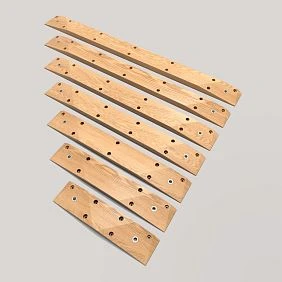
You can buy a 10° wooden mounting plate and compare it with FUR-031 by confirmed angle, material, dimensions, and fastening. The number 10° refers to the name of the alternative model, but does not prove that it is suitable instead of a part with assumed 12°.
Another option is buy a wooden mounting plateIt is necessary to separately check the thread, shape, dimensions, and compatible legs.
| Criterion | FUR-031 | FUR-017 | FUR-020 |
|---|---|---|---|
| Material by name or card | Steel | Wood | Wood |
| Confirmed thread in source data | M8 | Check in the card | Check in the card |
| Angle | Conflict 12°/0°, drawing needed | 10° in model name, parameters to check | Check |
| Attachment to the base | With self-tapping screws | Check | Check |
| Main reason for choosing | Compact metal assembly after size confirmation | Wooden inclined solution | Wooden mounting after verification |
| Can it be replaced without re-marking | No | No | No |
The comparative table does not assign a winner. It shows that the material and angle change the design. Replacing the plate after drilling almost always requires a new inspection of the holes.
How not to confuse FUR-031 with other parts
With a regular straight plate
A straight plate does not set an angle if its design is truly rated for 0°. Due to the 0°/12° discrepancy, FUR-031 cannot be classified as straight or angled until the drawing is obtained.
With a metal washer
The washer distributes the force under the fastener head, but it is not a platform for installing a furniture leg.
With a mounting plate for the cabinet
Fastening panels, canopies, and supports has a different purpose. The coincidence of the word "mounting" says nothing about compatibility.
With the mating part of a furniture tie
The tie connects panels, while FUR-031 is designed for a leg with an M8 stud.
With decorative overlay
Yellow zinc coating does not turn a technical plate into a face decor. Its place and visibility are determined by the furniture design.
With a wooden plate FUR-017 or FUR-020
They differ in material, shape, and possibly dimensions. Any replacement requires a new drawing.
How many mounting plates to order
The base quantity corresponds to the number of legs that are attached via FUR-031.
| Construction | Number of legs | Base number of plates |
|---|---|---|
| Coffee table on three legs | 3 | 3 pcs. |
| Table on four legs | 4 | 4 pcs. |
| Console on two legs | 2 | 2 pcs. |
| Two identical tables with four legs each | 8 | 8 pcs. |
| Set of three tables with three legs each | 9 | 9 pcs. |
However, arithmetic does not confirm the applicability of the part. First, load and construction are checked, then quantity.
Is a spare plate needed
For a single table, a reserve may be useful as protection against damage during installation, but there is no universal rule. For a production series, the reserve is calculated according to the workshop's internal standard.
Do you need to order one plate for a trial
A trial sample is useful when the actual dimensions have not yet been verified on the furniture. But the tabletop still cannot be drilled until the drawing is received. The sample supplements the documentation, not replaces it.
Practical route: from product card to finished layout
Step 1. Stop drilling
If the craftsman is waiting for dimensions, directly state: the published line 1 × 1 × 1 mm is not used.
Step 2. Record the article number
The request must state FUR-031. Not "M8 plate" and not "yellow metal plate".
Step 3. Obtain the current drawing
Check the full set of dimensions and the document date.
Step 4. Confirm the angle
Ask to explain the discrepancy between 12° and 0°.
Step 5. Verify the leg
Check the M8 stud, length, seating depth, and support shape.
Step 6. Verify the tabletopError 18. Not making a test template
A scale error is detected on the finished product.
Error 19. Print drawing not to scale
Printer settings stretch or shrink the image. The sheet must have a control dimension line.
Error 20. Not checking revision number
The old diagram may refer to a different version of the part.
Error 21. Ordering the plate before load confirmation
Use in light furniture does not prove suitability for a heavy table.
Error 22. Using FUR-031 for a seat without calculation
Human load requires separate verification.
Error 23. Moving the plate to adjacent holes
Old and new markings weaken the base.
Error 24. Treating yellow zinc as decorative trim
The coating belongs to a technical part and does not define the face design of the furniture.
Error 25. Painting over M8 threads
Paint or varnish interferes with proper connection.
Error 26. Tightening the leg by the wooden part with excessive force
The stud, threads, or the support itself can be damaged.
Error 27. Not checking the distance between the lowest points
Angled legs take up more or less space than expected.
Error 28. Not accounting for the baseboard behind the console
The rear leg hits the wall trim.
Error 29. Mixing plates of different models in one set
Even identical threads do not guarantee the same angle and height.
Error 30. Removing packaging before verifying the article number
If a discrepancy is found, it is harder to prove which model was received.
Who FUR-031 suits after confirming the drawing
The plate can be considered when the project includes a light furniture structure, wooden legs with a compatible M8 pin, and fastening with screws to a sufficiently sturdy base.
Signs of a suitable project:
- the furniture maker received the current drawing;
- the actual angle is confirmed;
- the position of the legs is calculated;
- The countertop has suitable thickness and structure;
- Self-tapping screws are selected according to the base;
- The load corresponds to the intended use;
- The orientation of all plates is marked;
- A trial assembly has been performed;
- The quantity matches the number of supports;
- The set is included in the specification.
When FUR-031 cannot be bought blindly
The order should be postponed if:
- The craftsman asks for actual dimensions, but there is no drawing;
- unknown actual angle;
- the leg has no confirmed M8 pin;
- the tabletop is already drilled for a different model;
- the base is too thin;
- the furniture belongs to heavy structures;
- the load of a person is transmitted through the supports;
- it is impossible to determine the direction of the tilt;
- self-tapping screws are chosen randomly;
- the customer expects to receive a ready-made set of fasteners together with the plate.
How to buy FUR-031 on STAVROS without losing technical data
The commercial route must maintain the connection between the card, drawing, and order.
First open the card and order FUR-031 with the current drawing. Before payment, request the missing dimensions and the actual angle. After receiving the document, pass it to the cabinetmaker, but do not allow drilling until the legs and base have been checked.
Then assemble the remaining items. In the section, you can Buy hardware for furniture legs and compare studs, plates, and other parts. An important rule: products from the same category are not necessarily compatible with each other. Thread, length, and dimensions are checked separately.
If a table or console is part of a general interior order, furniture parts and finishing moldings can be conveniently entered into one list, but do not mix technical lines. At the same time, you can buy wooden skirting board for the agreed room finish. The dimensions of the baseboard are not related to the FUR-031 layout and are issued as a separate item.
FAQ about the FUR-031 mounting plate
Can the size 1 × 1 × 1 mm from the card be used?
No. This line does not allow determining the actual dimensions and position of the holes. For layout, you need the current FUR-031 drawing.
What is the angle of FUR-031 — 12° or 0°?
According to published data, there is a contradiction. The card reports 12°, another material reports 0°. Only the value from the current confirmed drawing of the supplied part is considered valid.
Can I order the plate before receiving the drawing?
Technically, you can purchase the item, but you cannot drill the tabletop until the document is received. For a project-based purchase, it is better to agree on the parameters before payment.
What should be indicated on the drawing?
Full dimensions, steel thickness, hole diameters and center distances, position of M8 threads, edge offsets, actual angle and tilt direction.
Is FUR-031 suitable for four legs?
The quantity of four corresponds to a table with four supports, but compatibility depends on load, design, and orientation. Each plate must have its own position.
Can all plates be installed identically?
Only if this is directly shown on the confirmed assembly diagram. For angled mounting, identical orientation may direct the legs incorrectly.
Is the M8 stud included in the set?
Connection via M8 stud confirmed, but the kit contents need to be clarified. The presence of a separate stud cannot be assumed.
Are self-tapping screws included?
No. The card states that self-tapping screws for attaching the plate to furniture are not included in the kit.
What screws are needed?
The type and size are selected based on the plate holes, thickness, and material of the tabletop. A universal size cannot be assigned without a drawing.
Will an M8 × 60 stud fit?
It has the required M8 thread designation, but the length and design must be checked against the leg and plate. Compatibility is not determined by diameter alone.
Can FUR-031 be used for a dining table?
Only after confirming the allowable load and design. The card is oriented toward light furniture items and does not provide a universal approval for heavy tables.
Is the plate suitable for a bench?
Without calculating the load of a person, it cannot be recommended. A seat creates a different mode of operation than a coffee table.
Can FUR-031 be attached to MDF?
The possibility depends on the thickness, density of the base, fasteners, and load. The decision must be confirmed by a furniture maker after receiving the drawing.
Can the plate be attached to solid wood?
Such installation can be considered, but the direction of the grain, edge distances, and recommended screws must be taken into account.
What to do if the countertop is already drilled for a different plate?
Compare the drawings. If the holes do not match, you cannot simply drill additional holes nearby without assessing the strength of the base.
Can a template be made from a photograph?
No. A photograph does not provide accurate scale and center distances.
Would a drawing of a similar M8 plate work?
No. M8 thread does not mean identical dimensions and holes.
How to check the scale of a printed drawing?
The document must have a control line with a known dimension. After printing, it is measured with a ruler before making the template.
Is it necessary to obtain the actual plate before drilling?
For critical or serial work, it is advisable to check a sample. But even a physical part does not eliminate the assembly diagram and orientation calculation.
How to mark the left and right plates?
Use the designations PL, PP, ZL, and ZP or numbers. For each position, indicate the outer edge and the direction of the slope.
Why is the position of the M8 thread important?
It defines the top point of the leg axis. If the socket is offset from the center of the plate, the outer contour cannot be used as the only reference.
Does the metal thickness affect the layout?
It affects the height of the assembly and the fit, although the hole axes may remain the same. The value must be specified in the documentation.
Can the plate be painted?
The initial data does not describe additional painting. Any coating must not get into the threads or interfere with seating; the technology is agreed upon separately.
What is the yellow zinc coating for?
The card confirms the presence of such a coating but does not disclose its operational limits. One cannot promise use in any humid environment based solely on the name.
Can FUR-031 be used outdoors?
Such an application is not confirmed. For outdoor furniture, separately tested materials and protection are needed.
How many plates are needed for a table with three legs?
Three, if each leg is attached via FUR-031 and the model itself is suitable in terms of load and geometry.
Is a spare plate needed?
For a single piece of furniture, this is decided according to the estimate. For a series, the reserve is determined by production after a trial assembly.
When to choose FUR-017 instead of FUR-031?
When a wooden plate with a stated angle of 10° better matches the project and its parameters are confirmed. Replacement requires a new drawing and layout.
When to consider FUR-020?
When a wooden mounting plate suits the project and its thread, dimensions, and compatible legs are confirmed.
How to formulate an order?
Specify the article number FUR-031, M8 thread, quantity, compatible leg, and a link to the approved drawing. Studs and screws should be listed separately.
What to check upon receipt?
Article number, quantity, coating, integrity, hole placement, and compliance of the actual part with the approved drawing.
Acceptance of FUR-031: how to check the part before handing it to the workshop
Even an approved drawing does not cancel incoming inspection. The buyer or craftsman must ensure that the received plate matches the document used for layout. This check is especially important if the tabletop is already drilled or if a series of identical tables is being manufactured.
First, check the marking and quantity
The packaging, invoice, or product label must indicate the article number FUR-031. The quantity is recounted before work begins. For a table with four legs, a set of three parts is incomplete, even if the craftsman is ready to start marking.
If the order includes different mounting plates, they are laid out separately. You cannot rely only on the color of the coating: several models may have a similar appearance.
Then the outer contour is compared
Place the part on a printed drawing at a 1:1 scale, or measure the control parameters with a caliper. The overall length, width, position of the threaded socket, and holes are checked. If the dimensions differ, drilling is stopped until the cause is determined.
The angle is checked separately
The angle cannot be reliably determined by eye, especially when it comes to a slight deviation. The craftsman uses an appropriate measuring tool or a verification scheme. The main thing is to confirm that the resulting part matches the agreed document, not just resembles a photo.
The thread must work without effort and misalignment
A compatible M8 stud is carefully screwed in by hand. It should enter along the axis, without jamming or lateral play. Applying force to "break in" a new thread is not allowed: if the connection does not match, both parts can be damaged.
The coating and metal are inspected
The plate must not have deformations that prevent a tight fit, sharp damaged edges, clogged holes, or defects in the threaded socket. Minor visual features of the coating are assessed separately from geometry: for installation, the plane, holes, and thread are critical.
The result of the incoming inspection is recorded
For single furniture, photos of the part next to a measuring tool and the master's mark are sufficient. For a series, it is useful to draw up a short report: article number, batch, date, control dimensions, and permission to start drilling.
Checklist for the furniture maker before the first hole
Before starting work, the master must answer "yes" to each question:
- the current drawing FUR-031 has been received;
- the article number on the document matches the product;
- the actual angle is confirmed;
- the actual panel has been checked against the drawing;
- the tabletop has been measured in the mounting area;
- internal voids and reinforcements are known;
- the legs and M8 pins are in the workshop;
- stud length agreed;
- screws selected according to holes and base;
- leg axes calculated;
- lower furniture contour checked;
- orientation of PL, PP, ZL, and ZP marked;
- template tested on scrap material;
- drilling depth limited;
- front surface protected;
- customer approved leg position.
If at least one item remains open, a pause is cheaper than rework.
Three typical purchasing situations
Situation one: the craftsman asks for dimensions, but the product has not been ordered yet
Do not send him a screenshot of the line 1 × 1 × 1 mm. Request a drawing from STAVROS, confirm the angle and compatibility with the selected leg. After that, the craftsman will be able to build a preliminary scheme. For the final launch, it is advisable to verify the actual sample.
Situation two: four plates have already been received, the tabletop has not been drilled
This is the most convenient moment for checking. Measure the parts, compare them with the drawing, perform a dry layout and a test template. If the actual geometry differs from the document, stop the work and clarify the delivery.
Situation three: the tabletop has been drilled according to a different model
Do not try to "fit" FUR-031 with additional holes without assessing the strength. First, overlay the two drawings, determine the distance between the old and new markings, and pass the task to a designer or an experienced furniture maker. Sometimes it is safer to keep the previous type of fastening or make a reinforcing part than to weaken the base with closely spaced screws.
Why the drawing approval should be kept after assembly
After the project is completed, the documents do not lose their value. In a few years, it may be necessary to replace a leg, plate, or pin. Without the drawing, the owner will again face questions about size, angle, and orientation.
It is useful to put in the project archive:
- FUR-031 article card;
- agreed drawing;
- plate orientation photos;
- leg article;
- stud specification;
- screw type;
- tabletop dimensions;
- purchase date;
- remaining hardware, if provided.
This way, furniture becomes repairable. Replacement doesn't turn into a new investigation of unknown fasteners.
Final check of publication and order
Before publishing an article or completing a purchase, you need to ensure that the text and documents do not create false certainty. A size of 1 × 1 × 1 mm must be directly stated as unsuitable for marking. An angle of 12° cannot be presented as indisputable while a discrepancy with 0° remains. Actual dimensions, load, and recommended screws should not be invented.
The buyer, however, needs one practical result: to receive a set of information that allows a craftsman to drill the tabletop once and correctly. That is why technical caution here works in favor of the sale. A person does not refuse FUR-031 — they order it consciously, along with the drawing and compatible parts.
Price of FUR-031: what to compare besides the cost of one plate
The query "mounting plate FUR-031 price" seems simple, but for a finished table, the cost of the entire assembly matters. To the price of four plates, studs, screws, leg preparation, template making, and trial assembly may be added. If an unconfirmed size ruins the tabletop, the savings from preliminary verification disappear instantly.
Two scenarios should be compared.
The first scenario is a complete verified set. It includes agreed plates, compatible legs, studs, suitable screws, and a working drawing. The craftsman performs marking and assembly once.
The second scenario is buying from a photo. Parts are purchased separately, dimensions are determined after receipt, fasteners are selected on site, and the direction of the tilt is checked during assembly. This path may seem faster, but it transfers all technical risks to the workshop.
The price of the product remains important, but the decision is made based on the total cost of the finished connection. Before payment, it is useful to request two quotes: only FUR-031 and a set with suitable studs. Screws are still selected based on the tabletop, since they are not included in the plate set.
Last questions before pressing the "Buy" button
The buyer is ready to place an order when they can answer the following questions without guessing:
- Which document confirms the actual dimensions of FUR-031?
- Which angle applies to the supplied part?
- Where is the center of the M8 thread?
- How are the mounting holes positioned?
- Which leg is used in the project?
- Which stud is installed in the leg?
- Which screws are recommended for the selected base?
- How are the four plates oriented?
- Is FUR-031 suitable for the load?
- Has the countertop been checked at the drilling points?
- Has the template been made to a 1:1 scale?
- Has the drawing been coordinated with the furniture maker?
If answers are received, the product card turns into a clear order. If half of the items remain unknown, the purchase is not yet technically prepared. Do not replace missing data with confidence: one precise request to the manager is more useful than ten assumptions.
Documents transferred along with the parts
For a single coffee table, a compact set of documents is sufficient, but it must be complete. The workshop receives the order card, the current drawing FUR-031, the plate layout diagram, and the specification of legs and fasteners. If the master selects the screws, this decision is recorded after checking the material and thickness of the countertop.
For a small series of furniture, the set is expanded. An approved template, a photo of the trial assembly, corner markings, and control dimensions of the finished product are added. Such discipline does not complicate production but prevents the gradual shift of holes from one unit to another.
One control record is especially useful: "Drilling was performed according to drawing version ___." It links the actual furniture to a specific document. If the product card is later corrected or another edition of FUR-031 appears, the master will be able to understand by which geometry the already manufactured table was assembled.
The buyer does not necessarily need to understand every workshop operation. Their task is to prevent an erroneous line of 1 × 1 × 1 mm from turning into a production task. Further, responsibility is distributed clearly: STAVROS confirms the product and technical document, the designer places the supports, the furniture maker chooses the drilling technology, and the customer approves the external contour and purpose of the furniture.
Real marking is obtained before drilling, not after a mistake
The size 1 × 1 × 1 mm is not the working dimension of the FUR-031 mounting plate. The values 12° and 0°, published on different pages, also cannot be arbitrarily chosen for a project. Until an up-to-date drawing is obtained, the furniture maker has no basis to determine the part dimensions, center distances, and leg direction.
The correct sequence is simple: confirm the drawing, verify the actual angle, select a leg with an M8 stud, determine the screws, build an assembly diagram, make a test template, and only then drill the tabletop. This order seems slower only until the first mistake. Reworking finished furniture always takes more time and costs more.
STAVROS company combines mounting plates, furniture studs, wooden legs, and assembly materials in one catalog. The buyer can assemble a coordinated unit without searching for random parts on different platforms. But the strength of a comprehensive order is revealed only when each item is checked against the drawing and technical parameters are fixed before payment. For FUR-031, the main document should not be the 1 × 1 × 1 mm size from the table, but the actual diagram of the specific supplied plate.