Article Contents:
- A serial frame starts not with the machine, but with an unambiguous diagram
- Manual finishing seems cheap only until the first recount
- Additional processing should become part of the purchased item
- MDF, beech, and oak cannot be combined in one line
- The product card is a checkpoint, not a replacement for the drawing
- The geometry must be shown in a cross-section
- Width and depth are independent dimensions
- Residual thickness requires separate control
- Purpose helps understand the node, but does not define it
- It is better to name the base plane than to make it guess
- Right and left parts cannot be hidden under one quantity
- A photo of a prototype is useful only together with a drawing
- MDF 2600 mm long can reduce the number of initial strips
- Beech is suitable not only under enamel
- Oak is chosen for its texture, but texture cannot be standardized like printing
- The base formula shows only the lower limit
- Example: frame 700 × 400 mm
- Example: frame 900 × 500 mm
- The kerf width and allowance must be included in the model
- One frame may require one, two, or more source strips
- A mixed batch requires two lines
- The reserve also needs to be distributed according to execution.
- The processing cost does not replace the cost of the molding itself.
- Linear meters and pieces cannot be mixed in the same column.
- Packaging must match the cutting layout and assembly sequence.
- A single physical sample is not always included in the terms of a serial service.
- The sample is checked not only with a caliper.
- Changes after the sample are documented as a new version.
- Start with a functional requirement
- The measurement point matters
- The acceptance method is agreed before delivery
- Frame furniture front
- Door panel
- Wall panel and interior frame
- Display case or frame with glass
- Width and depth have swapped places
- Two different quarters were combined into one line
- Counted a hundred frames instead of a hundred slats
- Material was replaced after calculation
- Order was placed before processing approval
- Check the marking against the order
- A control profile is taken from each logical group
- Do not start cutting a disputed batch
- Check the path from the truck to the rack
- Long remnants also require space
- The 30 × 16 mm cross-section does not match the node
- The batch of processed profiles is below the set threshold
- The design requires not a quarter, but a different type of processing
- The profile must perform a load-bearing function without calculation
- Full repeatability of the natural pattern is needed
- A photo of the profile does not replace the article number
- The name 'wooden molding' also covers MDF in the card
- Quarter sampling is an option, not a standard for each plank
- Stage 1. Fix the node
- Stage 2. Choose the material
- Stage 3. Build the cutting map
- Stage 4. Prepare the technical specification
- Stage 5. Send the package to the manager
- Stage 6. Get manufacturability confirmation
- Stage 7. Verify the commercial proposal
- Stage 8. Approve the control format
- Stage 9. Accept and label the batch
- Ready-made request template
- What to check in the response
- A new frame width changes not only the two horizontal parts
- Replacing MDF with solid wood requires a new commercial proposal
- A change in the quarter may affect an already approved insert
- A reduction in the print run is checked by the number of processed strips
- Splitting an order into two deliveries should not create two different batches without control
- Changing the delivery address also affects the work plan
- Can I order fewer than 100 profiles with a quarter?
- Is one hundred pieces one hundred frames?
- What counts as one piece?
- Do I need to specify the sampling side?
- Can I write only the width and depth of the quarter?
- Can I make different quarters in one batch?
- Is MDF suitable for enamel?
- Can oak or beech be tinted?
- Why do MDF and solid wood have different lengths?
- Can MLD-051 be used under glass?
- Is sampling included in the price of a standard molding?
- Do I need to order a reserve?
- Can only part of the slats be processed?
- Is a physical sample needed?
- How to check the quarter when accepting delivery?
- Can the technical specification be changed after payment?
- Where can I get drawings of the original profile?
- What should I use to glue the frame after cutting?
- How to order delivery of a batch?
- Can MLD-051 be ordered in one batch for multiple facilities?
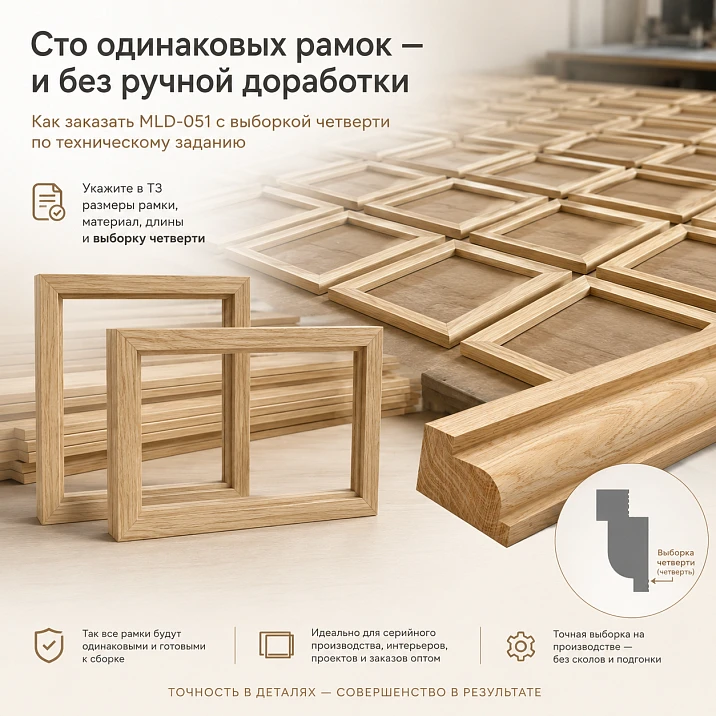
The profile has already been selected, the frame dimensions are approved, and the facade series is included in the production plan. And it is at this moment that it turns out: the standard molding has to be additionally milled before assembly. On one prototype, such an operation seems like a trifle. On a hundred identical frames, it turns into a separate work area—with equipment readjustment, templates, marking, control of the processing side, and the risk of repeating the same mistake hundreds of times.
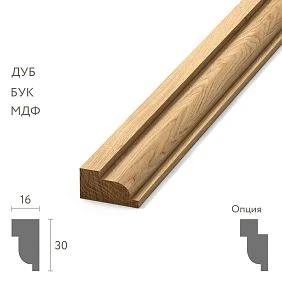
Order MLD-051 molding with rabbet cutting It can be done as a standard item with additional processing according to the technical specification. The base profile cross-section is 30 × 16 mm. MDF is produced in lengths of 2600 mm, while beech and oak are produced in lengths of 2400 mm. The rabbet cutting service is available for batches from 100 pieces. This does not mean that the manufacturer just needs to write “make a groove” in a letter. Before calculation and launch, the geometry of the cut, its position, the length of the processed section, the material, the quantity, and the method of part identification must be fixed.
The buyer's main task here is not just to Buy wooden furniture molding. It is necessary to turn the project idea into an unambiguous technical specification, according to which the sales department, technologist, production, and assembly area understand the same part. A good specification leaves no room for phrases like “we thought the rabbet should be on the other side” or “the drawing showed the front plane, but no one marked it.”
A serial frame begins not with the machine, but with an unambiguous diagram
In a single product, a craftsman can hold the insert against the profile, mark the side with a pencil, and remove material in place. For a series, such an approach is dangerous. It depends on the memory of a specific person, the condition of the template, and how the next part was laid out. A hundred identical profiles give a hundred opportunities to repeat the incorrect orientation.




Manual refinement seems cheap only until the first recalculation
Suppose one strip takes several minutes: take the part, set the stop, make the pass, deburr, check the size, move the profile. In the estimate, often only the cutter time in the material is noticed. But the operation includes preparing the workplace, setup, trial passes, inspection, cleaning, marking, and moving workpieces. The longer the batch, the more noticeable the indirect costs.
There is also a second layer of costs — rework. If the width of the groove is wrong, the insert will not fit. If the depth is too high, the profile may have insufficient thickness in the design area. If the side is mixed up, the parts cannot be corrected by a simple rotation when the frame pattern, face surface, or direction of end joints are already set.
Our factory also produces:





Additional processing should become part of the purchased item
For a production order, it is more convenient to think not like this: "we will buy a regular profile, and then cut something out." The precise wording sounds different: "we need MLD-051 of a certain material and length, with an agreed quarter on the specified side, in a quantity calculated according to the cutting map." Then processing is not lost between purchasing and assembly, but is accounted for in the specification from the very beginning.
This approach is especially important for a furniture factory, joinery shop, door production, wall panel contractor, and a company that assembles identical interior modules for a network of facilities. For regular purchases, it is useful to study in advance conditions for furniture manufacturers and agree on the format for transferring drawings, batch marking, and documents.
Get Consultation
What is confirmed for MLD-051 before individual processing
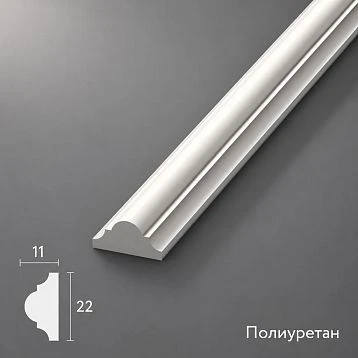
MLD-051 is a profiled molding of compact cross-section. It is considered for frame elements, trims, and other design nodes where the 30 × 16 mm geometry matches the structure. The product card provides for MDF, beech, and oak. But the material cannot be chosen separately from the length: the MDF strip is longer than the solid wood one.
| Parameter | Confirmed value | What does this change in the order |
|---|---|---|
| Article number | MLD-051 | The article number must be specified in all versions of the drawing and specification |
| Cross-section | 30 × 16 mm | The quarter must fit in the actual cross-section considering the residual thickness |
| MDF length | 2600 мм | Affects the cutting map, the number of slats, and waste |
| Beech length | 2400 мм | Requires a separate calculation of quantity |
| Oak length | 2400 мм | Requires a separate calculation of quantity |
| Sanding quality | «Prestige» | The surface is prepared for the further design cycle |
| Additional option | Rabbet selection according to the technical specification | Geometry is not assigned automatically; it is set by the customer |
| Minimum batch for the service | 100 pcs. | The threshold applies to processed profiles, not to the number of finished frames |
| Cost of the operation | Specified separately in the product card | It needs to be rechecked as current before invoicing |
| Packaging and delivery | Calculated taking into account the batch and length | They cannot be replaced with an approximate line "logistics" |
This table is not a ready-made technical specification. It describes the original product item. The dimensions of the rebate itself, the side, the processing length, tolerances, and the purpose of the assembly remain design data.
MDF, beech, and oak cannot be combined in one line
The phrase "MLD-051, 120 pieces" leaves too much unknown. What material should the profiles be made of? What is the length of each strip? Is the entire batch needed with the same sample? How will the surface be finished? Does the cutting map match for MDF and solid wood?
It is more correct to create a separate line for each modification. For example:
MLD-051, 30 × 16 × 2600 mm, MDF, "Prestige", for enamel, quarter selection per drawing TZ-051-03, 120 pcs.
For solid wood, the line is compiled anew:
MLD-051, 30 × 16 × 2400 mm, oak, "Prestige", quarter selection per drawing TZ-051-03, 120 pcs.
Even if the profile and quarter are the same, the length changes the cutting, packaging volume, and the number of initial strips. Mixing variants in one position is convenient only until the first production question.
Product card — a checkpoint, not a replacement for the drawing
Before buy MLD-051 sized 30 × 16 mm, you need to open the current card and check the material, length, conditions of additional processing, current service cost, and availability of the required volume. But the card does not know where exactly the quarter is oriented in your frame. This information is provided only by the project.
"Making a groove" and "selecting a quarter" are not the same technical specification
In conversational correspondence, a quarter is often called a groove. For preliminary discussion this is acceptable, but for production the term must be accompanied by a cross-section. A groove can be inside a profile and have material on both sides. A quarter is open to the edge and forms a step. One phrase without a drawing shows neither the shape nor the position of the removed material.
The geometry must be shown in a cross-section
The main drawing is an enlarged cross-section of MLD-051. It shows the original dimension of 30 × 16 mm and hatches the area that needs to be removed. Next to it, the width and depth dimensions of the cutout are placed. If there is a radius, chamfer, technological transition, or an area that must not be touched, this is also noted.
The diagram must be readable without mentally rotating the sheet. The front side is labeled with words or marked with a stable symbol. The rear plane, top, bottom, inner and outer sides of the frame receive clear names. It is not enough to write "right" because right changes when viewed from the back side.
Width and depth are independent dimensions
Width shows how far the cutout extends from the edge along one plane. Depth shows how far it goes into the profile thickness along another axis. Swapping these numbers creates a different joint. If two values are placed next to each other in a technical specification without leader lines, the probability of error increases sharply.
Example of notation:
-
quarter width — W;
-
quarter depth — H;
-
remaining shelf after machining — R;
-
Initial cross-section is 30 × 16 mm.
Letters in the working document are acceptable if there is a numerical table nearby and each letter is tied to an arrow on the drawing. There is no need to invent W, H, and R in the order: the actual values are set by the designer after checking the insert, the fixing method, and strength requirements.
Residual thickness requires separate control
The customer often checks only whether the glass, panel, or infill fits into the selected rebate. But after milling, the profile retains a working cross-section. Its sufficiency depends on the design, material, part length, connections, and load. The MLD-051 card does not confirm a universal rebate size for any application.
Therefore, the technical specification must separate two statements:
-
Project fact: a cutout of a specific width and depth is required.
-
Pre-launch check: the feasibility of such processing is confirmed by the manufacturer for MLD-051 and the selected material.
That is why order a molding according to the technical specification better after transferring the cross-section, not after paying for a standard product.
Technical specification that can be transferred from department to department
A good technical specification doesn't have to span dozens of pages. It must answer the questions that determine the outcome. For a series profile, a set consisting of a brief specification, a cross-section drawing, an orientation diagram, and a quantity table is convenient.
| Technical specification field | What to specify | Why there is a risk without this |
| Article number | MLD-051 | Similar profiles may have a different cross-section |
| Material | MDF, beech or oak | Length, processing, cutting, and finishing change |
| Initial length | 2600 or 2400 mm | Needed for calculating strips and packaging |
| Quantity of initial profiles | Whole number of pieces | The service is calculated based on processed profiles |
| Quarter section | Width and depth | The phrase "standard quarter" does not specify a size |
| Side | According to the signed diagram | "Left" without a viewpoint is ambiguous |
| Processing length | Across the entire bar or a local area | These operations cannot be considered identical |
| Start and end of processing | Dimensions from the base end | Needed for incomplete sampling |
| Front surface | Explicitly mark | Helps avoid mirror errors |
| Right and left parts | Separate with project item numbers | One drawing does not always fit both sides |
| Tolerances | Coordinate with the manufacturer | Requirements must be measurable and achievable |
| Purpose | Frame, door, panel, insert | Gives the technologist context, but does not replace dimensions |
| Finishing | For enamel, tinting, or another confirmed cycle | Affects the material and surface acceptance |
| Packaging | By groups, batches, or marking | Speeds up assembly kitting |
| Document version | Number and date | Prevents launching an outdated drawing |
After filling in the table, it is useful to check the document with the eyes of a person who did not participate in the design. If they can unambiguously point on the physical profile what and where is being removed, the task reads correctly. If they have to guess, the same question will arise in production.
The purpose helps understand the assembly, but does not define it
You can write that MLD-051 is used as a profile for a frame facade, framing a door panel, or as part of a wall frame. This is useful: the technologist sees the context. However, the words "under glass" do not specify the glass thickness, gap, seal, or seating depth. The phrase "under panel" does not convey the edge shape of the insert.
Therefore, queries like "order wooden profile for glass" are acceptable as a search and commercial formulation, but in a technical specification they must be detailed with precise dimensions.
Front side, inner edge, and frame direction
Most conflicts around sampling arise not from size, but from orientation. The customer shows the profile from the room side, the technologist looks at the cross-section, the operator places the strip with the back side up, the assembler rotates the finished part according to the frame direction. The word "left" manages to change meaning four times.
It is better to name the base plane than to make people guess it
On the drawing, you can indicate:
-
F — front surface;
-
B — back surface;
-
IN — side facing inside the frame;
-
OUT — outer side;
-
BT — base end, from which local processing is measured.
Abbreviations are chosen by the designer, but the explanation must be on the same sheet. If the drawing is sent separately from the letter, it does not lose its meaning. This is especially useful when documents are printed, sent via messenger, or uploaded to a production system without the original correspondence.
Right and left parts cannot be hidden under a single quantity.
Suppose the frame is assembled from vertical and horizontal profiles, and the rebate should face inward into the opening. After cutting and joining, the orientation of each side changes. For a continuous groove along the entire length of the original strip, this can be resolved by cutting. For local processing, finished end joints, or pre-marked elements, different versions may be required.
In the specification, it is useful to separate:
-
MLD-051-В1 — vertical left part;
-
MLD-051-В2 — vertical right;
-
MLD-051-Г1 — top;
-
MLD-051-Г2 — bottom.
These are internal project designations, not new STAVROS article numbers. They link the MLD-051 line item to the part map. The manufacturer is provided with a table where, for each project code, the quantity, material, blank length, and groove scheme are specified.
A photograph of a prototype is useful only together with a drawing.
A photo helps show the intent: which surface is visible, where the insert goes, how the profile is positioned in the frame. But perspective distorts size. In a photo, it is impossible to reliably measure the depth of the rebate. Therefore, the photograph serves as an explanation, not the sole basis for processing.
Before sending the task, make three images:
-
general view of the frame;
-
close-up of the assembly with the insert;
-
cross-section with linear dimensions.
Such a set reduces correspondence, but the drawing remains the main document.
MDF, beech, or oak: the material is chosen together with the finish and cutting plan.
The MLD-051 has three confirmed material options. They provide the same nominal cross-section of 30 × 16 mm, but do not become interchangeable automatically. The strip length, surface visual behavior, and further finishing logic differ.
| Criterion | MDF | Beech | Oak |
| Confirmed length | 2600 мм | 2400 мм | 2400 мм |
| Material type | Fiberboard | Solid wood | Solid wood |
| Typical project scenario | Opaque enamel with coordinated preparation | Array for enamel, tinting, or transparent finish per project | Projects where noticeable wood texture is desired |
| Cutting calculation | Separate, based on 2600 mm | Separate, based on 2400 mm | Separate, based on 2400 mm |
| Batch control | Geometry, surface, edge sampling | Geometry, direction and condition of wood, sampling | Geometry, texture, condition of wood, sampling |
| What cannot be promised in advance | Any coating without a trial cycle | The complete sameness of the natural pattern | The complete sameness of the natural pattern |
The table does not assign a coating on behalf of the customer. It shows why the material must be linked to a finish sample, not chosen only by price.
MDF 2600 mm long can reduce the number of initial slats
The extra 200 mm sometimes allows placing one more short part on a single slat or reducing waste. In another project, there will be no difference, because the set of parts still does not fit equally into 2400 and 2600 mm. The solution is provided not by the total length in meters, but by the cutting map.
If facades are painted with opaque enamel, MDF can be a logical candidate. But before a serial order, surface preparation, primer, painting system, and treatment of the recess area must be agreed upon. The statement "MDF is always easier to paint" is too crude: the result depends on the entire technological cycle.
Beech is suitable not only for enamel
Beech is chosen when solid wood with a relatively calm pattern is needed. It can be considered for opaque finishes or coatings that preserve the wood character, if provided by the project. For a series, a sample should be checked: the profile, quarter, ends, and main facade may accept the coating differently.
An order for "beech molding wholesale" should include not only the wood species. Specify the length of 2400 mm, the number of slats, sanding quality, quarter scheme, and sorting requirements for visible parts, if they are critical for the project.
Oak is chosen for its texture, but texture cannot be standardized like printing.
An oak surface reacts more noticeably to transparent or semi-transparent finishes. In a series, the natural wood grain will vary. This is not a production defect in itself, but a property of solid wood. If the frames need to look as consistent as possible, discuss sorting in advance and assemble finish samples on the actual profile.
Buy wooden molding from different materials is more convenient after comparing not only the cost per slat, but also the yield of parts, the painting method, the reserve percentage, and appearance requirements.
A length of 2600 or 2400 mm changes not the footage, but the parts layout.
When purchasing linear molding, the total perimeter of all frames is often calculated, a percentage is added, and the result is divided by the slat length. This method gives a rough estimate but can be significantly off. Offcuts do not always add up to useful lengths: a short piece from one frame may not fit any part of the next.
The basic formula shows only the lower bound.
Theoretical footage:
M = N × (2H + 2W),
Where:
-
N — number of identical frames;
-
H — length of one vertical part;
-
W — length of one horizontal part;
-
M — total profile length without allowance and technological losses.
Theoretical number of planks:
Ptheor = round up (M / L),
where L equals 2600 mm for MDF or 2400 mm for beech and oak.
This formula does not account for the placement of cuts. Therefore, a cutting map is mandatory after it.
Example: frame 700 × 400 mm
For one frame, you need:
-
two pieces of 700 mm;
-
two pieces of 400 mm.
Total — 2200 mm. This set fits into both a 2400 mm plank and a 2600 mm plank, if allowances, cut width, and joint features are not considered. Theoretically, for 100 frames, at least 100 source planks are required. The remainder from 2400 mm will be up to 200 mm, from 2600 mm — up to 400 mm per plank before deducting technological losses.
At first glance, MDF here produces more waste. However, the 400 mm remainder can be used for another item in the project. If there are no such parts, the extra length is of no use. Buying material just because the plank is longer is wrong.
Example: frame 900 × 500 mm
Set of one frame:
-
two parts of 900 mm each;
-
two parts of 500 mm each;
-
total length — 2800 mm.
One set does not fit into a single source plank. You need to combine parts from several frames. For 2400 mm, a scheme of 900 + 900 + 500 = 2300 mm is possible, and the remaining 500 mm part carries over to the next combination. For 2600 mm, you can fit 900 + 500 + 500 + 500 = 2400 mm or another combination if it is more convenient for production.
Without a cutting program or at least a combination table, dividing the total length by the plank length does not show the real quantity.
The kerf width and allowance must be included in the model
Each cut consumes material. Additionally, parts may have an allowance for trimming, miter joint, calibration, or a test cut. The values depend on the customer's equipment and technology. The article cannot assign universal 2, 3, or 5 mm.
In the initial data for the calculation, specify:
-
the net length of each part;
-
the allowance for each end;
-
the saw kerf width;
-
the minimum useful remainder;
-
the permissibility of combining remainders between different products;
-
the reserve percentage;
-
defect detection and control samples.
Only after this can you decide how much furniture molding to buy wholesale.
A hundred frames and a hundred profiles are different quantities
The service condition "from 100 pcs." applies to original profiles with additional processing. It does not mean a hundred finished frames, a hundred linear meters, or a hundred cut short pieces. Before requesting a price, you need to determine what exactly is considered one piece in the product card and invoice.
One frame may require one, two, or more original slats
In a compact size, a set of parts sometimes fits into one slat. In a large size, two or more are required. At the same time, from one slat you can obtain parts for several frames. Therefore, the number of frames cannot be converted into the number of profiles by a simple coefficient.
Example of calculation sequence:
-
Compile a parts list for one frame.
-
Multiply each item by the number of frames.
-
Add allowances.
-
Arrange parts across slats of 2400 or 2600 mm.
-
Determine the number of original profiles.
-
Add agreed reserve.
-
Check whether the number of processed profiles reaches the minimum batch.
-
Separately account for standard profiles without a rebate, if they are present in the project.
Mixed batch requires two lines
Suppose out of 130 slats only 90 should have a rebate, and 40 are used without processing. The total order exceeds 100 pcs., but the service may be estimated by the number of profiles on which the operation is performed. From the SEO scheme and the card, the threshold for the service is from 100 pcs.; counting unprocessed items toward this threshold without confirmation is not allowed.
Therefore, the request to the manager should sound specific:
130 slats MLD-051 from MDF are required: 105 pcs. with rebate selection per drawing, 25 pcs. standard. We ask to confirm the applicability of the batch condition and calculate both items separately.
The reserve also needs to be distributed by execution
If reserve profiles may be needed after painting and assembly have started, it is safer to include them in the processed batch. A standard spare slat will not replace a profile with a rebate without a new operation. The amount of reserve is assigned by the project, based on the length of the series, complexity of cutting, possibility of reordering, and requirements for batch uniformity.
The batch price consists of several independent lines
A buyer sometimes compares only the cost of a standard strip and the price of additional milling. For a serial project, this is not enough. The final amount depends on the material, the number of initial profiles, the number of pieces processed, packaging, delivery, reserve, and possible splitting of the batch by execution.
The cost of processing does not replace the cost of the molding itself
At the time of preparing the material in the MLD-051 card, the cost of quarter sampling is separately indicated — 185 ₽ per 1 piece. This figure cannot be carried over to the estimate as a constant: it must be rechecked before issuing an invoice. In addition, 185 ₽ is not the price of a finished strip, but the price of an additional operation for a confirmed volume.
Simplified calculation model:
S = P × Cп + Pобр × Cо + Cуп + Cд + Cдоп,
Where:
-
P — total number of profiles;
-
Cп — price of one strip of the selected material;
-
Pобр — number of profiles with a quarter;
-
Cо — current price of additional processing per piece;
-
Cуп — packaging;
-
Cд — delivery;
-
Cдоп — agreed additional expenses.
The formula is needed not for self-invoicing, but for checking the composition of the commercial proposal. If it contains only one total amount, ask to break down the items so that the quantity of standard and processed profiles is clear.
Linear meters and pieces cannot be mixed in one column
Material can be mentally counted in linear meters, but the product item and service are tied to slats. If the buyer transfers 260 linear meters, and the technologist expects 100 slats of 2600 mm, the values match. For solid wood, 100 slats of 2400 mm give already 240 linear meters. When changing material, the previous footage does not mean the previous quantity of pieces.
In the list, it is useful to keep four columns:
| Material | Plank length | Number of planks | Total theoretical footage |
| MDF | 2600 мм | 100 pcs. | 260 м |
| Beech | 2400 мм | 100 pcs. | 240 м |
| Oak | 2400 мм | 100 pcs. | 240 м |
This table does not yet show the useful yield of parts, but eliminates the basic unit of measurement error.
Packaging must correspond to the cutting and assembly sequence
Long-length profile requires protective packaging. The product card specifies packaging standards and a rigid frame for transportation. The specific number of packaging units depends on the order composition and must be included in the calculation. For production, not only safety but also batch splitting may be important.
For example, profiles can be requested to be grouped:
-
by material;
-
by sample type;
-
by right-hand and left-hand versions;
-
by delivery batches;
-
by objects;
-
by furniture series numbers.
The possibility of such labeling must be agreed upon in advance. Individual packaging cannot be promised without confirmation. However, it is reasonable to request a convenient packing list structure before payment.
First, a sample is approved, then a long production run is launched.
A drawing may be formally accurate and still not account for the actual fit of the insert, coating thickness, or assembly tooling specifics. Therefore, before processing the full batch, it is useful to include a control stage.
One physical sample is not always included in the terms of the serial service
The service is provided from 100 pieces. This does not mean that the manufacturer is obliged to produce one processed plank at the serial price before the order. Possible coordination formats are specified separately:
-
checking the drawing by a technologist;
-
approval of the digital cross-section;
-
trial processing under a separate calculation;
-
sample from another batch;
-
approval of the first part after launch;
-
control photo report with measurement.
In the technical specification, you should specify which acceptance format is needed, and the manager will confirm the available option.
The sample is checked not only with a caliper
The quarter geometry must match the drawing. But for a finished assembly, this is not enough. The control profile is applied to the actual insert, connected to the adjacent part, and the face line, edge, possible gap under the covering, and ease of assembly are checked.
Checklist for a proven assembly:
-
The profile cross-section matches the card.
-
The cutout is on the correct side.
-
The width and depth match the approved drawing.
-
The insert occupies the design position.
-
After assembly, no unfinished area that the profile should cover is visible.
-
The end joint does not conflict with the quarter.
-
The covering does not interfere with seating.
-
The part can be repeatedly installed without manual filing.
If after fitting each frame requires manual sanding, the serial geometry is not yet approved.
A change after the sample is documented as a new version
The phrase "make it a millimeter deeper, as discussed on the phone" is dangerous. After the edit, the drawing receives a new version number and date. The correspondence records that the previous version is canceled. The quantity, material, and processing side are re-checked, because correcting one dimension is sometimes accompanied by accidental replacement of other data when copying the file.
Tolerances must be measurable, but not fictional
The customer has the right to describe fit requirements. However, assigning production tolerances without knowing the process is not allowed. A value that is too tight may be technologically unjustified, while one that is too loose may not ensure assembly.
Start with the functional requirement
Instead of the general phrase "make it as accurate as possible," specify what the part must ensure:
-
the insert is installed without damaging the edge;
-
after painting, the design gap is maintained;
-
the frames are assembled without individual fitting;
-
the quarter does not extend to the face surface;
-
the dimension is controlled at the indicated points.
After that, the manufacturer can confirm the achievable tolerance and the inspection method.
The measurement point matters
The profile has relief and transitions. If the width of the quarter is measured from different reference points, the results differ. The drawing must include a reference plane from which the dimension is taken. For the depth, the reference surface is also specified.
The phrase "the depth is the same along the entire length" is useful, but it does not replace the dimension. If local machining is allowed, distances from the reference end face to the start and end of the recess are specified.
The acceptance method is agreed upon before delivery
For a serial batch, the following can be defined:
-
which dimensions are checked;
-
with which tool;
-
how many parts are included in the control sample;
-
how the results are recorded;
-
what is considered a nonconformity;
-
how disputed parts are separated.
This does not mean that any user-defined method is automatically accepted by the manufacturer. The parties agree on a reasonable procedure in the technical specification or an appendix to the order.
Where a quarter sample can be used — and why the designation does not guarantee compatibility
MLD-051 is considered for furniture frames, door and wall panels, trims, and other design components. The quarter can help hold an insert, form a seating step, or hide the edge of an adjacent material. But the specific application depends on the drawing.
Framed furniture front
In the front, the quarter may be associated with a panel, glass, mirror, or other insert. Before ordering, check:
-
the thickness of the insert;
-
fixation method;
-
required gap;
-
presence of seal;
-
edge overlap width;
-
corner connection;
-
position of the insert's front plane relative to the frame.
It cannot be claimed that MLD-051 fits any glass. The profile is suitable only when its cross-section and agreed sample meet the project requirements.
Door panel
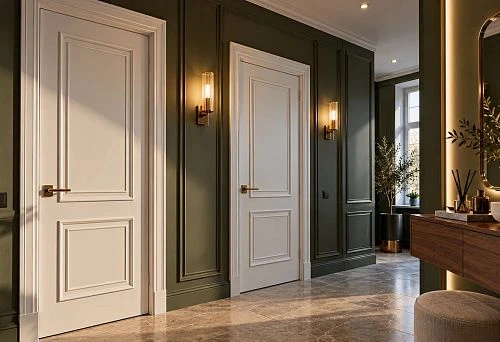
For a door, the dimensions of the panel, insert weight, operating conditions, frame design, and connection method are important. A decorative molding should not be described as a structural element without calculation. If the profile is used in door decoration, the load-bearing function and insert fixation are determined by the overall door design.
Wall panel and interior frame
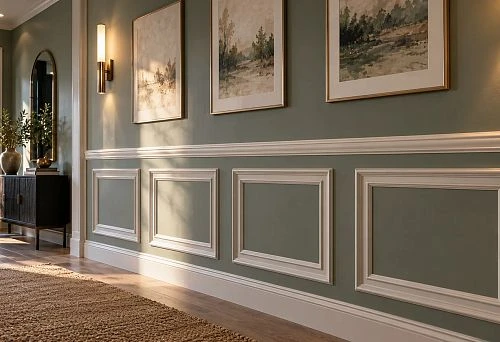
In the wall composition, the cutout can cover the edge of the panel or help connect finishing layers. Additional constraints appear here: base evenness, temperature and humidity conditions, joints, installation sequence, access to fastening. Before ordering profile for wall panel you need to make a cross-section node, not just a beautiful frontal layout.
Showcase or frame with glass
Glass requires engineering calculation and a safe method of retention. One quarter does not automatically become a fastener. Additional fixation elements, gaps, and operating conditions need to be determined. The article does not replace the work of a designer and the requirements for a specific showcase.
What to buy together with MLD-051 so that the batch does not stop at assembly
A serial order of a profile rarely exists separately from installation materials, decor, and the total linear footage of the object. But related items must be tied to the actual task, not added to the cart on the principle of "might come in handy."
| What to add to the order | Why this is required | What to check before purchase | Inner page |
| Materials for installation and finishing | Gluing, preparation, painting, or protective cycle according to the project | Compatibility with MDF, beech or oak and the selected finish | Buy materials for installation and finishing |
| Wooden overlays | Decorative finishing of frame facades or panels | Scale, material, thickness, position relative to the profile | Buy decorative furniture overlays |
| Other moldings | Assembly of a profile set for one project | Cross-sections, material, lengths and uniform finish | Select wooden moldings |
| Wooden trim for the room | Coordination of furniture frames with wall and floor finishes | Material, profile, batch, finish color | buy wooden skirting board |
| Product drawings | Check of initial sections and design of joints | File relevance and compliance with the selected modification | Download product drawings |
After the table, do not create one common cart, but a completeness list. For each item, indicate at which stage it is needed: cutting, assembly, painting, installation on
Width and depth have been swapped
This is a typical table error where two numbers stand side by side without arrows. The remedy is simple: dimension lines on the section and letter designations with a breakdown.
Two different quarters were combined into one line
The project may include profiles for inserts of different thicknesses or right-hand and left-hand versions. If everything is recorded as "MLD-051 with groove, 200 pcs.", the supplier does not see that the batch is heterogeneous. Separate the items and show the quantity for each scheme.
Counted a hundred frames instead of a hundred planks
The service is tied to pieces of the original molding. The number of frames is first converted into a parts list, then into a cutting map, and only after that into the number of slats.
The material was replaced after the calculation
Switching from MDF 2600 mm to beech 2400 mm changes the cutting layout. You cannot simply replace the word "MDF" with "beech" in a ready estimate. The quantity, leftovers, packaging, and finishing process are all recalculated.
The order was placed before the processing was approved
First, the customer pays for standard profiles, then asks to add a quarter. This may violate the service terms, deadlines, and production plan. Order MLD-051 from the manufacturer follows after the individual operation is included in the confirmed commercial offer.
Acceptance of a batch starts with documents, not with unpacking all bundles
When a long-length profile arrives at the warehouse, the temptation is simple: recount the bundles and immediately send the material to cutting. For MLD-051 with an individual selection, this is not enough. First, you need to ensure that the delivery matches the version of the task that was approved.
Check the marking against the order
At acceptance, the following must be available:
-
invoice or specification;
-
technical assignment number;
-
drawing version;
-
material;
-
length;
-
quantity;
-
separation of standard and processed profiles;
-
designation of right-hand and left-hand versions, if any;
-
packing list.
If the documents only say "molding," the batch loses its connection to the project. Internal warehouse labeling must retain the MLD-051 article number and the project processing code until cutting.
A control profile is taken from each logical group
Checking one random plank from a mixed shipment is not sufficient. Separate groups may include MDF, beech, oak, different quarter sizes, right-hand and left-hand versions. For each group, samples are selected according to an agreed inspection plan.
The sample is checked for:
-
original cross-section;
-
length;
-
material;
-
position of the quarter;
-
width and depth;
-
continuity of processing;
-
condition of edges;
-
absence of visible damage after transportation;
-
compliance with marking.
The number of parts to be inspected and permissible tolerances are set in the order documents, not invented at the warehouse after a problem is discovered.
Do not start cutting a disputed batch
If the sample looks mirrored, the size does not match, or the marking is unclear, separate the delivery and request clarification. Cutting turns a long plank into parts for a specific order and complicates resolving the discrepancy. Take photos with a ruler or measuring tool, the batch number, and a general view of the profile.
Delivery of long-length profile requires a separate line in the project plan
MDF 2600 mm long and solid wood 2400 mm long cannot be considered an ordinary small parcel. The dimensions affect packaging, transport, unloading, storage, and the ability to bring the material indoors.
Check the path from the machine to the rack
Before arranging delivery, answer practical questions:
-
is there space for unloading;
-
does the packaging fit through gates and doors;
-
can planks 2600 mm long be carried in without bending;
-
are the level supports prepared;
-
is the storage area protected from moisture and impacts;
-
will the batch be divided by production queues.
Delivery of STAVROS products is calculated based on current conditions and address. The article cannot promise a fixed delivery time or cost for any batch. These parameters are clarified after order fulfillment.
Long remnants also require space
The cutting map may leave useful offcuts. If the warehouse does not provide for their labeling, remnants quickly turn into unidentified material. For each offcut, specify the article number, material, length, presence of a quarter, and project. This allows using the remnant in the next frame without re-measuring and doubts.
When it is better not to order MLD-051 with a quarter
Honest commercial material should show the limits of application. Additional processing is not always useful.
The 30 × 16 mm cross-section does not match the joint
If the project requires a wider face shelf, greater depth, a different relief, or significant residual thickness after routing, MLD-051 may not be suitable. You cannot force a pre-selected profile to perform a task for which its geometry is inconvenient. the wooden moldings catalog Other sections can be compared, but the compatibility of each option is checked against the drawing.
The batch of processed profiles is below the set threshold
If 20 or 40 slats are required, the serial service from 100 pcs may not be available in the specified format. There is no need to artificially increase the order just to meet the threshold until storage, future demand, and the risk of project changes are calculated. Ask the manager for possible options and compare them with in-house finishing.
The design requires not a quarter but a different type of processing
Sometimes the project needs a closed groove, a complex milled contour, drilling, local routing with stops, or a ready-made end joint. The availability of a quarter service does not mean any custom operation is available. Submit the drawing and ask to confirm the technological feasibility.
The profile must perform a load-bearing function without calculation
MLD-051 is a decorative and frame profile. If the assembly bears significant load, holds a heavy insert, or works in a movable structure, an engineering check of the entire system is required. Strength cannot be justified only by the wood species or profile thickness.
Full repeatability of the natural pattern is required
Beech and oak remain natural materials. If the technical specification requires a visually identical pattern on hundreds of frames, such an expectation needs to be reconsidered or sorting criteria separately agreed upon. MDF under an opaque finish may better meet the requirement of uniform color, but even for it, an approved painting cycle is required.
How not to confuse MLD-051 with a similar profile
The site may have both old and new addresses for the same product card. For internal linking and working documents, use the primary human-readable URL of the MLD-051 card. However, what matters more than the address is the match of the article number, cross-section, and material.
A photo of the profile does not replace the article number
Narrow moldings look similar on screen. The image scale changes, and the cross-section may differ by a few millimeters. The specification states MLD-051 and 30 × 16 mm, and a drawing is attached to the technical assignment.
The name "wooden molding" also covers MDF in the card
The product group is called wooden moldings, while the specific MLD-051 is available in MDF, beech, and oak. The buyer should not infer the material solely from the category title. The modification is selected in the card and repeated in the invoice.
Selecting a rabbet is an option, not a standard for every strip
Standard MLD-051 and a profile with a rabbet per the technical specification are different items in a specific order. If they are stored side by side without labeling, the error will only show up during assembly. Separate them physically and in documentation.
Order route: from the design model to the invoice
A serial order is conveniently divided into several control points. This is not bureaucracy for the sake of paperwork, but a way to stop an error before it multiplies across a hundred strips.
Stage 1. Fix the node
The constructor shows MLD-051 in cross-section along with the insert and adjacent parts. It is checked that the 30 × 16 mm section fits, and after routing, sufficient geometry remains for the design function.
Stage 2. Select material
MDF 2600 mm, beech 2400 mm, and oak 2400 mm are compared. The decision is made considering finishing, appearance, cutting layout, and the budget for the entire batch.
Stage 3. Build a cutting layout
A parts list is compiled, allowances and saw kerf width are added, then the number of initial strips is determined. Standard and processed profiles are counted separately.
Stage 4. Prepare the technical specification
The document includes the quarter section, side, base surfaces, processing length, tolerances, right and left variants, quantity, and version.
Stage 5. Send the package to the manager
Not just the image needs to be sent. The email includes:
-
project card;
-
PDF drawing;
-
source file if necessary;
-
quantity table;
-
material and length;
-
delivery city;
-
desired packaging structure;
-
contact of the customer's technical specialist.
Stage 6. Obtain manufacturability confirmation
The manufacturer checks the possibility of executing the specified quarter, clarifies disputed points, and forms a calculation. If a change in size or side is required, the correction is returned to the drawing.
Stage 7. Verify the commercial proposal
The product, material, quantity, processing, current operation price, packaging, delivery, and deadlines are checked. A verbal agreement must appear in the confirmed document.
Stage 8. Approve the control format
The parties agree on a sample, first part, photo measurement, or another available method of confirmation before full processing.
Stage 9. Accept and label the batch
In the warehouse, profiles are linked to the technical specification version, separated by execution, and only after control are they transferred to cutting.
This route allows MLD-051 buy wholesale not as anonymous linear material, but as a prepared production item.
What to send to the manager before issuing an invoice
A short letter with a full set of data speeds up the calculation more than a long description of an idea without dimensions.
Ready-made request template
We ask you to calculate the supply of molding MLD-051 with a quarter cut according to the technical specification. Material — MDF. Cross-section of the original profile — 30 × 16 mm, length — 2600 mm. Quantity of profiles with processing — 120 pcs., standard — 20 pcs. Geometry and side of the cut are indicated in the drawing TZ-051-04. We ask you to confirm the technological feasibility, current cost of the additional operation, packaging, assembly time, and delivery to the specified city.
After the main text, attachments and the designer's contact are added. If the material is beech or oak, the length and cutting map are changed, not just the material name replaced.
What to check in the response
The manager's response should allow comparison of:
-
whether the correct article is calculated;
-
whether the correct material;
-
whether the correct length;
-
how many standard profiles;
-
how many profiles with processing;
-
which version of the drawing is accepted;
-
is the service enabled;
-
how is packaging accounted for;
-
what are the delivery conditions;
-
what other information still needs to be agreed upon.
For regular purchases terms of cooperation with furniture manufacturers help build a repeatable order channel, but each new technical specification still requires verification.
The project has changed after calculation: which items need to be recalculated
Serial frames rarely reach purchase without a single edit. The designer changes the facade width, the constructor increases the insert, the technologist suggests a different allowance, the customer moves part of the products to the next batch. The danger arises when a change is considered local: they correct one size on the drawing but leave the same number of profiles, material, and processing cost.
The new frame width changes not only two horizontal parts
If the horizontal part becomes 40 mm longer, for a hundred frames the total net footage will increase by 8 m, since each frame has two horizontals. But this conclusion is not enough. The new length may ruin a successful cutting combination: a set that fit into one plank no longer fits. Then the number of source profiles increases more than the increase in total footage shows.
After changing H or W, repeat the entire calculation:
-
update the parts list;
-
add current allowances;
-
build a new cutting map for 2400 or 2600 mm;
-
recalculate the number of standard and processed planks;
-
check the service threshold from 100 pcs.;
-
update the reserve;
-
requesting new packaging and delivery.
The old map is not marked as "approximate" but is withdrawn from circulation. Otherwise, a version that differs externally by one digit may end up in the workshop.
Replacing MDF with solid wood requires a new commercial proposal.
Switching from MDF to beech or oak changes the length of the original plank from 2600 to 2400 mm. Even with unchanged parts, the cutting result may differ. At the same time, the product price, finishing logic, visual matching requirements, and packaging volume change.
Correct sequence:
-
choose a specific wood species;
-
recalculate the cutting for 2400 mm;
-
confirm that the quarter is feasible in the selected material;
-
update the quantity;
-
review the reserve considering natural variability;
-
produce or approve a new finishing sample;
-
request a recalculated invoice.
You cannot take the MDF calculation and replace only the price of one plank in it. Such a document does not reflect the actual purchase.
Changing the quarter may affect an already approved insert.
If the width or depth of the groove is changed after testing the sample, the joint must be reassembled. A deeper step changes the position of the insert relative to the face plane. A wider one changes the overlap area and the remaining part of the profile. Even a small adjustment can affect the corner joint, coating layer, or fixing method.
The new version of the section must go through the same route as the first one:
-
check by the designer;
-
confirmation of manufacturability;
-
update of the execution table;
-
approval of control;
-
replacement of the version number in the specification;
-
Notification of procurement and assembly area.
Reduction in print run is checked by the number of processed strips.
The project started with 120 profiles with a quarter, but some facades were canceled. After recalculation, 92 remained. The total order together with standard moldings may still exceed one hundred pieces, but the number of parts with an additional operation has become less than the threshold specified for the service.
In such a situation, you cannot silently keep the previous processing price. You need to send the updated quantity and get confirmation of the terms. Possible solutions — returning some items to the queue, changing the cutting layout, postponing the purchase, or choosing another finishing method — are made only after an economic and technical comparison.
Splitting an order into two deliveries should not create two different batches without control.
Sometimes production needs the first 60 strips now, the remaining 60 in a month. In this case, the service is ordered for a total volume of 120 pcs. The possibility of phased shipment and its impact on price, deadlines, packaging, and material consistency are agreed upon in advance.
For solid wood, it is separately clarified whether both deliveries will be made from the same production batch and how this affects the visual pattern. Full identity of the wood cannot be guaranteed, but the requirement for consistency can be stated in advance and a response from the manufacturer obtained.
Changing the delivery address also affects the work plan.
A new city or another site changes logistics, the number of packaging units, and the labeling order. If one batch is distributed across multiple addresses, the specification indicates which packs belong to each site. Otherwise, the customer's warehouse is forced to open protective packaging for sorting, increasing the risk of damage before installation.
Before final confirmation, it is useful to issue a short change sheet:
| What has changed | Which document was updated | What needs to be recalculated | Who confirms |
| Frame size | Parts list and drawing | Cutting, quantity, reserve | Designer and procurement |
| Material | Specification | Length, price, finish, packaging | Technologist and customer |
| Quarter Geometry | Section drawing | Processing Capability and Control | Manufacturer |
| Print run | Quantity Table | Service Threshold and Cost | Manager |
| Delivery Schedule | Assembly Plan | Packaging and Queues | Logistics |
| Address | Delivery Request | Tariff and Labeling | Recipient |
Such a sheet does not replace updated documents, but shows which consequences have already been verified. It is especially useful when a designer, engineer, purchaser, technologist, and installation contractor work on the order simultaneously.
Frequently asked questions about MLD-051 with quarter cutout
Can I order fewer than 100 profiles with a quarter?
The service specified in the product card is provided for orders of 100 pcs or more. The possibility of a different format must be separately confirmed with a manager; it cannot be assumed to be available in advance.
Is one hundred pieces one hundred frames?
No. This refers to the number of source profiles for which additional processing is ordered. The number of frames is converted into the number of slats using the parts list and cutting map.
What counts as one piece?
One commercial piece is one slat of the selected modification and length. For MDF, the length is confirmed as 2600 mm; for beech and oak, it is 2400 mm.
Do I need to specify the side of the cutout?
Yes. The side must be shown in cross-section relative to the signed front and back surfaces. The words "left" or "rear" without orientation are ambiguous.
Can I write only the width and depth of the quarter?
Not enough. The side, base surfaces, machining length, quantity, material, and drawing version are needed. For a local sample, the start and end of the section are also specified.
Can different quarters be made in one batch?
This possibility must be confirmed. Different versions are documented as separate lines with their own drawings and quantities, not combined under a general phrase.
Is MDF suitable for enamel?
The card provides for MDF prepared for enamel. The specific primer, enamel, and application technology are selected according to the project and tested on a sample.
Can beech or oak be tinted?
Solid wood can be considered for finishes that preserve the wood grain, but the color and result depend on the coating system and natural texture. A sample on the selected material is needed before the series.
Why do MDF and solid wood have different lengths?
For MLD-051, 2600 mm is confirmed for MDF and 2400 mm for beech and oak. The article does not invent the reason for the production standard; the buyer should take into account the difference in cutting.
Can MLD-051 be used under glass?
Only after a design check. The profile cross-section, rebate dimensions, glass thickness, gaps, and method of safe fixation must be agreed upon in the joint.
Is the rebate included in the price of the standard molding?
No, in the product card it is listed as an additional option with a separate cost per piece. The current price should be rechecked before ordering.
Do I need to order a reserve?
A reserve is useful for a serial batch, but its size is determined by the project. It should account for cutting, possible defects, control samples, and the complexity of reordering.
Can only part of the slats be processed?
Yes, the request can be split into standard and processed items, but the minimum batch condition for the service must be checked based on the number of profiles with a rebate.
Is a physical sample needed?
For a responsible serial unit, a sample or another confirmed control format is desirable. The possibility of manufacturing a single trial strip is agreed separately.
How to check the quarter when accepting delivery?
Compare the side, width, depth, processing length, and edge condition with the approved drawing. The check is performed for each logical group of the batch.
Can the technical specification be changed after payment?
Any change requires approval of feasibility, cost, and timelines. It cannot be assumed that production will automatically replace an already launched version.
Where can I get drawings of the original profile?
For project preparation, you can download catalogs and product drawings, then ensure that the file matches the current MLD-051 card and the selected modification.
What should I use to glue the frame after cutting?
The composition is selected based on the materials of the profile, base, and finish. Suitable categories can be viewed in the section where they are presented Mounting and finishing materials, but the final decision is made according to the composition instructions and the technological map.
How to order delivery of a batch?
Specify the city, volume, material, and number of slats when requesting a calculation. Current rules are published on the page payment and delivery of products.
Can I order MLD-051 in one batch for multiple sites?
You can form a joint purchase if the material, processing, and schedule suit all sites. In the specification, you still need to divide the quantity and marking by addresses or phases.
A technical specification saves more than manual milling
MLD-051 with a cross-section of 30 × 16 mm can be ordered from MDF with a length of 2600 mm, as well as from beech or oak with a length of 2400 mm. But serial value appears not from the mere fact of additional processing. It appears when a hundred or more profiles come out with one confirmed geometry, the required side, and clear marking.
Before ordering, fix the dimensions of the quarter, the front surface, the processing length, the material, the quantity, and the cutting map. Separate standard and processed items. Check that the service threshold applies to the exact number of profiles. Agree on the control format and only then approve the invoice.
STAVROS company allows you to combine the MLD-051 card, additional processing, B2B terms, drawings, mounting materials, and delivery into one production order. This route helps eliminate manual rework of each frame and get a batch that can be launched into cutting and assembly according to a pre-approved process.