



































Article Contents:
- What lies behind the words 'wood-look': market anatomy
- Natural veneer on MDF base
- MDF with film coating (PVC foil, CPL)
- MDF with wood effect for painting
- WPC (Wood-Plastic Composite)
- Oak, walnut, ash, pine: wood-look decors and their character
- Oak-look: reliability and warmth
- Walnut-look: elegance and maturity
- Ash-look: the raw naturalness of Scandinavia
- Under the pine: rustic warmth and a dacha in the city
- Under wenge and exotic wood: graphics and contrast
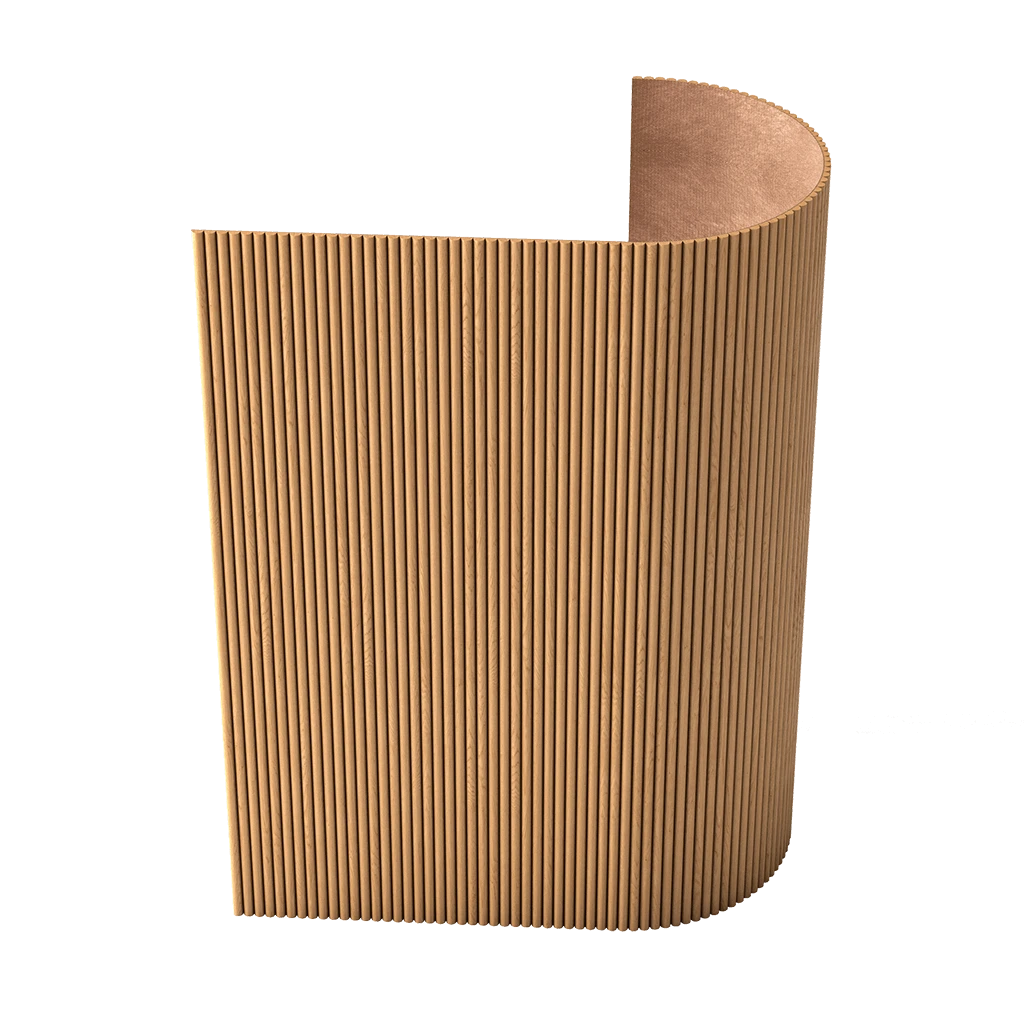
- Slatted wall panel under wood: parameters that determine the result
- Slat width and gap: the rhythm that the eye reads
- Slat thickness: volume and shadow
- Slat length: continuous or jointed surface
- Slat coating "under wood": matte, semi-matte, satin
- Slatted panels under wood in different rooms: precise recommendations
- Living room: visual center and architectural statement
- Bedroom: naturalness and tranquility
- Entryway: First Impression
- Kitchen: balance between naturalness and practicality
- Bathroom: Moisture-Resistant Solutions
- Office and commercial spaces: scale and status
- Real wood vs. wood-look: an honest comparison
- Color solutions for slatted wood-look wall panels
- Light decors: airiness and Scandinavia
- Mid-tones: natural neutrality
- Dark decors: depth and elegance
- Aged wood: brushed and patinated slats
- Lighting for slatted wood-look panels: how light creates naturalness
- Color temperature: warm only
- Light direction: angle reveals relief
- LED behind rails: glow from within
- Installation of wood-look slatted wall panel: three methods
- Method 1: adhesive installation
- Method 2: installation on battens
- Method 3: modular system
- Finishing slatted field: moldings, cornices, baseboards
- Typical mistakes when choosing wood-look slatted panels
- Frequently Asked Questions
- How do wood-look slatted panels differ from wall laminate?
- Can wood-look slatted panels be installed in the bathroom?
- How to care for wood-look slatted panels?
- How realistic do wood-look slatted panels appear in person?
- Can you buy wood-look slatted panels and install them yourself?
- What is more durable — veneer or film?
- Which wood-look species are best to choose for a living room?
- Conclusion
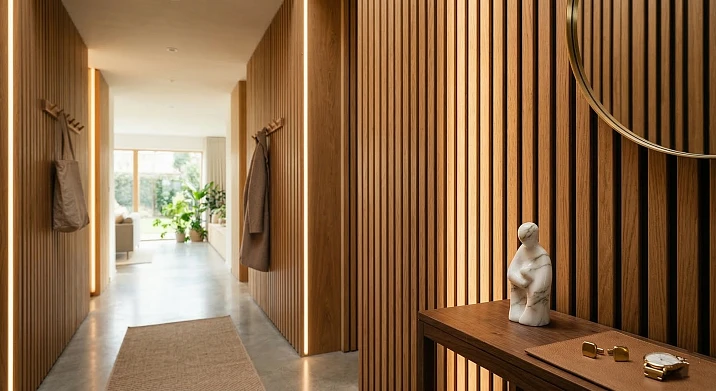
There is a question that sooner or later everyone involved in finishing asks themselves: how to get the warmth and naturalness of wood on a wall — without its caprices, without the need for annual maintenance, without a price tag that cuts all plans short mid-sentence? The answer that professional designers and experienced builders arrive at sounds surprisingly simple: wood-look slatted wall panels.
Not an imitation in the cheap sense of the word. Not 'wood-look' as a synonym for 'not real.' But a precisely calibrated solution where modern materials reproduce the visual and tactile naturalness of wood — while surpassing solid wood in stability, practicality, and price accessibility for a number of applications.
But let's be honest from the very beginning:wood-look slatted panels— is a topic that's easy to get confused about. The market coexists with fundamentally different products under this name: from MDF with film coating to natural veneer, from PVC with a printed pattern to thermally treated wood. Each of these materials has its own story, its own merits, and its own honest limitations.
This article is a professional breakdown without marketing cuts. What a wood-look slatted wall panel is in reality, what materials lie behind it, how to choose the right option for a specific room, and how not to buy a pretty picture instead of a quality product. Read carefully — every paragraph here is written for those making a decision, not just flipping through a catalog.
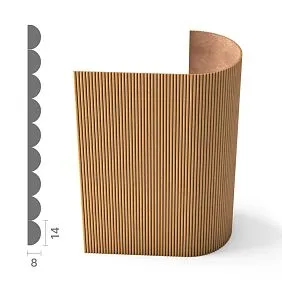
What's Behind the Words 'Wood-Look': Anatomy of the Market
Before choosing, you need to understand what exactly is being offered to you. The phrase 'wood-look slatted wall panel' combines several fundamentally different product categories. Confusion between them is the source of most disappointments when purchasing.


Natural Veneer on MDF Base
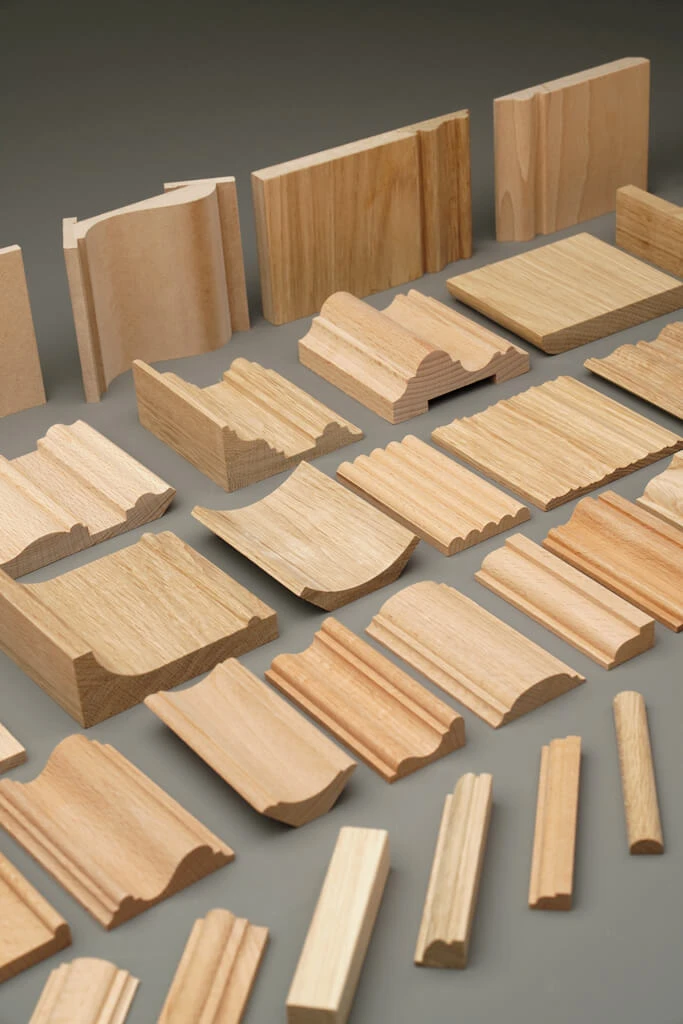
The first and highest quality 'wood-look' category is MDF slats faced with natural veneer from valuable wood species: oak, walnut, ash, cherry. Veneer is the thinnest slice of natural wood, 0.5–1.5 mm thick. It carries the authentic natural grain pattern, the living play of tone, the tactile warmth of wood. Looking at a wall with veneered slats up close — you see real wood. Because it is real — just in a very thin layer.
The MDF base gives the veneered slat stability that solid wood lacks: it does not warp, does not react to humidity fluctuations, does not crack during the heating season. VeneeredMDF Slatted Wall Panel— is a union of naturalness and stability. The best of both worlds.
Our factory also produces:


MDF with Film Coating (PVC Foil, CPL)
The second category is MDF slats with a film that imitates the texture and color of wood. The film is applied by the method of pressure and heat lamination. High-quality films (CPL — compact laminates) have an embossed surface that accurately reproduces the structure of wood fibers — from a distance of a meter or more, they are practically indistinguishable from natural veneer.
This is the mass market segment. Most 'wood-look' slatted panels in construction stores are precisely film-coated MDF. Advantages: low price, wide choice of decors (oak, walnut, pine, teak, wenge), resistance to scratches and moisture.
Limitation: film is still film. Upon very close inspection (30–40 cm), an experienced eye will distinguish it from natural material. Tactilely — less 'alive' than veneer or solid wood.
Get Consultation
MDF with wood-grain effect for painting
paintable slatted wall panelsMDF with embossed 'wood-grain' surface is a separate category. Here, the slat has a textured surface with wood grain but is painted independently in the desired color. Toning enamel applied over the relief 'reveals' the texture—darker paint collects in the 'pores' of the relief, creating a natural effect.
This solution is for those who want to combine natural texture with precise color matching: you choose a color from the RAL palette and apply it to the finished textured surface. The result is a slat with your chosen color and the natural relief of wood.
WPC (wood-polymer composite)
DCP slatted panelsWPC (Wood-Plastic Composite) is a material based on wood flour and polymer binder. It resembles natural wood in appearance, has a natural tone, is moisture-resistant, and frost-resistant. Main applications include facade and outdoor cladding, open terraces.
For interior finishing of residential spaces, WPC is used less frequently—the material is 'heavier' than MDF and tactilely less 'lively.' However, in areas with high humidity (bathroom, boiler room, covered terrace), WPC is more practical than natural wood.
Oak, walnut, ash, pine: 'wood-grain' decors and their character
Wood-grain slats are primarily a choice of decor. Which wood species to imitate? Each has its own visual character, its own 'temperature,' its own mood.
Oak: reliability and warmth
Oak is the most in-demand decor for slat panels. Large, expressive grain pattern, warm amber or golden tone, a sense of reliability and 'maturity.' Oak-grain slats in interiors are stylistically neutral: equally suitable in Scandinavian interiors (whitewashed oak), classic (dark oak), minimalism (natural oak without tinting), loft (oak with pronounced pores).
Oak decor options: natural (amber), whitewashed (Scandinavian light), 'tobacco' (warm brown), 'dark walnut' (rich dark brown), 'smoky' (gray-brown), 'aged wood' (with an aged effect).
Wooden slat panelsWith oak veneer — the closest option to solid wood: a lively grain, natural tone, warm tactile surface.
Walnut: elegance and maturity
Walnut is a rarer and more 'expensive' decor in visual appearance. Dark brown with a chocolate or purple undertone, a fine silky grain pattern. Walnut slats in the interior are elegance without ostentation, maturity without pretentiousness.
Walnut is suitable for a study, a living room with classic furniture sets, or a boutique-format restaurant or hotel. In a residential interior — walnut as an accent wall against neutral warm walls.
Walnut slatted wall panel — a 'premium' category even in film finish: the dark saturated tone requires quality lighting (warm light 2700K) and thoughtful combination with furniture.
Ash: the nervous naturalness of Scandinavia
Ash has a more 'nervous,' dynamic grain pattern compared to oak. A light natural tone (slightly cooler than oak), expressive dark grain lines on a light background. Ash slats are for Scandinavian and Japanese concepts, for light minimalist interiors.
Whitewashed ash is one of the most 'airy' decors for slatted panels. On a whitewashed background, dark grain lines create a delicate natural pattern that does not 'overwhelm' or clutter the space.
Pine: rustic warmth and a country house in the city
Pine — a warm yellow-reddish tone, large knots, wide grains. Pine decor creates the image of a 'country house,' 'rustic cottage,' or Scandinavian cabin by a fjord. For urban apartments in 'rustic,' 'country,' or 'hygge' styles — pine slats convey a sense of natural relaxation.
Important nuance: natural pine has resinousness, dimensional instability, and a tendency to yellow over time. Pine-look MDF or veneered slats are free from these drawbacks while preserving all the visual naturalness.
Wenge and exotic looks: graphics and contrast
Wenge, zebrano, merbau – decor options of exotic tropical wood species. A dark, almost black tone with contrasting light stripes (zebrano), or a uniform dark brown with an almost imperceptible wood grain pattern (wenge). Exotic-look slats are for bold concepts, for office and commercial spaces, for teenage rooms in a 'dark' style.
Wood-look slatted wall panel: parameters that determine the result
The decor is only part of the choice. The result in the interior is determined by a combination of parameters, each of which is important.
Slat width and gap: the rhythm perceived by the eye
Slat width is the first thing the eye 'reads' when looking at a slatted surface. It is what determines the 'scale' of the rhythm: delicate and intricate or monumental and architectural.
| Batten width | Gap | Rhythm character | Suitable for |
|---|---|---|---|
| 15–20 mm | 10–12 mm | Very delicate, 'musical' | Small rooms, ceiling height 2.4 m |
| 25–30 mm | 12–15 mm | Balanced, neutral | Standard residential spaces |
| 35–40 mm | 15–20 mm | Expressive, 'adult' | Spacious living rooms, studies |
| 45–60 mm | 20–25 mm | Monumental, architectural | Large spaces, ceilings 3+ m |
| 70–100 mm | 25–35 mm | Sculptural, almost architectural | Commercial properties, high-end |
The rule of proportionality works both ways: slats that are too narrow in a spacious room look 'petty', while slats that are too wide in a small room 'overwhelm'.
Slat thickness: volume and shadow
Slat thickness is a less noticeable but equally important parameter. It determines the depth of shadow in the gaps and the three-dimensionality of the slatted field.
A slat 10–12 mm thick is a flat surface with minimal shadow. With oblique lighting, it creates a barely noticeable relief. Suitable for delicate solutions.
Batten 18–22 mm thick — optimal for residential interiors. Shadow in the gap — 15–20 mm deep. The surface is perceived as volumetric, three-dimensional. With side lighting — expressive play of light and shadow.
Batten 28–35 mm thick — deep volume, sculptural relief. Each batten casts a noticeable shadow. For large spaces and architectural concepts.
Batten length: continuous or jointed surface
Standard length of batten panels — 2400, 2700, 3000 mm. For rooms with ceiling height up to 2.7 m — standard length allows mounting vertical battens without joints. For ceilings above 3 m — battens are joined. The joint location with proper installation (staggering joints between adjacent battens) — is unnoticeable.
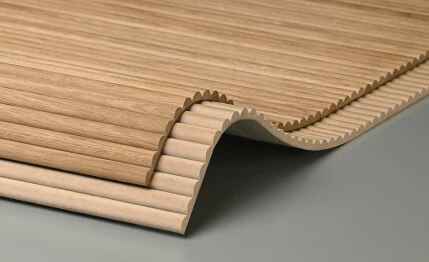
slatted modular wall panel— ready-made module with battens fixed on a backing with a specified gap. Module length is standardized. Module installation is faster and more precise than piece-by-piece batten mounting.
Batten finish 'wood-like': matte, semi-matte, satin
The degree of surface gloss fundamentally changes the perception of 'wood-like' decor.
Matte finish — no glare, maximum naturalness. Matte surface of an oak-like batten — visually indistinguishable from natural wood with oil finish. For residential interiors — optimal choice.
Semi-matte (satin) — slight silky sheen. Looks slightly 'richer' with side lighting. More practical for maintenance: dirt is less noticeable, surface is easier to wipe.
Glossy — not for 'wood-like' battens. Gloss kills naturalness: the surface stops looking like wood and starts looking like plastic. The only exception — special designer concepts with intentional 'lacquer' aesthetics.
Wood-look slat panels in different rooms: precise recommendations
There is no universal solution. Each room dictates its own requirements for material, parameters, and decor.
Living room: visual center and architectural statement
The living room is the most 'visible' room. A wood-look slat wall here carries maximum aesthetic weight: it's an accent element that sets the style and image of the entire space.
For a living room with ceilings 2.6–2.8 m: slat 35–40 mm, gap 18–20 mm, decor under natural oak or tinted ash, matte finish.Wall slat panels in interiorFor the living room — vertical orientation, from floor to ceiling on one accent wall.
Lighting: track spotlights with a 30–40° angle to the slat surface 'reveal' the 'wood-look' decor — with proper lighting, even film-faced MDF looks like natural material thanks to the play of shadow in the gaps and surface relief.
For a large living room (25+ sq. m): slat 50–60 mm, gap 22–28 mm, decor under walnut or wenge — a monumental scale proportionate to the space.
Bedroom: naturalness and tranquility
In the bedroom, a wood-look slat wall panel is primarily a psychological tool. The natural tone of wood on the wall behind the headboard creates an environment for quality rest.
Recommended decor: whitewashed oak, natural ash — light natural tones for the sleeping area. Slats 20–30 mm, gap 12–15 mm. Acoustic felt backing behind the slats — reduces external noise.
For a bedroom in a dark style ('bedroom noir'): decor in wenge or dark walnut finish, wide slats 40–50 mm, LED backlighting behind the slats in a warm tone of 2200K.
Entryway: first impression
Hallway — a room with high mechanical load on the walls: coats, bags, accidental impacts. Slatted panels here should be durable.
Optimal solution: MDF with matte enamel or CPL film. Film coating in the hallway is more practical than veneer: more resistant to scratches and abrasion. Decor in dark oak or walnut finish — hides contact marks better than light tones.
Height of the slatted field in the hallway: up to 120–150 cm from the floor ('working' height zone) or from floor to ceiling. The upper part of the slatted field — a shelf for hats and bags.
Kitchen: balance between naturalness and practicality
Slatted panels in the kitchenWood-look slatted panels — a question of zoning. Areas not in contact with grease splashes and water vapor (decorative wall opposite the work zone, dining area, 'island' above the dining table) — can be finished with wood-look slatted panels with a lacquered coating.
Backsplash (work area above the countertop) — not suitable for slatted panels made of MDF or natural wood. Tile or glass is needed here.
Ceiling area of the kitchen:Batten panels for ceilingsWood-look slatted panels above the dining table — create a 'warm ceiling island', visually highlighting the dining area.
Bathroom: moisture-resistant solutions
Only moisture-resistant options of wood-look slatted wall panels are suitable for bathrooms:
-
WPC slats with wood texture — unlimited water resistance
-
Moisture-resistant MDF (green) with water-based varnish — in areas without direct water contact
-
PVC slats with wood decor — fully moisture-resistant
Natural veneer and standard MDF — not suitable for bathrooms.
Office and commercial spaces: scale and status
In office spaces, a wood-look slatted wall serves a communication function: it showcases the company's taste and status. Larger parameters are appropriate here than in residential interiors.
Slat 60–80 mm, gap 25–35 mm, walnut or natural oak decor, floor-to-ceiling. Built-in LED strips behind slats — warm corporate lighting.Slatted Façade Panelsin a similar decor — to continue the exterior building image.
Real wood vs. wood-look: an honest comparison
This question arises for everyone who seriously approaches the choice. When to take natural solid wood, and when to use wood-look slatted wall panels — is the replacement justified?
| Criterion | Natural solid wood | Veneer on MDF | MDF with film |
|---|---|---|---|
| Natural appearance (visual) | ★★★★★ | ★★★★★ | ★★★★☆ |
| Tactile naturalness | ★★★★★ | ★★★★☆ | ★★★☆☆ |
| Dimensional stability | ★★☆☆☆ | ★★★★★ | ★★★★★ |
| Moisture resistance | ★★★☆☆ | ★★★★☆ | ★★★★★ |
| Ease of maintenance | ★★★☆☆ | ★★★★☆ | ★★★★★ |
| Price | ★☆☆☆☆ (high) | ★★★☆☆ | ★★★★★ |
| Repaintability | ✗ | ✗ | Paint-ready only |
| Service life | 30–50+ years | 15–25 years | 10–15 years |
Honest conclusion: for accent surfaces where naturalness is critical and budget allows — natural solid wood or veneer. For large areas, wet rooms, high-traffic zones — MDF with film or WPC. This isn't 'worse', it's 'more appropriate' for these conditions.
Color solutions for wood-look slatted wall panels
Wood-look decor is not a monochrome story. The modern market offers dozens of tints and effects, allowing you to create slats with the desired character.
Light decors: airy and Scandinavian
Whitewashed oak is the most popular light decor. A whitewashed tone with a barely noticeable grayish undertone. The natural wood grain pattern remains visible against the light background. Creates a Scandinavian atmosphere: clean, natural, spacious.
Natural ash is slightly cooler than whitewashed oak. A whitewashed shade with thin dark wood grain lines. For Japanese and Scandinavian concepts.
Whitewashed pine is a very light, almost white tone with large knots. A rustic look in a modern interpretation.
Light wood-look decors are for small rooms (visually expand), for children's rooms (safe naturalness), for rooms with insufficient natural lighting.
Medium tones: natural neutrality
Natural oak is an amber warm tone. An absolutely universal decor for any style and any room. Slats in natural oak color pair with white, gray, beige, dark green wall finishes.
Honey oak is slightly more saturated than natural. A warm golden tone with a pronounced honey undertone. A cozy, 'homely' look.
Natural cherry — a reddish-brown tone with a red undertone. A warm, 'authorial' finish. In modern interiors — an unexpected and expressive choice.
Dark finishes: depth and elegance
Oak 'tobacco' — a warm brown, 'mature' tone. For studies, meeting rooms, bedrooms in a classic style.
Oak 'smoky' — a gray-brown, neutral dark tone. For modern concepts without obvious 'warmth' — more of an intellectual than a cozy look.
Dark walnut — a rich chocolate tone with a delicate wood grain pattern. Elegance without ostentation.
Wenge — almost black with a dark brown undertone and contrasting light stripes. For bold design concepts.
Aged wood: brushed and patinated slat
Finish 'old wood' or 'brushed oak' — slats with an imitation of an aged surface. Open pores, soft 'worn' surface, uneven tone with dark accents in the recesses.
In the interior: creates the image of a 'home with history' — patiné, without the sterility of new construction. Suitable for loft, industrial, rustic, 'French Provence' styles.
Wood-look slatted wall panel with a brushed surface — a solution for those tired of the 'new-build perfection' of modern interiors.
Lighting for Wood-Look Slatted Panels: How Light Creates Naturalness
Wood-look decor largely depends on lighting. The right light 'creates' the naturalness of the surface. The wrong light exposes its artificiality.
Color Temperature: Warm Only
Warm white light (2700–3000K) 'activates' the amber and brown tones of wood-look decor. A slat in natural oak under warm light appears golden, vibrant, natural. The same slat under cool light (4000–5000K) 'dies,' loses its natural tone, and takes on a sterile look.
Non-negotiable rule: wood-look slatted panels — warm light only. 2700K is ideal. 3000K is acceptable.
Light Direction: Angle Reveals Texture
With direct (frontal) lighting, the slatted surface appears flat — the texture is not visible, the gaps don't 'play.' With side lighting (at a 30–45° angle) — each slat casts a shadow into the gap. The surface becomes voluminous, three-dimensional, sculptural.
A track spotlight directed at the slatted wall at a 30–40° angle from the ceiling is an essential element of lighting for a slatted interior. It is precisely what 'activates' the naturalness of the surface.
LED Behind Slats: Glow from Within
An LED strip mounted on the backing behind the slats creates a 'glow' effect from the gaps. With a warm color of 2700K — a soft, natural glow. Wood-look decor with such backlighting gains a warm, natural 'pulse': the surface looks alive even in the absence of other light sources.
Installation of wood-look slatted wall panels: three methods
installation of slatted panels— a topic that requires specifics. The three main methods differ in labor intensity, wall requirements, and result.
Method 1: adhesive installation
Application condition: flat wall (tolerance ±3 mm per 2 m), dry, without dust and grease stains.
Tools: mounting adhesive gun, painter's tape for fixing during curing.
Adhesive: mounting adhesive such as 'liquid nails' or specialized MDF adhesive — solvent-free. Apply in a zigzag pattern on the back surface of the slat.
Advantages: fast, no battens, clean installation. Slats adhere to the wall without gaps — no space behind the slat for LED strips and sound insulation.
Limitations: only flat walls. Dismantling is difficult (slats are glued permanently). Does not allow hiding wiring behind the slatted field.
Method 2: installation on battens
Application condition: any wall, including uneven ones (up to 25 mm deviation).
Battens: wooden (40×20 mm) or metal profile spaced 400–500 mm apart. Battens are leveled to ensure a flat slat surface regardless of the wall condition.
Slat fastening: finish nails (invisible fastening through the side surface of the slat), clips (hidden fastening), screws with plugs.
Advantages: applicable to any walls. Space behind the battens is for sound insulation, LED strips, hidden wiring. Demolition and replacement of individual slats are possible.
Complete step-by-step instructions for both methods are in theguide to DIY installation of slatted panels.
Method 3: modular system
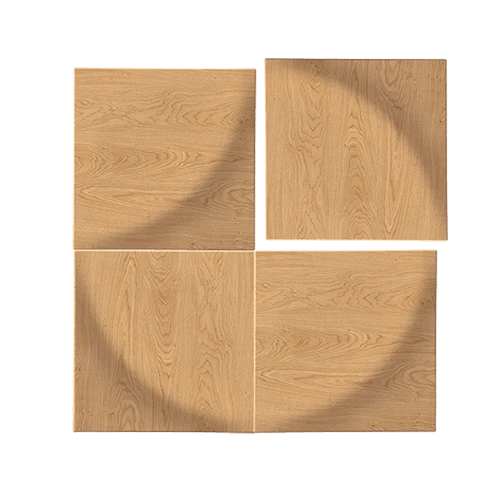
modular slat wall panelswith slats on a ready-made backing are mounted as a single panel. The backing is attached to the wall (glue or screws), the gap between slats is preset at the factory.
Plus: maximum gap precision, minimal installation time, can be installed solo. Minus: less flexible for non-standard room dimensions — requires trimming modules at the edges.
Finishing the slat field: moldings, cornices, baseboards
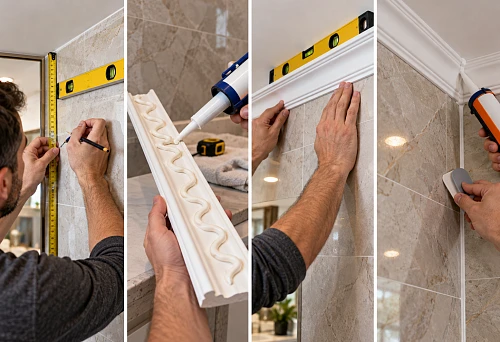
A professional installation result for wood-look wall slatted panels lies in the details of perimeter finishing. Unfinished edges of the slat field 'ruin' the look. Proper finishing creates a sense of architectural 'framing'.
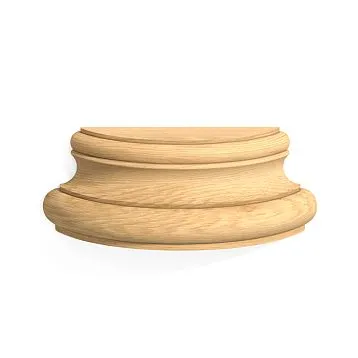
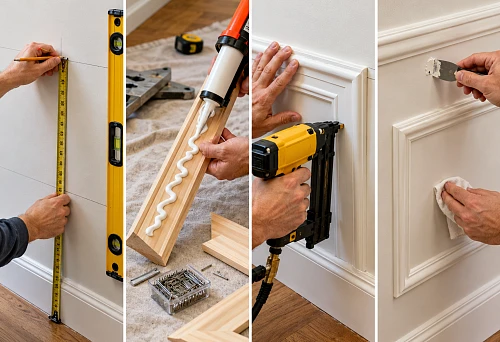
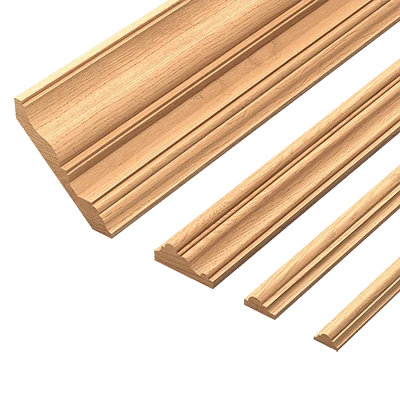
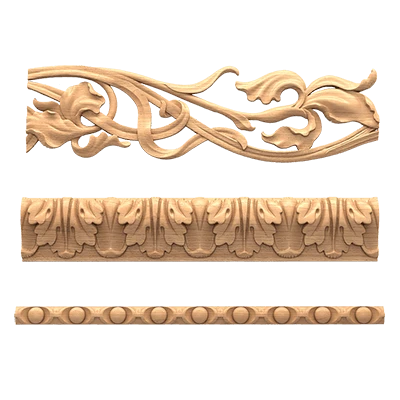
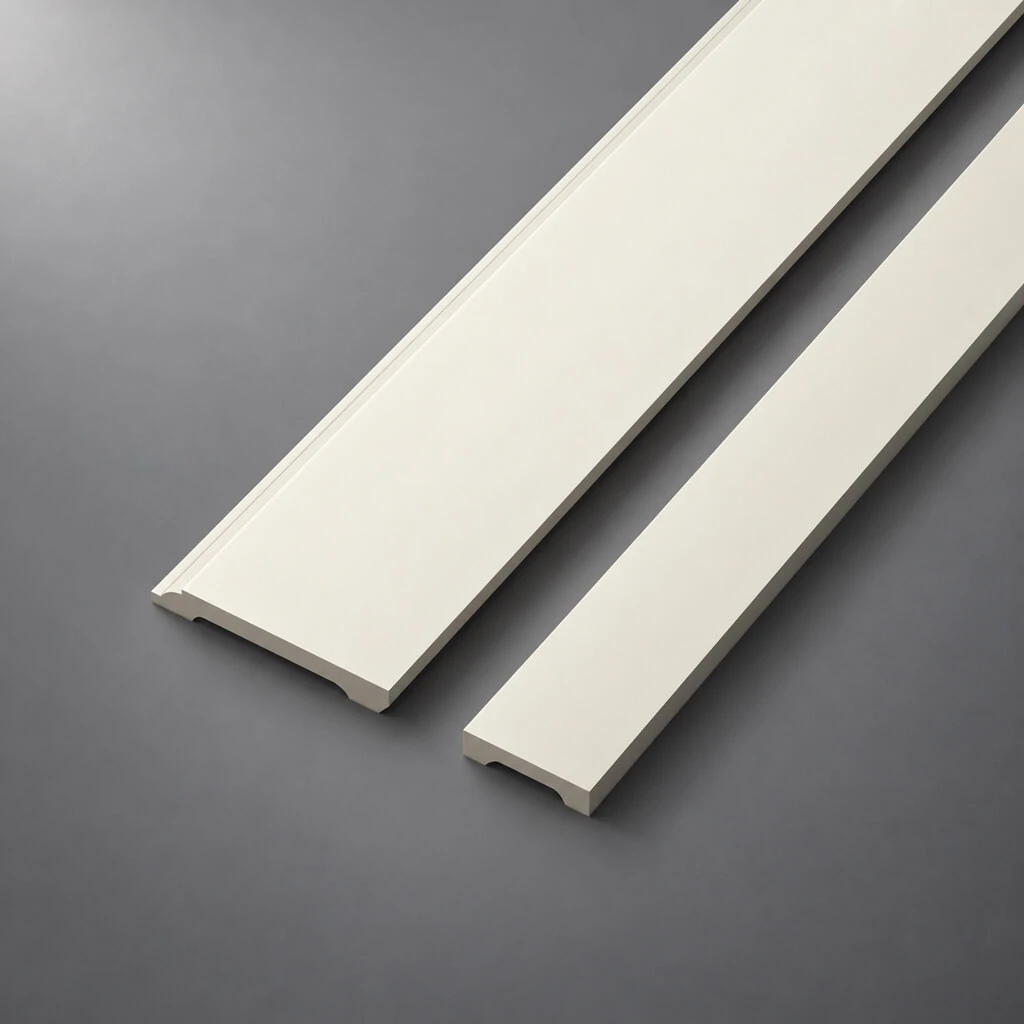
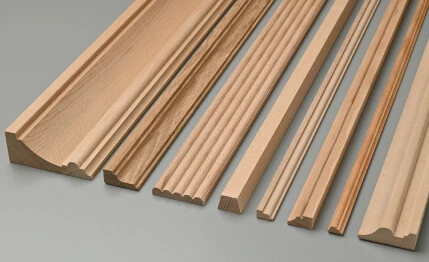
solid wood baseboardin the decor, matching the slats (or contrasting — by design decision) — the bottom finish. Plinth height: 60–100 mm depending on ceiling height. Profile: straight (modern style), profiled (classic).
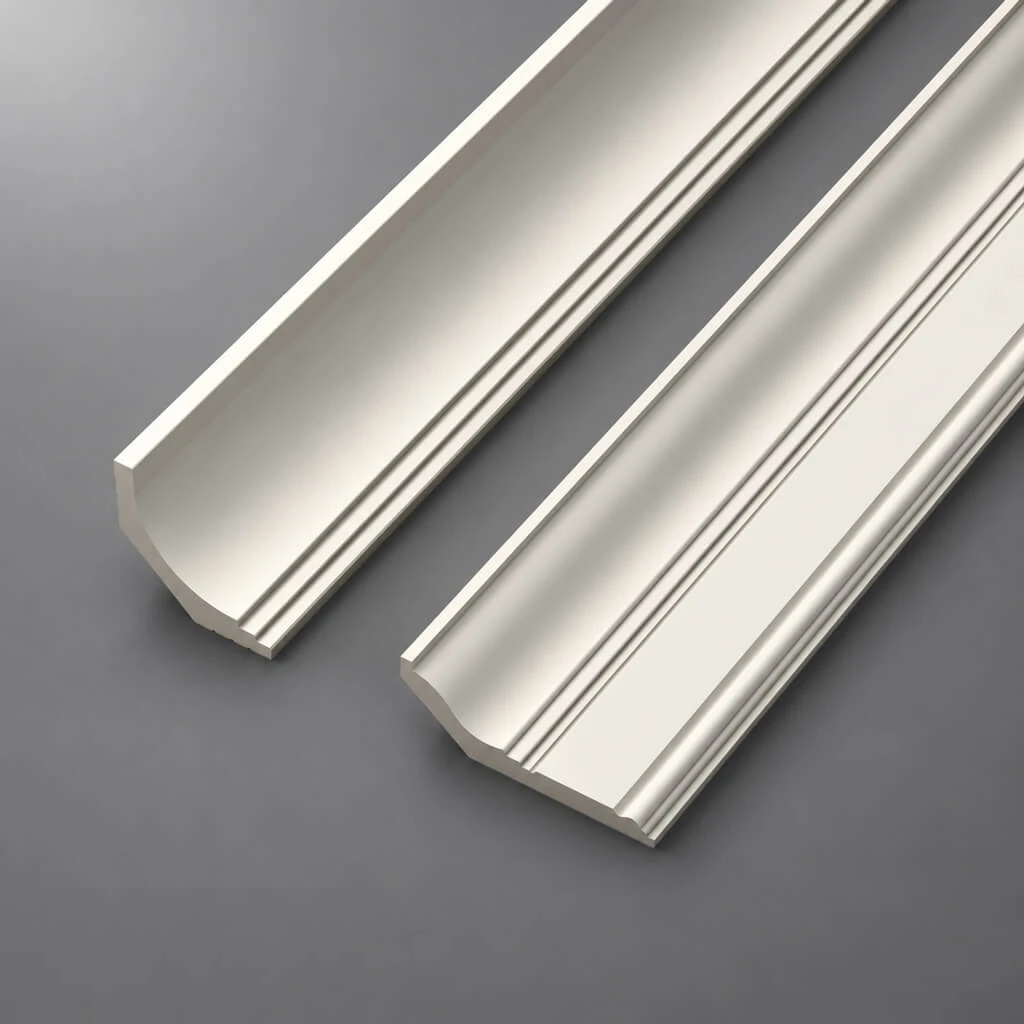
a polyurethane cornicealong the top edge of the slat field — the top finish. With LED backlighting behind the slats — a cornice with a groove for the LED strip: light 'flows' down from the cornice along the slats.
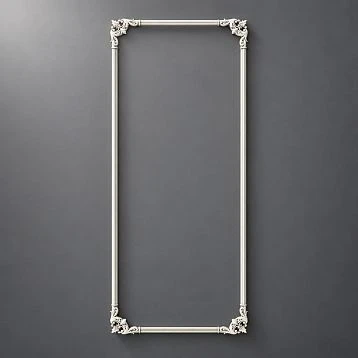
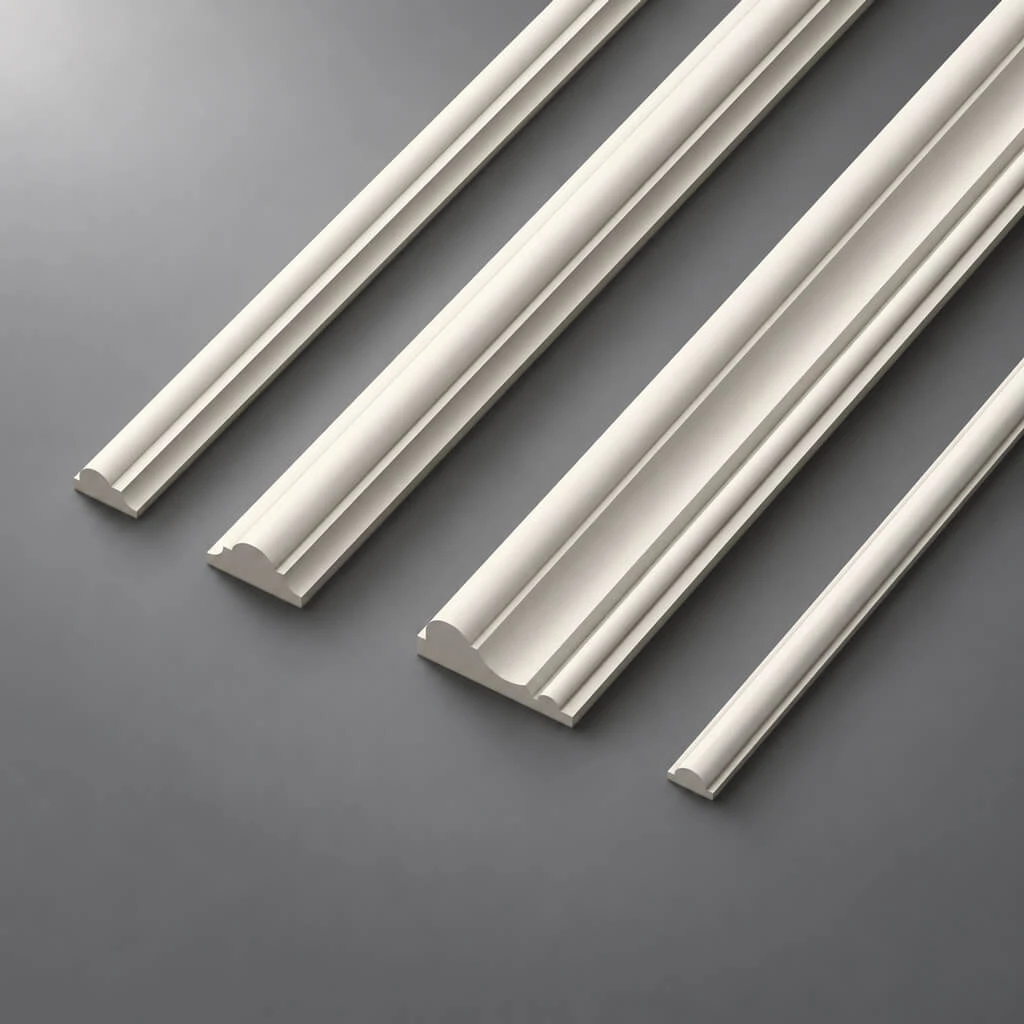
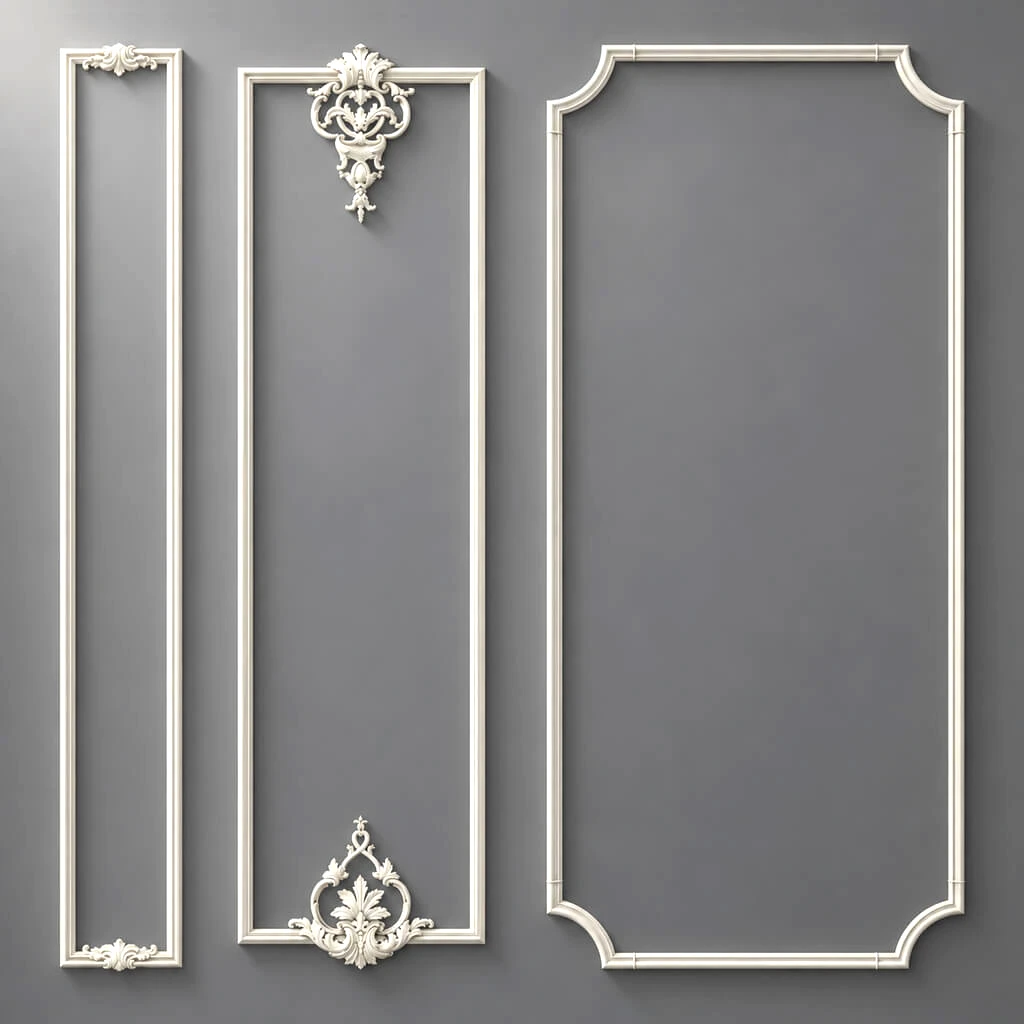
Woodensolid wood moldingalong the side edges — the 'frame' of the slat panel. Without side moldings, the slat field on an accent wall looks like 'an unfinished painting without a frame.'
Typical mistakes when choosing wood-look slat panels
Let's analyze the mistakes that are repeated over and over again. Learning from others' missteps is the cheapest way to learn.
Mistake 1: choosing 'wood-look' decor without considering the room's lighting. Dark decor (walnut, wenge) in a room with north-facing windows and without quality artificial lighting — a wall 'failure.' Dark tones require warm, bright light.
Mistake 2: mismatch between the scale of the slat and the room. A 70 mm slat in an 18 sq. m apartment living room — an architectural nonsense. A 20 mm slat in a business center lobby — goes unnoticed. The matching table is above in the article.
Mistake 3: ignoring acclimatization. MDF and especially natural veneer — must acclimatize in the room for 24–48 hours. Immediate installation after delivery from cold or a humid warehouse — risk of deformation.
Mistake 4: installation without perimeter finishing. A slat field without a plinth and cornice — looks like a temporary solution. Perimeter finishing is a mandatory part of the system, not an optional 'decor.'
Mistake 5: Skimping on lighting. Buying high-quality wood-look slatted panels and illuminating them with cold office lighting is like buying a Renoir painting and hanging it in a dark hallway. Lighting is an investment no less important than the material itself.
Frequently asked questions
How do wood-look slatted panels differ from laminate on a wall?
Laminate is a flat coating that imitates parquet. Slatted panels are a volumetric system with gaps between the slats, creating a three-dimensional rhythm and play of light and shadow. The effect is fundamentally different: laminate on a wall looks like 'parquet nailed to a wall,' while slatted panels look like an architectural surface.
Can wood-look slatted panels be installed in a bathroom?
In bathrooms, only moisture-resistant materials are suitable: WPC, moisture-resistant MDF with water-based varnish (in areas without direct water contact), PVC. Standard MDF and natural veneer are not applicable.
How to care for slatted panels with wood-look decor?
Film-coated MDF: damp microfiber cloth, neutral cleaner. Varnished veneer: damp wiping, neutral cleaner without abrasives. Oiled veneer: wiping, once a year – maintenance oil. Avoid: abrasive sponges, acidic and alkaline cleaners.
How realistically do wood-look slatted panels appear 'in real life'?
High-quality natural veneer is indistinguishable from solid wood. High-quality CPL film with embossing is indistinguishable from veneer at a distance of a meter or more. Upon very close inspection, an experienced eye will notice the difference. In an interior, this has no practical significance – no one examines walls from a distance of 20 cm.
Can it bebuy slatted panelswood-look and install them yourself?
Yes. The adhesive method on a flat wall is quite feasible for someone without a construction background. Installation on battens requires a laser level and a miter saw. Full instructions are in the step-by-step guide for DIY installation.
What is more durable — veneer or film?
With proper care, natural veneer with a lacquer coating lasts 15–25 years. High-quality CPL film lasts 10–15 years under domestic loads. Veneer can be locally restored if mechanically damaged, film cannot.
Which 'wood-look' species are best to choose for a living room?
For modern concepts: natural oak, bleached ash, 'smoky' oak. For classic: walnut, dark oak. For loft and industrial: wenge, brushed 'aged' oak. For Scandinavian style: bleached oak or ash.
Conclusion
A wood-look slatted wall panel is not a compromise between 'wanting natural' and 'lacking the budget'. It is an independent solution with its own logic, its own advantages, and its own area of application. Veneered slats carry genuine naturalness with the stability of an MDF base. Film-covered MDF provides color accuracy and high practicality at an affordable price. WPC opens up possibilities for wet and outdoor areas.
Choosing the right material and finish, well-selected slat and gap parameters, quality warm lighting, and impeccable perimeter finishing — that is the formula for a slatted interior where the naturalness of 'wood-look' becomes indistinguishable from the naturalness of real wood.
The full range for slatted systems: molding made of natural oak, ash, and birchmoldings, cornices, baseboards,decorative slatted wall panels— in the full catalog of STAVROS company.
STAVROS is a manufacturer of millwork and slat systems made from natural wood, with years of experience in implementing residential and commercial projects. Professional consultation on material selection, decor, and parameters for any space. Because naturalness is not about the price of the material. It's about the right choice and precise execution.