Article Contents:
- Why a handle changes furniture more than it seems
- Wooden furniture handles: when they are better than metal and plastic
- Oak or beech: what is the difference for a furniture handle
- Handles for a cabinet: how not to ruin a large facade
- Long handles on a cabinet: why they work
- Handles for a cabinet: horizontal or vertical
- Handles for the kitchen: shape, grip, and the issue of care
- Wooden handles and kitchen style
- Dresser handles: a small detail that changes everything
- Replacing handles on an old dresser: what to consider
- Surface-mounted handles: the most straightforward option for replacement
- What makes a surface-mounted handle expressive
- Profile and recessed handles: when a calmer facade is needed
- Profile handles: purity and minimalism
- Recessed handles: the disappearance of hardware
- Round, long, designer: how to choose the shape of a handle
- Round furniture handles
- Long handles for cabinets and kitchen fronts
- Designer handles: when a handle is a work of art
- How to choose a handle to match the color and style of the facade
- Choosing a handle by wood color
- Mistakes when choosing furniture handles
- Where to buy STAVROS wooden furniture handles
- Additional block: handles and the overall look of a wooden interior
- Furniture handles in different rooms: a brief selection guide
- Technical parameters when choosing a handle: a quick checklist
- FAQ: answers to popular questions about furniture handles
- Instead of a conclusion: the handle as an investment in style
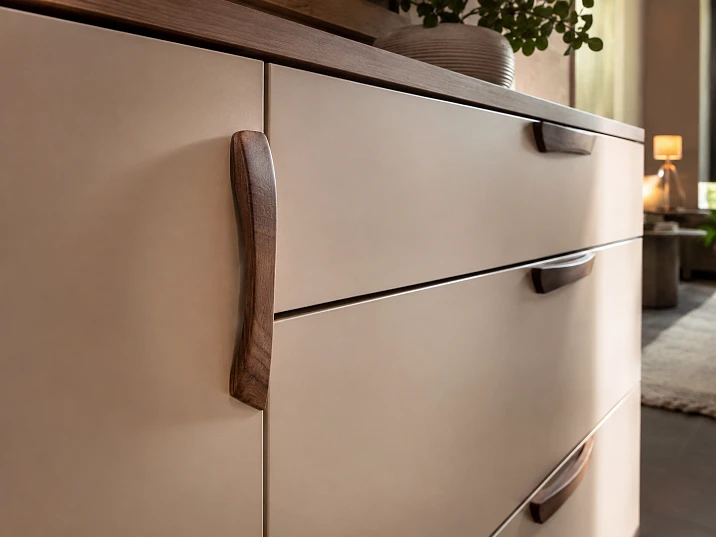
There are details that go unnoticed — and there are details that decide everything. Furniture Handles belong to the second category. A small object that you touch dozens of times a day can literally change the perception of an entire wardrobe, kitchen set, or old chest of drawers. Put a cheap chrome bracket on a good facade — and the furniture will lose half its value. Put a wooden handle of the right shape and proportion — and the same facade will play completely differently.
Why does this happen? Because the handle is the first thing the hand touches. It is the first thing the eye falls on when opening. It is the detail that sets the tone for the entire piece of furniture: cold or warm, strict or soft, cheap or expensive. In this article, we will break down everything in order: what types there are furniture handles, how to choose the right shape, material, and type of fastening, how to avoid mistakes when buying, and why a wooden furniture handle looks more convincing than metal and plastic in most interiors.
Why a handle changes furniture more than it seems
Imagine two identical kitchen sets. The same facade, the same colors, the same manufacturer. The only difference is the handles. On the first one — standard chrome brackets from the mass segment. On the second — wooden overlay handles made of oak with a soft rounded shape. Which one looks more expensive? The answer is obvious even to those who have never been involved in design.
The fact is that the human eye is extremely sensitive to textures and materials. The brain instantly reads signals: natural or synthetic, warm or cold, made with attention or without it. A wooden furniture handle carries information about warmth, living texture, and handcraft — and it is this feeling that is transferred to the entire piece of furniture.
But it's not just about the visual effect. The handle is a tactile experience. Cool metal and warm wood are perceived fundamentally differently. In the bedroom, where the chest of drawers stands by the bed and is opened with a half-asleep hand in the morning, a warm wooden handle is a small pleasure. In the children's room, it is safety and softness. In the kitchen with wooden facades, it is an organic continuation of the overall image.
The handle sets the character of the furniture. This is not a metaphor, it is literally so: the same door with different handles will look like classic, Scandinavian minimalism, Provencal country, or strict modern loft. That is why, when updating furniture, many designers start with replacing the hardware — it is fast, not too expensive, and gives an instant visual result.




Wooden furniture handles: when they are better than metal and plastic
The market for furniture hardware is huge. Metal, plastic, ceramics, glass, leather — there are plenty of options. But wooden furniture handles occupy a special niche, and here's why.
Texture and warmth. Wood is the only material that is simultaneously pleasant to the touch, visually beautiful, and organic in most residential interiors. Metal can be exquisite, but it is cold. Plastic can imitate anything, but it lacks liveliness. Wood retains warmth, its surface is slightly uneven — and this is not a flaw, but an advantage.
Compatibility with styles. A wooden handle is a universal element that works in classic, neoclassical, Scandinavian minimalism, Japandi, country, Provence, and eco-interiors. Unlike polished chrome or matte black metal, wood rarely conflicts with other elements. It easily combines with solid wood facades, slats, wooden furniture legs, wooden moldings, and carved decor.
Possibility of coating. wooden furniture handles can be both in their natural form and coated with oil, varnish, stain, or paint — this opens up wide possibilities for customization. unfinished wooden handles allow you to independently select the finish for a specific facade.
Eco-friendliness and durability. Solid oak or beech is not just beautiful words. It is dense, hard, wear-resistant wood that, with proper care, lasts for decades. An oak handle will not crack from temperature changes, will not fade from ultraviolet light, and will not delaminate over time.
Integration into the image. If there are wooden elements in the interior — wooden furniture legs, carved cornices, wooden slats, or Carved furniture decor — wooden fittings become part of a unified system, not a random detail.
Our factory also produces:
Oak or beech: what's the difference for a furniture handle
Among hardwoods, oak and beech occupy top positions in furniture hardware production. Oak is denser, has a pronounced grain pattern, and is slightly warmer in tone. Beech is more uniform in structure, a bit lighter, easy to work with, and holds its shape well. Furniture handles made of oak look more prestigious, especially if the facades are also made of oak or imitate it. Solid Wood Items STAVROS products are made from properly dried wood with strict climate control maintained during production — this ensures product stability and the absence of deformation during use.
Get Consultation
Cabinet handles: how not to ruin a large facade
A cabinet is a large piece of furniture. Tall doors, wide panels, significant visual weight. And it is here that the choice of handle becomes crucial: the wrong shape or scale of hardware can ruin the entire look.
The main rule for a cabinet is proportionality. A small knob handle on a tall door looks ridiculous: it gets lost, appears random and unjustified. For cabinet handles, especially for hinged doors, you need to choose a shape that supports the vertical or horizontal line of the panel.
Long handles on cabinets: why they work
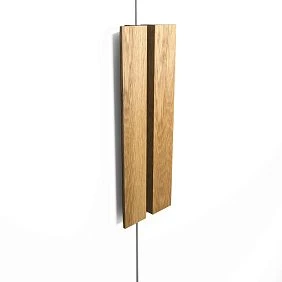
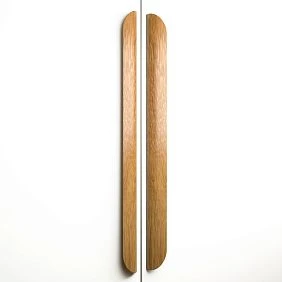
Long handles on cabinets are one of the most effective design techniques when working with tall facades. The elongated shape of the handle visually supports the vertical line of the door, making the cabinet appear slimmer and taller. At the same time, such a handle provides a comfortable grip along its entire length — an important practical advantage for hinged doors.
Long handles for a cabinet They are especially good for wardrobes, clothes closets, and tall kitchen cabinets. They are relevant in Scandinavian style, minimalism, and neoclassicism with simplified facades. Long wooden cabinet handles look warm and organic — significantly softer than metal counterparts of the same shape.
A handle for a hinged cabinet door must also consider one more point: when opening, both hands should have a good grip point. An elongated wooden handle allows you to grab the door at any convenient spot — which is especially important when the cabinet is not at eye level but lower or higher.
Cabinet handles: horizontal or vertical
The orientation of a handle on a cabinet is not a technical question, but a design one. A vertically placed long handle emphasizes height, giving furniture a slender look. A horizontal one, on the contrary, emphasizes width and works well for low cabinets or mezzanines. In classic interiors, horizontal handles often look more traditional; in modern ones, vertical handles create a concise, confident silhouette.
Kitchen handles: shape, grip, and maintenance concerns
Kitchen is the most intensive space in the home in terms of furniture use. Facades are opened dozens of times a day, hands can be wet, greasy, or simply hot. Nearby are steam, splashes, and temperature changes. All this means that handles for kitchen furniture should be chosen not only by appearance but also by practical characteristics.
Handle protrusion. The larger the protrusion, the more convenient the grip, but the higher the risk of accidentally hitting the handle when passing by. In narrow kitchens, this point is especially important: a handle that protrudes too much becomes an obstacle.
Grip shape. A round knob handle requires a pinch grip — this is less convenient with wet hands. An elongated bracket or profile handle allows you to grasp it with your whole palm — this is more reliable and hygienic.
Surface coating. Wooden furniture handles with coating are easier to clean, resistant to moisture and grease. unfinished wooden handles require additional treatment before installation in the kitchen, but allow you to choose any finish to match the facade.
Matching the facade. Handles for kitchen furniture should blend organically into the overall look of the set. If the facades are matte, painted, and minimalist — a wooden handle in a natural tone will add warmth and liveliness. If the kitchen is made of veneer or solid wood — a wooden handle will become an extension of the material.
You can buy handles for kitchen furniture in Saint Petersburg in the STAVROS catalog: buy furniture handles in Saint Petersburg — here is a wide selection of shapes, wood species, and types of finishes suitable for kitchen sets of any style.
Wooden handles and kitchen style
A wooden furniture handle in the kitchen is not only practical but also an expression of style. In a Scandinavian interior, a light oak handle with clean lines creates a feeling of lightness and air. In Provence, a slightly aged wooden handle with a soft shape conveys an atmosphere of coziness. In Japandi, a minimalist wooden bracket of a simple form speaks of mindfulness and taste. In all cases, wood proves to be a more 'expressive' material than metal or plastic.
Handles for a dresser: a small detail that changes everything
A dresser is a piece of furniture that often stands in a bedroom or children's room for years without requiring much attention. But just change the handles — and the dresser seems to step out of the shadows. This is one of the most budget-friendly and at the same time most effective ways to update furniture without replacement.
Why does this work? Because the handles on a dresser are the most noticeable part of its facade. The eye automatically focuses on the points that hands grasp. If these points are expressive — the furniture looks well-thought-out. If they are nondescript — even an expensive dresser seems boring.
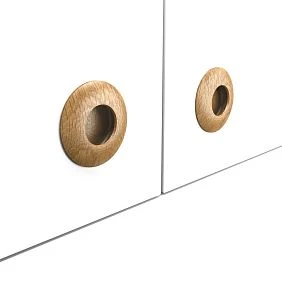
Wooden handles for a dresser are especially appropriate in the bedroom: they create a feeling of coziness, do not overload the interior, and pair well with textiles and wooden elements. Round wooden handle — a classic option for a dresser: it is minimalist, pleasant to the touch, and suitable for drawers of any size.
Replacing handles on an old dresser: what to consider
If you plan to replace the hardware on an existing dresser, there are several technical points to keep in mind.
-
Center-to-center distance — the distance between two mounting holes for a pull handle. Standards: 32, 64, 96, 128, 160 mm. Measure the existing holes before purchasing.
-
Hole diameter — important for knob handles and round handles with a single mounting point.
-
Mounting depth — the thickness of the drawer front through which the fastener passes.
-
Style of the new handle — should match the overall character of the dresser and the room.
If you are switching from knob handles to pulls with two mounting points, you will need to drill new holes. This is not difficult if you have basic skills, but it is important to mark the symmetry on all drawers in advance.
Surface-mounted handles: the most straightforward option for replacement
Surface-mounted handles are a type of furniture hardware that is immediately clear: they are clearly visible on the facade, attached externally, and serve as a decorative detail as much as a functional element.
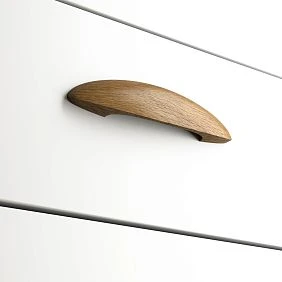
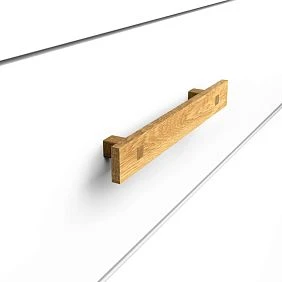
Surface-mounted handles for furniture — a convenient choice for those updating old furniture or wanting to add character to neutral facades. Their main advantage is visibility: such a handle becomes an accent, a focal point. That is why surface-mounted furniture handles are often chosen by designers when they need to add expressiveness to furniture without changing the facade.
What makes a surface-mounted handle expressive
Shape. A wooden surface-mounted handle can be rectangular, oval, with rounded ends, with carved patterns or chamfers — each option creates its own mood. A laconic rectangular shape is suitable for modern interiors. Softer shapes with curves — for classic and Provence styles.
Size. A surface-mounted handle should be proportional to the facade: a longer handle is appropriate for a wide dresser drawer, while a medium or short one suits a small door.
Material. A surface-mounted handle made of solid oak or beech looks incomparably richer than plastic or aluminum — even if the shapes are similar. This is again the same principle: natural material always adds value to furniture.
A wooden surface-mounted furniture handle is convenient for installation: as a rule, it is attached with one or two screws through the facade — a simple operation that does not require complex tools.
Profile and recessed handles: when a calmer facade is needed
Not always is the handle's task to attract attention. Sometimes the opposite is needed: a maximally clean facade where the hardware does not catch the eye but merely indicates the function. It is for such interiors that profile and recessed handles are created.
Profile handles: purity and laconicism
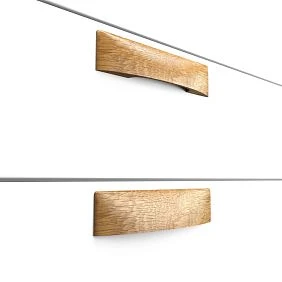
Profile handles for furniture — this is hardware where the shape of the profile itself serves as a gripping element. Such handles are typically mounted along the edge of the facade, creating a continuous horizontal or vertical line. Visually, they almost blend with the facade, making the furniture more monolithic and strict.
Profile handle — a favorite in modern kitchen design. In minimalist kitchens where the purity of horizontal lines and the absence of extra elements are important, a wooden profile handle adds necessary warmth without disrupting strict geometry. This solution works equally well in the kitchen, dressing room, and on wardrobes with hinged sections.
Wooden profile handle — an exquisite compromise between the aesthetics of Scandinavian minimalism and the naturalness of the material. Such handles look organic on facades made of veneer, painted MDF, and even plywood structures.
Recessed handles: disappearance of hardware
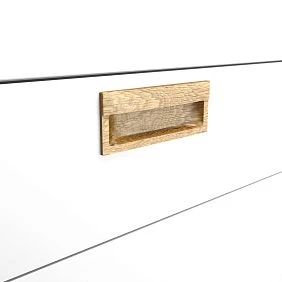
Recessed handles for furniture — this is the next step towards complete fusion of hardware with the facade. Such a handle does not protrude above the surface: it is recessed into a specially milled groove in the edge or plane of the door. From the outside, the facade looks almost hardware-free — only on closer inspection can you see a neat groove for fingers.
Wooden recessed handles for furniture — a rare but effective choice. They are perfect for furniture in the japonisme style, for built-in wardrobes with flat facades, for kitchens in the wabi-sabi style. Technically, such a handle requires more precise installation, but the result is worth the effort.
Round, long, designer: how to choose the shape of a handle
The shape of a handle is not just about aesthetics. It is function, ergonomics, and style all at once. Let's break down the main options.
Round furniture handles
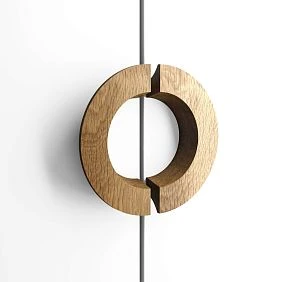
Round wooden handle — a classic of furniture fittings. It works on small facades: dresser drawers, cabinets, small cupboards. One central mounting point, a compact silhouette, a tactilely pleasant shape — all this makes the round handle a universal solution.
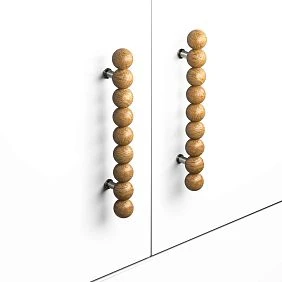
Round furniture handles are especially popular in Scandinavian, Provencal, and classic styles. In Provence, these are often painted or aged knob handles, sometimes with carved patterns. In Scandinavian style — minimalist wooden balls or hemispheres. A round wooden handle is good because it has no "wrong" angle: no matter how you look at the door, the handle's shape looks organic.
Long handles for cabinets and kitchen facades
Long handles for cabinets are an architectural technique in furniture. They structure the plane, add dynamics, and, as mentioned, emphasize the verticality of tall facades. In the kitchen, long handles are especially appropriate on tall cabinets and column units. A long handle for a cabinet made of natural wood looks restrained and noble — exactly what is needed for an expensive kitchen set.
Designer handles: when a handle is a work of art
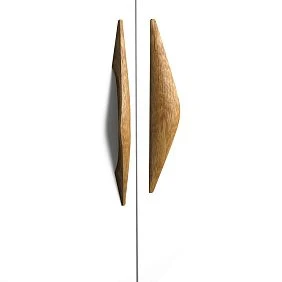
Designer furniture handles — a special category. Here, the handle ceases to be a functional element and becomes an art object. An unusual shape, author's carving, a combination of wood species, non-standard proportions — all this turns the handle into the main accent of the furniture.
Designer furniture handles are appropriate where the interior is conceived as authorial, where every detail carries a semantic load. If the rest of the furniture is restrained, one expressive handle can become a "quote" of the entire room's style. Designer handles for furniture made of wood are exactly the case when the buyer pays not for function, but for character.
How to choose a handle to match the color and style of the facade
Choosing a furniture handle is not only a matter of shape, but also a matter of compatibility with the facade. Let's consider several specific scenarios.
Light facade + warm wooden handle. This is one of the most winning combinations in modern interiors. White, beige, cream, or pastel facades pair beautifully with handles made of light oak or ash. The warm tone of the wood adds coziness to the interior, creating a feeling of Scandinavian lightness or Provencal softness.
Dark facade + contrasting handle. Dark facades — anthracite, wenge, dark walnut — look striking with handles made of light wood. The contrast creates an accent and makes the hardware part of the design concept.
Solid wood facade + wooden handle. If the facade is made of solid wood or high-quality veneer, a wooden handle is the only organic choice. Metal would stand out from the texture, plastic would seem cheap. Wood on wood creates a unity of material language.
Smooth modern facade + minimalist profile handle. For matte, monochrome facades without milling, profile handles or minimalist wooden pulls without extra details are best suited.
Classic facade with milling + decorative surface-mounted handle. Facades with profiles, cornices, and carved elements require a handle with character. A surface-mounted wooden handle with a chamfer or soft relief shape will organically complement the classic decor.
Matching the handle to the wood color
If you want the handle to blend with the facade, choose the same species or a close tone. If you want an accent, choose a contrasting species: light on dark or dark on light. Oak furniture handles are versatile: oak is neutral enough to pair with most color schemes. Handles made of dark species — walnut, wenge, merbau — create a striking accent on light facades.
Mistakes when choosing furniture handles
Experience shows: most mistakes when choosing hardware arise not from bad taste, but from a lack of information. Here are the most common ones.
A handle that is too small on a large facade. A small knob handle gets lost on a tall cabinet door or a wide kitchen drawer. The rule is simple: the larger the facade, the longer the handle should be.
Uncomfortable grip. A beautiful handle that is uncomfortable to grasp is a mistake. Before purchasing, it's important to assess the protrusion depth, profile shape, and ease of grip. This is especially important for kitchen handles, which are used several times an hour.
Mismatch with facade style. A carved decorative handle in a classic style on a smooth minimalist facade is a clear conflict. The handle should speak the same language as the rest of the furniture.
Different handles in one zone without logic. If different handles are used in a kitchen or cabinet space, it should be a deliberate design decision, not a random assortment. Mixing forms without logic creates visual noise.
Handle obstructs opening of adjacent door. When installing handles on corner or closely spaced facades, it's important to check that the protruding handle won't block the adjacent door or drawer.
Forgotten center-to-center distance. When replacing handles on existing furniture, you need to consider the distance between holes. If the new handle has a different center-to-center distance, you'll have to redrill the facade — this is not difficult but requires precision.
Beautiful but inconvenient to maintain. Handles with complex relief and deep grooves look nice but accumulate dust and grease in hard-to-reach places. For the kitchen, it's better to choose smoother forms with minimal decorative indentations.
Handle too heavy for a lightweight facade. A bulky, massive handle on a thin MDF facade can loosen the fastening over time. It's important to consider the weight of the hardware relative to the material and thickness of the facade.
Where to buy STAVROS wooden furniture handles
If you were looking for where to buy natural wood furniture handles with a wide selection of shapes and wood species — you've come to the right place. STAVROS company specializes in the production of wooden products for furniture and interiors: handles, legs, carved decor, molding elements, and other joinery products from solid oak and beech.
in the STAVROS catalog Furniture Handles for any task: long handles for cabinets, overlay handles for dressers, profile handles for kitchen sets, round handles for nightstands and small facades, designer handles for custom furniture.
The entire assortment is divided into categories:
-
Wooden furniture handles with coating — ready-to-install products with oil, varnish, or tinting;
-
unfinished wooden handles — for self-treatment and customization;
Shipment starts from one item. This means you can buy furniture handles both for a large project and for replacing hardware on a single dresser. Delivery is carried out in St. Petersburg and throughout Russia.
All products are made from properly dried wood in a strictly controlled microclimate. Solid Wood Items STAVROS handles are stable, do not deform, and retain their shape and color with proper use. The products are available in two quality levels — Standard and Prestige — allowing you to choose an option for both budget furniture updates and expensive custom projects.
If you are engaged in custom kitchens, cabinet furniture manufacturing, interior design, or simply want to update furniture at home — buy furniture handles in St. Petersburg from STAVROS means getting a natural product with confirmed quality, a real warehouse, and a convenient ordering system.
In addition to handles, the STAVROS assortment includes wooden furniture legs for sofas, armchairs, tables, and cabinets, as well as Carved furniture decor — cornices, rosettes, pilasters, overlay elements, and other products for classic and neoclassical furniture and interior design.
STAVROS is not just a supplier of fittings. It is a manufacturer with a deep understanding of wood as a material, with experience in the furniture and interior industry, with a catalog of over 4,000 models and 20,000 modifications. Here you can choose a handle not by chance, but with understanding: for a specific facade, for a specific style, for a specific task.
Additional block: handles and the overall image of a wooden interior
A discussion about furniture handles cannot be conducted in isolation from the overall image of the space. A handle is not an isolated element; it is part of a system. And this system only works when all details speak the same language.
If the interior has wooden legs on the sofa and wooden frames on the mirrors, wooden furniture handles logically continue this series. If the kitchen set stands on wooden furniture legs — wooden handles of the same species or a similar tone create a sense of a unified concept. If the room uses Carved furniture decor — cornices, rosettes, pilasters — a wooden handle with a soft relief organically fits into this decorative series.
That is why it is important to look at the handle not as a separate detail, but as an element of the interior composition. Ask yourself: what materials are already present in the space? What tones? What character — warm or cold, strict or soft? The answers to these questions will almost automatically suggest the right solution.
Furniture handles in different rooms: a brief selection guide
Kitchen: long handles for pencil cases and tall cabinets, profile or overlay for standard facades, must be coated — for ease of maintenance.
Bedroom: round or overlay handles for the dresser and nightstands, warm wood species, soft shapes.
Living room: if there is a sideboard, display cabinet, or cabinet with doors — a wooden handle with character will add individuality to the furniture.
Children's room: safe rounded shape without sharp corners, warm wood, possibly with paint or tinting to match the room's color.
Bathroom (if there is wooden furniture): handles with a coating resistant to moisture.
Walk-in closet: long vertical handles for swing doors, profile handles — for a calmer look.
Technical parameters when choosing a handle: a brief checklist
To avoid mistakes when purchasing, go through the following points before ordering.
-
Mounting type: through hole (bracket with two points), single screw (knob), mortise groove.
-
Center-to-center distance: when replacing an old handle — be sure to measure the existing holes.
-
Handle length: from end to end; for brackets — from center to center of holes.
-
Handle projection: distance from the facade to the nearest point of the handle; important for kitchens and narrow corridors.
-
Wood type and coating: consider operating conditions and the color scheme of the facades.
-
Style: should match the overall look of the furniture and interior.
FAQ: answers to popular questions about furniture handles
Which handles are best for a hinged wardrobe?
For tall hinged facades, long handles are optimal — they visually support the vertical line of the door and provide a comfortable grip. Long handles for a cabinet made of natural wood look warm and noble, especially on facades made of solid wood or veneer.
Are wooden handles suitable for the kitchen?
Yes, if operating conditions are considered. In the kitchen, it is better to choose Wooden furniture handles with coating: varnish or oil protect the wood from moisture and grease, making maintenance easier. The shape should be comfortable for gripping with a wet hand — a bracket or profile is preferable to a knob.
How is an overlay handle different from a profile handle?
An overlay handle is clearly visible on the facade — it protrudes and acts as a decorative accent. profile handle almost blends with the facade, creating a cleaner, calmer line. The choice depends on whether you want to make the hardware an accent or hide it in the background.
Can I replace the handles on an old dresser?
Yes, it's a simple and effective way to update furniture. The main thing is to check the center-to-center distance (if the handle is attached at two points) and the style of the new handles. Surface-mounted handles for furniture made of wood — one of the best options for a dresser: they are easy to install and instantly change the look of the piece.
Which handles look more expensive — wooden or metal?
It depends on the interior, but wooden handles in most living spaces look warmer and more unique. Especially convincing — if there are already wooden elements in the interior: furniture legs, slats, decor. Then wooden hardware becomes part of an organic system, not a random detail.
Where is the best place to buy furniture handles in St. Petersburg?
In the STAVROS catalog — here you can buy furniture handles made of natural wood with delivery to Saint Petersburg and Russia, with shipment from one item and a wide selection of shapes, species, and finishes.
What is the standard center-to-center distance for furniture handles?
The most common standards: 32, 64, 96, 128, and 160 mm. Before replacing a handle, always measure the existing holes on the facade.
Which wood handles are the most durable?
Oak and beech are the densest and most wear-resistant species for furniture handles. They hold their shape well, are resistant to mechanical stress, easy to process and paint. STAVROS produces Furniture handles made of oak from properly dried wood, which eliminates deformation during use.
Do I need to coat wooden handles before installation?
If you have chosen unfinished wooden handles — yes, it is recommended to treat them with oil, varnish, or paint before installation, especially if the handles will be used in the kitchen or in rooms with high humidity. This will extend the service life of the product and simplify maintenance.
Instead of a conclusion: the handle as an investment in image
A furniture handle is not a consumable or a random detail. It is a deliberate choice that affects how the entire piece of furniture looks, how the interior feels, and how the person who opens these doors every day feels.
A wooden handle is warmth, naturalness, durability, and individuality. Properly selected furniture handle it makes even a budget cabinet look expensive, and a good cabinet look flawless.
STAVROS is a Russian manufacturer of wooden products for furniture and interiors with a wide range of handles, legs, and carved decor made from solid oak and beech. Over 4000 models, shipment from a single item, controlled production, and stable quality — all this makes STAVROS a reliable partner for furniture makers, designers, and private buyers.
The full catalog of wooden furniture handles is available at: buy furniture handles — choose the shape, wood species, and finish that will perfectly suit your project.