








































Article Contents:
- The hallway as an architectural task: why every detail matters here
- Why vertical rhythm is especially important in the hallway
- Slatted panels for hallways: specifics of narrow and complex zones
- Non-standard hallway geometry
- Parameters of slatted panels for hallways: a decision table
- One wall or the entire perimeter?
- Structure height: floor-to-ceiling or panel scheme
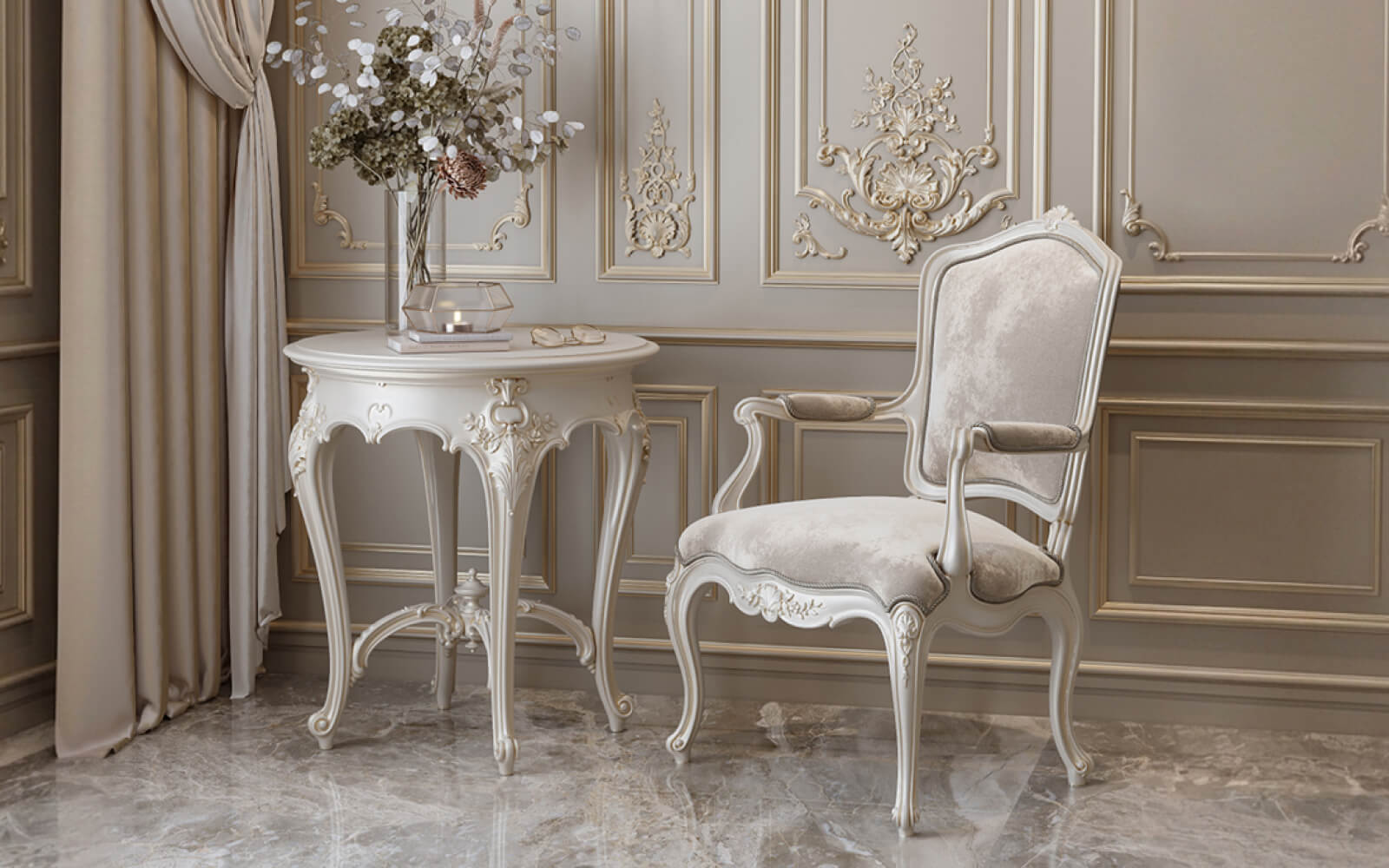
- Stucco decor in hallway interiors: not just a cornice, but a system
- Cornice: the horizontal frame of space
- Moldings: horizontal lines as architectural accents
- Overdoor appliqués
- Ceiling rosettes and medallions in the hallway
- System logic: how battens and molded decor create a unified hallway interior
- The 'bottom-up' principle
- The principle of a unified tone
- The principle of proportionality
- Hallway styles with battens and molded decor: five concepts
- Neoclassical hallway
- Modern classicism
- Scandinavian style with classic details
- Provence and Tuscan style
- Loft with classic accents
- Light and mirrors: hallway geometry as perception work
- Light on a slatted wall
- Mirror in a slatted panel system
- Stucco cornice and lighting
- Materials for the hallway: detailed selection based on operating conditions
- Slatted panels: what will withstand the hallway
- Polyurethane for hallway stucco decor
- Finishing walls with slat panels in the hallway: technical nuances
- Load-bearing system
- Installation in narrow spaces
- Finishing elements: baseboard and molding
- Zoning the hallway using slat panels and stucco decor
- Slat "boundary" zone
- Stucco "arch portal"
- Ceiling molding as a zone boundary
- Common mistakes in decorating small hallways
- Mistake 1: Too wide slats in narrow spaces
- Mistake 2: Horizontal slats with low ceilings
- Mistake 3: Large molding in a small hallway
- Mistake 4: Mismatched skirting and slat tones
- Mistake 5: Slat construction without final sealing
- Mistake 6: Mirror without lighting
- Mistake 7: Molded overlays without primer
- Practical recommendations: sequence of work when renovating a hallway
- Slat panels in hallway interior DIY: is it realistic
- FAQ: answers to popular questions about slat panels and molded decor in hallways
- About the Company STAVROS

You never get a second chance to make a first impression. This rule works not only in human relationships—it works in interior architecture with the same ironclad precision. The hallway is what a guest sees in the first three seconds. What the owner sees every time they return home. And what they later think about, already not quite understanding why.
A cramped, dark, cluttered room without character is tiring from the threshold. A space with a vertical rhythm of slats on the walls and clear ceiling decor is something else entirely: a feeling that the house welcomes you, not just exists.
Slatted panels in the hallway interior and stucco decor — a combination that until recently seemed a privilege of spacious country hallways. Today, this duo works in the most ordinary urban hallways of 4–7 m² — provided the designer (or an owner with a thoughtful approach) understands the principles of how each element works. These very principles are the content of this article.


The hallway as an architectural task: why every detail matters here
The hallway is the least studied room from a design perspective. Most apartment owners spend 80% of their renovation budget on the living room and kitchen, leaving the hallway the leftovers — and this is a fundamental error, not only aesthetic but also psychological.
Neuroscientists studying spatial perception have established: the first 3–5 seconds in a room form a lasting impression of the quality of the entire interior. The brain 'scans' surfaces, proportions, lighting — and delivers a verdict that is difficult to change with subsequent rooms. A guest who enters a bland hallway with bare walls is already primed for 'ordinary' — and even a luxurious living room will be perceived with an adjustment for that first impression.
On the contrary, an entry zone with thoughtful finishes, clear rhythm, and architectural details sets the tone for the entire house. This is not an exaggeration — it's the mechanics of perception.
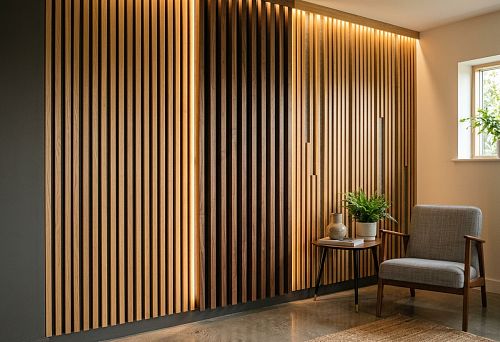
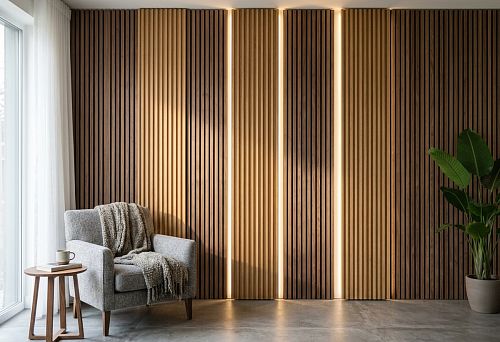
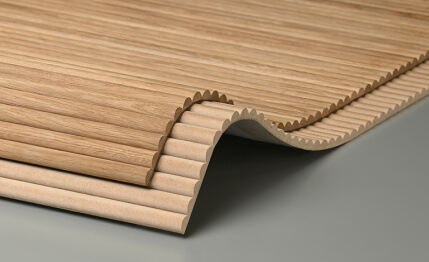
Slatted panels in the hallway interiorsolve the main problem of this room: they create a vertical rhythm where there is none. A monotonous flat wall is an absence of architecture. A slatted structure is a space that has order, depth, character.
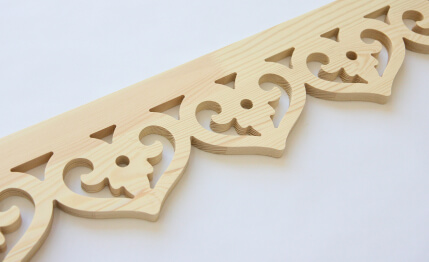
Relief Decorationadds a horizontal architectural frame: a cornice on the ceiling, molding at the transition, applied elements above the doorway. Vertical slats + horizontal stucco = a classic architectural pair that works at any scale.




Why vertical rhythm is especially important in the hallway
The hallway has a specific geometry found in no other room: it is elongated in length but narrow in width, and often has standard or even low ceiling heights. This combination — a 'tube' — creates visual discomfort: the space feels oppressive, closed.
Vertical battens eliminate this discomfort in a fundamental way. The gaze, falling on vertical lines, follows them from bottom to top—and the ceiling 'rises'. This is not an illusion in the cheap sense of the word: it is the work of the visual apparatus. The eye perceives the direction of the lines as an indication for spatial orientation.
Experiment: place two identical rooms side by side—one with vertical stripes on the walls, the other with horizontal ones. With the same ceiling height, the first room will be subjectively perceived as 15–20% taller. The battens in the hallway work exactly like that.
Besides height, vertical battens solve another problem of a narrow corridor: they 'push apart' the side walls. A rhythmically repeating vertical element creates a sense of movement—and the space seems not 'cramped' but 'directed'. These are fundamentally different psychological sensations.
Batten panel in the corridor—is not a decoration. It is an architectural tool for correcting the geometry of a space without demolishing a single square meter of area.
Our factory also produces:


Batten panels for the hallway: specifics of narrow and complex zones
Get Consultation
Non-standard hallway geometry
Hallways in standard apartments are rarely a perfect rectangle. Protruding ventilation ducts, niches for meters, slanted corners, doorways in several walls—all this creates geometric complexities that even an experienced craftsman does not always know how to handle.
Batten construction has a fundamental advantage over other types of finishing precisely in non-standard zones: battens are cut to individual sizes, go around ducts and niches, and enter corners through corner profiles. Where wallpaper bubbles, decorative plaster cracks, and tiles require a perfectly flat surface, the batten system is mounted on a frame—and wall variations of up to 20–25 mm are compensated without leveling.
Parameters of batten panels for the hallway: solution table
| Hallway width | Recommended slat width | Gap | Tone | Effect |
|---|---|---|---|---|
| up to 1.3 m | 35–40 mm | 10–12 mm | Light, white | Maximum expansion |
| 1.3–1.8 m | 40–50 mm | 12–14 mm | Any light / neutral | Optimal rhythm |
| 1.8–2.5 m | 45–60 mm | 12–16 mm | Any | Comfortable scale |
| over 2.5 m (hall) | 55–80 mm | 14–20 mm | Dark tones are acceptable | Architectural plasticity |
One wall or the entire perimeter?
For an entryway up to 6 m² — definitely one wall. The end wall (opposite the entrance door) or a long side wall. A slatted perimeter in a small entryway creates a 'cave-like' effect, which visually reduces the space.
For an entryway from 8–10 m² and spacious halls in country houses — an L-shaped or U-shaped configuration is possible. In this caseslatted panels for wallsthey create an 'enveloping' architectural environment.
Structure height: from floor to ceiling or a panel scheme
In an entryway with a ceiling of 2.5–2.7 m: slats from floor to ceiling give the maximum elongating effect. But they require precise baseboards and molding — without them, they look unfinished.
Panel scheme (height 1.2–1.6 m) with horizontal molding above — for entryways where a 'classical' style is needed or where the budget is limited. Above the molding: solid-color paint matching the slats or a neutral background.
Molded decor in the hallway interior: not just a cornice, but a system
When people say 'molding in the hallway,' most imagine a ceiling plinth — and stop there. This is about as limited as imagining kitchen design only by the color of the cabinet fronts.
Relief Decor in InteriorMolding in the hallway is a system of several elements, each performing its own architectural role. Let's break down this system element by element.
Cornice: the horizontal frame of the space
A ceiling cornice around the perimeter of the hallway is a basic element, without which the others lose part of their meaning. The cornice creates a horizontal boundary between the wall and the ceiling — a 'frame' that visually organizes the space.
In a hallway with slatted walls, the cornice performs an additional function: it 'receives' the verticality of the slats, stopping the eye on a horizontal element. The slats 'lift' — the cornice 'holds.' This is architectural balance.
Cornice size for the hallway:
-
Up to 2.5 m height: 45–60 mm (smooth or with minimal profile)
-
2.5–2.8 m: 60–80 mm (profiled with a shelf)
-
2.8–3.0 m and above: 80–100 mm (classical ornamental profile)
Material:Decorative stuccoPolyurethane is the only correct choice for the hallway. Plaster in the hallway is a risk: humidity fluctuations from the entrance door and temperature swings (especially in homes with insufficient thermal inertia) destroy plaster. Polyurethane is neutral to these factors.
Moldings: horizontal lines as architectural accents
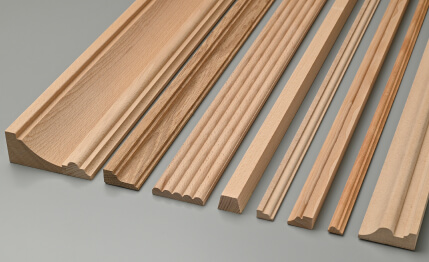
Moldings made of polyurethaneMoldings on hallway walls are horizontal profile strips that create 'tiering' in the space. A molding at a height of 1.4–1.6 m is a classic 'panel line,' the boundary between the lower slatted zone and the upper wall zone.
Molding is also a way to 'finish' the edges of a slatted structure. When a slatted panel does not extend the full height of the wall but stops at 1.4 m, a molding on top creates a clear horizontal boundary. Without molding, the top edge of the slatted structure looks unfinished.
Overdoor applied elements
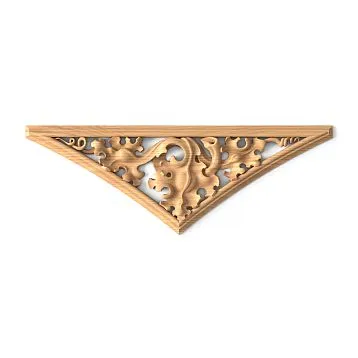
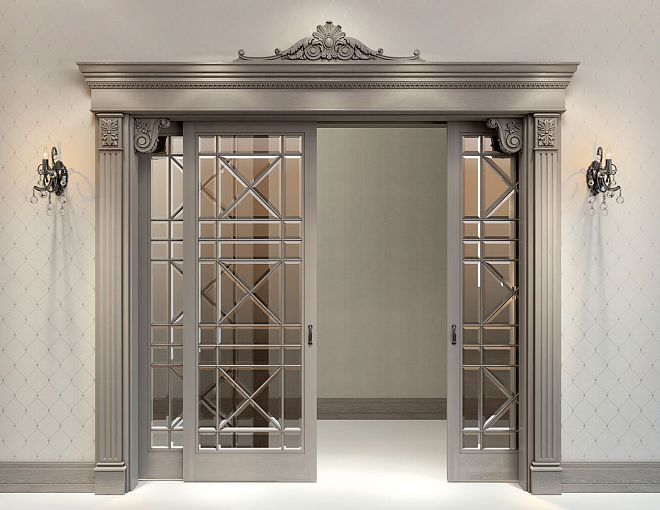
Relief DecorationIn the form of applied keystones, archivolts, or decorative pilasters on the sides of doorways — a way to turn an ordinary doorway into an architectural 'portal.'
In the hallway, doorways are 'gates' between zones: between the entrance area and the corridor, between the corridor and rooms. Decorating these transitions with applied moldings creates a system of architectural accents that makes the hallway a space with its own internal logic.
Minimal option: an applied keystone (keystone) above the center of a door's arched opening — a decorative wedge-shaped detail that 'closes' the arch. Installed with mounting adhesive, no special tools required.
Ceiling rosettes and medallions in the hallway
In the hallway, there is no space for a large dining room chandelier — the light source is most often built-in or small. But a decorative rosette on the hallway ceiling above the lighting point creates an accent that makes the ceiling a 'participant' in the space, not just an upper plane.
Hallway ceiling rosette diameter: 150–280 mm. A larger element in a narrow hallway feels oppressive. It's important to maintain proportion: the rosette diameter ≤ half the minimum dimension of the hallway's ceiling rectangle.
System logic: how battens and molded decor create a unified hallway interior
Battens on their own — good. Molded decor on its own — also good. But it's precisely the systemic connection between them that creates a result unattainable with a single tool.
The 'bottom-up' principle
The batten structure works in the lower and middle wall zones — from the floor up to 1.4–2.7 m. Molded elements complete the space from above: cornice, molding, overlays above openings. The gaze follows the battens from bottom to top and enters the system of molded horizontals — this is a natural, organic completion.
The principle of a unified tone
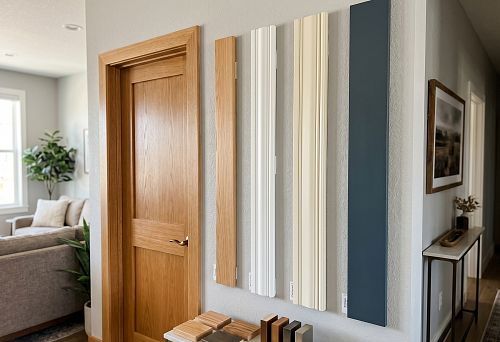
White battens + white molding — a neutral and fail-safe option for any hallway. Everything else — variations. But it's important: if the battens are painted in a color (wood, gray, anthracite), the molding should either match the tone (a more complex solution) or be white (contrasting, yet harmonious).
Intermediate mismatches in tone — dark battens + cream molding, or light gray battens + warm milk-colored cornice — require an experienced eye. Without a clear understanding of color relationships, such combinations give a feeling of being 'unfinished'.
The principle of proportionality
A thin cornice (45 mm) + narrow battens (35–40 mm) — a light, airy solution. A profiled cornice (80 mm) + wide battens (60–70 mm) — a substantial, classic one. You cannot combine a light cornice with wide battens — the details 'don't hear' each other.
Hallway styles with slats and stucco decor: five concepts
Neoclassical hallway
Vertical MDF slats in dark walnut or deep blue (NCS S 6020-R90B) on the end wall. Height: from floor to cornice. Cornice: profiled, 90–100 mm, with a shelf, in white tone. Molding at 1.5 m height — horizontal boundary of the lower panel zone. Applied pilasters made ofdecorative moldingat the edges of the slat structure — vertical 'columns' framing the slatted wall.
Floor: large-format marble porcelain tile. Mirror: in a gold frame, vertical. Light fixture: sconce with gold details.
This is a hallway that announces itself immediately: here they know what architecture is. Not pompous — dignified.
Modern classic
White slats (55 mm, gap 14 mm) on a dark gray base. Cornice: smooth profiled white, 70–80 mm. Moldings along the wall perimeter: framing the slatted panel 'in a frame'. Floor: dark parquet or wood-look porcelain tile. Light fixture: recessed with a ceiling rosette diameter of 200–250 mm.
White and dark — balance. Slats and stucco in the same tone — a unified ensemble.
Scandinavian style with classic details
Slats made of natural ash with transparent oil. Cornice smooth white 55–60 mm — minimalist, without ornament. Wooden hook-hanger. Linen rug. No rosette — only a pure white ceiling.
Here, stucco is present in minimal doses — the cornice as the only element of classicism. Everything else is wood and air.
Provence and Tuscan style
Solid oak slats in the tone of aged white or beige (RAL 1013 — pearl white). Cornice with a leafy ornament, 80–90 mm. Overlay rosettes on the ceiling and overlay medallions above doorways. Floor: terracotta tiles or aged porcelain stoneware.
In a Provence interior, stucco decoration gets maximum space for expression. Slats — a warm natural background. Stucco — a decorative story written on the ceiling.
Loft with classic accents
Dark anthracite slats (RAL 7016, 45 mm) on a dark base. Ceiling: white. Cornice: white smooth 45–55 mm — a minimal classic accent in a cold loft space. No ornament — only line.
Metal hooks. Concrete or dark floor. Industrial light fixture — track or spots.
In a loft hallway, stucco is not 'beauty'. It is architectural discipline: the cornice keeps the ceiling from feeling like a 'random' white plane.
Light and mirrors: hallway geometry as work with perception
Light and mirrors in a hallway with slatted panels and stucco decoration are not separate interior items, but components of a single architectural system.
Light on a slatted wall
A directional light source on a slatted wall is one of the most effective techniques in an entryway. A spotlight or sconce at a 30–45° angle to the surface of the slats creates vertical shadows in the gaps—and the surface gains a volume that doesn't exist without it.
An entryway without windows (most city apartments) depends exclusively on artificial light. This is not a limitation—it's an opportunity: properly placed light sources create a lighting scenario that would be impossible in a room with natural light.
Light temperature for an entryway with wooden slats: 2700–3000 K. For MDF in neutral tones: 3000–3500 K. Cool white (4000 K) kills the warmth of any wood.
Mirror in a system of slatted panels
A mirror in the entryway serves three functions: functional (assessing appearance before leaving), psychological (a sense of more space), and architectural (the reflection of the slatted wall creates an infinite rhythmic repetition).
Options for integrating a mirror with a slatted structure:
Mirror in a 'frame' of slats: the slatted structure runs above the mirror and on the sides—the mirror is inserted into the slatted wall like a 'painting'. Slats + mirror = a single plane.
Mirror with molding made of stucco decor: a vertical mirror framed by a rectangular molding made ofdecorative moldingon a slatted wall—a classic technique. The molding creates a 'frame' that gives the mirror architectural status.
Full-wall mirror on the side wall: in an entryway up to 1.4 m wide, a mirror on one side wall doubles the visual width. The slatted wall opposite is reflected in the mirror — creating a four-meter enfilade effect.
Molded cornice and lighting
LED strip behind the entryway cornice — a technology that turns a molded element into an indirect light source. The strip is installed in a special groove on the back of the cornice or behind a separately mounted decorative band — light diffuses across the ceiling, creating a soft glow without a visible source.
In a windowless entryway, this creates a 'sky' effect — the ceiling begins to glow. Light tone: 2700–3000 K. Power: 4–6 W/m. Control: dimmer or 'smart home' scene.
Materials for the entryway: detailed selection based on operating conditions
Slatted panels: what will withstand the entryway
The entryway is a high-traffic area: humidity fluctuations, mechanical contact, wet shoes near the floor. Selection rules:
Moisture-resistant MDF MR with 2K coating: mandatory standard. Emission class E1. Coating: two-component polyurethane varnish or 2K acrylic enamel. Surface hardness: H–2H on pencil scale. Matte or semi-matte.
slatted wall panels for interior finishingMoisture-resistant MDF in the entryway is the working standard. Do not try to save on the moisture resistance class: the edges of regular MDF in an entryway with humidity fluctuations will delaminate within 1–2 seasons.
Solid hardwood with UV varnish: for entryways where the tactile quality of the material is crucial. Oak or ash with UV varnish (hardness 2H–3H). The lower edges of the slatted structure (floor area) — sealed with neutral silicone.
MDF for painting: for projects with precise color solutions.paintable slatted wall panelsMade from primed MR-MDF + 2K polyurethane paint applied on-site. Matte finish — hides fingerprints.
Polyurethane for molded hallway decor
Decorative stuccoMade from polyurethane — the only correct choice for the hallway:
-
Unaffected by humidity fluctuations from the entrance door
-
Does not crack with temperature changes (winter — apartment, winter — stairwell)
-
Weighs 5–7 times less than plaster — does not require ceiling reinforcement
-
Cuts with a regular saw — installation is accessible without special skills
-
Can be repainted when changing the concept
What to buy: non-yellowing polyurethane (specified in characteristics), density of at least 130–150 kg/m³ (less dense products are soft and easily deformable). Corner elements — pre-made (not cut at 45°): for first-time installation, more reliable and faster.
Wall finishing with slatted panelsIn the hallway: technical nuances
Load-bearing system
In the hallway, PS/PN 60×27 mm metal profile is preferable: stable geometry, no reaction to moisture, good load-bearing capacity for hooks and shelves. Stud spacing: 400 mm.
Plane verification: 360° laser level is mandatory. In a narrow hallway (1.0–1.4 m), any curvature of the slat wall is visible when looking along it — no forgiveness for even a millimeter of deviation.
Gap behind the structure: 20–25 mm. Bottom and top ventilation gaps: 10–15 mm. Air circulation behind the structure prevents condensation in the area of the cold exterior wall.
Installation in narrow space
A hallway width of 1.0–1.4 m creates difficulties for working with long panels (2.4–2.8 m). Acclimate the material in another room. Cut in a room with normal width. Deliver pre-cut slats to the installation wall.
A miter saw cannot be deployed in a narrow hallway — use a sliding miter saw set up in the corridor, or a handsaw with a guide.
Detailed technologyinstallation of slatted panels— from base preparation to finishing elements.
Finishing elements: baseboard and molding
Skirting board:Pogonazh iz massiva60–80 mm high, matching the tone of the slats. In the hallway, the tall baseboard continues the vertical rhythm — accentuates the lower zone and protects the joint between the structure and the floor from mechanical damage.
Ceiling molding:Moldings made of polyurethanebetween the top edge of the slatted structure and the ceiling. In a hallway with a 2.5 m ceiling — even a 45-millimeter smooth molding fundamentally changes the perception of the structure.
Zoning the hallway using slatted panels and stucco decor
The hallway is often combined with a corridor or smoothly transitions into it. The zoning task is to mark the transition without a physical wall.
Slatted 'boundary' of the zone
Slatted panel only in the entrance area (from the entrance door to 1.5–2.0 m into the apartment) — and then neutral finishing in the corridor. The boundary between the slatted zone and the neutral one: a vertical molding made ofdecorative molding— a thin vertical strip marking the transition.
Stucco 'arched portal'
A decorative portal made of polyurethane overlays, framing the transition from the hallway to the corridor: pilasters on the sides + an archivolt on top. This is a classic architectural form — an arched portal — applied in a modern hallway. It creates a clear spatial boundary without thresholds, steps, or physical partitions.
Ceiling molding as a zone boundary
Moldings made of polyurethaneOn the ceiling — a horizontal frame that outlines the ceiling of the entry area. The zone 'under the frame' is the hallway. The zone beyond the frame is the corridor. This is a light, unobtrusive way of zoning through the ceiling plane.
Common mistakes in decorating small hallways
Mistake 1: Too wide slats in a narrow space
Slats 70–80 mm wide in a hallway 1.2 m wide visually 'bring the wall closer'. The space feels even more cramped. Rule: the width of the slat in a narrow hallway should be no more than 1/30 of the minimum width of the room. Hallway 1.2 m → slats no wider than 40 mm.
Mistake 2: Horizontal slats with a low ceiling
In a hallway with a 2.5 m ceiling, horizontal slats are a death sentence. The eye follows the horizontal line — and the ceiling 'lowers'. Only vertical direction. Exception: a slatted ceiling 'island' — a small fragment of a slatted structure on the ceiling near the entry area — works differently; it creates an accent, not a horizontal rhythm.
Mistake 3: Large molding in a small hallway
A cornice 150 mm high in a hallway with an area of 4 m² and a ceiling of 2.5 m is a disaster. The cornice 'eats up' 6% of the room's height and visually looms. Rule: cornice height ≤ 2.5% of the room's height. With a 2.5 m ceiling — no more than 60–62 mm.
Mistake 4: Mismatch in the tone of the baseboard and slats
Dark slats + white baseboard = the gaze 'falls' downward, focusing on the contrast at the floor. Lower contrast in the hallway worsens the perception of height. The baseboard should always match the slats in color or be 2–3 shades darker — never lighter.
Mistake 5: Slatted construction without final sealing
The joint between the slatted construction and the floor in the hallway is an area exposed to moisture from floor washing and snow from shoes in winter. Without sealing with neutral silicone, the MDF ends will swell within 1–2 seasons. Sealing is 30 minutes of work that extends the service life by 10–15 years.
Mistake 6: Mirror without lighting
A mirror in the hallway without a directed light source next to it is a functionally incomplete solution. Entering a dark hallway, a person sees a dark silhouette in the mirror. A sconce next to the mirror or spotlights directed at the mirror is a mandatory requirement.
Mistake 7: Molded overlays without primer
Polyurethane elements without special primer before painting — acrylic paint will peel off within a year. Polyurethane primer or primer for plastic creates an adhesion layer that holds the paint securely. Saving on primer = redoing the work in 12 months.
Practical recommendations: sequence of work when renovating a hallway
One common mistake during renovation is incorrect installation sequence for decorative elements. For a hallway with slatted panels and molded decor, the sequence is crucial.
Step 1: Rough finishing — leveling walls (if critical unevenness), ceiling putty, electrical work (wiring for lighting, outlets behind the slatted construction).
Step 2: Installation of the cornice and moldings. They must be installed before mounting the slatted structure — otherwise it is impossible to properly press the cornice to the wall/ceiling joint.
Step 3: Puttying and painting of the ceiling and the upper zone of the walls (above the cornice or above the level of the slatted structure).
Step 4: Installation of the supporting system for the slatted structure.
Step 5: Installation of the slats.
Step 6: Installation of the baseboard and finishing moldings along the edges of the slatted structure.
Step 7: Sealing of all joints.
Step 8: Installation of lights, mirror, hooks, shelves.
This sequence eliminates the need for 'access' to already closed surfaces and prevents damage to finished elements during subsequent work.
Slatted panels in the interior of a hallway by yourself: is it realistic?
Hallway wall — area 5–10 m². One person with basic construction experience can handle it in 1–2 days.Batten panel in the corridorDoing it yourself is a very realistic task, provided you have the right tools and accurate measurements.
What makes DIY in the hallway more difficult compared to other rooms:
-
Narrow space for working with long panels
-
Complex geometry (corners, niches, openings)
-
Need for acclimatization in another room
What makes it easier:
-
No moisture restrictions in the work area (unlike the kitchen)
-
Small area — faster installation
-
Good visibility of the entire wall from any point — easy to control vertical alignment
Polyurethane cornices and moldings are even easier to install: mounting adhesive + finishing nail, acrylic sealant in the joints, putty, painting. A 5 m² hallway: cornice around the perimeter — 3–4 hours of work.
Complete step-by-step guidefor installing slatted panels— from marking to final sealing.
FAQ: answers to popular questions about slatted panels and stucco decor in the hallway
Are slatted panels in hallway interiors only for large apartments?
No, and this is one of the main myths. For small hallways up to 5 m², slatted panels work even more effectively than for large ones: the vertical rhythm 'stretches' the space. The key is the right scale: narrow slats (35–45 mm), light tone, vertical orientation.
How difficult is it to combine slatted panels and stucco decor in a small hallway?
This is a question of proportionality, not difficulty. A small smooth cornice 45–55 mm + one slatted wall + minimal molding — these are three elements that create a system. It can be implemented in 2–3 days and does not require special skills.
Can stucco overlays be placed above a door opening if it is non-standard?
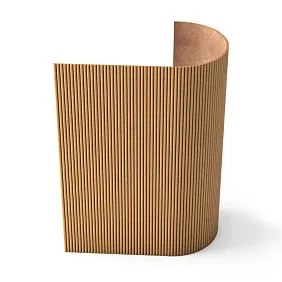
Yes.Relief Decor in Interiormade of polyurethane can be cut to the required sizes with standard tools. For non-standard arched openings — usesoft slat panelsand flexible polyurethane profiles.
How to care for slatted panels in the hallway?
Dry or slightly damp microfiber. Matte finish — once every 1–2 weeks. Lower zone (up to 90 cm) — more often. Aggressive chemicals and abrasive agents — absolutely not. With proper care, the service life of 2K coating is 15–20 years.
Is it necessary to remove old wallpaper before installation?
Preferably. Wallpaper is an unstable layer that may peel off along with the supporting structure. If removal is impossible — deep penetration primer, adhesion test, fastening the lathing with dowels into the wall.
Which light fixture to choose for a hallway with slatted panels?
Recessed spotlights + sconce next to the mirror — the optimal combination. Spotlights: with rotation capability, angle 30–45° onto the slatted wall. Sconce: with directed light onto the mirror. If there is a molded rosette — chandelier or pendant light in a matching style.
Slatted construction in the hallway — how sound-insulating is this solution?
Standard slatted construction is not a sound insulation system. But with the addition of technical felt or acoustic foam behind the supporting base — reduction of reverberation inside the hallway by 10–15%. For city apartments with a noisy entrance, this is noticeable.
HowSlatted panels in the hallway interiordo they combine with a stretch ceiling?
Excellent. The rack structure is installed before the stretch ceiling. The top edge is concealed under the fabric or under the cornice. An 8–10 mm gap between the top of the structure and the fabric is mandatory. The cornice is installed before stretching the fabric.
About the company STAVROS
The hallway is the face of your home. And, like any face, it requires attention to detail. Not the loudest materials, not the biggest budget — but the right materials with the right characteristics, installed with precision that is noticeable even at a glance.
STAVROS is a Russian manufacturer of architectural wooden and polyurethane elements for interiors. Full production cycle: chamber drying to 8–10%, CNC milling with a tolerance of ±0.1 mm, application of two-component coatings in factory conditions. Complete documentation for each batch: declaration of conformity, emission class E1, technical specifications.
For your hallway in the STAVROS catalog:Slatted panels in the hallway interior— ready-made solutions for corridors and halls;Wooden slat panelsmade of oak and ash with UV varnish;MDF Slatted Wall Panel— MR class with 2K coating;paintable slatted wall panels— for precise tone;Decorative stucco— made of non-yellowing polyurethane — overlays, pilasters, keystones;moldings made of polyurethane— cornices, moldings, baseboards;Pogonazh iz massivafor skirting boards and finishing elements;soft slat panelsfor curved areas and non-standard openings.
Free consultation on materials, proportions, and installation solutions for any hallway — from 4 m² to a spacious country hall. STAVROS — because the hallway deserves the same attention as any other room in your home.