











































































Article Contents:
- Perm and its climate: technical introductions that change the choice
- What slatted panels solve in interior design: functional breakdown
- Rhythm as the structure of space
- Acoustic comfort
- Masking unevenness
- Zoning without partitions
- Thermal and visual warmth
- Ceiling molding: when it's needed and what exactly it does
- Cornice: function is more important than aesthetics
- Rosette: the central accent of the ceiling
- Ceiling medallion and central decor
- Frieze and ornamental belt
- How to connect a slatted wall and ceiling decor: system logic
- Principle of vertical and horizontal
- Principle of scale correspondence
- Principle of tonal unity
- Principle of a single accent
- Slatted panels for different zones of a Perm apartment
- Living room: balance between activity and tranquility
- Bedroom: silence through material and light
- Hallway and corridor: spatial technique
- Kitchen: pragmatism above all
- Children's room: lightness and style
- Slatted ceiling as an alternative: when it works better than a cornice
- Materials for slatted panels: analysis for the Perm climate
- Solid oak with oil finish
- MDF with film coating
- MDF for painting
- Thermowood
- Ceiling molding: technical breakdown by elements
- Cornice: profile, size, installation
- Baseboard: finishing from below
- Moldings: wall framing structure
- How to avoid overloading the upper plane
- Signs of an overloaded ceiling
- Principles of a delicate ceiling
- Typical mistakes in rooms with active finishes
- First mistake: slatted panels on all four walls
- Second error: installation without acclimatization
- Third mistake: cornice without corner profile
- Fourth mistake: different shades of white
- Fifth mistake: cornice without correct size
- Sixth mistake: purchase without a sample
- Installation of slatted panels: key stages
- Stylistic Solutions: Combination Table for Different Interiors
- Types of Slat Panels: A Format Navigator
- STAVROS: A System Manufacturer for Architectural Results
- FAQ: Answers to Popular Questions

Ceiling and walls are not two separate design solutions. They are one space. One envelope that either works as a unified whole or falls apart into disconnected surfaces, each living its own life. It is precisely this feeling—'as if something is wrong, but it's unclear what'—that arises in most interiors where walls and ceilings were chosen independently of each other.
When a person in Perm is looking to buy slatted panels, they typically already know what they want for the walls. But the question of what to do with the ceiling—how to treat it, how to finish the perimeter, whether ceiling molding is needed and what kind—remains open. And yet, it is here that the decision is made which determines whether the renovation will result in architecture or just a collection of materials.
This article is about how to think about walls and ceilings simultaneously. How to combine the linear rhythm of slatted panels and the plasticity of ceiling relief into a unified system. How not to overload the space and yet not leave it empty. And why in Perm's climate all this has an additional dimension—a purely technical one that cannot be ignored.




Perm and Its Climate: Technical Prerequisites That Change the Choice
A conversation about materials without a climatic context is a conversation about nothing. Perm is a city with a sharply continental climate: harsh winters with frosts down to -30°C and below, dry heating air in apartments (humidity 10–20% against a norm of 40–60%), hot summers. The temperature amplitude is one of the greatest among Russian cities with over a million inhabitants.
What does this mean for finishing materials? Wood in such conditions operates under constant stress. In winter—it actively dries out in a warm, dry apartment. In summer—it absorbs some moisture. This cyclical process, with incorrectly chosen material and treatment, leads to cracks along the grain, deformation of slats, gaps, and coating delamination.
This is not a reason to refusewooden slat panels—it is a reason to choose them consciously. In Perm, only properly treated materials work: oil finish with wax, sealed ends, mandatory acclimatization before installation. MDF with film coating is more predictable in this regard—the film stabilizes the geometry, the board does not deform as severely as solid wood.
Polyurethane ceiling molding behaves flawlessly in the Perm climate: polyurethane does not react to cold, dryness, or temperature fluctuations. This makes it an ideal material for ceiling decor precisely in such climatic conditions where plaster often cracks due to building settlement and humidity changes.




What slatted panels solve in interior design: a functional breakdown
Before moving on to the ceiling question, it's important to clearly understand whySlatted wall panelsare needed at all and what tasks they can solve. This is not a decorative question—it's a question of architectural thinking.
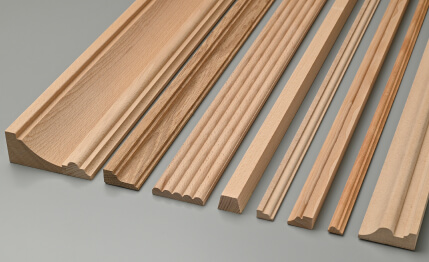
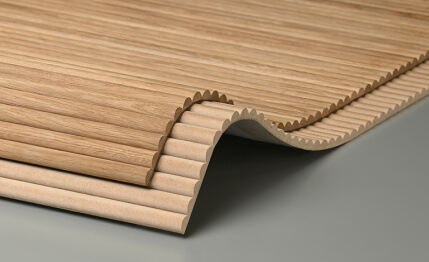
Our factory also produces:



Rhythm as spatial structure
A wall with slatted panels is a structured surface. The repeating vertical (or horizontal) rhythm of the slats creates an order that the brain perceives as 'architecture.' A smooth wall is neutral. A slatted wall is active. One creates a background, the other an accent.
Exactly thereforeWall finishing with slatted panelseven on a modest budget delivers an effect disproportionate to the material cost. Rhythm is an inexpensive way to create an expensive feel.
Get Consultation
Acoustic Comfort
In an apartment with hard surfaces—tile, plaster, glass—sound reflects, making the space echoey. Slats with a gap between them and the wall absorb some sound energy, especially in the mid-to-high frequency range.Slatted panels in interior design—this is not professional acoustic treatment, but a noticeable improvement in acoustic comfort in a living space.
Concealing unevenness
Walls in Perm homes, especially older buildings, are rarely perfectly even. Installing slatted panels on a frame allows for creating a geometrically flawless surface over any irregularities of the base wall—without costly leveling.
Zoning without partitions
One slatted wall in an open-plan layout is immediately 'read' as a separate zone—even without physical partitions.slatted panels for walls— one of the most effective zoning tools in modern apartments with combined kitchens and living rooms.
Thermal and visual warmth
Wood (or wood-imitating material) brings warmth into a space—both literally and metaphorically. For Perm with its long, cold winters, this is especially significant: an interior with wooden surfaces feels warmer even at the same air temperature.
Ceiling molding: when it's needed and what exactly it does
Ceiling molding— one of the most enduring architectural tools in the history of interior design. Not because it's 'beautiful,' but because it solves specific problems. Let's talk about them honestly.
Cornice: function is more important than aesthetics
A ceiling cornice conceals the technological joint between the wall and the ceiling. This is a junction that is always problematic: during building settlement, temperature fluctuations, and humidity changes, it's here that the first cracks appear. The cornice structurally masks this issue.
Simultaneously, the cornice creates a horizontal line along the perimeter of the room. This line visually 'raises' the ceiling—not because it creates an illusion of height, but because it introduces an intermediate horizontal accent between the wall and the ceiling, making the transition architecturally complete.
Ceiling moldingMade of polyurethane, it is installed using special mounting adhesive and, if necessary, additionally secured. With proper installation, its service life is decades. Polyurethane does not crack, crumble, or deform.
Ceiling Rose: The Central Accent of the Ceiling
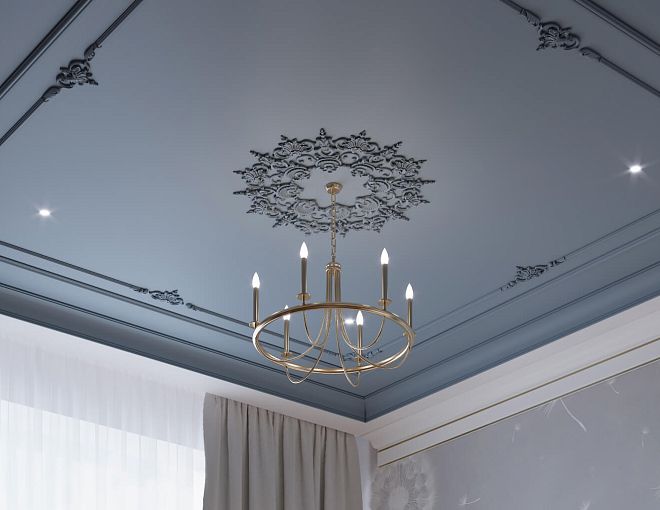
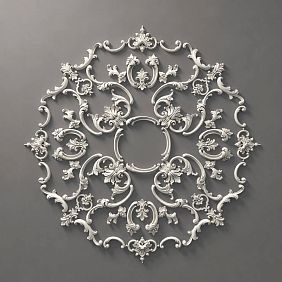
A ceiling rose is a decorative element around the chandelier mounting point. With a ceiling height of 2.7 m or more and a central light fixture, the rose completes the ceiling as an architectural element. Without a rose, the chandelier 'hangs' in emptiness. With a rose, it is framed and integrated into the ceiling structure.
With spot lighting and a ceiling below 2.7 m, a rose is not needed. With a slatted ceiling, a rose is structurally excluded.
Ceiling Medallion and Central Decor
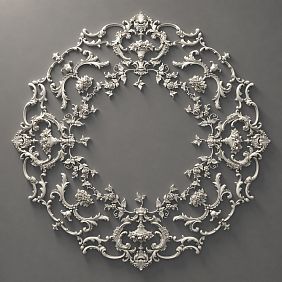
This is an evolution of the rose idea: a large, relief medallion as the central accent of the ceiling. It is suitable in large rooms from 25–30 m² with a ceiling height from 3 m. In a standard apartment, a medallion can 'overwhelm' the space — its scale must correspond to the room's height and area.
Frieze and Ornamental Band
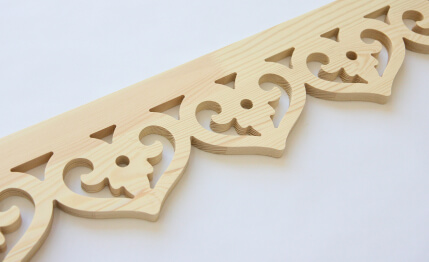
A frieze is a horizontal strip with an ornament or relief, running along the top of a wall or the lower part of a ceiling. In modern interiors, a frieze is used as a transition element between the wall and ceiling — more complex and rich than a simple cornice, but it is only used in interiors with a rich architectural program.
How to Connect a Slatted Wall and Ceiling Decor: The Logic of the System
This is the key question. And the answer is not 'it's beautiful' or 'I like it'. The answer lies in architectural logic, which works independently of taste.
Principle of vertical and horizontal
slatted wall panels for interior finishingcreate a vertical rhythm—vertical lines of battens work from bottom to top. The ceiling cornice creates a horizontal line—perimetric, strictly horizontal. The meeting of vertical and horizontal is an architectural point, a node that requires an architectural solution.
The cornice is precisely this solution. It completes the verticality of the battens with a horizontal accent. Without a cornice, the battens 'disappear' into the ceiling and get lost. With a cornice—they are clearly defined, and their rhythm is readable to the end.
The principle of proportional correspondence
The height of the cornice should correspond to the width of the batten. This is not an aesthetic whim—it is proportional logic.
| Batten width | Recommended cornice height | Note |
|---|---|---|
| 40–55 mm | 50–70 mm | Narrow battens—light cornice |
| 60–90 mm | 75–100 mm | Medium rhythm—medium cornice |
| 100–130 mm | 100–130 mm | Wide battens—substantial cornice |
| 140–180 mm | 130–160 mm | Large format—monumental cornice |
A mismatch of scales creates a disharmony that is difficult to describe in words but is immediately felt by the eye.
Principle of tonal unity
Warm wooden battens require a warm white cornice. Cold gray battens—neutral or cool white. Color temperature conflict is the most common and most subtle mistake when selecting materials together.
Check tonal matching under your lighting. The monitor screen lies — warm white and cool white appear almost identical on screen. In a real interior with warm 2700K lighting, the difference is obvious.
The principle of one focal point
It never works when a slatted wall, an ornate ceiling with a rosette and frieze, and moldings on all other walls all try to function as a unified whole. This is not a unified whole — it's a competition of details. The brain cannot focus on three visual focal points simultaneously: it gets tired and interprets the space as chaotic.
Rule: one main decorative element per room. If it's a slatted wall — the ceiling cornice should be delicate. If it's an ornate ceiling with a rosette and frieze — the slatted panels should be restrained: light-colored, narrow, covering a small area.
Slatted panels for different zones of a Perm apartment
Living room: balance between activity and tranquility
Slatted panels in the living room interiorare applied to one accent wall — behind the seating area or behind the TV. Never on three or four walls simultaneously: the space will lose airiness and turn into a 'wooden box'.
The best scheme for a Perm living room:
-
One slatted wall made of solid oak or MDF, slat width 90–110 mm, floor to ceiling.
-
Ceiling cornice around the perimeter —ceiling moldinggeometric profile 95–110 mm, warm white.
-
The other three walls are neutral plaster or wallpaper without a pronounced pattern.
-
Spot lighting or hidden lighting behind the battens —Slatted panels with lightingwith a 2700K LED strip creates a warm evening mode.
TV area with slatted panels— battens from floor to ceiling, TV on a bracket directly attached to the wooden surface. This is one of the most expressive solutions for a modern living room.
Bedroom: silence through material and light
slatted panels in the bedroom— the wall behind the headboard. Warm tone, dense rhythm, no dark wood in a small room. Batten width 65–80 mm — a medium rhythm that creates a cozy, enveloping feeling.
The cornice in the bedroom is simple, without ornament, 65–80 mm. Its task is to close the perimeter and add completeness, without claiming a decorative role. In the bedroom, the cornice should be inconspicuous — it works 'in silence'.
A chandelier in the bedroom is inappropriate: a central chandelier over the bed is an outdated solution. Spot or hidden lighting, floor lamps, sconces by the headboard — this is the modern lighting scenario for a bedroom.
Hallway and corridor: a spatial technique
Slatted panels in the hallway interiorAlong the long wall of the corridor, they create a perspective effect: vertical slats visually 'stretch' the narrow space into depth. This is one of the few techniques that works specifically in a corridor—it doesn't just decorate, but solves a spatial problem.
Important: in a dark, narrow hallway—only light-colored slats. Dark slats in a dark corridor create a tunnel effect, making you want to get out.
A cornice in the hallway is a must. It 'raises' the ceiling and adds vertical scale. For a standard 2.6 m ceiling in the hallway—a cornice of 70–85 mm with a simple profile.
Kitchen: pragmatism above all
Slatted panels in the kitchenIn Perm—only moisture-resistant materials. MDF with sealed edges and film coating or thermowood. Natural solid wood without special treatment in areas of steam and moisture is a direct path to deformation and delamination.
In an open-plan kitchen-living room, slats are appropriate in the living area—as a zoning element. The kitchen area remains neutral with functional tiles and coverings for wet environments.
Children's room: lightness and imagery
In a children's room, slatted panels work differently than in any other space. Here, you don't need an 'adult' architectural accent—you need a surface that creates imagery. White or light gray slats in the play or study area create a sense of spatial order without heaviness. The cornice is minimalist, 50–60 mm. No ornamental molding.
Slatted ceiling as an alternative: when it works better than a cornice
Batten panels for ceilings—a separate topic that many overlook. The ceiling occupies a huge area in the space—and most people simply paint it white without thinking. A slatted ceiling turns this 'forgotten' surface into an architectural element.
When does a slatted ceiling work better than just a cornice with a white ceiling?
-
With a ceiling height of 2.8 m and above, the slats on the ceiling do not feel 'oppressive'.
-
In rooms without a central light fixture, hidden lighting behind the slats replaces a chandelier.
-
In bathrooms and wet areas, a slatted ceiling with a ventilation gap ensures air circulation.
-
In zoning areas: a slatted ceiling only over the dining area or only over the sofa creates a visual 'dome' without physical partitions.
How to combine a slatted ceiling with ceiling molding? There is one effective technique: a cornice is installed around the perimeter of the room, and the slatted ceiling occupies the central zone. In this case, the cornice serves as a frame for the slatted 'island' on the ceiling—a clear boundary between the molded perimeter and the wooden center.
Materials for slatted panels: analysis for the Perm climate
Solid oak with oil finish
Solid oak slat panels— maximum durability with proper treatment. Oak is dense and holds its shape well. With oil finish, treatment of ends and backside, and acclimatization before installation—it is the optimal choice for Perm even considering dry heating air.
Acclimatization in the Perm climate: at least 7–10 days in a heated room. This is critical: wood delivered with 12–14% moisture must 'dry out' to an equilibrium moisture content of 8–9% in a Perm apartment—before installation, not after.
MDF with film coating
MDF Slatted Wall Panel— the most stable option for Perm conditions. The film coating seals the surface, MDF does not react as sharply to humidity changes as solid wood. Wide range of decors, affordable price, quick installation.
Critical issue: edges. Low-quality MDF has unsealed edges — in dry air, they can develop micro-cracks around the perimeter. Demand proof of edge sealing from the supplier.
MDF for painting
paintable slatted wall panels— profiles without a decorative layer. Absolute color freedom. Especially effective in a monochrome solution: polyurethane slats and ceiling cornice painted in one tone — a powerful modern technique that blurs the line between wood and molding.
Thermowood
For wet rooms and non-standard areas — thermowood. Characteristic dark chocolate tone, matte surface, absolute stability under any humidity changes. In a Perm apartment — bathroom, kitchen backsplash, balcony.
Ceiling molding: technical breakdown by elements
Cornice: profile, size, installation
ceiling molding— polyurethane in cornice design — the main and most in-demand element. The cornice profile determines its stylistic affiliation:
-
Right angle and ogee — modern, geometric. For minimalism, Scandinavian style, loft.
-
Goose with a belt is a transitional profile. Works in modern classic and neoclassical styles.
-
Multi-level profile with an ornamental belt is rich, classic. For neoclassical and Renaissance interiors.
Cornice size rule: 1/25–1/30 of the ceiling height.
-
Ceiling 2500 mm → cornice 83–100 mm.
-
Ceiling 2700 mm → cornice 90–108 mm.
-
Ceiling 3000 mm → cornice 100–120 mm.
-
Ceiling 3500 mm and above → cornice 116–140 mm.
Installation: special polyurethane adhesive + additional fixation with liquid nails in corner areas. Cornice joints on straight sections at 90° with acrylic sealant filler. Corner joints at 45° with precise cutting or with ready-made corner elements.
Baseboard: bottom finishing.
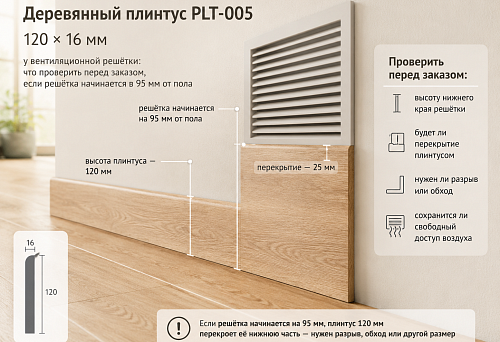
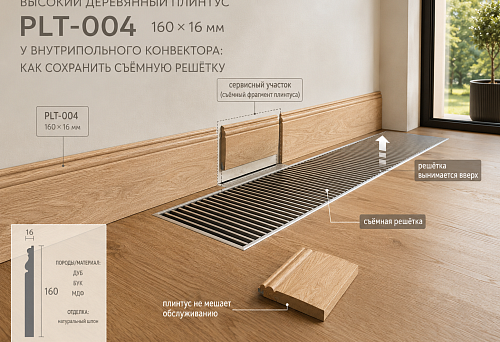
Polyurethane floor baseboard is a mirror task relative to the ceiling cornice: to close the joint between the wall and the floor, to create a horizontal line at the bottom. With plank paneling, the baseboard is installed over the lower edge of the planks—this is both a starting profile and a decorative baseboard simultaneously.
The height of the baseboard corresponds to the height of the cornice: if the cornice is 95 mm, the baseboard is 80–95 mm. A size gap of more than 20 mm creates a proportional imbalance.
Moldings: the frame structure of walls
Wall moldings paired with slatted panels create a two-level wall structure:
-
The lower part — slats up to the horizontal limiter (approximately 1/3 of the wall height).
-
The upper part — the wall with frames made of molding.
-
The horizontal profile separates the zones.
This is one of the most sophisticated techniques in modern interior design: combining the textural rhythm of slats with the geometric framing of molding. The result is a wall that looks significantly more complex and richer than each element separately.
How not to overload the upper plane
The ceiling is the most psychologically 'loaded' surface. It is from here that the feeling of spatial 'pressure' begins. Therefore, the rule 'less is more' is more important here than anywhere else.
Signs of an overloaded ceiling
-
Cornice + rich ornamental frieze + rosette + ceiling beam + hidden lighting — all at once.
-
Too high a cornice with a low ceiling (visually lowers the ceiling).
-
Ornamental rosette with spot lighting (a rosette without a chandelier looks abandoned).
-
Slatted ceiling + heavy ornamental cornice (conflict of texture and relief without clear logic).
Principles of a delicate ceiling
One role — one element. If the ceiling carries a decorative load (rosette, slatted fragment) — the cornice should be simple and inconspicuous. If the main feature is the cornice — the ceiling remains white and clean.
Cornice height within proportion. Do not exceed the recommended ratio of 1/25. This is not a convention — it's a working formula.
Ceiling color. A white ceiling with warm wooden slats — always works. A colored ceiling — only with a clear design concept. A beige or cream ceiling matching the slats gives a monolithic effect.
Hidden lighting as an alternative to a chandelier. LED strip in the body of the cornice or in the gaps of a slatted ceiling creates soft diffused lighting that makes the ceiling 'float' — visually light and airy.
Typical mistakes in rooms with active finishes
First mistake: slatted panels on all four walls
The most common mistake of people who 'fell in love with slats' and decided to use them to the maximum. Four slatted walls in the living room is not an interior, it's a finishing material without an idea. An accent works only in contrast with a neutral background.
Second error: installation without acclimatization
In Perm with its dry heating air, installing solid wood without acclimatization guarantees gaps after the first season. 7–10 days of conditioning in the room is not a recommendation, but a technological requirement.
Third mistake: cornice without a corner profile
The corner joints of the cornice are the most vulnerable spot. Without an accurate 45° cut or a ready-made corner element, the joints will be visible and will separate. A professional result requires professional cutting tools or ready-made corner overlays.
Fourth mistake: different shades of white
A cornice in 'pure' white (cool shade) and a wall in 'warm' white are two different colors that together create a sense of mismatch. Especially noticeable under warm lighting. Paint the cornice the same shade as the walls or the same tone with slight lightening.
Fifth mistake: cornice without the correct size
A 150 mm cornice with a 2.5 m ceiling is aesthetically aggressive. It will lower the ceiling and create a feeling of tightness. The 1/25–1/30 formula works. Don't break it out of a desire to 'make it richer'.
Sixth mistake: buying without a sample
All decisions regarding tone and material matching should be made based on physical samples under your lighting. Photos are approximate. A sample is exact.
Installation of slatted panels: key stages
installation of slatted panels— a sequential process where each stage influences the next:
1. Wall preparation. The wall does not need to be perfectly level when installing on a frame. However, large protrusions and unevenness should be knocked down — they can interfere with the installation of the frame.
2. Frame marking. Horizontal battens with a spacing of 400–500 mm, strictly horizontal using a level. The first batten is at the floor, the last one is at the ceiling. Attachment to the wall — using dowel nails with a spacing of 400–500 mm along the length of the batten.
3. Acclimatization. 7–10 days for solid wood in a Perm apartment in winter. The slats must stabilize at the humidity level in which they will exist.
4. Installation of the starter profile. The lower horizontal profile is installed strictly horizontally — it sets a straight line for the entire slat surface.
5. Installation of the first slat. Strictly vertical using a level. This determines the geometry of the entire surface. The first slat is the most critical element.
6. Installation of subsequent slats. Attachment through the groove (concealed) or through the hole (exposed). Gap between solid wood slats — 1–2 mm for expansion compensation.
7. Finishing elements. Corner profiles, top finishing element, junction with the cornice.Installation of batten panelsWithout finishing elements leaves unfinished edges that spoil the entire result.
8. Cornice installation. After completing the slatted wall — install the cornice around the entire perimeter. Installation logic: first corners (or ready-made corner elements), then straight sections. Joints — with acrylic sealant.
Style solutions: combination table for different interiors
| Style | Slats | Ceiling cornice | Additionally |
|---|---|---|---|
| Modern Classic | Warm oak, 90–110 mm | Profile with soft ogee, 100–120 mm | Wall moldings |
| Scandinavian | Light MDF or ash, 55–75 mm | Straight geometric, 55–70 mm | Without ornament |
| Neoclassical | Light dense wood, rhythm 60–80 mm | Ornamental belt, 120–150 mm | Socket for chandelier |
| Loft | Dark brushed wood | Straight cornice or no cornice | Exposed utilities |
| Eco | Thermowood or solid wood with matte oil | Minimalist, 50–65 mm | Live plants |
| Minimalism | White/gray MDF, narrow slat 40–55 mm | Right angle, 40–55 mm | Monochrome |
Types of slat panelsFormat Navigator
Before buying slatted panels in Perm, it's important to understand the variety of formats:
Single slats — piece-by-piece installation. Maximum flexibility: you can vary the spacing, alternate wood species, create custom patterns.
slatted modular wall panel— a ready-made module with slats on a backing. Ideal for DIY: geometry is guaranteed, installation is quick.
soft slat panels— a flexible base allows installation on curved surfaces: arches, columns, rounded corners.
Ceiling slat panels — specialized structureswith hidden ceiling mounting. Wall slats cannot be used on ceilings — different loads and fastening methods apply.
Slatted Façade Panels— DPC or thermally modified wood for outdoor use. For exterior building cladding in Perm, considering harsh winters.
STAVROS: a systems manufacturer for architectural results
When you decide to buy slatted panels in Perm and simultaneously select for them ceiling moldingas a unified architectural system — you need a manufacturer that operates precisely within this logic.
STAVROS producesRafter panelsfrom solid oak, ash, thermowood, MDF with film coating and for painting — in a wide range of formats, widths, and finishes. Simultaneously — a complete lineceiling moldingsfrom polyurethane: cornices, baseboards, moldings, rosettes, corner elements. Everything is produced within a unified system with guaranteed stylistic and tonal consistency.
Pogonazh iz massivaSTAVROS — baseboards, trims, additional elements — covers all transitions and joints, creating that completeness which cannot be purchased as separate add-ons from a hardware store.
Delivery to Perm is a standard service. Samples are available in advance. Compare them under your lighting, in your space. Make decisions based on real materials, not screen photos.
STAVROS is not just a catalog of finishing materials. It is a production system where each element is created with an understanding of how it will function in an interior not in isolation, but in context. The wall and ceiling are one space. And the solution for this space should be approached as a single architectural statement. This is exactly what STAVROS makes possible.
FAQ: Answers to popular questions
Is it possible to buy slatted panels in Perm with delivery from the manufacturer?
Yes. Most manufacturers offer delivery across all of Russia, including Perm. We recommend ordering samples before the main order — especially to check the tone under your lighting.
Is acclimatization of solid wood slatted panels necessary in the Perm climate?
Mandatory. In winter, in a heated apartment in Perm, air humidity drops to 10–20%. Solid wood must be kept in the room for 7–10 days so it dries to the working moisture level before installation.
Which ceiling molding to choose for a 2.5 m ceiling?
A cornice 83–100 mm high with a simple geometric profile. Avoid ornamental profiles with rich relief—they create pressure on low ceilings.
Can a slatted ceiling be combined with a ceiling cornice?
Yes. A cornice around the perimeter + a slatted fragment in the center is a workable solution. The cornice frames the slatted 'island' and creates an architectural boundary between the two surfaces.
What is the difference between MDF and solid wood for slatted panels?
MDF is more stable with humidity fluctuations, more affordable, and offers a wider choice of finishes. Solid wood has a living texture, is more durable with proper care, and is more expensive. For Perm, both options work with proper treatment.
How many slatted panels to take with a margin?
10–15%. In Perm, considering logistics, 15% is preferable.
Can slat panels be installed independently?
Yes, especially in modular format. A detailed step-by-step guide is in the articleHow to install slatted panels.
How to choose the width of the slat?
Focus on the room area: small rooms — narrow slats 45–65 mm. Medium rooms — 70–100 mm. Large spaces and halls — 110–150 mm.