




































































Article Contents:
- What lies behind a commercial query: anatomy of intent
- Why it's important to understand the task before choosing a material
- Two types of slat panel buyers
- Which slat panels are suitable for different rooms: complete application map
- Living room: accent wall as an architectural dominant
- Bedroom: warmth and quietness of wooden texture
- Children's room: naturalness and safety
- Study and work area: concentration environment
- Kitchen: dining area and bar counter zone
- Hallway: first impression and visual transformation
- Where to use stucco decor: three levels of architectural work
- Level one: basic system (cornice + baseboard)
- Level two: advanced system (cornice + baseboard + molding elements)
- Level three: complete architectural system
- Where decorative stucco is applied in different rooms
- Living Room
- Bedroom
- Office
- Hallway
- Kitchen (dining area)
- How to assemble wall and ceiling into a unified system: architectural logic
- Three principles of a unified system
- Table: ceiling height and decor system
- Lighting as part of the system
- What to look for when comparing assortment: criteria that work
- First criterion: transparency of characteristics
- Second criterion: geometric accuracy
- Third criterion: end coating
- Fourth criterion: polyurethane quality
- Fifth criterion: batch uniformity
- Where buyers most often make mistakes: top 8 real errors
- First mistake: buying without a sample
- Second mistake: incorrect quantity calculation
- Mistake three: buying cornice and baseboard 'separately' from slats
- Mistake four: installation without acclimatization
- Mistake five: ignoring base preparation
- Mistake six: incorrect orientation of slats
- Mistake seven: dark slats with insufficient lighting
- Mistake eight: neglecting kitchen ventilation with wooden slats
- Delivery from Novosibirsk or to Novosibirsk: what you need to know
- Regional market vs federal manufacturers
- Logistics of long-length cargo
- Packaging and acceptance
- Practical scenario: 20 sq.m. living room in Novosibirsk, modern classic
- About the Company STAVROS
- FAQ: Answers to Popular Questions

Novosibirsk is Russia's third largest city, and the pace of life here matches: fast, intense, demanding. When a Novosibirsk buyer types into the search bar "slatted panels buy in Novosibirsk" — they've already passed the 'look at pictures' stage. They know what they want. The question is different: how to choose correctly — not based on 'I like the price' or 'looks nice on the website', but on the principle of 'this will solve my problem and last ten years'. This article answers exactly that question. No fluff, no listing the obvious — only practical selection, system assembly, and working with with molded decoration as a finishing architectural element.







What lies behind a commercial query: anatomy of intent
The query "slatted wall panels Novosibirsk" is commercial intent in its pure form. The person has already made a decision. They're not asking 'what's better — slats or wallpaper'. They're looking for a specific product and a specific supplier. This is a buyer with a task.




Why it's important to understand the task before choosing the material
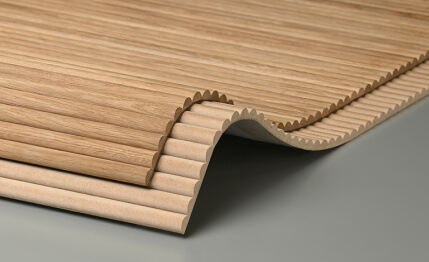
The task 'I want wooden slats' is half the job. The full task sounds different: 'I want an accent wall in a 3×2.6 m living room, style — modern classic, ceiling 2.6 m, lighting — warm, budget — medium'. From this formulation it immediately becomes clear: wood species (oak), slat width (60–70 mm), orientation (vertical), finish tone (medium warm), cornice (80–90 mm with a roundover), baseboard (80 mm). Five parameters instead of one vague desire.
That's why the conversation about slatted wall panels for interioralways start with the task. The material follows it — not the other way around.
Our factory also produces:




Two types of slatted panel buyers
First type: independent homeowner. Does repairs themselves or with a crew. They need clear specifications, precise dimensions, installation method, and final appearance. They make the decision themselves and take responsibility for it.
Second type: design project client. Works with a designer or architect who creates the specification. The buyer chooses from the proposed options — but wants to understand what they are paying for. They care about not only visual but also performance characteristics.
This article is equally useful for both types: it provides a system, not just 'look at our assortment'.
Get Consultation
Which slatted panels are suitable for different rooms: a complete application map
Buy slatted wall panels in Novosibirsk— is a broad query. It hides several fundamentally different scenarios. Let's analyze each.
Living room: accent wall as an architectural focal point
The living room is the main public space of an apartment or house. Here, the slatted panel works as an accent wall—the visual center of the space, around which all furniture and lighting arrangements gravitate.
Optimal parameters for a living room with a ceiling height of 2.5–2.7 m:
-
Slat width: 60–80 mm.
-
Orientation: vertical (lifts the gaze, visually increases height).
-
Gap: 10–14 mm.
-
Wood species: oak oil (warm natural tone), ash (neutral light), walnut (dark, for accent walls with a TV).
-
Backing: dark—anthracite, graphite, black. Creates depth behind the slats.
-
Lighting: sconces with side direction or LED behind the slats in the lower part.
Result: the wall behind the sofa or the wall with the TV zone gains architectural character. The space stops being 'an apartment with furniture' and becomes a deliberate living interior.
Bedroom: warmth and quietness of wooden texture
The bedroom requires a special approach. Here, slatted panels are not for show, but for ambiance. The headboard wall with wooden slats creates a warm backdrop that promotes psychological relaxation—exactly what a sleep space needs.
Parameters for the bedroom:
-
Slat width: 40–60 mm.
-
Orientation: vertical.
-
Tone: neutral warm (bleached oak, natural ash, soft beige MDF).
-
No dark wood—a bedroom with dark slats requires excessive lighting, which ruins the atmosphere.
-
Panel height: from floor to ceiling or up to 1.6–1.8 m (with a molding frame).
Children's room: naturalness and safety
For a children's room—only eco-friendly materials. Formaldehyde emission class E0 (preferred) or at least E1. Natural wood with a water-based oil coating without solvents is the optimal choice.
Parameters for a children's room:
-
Slats 30–50 mm, light tone.
-
For a colored accent — MDF painted in a pastel RAL shade (mint, powder pink, blue).
-
Panel height up to 1.2–1.5 m (lower zone) — a child lives in the lower part of the space, decor should work at their perception level.
Study and work area: concentration environment
A study with slatted panels is a workspace with character. Wooden slats create a sense of order and solidity. This is an environment where work happens differently — more focused, more productive.
Cabinet parameters:
-
Slats 60–80 mm, dark tone (wenge, dark walnut, graphite MDF).
-
One or two walls — no more.
-
Acoustic panel on MDF backing with felt — solves echo problems in enclosed workspaces.
Kitchen: dining area and bar counter zone
In the kitchenbuy slatted wall panels in Novosibirskand must be installed in the correct zones. The wall behind the dining table, the wall with the bar counter, and the end wall are zones without direct exposure to steam and grease. Here, slats work excellently.
Limitations for the kitchen: slats are not installed in the backsplash above the countertop, near the stove without sufficient ventilation, or above the sink. Material: MDF with two-component lacquer coating — maximum moisture resistance for the kitchen environment.
Corridor: first impression and visual transformation
The corridor is a space that most homeowners leave 'for later.' And in vain. It is the corridor that forms the first impression of an apartment. Narrow vertical slats 30–50 mm covering the entire wall height create a rhythm that lifts the gaze and makes a narrow corridor visually more spacious.
Additional advantage: slatted panels in the corridor protect walls from mechanical damage — chips when moving furniture in, scratches from outerwear, marks from keys. This is functional protection with a decorative effect.
Where to use molded decor: three levels of architectural work
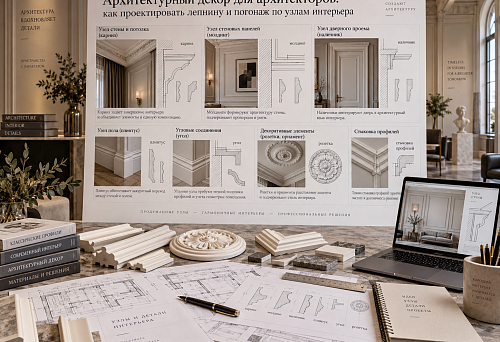
Relief Decoration— this is not an optional 'beautiful element.' It is an architectural tool without which the slat system remains incomplete. Let's consider three levels of its application.
Level one: basic system (cornice + baseboard)
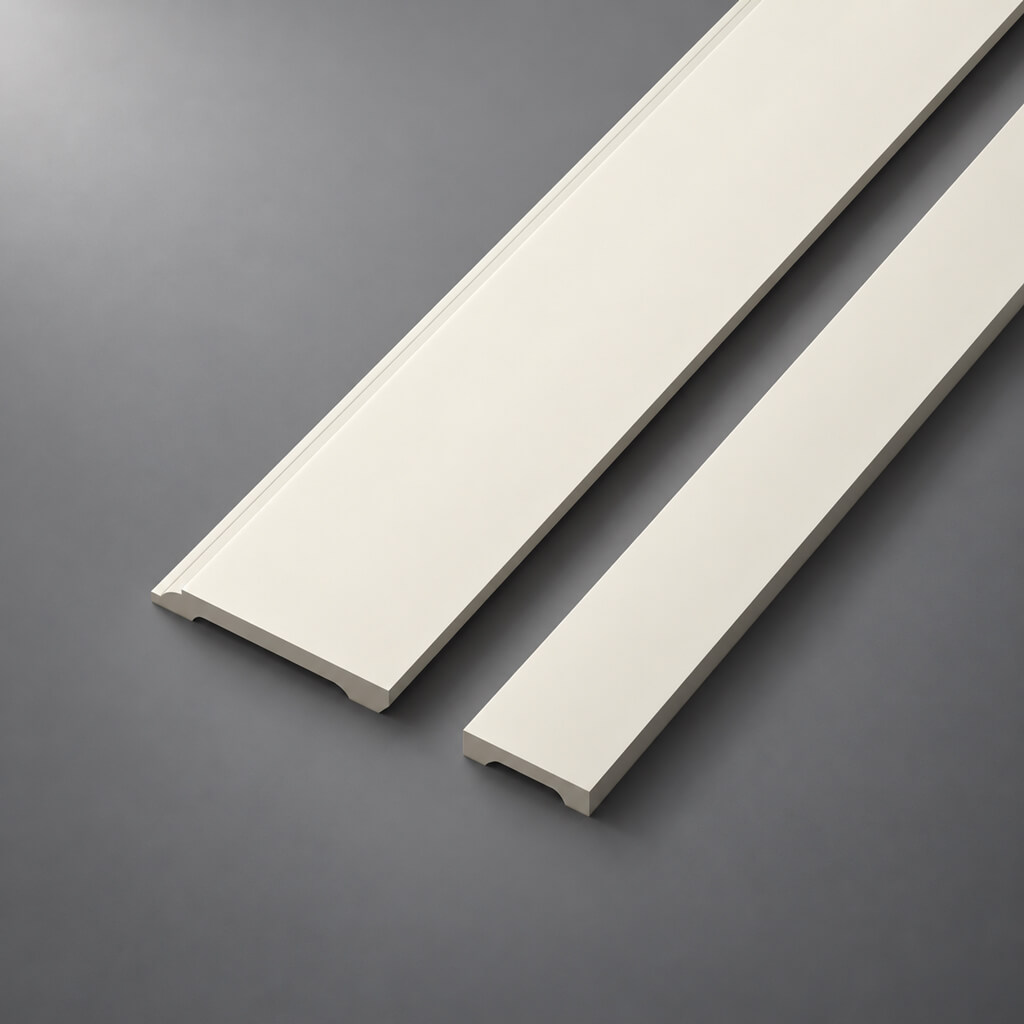
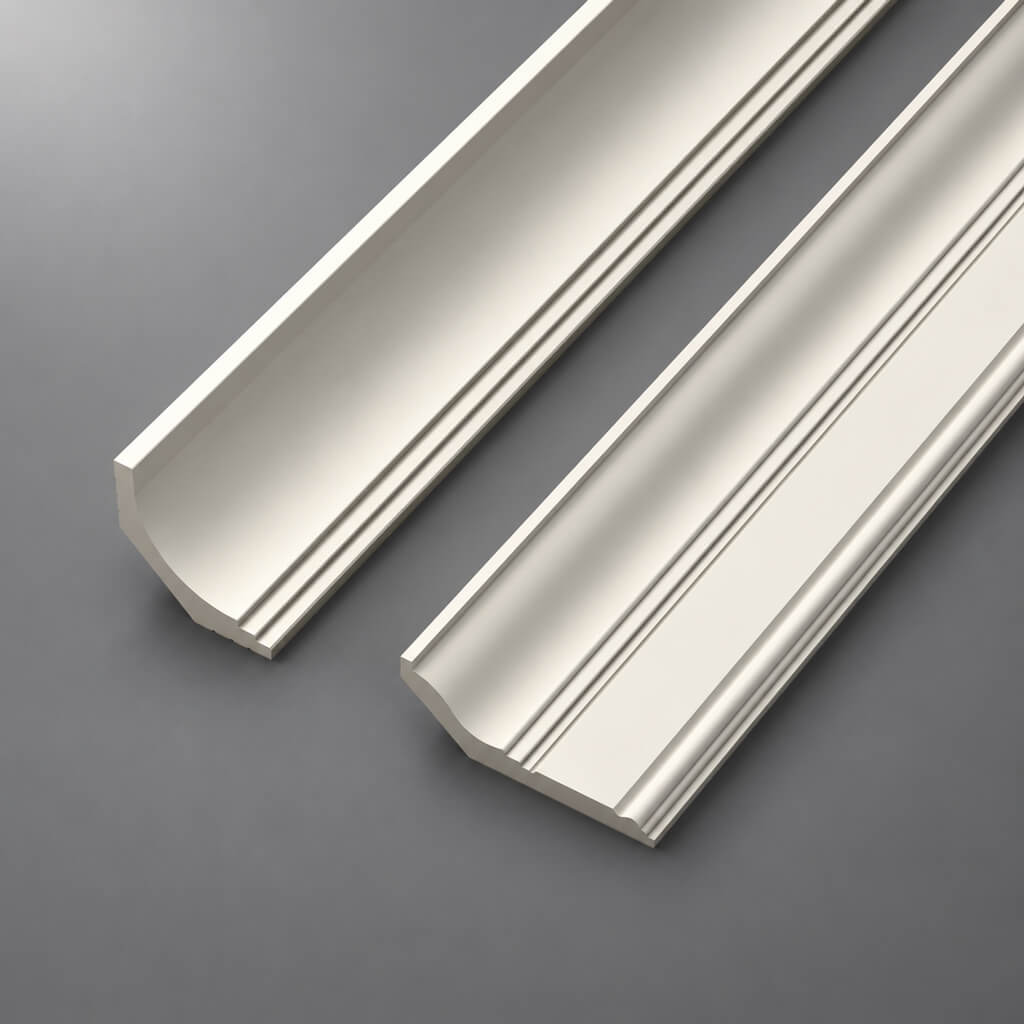
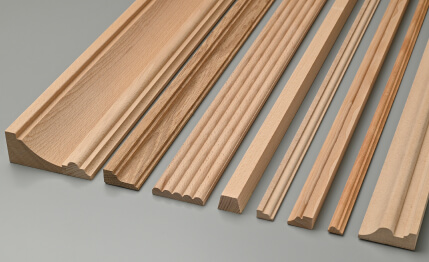
The minimally necessary set for any slatted wall. The cornice closes the upper technical gap and creates the upper architectural boundary. The baseboard closes the lower gap and creates the lower boundary.
Without these two elements, a slatted panel looks like a 'construction semi-finished product.' With them — like a well-thought-out finishing system.
Basic system parameters:
-
Cornice: width = 80–120% of the slat width. For 60 mm slats — cornice 50–75 mm.
-
Baseboard: height = 80–120% of the slat width. For 60 mm slats — baseboard 50–75 mm.
-
Profile: matches the interior style.
Second level: developed system (cornice + baseboard + molding elements)
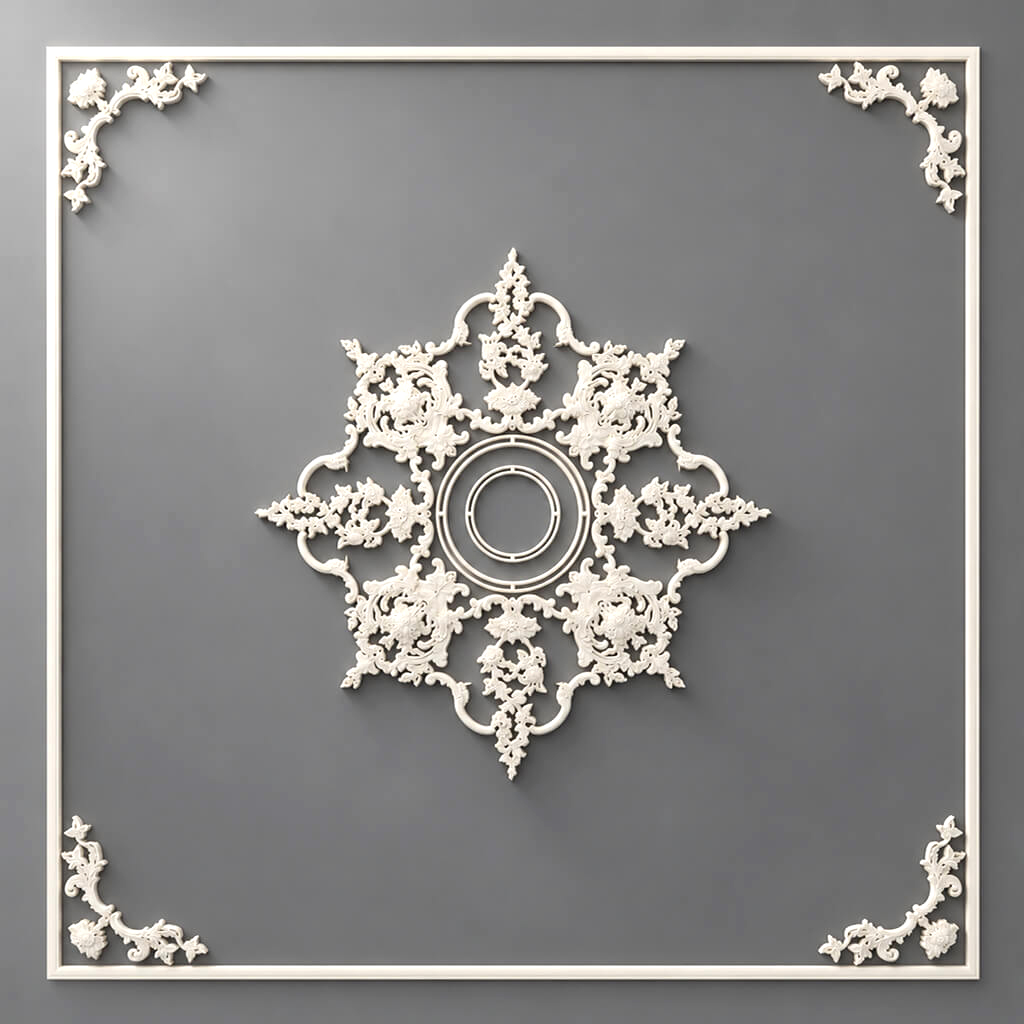
A horizontal belt, a molding frame around the slatted field, and a ceiling rosette are added. This is the level of modern classic and neoclassical.
The horizontal belt at a height of 1.0–1.2 m divides the wall into a lower slatted register and an upper neutral one. This is the classic two-level wall scheme, known in architecture since the Renaissance.
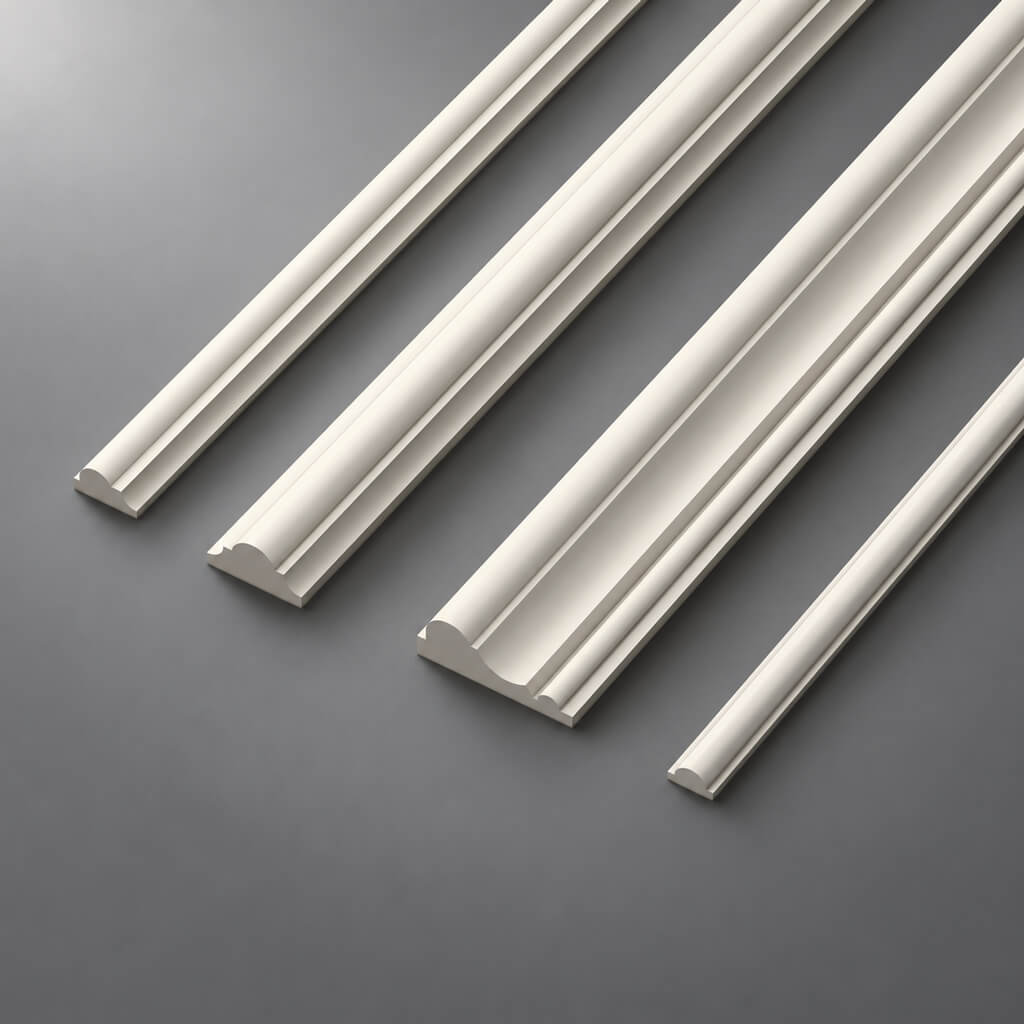
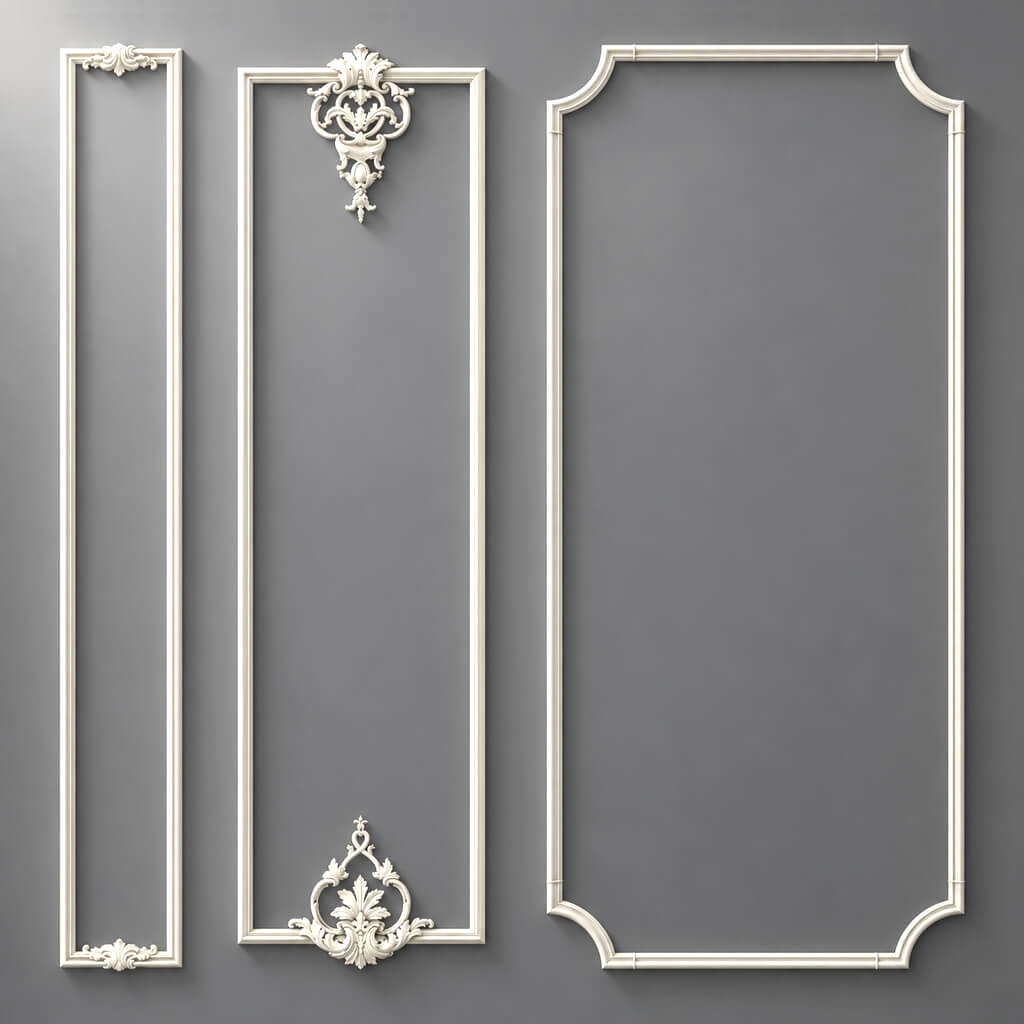
A molding frame around the perimeter of the slatted field (molding 30–50 mm on the lateral sides and horizontals of the field) turns the slatted field into a 'picture object' with clear boundaries.
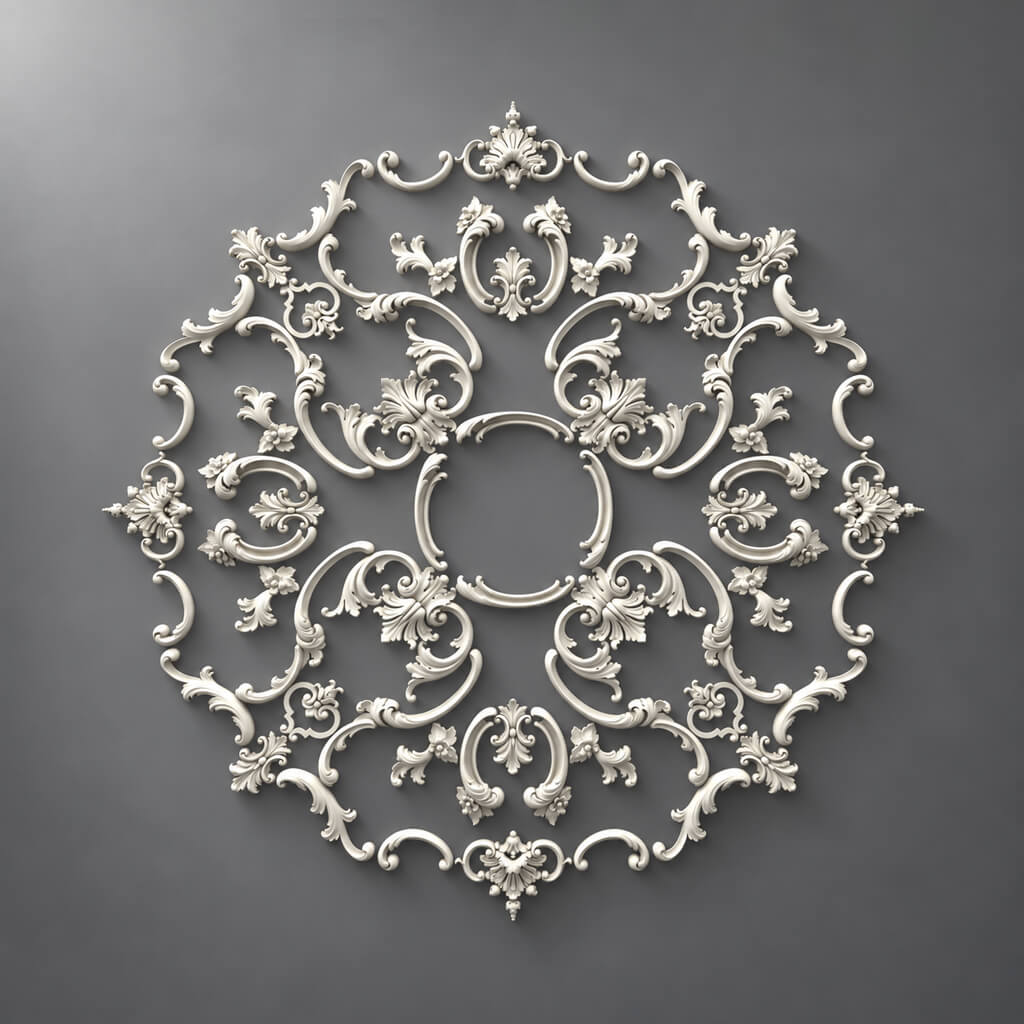
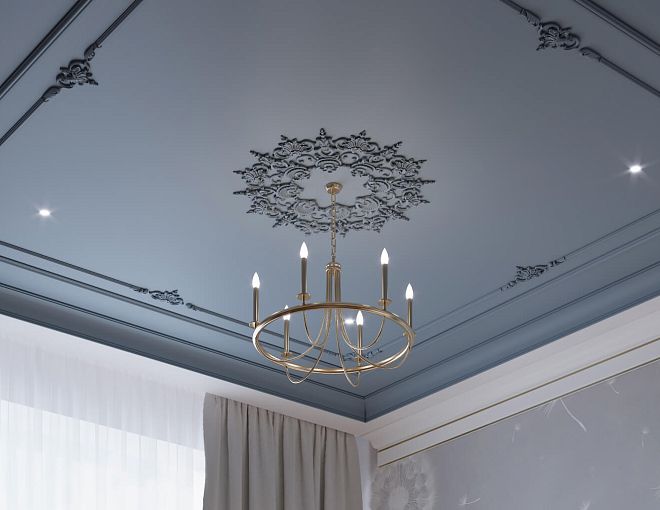
A ceiling rosette 250–350 mm under the chandelier creates an architectural accent on the ceiling, echoing the decorative system of the walls.
Third level: complete architectural system
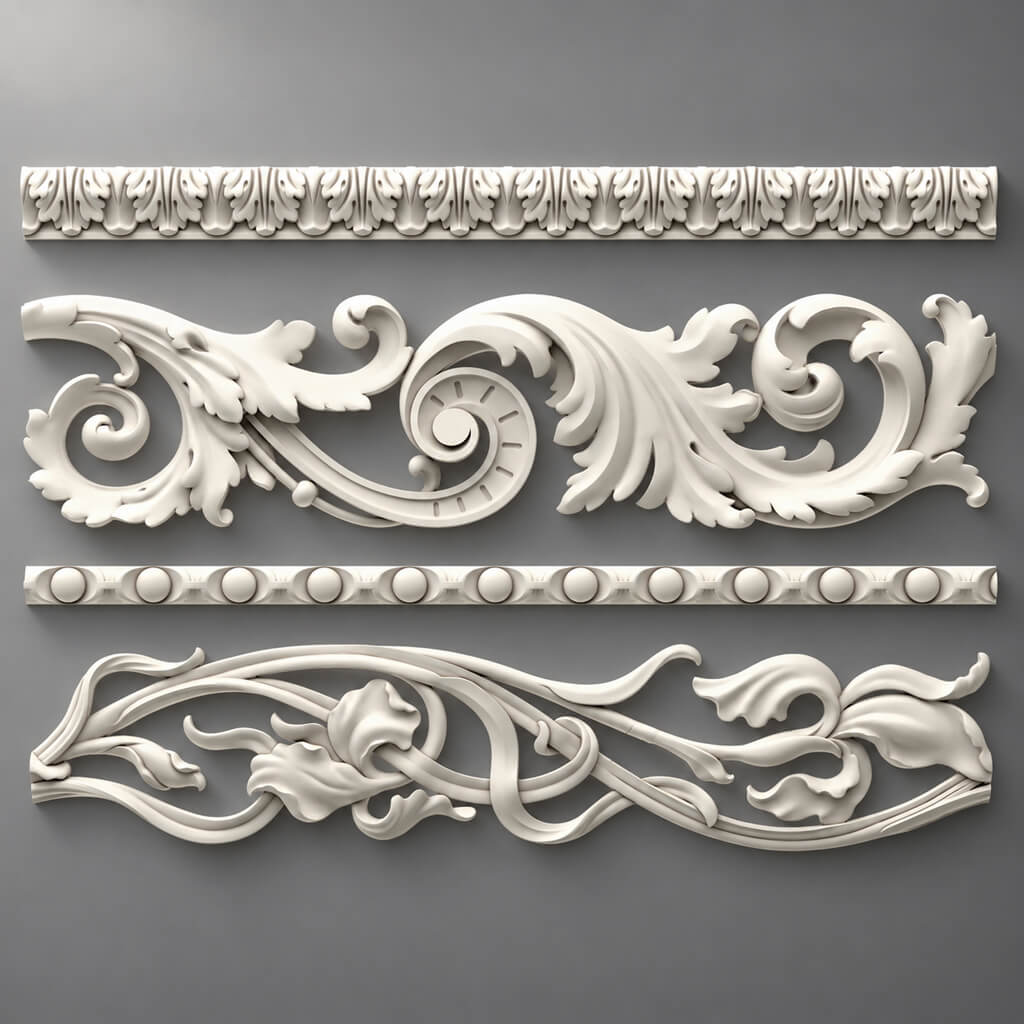
For rooms with ceilings from 2.8 m and a request for a rich classic or neoclassical interior. Includes all of the above plus pilasters, horizontal cornices at several heights, ceiling beams (for appropriate styles), decorative medallion overlays.
This is the level of 'premium' class design projects — but modern polyurethane products make it accessible to a wide range of buyers.
Where decorative molding is used in different rooms
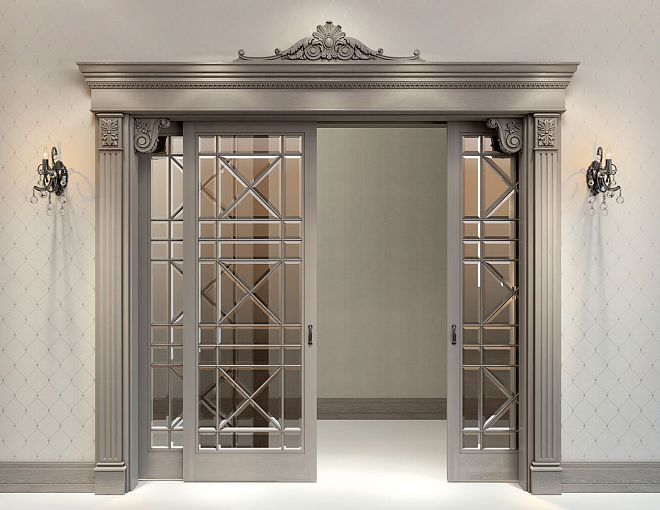
Decorative stuccomade of polyurethane works in all rooms — but with varying intensity.
Living Room
Here, molding can work at full capacity: an 80–120 mm cornice with a moderate or developed profile, a 280–400 mm rosette for a chandelier, a horizontal cornice, molding frames. With a ceiling of 2.7 m and above — a full system. With a ceiling of 2.5 m — a basic or medium system.
Bedroom
Delicacy is the main principle. A 50–70 mm cornice with a simple profile. A 200–280 mm rosette — only if there is a ceiling chandelier above the bed. No cornices or complex systems.
Office
A horizontal cornice at a height of 1.2 m (divides the lower slatted field and the upper neutral zone) + an 80–100 mm cornice + an 80 mm baseboard. A restrained but architecturally clear system.
Corridor
Only a 50–70 mm cornice and a 60 mm baseboard. In a long corridor (more than 4 m) — vertical molding pilasters every 90–100 cm for rhythmic division of the long wall.
Kitchen (dining area)
A 60–80 mm cornice around the perimeter of the kitchen ceiling — and only that. Above the work area with a stove — no overhead decorative elements.
How to assemble the wall and ceiling into a single system: architectural logic
This is a key skill that distinguishes 'beautiful renovation' from 'architecturally complete interior'. A wall and a ceiling are not two separate surfaces. They are parts of a single room volume, and their design must be cohesive.
Three principles of a unified system
First principle: unified stylistic language. The cornice profile and the baseboard profile must belong to the same architectural vocabulary. A rectilinear cornice + a cabochon baseboard with a scroll are different languages. A rectilinear cornice + a rectilinear baseboard are one language.
Second principle: scale coordination. All elements of the system are scaled relative to the size of the slat and the height of the room. There is no 'very large' cornice and 'very small' baseboard with the same slats.
Third principle: color sequence. All molding elements are one color (most often white). Or all are one neutral tone. Mixing a white cornice, a beige baseboard, and a gray belt in one room destroys visual cohesion.
Table: ceiling height and decorative system
| Ceiling Height | Crown Molding | Skirting board | Additionally |
|---|---|---|---|
| up to 2.4 m | 50–60 mm, rectilinear | 50–60 mm | Perimeter only |
| 2.5–2.6 m | 60–80 mm | 60–80 mm | Cornice + baseboard |
| 2.7–2.8 m | 80–100 mm | 70–90 mm | + molding frame |
| 2.8–3 m | 90–120 mm | 80–100 mm | + socket, belt |
| from 3 m | 120–180 mm | 100–130 mm | + pilasters, beams |
Lighting as part of the system
The wall-ceiling system does not exist without lighting — because it is the light that 'turns on' the wooden texture. Side lighting creates shadows in the gaps between the slats — and the panel comes to life. Direct ceiling light flattens everything. This is a technical rule that must be considered when planning the system.
Recommendation: when installing a cornice with a box — immediately lay the LED strip for backlighting. Warm white light 2700–3000 K, directed along the wall, reveals the wooden texture of the slats in a way that no ceiling light fixture can.
What to look for when comparing the assortment: criteria that work
The market for slatted panels in Russia is wide. There are many sellers — significantly fewer manufacturers. How to distinguish a quality product from a marketing-attractive but unreliable one?
First criterion: transparency of characteristics
A quality manufacturer specifies: wood species or MDF composition, type of coating (varnish, oil, wax, enamel), formaldehyde emission class, moisture resistance of the base, geometric tolerances. If the product page only says 'slatted panel oak 60 mm' without technical details — this is a reason to be cautious.
Second criterion: geometric accuracy
For slatted panels, batch width stability is critical. A tolerance of ±0.3–0.5 mm is standard for industrial production. A deviation exceeding 1 mm results in visible gap inconsistency in the finished wall. Clarify tolerances with your supplier.
Criterion three: end coating
The ends of the slats are the most vulnerable point. If the ends are not sealed with a coating, wood absorbs moisture from the end grain faster than from the face surface, leading to deformation. A good manufacturer seals the ends with the same enamel or varnish as the face surface.
Criterion four: polyurethane quality
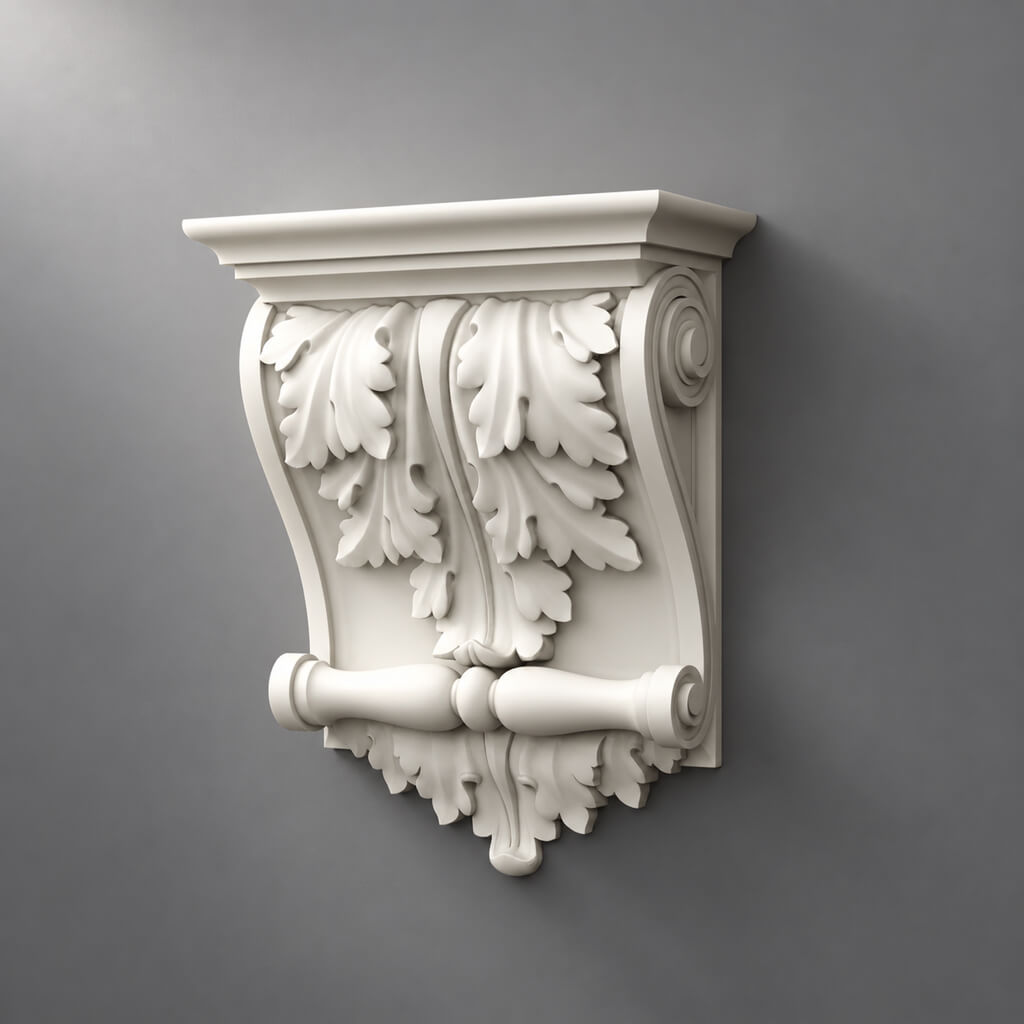
Polyurethane Itemsshould be sufficiently rigid—not bending under light pressure on the middle of the strip. The back (mounting) surface is flat, without waves. The profile of the face surface is sharp, without blurred transitions.
Criterion five: batch uniformity
When ordering multiple packs of the same article number, all should be from the same production batch. Different batches may vary slightly in tone. For natural wood, this is normal and adds value. For painted MDF, it is unacceptable.
Where buyers most often make mistakes: top 8 real errors
Error one: buying without a sample
A photograph on a monitor is not a substitute for a real sample in your space. The wood tone under your specific lighting may look completely different than it did online. Request samples or purchase a small test batch.
Second mistake: incorrect quantity calculation
Trimming at corners and near the ceiling, expansion gaps, and transport damage—all of these consume material. Standard allowance for slats: +10% to the calculated quantity. For moldings: +15% (miter cuts at angles produce significant waste).
Third mistake: buying the cornice and baseboard 'separately' from the slats
The most common mistake: slats are purchased, installed—and only then does the buyer discover that the cornice they liked doesn't match the width of the slats or the style. Buy the system as a whole: slats + cornice + baseboard as one set.
Fourth mistake: installation without acclimatization
Material brought in from the cold (especially critical in winter in Novosibirsk) must acclimate indoors for 48–72 hours. Installation 'straight from the cold' will cause the material to expand—and deform the installed system.
Fifth mistake: ignoring surface preparation
Slatted panel on a frame—the base doesn't matter. Slatted panel with direct mounting—the base must be level, dry, and primed. Old wallpaper, crumbling plaster, traces of old paint—all of this must be removed before installation.
Sixth mistake: incorrect orientation of slats
Vertical slats draw the eye upward—increasing perceived height. Horizontal slats widen—increasing perceived width. In a room with a low ceiling (up to 2.5 m), horizontal slats are a poor choice. In a wide room with a high ceiling—horizontal slats are acceptable for creating a 'wide' effect.
Mistake seven: dark slats with insufficient lighting
Dark walnut, wenge, graphite — beautiful in photos, but require powerful and well-thought-out lighting. In a room without side light sources, dark slats absorb light and make the room gloomy. If you don't have side sconces or hidden lighting — choose a neutral or warm tone.
Mistake eight: neglecting the kitchen hood with wooden slats
In a kitchen with wooden slats and a weak hood — grease and steam settle on the wood. Without regular care, after 1–2 years the surface darkens and acquires a 'kitchen' smell. Either a powerful hood, or a different material in areas with steam exposure.
Delivery from Novosibirsk or to Novosibirsk: what you need to know
Regional market versus federal manufacturers
In Novosibirsk, there are local suppliers of slatted panels. But choosing a federal manufacturer with delivery often gives a better result in terms of price-quality ratio — especially when ordering specific species, sizes, and finishes that are not available regionally.
Logistics of long-length cargo
Slats 2400–3000 mm long — long-length oversized cargo. For Novosibirsk: transport companies SDEK Cargo, Delovye Linii, PEK, Baikal-Service accept this format. Delivery cost to Novosibirsk from Moscow or a regional warehouse — from 800 to 2500 rubles per item depending on weight and volume.
Packaging and acceptance
Proper slat packaging: wrapping film, protective corner pieces on the ends, spacers between slats. Upon receipt — mandatory inspection of each item for compliance with the order and presence of damage. Claims for transport damage are accepted only at the time of acceptance, in the presence of a representative of the transport company.
Practical scenario: a 20 sq.m. living room in Novosibirsk, modern classic style.
To turn all of the above from theory into specifics — let's analyze one complete project.
Room: living room 20 sq.m., ceiling 2.65 m. Accent wall behind the sofa, wall width 3.6 m. Style — modern classic. Lighting — chandelier in the center + two sconces by the accent wall.
Slat panels: oak oil, medium tone (natural or with light tinting), width 65 mm, gap 12 mm. Backing — anthracite. Vertically, full wall height 2.65 m. Number of slats: 3600 / (65+12) = 47 slats + 10% reserve = 52 slats 2.65 m long.
Cornice: profile with a slight curve, width 85 mm, white. Length: room perimeter.
Baseboard: profile with a cap, height 80 mm, white. Length: room perimeter.
Molding frame: fillet 40 mm, white, around the perimeter of the slat field on the accent wall.
Rosette: diameter 300 mm for the chandelier in the center of the ceiling.
Lighting: warm white 2700 K LED strip behind the cornice box (hidden perimeter ceiling lighting), two sconces with side direction by the accent wall.
Result: a completed interior with architectural structure — a warm wooden wall framed by molding elements, a glowing cornice, a significant ceiling rosette. Not an 'apartment with furniture,' but a conscious living space.
About the company STAVROS
When you face the task —buy slatted wall panels in Novosibirskwith delivery and quality guarantee — STAVROS becomes the choice that answers all questions at once. STAVROS is a full-cycle Russian manufacturer: solid wood and MDF slatted panels across the entire width range (25–150 mm), all popular wood species and finishes, precise geometry with production-level tolerances.
Decorative stuccoand the full range of STAVROS polyurethane products — cornices, moldings, baseboards, rosettes, beams, overlay elements — are developed as a system, coordinated with the slatted panels in scale, style, and color solutions. The buyer receives not a disparate set of materials, but an architectural system ready for installation.
Delivery to Novosibirsk and all cities of the Siberian region — with professional packaging and reliable transport partners. STAVROS specialists provide consultation on selection: they will help form a complete kit for a specific room, calculate the quantity, and offer ready-made style solutions. Because the right interior begins with the right material — and STAVROS knows this better than others.
FAQ: Answers to popular questions
Can you buy slatted panels in Novosibirsk with city delivery?
When ordering from a federal manufacturer (STAVROS and others) — delivery to Novosibirsk is carried out through transport companies (SDEK, Delovye Linii, PEK). Large orders can be delivered to the address. Delivery times from Moscow to Novosibirsk are 4–7 business days depending on the transport company.
Which finish for slatted panels is best suited for the Siberian climate?
For spaces with central heating (a typical city apartment in Novosibirsk) — standard humidity and temperature conditions. Oil or varnish finishes are equally suitable. If there is air conditioning or intensive ventilation — varnish finish is more stable during sharp humidity fluctuations.
What is better — a cornice made of polyurethane or plaster?
For living spaces, polyurethane cornice is preferable: it is lighter (3–5 times), does not deteriorate when in contact with humid air, does not crumble during installation, can be painted with acrylic paint without special primer, and is cheaper with comparable aesthetics. Plaster is justified only in special historical restoration projects where identity to the original material is important.
Can slatted panels be installed in an apartment with underfloor heating?
Yes, but with caveats. The underfloor heating system affects the temperature of the lower part of the wall. Wooden slats near the underfloor heating experience slightly greater thermal impact. Recommendation: a compensation gap at the floor of at least 10 mm (covered by the baseboard), finish — oil or hard wax (more elastic during thermal expansion than rigid varnish).
Is special wall preparation needed for polyurethane cornices?
The wall in the cornice installation area must be clean (free of dust and grease), dry, without crumbling plaster. Perfect flatness is not required — acrylic adhesive compensates for minor unevenness. For significant unevenness (more than 5 mm) — preliminary leveling with putty in the installation area.
Can slatted panels be combined with wallpaper on adjacent walls?
Yes, this is a classic and very organic scheme. An accent slatted wall + three walls with neutral wallpaper (light tone, coordinated with the wood). The joint between the slatted panel and wallpaper at the corner is covered with a 20–30 mm corner molding or neat abutment without molding (with precise installation).